IMPROVING STUDENTS’ VOCABULARY BY USING VISUAL MEDIA AT SMP NEGERI 10 MAKASSAR
A THESIS
Subbmited in Partial Fulfillment of the Requirements for the Degree of Sarjana Pendidikan in English Eduction Departement of
Tarbiyah and Teaching Science Faculty of Alauddin State Islamic University of Makassar
By
A. RISKAWATI HAJIS Reg.Number : 20401110010
ENGLISH EDUCATION DEPARTMENT
FACULTY OF EDUCATION AND TEACHING SCIENCE ALAUDDIN STATE ISLAMIC UNIVERSITY OF MAKASSAR
PERNYAAAN KEASLIAN SKRIPSI
Dengan penuh kesadaran penulis yang bertanda tangan di bawah ini menyatakan bahwa skripsi ini benar hasil karya penulis sendiri. Jika di kemudian hari skripsi ini terbukti merupakan duplikat, tiruan, atau dibuat orang lain secara keseluruhan atau sebagian, maka skripsi dan gelar yang diperoleh karenanya batal demi hukum.
Makassar, 14 April 2014 Penulis
PENGESAHAN SKRIPSI
Skripsi yang berjudul, “Improving Students’ Vocabulary by Using Visual Media at SMP Negeri 10 Makassar” yang disusun oleh A. Riskawati Hajis, Nim: 20401110010, mahasiswa Jurusan Pendidikan Bahasa Inggris pada Fakultas Tarbiyah dan Keguruan UIN Alauddin Makassar, telah diuji dan dipertahankan dalam sidang munaqasyah yang diselenggarakan pada hari Senin, tanggal 14 April 2014 M yang bertepatan dengan 14 Jumadil Akhir 1435 H, dinyatakan telah diterima sebagai salah satu syarat untuk memperoleh gelar Sarjana Pendidikan (S.Pd.) pada Fakultas Tarbiyah dan Keguruan, Program Studi Pendidikan Bahasa Inggris, dengan beberapa perbaikan.
Samata – Gowa, 14 April 2014 M.
14 Jumadil Akhir 1435 H. DEWAN PENGUJI
Nomor SK:388 Tahun 2014
Ketua : Dra. Hj. Djuwairiah Ahmad, M.Pd., M.TESOL. ( ) Sekertaris : Erwin Hafid, Lc., M.Th.I, M.Ed. ( ) Munaqisy I : Drs. H. Wahyuddin Naro, M.Hum. ( ) Munaqisy II : Dra. St. Azisah, M.Ed.St., PhD. ( ) Pembimbing I : Dr. Muhammad Yaumi, M. Hum., M.A ( ) Pembimbing II: Erwin Hafid, Lc., M.Th.I, M.Ed. ( )
Diketahui oleh :
Dekan Fakultas Tarbiyah dan Keguruan UIN Alauddin Makassar
PERSETUJUAN PEMBIMBING
Pembimbing penulisan skripsi saudari A. Riskawati Hajis, Nim : 20401110010, mahasiswi Jurusan Pendidikan Bahasa Inggris pada Fakultas Tarbiyah dan Keguruan UIN Alauddin Makassar, setelah dengan seksama meneliti dan mengoreksi skripsi yang bersangkutan dengan judul “Improving
Students’ Vocabulary by Using Visual Media at SMP Negeri 10 Makassar” memandang bahwa skripsi tersebut telah memenuhi syarat-syarat ilmiah dan dapat disetujui untuk diajukan ke sidang munaqasyah.
Demikian persetujuan ini diberikan untuk persetujuan selanjutnya.
Samata, 2 April 2014 Pembimbing I Pembimbing II
ACKNOWLEDGMENTS
Alhamdulillah Rabbil Alamin, the researcher praises to Allah Swt, the
almighty for the blessing and mercy. The researcher could complete this writing thesis. Salawat and Salam were addresed to the beloved and the choose messenger, Muhammad Saw.
The researcher would like to express her deepest gratitude to those who have helped and supported her until this undergraduate thesis was able to be finished. They were as follows :
1. The researcher’s beloved parents Hajis Tajuddin and A. Rahmawati AM, who always give attention to their children, and their strong motivation both material and spiritual until the completing of this writing thesis. The researcher’s beloved brother and sister, A. Rizky and A. Risna Fitriani H, thanks a lot for their love, pray and support.
2. Prof. Dr. H. A. Qadir Gassing HT, M.S., the Rector of Alauddin State Islamic University of Makassar for his advice during she studied at the university.
3. Dr. H. Salehuddin, M.Ag., the Dean of Tarbiyah and Teaching Science Faculty for advice and motivation.
4. Dra. Hj. Djuwairiah Ahmad, M.Pd., M.TESOL and H. Erwin Hafid, Lc., M.Th.I, M.Ed., the Head and the Secretary of English Departement of
University (UIN) Makassar who have helped, guided, and supported the researcher.
5. The researcher would like to say her sincere thanks for the guidance and correction to this writing: deeply thanks are expressed to some people, especially to Dr. Muhammad Yaumi, M.Hum., M.A as the first – consultant, and H. Erwin Hafid, Lc., M.Th.I, M.Ed. as the second –
consultant who always gave advice and guidance.
6. The researcher indebted the headmaster of SMP Negeri 10 Makassar, Drs. Muh. Yunus Yusuf, MM., to the English Teacher, Efidwisma, S.Pd., and
staff who have given her opportunity to conduct this research. Also for the first grade students, the researcher would like to say many thanks for their cooperation and participation during the completion this research.
7. The researcher said thanks for her beloved friends in PBI 1 and PBI 2 academic year 2010 who always helps to solve the problems and give spirit and mental support to researcher.
Finally the researcher was sure that this thesis was still far from being perfect, so the researcher sincerely appreciates the constructive criticism from the reader. Wabbilahi Taufik Walhidayah Wassalamu Alaikum.
Makassar, 14 April 2014 The Researcher
LIST OF CONTENTS
TITLE PAGE ... i
PERNYATAAN KEASLIAN SKRIPSI ... ii
PERSETUJUAN PEMBIMBING ... iii
B. Problem Statements ... 3
C. Research Objectives and Significances ... 3
D. Reseach Scope ... 4
CHAPTER II REVIEW OF RELATED LITERATURE A. Previous Related Research ... 5
B. Concept of Implementation ... 6
C. Vocabulary ... 7
1. Definition of Vocabulary ... 7
2. The Importance of Vocabulary ... 8
3. Kinds of Vocabulary ... 9
D. Guidelines and Strategis to Development Ability Vocabulary of Students ... 11
1. Build Vocabulary Instruction into Everyday Routines ... 11
2. Select the Best Words to Teach ... 12
3. Explicitly Teach New Words ... 12
E. Visual Media in Teaching Vocabulary ... 13
1. The Concept Visual Media ... 13
2. The Importance of Visual Media in Teaching Vocabulary ... 14
3. Kinds of Visual Media ... 16
CHAPTER III RESEARCH METHOD A. Research Design ... 19
B. Research Setting ... 20
C. The Position of Researcher and Participant in Research ... 21
D. Research Instrument ... 21
E. Research Procedures ... 23
F. Technique of Data Analysis ... 24
CHAPTER IV FINDINGS AND DISCUSSION A. Findings ... 30
B. Discussion ... 43
CHAPTER V CONCLUSION AND SUGGESTION A. Conclusion ... 45
B. Suggestion ... 46
BIBLIOGRAPHIES ... 47
APPENDICES ... 52
LIST OF TABLES
Table 1 : The Form of Observation Sheet ... 22
Table 2 : Scoring of Vocabulary ... 25
Table 3 : Classification Score of Students ... 26
Table 4 : The Frequency and Percentage of Ability Test ... 29
Table 5 : The Result of Observation in the First Cycle ... 32
Table 6 : The Frequency and Percentage of the Students’ Vocabulary in the First Cycle ... 34
Table 7 : The Result of Observation in the Second Cycle ... 38
LIST OF APPENDICES
Appendix 1 : Lesson Plan of Cycle 1 ... 52
Appendix 2 : Materials of Cycle 1... 60
Appendix 3 : Lesson Plan of Cycle 2 ... 68
Appendix 4 : Materials of Cycle 2 ... 69
Appendix 5 : Research Instrument in Cycle 1 ... 70
Appendix 6 : Research Instrument in Cycle 2 ... 72
Appendix 7 : The Result of Observation in Cycle 1 ... 74
Appendix 8 : The Result of Observation in Cycle 2 ... 75
Appendix 9 : The Students’ Worksheet ... 76
Appendix 10 : The Score of Ability Test ... 77
Appendix 11 : The Score of Students in Cycle 1 ... 78
Appendix 12 : The Score of Students in Cycle 2 ... 79
i ABSTRACT
Title : Improving Students’ Vocabulary By Using Visual Media at SMP Negeri 10 Makassar.
Researcher : A. Riskawati Hajis Reg.Number : 20401110010
Consultant I : Dr. Muh.Yaumi, M.Hum., M.A Consultant II : Erwin Hafid, Lc, M.Th.I, M.Ed
This research was “Improving Students’ Vocabulary By Using Visual Media at SMP Negeri 10 Makassar”. It consisted of two problem statements. They were (1) How was the implementation of Visual Media in improving the students’ vocabulary of first year students’ at SMPN 10 Makassar? (2) How was the improvement of students’ vocabulary through Visual Media of first year students’ at SMPN 10 Makassar?. The objective of this research was to find out improvement of the students’ vocabulary by visual media of VIIB at SMPN 10 Makassar.
This research was a classroom action research. It consisted of two cycles. The procedure of the research in every cycle consisted of four stages. They were planning, acting, observing, and reflecting. The subject of the research consisted of 43 students of VIIB at SMPN 10 Makassar. The instruments of this research were test which was analyzed by quantitative analysis and observation sheet which was analyzed by qualitative analysis.
1 CHAPTER I
INTRODUCTION
A. Background
English was the first foreign language in Indonesia. Many schools or
courses have given English as one of the lessons. English have four skills:
speaking, reading, listening, and writing and vocabulary as component could be
a tool to increase all the skills of English.
One of the main problems faced by students in mastering and learning
English was a lack of vocabulary. In order to master all the skills in English
included speaking, listening, reading, and writing, they were afraid in learning
English. Vocabulary was basic to mastery all English skills. Vocabulary was a
unity of letters to be words which was formed by a set of user communities.
Meanwhile, according to Penny (1991: 60) in Julita (2011), vocabulary could be
defined as words that taught in a foreign language. In brief, vocabulary was a
unity of letters that became words that taught in a foreign language.
Vocabulary has a tool that used to understand and master English.
Vocabulary was a main component to increase all English skills. Indeed
mastered vocabulary was a difficult thing, was not as easy back your hand
needed a process in mastering vocabulary. Many factors that affecting the
2
First, the difficulties of students to understand and remember vocabulary.
Many students were obtaining difficult when they spoke because restrictiveness
their vocabulary.
Second, the lack of used the media only always rely on the speech method
without involved media. The students were not interested and difficulty to
understand vocabulary.
Third, learning English was stilted or serious that made students depressed
or afraid to develop their ability in vocabulary.
Fourth, the lack of control memorize students’ vocabulary. They were easy
to forget vocabulary has been taught or learned.
One of popular junior high schools was at SMPN 10 in Makassar. It has
prestige among other schools. Certainly, the quality of that school should be as
well as its prestige. In fact, there were still some problems that faced such as the
students English ability. When the researcher did taught English there, the
researcher found that the ability of student still low and need effort to increase
students’ vocabulary. The students were blank and difficult to said or write
anything about vocabulary. However the researcher realized that the students
have potential and ability to increase their vocabulary.
One of solution to solve it was applying Visual Media. The usage of visual
media in teaching vocabulary facilitated them to understand an object that want
3
Visual media such as picture, posters, cartoon and other visual media
could became facility to teach and learn vocabulary. Through the usage of visual
media, they were expected be more interested and more active in the process of
learning vocabulary.
Reference to the description above, then the researcher was interesting to
lift a title " Improving Students’ Vocabulary By Using Visual Media at SMP
Negeri 10 Makassar".
B. Problem Statements
Based on the description above, the researcher was able to decipher the
problem issues in this study included:
1. How was the implementation of Visual Media in improving the students’
vocabulary at SMPN 10 Makassar?
2. How was the improvement of students’ vocabulary through Visual Media
at SMPN 10 Makassar?
C. Research Objectives and Significances
The objectives of the backdrop authors conducting this research were:
1. To know the extent mastery vocabulary of English students of SMPN 10
Makassar.
2. To prove that visual media could applied in learning vocabulary to
increase ability of students.
3. To get an idea of the response of students on the usage of visual media to
4
4. To get information how much increase vocabulary students using visual
media.
The results of this research which the backdrop author did the reseach
would be useful for :
1. Teachers
Through the implementation of this classroom action research, teachers
learn instructional techniques in teaching of vocabulary that varied through
the usage of visual media, the problems that were found during the process
of learning English vocabulary could be overcame.
2. Students
The results of this research were very useful for students to improve their
vocabulary without realizing it, because they were able to learn with fun
and easy to understand objects that studied by using visual media.
D. Reseach Scope
Based on a problem that often encountered students in teaching and
learning English, specially their difficulty in mastering vocabulary. So, the
researcher limit this research in the area of vocabulary. Some of them were
5 CHAPTER II
REVIEW OF RELATED LITERATURE
A. Previous Related Research
Many studies have been performed by the researchers related with the
usage Visual Media in encouraging students to learn English spesially
vocabulary. Some of them were mentioned with their report as follows:
1. Arianto (2003) in his research on the use of media in teaching vocabulary to
young learner concluded that the media should be atractive and interested
for the students. The instructional media could increase students’ motivation
in learning, the students activated to give responds, enable them to repeate
what they learned, and encourage them to interest with English.
2. Ja’afari (2000) in his research concluded that the usage picture in teaching
vocabulary could make a positive contribution in teaching and learning
vocabulary. Students were active in learning process.
3. Nilawati (2009) reported that mastery of the students’ vocabulary improved
after the puppets was giving. It was supported by the significant result of the
pretest that was lower (56.64%) than post-test (96.19%).
4. Rokni and Karimi (2013) stated the usage of visual materials was more
effectives than learning without visual materials. The positive effect of
using visual materials such as, pictures, and flash cards became obvious.
Students could remember words and make sentences than they learned
words verbally. Using pictures in teaching vocabulary would help teacher to
6
pictures and this way was enjoyable for them. The most importants point
was that memory would be better by the use of visual materials for students
to learn vocabulary .
5. Siregar (2013) in her research showed that the mean scores of students in
teaching vocabulary by using picture chart was 77. I could be concluded that
the criteria was good.
From the researchers’ findings above, the researcher used Visual Media
to improve students’ vocabulary. The researcher combined some visual media in
improving students’ vocabulary. It was different with the researcher above that
have mentioned. The combination some visual media could increase students’
interaction. It made condition in teaching and learning process was alive. The
students were active to learn. The students were happy, interested, easy to
remember and enjoyable to learn vocabulary.
In improving students’ vocabulary should be taught the pronunciation of
the vocabulary because most students sometimes difficult pronounce the
vocabulary. Therefore, necessary guidance and repetition to students accustomed
and easy to said it.
B. Concept of Implementation
Implementation defined as a specified set of activities that designed to
put into practice an activity or program (Fixsen, Naoom, Blase, Friedman &
7
In addition, Widodo in Kurnialloh (2013), implementation was a process
that involved some sources, included human, financial, and organizational by
governments and private (individual or group). The process carried out to
achieve the objectives.
Fullan (1982) in Psychologymania (2013) stated that the definition of the
implementation of learning was a process of laying into practice an idea ,
program or set of new activities for people to achieve or expect a change.
According Wahab (2004:64) in article of State University Yogyakarta
(2008) stated that implementation provided the means for carrying out and to
give practical effect to things.
In conclusion, The implementation was the activities of planning in the
program to success or failure, the innovation of activities to improve problem
that faced that focus on the actions of those who change it into practice as the
key to success or failure.
C. Vocabulary
1. Definition of Vocabulary
Vocabulary as component could be tool to increase all the skills of
English. Without vocabulary students could not improve their ability to
communicate with foreign people, read English literature, wrote English
literature.
According Horn ( 1998 : 1447) in Kasim (2011) defined that vocabulary
8
language. 3). The words that people were using when they spoke. 4). A list of
word with meaning specially in a book for learning foreign language.
Similarly, Hornby (1986: 478) in Siregar (2013) stated that vocabulary
was collection of word that could be used by a person in profession to express
his or her mind. It means that vocabulary was the totals number of words that
someone own in expressing a language in communication.
Whereas Oxford Learner’s Pocket Dictionary defined that vocabulary
were all the words that a person knew or used. Good (1973: 143) in Kasim
(2011) defined that vocabulary as the words have meaning when heard or seen
by individual himself to communicate with others.
Similarly, Read (2006:16) in Siregar (2013) said that vocabulary was not
just a set of individual language learners in the form of vocabulary and the
ability to access knowledge for communicative.
By looking over those definition, the writer concluded that vocabulary
was a unity of letters then became words then arrange to use by person or group
to communicate.
2. The Importance of Vocabulary
Vocabulary was basic to learn English. It was reason why vocabulary
was very important to teach for students. John Dewey (1910) in Bintz (2011)
stated that vocabulary was important critically because a word was an instrument
9
Allen (1997: 149) in Kasim (2011) said that vocabulary was very
important in a language. Vocabulary was basic communication (Krasen: 24) in
Siregar (2013). From vocabulary, we would know and understand a language.
As students moved from grade to grade, students must be able have more
vocabulary. McCarten (2007) said that the total of words students needed to
learn between 12.000 and 20.000 depended on their level of education.
Most reserchers believed that students naturally add between 2000 to
3000 new words each years, yet they would meet 10.000 new words in their
reading alone (Nagy and Anderson 1984) in article Beach City Press (2007).
Needed increase vocabulary day to day to support mastery of a target language.
Learning vocabulary needed long process from knew, remembered, and
understood words. When we learned or taught about vocabulary have repeated
word day to day continual. Smith (1998) in Bintz (2011) said that one important
found from reserach suggested that vocabulary learning never stops. Vocabulary
learning was a continual process of encounter new words, Harmon (2009) in
Bintz (2011).
In conclusion, vocabulary was a central of language and of critical
importance of typical language. Vocabulary learning needed as basic foundation
to construct skills of English.
3. Kinds of Vocabulary
Vocabulary has many kinds. According Good (1959) in Juita’ thesis
(2011). Good divided vocabulary into four kinds. There were oral, writing,
10
Oral vocabulary was a word which used by person or group to express
ideas orally and actively. Writing vocabulary referred to word which commonly
used in writing. Listening vocabulary referred to person that was understanding
when they heard and reading vocabulary was the words that found in writing
form.
Schail Williams S. (1967: 57) in Kasim (2011) stated that every person
has three types of vocabulary as follows: active, reserve, and passive vocabulary.
Active vocabulary was the words customarily used in speaking. Reserve
vocabulary was the words used in writing, we rarely used in speaking. Passive
vocabulary was the words vaguely. We never used them in either speaking and
writing. It could understand when listened and read.
According to Finnochiaro (1974: 73) in Nilawati (2009) there were two
kinds of vocabulary, namely active vocabulary and passive vocabulary. Active
vocabulary referred to the words that the student could understand, pronounce
correctly and use constructively in speaking and writing. On the other hand,
passive vocabulary referred to the words in which the students could recognize
and understand while they were reading or listening when someone spoke.
However, they did not use the words in speaking or in writing.
Based on the definition above, the researcher concluded that vocabulary
divided into four part. There were speaking, writing, reading and listening. This
was proved that vocabulary have related to improve four skills in English as the
11
D. Guidelines and Strategies to Development Ability Vocabulary of Students
The vocabulary was thing that uneasy and complex to teach. Vocabulary
was foreign word that taught to students. Students obtain trouble to remember
words, understand meaning and many trouble again that could come to learn it.
Therefore, teachers must have guidelines and strategis to increase students’
vocabulary.
According Government of South Australia (2011) must have guidelines
and strategis to increase students’ vocabulary. This section looks at ways which
teachers could apply:
1. Build vocabulary instruction into everyday routines
The way memorized new word was through repeated rehearsal of the
word. The statement supported by Preszler, Rowenhorst, and Hartmann (2006)
defined that students must used a word between six and fourteen times before
they were capable of used it independently.
In addition, repetition was an important aid to learn and actively recalled
a word was a more effective way of learning than simple exposure or just seeing
a word over and over, Sökmen (1997) in McCarten (2007). McCarten (2007)
also agree that repeated words aloud helped students remembered words better
than repeated them silently.
However, simply repeated an item (the basis of learning) that have long
effect to really remembered it. Repetition (build vocabulary everyday routines)
was important was repetition with word by word. It has been estimated that
12 2. Select the best words to teach
Identifying words to teach. Advisable, teaching vocabulary from
concrete words. The concrete words like book, chair, pen, and other vocabulary.
It was easy to explain because those words were in front of students and familiar
with students. The words used depending on the age of the children. The words
that needed by the students in their academic and non academic purpose. This
was good way to introduce basic of vocabulary for the begginers.
3. Explicitly teach new words
Explicitly teach was read aloud or mention the word. Showing words and
asked them to said it aloud, explain the meaning explicitly through a
student-friendly definition and used of synonyms, provided examples, asked questions to
determine, when they remembered and understood the word then students wrote
their vocabulary to be judged as true or false by other students or teacher.
4. The usage of graphic organisers
Graphic organisers for vocabulary could understand and retention of
words by showing relationships between words. Organizing vocabulary in
meaningful ways made it was easy to learn (Schmitt 1997; Sökmen 1997) in
McCarten (2007). The strategies could use to organise words such as graphic
organisers, word trees, word maps, Y charts and other way to organise words to
explain meanings of word clearly.
Examples of them were the foods. The foods have many type such as
carbohydrate, protein and many type of food. Students could draw their general
13
Providing examples helped students to develop a clear and accurate concept of
the word.
The usage of graphic must be taught. The students who need these
strategies would become efficient after seeing the teacher used them once or
twice. The strategies need to be modelled, with each step explained, and
feedback.
E. Visual Media in Teaching Vocabulary
1. The Concept Visual Media
The usage of visual media in teaching vocabulary was facility to interact
between the teacher and the students. The teaching media was media that was
using to support the instructional interaction between the teacher and the
students, Heru (1998) in Arianto (2003). It used to make the process of learning
to work be well, it has very important in increasing students’ attention to accept,
and active to give response vocabulary that have taught by teacher. In the other
hand, using media could increase motivation of students in learning, situation be
fun in learning vocabulary.
Media derived from Latin was the plural of medium. Literally, it was
intermediary or introduction source of message. In education, the media
interpreted as a learning source component. It was containing material for
students’ environment that could be stimulated to learnable object that would
learn. Whereas according Kasim (2011) media was the part of equipments that
14
The opinion before, it was similar with AECT (Association of Education
and Communication Technology) in book ‘Media Pembelajaran’ Arsyad defined
that media as forms and channels used to convey messages and information in
Arsyad (2002).
Visual was a tool used to convey messages and information that enjoyed
through eyes. The visual media in the learning process was a tool used by eyes
to transferable an ideas or concept of messages that would taught, in order to
students obtain the idea.
In conclusion, visual media were tools that used to convey message
through eyes with aim to help student in learning process.
2. The Importance of Visual Media in Teaching Vocabulary
The usage of visual materials was useful and it was an important way of
vocabulary learning. Vocabulary was word from other culture or country. It was
not easy to know until remember the new word. We needed long process to
remember it perfectly. English teachers must created a material that could make
students knew until remembered it. Using visual media in teaching vocabulary
could make students memorable it.
Koren (1997) in Rokni & Karimi (2013) stated points out that the
learning of foreign words with pictures could be easy and memorable than the
15
There were many research studied on learning vocabulary by pictures or
examples. Further, Underwood (1989) in Rokni & Karimi (2013) has concluded
that visual memory played an important role in learning. For learners,
memorized words by used visual objects was more effective than memorize only
the text.
According Nelson, Reed, & Walling (1976) in Rokni & Karimi (2013)
said that the usage of visual materials such as pictures was an effective method
and it has good results. If teachers used visual and verbal aids together, the
students’ learning was better (Mayer & Sims, 1994) in Rokni & Karimi (2013).
Teaching vocabulary used visual media made students be enthusiasm,
gave motivation to learn vocabulary and enjoyable learned vocabulary. Danan
(1992) in Rokni & Karimi (2013) stipulated that language teachers used different
visual materials could increase students’ interaction and motivation in the
classroom. The usage of pictures could be better and more useful than other
materials. Nelson, Reed, & Walling (1976) in Rokni & Karimi (2013) suggested
that the usage of visual things like pictures have a positive outcame and better
results in learning.
Relevance of visual media in teaching vocabulary was one medium that
could make learning vocabulary more be fun, interesting and students were not
bored, because teaching vocabulary was not easy introduce to students. The
teacher needed a way to teach vocabulary and through visual media made
16
The above opinion was similary with Levie and Lentz (1982) in Arsyad
(2002) defined that there were four functions of learning media specially the
visual media. There were atensi function, affective function, cognitive function,
and compensatory function.
Atensi function, visual media could attract the attention of students were
able to be concentrated on what was being taught. It was able to be transferred
the lessons successfully and facilitated students to remember the lesson that have
taught by their teacher.
Affective functions could be seen from the students' level of enjoyment
while learned, students could receive lessons with fun not seem like received
lessons with full pressure.
Cognitive function, with visual media in the learning process could
facilitate students to process, understand, remember content or message in the
visual media.
Compensatory function was convenience provided to students who were
weak and slow to accept and understand the subject of content. Visual media
could be easy to students organized the content and be easy remembered it.
In conclusion, using visual media in teaching vocabulary was best way to
increase and improve students’ vocabulary and students knew, increased their
17 3. Kinds of Visual Media
Arsyad (2002) classified visual media into five parts. There were picture
or photos, sketch, cartoon, poster, and media slide.
Picture or photos was the most common media. It was similar with real
object. It was the most common language that was easy to understand, my point
was from this media students could easy to interpret abstract concept into more
realistic or concrete.
Whereas, sketch was a picture that seem rough draft. It presented without
detail. The usage sketch in learning proccess to attract attention of students.
Cartoon was depiction that form a caricature or painting of person, idea,
and situation. It designed to influence opinion of students. Usefulness cartoons
to teach could clarify the content of the material.
Posters made on paper, cloth, and wood sticks. Poster was not only
important to convey a particular message or impression but also able to
influence and motivate the behavior from people who saw it.
The media slide was visual media that projected through a device that
called the Slide Projector. A slide program usually consisted of several frames
18
In teaching vocabuary, the researcher only used pictures or photos,
sketch and cartoon because they was easy to understand, enjoyable, attracted the
attention of students and good way to introduce vocabulary. Why I did not take
poster because poster unimportant to convey a message but also able to
influence and motivate the behavior of people who saw it and I did not take slide
19 CHAPTER III
RESEARCH METHOD
A. Research Design
This research, the researcher used Classroon Action Research (CAR).
The aim of using this Classroom Action Research was improving the ability
students’ vocabulary by using visual media.
Class action research was a kind of research that used in the classroom
area. The research was a method to develop skills of group and a way to solve
the problem that appeared in the class area (Suyadi, 2012).
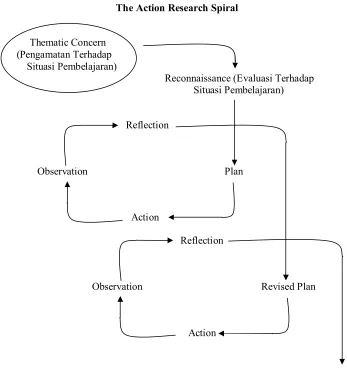
Kemmis and McTaggart suggested that components of Classroom Action
Research were series of activities began from a plan of action until the last
proccess was reflection. It called a cycle research. Each cycle consists of four
stages: (1) action planning, (2) the implementation of the action, (3) observation
and interpretation, and (4) analysis and reflection. Normally, this research
concluded on the second cycle (Latief, 2009).
In conclusion, classroom action research was activites began from plan
until reflection that did by teacher or researcher. This was doing in classroom
area to solve a problem that came from students, and in teaching and learning
20
The Action Research Spiral
Thematic Concern (Pengamatan Terhadap Situasi Pembelajaran)
Reconnaissance (Evaluasi Terhadap Situasi Pembelajaran)
Reflection
Observation Plan
Action
Reflection
Observation Revised Plan
Action
Revised Plan
Figure 1. Kemmis, S., McTaggert. R. In Latief (2009)
B. Research Setting
This research was conducted at the Junior High School 10 Makassar in
Andi Tadde. Junior High School 10 Makassar was led by Drs. Muh. Yunus
Yusuf, MM. The subject of this research was the students of VIIB consist of 43
21
This research was conducted in the second semester of academic year 2013 –
2014 started from Januari to Februari .
C. The Position of Researcher and Participant in the Research
This research, the researcher was an instructor and a teacher was a
collaborator during the teaching process go on. The aim was to asses the
teaching method that have given by researcher as a reference for the next cycle.
The participant of research was students as object of research , where the
research hoped after researching the students could increase their vocabulary to
improve their skills in English.
D. Research Instrument
The instruments used in this research were:
1. Test
Test was a series of questions or exercies as well as other equipment used
to measure the skills, knowledge, intelligence, ability or talents of individual or
groups (Arikunto, 2006:150). Test used for measuring the students’ achievement
on vocabulary and understanding of material.
2. Observation Sheet
The guidelines consisted of a list of the students’ activites that have
observed during learning proccess. It was used to identify whether using visual
media could overcome the students’ problems and improve the students’
22
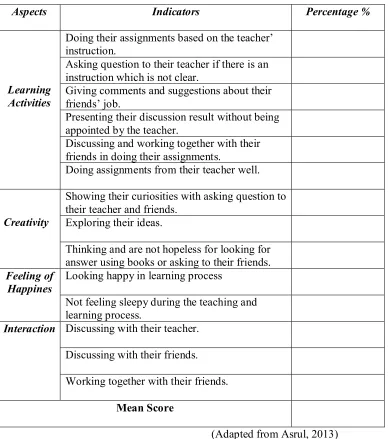
There were some aspects observed in the teaching and learning process,
influence visual media to increase and improve students’ vocabulary,
experiences, opinion, interest students to learn vocabulary by using visual media
and name of the students.
Table 1: The Form of Observation Sheet
Aspects Indicators Percentage %
Learning Activities
Doing their assignments based on the teacher’ instruction.
Asking question to their teacher if there is an instruction which is not clear.
Giving comments and suggestions about their friends’ job.
Presenting their discussion result without being appointed by the teacher.
Discussing and working together with their friends in doing their assignments.
Doing assignments from their teacher well.
Creativity
Showing their curiosities with asking question to their teacher and friends.
Exploring their ideas.
Thinking and are not hopeless for looking for answer using books or asking to their friends. Feeling of
Happines Looking happy in learning process
Not feeling sleepy during the teaching and learning process.
Interaction Discussing with their teacher.
Discussing with their friends.
Working together with their friends.
Mean Score
23
E. Research Procedures
This research was conducted with using Classroom Action Research. It
consisted of two cycles. Each cycle consisted of two meetings. In a cycle, it
consisted of four steps. They were :
a. Plan
In this step, the researcher prepared what that would teach. The
researcher prepared materials that based by the usage of visual media in teaching
vocabulary. After formulating the material that would present, the activities of
the next stage prepared lesson plans included: the creation of lesson plan (RPP),
then prepared data collection tools included: student worksheets (test),
observation sheet, and the last was camera.
b. Action
In general the procedure of the action in each cycle were :
In this step, firstly, the researcher started with explained what was visual
media. Afterwards, the reseracher showed vocabulary by visual media such as
picture, sketch, and cartoon. The researcher invited students to identify the
picture to measure how many vocabulary that students’ have until invited
students said the word aloud.
Then, the researcher showed again the visual media until three times.
24 c. Observation
The researcher observed what happend in the classroom, from problem
of students until teaching and learning proccess. The researcher gave observation
sheet some of the students. The researcher did it to obtaine information about
students’ opinion about visual media in learning vocabulary and learning
process.
d. Evaluation and Reflection
This step, the researcher analyzed the weakness that the researcher
obtained in observing. After the researcher analyzing the weakness, the
researcher looked for the problems solving for the weakness. In the step also, she
thought what the researcher have did in the next step.
F. Technique of Data Analysis
After the researcher had collected data, the reseracher analyzed result that
the researcher obtain valid data. Two techniques were used in analyzing the data.
They were :
1. Quantitative Data
Quantitative data were obtained from the result of the test that was
carried out at the end of the cycle. The test consisted of some questions of
25
This analysis used test to measure ability students that have related with
vocabulary, there were how many vocabulary that students have after the
researcher applying her method during the cycles. The analysis was follows :
To know the students’ achievement in each cycle, the researcher used
statistic analysis. The steps were below :
a. Scoring and classifying the students’ vocabulary ability as suggested by
Hughes in Juita (2011) here were explained the detailed of the explanation
above with its criteria.
Table 2: Scoring of Vocabulary
Classification Score Criteria
Excellent 5 Use of vocabulary to mastery English vocabulary Good 4 Sometimes use to mastery English vocabulary
although its no fluently
Average 3 Frequently the wrong words, discussion somewhat limited vocabulary
Poor 2 Misuse of word and very limited vocabulary make comprehension quite difficult
Very poor 1 Vocabulary limitations so extreme as to make discussion virtually impossible
b. Scoring the students’ answer of test by using this formula (Pusat
Kurikulum, 2006:32) in Juita (2011):
Score : Students’ correct answer X 100 Total number of item
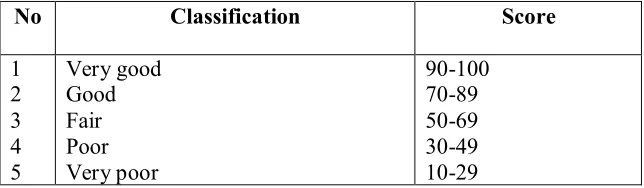
c. Classifying the score of the students that adapted from (Ufrah. 2009:32) in
26 Table 3: Classification Score of Students
No Classification Score
1
d. Calculating the rate percentage of the students score (Gay, 1981 :448).
% = ƒ
e. The mean score of the students’ achievement (Gay, 1981:298).
X = ∑x
during the treatment in each cycle. Qualitative data was the guidelines consisted
27
Data analysis in qualitative research did since before entering the field,
for the field, and after completion of the field. In this case Nasution in Faisal
(2013) stated "The analysis has been started since formulated and explained the
problem, before entering the field and continue until the writing of research
results. Analysis of the data became a handle to next research. However, in
qualitative research, data analysis was more focused during the process
collecting data in field.
1. Before analysing
Qualitative research has been to analyze the data before researcher
entered the field. Analysis was performed on data from preliminary studies or
secondary data, which would be used to determine the focus of research.
However, the focus of this research was still tentative, and would be developed
after researcher entering the field and over.
Quantitative researchers would cancel his research. If qualitative
researchers did not do it, because the focus of the research was temporary and
would be developed after the field.
2. Field Analysis Model Miles and Huberman
Data analysis in qualitative research, conducted at the time of data
collection, and after the collecting data in period. At the time the researcher
collecting data of result observation sheet, the researcher had conducted an
analysis of the answers. If the answer after the analysis was not satisfactory, then
the researcher would continue to give other question again to a certain extent,
28
suggested that the activity in qualitative data analysis done interactively and
continued over time until saturation. Activity in the analysis of data, namely data
reduction, the data display and conclusion drawing / ferification.
a. Data reduction
The data obtained in the field was many, for it should be noted carefully
and detail. The longer researchers in the field, the amount of data would be
many, complex and complicated. So, the researcher needs to be done analysis
data through data reduction. Data reduction mean summarized, chose the basic
things, focus on the things that were important, and wasted unnecessary. Thus,
data reduction would provide a clear illustration, and the researcher be easy to
collect data.
In reducing the data each researcher would be guided by the objectives
that would achieved. The main objective in qualitative research was the finding.
Therefore, if researcher in conducting research, find everything deemed foreign,
unknown, yet have. So, it was precisely what should be the concern of
researcher in performing data reduction.
Data reduction was a thinking process that required sensitive intelligence
and the breadth and depth of hogh insight. For new researcher, in conducting
data reduction could be discusses at a friend or other person who was deemed an
29 b. Data display
After the data reduction, the next step was data display. The presentation
of quantitative research was in the form of tables, and graphs. Through the
presentation of the data, the data have organized. So, it would be more easily
understood. With data display would be easy to understand what happened, to
plan work based on what has been understood Miles and Huberman in Faisal
(2013).
c. Conclusion Drawing/verification
The third step in qualitative data analysis by Miles and Huberman were
drawing conclusions and verification. Preliminary conclusions presented still
tentative, and changed if not found strong evidence supporting in the next phase
of data collection. But, if the data conclusions presented in the early stages,
supported again by valid evidence and consistent when researcher returned in the
field to collect data. So, the statement of conclusions was a credible conclusion.
Thus, the conclusions in qualitative research may be able to answer the
problem formulation is formulated from the beginning, but maybe not, because
as has been noted that the formulation of the problems and issues in qualitative
30 CHAPTER IV
FINDINGS AND DICUSSION
This chapter discussed the findings and discussion of this research. In the
finding section, the reseracher showed all the data which she collected during the
reseach. In the discussion section, the reseracher analyzed and discussed all the
data in the finding section. She compared the data collected during two different
cycles. The problem statements of this study were also answered in this section.
A. Findings
This section was divided into two parts. They were findinging in the first
and second cycles. The explanations were given below :
1. The First Cycle
This cycle was conducted for three meetings. The first and the second
meeting were used to teach the material and the third meeting was a competence
test. It was conducted on January, 18th,22th, and 25th 2014. The explanation were
given below:
a. Plan
To conduct this research, all required materials were prepared first. The
researcher prepared lesson plans, material for teaching was visual media such as
picture, students worksheets (test) and observation sheet. Before giving ability
31
general, and showed some samples. The resercher observed students’ vocabulary
through giving ability test individually. In 10 minutes of the test. During the
ability test, most of the students asked many questions about vocabulary that
they were going to write. Some of students had just made some sentences, and
others wrote nothing on their paper.
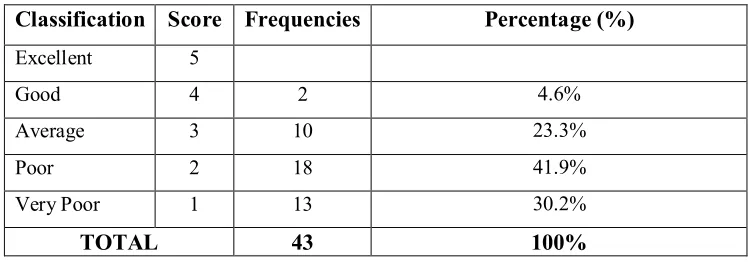
After checking the result of the students’ ability test, the researcher
concluded that the students’ vocabulary were very lack. The result of ability test
could be seen at the following Table 4.
Table 4 : The Frequency and Percentage of Ability Test
Classification Score Frequencies Percentage (%)
Excellent 5
Good 4 2 4.6%
Average 3 10 23.3%
Poor 2 18 41.9%
Very Poor 1 13 30.2%
TOTAL 43 100%
The table above showed that, the students’ score in ability test was very
poor. From 43 students who followed the test, there were 2 (4.6%) students
obtained good, 10 (23.3%) students obtained average, 18 (41.9%) students
obtained poor, and 13 (30.2%) students obtained very poor.
The mean score of ability test was 6.33. It mean that the students’ ability
in vocabulary was still less. Therefore, the researcher tried to apply visual media
32 b. Action
After the researcher obtaining the score of ability test, she continued in
the next step. In action, this research divided be two meeting.
1. The First Meeting
The first meeting of the first cycle was conducted on January 18th, 2014
started from 10.30 until 11.50 in the morning. In this meeting, the researcher
became teacher of the class. This meeting focused to learn and comprehend
adjective.
Steps in teaching and learning process were: First, the researcher greet
and then warm up students to burn their spirit and then checked their attendance.
Indirectly, it made them feel enjoy, fun and be confidance. Second, the
researcher began the lesson by asking the students about adjective. Third, the
researcher gave few minutes to explain about adjective, from definition of
adjective, and some samples of adjective. Fourth, the reseacher showed some
adjective through visual media. Fifth, the researcher invited students to identify
the adjective by visual media. Sixth, the researcher invited student to pronounce
of adjective. The researcher repeated to show adjective until three times.
2. The Second Meeting
The second meeting of the first cycle was conducted on January 22th, 2014
started from 9.45 until 10.25 in the morning. In the second meeting was the same
33
The second meeting, the researcher discussed about person or profession,
from definition until samples of person or profession. The researcher was
showing some persons or profession through visual media.
The researcher invited students to identify the person or profession
through visual media, and the researcher invited student to pronounce about
vocabulary of person or profession. The researcher repeated to show vocabulary
of person or profession until three times.
3. The Third Meeting
The third meeting was conducted on January 25th, 2014. The activities
begin reminding the students what they did the previous meeting. Approximately
15 minutes, the researcher gave instruction to students that they will do that
along day with providing some samples.
Subsequently, The researcher gave worksheet to measure students’
vocabulary. After students doing their worksheet, the researcher gave students
observation sheet to obtain an idea of the response of students.
c. Observation
In the first and the second meeting, the researcher observed the teaching
and learning process. The Students observed how they worked individualy or
34
How the condition and situation of the class was applying of visual
media and to know the improvement of the students’ achievement and to see
whether visual media could improve the students’ vocabulary. They used
guidelines of observation.
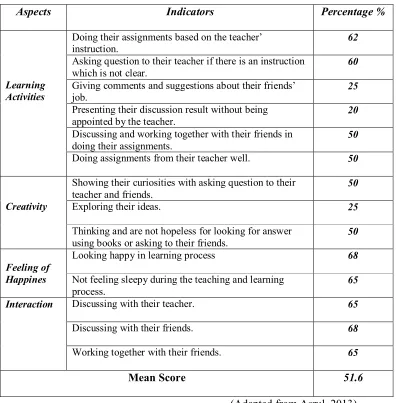
Table 5. The Results of The Observation in The First Cycle
Aspects Indicators Percentage %
Learning Activities
Doing their assignments based on the teacher’
instruction. 62
Asking question to their teacher if there is an instruction
which is not clear. 60
Giving comments and suggestions about their friends’
job. 25
Presenting their discussion result without being
appointed by the teacher. 20
Discussing and working together with their friends in
doing their assignments. 50
Doing assignments from their teacher well. 50
Creativity
Showing their curiosities with asking question to their
teacher and friends. 50
Exploring their ideas. 25
Thinking and are not hopeless for looking for answer
using books or asking to their friends. 50
Feeling of Happines
Looking happy in learning process 68
Not feeling sleepy during the teaching and learning
process. 65
Interaction Discussing with their teacher. 65
Discussing with their friends. 68
Working together with their friends. 65
Mean Score 51.6
35
Based on the table of observation before, the teaching and learning
process was not maximal. There were still some descriptors which must be
improved. Beside that, there were also some descriptions that did well even
though they still needed to be improved in the next cycle.
There were some indicators that made the teacher happy because most
students looking happy in learning process and most students discussed with
their friends. However, some aspects have increased. It still needed to be
improved in the next cycle.
The researcher concluded that there were some indicators did not
perform well. The causes of that were most students just silence because they
were lack vocabulary. Many students were still afraid and shy to speak. Most
students confused to pronounce the word.
The condition in the classroom was very crowded and hot. The students
did not have enough time to discuss with their friend and their teacher. The
students did not do their assignment well, and many students afraid shared their
idea when learning process,
Besides observing whether using visual media could overcome the
students’ problem and improve the students’ vocabulary. The researcher gave
the students a competence test to know the students’ achievements of the
material during in teaching and learning process. For more detailed information
of the result of the competence test in the first cycle, it could be seen at the
36
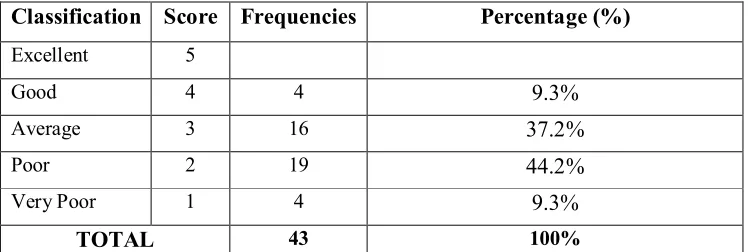
Table 6 : The Frequency and Percentage of The Students’ Vocabulary in The
First Cycle
Classification Score Frequencies Percentage (%)
Excellent 5
Good 4 4 9.3%
Average 3 16 37.2%
Poor 2 19 44.2%
Very Poor 1 4 9.3%
TOTAL 43 100%
The table above showed that the students’ score in ability test was less.
From 43 students who followed the test, there were 4 (9.3%) students obtained
good, 16 (37.2%) students obtained average, 19 (44.2%) students obtained poor,
and 4 (9.3%) students obtained very poor.
It could be compared with result of the ability test where only 2 (4.6%)
students obtained good, 10 (23.3%) students obtained average, 18 (41.9%)
students obtained poor, and 13 (30.2%) students obtained very poor.
The mean score of the students in the ability test was 6.33 and in the first
cycle it increased to 6.80. This was considered as a good improvement of the
students’ vocabulary. However, the mean score was not successful until the
mean score of students reach 7 of 10, it could improve the students’ vocabulary.
In addition, it concluded that in the first cycle. There were improvement
the students’ participation in the class. Neverthless, the researcher was still
37
Therefore, the researcher decided to improve the students’ vocabulary the next
cycle, the second cycle.
d. Reflection
Based on the result of the observation and the score of the students, the
researcher concluded that there were some aspects in the teaching and learning
that were still needed to improve. The observation showed that there were many
aspects must increase from students’ vocabulary, learning activities, creativity,
feeling of happines, and interaction in learning process.
In learning vocabulary process, there were still many problems faced by
the students. Some of the students were less vocabulary, some others were poor,
some students were afraid to share their idea, and most students were difficult to
pronounce vocabulary. Based on those problems, the researcher decided to
continue the research to the next cycle.
2. The Second Cycle
The second cycle was conducted on January, 29th, on February 1th and 5th,
2014. The procedures of teaching and learning in the second cycle were mostly
the same as the procedures done in the first cycle. The explanation were given
38 a. Plan
In the step, the researcher prepared all the things needed in the process of
teaching and learning such as lesson plans, materials, visual media such as
picture, students worksheets (test), and observation sheet.
b. Action
1. The First Meeting
The first meeting of the second cycle was conducted on January 29th,
2014 started from 10.30 until 11.50 in the morning. The action in the first
meeting was the researcher taught about food words by visual media. This
meeting focused to understand and comprehend food words.
The procedures in the first meeting of this cycle were the researcher
began the lesson through asking the students about food words that they knew,
the researcher gave few minutes to explain about food words from definition,
until some samples of food words. The reseacher showed some food words
through visual media.
The researcher invited students to identify the food words by visual
media. The researcher invited student to pronounce the food words. The
researcher repeated to show food words until three times. It made students easy
39 2. The Second Meeting
The first meeting of the second cycle was conducted on February 1th,
2014 started from 9.45 until 10.25 in the morning. This meeting focused on verb.
The procedures in the second meeting of this cycle were the researcher
began the lesson through asking the students about verb that they knew, the
researcher gave few minutes to explain about verb from definition, until some
samples of verb. The reseacher showed some verbs through visual media.
The researcher invited students to identify the verb by visual media. The
researcher invited student to pronounce the verb. The researcher repeated to
show verb until three times. It made students easy to remember it. The
researcher gave worksheet to measure students’ vocabulary.
3. The Third Meeting
The third meeting was conducted on February 5th, 2014. The activities
begin reminding the students what they did the previous meeting. Approximately
15 minutes, the researcher gave instruction to students that they will do that
along day with providing some samples.
Subsequently, The researcher gave worksheet to measure students’
vocabulary. After students doing their worksheet, the researcher gave students
40 c. Observation
The aspects which were observed during the teaching and learning
process in the second cycle were just the same as in the first cycle. The aspect
were learning activities, creativity, feeling of happiness, interaction in learning
process.
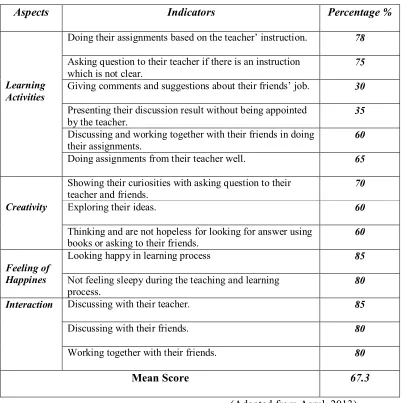
Table 7. The Results of The Obseravtion in The Second Cycle
Aspects Indicators Percentage %
Learning Activities
Doing their assignments based on the teacher’ instruction. 78
Asking question to their teacher if there is an instruction
which is not clear. 75
Giving comments and suggestions about their friends’ job. 30
Presenting their discussion result without being appointed
by the teacher. 35
Discussing and working together with their friends in doing
their assignments. 60
Doing assignments from their teacher well. 65
Creativity
Showing their curiosities with asking question to their
teacher and friends. 70
Exploring their ideas. 60
Thinking and are not hopeless for looking for answer using
books or asking to their friends. 60
Feeling of Happines
Looking happy in learning process 85
Not feeling sleepy during the teaching and learning
process. 80
Interaction Discussing with their teacher. 85
Discussing with their friends. 80
Working together with their friends. 80
Mean Score 67.3
41
The table showed that there were significant increasing at students
behavior in the class. In the aspects learning activities, feeling of happines and
interaction in learning process.
To measure the students’ vocabulary. For more detailed information of the
result of the competence test in the second cycle.
The result of the students’ vocabulary in the second cycle could be seen at
the following Table 8.
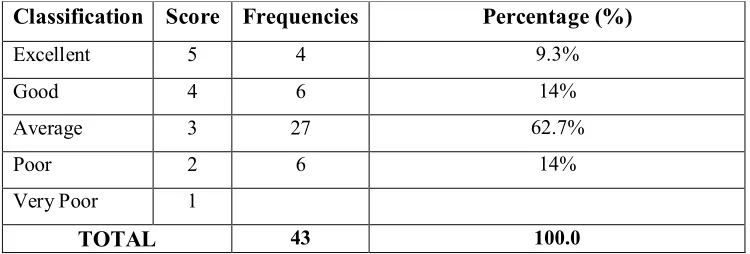
Table 8 : The Frequency and Percentage of The Students’ Vocabulary in The
Second Cycle
Classification Score Frequencies Percentage (%)
Excellent 5 4 9.3%
Good 4 6 14%
Average 3 27 62.7%
Poor 2 6 14%
Very Poor 1
TOTAL 43 100.0
The table above showed that the score of the students increased. There
were 4 (9.3%) students obtained excellent, 6 (14%) students obtained good, 27
(62.7%) students obtained average, and 6 (14%) students obtained poor.
It could be compared with result of the ability test where only 2 (4.6%)
students obtained good, 10 (23.3%) students obtained average, 18 (41.9%)
42
The mean score of ability test was 7.51. It mean that the students’ ability
in vocabulary have reached 7 of 10.
In addition, in the ability test students mean score 6.33 but increased in
the first cycle the students mean score was 6.80 and in the second cycle it was
7.51. This was considered a good improvement of students’ achievement.
It had reached the research target. To see the comparison of the students’
mean score from first cycle until second cycle.
d. Reflection
The result of students’ achievement in both test and observation at the
second cycle showed a significant increased. It could be seen through the student
mean score which was 7.51. By observation the students also showed positive
response toward learning activities, feeling of happines and interaction.
In addition, the succesful criteria of the research had been achieved. It
showed by the students’ mean score which passed over the point 7.0, as the
standard of vocabulary and elements of vocabulary. Therefore, the action was
43
B. Discussion
This part, the researcher would explain the implementation of visual
media that could improve students’ vocabulary.
The usage of visual media in a vocabulary learning could provide many
benefits for students. We knew that vocabulary was new language to students.
They have received as their second language. To make vocabulary easy to be
learned by students. Visual media was the better media that could use in
teaching vocabulary. This was supported by Koren (1997) in Rokni & Karimi
(2013) stated that the learning of foreign words with pictures could be easier and
memorable than the words without pictures.
In addition, some studies show that visualizations of text book could be
more effective in increasing student comprehension of a concept than simply
outlining information in a text book chapter (Robinson & Kierwa, 1998) in
McDermott (2010).
Studying a foreign language sometimes made students bored because
they did not understand word to word from a new language that were not
familiar. With visual media students be enthusiasm, gave motivation to learn
vocabulary and made students enjoyable learned vocabulary.
Danan (1992) in Rokni & Karimi (2013) stipulated that language
teachers used different visual materials that could increase students’ interaction
44
Learning vocabulary means learning a message or meaning of the
vocabulary. The usage of visual media in learning and teaching vocabulary
facilitated the delivery of messages from the vocabulary and easy to understand
by students. This was supported by Robinson & Kiewra (1994) in McDermott
(2010) that using infographics such as charts, graphs and other visual was an
efficient way of conveying information to students.
In addition, several studies have indicated that the usage of visual aids
greatly improve information retention and improve student understanding of
unfamiliar concepts (Butcher, 2006; Mayer & Sims 2004; Robinson & Kiewra,
1994; Shulten, 2010) in McDermott (2010).
This proved that the implementation of visual media could improve
students' vocabulary. It could prove of every test that have done by students. The
result of the ability test students was 6.33, in the first cycle the students mean
score was 6.80 and in the second cycle it was 7.51. This was considered a good