A Thesis
Submitted in Partial Fulfillment of the Requirement for the Degree of Sarjana Pendidikan in English Education Department of
Tarbiyah and Teaching Science Faculty of UIN Alaudddin Makassar
By:
Wiwiek Wahyuni Reg. Number: 20400113154
ENGLISH EDUCATION DEPARTMENT
TARBIYAH AND TEACHING SCIENCE FACULTY
ALAUDDIN STATE ISLAMIC UNIVERSITY
v
Alhamdulillahi rabbil‘Alamin, the researcher would like to express her most profound gratitude to Allah swt, for his blessing and mercies so that the writer could start and finish writing this research report as who has given guidance, mercy, and good health. Salam and Shalawat are delivered to our beloved prophet Muhammad saw who has brought the human being from darkness into the lightness.
During the writing this thesis, the researcher realizes that she received much assistance, suggestion and advice from beloved parents, Ambas and Nurbia,who always give her unlimited affection, sacrifice, prayer, and support her in finishing this thesis the number person. Without the suggestion, advice and assistance of this people, this thesis would never have existed. Therefore, the researcher would also like to express her appreciation and sincere thanks to them especially to the following.
1. Prof. Dr. H. Musafir Pabbari, MS., as the Rector of UIN Alauddin Makassar.
2. Dr. H. Muhammad Amri, Lc, M.Ag., as a Dean of Tarbiyah and Teaching Science Faculty of UIN Alauddin Makassar.
3. Dr. Kamsinah, M.Pd.I., and Sitti Nurpahmi, S.Pd., M.Pd., as the Head and Secretary of English Education Department of Tarbiyah and Teaching Science Faculty of UIN Alauddin Makassar.
4. Dr. H. Nur Asik, M.Hum. and Sitti Nurpahmi, S.Pd., M.Pd as the first and second consultants, thanks so much for their valuable, advice and great suggestion during the writing of this thesis.
vi this thesis.
7. Thanks to Alfi Lauhin Mahfud. S.Pd, Kasmwati Amir. S.Pd, who has helped the researcher in finishing this writing.
8. Thanks to my lovely friends, Syarifuddin, Arni, Arman, and Rini, for everything that they given to the researcher’s life. Thanks for all of your suggestion, affection and togetherness. The researcher was really praise recognized them.
9. Big thanks to all of the researcher’s family, Titi Sandra, S.Pd, Gusti Hari, S.Pd, Lisda, S.Kom, Ma’ruf, S.E and Badi Bahtiar, S.Pd. Thanks for their financial aid and prayer, motivation and sacrifices for the researcher success.
10.All of the researcher’s best friend from English Education Department 2013, especially for PBI 7,8, thanks for friendship and togetherness.
11. Thanks to the researcher’s friends in KKN Pinrang ( Lembang ) Nunung, Wawa’, Inci, Biya, Regina, Danil, Opiq, UllahandArmin. Thanks for their nice suggestion, motivation, time, friendship and togetherness.
vii
Samata-Gowa, 15 November 2017
viii
CHAPTER II. REVIEW OF RELATED LITERATURE A. Literature Review... 5
1. Previous related research findings ... 5
2. Pertinent Ideas………. 5
1. Concept of Vocabulary ... 5
a. Definition of Vocabulary……….. 6
b. Parts of Vocabulary………... 7
c. Principles of teaching and learning vocabulary... 8
ix
F. Data analysis teqnique ………. 23
xi
xii
Appendix II : Score of students pre-test and post-test in experimental class
(VIII A) ... 50
Appendix III : Score of students pre-test and post-test in control class (VIII B) ... 51
Appendix IV : The mean score of experimental and control class... 52
Appendix V : Standard deviation of Experimental class and control class ………. 53
Appendix VI : The significance different ……….. 56
Appendix VII: The distribution of T-Table……… 57
Appendix VIII: Lesson plan of the material……….. 58
Appendix IX : Research instrument ……….. 78
xiii
Title : Improving the 3 Years Students’ Vocabulary through Treffinger Learning Model at SMP Negeri 1 Limboro
Consultant I : Dr. H. Nur Asik, M.Hum
Consultant II : Sitti Nurpahmi, S.Pd.,M.Pd
The aim of this reseach was to find out the improvement 3rd years of the students vocabulary through Treffinger Learning Model.
The method of this research was a Classroom Action Research that consisted of two cycles. One cycle consisted of four meetings. It means that there were eight meetings for two cycles. This classroom action research was done at the 3rd years students at SMP Negeri 1 Limboro. The subject of this research was 3A academic year of 2017/2018 by using Treffinger Learning Model. It consisted of 28 students.
The implementation of this research was giving the improvement for the
1
One of the important elements to master foreign language is vocabulary, English would never be succesful without learning and undesrtanding vocabulary. Having much vocabulary and a good knowlidge about vobulary supports to master the four English kills,i.e. listening, speaking, reading and writing. For all the aspect of English vocabulary is important as well as other aspect of English. An important thing is due to the fact that, vocabulary is one of the components of language and no language exists without words. Words are signs or symbols for ideas. Vocabulary building is not an easy thing to do due to one word may have many various meanings, and word forms.
According to Duran (2006) Vocabulary must be taught as a prerequisite knowledge to learn English language, because with vocabulary knowledge students are able to write and also communicate orally. Armbruster at.al(2003) On the other hand, readers cannot understand what they are reading without knowing what most of the words mean. So, learning English emphasize that without vocabulary, students cannot communicate to express their ideas, feeling, and other things in oral and written form and cannot comprehend a text.
vocabulary. The second, low interest and motivation of students in learning English caused by situation and condition of the classroom. The third, the teachers used the old method so that, students are not interested in following the class.
( Jawiah, interview, on 10thJune 2016)
Based on the problem before, the teacher should provide some new alternative ways or method to improve the students’ vocabulary so with the new method the students will interest to follow in the class, when they are interest with the method automatically they can improve their vocabulary mastery. Therefore, the reseacher will use Treffinger of this research due to this technique is good stimulate the students’ interst and motivation in learning vocabulary. Treffinger models is one of the few models that deal with with creativity issues derectly and advice on how to achieve elignment. By invilving cognitive and effective skills at every level of this model, Treffinger shows intereletetion ships and enterpendencies between the two encouring creative learning. Learning Model thats a new method and furthemore, the researcher believes that Treffingger Learning Model is easy and effective to use for the students in learning English vocabulary.
B. Research Problem
C. Research Objectivie
The objective of study was based on the statement of the problem abovis to improve students’ vocabulary mastery after being taught by Treffinger Learning Model of the 3rdgrade student’s of SMP Negeri 1 Limboro.
D. Research Significance
The results of this research were expected to have theoretical and practical contribution. Theoretically, this research could gave more benefit to English language teaching and learning.
1. This study was respect to stimulate the teachers to be creative to develop and explore interesting treffinger in teaching vocabulary.
2. The result of this study was expected to be used by further researcher as information.
3. The result of this research hopefully gave useful and helpful information for curriculum development.
Practically it can be used as a model to improve students’ vocabulary mastery, and it may guide, help and encourage them to express their ideas, feeling, and other things orally and written and also increase of the students’ interest to learning English especially English vocabulary.
E. Research Scope
5
The importance of vocabulary has made many language teachers and researchers explore and expose language teaching process by implementation of various strategies, techniques and methods. Some of researchers related to the topic described in this research:
Titin Faridatin Nisa (2011) in her research “ Pembelajaran Matematika dengan setting Model Threffinger Learning dalam mengembangkan kreativitas
siswa “ found that, the method was improve the students’ cearivity in study matetatika.
Muhaimnu,W,H.(2014) Efectivitas model pembelajaran Treffinger berbemantuan lembar kerja siswa terhadap hasil belajar siswa SMA. The students find it easier to do the tesk because the students have followed the step in the treffinger learning model.
Imas Teti Roheti. Penerapan Model Treffinger Pada Pembeajaran Matemata Untuk Meningtkan Kemampuan Berikir Kreatif Siswa SMP. Students
succes in improving the ability of creative thinking and very compact in groups.
This research is different from the others researchers, this research aims at
finding the improvement of the students’ vocabulary by using Treffinger learning model the model that is using here is not using before yet.
Based on the reserch findings above, it can be inferred that, there are many kinds of techniques of teaching vocabulary related to using Threffinger learning model to increase the students’vocabulary mastery. Both of them is to know how extent the effectiveness using Treffinger for improving English vocabulary.
B.Some Partient Findings
This part explain about Vocabulary and Threffinger model. 1. Vocabulary
a. Defenition of Vocabulary
There are various defenition of vocabulary , some of them :
Hiebert (2005) stated that, vocabulary is the knowledge of a word not only implies a definition, but also implies how that word fits into the world. And also Allen (2006) stated that, vocabulary is related to and affects comprehension. The relationship between word knowledge and comprehension is unequivocal.
According to Spears (2002) state that vocabulary is :
1) The words that someone knows; the words that are part of someone’s
language.
2) The words used in certain business, profession, or activity.
3) A list of words with brief meanings, like those found in foreign-language dictionaries; a glossary of words and their meanings
Other definition of vocabulary, Ur (1996) state that: Vocabulary can be defined, roughly, as the words teacher teach in the foreign language. However, a new item of vocabulary may be more than a single word which is made up of two or three words but express a single idea. There are also multi word idioms where
the meaning of the phrase can’t be defined from an analysis of the component
word.
Furthermore, based on definition above, the researcher find opinion about vocabulary, the important point of them is vocabulary must be developed if
students’ want to express their thought, heart, and self in oral or print (written). b. Types of Vocabulay
Basicaly, vocabulary divided into two type vocabulary; active vocabulary and passive vocabulary. Harmer (1991) say that, active vocabulary refers to the vocabulary that the students have been taught or have learned and which they are expected to be able to use, and passive vocabulary refers to the vocabulary that, the students do not frequently use but can be recognized and understood the meaning both in textual and oral contexts consists of those words, which are not
usually part of one’s speaking vocabulary but which are recognized and
understood when reading and listening. The passive vocabulary is usually many times larger than active vocabulary.
words which the students will recognize when they meet them but which they will probably not be able to produce.
In processing of development students’ vocabulary , Hiebert et.al(2005) explained there are two type of vocabulary namely receptive vocabulary and productive vocabulary, they can be explain as follows:
1. Receptive, or recognition, vocabulary is that set of words for which an individual can assign meanings when listening or reading. These are words that are often less well known to students and less frequent in use. Individuals may be able assign some sort of meaning to them, even though they may not know the full subtleties of the distinction.
2. Productive vocabulary is the set of words that an individual can use when writing or speaking. They are words that are well-known, familiar, and used frequently.
Forthemore Armbruster, (2003) explain another type of vocabulary in acquiring vocabulary they are indirect vocabulary learning and direct vocabulary learning it can be described as follows:
1) Indirect Vocabulary Learning
2) Direct Vocabulary Learning
Students’ learn vocabulary directly when they are explicitly taught both individual words and word-learning strategies. Direct vocabulary instruction aids reading comprehension.
c. Principles of Teaching and Learning Vocabulary
For teaching and learning vocabulary, the teachers’ need to understand the principle in learning and teaching vocabulary. Because to mastery vocabulary, teacher have to know what kind of vocabulary that they give, what kind of method or technique they use, how many vocabulary that they should teach, and how present vocabulary. According to Wallace in Setiadi (2010) put forward seven principles of teaching vocabulary as follows:
1) Aims
Teaching vocabulary, students’ have to be dear about our aims, how any vocabulary expect the students to be able to do? If it is not clear on this point, it will be difficult to assess how successfully the vocabulary learning has been attained.
2) Quantity
when there are too many words the students may become confused, discourage, and frustrated.
3) Need
In most cases, the choice on vocabulary taught to the students, the teachers use a course books or syllabus. In any case, the teachers in choosing the vocabulary that are going to be taught will relate to the aim of the course and objective of individual lesson. It is also possible for the teachers in a sense, to put responsibility of choosing the vocabulary to be taught to the students. In other words, the students are put in the situation where they have to communicate the words they need, as they need then, using the words as the information.
4) Frequent Exposure and Repetition
Teaching and learning vocabulary, there have to be a certain amount of repetition until there is evidence that the students have learnt the target words. This simplest way of checking that learning has been done is by seeing whether the students can recognize the target words and identify their meaning. If the words have to be part of the students, productive vocabulary, the must be given an opportunity to use them, as often as necessary for them to recall the words at all, with the correct spelling, pronunciation, and identify their meaning.
5) Meaningful Presentation
6) Situation and Presentation
The words presented are appropriate to the students’ situation with favorable
condition, enough time-convening and a convenient method; the students will automatically succeed in learning vocabulary.
7) Presenting in Context
Words are very seldom occurring in isolation, so it is important for students to know the usual collocation in which the words occur. So from the very beginning the word must appear in its natural environment, as it was among the words it normally collocates with. Collocations are words, which are commonly associated.
d. Teaching Vocabulary
The most frequently vocabulary is presumably that which individual feel mostly needed. These needs will be very different kinds of situation. That is way the teacher should select the vocabulary, in order that the teaching can be done easily to be able to use them in expressing their needs. According to Harmer (1991) there are many occasions when some presentation and/or explanation is the best way to bring new words into the classroom.
1) Realia
One way of presenting words is to bring the things they represent into the
classroom by bringing ‘realia” into the room. Words like “postcard”, “ruler”,
2) Pictures
Bringing a pen into the classroom is not a problem. Bringing in a car, however, is. One solution is the use picture. Picture can be boarded drawings, wall pictures and charts, flashcards, magazine pictures and any other non-technical visual representation. Picture can be used to explain the meaning of vocabulary items. Teachers can draw things on the board or bring in pictures. They can illustrate concepts such asaboveandoppositejust as easily as hats, coats, walking sticks, cars, smiles, frowns, etc.
3) Mime, action, and gesture
It is often impossible to explain the meaning of words and grammar either through the use of realia or in pictures. Actions, in particular, are probably better explained by mime. Concepts like running orsmoking are easy to present in this
way: so are ways of walking, expressions, presentations (“to”, “towards”, etc) and
times.
4) Contrast
Researcher saw how words exist because of their sense relations and this can be used to teach meaning. Students’ can present the meaning of “empty” by contrasting it with “full”, “cold” by contrasting it with ”hot”, “big” by contrasting
it with “small”. Researcher may present this concept with pictures or mime, and by drawing attention to the contrasts in meaning ensure our students’
5) Enumeration
Another sense relation is that the general and specific words. Researcher can use this to present meaning. Students’ can say ‘clothes’ and explain this by enumerating or listing by various items. The same is true of ‘vegetable’ or
‘furniture.’
6) Explanation
Explaining the meaning of vocabulary items can be very difficult, especially at beginners and elementary levels. But with more intermediate students such a technique can be used. It is worth remembering the explaining the meaning of a word must include explaining any facts of word use which are relevant. If are explaining the meaning of ‘mate’ (=friend) students have to point out that is a colloquial word used in formal contexts and that is more often used for males than for female.
7) Translation
Translation is quick and easy way to present the meaning of words but it is not without problems. In the first place it is not always easy to translate words, and in the second place, event where translation is possible, it may make it a bit too easy for students by discouraging them from interacting with the words. When translation can quickly solve a presentation problem it may be a good idea, but
e. Vocabulary Selection
Before teaching students’ vocabulary the researcher should know which words are useful to be taught, but how do the teachers determine exactly what are useful. The selection of words which are to be taught to the students is a very important procedure in the language learning process. However, the word selection process doesn’t mean that, the students will be fluent in expressing themselves in English learning that list, i.e., what students need to know regarding vocabulary is the word meaning, the word use, the word formation and the word content.
Harmer,(1991) stated that When conveying the meaning to the students, teachers should teach their students that a word may have more than one meaning
when used in different contexts. For example, the word “book” has at least twelve
different meanings when used in context. It has different meanings as a noun, other meanings as a verb. One may say “I buy a new book” and “I booked my ticket three days ago”; another “if you drive too fast on the way you might be
bookedfor speeding”. f. Testing Vocabulary
Testing students’ vocabulary is important to be carried out to measure the students’ comprehension of words used in speaking or writing. Vocabulary
authentic, but even that task is constrained by a contrived situation in which the places, or ideas, or a particular one of these.
b. Noun is used to refer to people and things as well as to abstract ideas and phenomena. The definition above, teacher can draw a conclusion that noun is a word which is used to name or identify a person, place, thing, idea and condition.
3. Threffinger Learning Model
Forthen more Munandar in Nisa (2011) Threffinger leraning models consist of the following steps: basic tools, practice with procces and working with real problems.
a. Step I ( besic tools )
Basic tools or techniques include creativity divergent thinking skills and creative techniques contained. in the introduction, functions include the development of self devergen fluency, flexibility, originality, and of detail in thinking. The effective part of Phase 1 includes the willingness to answer, openness to experience, the willingness to accept similarity or ambiguity, the sensitivity to the problems and challenges, curiosity, courage to take risks, awareness and trust yourself.
As for the learning activities at one stage in this study are (1) the teacher gives an open issue with the answers more than a settlement, (2) the teacher guides the students had a discussion to convey the idea or ideas at the same time provide an assessment of each group.
b. Step II ( Practice with procces )
imagery, meditation and your relaxation (relaxation), and the development of psychological safety in the creative or creating.
There is a real emphasis on the development of increased awareness, openness preconscious functions, and opportunities for personal growth. In the second stage this is only a stage in the process of movement towards creative learning, and not the final destination of its own. The learning activities in the second stage of this research, namely (1) the teacher guide and student direct for discussion by giving examples of analog, (2) the teacher asks the students to make an example in everyday life.
c. Step III ( working with real problems )
Working with real problems, i.e. applying the skills learned in the first two stages to the challenges of the real world. Here students use their skills in ways that are meaningful to their lives. Students not only learn the skills of creative thinking, but also how to use this information in their lives. In the realm of introduction, it means involvement in asking questions that are independent and self-directed. Creative learning someone to lead to the identification of the challenges or problems which means asking questions related to these issues, and management of the sources that lead to development or product results.
C.Theoretical Framework
in process of teaching and learning English. While, Hornby (1983) in Advance
Learner’s of Current English says that vocabulary is: 1) All the words that a person knows or uses, 2) All the words in a particular language, 3) The words that people use when they are talking, 4) A list of words with their meaning in a book for learning a foreign language.
Treffinger Learning Model is a learning model that uses three steps of learning model using student creativity. students are divided into small groups to help each other with learning materials and complete the tasks assigned by the teacher. learning by using treffinger model can foster the creativity of students in solving problems, with the following characteristics: (1) smoothly with problem solving, (2) have ideas more than one answer, (3) applying jawan with ideas made through discussion, (4) being confident in answering questions from the teacher, (5) having more than one answer, (6) applying problems in life and finding your own sources of problem solving.
19
This research, the researcher conductedClassroom Action Research (CAR). It was conducted by the teachers or lecturers who want to help their students mastered the materials. The main proposes of Classroom Action Research were to
identify and to solve the students’ problem in the class.
Jean McNiff (2002) states action research involves learning in and through action and reflection, and it was conducted in a variety of contexts, including the social and caring sciences, education, organisation and administration studies, and management. Because action research is always to do with learning, and learning was to do with education and growth, many people regard it as a form of educational research.
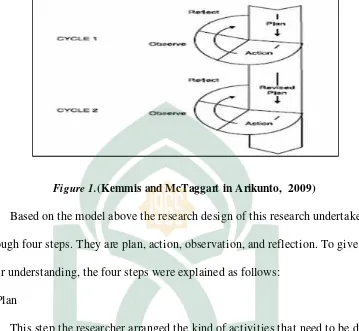
Kemmis and Taggart describe that, the model or the procedures of CAR into four steps. They were; (1) plan, (2) action, (3) observation and evaluation (4) reflection. The relations among them was called a cycle. It means that, a cycle consists of plan, action, observation, evaluation, and reflection. Cyclical action
Figure 1.(Kemmis and McTaggart in Arikunto, 2009)
Based on the model above the research design of this research undertaked through four steps. They are plan, action, observation, and reflection. To give a clear understanding, the four steps were explained as follows:
a. Plan
This step the researcher arranged the kind of activities that need to be done in the action step. The reseracher prepared Treffinger as a teaching model.
Furthermore, the researcher prepared the lesson plan. b. Action
This step, the researcher taugh vocabulary to the students. The teaching procedure as follows:
1. Researcher introduces and explain topik 2. Students’ were divided into groups 3. Students’ do the test
c. Observation
This step, the researcher observed the students’ activities in the learning
process as well as the students’ attractiveness in learning vocabulary through Treffinger Learning Model. The aims of this activity are to evaluate the
teaching-learning process, to know how the influence of the Treffinger Learning Model.
d. Reflection
This step, the researcher analyzed the weakness of the result from the observation step. Then, the researcher analyzed the factor affecting the weakness. However, if the result has not achieved the score target, it should step to the next cycle regarding re-planning, re-acting, and re-observing. Concurrently, the researcher planed the new steps that she would do in the next step.
B.Research subject
The position of students in this research was object, which the 3rd years students at SMP Negeri 1 Limboro. Especially, the students of the 3rd years, which consist of 28 students, was covered by 11 males and 17 females. The selection of the 3rdyear students at SMP Negeri 1 Limboro the participant of the research was based on the interview with the teacher which said that, the students lack of vocabulary and it was the main problem that caused the students were hard to master the language.
Collaboration as an important feature of this type of this research, Collaborator in classroom action research was person who helps the researcher to collect the data. The collaborator of this research was English teacher who teach English in SMP Negeri 1 Limboro , she was Mrs. Jawiah.estionnaire, observation list, interview, test, etc. In this study, the researcher used observation and test.
1. Observation Checklist
List In arranging check list of observation, the researcher listed some
students’ observable behavior that indicates their activities and response during teaching learning process through Threffinger Learning Model.
2. Test
This research, the researcher used an achievement test to measure the student’s progress in vocabulary power. Related to the achievement test, there were many types of achievement test, such as essay test, multiple choice tests, and so on. The researcher used multiple choices test. With those forms, the researcher can get score directly. The scoring can be done quickly and accurately.
D. Data analysis technique
This study used descriptive statistical analysis to find out the improvement of students’ English vocabulary power in noun using threffinger learning model. The steps were:
1. Method of Analyzing Observation Checklist
will be analyzed by calculating the percentage from the checklist as the pattern
a. Measuring the students individual ability In every cycle, after giving a
treatment the researcher gave test to students. The score of the correct answer is 5 and 0 to each wrong answer. The result of the test was analyzed by using percentage scoring as following formula
Students’ correct answer
Score= x 10
Total Number of items
Assessing the students’ vocabulary mastery scores by using the rubric below. The Classification of Students’ score
( Arikunto 2009 ) Persentage of correct answer Score Criteria
90– 100 Excellent Aut standing 75 – 89 Good Above avirage
60 – 74 Fair Satisfactory
50 – 59 Less Below avirage
b. This formula used to know the mean score of the students’ achievement: = ∑
Where: : Mean Score
∑ X: The sum of all scor
N : the number of subject (students)
(Gay, 2006)
The result of those formula the researcher analyzed the score of test and
26
the researcher got the data from each cycle. The finding section, show all the data which were collected in all cycles. In the discussion section, analyzed and discussed all the data from the findings section. The results were as follow: A.Findings
This research was done on Friday, August, 19 2017. In this first cycle, the researcher used Treffinger Learning Model to teach vocabulary in noun, and students were being enthusiastic because it was their first experience. The test result of the first cycle can be seen in the table below:
1. First Cycle
This research was conducted on Saturday, July, 26 2017. In this activity, the researcher became a teacher. The students’were enthusiastic in following the treatment, the researcher told students’ that she would use Threffinger Learning Model to teach vocabulary in noun. This research was classroom action research there were four steps; planning, acting, observing and reflecting. The activities were as follow:
a. Planning
b. Actions
Actions consist of four meetings; in the first and the second meeting using contextual teaching and learning approach in teaching and learning process. In the four meeting the students were given achievement test.
1. The first meeting
The first meeting focused on improving students’ skill in developing idea. In this meeting was conducted on July, 26 2017 from 08.50-10.10 am. Researcher and the collaborator, Jawiah, entered in the class. The teacher was welcomed by students that sit down on the chair and several students play around the class. The situation was noisy; some students were still talking with their friends. After all of the students were ready, the teacher started the meeting by praying. The teacher opened the lesson by introducing and checked the students’ attendance. After that the teacher continued to the lesson. The procedures were:
a. Teacher introduces and explains what the Treffinger learning model is. b. Teacher explain the procedure of treffinger learning model
c. Students write vocabulary.
The students do that researcher instruction. 2. The second meeting
students search the test answer most of them write the answer in a latter, most if them read their result of discussion.
3. The third meeting
This meeting was conducted on August, 02th2017 from 08.55-10.15 am. In this meeting same with the second meeting and all of the activity, but the different material.
1. The fourth meeting
The last meeting in the first cycle was conducted on August, 5th 2017 from 10.40 -12.00 am. That is the students do the test to know the omprovment student vocabularry after apply the method.
c. Observation
In observation step, the teacher was helped by the collaborator to observe the learning process. This is to know what happen in the class during the lesson from opening until closing. The collaborator observed the activities during the teaching learning process in using treffinger learning model. To observe them, he used observation checklist which were made before conducting this research. The result of the observation was analyzed to find the strengths and the weaknesses of the action. In the fourth meeting, she did not observe the teaching and learning process because the students were given a competence test for the first cycle. This
test was very important to know the students’ improvement in vocabulary.
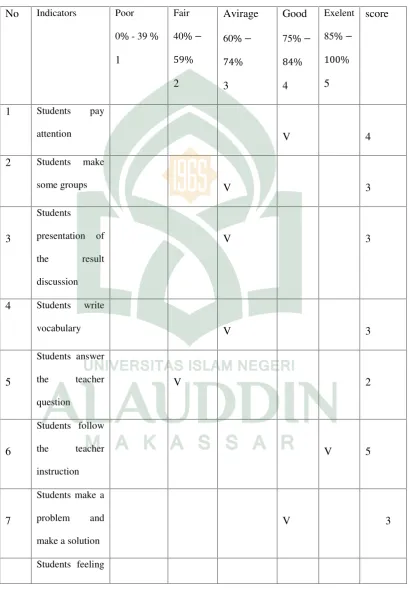
1. The researcher observed the activeness and attention of students in the classroom during teaching learning process.
2. The researcher observed students follow the researcher intruction. 3. The researcher observed the students’ task, theydo or not.
4. The teacher observed the students feeling enjoy to learning. 5. The teacher observed the students bring the dictionory. d. Reflecting
For the reflection on the activity during cycle 1, the researcher noted that, there were some problems should be solved in the next cycle, the problems were as follow: Class should be conducive during teaching learning process, before teacher started the activity. It found some students shouted making noise. When the activity in progress, it found that some students were passive, they were not fully joining the teaching learning process. It was then the duty of the teacher to give some more attention and motivation toward the students in order to make them interest to join the activity. There were many students that can’t answer the question from teacher.
2. Second cycle
a.Planning
The planning, the researcher arranged lesson plan based on the teachingmaterial, improved the teaching strategy, test and prepared the observation checklist.
The second cycle was conducted on Friday , August, 19 2017. In this cycle the researcher tried to handle weakness in the first cycle. There steps were as follow:
1. The researcher made lesson plan as guiding to teach students in the second cycle.
1. Teacher started by greeting the students’. 2. Teacher checked students’attandence.
3. Teacher asked students’about the material in previous meeting. 4. Teacher asked some students’about the name of foods in English . 5. Teacher ask the students’about the material by followed the lesson plan. 6. Students’worked in group.
8. Students’done the assigment from the teacher. 9. Students’and teacher discussed the assigments. c. Observing
The observation step during cycle 2 did not different with the previous cycle, the researcher also observed the events that happened during teaching learning process. The researcher observed the activity by using observation checklist, the steps were as follow:
1. The researcher observed the activeness and attention of students in the enough. This involved teaching learning process, students’ activeness and attention, students’ ability in using English children song. The reflection results were as follow:
1. Class was conducive enough, since some students were concentrated to join the activity.
4. Teacher had provided enough time; this can be shown that most of students come forward to answer the questions.
After the researcher implementing Treffinger Learning Model in teaching noun, the researcher got the data from each cycle. It was analyzed to get the improvement in every cycle, and then the researcher got the result of the classroom action research. The results were as follow:
1.First Cycle
This cycle was done on Friday, August, 05 2017. In the first cycle the researcher used the Treffinger Learning Model to teach vocabulary in noun,and students were being auhusiatic because it was a new model for them. The test selut of the first cycle can be seen in th table below :
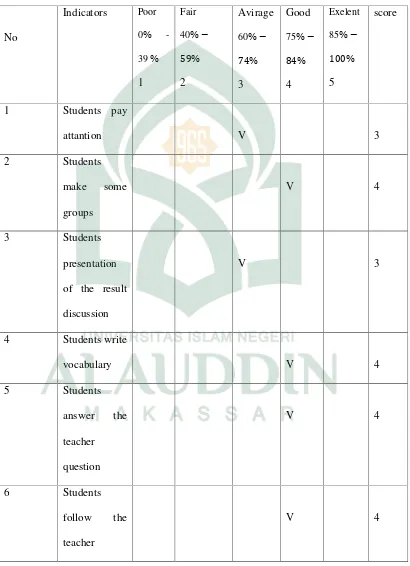
Based on the result of observation above it can be concluded that, only half of the students are active and enthusiastic, a half students need more attention from the teacher in teaching learning process. They paid attention to the lesson, although some students cannot answer the question because they still difficult to remember the word.
After implementing the test, the researcher examined it and gave score. In giving score, the researcher used the following formula:
Students’ correct answer
Score= x 100
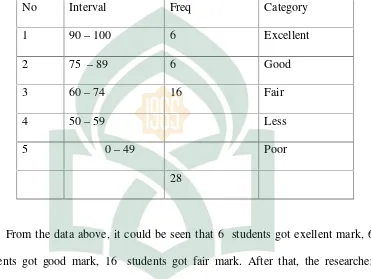
The result of the test above, the researcher then classified the students’ ability and their percentage using the formula. The result of the scoring percentage as follow:
Table 5.The category of the students score and their percentage
No Interval Freq Category
1 90– 100 6 Excellent
2 75 – 89 6 Good
3 60 – 74 16 Fair
4 50 – 59 Less
5 0 – 49 Poor
28
From the data above, it could be seen that 6 students got exellent mark, 6 students got good mark, 16 students got fair mark. After that, the researcher calculated the mean using the same formula with previous research. The result of the mean of the first cycle is:
= x 100 = 7,053
The result of the mean was 7,053. It means that, the students’ score in
first cycle could be said unsuccessful, because the whole students get over 13 of
the achievement. But it was unsatisfied yet,because 16 students still got fair
2.Second cycle
The second cycle was conducted on saturday, august 19 2017. There was
significant improvement in this cycle, it could be seen from the result of the test below:
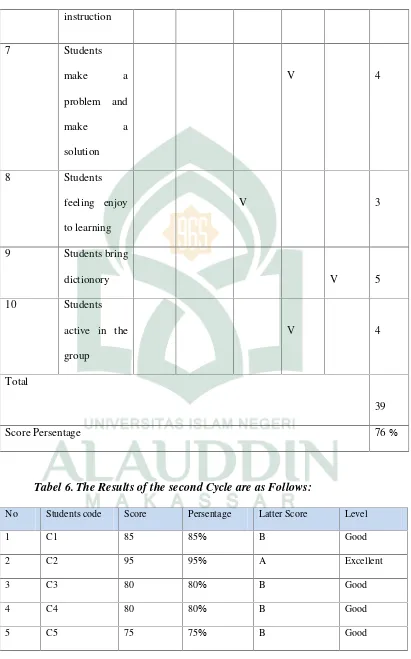
Then, the researcher calculated students’ score based on the percentage formula to categorize their ability. The result of the scoring percentage as follow:
Table7. The Category of The Students Score and Their Percentage No Interval Freq Category
1 90– 100 6 Excellent
2 75 – 89 20 Good
3 60 – 74 Fair
4 50 – 59 Less
5 0 – 49 Poor
26
From the Table 6 above, it could be seen that 6 students got exellent mark and 10 students got good mark, the researcher could calculate the average (mean) of the score as follows:
= x 100 = 8,53
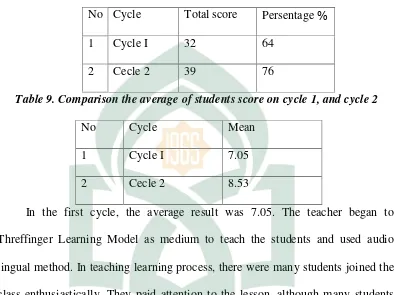
Table 8. Comparison percentage students enthusiastic in response teaching learning process using Threffinger Learning Model cycle 1, and cycle 2.
No Cycle Total score Persentage%
1 Cycle I 32 64
2 Cecle 2 39 76
Table 9. Comparison the average of students score on cycle 1, and cycle 2
No Cycle Mean
1 Cycle I 7.05
2 Cecle 2 8.53
In the first cycle, the average result was 7.05. The teacher began to Threffinger Learning Model as medium to teach the students and used audio lingual method. In teaching learning process, there were many students joined the class enthusiastically. They paid attention to the lesson, although many students still confused with past form.
In the second cycle, the average result was 8,53. Before the lesson was begun, the research asked the students to give more pay attention to the lesson. All activities in this cycle run well. According to the research that use children Threffinger Learning Model in teaching vocabulary caused their interesting and responses more increasing than before. The researcher felt that the implementation
B.Discussion
Vocabulary is one of the most important elements in language. Without vocabulary, no one can speak or understand a language. In other words, when people do not have much vocabulary or do not master it well, they cannot say or write something. In order to convey ideas, thought and feeling, people need much vocabulary so that the listener can understand it well. According to Brown (2004) vocabulary is the content and function words of language which are learned
through by that they become a part of the child’s understanding, speaking, reading, and writing. Second, vocabulary is words having meaning when hard or seen even though the individual produces it when communicating with others.
The reason why the researcher choose vocabulary as the the experiment. because Vocabulary is central to English language teaching because without sufficient vocabulary students cannot understand others or express their own ideas. So vocebularry helps students or facilitates student communication in teaching and learning, and the students understant the teacher mean.
The problems that after happen on students vocabulary, the first vocabularies as very poor caused by some abstruction in learning vocabulary. The second low interst and motivation of students in learning english caused of situation and condition in class room. The third teacher used the old method so that students are students not interest in following the class.
38
This research shows that the use of Threffinger Learning Model as a media
to improve students’ English vocabulary mastery in noun can help the students solve their problems. The test result indicated that the students understanding on noun form. there was significant improvement of students’ vocabulary in every cycle. The students avirage score giving the treatment using Threffinger Learning Model, increased significantly (the students’ average score from first cycle was 7.05 and the average score of the students in the second cycle was 8.53 ) It showed that the use of Threffinger Learning Model could improve students’ English noun vocabulary mastery.
B. Suggestions
In relation to the conclusion above, the researcher proposes the following offers:
1. For the teacher
2. For the student
Students have to be more active in teaching and learning process in order
to improve their vocabulary. The students having low interest should encourage themselves and realize the importance of active invovement in teaching learning
process.
3. To the other researcher
40
Arikunto, Suharsimi,Dasar-Dasar Evaluasi Pendidikan, Jakarta: PT Bumi A ksara Jawa,2009
Arikunto, Suharsimi.Prosedur Penelitian Suatu Pendekatan Praktik.Jakarta: RinekaCipta, 2013.
Armbruster, Bonnie B., Fran Lehr, & Osborn Jean.Put Reading First: The Research Building Blocks for Teaching Children to Read (2ndEdition).
Center for the Improvement of Early Reading Achievement (CIERA). 2003
Brown, H. Douglas. Language Assessment. Principle and Classroom Practices. NewYork: Pearson Education. 2003
Departement Pendidikan Nasional.Petunjuk Teknis Pengajaran Bahasa Inggris.Jakarta : Depdiknas. 2005.
Duran, Elva. Teaching English Learners in Inclusive Classroom 3rd Edition. Charles Thomas Publishing, Ltd. 2006
Gay, L, R. Educational Research : competenciel for analysis and applycation. Second edition. London:A.Bell& Howel Company. 1978
Harmer, Jeremy.The Practice of English Language Teaching: 1stEdition. London: Longman. 1991
Hiebert, Elfrida.H & Kamil Michael. L. Teaching and Learning Vocabulary: Bringing Research to Practice. Lawrence Erlbaum Associates, Publishers. 2005
Hornby,A, S. Oxford Student’s Dictinory of AMERICAN English. New York. Oxford University Press. 1983
Rahmawati,Indah. The Use Of English Children Songs As Media To Improve
Students’english Vocabulary Power In Noun.2010
Spears, Richard, A. NTC’s Pocket Dictionary of Words and Phrases. The McGrow-Hill Companies.2002
Setiadi, M, A. Using Fables in Improving students’ Vocabulary Mastery. Unpulished Thesis.Makassar: Postgraduate Program of UNM Makassar. . 2010
Setiawati. Penerapan Pelmbelajaran Kooperaif Model Treffinger Dalam Meningkatkan Hasil Belajar Sswa Mata Pelajaran Melakukan
Prosedur Adminstrasi Keas X SMK 4 Jember Tahun Pelajaran
2012/013.2014
Sudjana , N.Metode Statistika. Bandung . PT Remaja Rosda Karya.1999
Muhaimnu,W,H. Efectivitas model pembelajaran Treffinger berbemantuan lembar kerja siswa terhadap hasil belajar siswa SMA.Universitas Negeri Semarang Fakultas Matematika Dan Ilmu Pengetahuan Alam.2014 Nisa,T,F.Pembelajaran Matematika dengan Setting Model Treffinger untuk
Mengembangkan Kreativitas Siswa. Universitas Muhammadiyah Sidoarjo.2011
1
Nama Sekolah : SMP Negeri 1 Limboro Mata Pelajaran : Bahasa Inggris
Kelas/ Semester : IXa/ Ganjil Pertemuan : 1
Lokasi waktu : 2 x 60 menit A. Kompetensi Inti
1. Menghargai dan menghayati ajaran agama yang di anutnya
2. Menghargai dan menghayati perilaku jujur, disiplin, tanggung jawab, peduli ( toleransi, gotong royong) , santun, percaya diri, dalam berinteraksi secara efektif dengan lingkungan sosial dan alam dalam jangkaun pergaulan dan keberadaannya.
3. Memahami dan menerapkan pengetahuan ( faktual konseptitual, dan prosedur ) terhadap rasa ingin tahuannya terhadap ilmu pengetahuan, tekhnologi, seni, budaya terkait fenomena dan kejadian tampak di mata.
4. Mengolah, menyaji, dan menalar dalam ranah konkret ( menggunakan, mengurai, merangka, memodifikasi, dan membuat )
2
1.2 Menunjukkan perilaku tanggung jawab, peduli, kerjasama, dan peduli damai, dalam melaksanakan komunikasi fungsional.
1.3 Menerapkan struktur teks dan unsur kebahasaan untuk melakukan fungsional menyatakan dan menanyakan tentang arti dari benda yang tidak di ketahui.
1.4 Mengumpulkan kata kata sulit yang ada dalam teks. C. Indikator Pencapaian Kompetensi
1.1.1 Menunjukan sikap syukur dan sunguh-sungguh dalam belajar 1.1.2 Menunjukkan rasa syukur kesempatan belajar bahasa inggris. 1.1.3 Bertanggung jawab, peduli, kerja sama dan cinta damai, dalam
melaksanakan komunikasi fungsional
1.1.4 Menentukan unsur kebahasaan tentang tindakan/ kegiatan yang sedang di lakukan / terjadi saat ini.
1.1.5 Menentukan tentang tindakan / kejadian/ yang sedang di lakukan . 1.1.6 Menyusun kata susah yang telah di dapat pada teks .
D. Tujuan Pembelajaran
Di akhir pembelajaran siswa mampu memahami dan mengerti kata- kata sulit yang awalnya tidak di mengerti . dan siswa mampu
3
5. peneliti akan menjelakan alasan mengapa masuk
dalam kelas
menggantikan guru.
4
Besic Tools
selama masa penelitian.
2. Siswa di bagi menjadi 4-5 kelompok.
Peneliti memberikan suatu masalah dan jawaban dari masalah dari tersebut jawabannya lebih dari satu.
1. Siswa di minta untuk membayangkan sebuah rumah.
5
Practice With Procces
menyebutkan hasil dari diskusi kelompok mereka.
Peneliti mengarahkan dan membimbing siswa dan memberikan contoh analog.
1. Peneliti mengajukan
pertanyaan “dengan apa
adek adek adek
membuka pintu ?”
2. Siswa di minta untuk mendiskusikan dan di
minta untuk
6 Working with
real problems
permasalahan sendiri dan
mampu menjawab dari
permaslahan dari mereka
sendiri.
Menggunakan
kemampuan dalam
menyelesaikan masalah
terhadap tantangan
tangan yang mereka
dapatkan .
1. Peneliti mengajukan
pertanyaan kepada siswa
“ jika adek adek berada
dalam sebuah rumah dan
rumah tersebut terbakar
nah dengan apa anda
7
dari hasil diskusi di
kelompok.
Penutup 1. Peneliti memberikan
motovasi kepada siswa.
2. Pemneliti memberikan
kesimpulan kepada siswa.
3. Siswa di minta pada tiap
pertemuan untuk
membawa kamus.
4. Peneliti menyampaikan
kegiatan yang akan
datang.
10
8 Mata Pelajaran : Bahasa Inggris
Kelas/ Semester : IXa/ Ganjil
Pertemuan : II
Lokasi waktu : 2x 60 menit ( 1 pertemuan )
A. Kompetensi Inti
1. Menghargai dan menghayati ajaran agama yang di anutnya
2. Menghargai dan menghayati perilaku jujur, disiplin, tanggung jawab,
peduli ( toleransi, gotong royong) , santun, percaya diri, dalam
berinteraksi secara efektif dengan lingkungan sosial dan alam dalam
jangkaun pergaulan dan keberadaannya.
3. Memahami dan menerapkan pengetahuan ( faktual konseptitual, dan
prosedur ) terhadap rasa ingin tahuannya terhadap ilmu pengetahuan,
tekhnologi, seni, budaya terkait fenomena dan kejadian tampak di
mata.
4. Mengolah, menyaji, dan menalar dalam ranah konkret ( menggunakan,
mengurai, merangka, memodifikasi, dan membuat )
B. Kompetensi Dasar
1.2 mensyukuru kesempatan dapat mempelajari Bahasa Inggris sebagai
bahasa pengantar kominikasi internasional yang di wujudkan dalam
9 fungsional menyatakan dan menanyakan tentang arti dari benda yang
tidak di ketahui.
1.5 Mengumpulkan kata kata sulit yang ada dalam teks.
C. Indikator Pencapaian Kompetensi
1.5.1 Menunjukan sikap syukur dan sunguh-sungguh dalam belajar
1.5.2 Menunjukkan rasa syukur kesempatan belajar bahasa inggris.
1.5.3 Bertanggung jawab, peduli, kerja sama dan cinta damai, dalam
melaksanakan komunikasi fungsional
1.5.4 Menentukan unsur kebahasaan tentang tindakan/ kegiatan yang
sedang di lakukan / terjadi saat ini.
1.5.5 Menentukan tentang tindakan / kejadian/ yang sedang di lakukan .
1.5.6 Menyusun kata susah yang telah di dapat pada teks .
D. Tujuan Pembelajaran
Di akhir pembelajaran siswa mampu memahami dan mengerti kata- kata
sulit yang awalnya tidak di mengerti . dan siswa mampu
mengaplikasikannya di kehidupan sehari-hari.
E. Metode Pembelajaran
11 Kegiatan inti
Practice With
Procces
4. Siswa di minta untuk
membayangkan sebuah
pulau.
5. Siswa mendiskusikan
dan menuliskan apa
yang ada pada pulau.
6. Dalam setiap satu
kelompok ada satu
perwakilan untuk
menyebutkan hasil dari
diskusi kelompok
mereka.
Peneliti mengarahkan
dan membimbing siswa
dan memberikan contoh
12 Working with
real problems
berkunjung ke suatu
pulau ?”
I. Siswa di minta untuk
mendiskusikan dan
di minta untuk
menyampaikan hasil
diskusi pada
kelompok mereka.
J. Siswa membuat
permasalahan sendiri
dan mampu
menjawab dari
permaslahan dari
mereka sendiri.
Menggunakan
13 dapatkan .
3. Peneliti mengajukan
pertanyaan kepada
siswa “ jika adek adek
terjebak di sebuah
pulau, bagaimana adik
adik keluar dari pulau
tersebut?”
4. Siswa di minta
mendiskusikan dan
menyampaikan gagasan
dari hasil diskusi di
kelompok.
5. Peneliti memberikan
motovasi kepada siswa.
14 7. Siswa di minta pada tiap
pertemuan untuk
15 Mata Pelajaran : Bahasa Inggris
Kelas/ Semester : IXa/ Ganjil
Pertemuan : III
Lokasi waktu : 2x 60 menit ( 1 pertemuan )
A. Kompetensi Inti
1. Menghargai dan menghayati ajaran agama yang di anutnya
2. Menghargai dan menghayati perilaku jujur, disiplin, tanggung jawab, peduli
( toleransi, gotong royong) , santun, percaya diri, dalam berinteraksi secara
efektif dengan lingkungan sosial dan alam dalam jangkaun pergaulan dan
keberadaannya.
3. Memahami dan menerapkan pengetahuan ( faktual konseptitual, dan
prosedur ) terhadap rasa ingin tahuannya terhadap ilmu pengetahuan,
tekhnologi, seni, budaya terkait fenomena dan kejadian tampak di mata.
4. Mengolah, menyaji, dan menalar dalam ranah konkret ( menggunakan,
mengurai, merangka, memodifikasi, dan membuat )
B. Kompetensi Dasar
1.1 mensyukuru kesempatan dapat mempelajari Bahasa Inggris sebagai bahasa
pengantar kominikasi internasional yang di wujudkan dalam semangat
16 fungsional menyatakan dan menanyakan tentang arti dari benda yang tidak
di ketahui.
1.4 Mengumpulkan kata kata sulit yang ada dalam teks.
C. Indikator Pencapaian Kompetensi
1.4.1 Menunjukan sikap syukur dan sunguh-sungguh dalam belajar
1.4.2 Menunjukkan rasa syukur kesempatan belajar bahasa inggris.
1.4.3 Bertanggung jawab, peduli, kerja sama dan cinta damai, dalam
melaksanakan komunikasi fungsional
1.4.4 Menentukan unsur kebahasaan tentang tindakan/ kegiatan yang
sedang di lakukan / terjadi saat ini.
1.4.5 Menentukan tentang tindakan / kejadian/ yang sedang di
lakukan .
1.4.6 Menyusun kata susah yang telah di dapat pada teks .
D. Tujuan Pembelajaran
Di akhir pembelajaran siswa mampu memahami dan mengerti kata- kata
sulit yang awalnya tidak di mengerti . dan siswa mampu
mengaplikasikannya di kehidupan sehari-hari.
E. Metode Pembelajaran
18 Kegiatan inti
Practice With
Procces
7. Siswa di minta untuk
menyebutkan ada
berapa merek Hand
Phone ( HP ) yang
mereka ketehui.
8. Siswa mendiskusikan
dan menuliskan apa
yang ada pada pulau.
9. Dalam setiap satu
kelompok ada satu
perwakilan untuk
menyebutkan hasil dari
diskusi kelompok
mereka.
Peneliti mengarahkan
dan membimbing siswa
19 Working with
real problems
H. Peneliti mengajukan
pertanyaan “apa fungsi
HP menurut adik adik?”
I. Siswa di minta untuk
mendiskusikan dan
di minta untuk
menyampaikan hasil
diskusi pada
kelompok mereka.
J. Siswa membuat
permasalahan sendiri
dan mampu
menjawab dari
permaslahan dari
mereka sendiri.
Menggunakan
20 dapatkan .
K. Peneliti mengajukan
pertanyaan kepada
siswa “ jika HP yang
adik adik miliki rusak
apa yang akan kalian
lakukan?”
L. Siswa di minta
mendiskusikan dan
menyampaikan gagasan
dari hasil diskusi di
kelompok.
8. Peneliti memberikan
motovasi kepada siswa.
9. Peneliti memberikan
21
10. Siswa di minta pada
tiap pertemuan untuk
22
1 ABD. HARIS C1
2 ARHAN C2
3 BUSMAN C3
4 DANDI C4
5 ERWIN B C5
6 JUANDA C6
7 JUNAEDI C6
8 MUH. YUSUF C8
9 ANNISA AMELIA C9
10 CICI PUTRI ANGRIANINGSIH C10
11 FAJRAWATI C11
12 HUSNAH C12
13 HARDENI C13
14 ISNAWATI C14
15 MUTIARA ANANDA C15
16 NUR ADILA C16
17 NUR AULIA C17
18 NURJANNAH C18
19 NURMADINAH C19
23
24 SAHRUL C24
25 SUKRAN C25
26 RAHMI C26
27 ROSMIATI C27
25
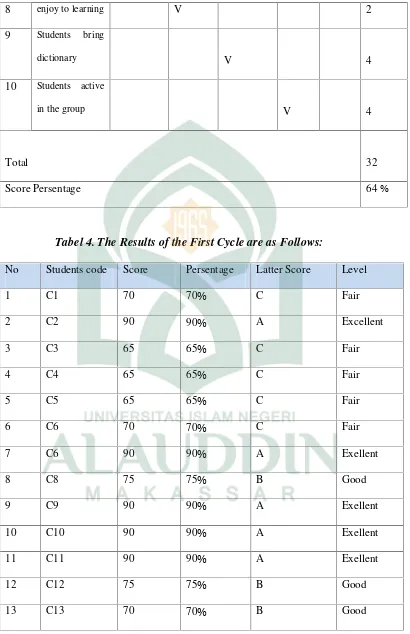
10 Students active
in the group V 4
Total 32
Score Persentage 64%
Tabel 4. The Results of the First Cycle are as Follows:
No Students code Score Persentage Latter Score Level
1 C1 70 70% C Fair
2 C2 90 90% A Excellent
3 C3 65 65% C Fair
4 C4 65 65% C Fair
5 C5 65 65% C Fair
6 C6 70 70% C Fair
7 C6 90 90% A Exellent
8 C8 75 75% B Good
9 C9 90 90% A Exellent
10 C10 90 90% A Exellent
11 C11 90 90% A Exellent
12 C12 75 75% B Good
26
17 C17 75 75% B Good
18 C18 60 60% C Fair
19 C19 70 70% C Fair
20 C20 70 70% C Fair
21 C21 65 65% C Fair
22 C22 90 90% A Good
23 C23 60 60% C Fair
24 C24 75 75% B Good
25 C25 70 70% C Fair
26 C26 65 65% C Fair
27 C27 70 70% C Fair
28
Tabel 6. The Results of the second Cycle are as Follows:
No Students code Score Persentage Latter Score Level
1 C1 85 85% B Good
2 C2 95 95% A Excellent
3 C3 80 80% B Good
4 C4 80 80% B Good
29
9 C9 100 100% A Exellent
10 C10 95 95% A Exellent
11 C11 100 100% A Exellent
12 C12 Absent Absent Absent Absent
13 C13 80 80% B Good
14 C14 80 80% B Good
15 C15 75 75% B Good
16 C16 80 80% B Good
17 C17 75 75% B Good
18 C18 75 75% B Good
19 C19 75 75% B Good
20 C20 75 75% B Good
21 C21 85 85% B Good
22 C22 95 95% A Excellent
23 C23 75 75% B Good
24 C24 Absent Absent Absent Absent
25 C25 75 75% B Good
26 C26 75 75% B Good
27 C27 75 75% B Good
Mandar Regency, and west Sulawesi. She has six sisters and three brothers. She is
the seventh daughter of Abd. Latif and Hamida.
she started her education in elementary school SD 034 INP Napo and
graduated in 2007. She continued her study in SMP Pesantren AL-Ikhlash
Lampoko and graduated in 2010. And then she continued her study in SMA
Negeri 1 Tinambung and graduated in 2013. In the same year she was accepted in
English Education Department of Tarbiyah and Teacher Training Faculty of UIN