The Imbalance Aitude of the Journalists in Chemical
Castraion Texts:
An SFL Criical Discourse Analysis
Mustofa Kamal, Riyadi Santosa, Djatmika
Sebelas Maret University
E-mail: [email protected]
ABSTRACT
This research invetigates how journalits behave in texts. The analysis focuses on the exploitation of attitudinal lexis. This is qualitatively explored through attitude and graduation. The data sources were columns of news, taken from an online version of The Jakarta Pot on June sixth 2016. Having been selected using criterion-based sampling technique, the sources of data resulted in six chemical catration texts. The procedure of invetigation consits of domain, taxonomic, componential, and cultural value analysis. The result shows that journalits are subjective in reporting news by unbalancing the pros and cons, inconsitent in work from delivering news to criticizing government oicials, and provocative by up-scaling critical evaluations againt the government policy on sex ofenders.
Keywords: attitude, graduation, chemical catration, journalits, evaluations
INTRODUCTION
The attitude of journalits is embodied in attitudinal lexis. This evaluative lexis spreads over a text. The evaluation may come from journalits or other participants they included in the texts. Both journalits and participants can either negatively or positively evaluate the issue. Nevertheless, the decision of which and who to include and to dominate rets with the journalits. This evaluation or ideology is then transferred to readers. In turn, the readers may accept or reject it. Such journalits-readers interaction relects an interpersonal metafunction (Santosa, 2003: 21).
The main reason for conducting this research is that journalits of two-sided texts have more space to show particular inclinations to be or to do something for certain purposes. Such inclinations could likely to lead to serious impacts on both government and public. Those tendencies are also opposite to the job as a journalit because ‘ideal’
journalism rejects any bias. On the contrary, objectivity is highly praised since it deals with delivering facts to the people (Maras, 2013: 204). Facts could be delected away from the people by journalits if they surrender to ‘temptation’. In this case, a huge amount of money or other appealing sorts of bribes could possibly be diicult for them to resit. Even a journalit of the highet integrity, as Burrows said, till have to deal with another barrier, that is determining which facts to put or to leave out (as cited in Applegate, 1996: 39). Therefore, objectivity is not only a challenge but also a burden to them.
the two sides, either pros or cons. Both pros and cons seem to be more diicult to be made equal since the issue of chemical catration deals with human right. This sentence merely breaches the fundamental right of the perpetrator as chemical catration has potential to threaten his or her life. In other words, this is againt democracy. How democracy upholds human rights has been
implied by Lincoln’s repetitive people in part of
his speech “the government of the people, by the
people, for the people” (Chapman & Nuttal, 2011:
15). Lincoln’s quote implies that in a democratic country, the government plays the servant while the public act as a king.
There are several reviews of pat research from which the researchers found a gap. They are mentioned as follows. O’Hallaron et al. (2015) invetigated the attitude of academic writers while Moore and Schleppegrell (2014) and Horarik et al. (2015) decided on that of novelits for the topic of the research. In addition, Yasuda (2014) probed for tudents’ attitude and their perception as well. Despite exploiting appraisal, prior tudies by Santosa, Priyanto, Nuraeni, and Dzakiria (2016) and Santosa, Priyanto, and Nuraeni (2014) did not research the attitude. The former explored the language of mass treet protets in Indonesia while the latter invetigated the regiter of antagonit.
This research aims at identifying the attitude of journalits that manifets in an appraisal sytem. The sytem of appraisal consits of (1) attitude that is concerned with types of evaluations addressed to the news topic, chemical catration, and (2) graduation that deals with scales of evaluations. Both attitude and graduation were coined by Martin and White (2005). Their explanation is given below.
Evaluations can be about human feelings (afect) and behavior (judgment), and things (appreciation) which include natural phenomena and semiosis (Martin & White, 2005: 35-6). These three types of attitudinal lingual units may be up- or down-scaled. Both up- and down-scaling has to do with ‘trength’ and ‘accuracy’. Scaling evaluation based on trength is termed force while focus is another term of accuracy-based grading evaluation. Evaluative lexis is delivered using various means such as projecting source, modality, and concession when the source of attitude is other
than writer. Meanwhile, a writer has no means of conveying evaluation (Martin & Rose, 2007: 42-58).
The sources of data are columns of news. They
come from an online version of The Jakarta Pot.
All of them were collected on June the sixth 2016. Then, they were selected using criterion-based sampling technique. As cited in Santosa (2014: 54), Lincoln and Guba argued that a qualitative research needed particular criteria used to avoid any deviations that could ditance the research from its purpose. The criteria are as follows:
(1) The texts are about chemical catration (2) The texts were published on the columns
of news
(3) The texts provide lots of attitudinal lexis
Through the criteria above, the selection of data sources resulted in six texts. They are
Chemical Catration ‘Would Violate Human Rights of Sex Ofenders’, Chemical Catration May Lead to Saditic Personality: Psychologit, Proposed Chemical Catration Debate Continues, Catration for Rapits of Kids, Miniter Supports Catration for Child Sex Ofenders, and Govt Issues Perppu on Sexual Violence againt Children.
Based on the appraisal sytem, content analysis was carried out to identify the journalits’ attitude. In this analysis, the data were classiied according to their domains and taxonomy. One by one, the data illed each category of the domains and taxonomy. Afterwards, componential analysis showed the total data from all classiications in a matrix. This matrix would display none other than patterns used to interpret the theme of soft culture,
that is to say the way The Jakarta Pot journalits
behave in chemical catration two-sided texts (Spradley, 1980).
FINDINGS AND DISCUSSION
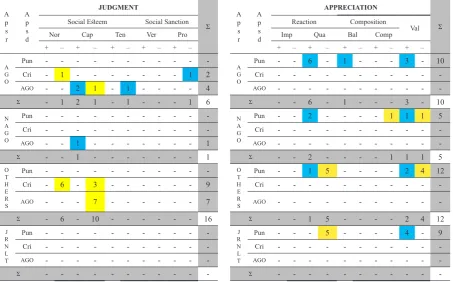
23 data of judgment and 36 data of appreciation occupy each slot of their speciic features. These narrow features will be able to show evaluations conveying the journalits’ disagreement over and agreement to chemical catration.In general, the positive feature (+) represents the journalits’ agreement to chemical catration
while the negative one (‒) relects their disagreement. However, 2 of the 36 negative evaluations show the journalit’s agreement to the punishment. Therefore, the inal total of the data implying journalits’ disagreement is 34. These 34 negative evaluations manifet in ‒normality, ‒capacity, ‒quality, ‒complexity, and ‒valuation. Meanwhile, there are 25 evaluations conveying the journalits’ agreement to the sentence. They disperse over texts through ‒propriety, ‒tenacity, +capacity, +quality, +balance, and +valuation. All the data ditribution is given in the table 1 as follows. Nor Cap Ten Ver Pro + ‒ + ‒ + ‒ + ‒ + ‒
Note: Apsr = appraiser; Apsd = appraised; AGO = authoritative governmental oicials; NAGO = non-authoritative governmental oicials; JRNLT = journalits; Pun = punishment; Cri = criminals; Nor = normality; Cap = capacity; Ten = tenacity; Ver = veracity; Pro = propriety; Imp = impact; Qua = quality; Bal = balance; Comp = complexity; Val = valuation; (+) = positive; (‒) = negative
Evaluations showing disagreement over chemical catration Evaluations showing agreement to chemical catration
A
J
udgment: ‒Normality
AGO exploited only 1 ‒normality to evaluate Cri while OTHERS used this type of evaluation 6 times to judge the same participant. Thus, the whole data categorized as ‒normality are 7. The example of ‒normality analysis is presented below.
it may create a more saditic person, a
psychologit has said. (TJP/N/J2/jdg/‒ nor/23)
The clause above shows that the source of the
evaluation falls on a psychologit that uses epithet
to appraise person. This judgment manifets in
saditic which, based on attitude, is classiied into
judgment: ‒normality.
Within attitude perspective, the word saditic
is categorized into judgment because the object
of appraisal person is human that refers to the sex
ofender. Since the normality of the perpetrator
is assessed negatively by a psychologit, ‒
normality becomes the next speciication. Such
a psychologit’s negative reaction to chemical catration expresses the disagreement of journalits over the sentence.
J
udgment: +Capacity
The appraised AGO received 2 assessments of +capacity from the appraiser AGO. In addition, NAGO also participated in judging AGO with jut 1 +capacity. So, +capacity comprises 3 data. How +capacity relects the journalits’ agreement to chemical catration is illutrated with an example below.
The House could even sugget extra
tipulations, Firman continued, to provide more deterrents for rapits should the regulation made by the State Palace be deemed not to provide enough protection for children and women. (TJP/N/J4/ jdg/+cap/80)
In the above clause, Firman is the evaluator
who appraises the House with modality: ability.
The lingual unit used to judge is could while the
type of the appraisal is judgment: +capacity.
The evaluative lexis could belongs to
judgment because the thing which is assessed the House is human. The House covers authoritative governmental oicials who are in charge of the
contitution as to chemical catration. The House’s
capacity is judged positively (+capacity) by Firman
as he thinks they are capable of suggeting extra
tipulations (“The House could even sugget extra
tipulations,”)if chemical catration is perceived of as less efective to deter the suspects of sexual
crimes (“to provide more deterrents for rapits…”)
and insuicient to protect women and children (…
should the regulation be made by the State Palace be deemed not to provide suicient protection for children and women). The pro nuances of Firman’s
evaluation to authoritative governmental oicials above represent the journalits’ agreement to the punishment.
A
ppreciaion: +Valuaion
AGO gave 3 +valuations to Pun while there is only 1 +valuation addressed by NAGO and 2 by OTHERS to Pun. Meanwhile, JOURNALISTS assessed this appraised participant with +valuation 4 times. As a result, the total data of +valuation are 10. The example as follows would help the readers undertand the invetigation.
However, Indonesian Child Protection Commission (KPAI) chairman Asrorun Niam Sholeh insited that chemical
catration was a viable solution to curb the
country’s rampant sexual abuse of children. (TJP/N/J1/apc/+val/17)
In the clause above, it is mentioned that
Asrorun Niam Sholeh plays as the appraiser
who exploits attribute to appreciate chemical
catration. His evaluation is embodied in viable solution while the classiication of his assessment is appreciation: +valuation.
The ‘thing’ (head in traditional grammar
perspective) of the nominal group appraised,
chemical catration, is catration. Catration is categorized as material (non-human). Therefore,
the speciication of attitude of viable solution is
appreciation. In this case, viable solution comes
to be a solution that can overcome sexual crimes.
In other words, viable solution contains positive
value and, thus, it is labeled as +valuation. Asrorun
Niam Sholeh’s assessing chemical catration
as viable solution represents the journalit’s agreement to the punishment.
A
ppreciaion: ‒Complexity
NAGO selected ‒complexity to appreciate Pun. No one used -complexity to appraise Pun other than NAGO. In other words, ‒complexity merely collected 1 datum. The following is the example of the analysis.
“There are several additional punishments. They [sex ofenders] could be either chemically catrated or given chip implants, or probably both,” he went on, adding
that the chemical catration would only be carried out on adult sex ofenders. (ebf) (TJP/N/J6/apc/‒com/cpl/95)
Based on the above clauses, the one who evaluates is Yasonna as he in he went on refers
to him. She chooses probably which is an
adverbial group as attitudinal lexis to appraise
the tatus of giving additional punishments for sexual criminals. The type of appraisal belongs to
appreciation: composition: ‒complexity.
Since the thing appreciated is the tatus
of giving additional punishments for sexual ofenders which is not human, appreciation becomes the type of appraisal. The types of additional punishments for sex violence perpetrators are diicult to determine. This is due to the complexities surrounding the process of sexual crimes invetigation. On the one hand, sexual violence victims and perpetrators are sometimes equally underage, but on the other the victims are much younger than the sex ofenders. Underage perpetrators have diferent physiological conditions from adult ofenders so that if the chip intallation becomes an option of punishment, thorough observation is needed for the sake of their life. So intricate is the process of invetigation that it leads to the use of ‒complexity. Such complexity makes Yasonna
decide on the lexis probably for the assessment.
By using lexis probably, if it turns out that the
type of additional penalty is chemical catration, or chip implant, or both, Yasonna will not have to bear the consequences. Since the evaluation is negatively addressed to additional punishments for chemical catration, Yasonna implies the journalits’ disagreement over the sentence.
A
ppreciaion:
–Quality
OTHERS appreciated Pun 5 times and they all are
–quality. To the same appraised participant, 5 – qualities were also delivered by JOURNALISTS.
So, the total data of ‒quality amount to 10. Below
is the example of the analysis.
The government should consider many aspects before using chemical catration as punishment for child moleters as it may
create a more saditic person, a psychologit has said. (TJP/N/J1/apc/-rea/qua/22)
The sentence above demontrates that a
psychologit plays as an evaluator who appraises
chemical catration. Create which is a process
becomes the contituent to assess the punishment
and this appraisal is categorized into appreciation:
reaction: ‒quality.
Appreciation becomes the speciication of
the evaluative lexis create since it as the appraised
participant refers to chemical catration which
is not human. It is responded negatively by the
following may create a more saditic person. May
create a more saditic person holds the nuance of dislike to chemical catration. Because of such
dislike, appreciation is speciied to be reaction:
‒quality. To tet quality for positive or negative,
a quetion did I like it? is used (Martin & White,
2005: 56). If the related evaluation implies I liked
it, it will be categorized as +quality. However,
if the concerned appreciation conveys I did not
like it, ‒quality will be the next category. So far a psychologit’s appreciation has demontrated the disagreement of journalits over chemical catration.
are not objective in reporting chemical catration. Their subjectivity has been proven through domination of negative evaluations (cons) over the positive ones (pros) (Martin & Rose, 2007). On the contrary, journalism upholds objectivity because it plays a vital role in reporting facts to readers (Maras, 2013: 204). Proit allegedly becomes the factor in journalits’ subjectivity. Chronologically, the mass media concerned managed to voice the people’s wishes by unbalancing pros and cons. As a result, the public sided with that mass media againt the government. In other words, it has successfully won the hearts of the people. Therefore, the revenue could increase dratically as the public are none other than news consumers. In harmony with such argument, Henry Wickham Steed (as cited in Bromley & O’Malley, 1997: 118-20), tated that the board of mass media businessmen took the advantage of today’s chaotic
newspaper production to reap the beneits and
beat their rivals even before they knew how to do that. Their success would depend on their ability to read the wishes of the public, voice their wish, and guide them to that wish, of course,
if they knew the way. Other than this research, the imbalance between negative evaluations and positive evaluations is also found in one-sided texts as what has been explored by Santosa et al. (2014). This emphasizes that journalitic objectivity is in crisis at leat in both one and two-sided texts from those two invetigations.
Secondly, the journalits are not consitent in work from delivering news to criticizing government. The inconsitency of journalits can be seen within the highet exploitation of judgment: ‒capacity found in the six texts among other elements of attitude (Martin & White, 2005). Very close to the irt case above, the motive behind the journalits’ inconsitency is supposedly commercialism. Firt, the related mass media tried to attract the people by conveying the incapability of government oicials. This has been detected through the analysis of attitudinal lexis which resulted in judgment: ‒capacity as the mot-exploited sub category of attitude. Judgment: ‒ capacity refers to any negative evaluation that refers to the human’s ability (Martin & White, 2005: 52). Those whose ability was poorly judged are authoritative governmental oicials (AGO in
the domain of the table above). Such sensational news could, of course, work up the people’s enthusiasm. In line with this argument, Mindich (as cited in Chapman & Nuttal, 2011: 223)
satirized in a quetion “Why talk to half the town
with party slogans, reasoned the editors, when you can reach them all with sensationalism and/or balanced reports?”. By sensationalism, the mass media could hold the public’s interets. When it had them in hand, this would dramatically extend its earnings. News is merely a commodity with which the people contribute much of the mass media’s income (Herbert, 2001: 59).
Graduaion
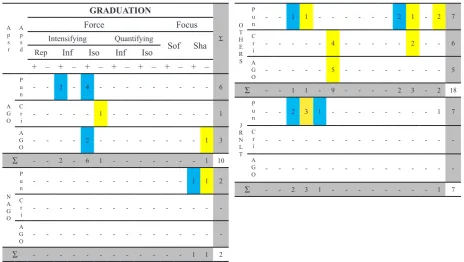
The number of the data belonging to graduation does not match that of attitude as not every attitudinal lingual unit contains or is lanked by elements of graduation. In the table below, there are 21 data of graduation that follow or precede the evaluations againt chemical catration. These negative evaluations are either up- or down-scaled by 14 data of intensifying, 3 data of softening, and 4 data of sharpening. Meanwhile, 15 data of graduation accompany evaluations expressing the agreement to the punishment. These data scale the positive evaluations in the form of 12 intensifyings, 2 softenings, and 1 sharpening. The table of componential analysis (table 2) presents the ditribution of the data.
F
orce: Intensifying: Isolaion
AGO got 5 ‒evaluations with intensifying: isolation attached to them. Such negative evaluations come from OTHERS. For the second time, OTHERS used intensifying: isolation to scale 4 ‒evaluations that fall on Cri. With the similar graduation technique, 1 negative assessment addressed to Cri was given by AGO. Thus, all intensifyings: isolations which accompany negative evaluations amount to 10. To undertand the way intensifying: isolation works, an example is presented below.
more saditic person (TJP/N/J2/gra/for/int/
iso/23)
In the above phrase, more tands as the grade
of evaluation. This belongs to force: intensifying:
More is a lingual unit of graduation that
accompanies an evaluative word saditic. Since
more scales the ‘power’ of saditic, force becomes
the next classiication. Force is then speciied to
be intensifying because the power does not relate
to ‘accuracy’, but ‘trength-weakness’. More does
not merge with attitudinal lexis and, thus, the next
classiication becomes isolation.
F
ocus: Sotening
OTHERS exploited 1 softening as an amplifying technique for a negative appraisal which is addressed to Pun. Another appraised participant
that received softening is Cri. From OTHERS, Cri got 2 ‒assessments accompanied by this type of graduation. Thus, the total number of softening attached to negative evaluations is 3. The example of the invetigation is given as follows.
Chemical catration may lead to saditic
personality: Psychologit (TJP/N/J2/gra/ foc/sof/19)
In the above clause, the contituent that
indicates the scale of evaluation is may while the
A
Rep Inf Iso Inf Iso
+ ‒ + ‒ + ‒ + ‒ + ‒ + ‒ + ‒
Note: Apsr = appraiser; Apsd = appraised; AGO = authoritative governmental oicials; NAGO = non-authoritative governmental oicials; JRNLT = journalits; Pun = punishment; Cri = criminals; Rep = repetition; Inf = infusion; Iso = isolation; Sof = softening; Sha = sharpening; (+) = positive; (‒) = negative
Graduation accompanying evaluations showing disagreement over chemical catration Graduation accompanying evaluations showing agreement to chemical catration
type of that scaling technique is focus: softening.
The lexis of graduation may is classiied into
focus because the grade aimed at the evaluative lexis refers to accuracy. Focus is then speciied to be softening because of its weak accuracy. The weakness is evident from the meaning of that
scaling word may, ‘perhaps’. In connection with
this, something which is appreciated by perhaps
feels ‘vague’ and, therefore, the level of accuracy is low.
F
ocus: Sharpening
Journalits (JRNLT) used 1 sharpening to amplify a ‒appreciation directed at Pun. Pun also received 2 ‒appreciations that are scaled with sharpening by OTHERS and 1 ‒appreciation from NAGO. On the other hand, the appraised AGO was once judged negatively by the appraiser AGO who scaled their judgment with sharpening. So, the total data belonging to sharpening that accompanies negative assessments are 5. Below is the example of the analysis.
Chemical catration ‘would violate human
rights of sex ofenders’ (TJP/N/J1/gra/foc/ sha/1)
From the clause above, it is evident that would
tands as the scaling contituent while the type of
such scaling technique is focus: sharpening.
Would which plays as lexis of graduation
precedes the attitudinal lexis violate. That scaling
word refers to ‘accuracy’ and, therefore, focus becomes the speciication of graduation. Focus
is then speciied to be sharpening since would in
this context means future which, based on English perspective, certainly happens. In other words, the level of accuracy is ‘high’.
The matrix in the componential analysis table above implies that journalits managed to timulate the public to oppose the government. Such a motive has been discovered through the domination of intensifying: isolation over other graduation sub categories (Martin & White, 2005). This provocative action is supposed to uphold democracy. Chronologically, journalits had the right to challenge the government to the public (Applegate, 1996: 114). The challenge was that the
issue of chemical catration only violates human rights of sex ofenders while democracy, as the form of Indonesian government, upholds humanity. This corresponds with what has been implied in
Lincoln’s quote “The government of the people, by
the people, for the people” (as cited in Chapman &
Nuttal, 2011: 15). Unfortunately, not all elements of society fully undertand democracy. However, since humanity is everything to democracy, the notion about chemical catration should have been opposed. The mass media then played its role to voice opposition through amplifying critical evaluations againt the government policy. To up-scale those evaluations, they predominantly exploited graduation: force: intensifying: isolation.
CONCLUSION
This section provides the outlines of what has been discussed. Firt, journalits are not objective in reporting news of chemical catration. Such subjectivity is evident from the exploitation of negative appraisals that defeat the positive ones. Reputedly, the mass media concerned tries to make a big proit from reporting more cons than pros of chemical catration. Firt, journalits present a ‘democratic’ voice, that chemical catration violates the human rights of sex ofenders. This is none other than to h ook the people as news consumers. When the ma s s media have successfully grasped the public, their income rises dramatically.
Secondly, journalits are not tenacious in carrying out the duty to only report the news of chemical catration. Intead, they predominantly highlight the government igures engaged in it. This has been revealed through the discovery of judgment: -capacity that outperforms other attitude elements. This non-tenacious trait is supposed to aim for ‘commercialism’. To wage this motive, the mass media needs to win the hearts of the public by voicing their wishes. To boot the people’s voice, journalits breach ‘objectivity’ as a journalit’s code of ethics through giving more portions to cons by criticizing the government oicials involved in creating regulation for sex ofenders.
up-scaling critical evaluations againt the government policy on sex ofenders. The highet occurrence of intensifying: isolation among other sub categories of graduation is the proof. The reason behind the journalits’ provocation is democracy. Democracy upholds humanity which goes againt the chemical catration. Since it is againt the principle of democracy, the policy needs to be opposed. To ight againt chemical catration, the journalits throw critical appraisals which are ampliied by various reinforcing lexis. With this amplifying lingual unit, negative evaluations could be more efective to provoke the people to go againt the government policy on sex perpetrators.
REFERENCES
Amindoni, A. (2016, May 25). Govt issues perppu on sexual violence againt children. The Jakarta
Pot. Retrieved on 6 June 2016, from http:// www.thejakartapot.com/
Applegate, E. (1996). Print and Broadcat Journalism. Connecticut: Praeger.
Bromley, M. & O’Mallley, T. (1997). Journalism
Reader. London: Routledge.
Chapman, J. L. & Nuttal, N. (2011). Journalism Today: A Themed Hitory. Wet Sussex: Wiley-Blackwell.
Halim, H. & Ramadhani, N. F. (2016, May 26). Catration for rapits of kids. The Jakarta Pot. Retrieved on 6 June 2016, from http://www. thejakartapot.com/
Herbert, J. (2001). Practicing Global Journalism: Exploring Reporting Issues Worldwide. Oxford: Focal Press.
-Horarik, M. M., Sandiford, C., Love, K., & Unsworth, L. (2015). New ways of working ‘with grammar in mind’ in school english: Insights from sytemic functional grammatics. Linguitics
and Education, 31, 145-158.
Maras, S. (2013). Objectivity in Journalism. Cambridge: Polity Press.
Martin, J. R. & White, P. R. R. (2005). The Language of Evaluation: Appraisal in English. New York: Palgrave Macmillan.
Martin, J. R. & Rose, D. (2007). Working with Discourse: Meaning beyond The Clause. London and New York: Continuum.
Moore, J. & Schleppegrell, M. J. (2014). Using a functional linguitics metalanguage to support academic language development in the english language arts. Linguitics and Education, 26, 92-105.
O’Hallaron, C. L., Palincsar, A. S. & Schleppegrell, M. J. (2015). Reading science: Using sytemic functional linguitics to support critical language awareness. Linguitics and Education, 32, 55-67.
Santosa, R. (2003). Semiotika Sosial. Surabaya: Putaka Eureka dan JP Press.
Santosa, R. (2014). Metode Penelitian Kualitatif Kebahasaan. Surakarta: UNS Press. Santosa, R., Priyanto, A. D., Nuraeni, A. & Dzakiria, H.
(2016). The language of mass treet protets in indonesia. Advanced Science Letters, 22(12), 4393-4396.
Santosa, R., Priyanto, A. D. & Nuraeni, A. (2014). Genre and regiter of antagonit’s language in media: An appraisal tudy of indonesian newspapers. Kata: The Study of Language and Literature, 16, 23-36.
Spradley, J. P. (1980). Participant Observation. New York: Holt, Rinehart and Winton Inc. Sundaryani, F S. (2015, October 31). Chemical
catration ‘would violate human rights of sex ofenders’. The Jakarta Pot. Retrieved on 6 June 2016, from http://www.thejakartapot. com/
Team, T. J. P. (2015, October 21). Miniter supports catration for child sex ofenders. The Jakarta Pot. Retrieved on 6 June 2016, from http:// www.thejakartapot.com/
Team, T. J. P. (2015, December 19). Chemical catration may lead to saditic personality: Psychologit.
The Jakarta Pot. Retrieved on 6 June 2016, from http://www.thejakartapot.com/
Yasuda, S. (2014). Exploring changes in l writers’ meaning-making choices in summary writing: A sytemic functional approach. Journal of Second Language Writing, 27, 105-121. Yosephine, L. (2016, May 24). Proposed chemical