SANTIKA PURWITANINGSIH
3613100008
JURUSAN PERENCANAAN WILAYAH DAN KOTA
FAKULTAS TEKNIK SIPIL DAN PERENCANAAN
INSTITUT TEKNOLOGI SEPULUH NOPEMBER
2015
CRITICAL REVIEW
THE CAPACITIES OR INSTITUTIONS FOR THE
INTEGRATION OF ECOSYSTEM SERVICES IN COASTAL
STRATEGIC PLANNING: THE CASE OF JIAOZHOU BAY
KATA PENGANTAR
Puji syukur kehadirat Tuhan Yang Maha Esa atas segala limpahan rahmat, taufiq, serta
hidayah-Nya sehingga kami dapat menyelesaikan makalah tugas mata kuliah Perencanaan
Pesisir (RP14-1322
) yang berjudul “
Critical Review Jurnal: The Capacities of Institution
for the Integration of Ecosystem Services in Coastal Strategic Planning: The Case
of Jiaozhou Bay
” dengan lancar.
Selama proses penulisan makalah ini, kami banyak mendapatkan bantuan dari
pihak-pihak lain sehingga makalah ini dapat terselesaikan dengan optimal, sehingga pada
kesempatan ini, penulis ingin menyampaikan rasa terima kasih kepada semua pihak yang
telah membantu dalam penyelesaian makalah ini, yaitu :
1.
Bapak Adjie Pamungkas, ST. M.Dev.Plg, Ph.D dan Ibu Ema Umilia, ST. MT. selaku dosen
mata kuliah Perencanaan Pesisir.
2.
Orang tua dan keluarga yang selalu memberikan motivasi.
3.
Rekan-rekan di jurusan Perencanaan Wilayah dan Kota ITS yang memberikan motivasi
dan bantuan demi kelancaran pembuatan makalah ini.
Kami berharap, semoga makalah ini dapat bermanfaat terutama dalam menambah
wawasan tentang analisis lokasi dan keruangan. Tak ada gading yang tak retak, kami
menyadari bahwa makalah ini masih
jauh dari kata sempurna, oleh karena itu, kritik dan
saran yang bersifat membangun sangat kami harapkan.
Surabaya, 10 November 2015
CRITICAL REVIEW
ii
IDENTITAS JURNAL
a.
Judul Penelitian
:
The Capacities of Institution for The Integration of Ecosystem
Services in Coastal Strategic Planning: The Case of Jiaozhou
Bay
b.
Penulis
:
i.
Ruiqian Li
ii.
Yongfu Li
iii.
Margo van den Brink
iv.
Johan Woltjer
c.
Nama Jurnal
:
Ocean & Coastal Management
Kapasitas Lembaga dalam Pengintegrasian Jasa Ekosistem dalam Perencanaan
Pesisir Strategis (Studi Kasus: Teluk Jiaozhou, Tiongkok)
SUMMARY
Dewasa ini, konsep jasa ekosistem telah menjadi isu utama dalam manajemen dan
perencanaan lingkungan di semua tingkat pengambilan keputusan (De Groot, dkk, 2010). Jasa
ekosistem merupakan semua keuntungan yang diperoleh manusia dari ekosistem (MA, 2005).
Lembaga, insentif dan mekanisme pengaturan mempengaruhi penggunaan jasa ekosistem
dan efektif dalam memelihara dan mengelola penyediaan jasa ekosistem, sehingga
berkontribusi terhadap keberlanjutan jangka panjang dari keputusan manajemen. Makalah ini
menjelaskan bagaimana praktek integrasi antara pemikiran tentang jasa ekosistem (manfaat
lingkungan bagi manusia) dengan lembaga (organisasi, aturan kebijakan) sangat penting bagi
perencanaan tata ruang pesisir.
Tujuan dari penelitian ini adalah untuk mengidentifikasi sejauh mana jasa ekosistem
pesisir telah terintegrasi dalam perencanaan pesisir strategis, serta untuk mengetahui
kekuatan dan kelemahan kelembagaan yang mungkin ada dalam penggunaan jasa ekosistem.
Kedua pertanyaan ini dijawab menggunakan aplikasi konten analisis dan kerangka analisis
multi level terhadap lembaga formal, dan empat rencana tata ruang strategis Teluk Jiaozhou
sebagai bahan analisa, antara lain
‘Conservation and Development around Jiaozhou Bay’
Strategy of Qingdao, The Development Plan of Shandong Peninsula Blue Economic Zone, The
Twelfth Five-year National Economic and Social Development Plans of Qingdao,
dan
The
Overall Urban Plan of Qingdao (2011-2020).
Hasil penelitian menunjukkan bahwa beberapa jasa ekosistem telah diakui secara
implisit, meskipun tidak secara keseluruhan. Hal ini disebabkan oleh kelemahan kelembagaan
dalam rencana strategis Teluk Jiaozhou, seperti kecenderungan orientasi terhadap pasar,
struktur kelembagaan yang terpisah-pisah dalam mengelola jasa ekosistem, penilaian jasa
ekosistem yang terbatas, serta kurangnya refleksi yang terintegrasi dari nilai sosial suatu jasa
ekosistem dalam pengambilan keputusan.
PEMBAHASAN
Keterlibatan Jasa Ekosistem dalam Rencana Strategis Teluk Jiaozhou
CRITICAL REVIEW
2
kebijakan yang tidak tepat, rendahnya penegakan hukum
(law enforcement)
, dan rendahnya
kemampuan sumberdaya manusia (SDM).
Permasalahan di pesisir di atas bila dikaji lebih lanjut memiliki akar permasalahan yang
mendasar. Menurut Dahuri (2003) ada lima faktor, yaitu pertama tingkat kepadatan penduduk
yang tinggi dan kemiskinan, kedua konsumsi berlebihan dan penyebaran sumberdaya yang
tidak merata, ketiga kelembagaan,
keempat, kurangnya pemahaman tentang
ekosistem alam, dan kelima kegagalan sistem ekonomi dan kebijakan dalam menilai
ekosistem alam.
Berdasarkan standar sistem klasifikasi Jasa Ekosistem yang diterbitkan oleh
Millenium
Ecosystem Assessment
pada tahun 2005, Jasa Ekosistem dibagi menjadi 4 kategori, yaitu
penyediaan (produk dari sebuah ekosistem), pengaturan (keuntungan yang didapatkan dari
peraturan proses ekosistem), budaya (persediaan kesempatan terhadap keuntungan
nonmaterial dan pengembangan kognitif), serta jasa pendukung lainnya (layanan yang
diperlukan untuk keberlangsungan dari ketiga kategori ESs di atas). Klasifikasi secara detil
dapat dilihat dalam Tabel 1 pada Lampiran.
Berdasarkan analisis konten yang telah dilakukan terhadap empat rencana strategis
Teluk Jiaozhou diperoleh fakta bahwa dari keempat kategori yang telah disebutkan di atas,
jasa penyediaan
(provisioning)
merupakan yang paling banyak disebutkan, terutama dalam
hal ruang pesisir untuk industri dan infrastruktur, kemudian diikuti oleh jasa budaya,
pendukung, dan pengaturan. Hanya tiga pelayanan spesifik yang disebutkan secara eksplisit
dari jasa pengaturan, yaitu peraturan banjir, peraturan iklim (penyerapan karbon melalui
pertukaran fungsi alga dan kerang), dan pemurnian serta pengolahan air (melalui lahan basah
buatan). Padahal, jasa pengaturan yang memiliki fungsi pemeliharaan dan peningkatan, dapat
diasosiasikan dengan kapasitas sistem sosio-lingkungan untuk mengatasi atau beradaptasi
dengan gangguan dari beberapa hal yang bisa mempercepat perubahan manusia dan
lingkungan (Carpenter, dkk, 2006, Bennett, dkk, 2009). Dalam rencana strategis pesisir,
program dan rencana dalam bidang jasa pengaturan diperlukan untuk meningkatkan
kemampuan keberlanjutan sistem sosio-lingkungan dalam menghadapi gangguan. Tingkatan
perhatian terhadap jasa ekosistem tersebut dipengaruhi oleh lembaga formal yang
menaunginya.
Kelebihan dan Kelemahan Kelembagaan dalam Perencanaan Strategis di Teluk
Jiaozhou Terkait dengan Jasa Ekosistem
peningkatan dan optimalisasi struktur ekonomi kelautan dikarenakan tujuan politik untuk
mencapai pengembangan yang berkelanjutan dan menjawab perubahan iklim. Selain itu,
sudah ada inisiatif yang kuat untuk melindungi lingkungan kelautan di kawasan Teluk Jiaozhou
(berupa perlindungan lahan basah dan keanekaragaman hayati), yang secara langsung
menambah jaa pendukung dan dengan demikian juga membantu kelangsungan dari jasa yang
lain.
Namun, terdapat kecenderungan inisiatif yang dominan terhadap keuntungan ekonomi,
dalam hal ini dikaitkan dengan jasa penyediaan dari tingkat kelembagaan makro hingga mikro.
Nilai pasar yang nyata dan tidak langsung dapat memenuhi tuntutan pemerintahan yang
utama. Sedangkan jasa ekosistem yang lain tidak mampu untuk memperoleh perhatian yang
sama seperti jasa penyediaan. Pertimbangan rasional dan penggunaan jasa pengaturan yang
disediakan oleh ekosistem telah diabaikan. Hal ini menunjukkan bahwa rencana strategis di
Teluk Jiaozhou belum mencakup keseluruhan jasa ekosistem. Selain itu ada struktur
kelembagaan yang terpisah-pisah dalam manajemen jasa ekosistem pesisir serta tidak
terdapat koordinasi mekanisme yang efektif dan terpadu dalam rencana strategis Teluk
Jiaozhou sehingga terdapat kesulitan dalam berbagi informasi, mengumpulkan pendapat serta
mengklarifikasi yuridiksi antar departemen dan sub bagian yang terus menerus mengejar
kepentingan individu dari jasa ekosistem. Selanjutnya dalam analisis tingkat mikro diketahui
terdapat kapabilitas teknologi dan tenaga ahli yang terbatas dalam penilaian jasa ekosistem
sehingga mengakibatkan metode penilaian yang saat ini terdapat dalam hukum dan peraturan
kurang wawasan tentang nilai sesungguhnya dari jasa ekosistem. Kelemahan ini juga
disebabkan oleh kurangnya integrasi nilai sosial jasa ekosistem dalam proses pengambilan
keputusan. Kerangka kelembagaan saat ini tidak mengakomodir penduduk lokal untuk
berpartisipasi dalam proses perencanaan dan pengambilan keputusan secara keseluruhan.
Pelaksanaan Integrasi Jasa Ekosistem dalam Perencanaan Pesisir di Indonesia dan
Negara Lain
CRITICAL REVIEW
4
Sebagai contoh langsung adalah program jasa lingkungan di DAS Brantas Hulu di Jawa
Timur. DAS Brantas telah mendapat status kritis diakibatkan oleh kecenderungan penggunaan
jasa penyediaan dengan mengesampingkan jasa pengaturan sejak tahun 1989, namun upaya
penanggulangannya terkotak-kotak di antara lembaga publik dan swasta. Beberapa isu
tentang pengelolaan hulu DAS adalah lembaga-lembaga masih menerapkan pendekatan
‘
top-down
’
walaupun sudah mulai menggunakan pendekatan partisipatif, hanya sedikit kebijakan
lembaga pemerintah yang didasarkan pada data kuantitatif, dan dokumentasi pengetahuan
dan metode pengolahan lahan masih lemah, masih kuatnya pendekatan sektoral dalam
pengelolaan lahan dan masih lemahnya koordinasi dan keterpaduan di antara para pemangku
kepentingan, upaya proyek pada tingkat masyarakat masih berlandaskan pendekatan sektoral
dan kurang memperhatikan dampak pada fungsi DAS, penegakan hukum yang lemah,
meningkatnya kemiskinan setelah krisis ekonomi, kurangnya kesadaran masyarakat lokal
tentang degradasi lingkungan, serta tidak adanya upaya penyebaran informasi/sosialisasi
secara partisipatif.
Sama halnya dengan implikasi kelembagaan dalam penelitian yang dibahas, implikasi
kelembagaan formal internasional lainnya juga berfokus pada ekosistem yang beragam di
bawah konteks kelembagaan yang berbeda. Untuk detilnya dapat dilihat dalam
Tabel 2 di
Lampiran.
REKOMENDASI
Jalan keluar yang dipandang efektif untuk mengatasi kelemahan kelembagaan di atas
sekaligus sebagai upaya untuk menjamin keberlanjutan pembangunan di masa mendatang
adalah mengintegrasikan kepentingan lingkungan pada tingkatan pengambilan keputusan
yang strategis melalui aplikasi Kajian Lingkungan Hidup Strategis.
antar daerah, dsb.), keseimbangan (menekankan aplikasi keseimbangan antar aspek,
kepentingan, maupun interaksi antara makhluk hidup dan ruang hidupnya), dan keadilan.
Atas dasar kaidah-kaidah di atas, maka penerapan KLHS dalam penataan ruang dapat
menjawab permasalahan-permasalahan seperti yang telah disebutkan di atas.
DAFTAR PUSTAKA
Anonim,
2012.
KLHS
dalam
Perencanaan
Tata
Ruang.
http://blh.pekanbaru.go.id/index.php/laboratorium-udara/35-klhs-dalam-perencanaan-tata-ruang
. Diakses pada tanggal 10 November 2015.
Harahap, R. Hamdani, 2015.
Pengelolaan Wilayah Pesisir Berbasis Masyarakat Yang
Berkelanjutan
. Medan: Universitas Sumatera Utara.
Wienarto, Nugroho, dkk, _____.
Mengintegrasikan Jasa Ekosistem dalam Perencanaan Tata
Ruang
.
Republik Indonesia, 2007.
Undang-Undang Penataan Ruang
. Jakarta: Sekretariat Negara.
Republik Indonesia, 2007.
Undang-Undang Pengelolaan Wilayah Pesisir dan Pulau-Pulau Kecil.
CRITICAL REVIEW
6
LAMPIRAN
Tabel 1. Jasa Ekosistem Pesisir yang Berhubungan dengan Perencanaan Tata Ruang Pesisir
Kategori
Jasa Pesisir dan Contohnya
Penyediaan
Ikan dan hasil laut lainnya
Produksi energi
Penggunakan biokimia dan farmasi
Transportasi dan navigasi
Ruang pesisir untuk pengembangan industri dan
infrastruktur
Penyediaan air untuk permukiman dan industri
Pengaturan
Penanggulangan banjir, badai, tsunami, dan topan
Intrusi air laut
Blooming alga
Erosi dan pengendalian pendangkalan
Pemurnian air
Pengaturan iklim
Budaya
Pariwisata dan rekreasi
Nilai kognitif
Estetika
Cagar budaya dan identitas
Pendukung
Pemeliharaan keanekaragaman hayati
Pemeliharaan habitat
Keasrian ekosistem
Struktur tanah
Sumber: MA, 2005, Beaurmont, dkk, 2007, Ronnback, dkk, 2007, Osterblom, dkk, 2010, dan Atkins, dkk, 2011
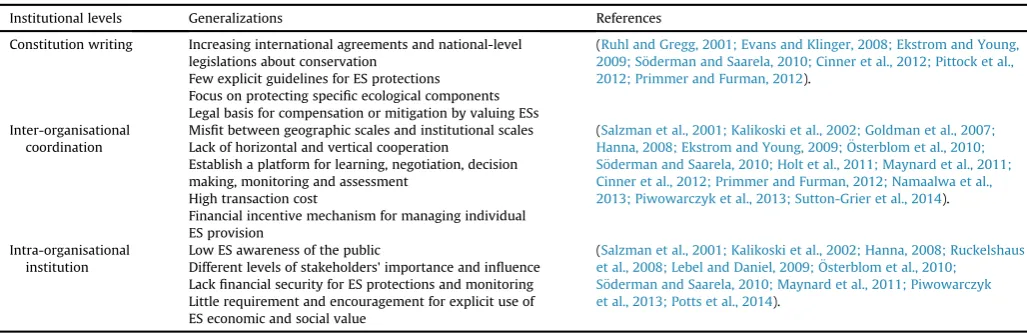
Tabel 2. Generalisasi Kasus Internasional terhadap Integrasi Jasa Ekosistem
Level Lembaga
Generalisasi
Referensi
Penulisan konstitusi
Meningkatkan persetujuan tingkat
internasional dan nasional mengenai
konservasi
Fokus
melindungi
komponen
lingkungan tertentu
Dasar legal untuk kompensasi dan
mitigasi
dengan
menilai
jasa
ekosistem
Ruhl dan Gregg, 2001;
Evans dan Klinger, 2008;
Ekstrom dan Young, 2009;
Soderman
dan
Saarela,
2010; Cinner, dkk, 2012;
Pittock, dkk, 2012; Primmer
dan Furman, 2012.
Koordinasi organisasi
internal
Ketidaksinkronan
antara
skala
geografis dengan skala kelembagaan
Lemahnya koordinasi secara vertikal
dan horizontal
Biaya transaksi yang mahal
Mekanisme insentif finansial untuk
penyediaan jasa ekosistem secara
individu
Salzman,
dkk,
2001;
Kalikoski,
dkk,
2002;
Goldman, dkk, 2007; Hanna,
2008; Ekstrom dan Young,
2009;
Osterblom,
dkk,
2010;
Soderman
dan
Saarela, 2010; Holt, dkk,
2011; Maynard, dkk, 2011;
Cinner, dkk, 2012; Primmer
dan
Furman,
2012;
Namaalwa,
dkk,
2013;
Piwowarczyk, dkk, 2013;
Sutton-Grier, dkk, 2014.
Koordinasi
antar
lembaga
Rendahnya kesadaran tentang jasa
ekosistem
Perbedaan tingkatan kepentingandan
pengaruh antar stakeholder
Rendahnya keamanan finansial untuk
perlindungan dan pengawasan jasa
ekosistem
Sedikitnya
penggunaan
secara
eksplisit atas jasa ekosistem dan nilai
sosial
2010;
Soderman
dan
Saarela, 2010; Maynard,
dkk, 2011; Piwowarczyk,
dkk, 2013; Potts, dkk, 2014.
The capacities of institutions for the integration of ecosystem services
in coastal strategic planning: The case of Jiaozhou Bay
Ruiqian Li
a,*, Yongfu Li
b, Margo van den Brink
a, Johan Woltjer
aaDepartment of Spatial Planning&Environment, Faculty of Spatial Sciences, University of Groningen, 9700AV Groningen, The Netherlands bResearch and Development Center of Marine Biotechnology, Institute of Oceanology, Chinese Academy of Sciences, 266071 Qingdao, China
a r t i c l e
i n f o
Article history: Received 9 January 2014 Received in revised form 5 December 2014 Accepted 6 February 2015 Available online 10 February 2015
Keywords: Ecosystem services Coastal strategic planning Institution
Capacity Jiaozhou Bay
a b s t r a c t
This paper explains how the practice of integrating ecosystem-service thinking (i.e., ecological benefits for human beings) and institutions (i.e., organisations, policy rules) is essential for coastal spatial plan-ning. Adopting an integrated perspective on ecosystem services (ESs) both helps understand a wide range of possible services and, at the same time, attune institution to local resource patterns. The objective of this paper is to identify the extent to which ESs are integrated in a specific coastal strategic planning case. A subsequent objective is to understand whether institutions are capable of managing ESs in terms of uncovering institutional strengths and weaknesses that may exist in taking ESs into account in existing institutional practices. These two questions are addressed through the application of a content analysis method and a multi-level analysis framework on formal institutions. Jiaozhou Bay in China is used as an illustrative case. The results show that some ESs have been implicitly acknowledged, but by no means the whole range. This partial ES implementation could result from any of four institutional weaknesses in the strategic plans of Jiaozhou Bay, namely a dominant market oriented interest, frag-mented institutional structures for managing ESs, limited ES assessment, and a lack of integrated reflection of the social value of ESs in decision-making. Finally, generalizations of multi-level institutional settings on ES integration, such as an inter-organisational fragmentation and a limited use of ES assessment in operation, are made together with other international case studies. Meanwhile, the comparison highlights the influences of extensive market-oriented incentives and governments' exclu-sive responsibilities on ES governance in the Chinese context.
©2015 Elsevier Ltd. All rights reserved.
1. Introduction
Recently, the concept of Ecosystem Services (ESs) has become a major issue in environmental planning and management at all decision-making levels (De Groot et al., 2010). It is broadly described as the‘contributions of ecosystems to human well-being’
(De Groot et al., 2010). ESs capture the interdependent relation-ships between human wellbeing and the services that ecosystems supply. By making ESs explicit e that is, by identifying and
assessing ESs and their relationships at various temporal and spatial scaleseit is possible to provide an evaluation of various
decisions about the future supply of the whole range of ESs (Hancock, 2010).
Until now, scholars in thisfield have increasingly focused on analysing institutions for integrating ESs in policies and plans. In-stitutions, incentives and regulatory mechanisms affect the use of ESs and can be effective in preserving and managing the supply of ESs, thus contributing to the long-term sustainability of manage-ment decisions (Hancock, 2010). Institutions are ‘enduring regu-larities of human action in situations structured by rules, norms, and shared strategies, as well as by the physical world’(Crawford and Ostrom, 1995). Consequently, institutional design refers to devising and realizing rules, procedures and organisational struc-tures to enable and constrain behaviour and action so as to preserve values, achieve desired objectives or execute certain tasks (Alexander, 2006).
There are two main objectives of the research that focus on analysing institutions for integrating ESs. The first objective has been to assess or support policy and decision making with regards to ESs through, for instance, the economic valuation of ESs, social value assessment, trade-off analysis, and mapping and modelling.
*Corresponding author. Department of Spatial Planning and Environment, Uni-versity of Groningen, P.O. Box 800, 9700AV Groningen, The Netherlands.
E-mail address:[email protected](R. Li).
Contents lists available atScienceDirect
Ocean & Coastal Management
j o u r n a l h o m e p a g e : w w w . e l s e v i e r . c o m / l o c a t e / o c e c o a m a n
http://dx.doi.org/10.1016/j.ocecoaman.2015.02.001
0964-5691/©2015 Elsevier Ltd. All rights reserved.
improving coastal institutions (e.g. Kumar, 2010; Barbier et al., 2011; Pike et al., 2011; Haines-Young et al., 2012; Onaindia et al., 2013; Lopes and Videira, 2013). The second objective has been to examine and understand how specific institutions are related to certain ESs. For example, Namaalwa et at. (2013) analysed the institutional context for management of Namatala wetland to examine drivers of ES changes. Primmer and Furman (2012)
reviewed three operational governance settings, i.e. consecration of forest biodiversity, urban land use planning and natural resource strategies, finding mismatch between governance needs and ES approaches. Historical analysis of urban strategic plans in Mel-bourne and Stockholm was conducted byWilkinson et al. (2013), revealing a variable and inconsistent attention to urban ES over time. EU policies in thefields of agriculture, forestry, environmental policy, water and regional development were also assessed, uncovering that many ESs were often negatively affected by pol-icies (Hauck et al., 2013). With regards to coastal ESs, the existing studies mainly focus on more comprehensive institutional analyses on, for instance, integrated coastal zone management (ICZM) or ecosystem-based management (EBM) (e.g.Cao and Wong, 2007; Carollo and Reed, 2010; Katsanevakis et al., 2011; Deboudt, 2012; Wu et al., 2012; Carcamo et al., 2013; Valman, 2013). Only occa-sionally do these studies identify and assess coastal ESs clearly. Besides, only a few studies have attempted to examine what and how coastal ESs may be included in planning and management, for instance, analyses of Polish coastal municipal strategic plans (Piwowarczyk et al., 2013), English coastal wetlands management (Holt et al., 2011) andfinancial mechanism design for ESs in coastal and marine settings (Lau, 2013). Nevertheless, they tend either to illustrate an identification of some certain coastal ESs, or these studies are only limited to partial institutional restrictions on ES implementation, rather than assuming a broader institutional design context.
Therefore, the objective of this paper is to identify the extent to which a range of coastal ESs are integrated in coastal strategic planning, and to detect what institutional strengths and weak-nesses there could be for ESs use according to a multi-level framework for institutional design analysis as developed by
Alexander (2005, 2012). Our purpose is primarily to improve our grounded knowledge of the current institutional capacity of facil-itating ES governance, which can been seen as an initial and essential step for designing institutions, not to stress how to develop institutions for identified causal effects by a complete assessment of formal institutional design. This Alexander's frame-work facilitates a comprehensive analysis of rules, process and organisational structures, which could be important implications for ES governance. Within this broad institutional framework, this study focuses on one particular institution, namely coastal strategic planning. Strategic planning is distinguished by its typical charac-teristics and its position within the institutional network, e.g., the focus on longer-term goals, the importance of contextual reflection and its comprehensive guiding function for sectoral plans and or-ganisations. These factors imply that strategic planning is unable to ignore the essential planning function of natural resources and ecosystem services, which are suffering from both natural and anthropogenic pressures. Strategic planning could require the in-clusion of an ES perspective to make motivating the institutional framework more sustainable.
The central argument of this paper is that it is essential to integrate perspectives from both ecosystem-service thinking and institutions for effective coastal strategic planning. Identifying ESs
opportunities for evolving institutions to be more effective in implementing ES concept and methods.
The structure of this paper is as follows. First, we introduce the central case and the related coastal strategic plans. This paper uses Jiaozhou Bay in China as an example. There are two main consid-erations underpinning this case selection. One is the long-term role played by this bay in providing rich ESs to urban/regional planning and development (Zhao et al., 2005; Ge and Zhang, 2011), which implies a potential advantage when identifying multiple ESs in strategic planning. The other consideration is that the case has relatively comprehensive institutional arrangements in place (Li, 2006; Wu et al., 2012), which facilitates its role as an illustrative case, and potentially offers generic insight into the policy imple-mentation for different ESs. Following that, we explain the two methods adopted to operationalize the two perspectives of ecosystem-service thinking and institutions. First, a content anal-ysis method was applied to identify the extent to which ESs are integrated in the coastal strategic plans for Jiaozhou Bay. Second, the multi-level framework of institutional design analysis as developed byAlexander (2005, 2012)was employed to analyse the three levels (the macro, meso and micro) of institutions for the strategic plans concerning to Jiaozhou Bay. After explaining the results, we discuss the capacity of existing formal institutions to manage ESs in Jiaozhou Bay. Finally, we provide general institu-tional implications for ES governance from this research together with other international case studies.
2. Methods
2.1. Study area
Jiaozhou Bay is a semi-enclosed shallow-water body situated on the southern coast of the Shandong Peninsula in East China (Fig. 1), surrounded by Qingdao City (7 districts and 5 county-level cities along the Bay with a population of 8.71 million) in Shandong province. In 2012, the Bay covered an area of 343.5 km2and had 206.8 km of coastline. Jiaozhou Bay is a typical case in China, as it strongly supports urban development through a wide variety of ESs (e.g. tourism,fisheries, transportation and agriculture:Zhao et al., 2005). Meanwhile, its ecosystem has been altered by climate change, storm surges, seaweed blooms, flooding and various anthropogenic pressures, in particular as a consequence of land reclamation, causing irreversible damage to some ESs (Ge and Zhang, 2011). In this area, strategic planning involves an essential institutional effort to address these problems with regards to managing behaviours or actions of organisations, agencies, groups and individuals in certain geographical areas. The municipal gov-ernment, provincial government and some national ministries take the main responsibility for developing strategic plans (seeTable 1). A particular sector is assigned as a coordinating body to implement planning process. Other government sectors whose authorities may be related to any coastal issue (e.g. the Forestry Bureau, Ocean and Fisheries Bureau and Environmental Bureau) will be typically involved in consultation andfinal agreement in terms of meetings or official letters. An expert advisory committee is established to provide professional support for assessing feasibility and impact. After the plan draft is formed, it is submitted for public comment. Finally, the State Council, provisional or municipal government have the right of approval for these plans.
ecological and garden-like metropolitan area around the Bay. It is an important urban space development strategy which integrates ecological protection and industrial development. Based on this plan, Qingdao was adopted in a national sustainable development strategyeThe Development Plan of Shandong Peninsula Blue
Eco-nomic Zone(Plan 2). This plan is the first regional development strategy with a marine economy theme in China. Optimizing the landscape of land and sea, establishing a modern marine industrial system and strengthening the marine ecological civilization within Shandong Peninsula are a few examples of where coastal resources are benefited from. Furthermore, policymakers and planners from
Qingdao have also tended to emphasise the critical role of Jiaozhou Bay in supporting the municipal economy and guaranteeing citi-zens' wellbeing. Consequently, two statutory urban strategic plans,
The Twelfth Five-year National Economic and Social Development Plans of Qingdao (Plan 3) andThe Overall Urban Plan of Qingdao (2011e2020)(Plan 4), are used to reflect this perspective.
Together, these four strategic plans present the close ties be-tween regional/local development and the coastal ESs of Jiaozhou Bay. They also represent the powerful influence that coastal insti-tutional networks have over whether the ES concept will be considered. Moreover, to gain a broader view of institutional
Fig. 1.Jiaozhou Bay, Qingdao and Shandong Province.
(Source: The map of Shandong province was adopted fromWu et al. (2012).
context and insights into the practice of these strategic plans, we also investigated a number of policies, legislations, regulations, and government reports pertaining to this bay and the four plans. These formal institutions, remaining dominant in this area, are critical for affecting and structuring ES utilization, which have been strikingly demonstrated through the strategic plans. In particular, institutions with a direct interest in or control over natural resources (e.g. wetlands habitat conservation), markets (e.g. aquaculture and oil) or nonmarket values of affected populations (e.g. recreation and education) are involved in these four plans, thereby stimulating, permitting, limiting and prohibiting certain activities of using coastal ESs. Rewards and sanctions (e.g. tax preferences for over-seasfishery and marine energy, a sea use fee, and an ecological compensation fee) related to coastal actions are also addressed in these strategic plans. These documents provide available and valuable information on ES governance. We therefore assumed that analysis on formal institutions, particularly these strategic plans, could serve as a way to inform a study of how ESs are included, what existing institutional practices seem helpful or harmful for promoting ES integration.
2.2. Content analysis
To identify the extent to which ESs are integrated into the coastal strategic plans for Jiaozhou Bay, a content analysis method accompanied by text interpretation was employed. This method
ecosystem characteristics and the context in which ES information should be identified. The analysis is based on an interpretation of narratives related to coastal goods and services as they emerge from the strategic plans.
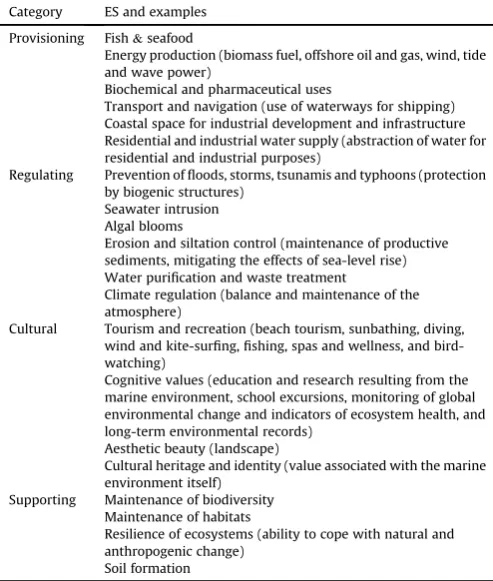
A coding system is essential to grouping and analysing texts relevant to ESs. First, to establish a coding system, we applied the standard ESs classification system published by the Millennium Ecosystem Assessment (MA, 2005). It contains four categories: provisioning (products obtained from ecosystems), regulating (benefits obtained from regulation of ecosystem process), cultural (providing opportunities for non-material benefits and cognitive development) and supporting services (services that are necessary for the proper delivery of the above three ES groups). Given the particular services provided by coastal ecosystems based on the above four main categories, a detailed classification (Table 2) was prepared based on previous research prior to the examination of these plans. This classification exercise provided a wide range of coastal and marine ES concepts and examples (e.g.Beaumont et al., 2007; R€onnb€ack et al., 2007;Osterblom et al., 2010; Atkins et al.,€
2011). The meaning of these concepts for coastal ESs is based on definitions and examples according to the scientific literature collected. The overall classification includes criteria for interpreting and validating data. The classification also served as a coding sys-tem to facilitate the consistency of the document analyses overall. Subsequently, the four selected coastal strategic plans were opened one by one and examined sentence by sentence to identify
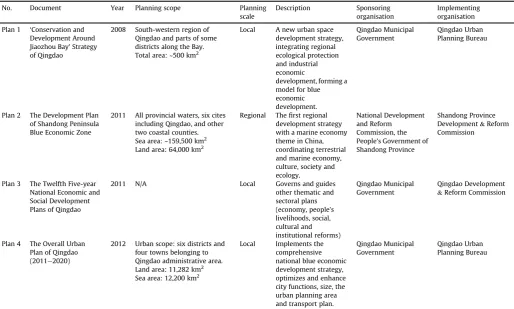
Summary of four strategic plans related to Jiaozhou Bay.
No. Document Year Planning scope Planning scale
Description Sponsoring organisation
Implementing organisation
Plan 1 ‘Conservation and Development Around Jiaozhou Bay’Strategy of Qingdao
2008 South-western region of Qingdao and parts of some districts along the Bay. Total area: ~500 km2
Local A new urban space development strategy, integrating regional ecological protection and industrial economic
development, forming a model for blue economic development. Qingdao Municipal Government Qingdao Urban Planning Bureau
Plan 2 The Development Plan of Shandong Peninsula Blue Economic Zone
2011 All provincial waters, six cites including Qingdao, and other two coastal counties. Sea area: ~159,500 km2 Land area: 64,000 km2
Regional Thefirst regional development strategy with a marine economy theme in China, coordinating terrestrial and marine economy, culture, society and ecology.
National Development and Reform Commission, the People's Government of Shandong Province
Shandong Province Development&Reform Commission
Plan 3 The Twelfth Five-year National Economic and Social Development Plans of Qingdao
2011 N/A Local Governs and guides other thematic and sectoral plans (economy, people's livelihoods, social, cultural and institutional reforms) Qingdao Municipal Government Qingdao Development
&Reform Commission
Plan 4 The Overall Urban Plan of Qingdao (2011e2020)
2012 Urban scope: six districts and four towns belonging to Qingdao administrative area. Land area: 11,282 km2 Sea area: 12,200 km2
Local Implements the comprehensive national blue economic development strategy, optimizes and enhance city functions, size, the urban planning area and transport plan.
Qingdao Municipal Government
Qingdao Urban Planning Bureau
type of ES was referred to in a way that is linking to the meaning of an ES concept or containing any examples in the coding system (Table 2), it was marked and counted. Accordingly, key references could be summed up in a table. Meanwhile, the frequency of the interpreted and marked ESs would be calculated in another table. This table with the references stated above enabled a clear under-standing of differing extents to which each ES was integrated. Finally, two rounds of document checking were performed before we summarized and drew a figure to show total frequencies in terms of four ES categories in the Jiaozhou Bay coastal strategic documents.
2.3. A multi-level analysis framework
For our purpose of understanding how the existing formal in-stitutions are capable of managing the four categories of ESs as an initial step towards institutional design, we adopted the multi-level framework of institutional design as developed by Alexander (2005, 2012)to guide our analysis, thereby explaining results (i.e. different degrees to which each ES is included in the content analysis of strategic planning documents).Alexander (2005, 2012)
clarified that there are three‘levels’associated with institutional design: constitution writing (the macro-level), inter-organisational coordination (the meso-level) and intra-organisational institution (the micro-level). Each level has different emphases on intuitions. At the highest level, significant macro-societal processes and in-stitutions that may affect the whole societies are the main target for institutional design. Moreover, national and supra-national con-stitutions, legal codes and processes as well as innovative and wide-ranging strategic political-administrative programmes also occur at this level. The meso-level concerns planning and
implementation structures and processes. This includes establish-ing and operatestablish-ing inter-organisational networks, createstablish-ing new or-ganisations and transforming existing ones. The meso-level also includes laws, regulations and resources to develop and implement policies, programmes, projects and plans, through which incentives and constraints may be devised and deployed. The lowest level involves intra-organisations, addressing organisational sub-units and small semi-formal or informal social units, processes and in-teractions, such as committees, teams, task forces and work groups. Of this framework, the meso-level is associated most strongly with the planners' field of practice (Alexander, 2005). Coastal strategic planning, which can be conceptualized as a specific type of institution, also belongs to this level. This specific institution is the main subject we analysed. To examine the institutional implica-tions for integrating ESs in coastal strategic plans, it is important to understand what current “rules, procedures and organisational structures”(Alexander, 2006) are for managing coastal behaviours or actions from three levels rather than focussing solely on the meso-level. Some agencies, legislative acts and regulations appeared in all four Jiaozhou Bay plans, which demonstrate attention and effort being accorded to coastal institutional practices by those in government and policymakers, albeit generally. The layered analysis framework of institution design here also included a focus on understanding contextual institutions (for coastal stra-tegic planning), similar to established methods of institutional analysis (e.g.North, 1990; Crawford and Ostrom, 1995; Williamson, 2000; Hogan et al., 2011; Ostrom, 2011). During the analysis we found that the explicit emphasis in Alexander's framework on a coordination at the meso-level, particularly concerning planning and its nested institutions that are required to be carefully designed provided a better way for framing and interpreting the Jiaozhou Bay data to ascertain its institutional capacity. To have a more adequate understanding of institutions, we added to this framework some key elements like positon, boundary, aggregation and choices, particularly with regards to rules, mainly from Ostrom's institu-tional analysis methods (Ostrom, 2011). These additions are important because they, for instance, specify who is involved, what their roles are, and who decides for coastal strategic planning. Scientific articles, legal documents, annual reports, newspapers and websites were examined to gain an overview of the institutional context (e.g.SOA, 2001; Lau, 2005; SOFD, 2012; QOFB, 2012; Wu et al., 2012). The results of this contextual analysis for institu-tional practice are presented in Section3.2. Finally, our institutional analysis was confirmed by emailing or telephoning the five key government departments which had been involved in these four Jiaozhou Bay strategic plans.
3. Results
3.1. ES inclusion in the Jiaozhou Bay strategic plans
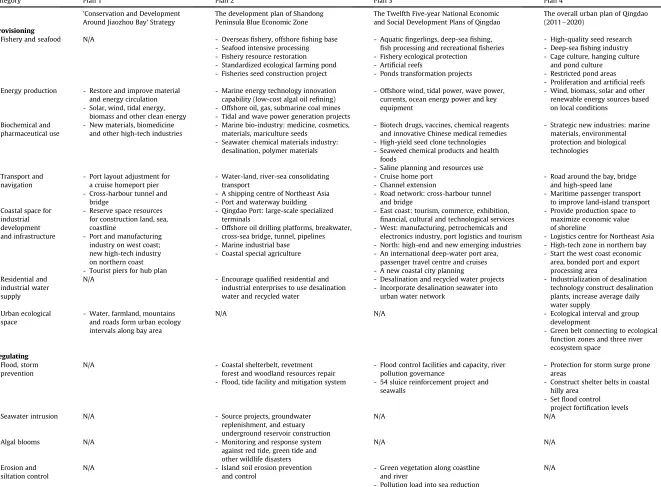
Table 3shows the result of the content analysis of four strategic documents by using the whole set of coding elements inTable 2.
Table 3 presents summarized references to coastal ESs from the four strategic plans we studied, which suggests that diverse activ-ities in strategic plans could be characterised according to their different way of using and impacting ESs. It is clear that the term ecosystem service was not mentioned explicitly. However, the analysis found all the ESs listed inTable 2, except for the supporting services of resilient ecosystems and soil formation. Furthermore, two other services were identified in the plans: urban ecological space and sea sports (seeTable 3). The former service is a provi-sioning service referring to the ecological space for establishing urban ecology intervals. It also benefits urban planning in terms of dividing different developing groups/function zones, while forming
Table 2
Coastal ecosystem services related to coastal spatial planning.
Category ES and examples
Provisioning Fish&seafood
Energy production (biomass fuel, offshore oil and gas, wind, tide and wave power)
Biochemical and pharmaceutical uses
Transport and navigation (use of waterways for shipping) Coastal space for industrial development and infrastructure Residential and industrial water supply (abstraction of water for residential and industrial purposes)
Regulating Prevention offloods, storms, tsunamis and typhoons (protection by biogenic structures)
Seawater intrusion Algal blooms
Erosion and siltation control (maintenance of productive sediments, mitigating the effects of sea-level rise) Water purification and waste treatment
Climate regulation (balance and maintenance of the atmosphere)
Cultural Tourism and recreation (beach tourism, sunbathing, diving, wind and kite-surfing,fishing, spas and wellness, and bird-watching)
Cognitive values (education and research resulting from the marine environment, school excursions, monitoring of global environmental change and indicators of ecosystem health, and long-term environmental records)
Aesthetic beauty (landscape)
Cultural heritage and identity (value associated with the marine environment itself)
Supporting Maintenance of biodiversity Maintenance of habitats
Resilience of ecosystems (ability to cope with natural and anthropogenic change)
Soil formation
Source: (MA, 2005, Beaumont et al., 2007, R€onnb€ack et al., 2007,Osterblom et al.,€
2010, Atkins et al., 2011).
Category Plan 1 Plan 2 Plan 3 Plan 4
'Conservation and Development Around Jiaozhou Bay' Strategy
The development plan of Shandong Peninsula Blue Economic Zone
The Twelfth Five-year National Economic and Social Development Plans of Qingdao
The overall urban plan of Qingdao (2011e2020)
Provisioning
- Fishery and seafood N/A - Overseasfishery, offshorefishing base - Seafood intensive processing - Fishery resource restoration - Standardized ecological farming pond - Fisheries seed construction project
- Aquaticfingerlings, deep-seafishing,
fish processing and recreationalfisheries - Fishery ecological protection
- Artificial reefs
- Ponds transformation projects
- High-quality seed research - Deep-seafishing industry - Cage culture, hanging culture
and pond culture - Restricted pond areas - Proliferation and artificial reefs - Energy production - Restore and improve material
and energy circulation - Solar, wind, tidal energy,
biomass and other clean energy
- Marine energy technology innovation capability (low-cost algal oil refining) - Offshore oil, gas, submarine coal mines - Tidal and wave power generation projects
- Offshore wind, tidal power, wave power, currents, ocean energy power and key equipment
- Wind, biomass, solar and other renewable energy sources based on local conditions
- Biochemical and pharmaceutical use
- New materials, biomedicine and other high-tech industries
- Marine bio-industry: medicine, cosmetics, materials, mariculture seeds
- Seawater chemical materials industry: desalination, polymer materials
- Biotech drugs, vaccines, chemical reagents and innovative Chinese medical remedies - High-yield seed clone technologies - Seaweed chemical products and health
foods
- Saline planning and resources use
- Strategic new industries: marine materials, environmental protection and biological technologies
- Transport and navigation
- Port layout adjustment for a cruise homeport pier - Cross-harbour tunnel and
bridge
- Water-land, river-sea consolidating transport
- A shipping centre of Northeast Asia - Port and waterway building
- Cruise home port - Channel extension
- Road network: cross-harbour tunnel and bridge
- Road around the bay, bridge and high-speed lane - Maritime passenger transport
to improve land-island transport - Coastal space for
industrial development and infrastructure
- Reserve space resources for construction land, sea, coastline
- Port and manufacturing industry on west coast; new high-tech industry on northern coast - Tourist piers for hub plan
- Qingdao Port: large-scale specialized terminals
- Offshore oil drilling platforms, breakwater, cross-sea bridge, tunnel, pipelines - Marine industrial base
- Coastal special agriculture
- East coast: tourism, commerce, exhibition,
financial, cultural and technological services - West: manufacturing, petrochemicals and
electronics industry, port logistics and tourism - North: high-end and new emerging industries - An international deep-water port area,
passenger travel centre and cruises - A new coastal city planning
- Provide production space to maximize economic value of shoreline
- Logistics centre for Northeast Asia - High-tech zone in northern bay - Start the west coast economic
area, bonded port and export processing area
- Residential and industrial water supply
N/A - Encourage qualified residential and industrial enterprises to use desalination water and recycled water
- Desalination and recycled water projects - Incorporate desalination seawater into
urban water network
- Industrialization of desalination technology construct desalination plants, increase average daily water supply
- Urban ecological space
- Water, farmland, mountains and roads form urban ecology intervals along bay area
N/A N/A - Ecological interval and group
development
- Green belt connecting to ecological function zones and three river ecosystem space
Regulating - Flood, storm
prevention
N/A - Coastal shelterbelt, revetment forest and woodland resources repair - Flood, tide facility and mitigation system
- Flood control facilities and capacity, river pollution governance
- 54 sluice reinforcement project and seawalls
- Protection for storm surge prone areas
- Construct shelter belts in coastal hilly area
- Setflood control project fortification levels - Seawater intrusion N/A - Source projects, groundwater
replenishment, and estuary underground reservoir construction
N/A N/A
- Algal blooms N/A - Monitoring and response system against red tide, green tide and
- Water purification, waste treatment
- Wastewater treatment, reclaimed water utilization - Artificial wetlands
- Pollution control and ecological remediation
- Water storage dam, artificial wetlands, river ecological restoration
- Water source protection area and forest belt - Sewage treatment and
recycling facilities - Eco-control of rivers - Climate regulation - Establish sound urban structure
and layout pattern that conforms to natural processes
- Carbon sequestration function of algae, shellfish, etc.
- Develop ocean carbon sink industry
N/A N/A
Cultural - Tourism and
recreation
- Wetland park for ecotourism - Tourism function exploitation
around the bay
- Coastal agricultural tourism corridor - Tourism product quality and leisure
facility improvement - Cruise routes based on water/
island tourism
- Holiday, marine, cruise, cultural, rural and specialityfishing village tourism, exhibition festivals and sports tourism
- Four tourism clusters characterized by European style architecture, sailing, cruises, island resorts, Clam Festival products, sports
fishing and leisure
- Sea sport N/A - Sea sports facilities
- Marine sports centre and industry base
- Sailing infrastructure and activities - High-level sporting events
- East Bay Coastal Zone develops yacht leisure and races
- Cognitive values - Total pollution source control, annual total emissions reduction, water quality function standards - Dynamic monitoring and
emergency response system
- Enhance the marine innovation platform - university and discipline
construction, international cooperation
- Information infrastructure - Marine climate meteorological
research
- Strengthen offshore technology application - Research into basic marine science - Oil spills, red tides, enteromorpha, storm
surges and sea ice forecasting systems - Environmentally-friendly technology and
equipment
- Information sharing systems
- Blue high-end R&D centre establishment
- Education centres: a combination of science, education and training, promoting sea-related
vocational institutions
- Monitoring and forecasting system
- Aesthetic beauty - Natural landscape: shoreline, wetlands and river headland - Human landscape design
N/A N/A - Protect landscape of mountain,
sea, city, island, bay and river - Afforest mountain range - Cultural heritage
and identity
N/A N/A - International Beer Festival and Sailing
Week
- Historical sites, buildings and districts - Marine folk festivals and performing
arts industry
- Strengthen the Olympic Sailing City brand
- National marine cultural exchange platform - Urban purple line to protect
heritage Supporting
- Maintenance of biodiversity
- Artificial measures to moderate the introduction of suitable species
- Rare and endangered species gene pool maintenance and ambulance operation, monitoring ambulance network, aquatic organism breeding
- Urban wetland park construction - Delineation of wetland protection zones
- Maintenance of habitats
- Designate marine protected control line, non-reclamation area - Environmental capacity research - Ecological wetland planning
- Protected ocean andfishery areas
- Marine ecological restoration governance: resource use compensation, typical ecosystem protection and restoration
- Delineate land reclamation and river control lines and the intergenic ecological region
- Island and marine protected areas - Wetland Nature Reserve
- Estuarine ecosystem restoration project
- Restore natural properties of aquiculture ponds and control pollution sources - Natural shoreline and
bay-round wetland
- Urban blue line to provide boundaries for river, reservoir and wetland protection
- Resilience N/A N/A N/A N/A
- Soil formation N/A N/A N/A N/A
sailing, yacht races and other seawater competitions. This service was taken into consideration in strategic planning as a source of both cultural and economic benefits.
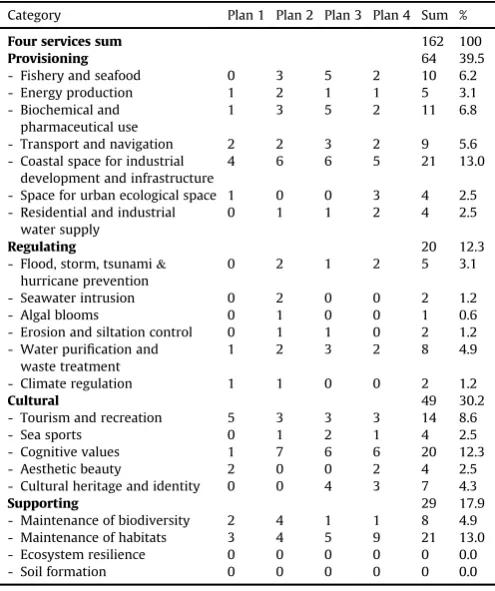
Table 4provides a frequency overview of ESs as presented in the four coastal strategic planning documents. First, coastal space for industry and infrastructure (belonging to the provisioning category) was mentioned the most. Interestingly, this result accounts for about 13 percent of the all coded results. The emphasis of the coastal spatial resource utilization was on marine resource advantages. Their‘superior position’and‘powerful driving forces’were regarded as benefitting main industrial development. Second, the habitat maintenance service (under the supporting category) was included as often as the previous service. As shown inTable 3, the maintaining habitat service illustrated a close link with the increasingly serious coastal problems (e.g. shrinking sea area and water pollution) and protecting biodiversity. Third, cognitive value, a specific cultural service, accounted for around 12 percent of all coded results. Marine biological, chemical and energy technologies were presented as sources of substantial economic benefits in the strategic plans. The scientific research and technologies based on the marine resources thus demonstrated a tremendous advance. Fourth, mitigating ma-rine disasters, monitoring disasters, meteorology and water quality were all promoted in the marine information strategy. The cultural service of tourism and recreation also had an important place in the strategic plans. Beach leisure is a traditional and famous urban symbol of Qingdao, forcing those in government to commit to planning wetland parks, speciality fishing village tourism and exhibition festivals (seeTable 3). By contrast, the resilience of eco-systems and soil formation services were rarely mentioned. The most likely reason is the abstract quality of these services and the difficulty experienced in valuing them.
the provisioning group was the most commonly mentioned (39.5%), followed by cultural, supporting and regulating services at 30.2%, 17.9% and 12.3%, respectively. This result is consistent with the general human social preference for provisioning services provided by different ecosystems (Foley et al., 2005). Nonetheless, the results show less prominence for the regulating services. Only three specific services belonging to this group were explicitly mentioned (seeTable 3), namelyflood regulation (coastal shelter-belt construction), climate regulation (carbon sequestration through exchange functions of algal and shellfish), and water pu-rification and treatment (through artificial wetlands). Regulating measures were presented not so much as designs involving ecosystem functions and processes, but predominantly as employing artificial methods. For instance, many construction projects have been planned to mitigate storm surges in Jiaozhou Bay, such as breakwaters, underground reservoirs and dams.
Applying our method, ESs can be clearly identified in coastal strategic planning. The whole range of possible services in planning can thereby be detected, including those previously neglected.
Rodríguez et al. (2006) report that a heavy emphasis on provi-sioning ESs could be a consequence of their value, being more tangible and identifiable by societies, whereas the economic values of other ESs are more difficult to quantify. For instance, it has previously been difficult to value the supporting services of resil-ient ecosystems and soil formation investigated in this research. However, the other ESs might be more critical for the whole system than the provisioning ESs. The regulating services, which have the function of maintenance and enhancement, could be associated with the capacity of socio-ecological systems to cope with or adapt to the disturbances of various kinds which accelerate human and ecological changes (Carpenter et al., 2006; Bennett et al., 2009). In coastal strategic plans, actions and plans that act on the regulating services are needed to improve the future ability of socio-ecological systems to be sustained against shocks.
The levels of attention paid to the various ESs discussed here were obviously influenced by the current formal institutions they were a part of. Some ESs identified in the four strategic plans were associated with several general regulatory and financial mecha-nisms, illustrating links between ESs and institutions. To make this clearer, we will develop insights into the integrated implication for ES use from three levels in the following section.
3.2. Existing institutions for integrating ESs into the selected strategic plans
3.2.1. The macro-level
Sustainable development in China is a fundamental national strategy (Wu et al., 2012). Since the 1990s, China's Ocean Agenda 21 (1996), the Marine Development Programs (1998), the National Marine Economy Development Plan (2003) and the National
Table 4
Coastal ecosystem services presented in coastal strategic documents for Jiaozhou Bay.
Category Plan 1 Plan 2 Plan 3 Plan 4 Sum %
Four services sum 162 100
Provisioning 64 39.5
- Fishery and seafood 0 3 5 2 10 6.2 - Energy production 1 2 1 1 5 3.1 - Biochemical and
pharmaceutical use
1 3 5 2 11 6.8
- Transport and navigation 2 2 3 2 9 5.6 - Coastal space for industrial
development and infrastructure
4 6 6 5 21 13.0
- Space for urban ecological space 1 0 0 3 4 2.5 - Residential and industrial
water supply
0 1 1 2 4 2.5
Regulating 20 12.3
- Flood, storm, tsunami&
hurricane prevention
0 2 1 2 5 3.1
- Seawater intrusion 0 2 0 0 2 1.2
- Algal blooms 0 1 0 0 1 0.6
- Erosion and siltation control 0 1 1 0 2 1.2 - Water purification and
waste treatment
1 2 3 2 8 4.9
- Climate regulation 1 1 0 0 2 1.2
Cultural 49 30.2
- Tourism and recreation 5 3 3 3 14 8.6
- Sea sports 0 1 2 1 4 2.5
- Cognitive values 1 7 6 6 20 12.3
- Aesthetic beauty 2 0 0 2 4 2.5
- Cultural heritage and identity 0 0 4 3 7 4.3
Supporting 29 17.9
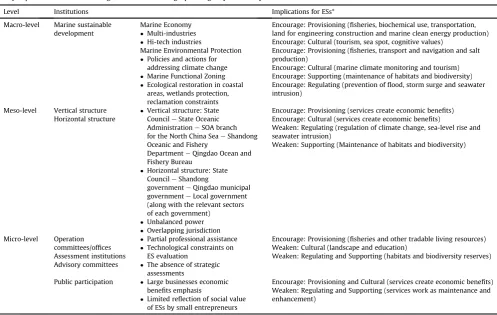
Marine Development Plan (2008) have proposed background, ob-jectives and tasks for sustainable marine development. In 2011, China's Policies and Actions for Addressing Climate Change (2011) were developed with a focus on using marine clean energy, marine climate monitoring and ecological restoration in coastal areas. All these national directives encourage both the adjustment of the marine economy and more efforts to be invested into marine environmental protection (seeTable 5). As an important coastal province, in 2009, a national-level proposal for the Shandong Peninsula Blue Economic Zone (Qingdao took a leading role in this region) was promoted to enhance the regional economy, its science, resource utilization and culture. In provincial and coastal municipal strategic plans, marine economic structures werefirst adjusted and optimized, from a narrow focus onfisheries and salt production into a comprehensive system. In 2011,fisheries, coastal tourism, ocean chemical production, marine transportation and engineering construction dominated, accounting for around 80 percent of value added by Shandong's marine industry (SSB, 2011), greatly enhancing the provisioning and cultural services. Meanwhile, traditional raw material industries were not supported, but energy-saving hi-tech industries were encouraged. For instance, a Northern Jiaozhou Bay Hi-tech Zone was promoted in Plan 1, focussing on marine biochemical and pharmaceutical research, the utilization of solar energy, wind energy, marine bioenergy and other hi-tech technology eligible for general tax benefits. Consequently, the provisioning services and cognitive values ecosystem services increased.
Marine environmental protection also attracted extensive attention and was supported by some sectoral laws. In particular,
the Law of Sea Area Use Management was enacted to coordinate conflicts between economic development and environmental protection, by promoting a unique form of marine spatial planning, namely Marine Functional Zoning (MFZ). This law stipulates that any sea use must comply with the MFZ scheme established by the State (SOA, 2001). In the recent Shandong provincial MFZ (approved by the State), the main functional zones of Jiaozhou Bay were designated for shipping, tourism, and the fishing and salt industries (SOFD, 2012), creating legal priorities for developing these specific provisioning services on the basis of local ecosystem patterns and functions. In addition, the supporting services of habitat/biodiversity maintenance could be highlighted by the Jiaozhou Bay wetlands protection initiative as well as the con-straints placed on reclamation activities along the Bay (e.g. forbidden land recovery for certain areas, compensation and afine for illegal changes to marine features).
3.2.2. The meso-level
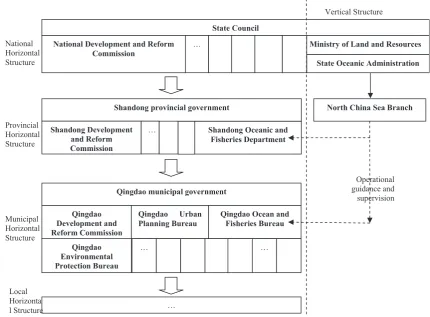
Vertical and horizontal power and institutional structures coexist in China (Lieberthal, 1997). As a result, the unified coastal ecosystem for management is artificially divided. With regard to the vertical institutional structure relevant for coastal strategic planning related to Jiaozhou Bay, Fig. 3 presents a hierarchy of sectors or departments with similar functional natures, ranging from central to local government (Wu and Sun, 2011). Specifically, the State Council has a department named the State Oceanic Administration (SOA), which is the leading agency responsible for China's ocean policymaking and overall management of ocean and coastal affairs (Cao and Wong, 2007). An SOA branch for the North
Table 5
Likely implications for ESs of existing institutions of strategic planning for Jiaozhou Bay.
Level Institutions Implications for ESs*
Macro-level Marine sustainable development
Marine Economy
Multi-industries Hi-tech industries
Encourage: Provisioning (fisheries, biochemical use, transportation, land for engineering construction and marine clean energy production) Encourage: Cultural (tourism, sea spot, cognitive values)
Marine Environmental Protection
Policies and actions for
addressing climate change
Marine Functional Zoning Ecological restoration in coastal
areas, wetlands protection, reclamation constraints
Encourage: Provisioning (fisheries, transport and navigation and salt production)
Encourage: Cultural (marine climate monitoring and tourism) Encourage: Supporting (maintenance of habitats and biodiversity) Encourage: Regulating (prevention offlood, storm surge and seawater intrusion)
Meso-level Vertical structure Vertical structure: State
CouncileState Oceanic
AdministrationeSOA branch
for the North China SeaeShandong
Oceanic and Fishery
DepartmenteQingdao Ocean and
Fishery Bureau
Horizontal structure: State
CouncileShandong
governmenteQingdao municipal
governmenteLocal government
(along with the relevant sectors of each government)
Unbalanced power Overlapping jurisdiction
Encourage: Provisioning (services create economic benefits) Encourage: Cultural (services create economic benefits)
Weaken: Regulating (regulation of climate change, sea-level rise and seawater intrusion)
Weaken: Supporting (Maintenance of habitats and biodiversity) Horizontal structure
Micro-level Operation committees/offices
Partial professional assistance Technological constraints on
ES evaluation
The absence of strategic
assessments
Encourage: Provisioning (fisheries and other tradable living resources) Weaken: Cultural (landscape and education)
Weaken: Regulating and Supporting (habitats and biodiversity reserves) Assessment institutions
Advisory committees
Public participation Large businesses economic
benefits emphasis
Limited reflection of social value
of ESs by small entrepreneurs
Encourage: Provisioning and Cultural (services create economic benefits) Weaken: Regulating and Supporting (services work as maintenance and enhancement)
*‘Encourage’implies an institution with regards to strong incentives, legislation, permits, rewards, subsidies, information (monitoring information, professional knowledge, social value) or assessments that may stimulate or protect particular ESs.‘Weaken’implies institutions with less of these institutional arrangements, or with factors ignoring or even damaging particular ESs.
China Sea has been established in Shandong. SOA and its North China Sea branch offer operational guidance and supervision to the lower-level marine departments (e.g. Shandong Oceanic and Fisheries Department, Qingdao Ocean and Fisheries Bureau). One guidance and supervision practice involves directing the regulating and supporting services, for example, the control of pollutants discharged into sea, the regulation of climate change and sea-level rise, and marine ecological damage management. However, in comparison with other government bodies, SOA and its branches have more interest in ES protection, but less power over lower-level marine departments. There are direct and strict administrative relationships between government bodies and the lower-level departments. The result of this power issue is a limitation of the extent to which SOA and its branches can discharge their functions in introducing and implementing regulating or supporting services in the four selected plans. Similar problems also exist in different but relevant state-level departments (for instance, the Ministry of Environmental Protection), for efficiently encouraging, regulating or supporting ESs in local areas.
The horizontal institutional structure relevant for coastal stra-tegic planning related to Jiaozhou Bay (see alsoFig. 3) consists of government bodies (from the national to the local level) and their functional sectors (Wu and Sun, 2011). Due to the high spatial heterogeneity (coastal land, intertidal area and aquatic systems) in coastal areas (Cao and Wong, 2007) and the various jurisdictions provided by the differing sectoral legislative orders, power has been diffused to many different departments (e.g. marine, environ-mental protection, agriculture, forestry and land resources). During
planning coordinator, have resulted in only a partial consideration of ESs. It is therefore necessary to create platforms involving the sectors engaged in coastal strategies, for knowledge sharing and cooperative planning about integrated coastal strategies based on ESs management.
The coordinating body of the four selected plans was either the Development and Reform Commission (DRC) or the Urban Planning Bureau (UPB). These agencies have played“a privileged role with an authority to accord scientific knowledge” (Waylen and Young, 2014) over other sectors in planning. These two bodies emphasise economic or social benefits and spatial planning (e.g. establishing urban ecology intervals and arranging coastal industrial space), respectively. As a consequence, both authorities emphasised the provisioning and cultural services over the ESs without obvious economic values (such as the regulating and supporting services). In addition, the jurisdictions of the many different departments falling under a given government body frequently overlapped or were unclear. These departments pursued single-sector interests with regards to market, social or ecological benefits, performance targets and more administrative rights, which hampered inter-organisational interaction and the efficiency of planning pro-cesses. This especially is the case for cross-sector, cross-boundary or cross-time issues such as the question how to guarantee habitat conservation under developing pressures of upstream areas, and how to define an acceptable ecosystem level for dredging,filling and other activities allowed with respect to their long-term cu-mulative effects. These kinds of mismatches between the current institutional structure and the coastal resources for governance
ESs. The varying monitoring information could have resulted in different or even conflicting considerations of the same coastal ESs (particularly the regulating and supporting services) among the involved departments. This inconsistency could obstruct sectoral bodies from stressing the importance of the regulating or sup-porting services in strategic plans. Another barrier to better un-derstanding the information by diverse sectoral bodies could be methodological difficulties in mapping or measuring values of ESs. Overall, coastal functions and ecosystem services were divided among different departments, possibly causing the ineffective exploitation of the ESs as well as the application of the concept in coastal strategic planning.
3.2.3. The micro-level
This level concerns operation committees/offices, assessment institutions, advisory committees and public participation (see
Table 5). To smoothly implement each of the strategic plans for Jiaozhou Bay, a leading operation committee/office was established under the main coordinating sectoral body, such as the DRC and UPB. The responsible sector organized and supported the advisory committees and assessment institutions authorized by the gov-ernment to conduct field investigations and environmental as-sessments for the four strategic plans. Public participation was required during the course of these investigations and assessments, following certain laws and regulations. However, these micro-level institutional arrangements also exerted different effects on the ESs. First, coastal strategic planning related to Jiaozhou Bay required expert scientific knowledge and experience from an array of marine disciplines. Although experts from thefields of marine resource development and environmental protection were included, their advice mainly concerned the provisioning services, such as enhancing biological, energy or seawater resource use and port economy (SPBEZCO, 2013). The absence of professional assistance on how to employ the cultural, regulating and supporting services could have undermined the inclusion of these services in the four strategic plans.
In addition, according to current law and regulations, the assessment institutions authorized by the government are responsible for Marine Environmental Impact Assessment, Sea Area Use Demonstration and Marine Ecological Damage Compensation for all kinds of marine projects before being approved by the local governments in subsequent specific plans. When carrying out these assessments, technological constraints regarding evaluating the less tangible and identifiable ESs (some of the cultural, and the regulating and supporting services) could result in the less suc-cessful implementation of a broad range of ESs. For example, tradable living marine resources (mainly belonging to the provi-sioning service) are the main basis for calculating the damage caused by planned marine economic activities (QOFB, 2012). In contrast, damage assessments of the natural landscape, tourism and nature reserves depend solely on expert groups, which could fail to reflect‘true’value of coastal and marine ESs due to subjective factors (QOFB, 2012). In addition, the lack of Strategic Environ-mental Assessment (SEA) normative guidelines deters the assess-ment institutions from employing SEA, which is a potential method for including ESs in spatial planning (Geneletti, 2011).
Third and finally, in China politicians tend to focus on large businesses rather than small entrepreneurs, such as individual
fishermen who actively use certain ES, and who, as a consequence, are not explicitly considered as important stakeholders (Lau, 2005). Indeed, this phenomenon is also due to a lack of environmental awareness among the general public. As a result, large businesses are able to exploit high-value market services, while local com-munities merely act as supporters in terms of providing advice and collecting data for the executive institutions (Wu et al., 2012),
specifically offering the varying social values attached to the regulating and supporting services such as the prevention of seawater intrusion, soil conservation and other functional services. Then the important local knowledge of systems' functioning and monitoring could be missed (Gelcich et al., 2006).
4. Reflection and discussion
4.1. Institutional strengths and weaknesses of strategic planning in Jiaozhou Bay
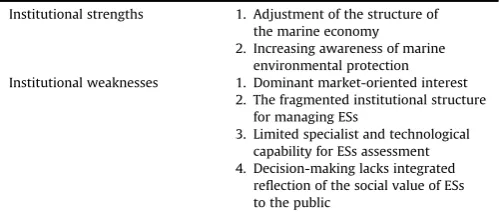
Based on the empirical analysis of Jiaozhou Bay, we can conclude that the four coastal strategic plans that we studied were strongly influenced by their institutional context from three levels, which further impacts on the levels of inclusion of the four cate-gories of ES. Together, the results demonstrate two institutional strengths that yield benefits to integrating coastal ESs into strategic planning. At the same time, the selected strategic plans face four main weaknesses that could create obstacles for their institutional capacity of ES governance (seeTable 6).
Most of these strategic plans emphasise the adjustment and optimalisation of marine economic structures because of the po-litical aim to achieve sustainable development and address climate change. This is thefirst institutional strength essentially respon-sible for encouraging a wide range of ESs due to a great increase in the varieties of marine industries that can employ the various coastal ESs, and of the energy-saving hi-tech industries. The second strength is the strong initiatives for marine environmental pro-tection in the Jiaozhou Bay area (in particular wetlands and biodi-versity protection), which directly enhance the supporting service and thereby assist the proper delivery of the other services.
However, the current formal institutional design of the coastal strategic plans relevant to Jiaozhou Bay also has four important weaknesses. The first is the dominant initiative of economic benefit, particularly related to the provisioning services from the macro to the micro institutional design level (seeFig. 2and the last column ofTable 5). Their indirect and tangible market values can meet the demands of major governance bodies. Other ESs are un-able to receive the same amount of attention as the provisioning services. Rational consideration and employment of the regulating services provided by the ecosystem, in particular, has been ignored (see Table 5). Unfortunately, the strategic plans in Jiaozhou Bay therefore do not employ the whole range of ESs.
The fragmented institutional management of coastal ESs (i.e. the co-existing vertical and horizontal structures discussed for the meso-level) is a second weakness. There is no unified and effective coordination mechanism for the strategic plans in Jiaozhou Bay. As a result, it is difficult to share information, collect opinions and clarify jurisdictions