A guide to dairy
herd management
A guide to dairy
herd management
Contacts:
Meat & Livestock Australia Level 1, 165 Walker Street North Sydney NSW 2060 Australia
Ph: +61 2 9463 9333 www.mla.com.au
Author:
John House, The University of Sydney, New South Wales, Australia
Editor: Ian Partridge
Acknowledgment:
Dr John Moran, Department of Primary Industries, Victoria, Australia
Published by:
Meat & Livestock Australia Limited ABN: 39 081 678 364
October 2011
© Meat & Livestock Australia Limited 2011 ISBN: 978-1-74191-653-9
Care is taken to ensure the accuracy of the information contained in this publication. However, LiveCorp and Meat & Livestock Australia cannot accept responsibility for the accuracy or completeness of the information or opinions contained in the publication. You should make your own enquiries before mak-ing decisions concernmak-ing your interests. LiveCorp and Meat & Livestock Australia accept no liability for any losses incurred if you rely solely on this publication.
Reproduction in whole or part of this publication is prohibited without prior consent and acknowledge-ment of LiveCorp and Meat & Livestock Australia.
The inclusion of trade or company names in this publication does not imply endorsement of any product or company by LiveCorp, MLA or any contributor to this publication. LiveCorp, MLA and the contributors to this publication are not liable to you or any third party for any losses, costs or expenses resulting from any use or misuse of the information contained in this publication.
LiveCorp
Suite 202, 32 Walker Street, North Sydney, NSW 2060, Australia
ii A guide to dairy herd management
Introduction
lncreasing numbers of Australian dairy animals are being exported to coun-tries seeking to improve their production of milk and dairy products.
Some cattle are going to countries in the tropics and subtropics, other going to countries with more temperate climates.
These Australian dairy cattle are of high genetic potential; they need good management and good feeding to produce high yields of milk in their new homes and environments.
The success of such programs depends largely on the awareness and abil-ity of new owners of these stock to meet these standards of feeding and general herd management, and this book is designed to provide the infor-mation needed for good decisions to be made. Key factors in management include nutrition, cow comfort and reproductive management.
In collaboration with the importing countries, the Australian Government has instigated procedures for strict animal selection and quarantine prior to transport, while the exporting agencies are developing post-arrival pro-tocols to reduce stresses on the newly-arrived stock.
Contents
Introduction
i
1 Principles of dairy farm management
1
Environment and facilities 1
Expertise 2 Animals 2
Dairy herd health and production 3
2 Nutrition
5
Key points 5
Feed composition 6
– nutrients for milk production 6
Water 6 Energy 6 Protein 6 Fibre 7
Energy and digestibility 7
Vitamins 8 Minerals 8
Sources of feed 9
Temperate and tropical grasses 9
Nutritional requirements 14
Useful resources 16
3 Feeding management
17
Key points 17
Feeding high-production cows 17
Useful resources 21
4 Managing young stock
22
Key points 22
Maternity management 24
Calf management 24
Calf diseases 27
Common management procedures 29
Growth 30
Useful resources 31
5 Reproduction management
32
Key points 32
Heat detection 32
Reproductive goals 36
Nutrition, cow health and reproductive performance 37
Biosecurity 38
Useful resources 39
iv A guide to dairy herd management
...Contents continued
6 Cow comfort
40
Key points 40
Dairy and shed design 40
Shed design and management 45
Useful resources 47
7 Heat stress
48
Key points 48
Sources of heat 48
Cooling strategies 49
Cooling cows 50
Feeding management 51
Useful resources 52
8 Milk harvesting
53
Key points 53
Milking hygiene 61
Drying cows off 62
Post-harvest milk quality 62
Milk cooling and storage 62
Milk transport 62
Useful resources 63
9 Common disorders in dairy cattle
64
Key points 64
Facilities to manage sick and lame cows 64
Metabolic disorders 69
Three fundamental factors that determine the health and productivity of a high-potential dairy cow are nutrition, comfort and reproduction. Cows need to be well fed, maintained in a comfortable environment, and bred in a timely fashion in order to express this potential. Conversely, the health and productivity of cows will be restricted by the factor most limiting.
The limiting factor has a consequence and an interaction. For example, if nutrition is poor, milk production drops quickly and cows in poor condition will not cycle properly for good reproduction. If cows are stressed and uncomfortable, they are more likely to develop lameness and mastitis—which will affect both production and reproduction. Failure to conceive leads to protracted lactations with more cows in the herd in later lactation and less milk. Poor reproductive performance reduces the number of offspring, contributes to forced culling and provides fewer replacement heifers to replace the culled cows.
While the concepts of nutrition, comfort and reproduction are simple, the logistics of catering to the cows’ needs for 365 days of the year can be challenging as seasonal conditions and feed availability fluctuate.
This manual outlines the principles and some of the practical challenges that may be encountered in dairy cow management.
Environment and facilities
Cows are resilient creatures but an uncomfortable environment comes at a cost to their health and productivity.
Facilities – Animal housing design can either mitigate or create adverse environmental conditions. Cows need a clean, dry, comfortable place to lie down. Walking surfaces should provide sufficient traction to avoid slipping but should not be too abrasive or rough. Cattle should have constant access to fresh clean water and feed with sufficient trough space for the number of animals in the group to avoid competition between animals. Good feed quality demands feed storage facilities that prevent feed spoilage.
Cow comfort – When cows have to stand for long periods because they cannot lie down in a clean dry area, they may become lame. Cows that are lame or have to stand on slippery surfaces are less likely to show sexual behaviour and hence less likely to become pregnant. If they are forced to lie in wet dirty areas, the risk of mastitis is increased. The results can be more disease, lower production and heavier culling.
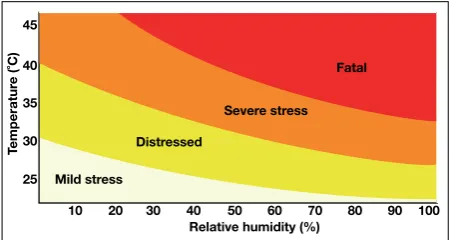
Heat stress – The large body mass of cows of temperate breeds and their high metabolism makes them susceptible to heat stress under hot conditions. Hot cows eat less, are more likely to become sick and more difficult to get pregnant. Providing adequate shade and cooling for cows during hot weather promotes milk production, reduces mortality, and improves reproductive performance. Cows should always have access to fresh clean water.
Cold stress – Adult cows are generally more resilient to cold stress than humans because of their larger body mass; however, frost damage to teats can make them more susceptible to mastitis. Young calves need more feed during cold weather.
Hygiene – Good hygiene will prevent transmission of disease, but waste management is a significant logistical problem where cattle are managed intensively. Udder health is largely influenced by the level of hygiene practiced before, during and after milking. Milking wet, dirty udders increases the risk of mastitis, wiping cows’ teats with a dirty cloth transmits pathogens between cows, and failing to sanitise teats after milking provides opportunity for disease to spread. Young calves are particularly susceptible to pathogens that cause diarrhoea, but the risk of disease is reduced by feeding adequate colostrum, good milk handling practices, and reducing exposure to manure from other animals.
Biosecurity – It is always preferable to prevent the introduction of disease agents onto the farm. Biosecurity protocols should be developed to identify and manage sources
1 Principles of dairy farm management
2 A guide to dairy herd management
from introduced livestock, people, equipment, feed, wildlife and water.
Human food quality – The dairy produces milk and meat for human consumption, and the consumer expects that the product will be nutritious and safe. A number of pathogens can infect both animals and humans. Properly functioning equipment for milk harvesting, cooling and storage and good milking routines are important for the health of the cows and for milk quality. Some medications to treat sick cattle or to facilitate their reproductive management can have adverse impacts on milk products or people. Individual identification, good record keeping of medication and chemical use, and observance of withholding periods will avoid contamination of human food.
Expertise
Dairy farming is a sophisticated industry that calls for diverse knowledge and expertise relating to animal health, soils, cropping, mechanics, business, and construction. As herd size increases, so does the need for extra staff. The success of the dairy farm is often constrained by the weakest link in the staff team. For example, investing in resources to keep cows comfortable will not achieve high production if the person responsible for feeding the cows does not pay attention to detail and fails to feed cows their appropriate ration.
The complexity and difficulties associated with staff management increase as the number of staff employed increases. Management needs to be proactive in developing staffing structure and protocols. Planning increases the likelihood of good outcomes. Farms that do not have development plans for staff and project plans tend to practice crisis management, moving from one problem to the next.
Proactive strategies include:
•Establishing clear goals for each area of the business
•Developing standard operating procedures for common tasks
•Developing training programs for staff to implement the operating procedures effectively
•Scheduling staff and defining staff roles improves staff productivity
•Identifying individual animals and keeping good records
•Establishing a monitoring system for each aspect of the business to provide rapid feedback regarding program outcomes. It is difficult to manage practices for which there is no measure of success.
•Identifying knowledge gaps and seeking professional input in these areas; examples include nutrition, animal health, milk harvesting and milking machines, milk cooling and storage, agronomy, finance.
Animals
There are numerous approaches to profitability in dairy farming. Some focus on minimising input costs while accepting lower milk production; others use high inputs to maximise production and profitability.
There is no universal ‘best’ system. Which system is ‘best’ will greatly depend on the costs of feed and labour and the price for milk, but will also reflect differences in skills and resources on any given farm.
The genetic capacity of the cow to produce large volumes of milk can be realised only if the amount of nutrients fed meet the nutrient output in the milk. High-potential cows cannot produce large volumes of milk if fed poor-quality or inadequate amounts of feed. They will attempt to produce milk but at the expense of body condition and reproduction.
The five conditions of animal care to promote health, productivity, and longevity are:
•freedom from hunger and thirst
•freedom from discomfort
•freedom from pain, injury or disease
•freedom from fear and distress
Dairy herd health and
production
The cycle of life
The life cycle of a dairy cow is predictable and therefore can largely be managed with scheduled activities. For dairy farms that maintain a seasonal calving pattern with cows calving every twelve months, the life cycle of the cow can be linked to an annual calendar of management events. However, maintaining a 12-month calving interval poses several reproductive challenges, and farms calving cows all year round often have a calving interval closer to 13 months.
This section focuses on the life cycle of the cow rather than on the calendar year.
Birth – Holstein cows have been selected for milk production and not for ease of calving or mothering ability; thus birth is a high risk event that can lead to the loss of both the cow and calf. Calf mortality is approximately three per cent of those born to cows and some six per cent of those born to heifers. Calf mortality at birth can be much greater when heifers are poorly grown, the nutrition of pregnant stock is poorly managed, the calving area is disruptive to normal cow behaviour, and when sire selection does not take calving ease into consideration.
Strategies to reduce the risk of calving problems include nutritional management of young stock so that heifers are well grown when they have their first calf and use of ‘calving-ease’ sires to breed heifers.
At birth, the calf is immunologically naïve and highly susceptible to pathogens. Good quality colostrum promotes calf immunity and should be fed to calves within six hours of birth. Colostrum quality is influenced by:
•the age and health status of the mother
•the timing of colostrum harvest relative to birth
•the hygiene of the equipment used to harvest and store the colostrum.
As bacteria can multiply in colostrum, it should either be fed directly to the calf after being harvested or cooled rapidly to 4oC for
short-term storage.
The risk of calf disease is reduced when calves are fed colostrum at birth, fed milk that has been appropriately handled and stored, born and raised in a clean dry area and kept separate from older calves that could be a source of infection.
Heifer conception – The onset of sexual maturity is related more to body weight than to age. Heifers should weigh 85% of the adult cow weight at the time of calving. Target growth rates and breeding weights for heifers differ slightly for those raised in intensive systems or on pasture. Well-fed Holstein heifers will gain around 800 grams per day to achieve a target breeding weight of 350–375kg by 15 months of age; heifers reared on pasture are more variable, reaching a body weight of 310– 350kg at 18 months.
Weight at joining is related to weight at calving and subsequently to milk production. Well-grown heifers are less likely to have calving difficulties, will produce more milk and get back in calf more rapidly than poorly grown heifers.
Calving – Individual animal identification and good reproductive records and management are important for management of calving cows. Reproductive records allow prediction of when cows are due to calve.
Good nutritional management of cows before calving reduces the risk of metabolic diseases that can contribute to weakness and subsequently calving difficulty. For a good ration to be effective, it needs to be fed to the right cow for the appropriate period.
The four weeks prior to calving are recognised as a crucial time for dairy cattle. Cows that are fed and managed well before calving are less likely to have problems with metabolic diseases such as milk fever, ketosis, retained placenta, metritis, abomasal displacement or death.
The health of cows after calving is also influenced by the environmental conditions at calving and by the quality of care provided to calving cows. Cows calving in dirty wet yards are more likely to develop uterine infections, as do unhygienic practices or excessive traction by handlers helping calving cows.
4 A guide to dairy herd management
Death – Common causes of death include calving difficulty, mastitis and metabolic disease; nearly all occur within 60 days of calving. Strategies to prevent disease and mortality should deal with the period which spans the four weeks before and the four weeks after calving.
Conception – After calving, cows should start into a reproductive management program with targets established for average days-to-first-breeding, efficiency of heat detection and for pregnancy rate. Contingency plans should also be in place for cows that experience calving difficulty, retained placenta, or metritis so as to minimise their impact on reproductive performance. The days between calving and conception dictate the calving interval and have a large impact on future milk production, herd structure, and availability of replacement heifers.
Culling – Cows should be culled from the herd toward the end of their lactation on the basis of a lowered future productive potential. Culling decisions based on voluntary criteria such as low production, age and conformation tend to promote herd productivity whereas those based on involuntary criteria associated with failure of conception, disease or injury have a negative impact on herd structure. Recording the identity of animals culled, stage of lactation at which they were culled and reason for culling helps to identify causes of attrition that need to be investigated.
Dry cows – Cows are dried off 50–60 days before their projected calving date to allow the mammary glands to recover. High-risk periods for new intra-mammary infections include the early and late dry period and early lactation;
the non-lactating or ‘dry’ period provides an opportunity to treat existing intra-mammary infections and to prevent new intra-mammary infections.
Strategies to reduce the risk of new intra-mammary infections during the dry period include intra-mammary therapy at the time of drying off and implementing good environmental and nutritional management. Attention to detail is important when working with cows—particularly when administering medications as poor treatment technique can introduce pathogens. When milking is stopped, the mammary gland becomes engorged and some cows may leak milk. This opens the teat end allowing bacteria to enter the gland. Similar engorgement and leakage of milk can be seen before and after calving. During these times, the cows must be kept in a clean environment.
Routines – In batch-calving herds where all cows calve over a short period, the cycle of life may be incorporated into an annual calendar. This is not possible with year-round calving herds where efficiencies can be gained by scheduling repetitive routine tasks into daily, weekly or fortnightly activities. A good record-keeping system facilitates scheduling of common tasks with procedures such as vaccination schedules and reproductive synchrony programs linked to the stages of the production cycle. Many dairy software programs can generate lists of cows according to their stage of lactation or pregnancy. Establishing a schedule provides a level of predictability to work routines and assigns responsibility to individuals promoting accountability when multiple people are involved.
2 Nutrition
Key points
• Feedcomposition–Allfeedstuffsfedto cowscontainsomewater.Toaccountfor thedifferentwatercontents,theweightof feedisexpressedonadrymatterbasis. The dry matter of a feed is the weight of the feed after all the water has been extracted.
• The dry matter content of mixed dairy rations is usually formulated to be 50–75%oftheration.Wetterordrierthan thislimitsconsumption.
• Feedutilisation–Dairycowsusefeedfor severaldifferentfunctions.Theseinclude ‘maintenance’ofbodilyfunctions,growth (inyoungstock),pregnancyandmilkpro
-duction.
• Feed consumption – The daily feed intakeformaintenanceofanon-pregnant mature cow is about 1.2% of her body weight.Thusa600kgcowneedstoeat about 7.2kg of good-quality dry matter perdayjusttomaintainbodilyfunctions. • Theamountofdrymatterfedtoheavily pregnant, non-lactating cows should be around2%ofbodyweight.Theadditional feed is to meet the needs of advancing pregnancy.
• Lactationdramaticallyincreasesthefeed requirements of high-producing dairy cows. The amount of good-quality dry matteramilkingcowshouldbefedcan beestimatedbyadding5kgper10litres of milk produced to the maintenance requirementofthecow.
• High-producingcowscaneat4%oftheir bodyweightindrymatterperdayatpeak lactationwhenfedhighly-digestiblefeed.
• Whenthenutrientoutputinmilkexceeds theamountofnutrientseatenduringearly lactation, cows lose weight. Excessive lossofweightor‘BodyCondition’during early lactation indicates the nutrient requirements of the cow have not been met.
• Milk production is driven by dry matter intake,whichisinluencedbythequality or digestibilityofthefeedfed.
• Poor-quality feed takes longer to digest and therefore limits the amount of feed a cow can eat each day; this limits the amountofnutrientsavailableformilkpro
-duction.
• Good-quality forage provides the foun
-dationofdairyrations.
• Key points in growing good-quality for
-agesfordairycows:
1. Selectthemostappropriatespecies fortheregionandenvironment. 2. Managethecroptooptimisegrowth
andquality.
3. Harvest the crop at the optimum stageofmaturityfornutritivevalue. • Excess forage can be conserved as
silageorhay.
• Concentratesupplementscanbesourced alreadyformulatedorasrawingredients. Their selection should be based on the need for additional energy or protein in thediet.
6 A guide to dairy herd management
Feed composition
– nutrients for milk production
When dairy cows eat, they extract from the feedwater,energy,protein,ibre,vitaminsand minerals.Thefourrequirementsthataremost commonly limiting are water, energy, protein andibre.
Water
Waterisnotanutrientbutisvitalforallbody functionsandinregulatingbodytemperature. Thebodyofacowiscomposedof70–75% waterincludingtherumencontents,andmilk isabout87%water.Anabundant,continuous supplyofcleandrinkingwaterisvitalfordairy cows.
Energy
Energy is not a nutrient but is derived from most parts of the feed. Cows use energy to function (breathe, walk, graze, gain weight, lactate and maintain a pregnancy). Energy isthekeyrequirementofdairycowsformilk productionasitdeterminesmilkyieldandmilk composition. The energy content in feeds is quantiiedintermsofmegajoulesofmetabo
-lisableenergy(MJofME)perkgDM.Starch andfatsarecommonsourcesofenergy. Grainisthemainsourceofstarchintheration of a dairy cow. Cereal grains include maize, wheat, barley and sorghum while dried cas
-sava is a source of highly digestible starch. Fermentation of grain in the rumen favours productionofpropionicacid(oneofthevola
-tilefattyacids)whichthecowusestomake glucoseandsubsequentlylactose—themain sugarinmilk.Increasedlactoseincreasesmilk volume and the increased energy availability also promotes synthesis of milk proteins. Conversely, increased lactose reduces milk fat.
The mix of different microorganisms in the cow’s rumen depends on the type of feed eaten. Too much grain in a ration produces excess volatile fatty acid and the pH of the rumenluidmaydeclinebelowpH6(acidosis). This favours the starch-digesting micro-organismsandinhibitsthosethatdigestibre. Acidosis from consuming excessive starch contributestoindigestion,laminitis,lameness andpossibledeath.
Fatisagoodenergysourcethatishighlypal
-atableandrelativelycheap.However,aration containingmorethan6%fat(onadrymatter basis) will decrease the digestion of dietary ibre, and reduce milk protein and milk fat to below 3%. Solid fats are much safer to feedthanliquidoils.Examplesoffeedscon
-tainingfatincludebrewersgrain(10%),whole cottonseed (23%), added oils and added rumen-protectedorbypassfat.
Protein
Proteinisaconstituentofalltissues(muscle, skin, organs, foetus), and also builds and repairs the body’s enzymes and hormones. Proteinisneededforthebody’sbasicmeta
-bolicprocesses,growth,pregnancyandmilk production. The protein content in feeds is quantiiedintermsofpercentoftheDM. The rumen microorganisms can synthesise protein for their own bodies from plant pro
-tein (and also from simple, inorganic forms of nitrogen). They cannot breakdown plant ibreoruseenergy-richstarchifthesupplyof nitrogencompoundsintherationislow.Slow digestionofibrepreventsthecowfromeating morefeed,andmilkproductiondeclines.
Milk production is the major inluence onproteinneeds.
Table2.1.Energyrequirementsfordairycows
Bodyfunction Energyrequirement(MJ)
Maintenance 60MJfor500kgbodyweight±5MJforevery50kgchange Milkproduction 5MJ/LforHolsteincows;6MJ/LforJerseycows
Weightchange –28MJ/kgweightloss;+34MJ/kgweightgain
Pregnancy 5months=5MJ,6months=8MJ,7mths=11MJ,8mths=15MJ,9mths=20MJ Exercise 1,3or5MJ/kmforlat,slopingorhillylandrespectively(upto25%maintenance)
Fibre
The ibre fraction of the ration is digested slowly in the rumen by rumen microorgan
-isms.Foreficientdigestion,therumenmust containibrefromforages.Fibreensuresthat thecowchewsitscud(ruminates)andthere
-foreproducessalivawhichbufferstherumen against sudden changes in acidity (see aci
-dosis).
FibrecanbequantiiedasNeutralDetergent Fibre (NDF) and Acid Detergent ibre (ADF). High levels of NDF reduce the intake of a ration.High-producingdairycowsarelimited toaNDFintakethatisequalto1.1%ofthe cow’sbodyweight.
Drymatterintake(DMI)canbeestimatedfora forageorration
DMI=(1.1xBodyweight)/NDF% Forexample
If a 500kg cow is fed forage with a NDF of 40%
EstimatedDMI=(1.1x500)/40=13.75kg
Figure 2.1. Digestibility of carbohydrate components of feedstuffs
Carbohydrates
Non-structural(non-ibre)
carbohydrates Cellwall
Neutraldetergentibre
Aciddetergentibre
Sugar Starch Pectin celluloseHemi- Cellulose Lignin
Rapidtomedium
breakdown breakdownSlow Indigestible Inruminants,energyisreleasedfromcarbo
-hydrates, lipids (fats and oils), and proteins throughdigestionbymicroorganismsinthe rumen.Some75%ofthedrymatterinplants iscomposedofcarbohydrates,withdifferent formsservingdifferentrolesintheplant. These forms are broken down differentially intherumen(Figure2.1).Plantcellwallsare made up of cellulose, hemicellulose, lignin, silica(andsomeprotein),andbecomeharder (more ligniied) as the plant ages. Lignin is completelyindigestible.
Plant ibres require more energy to break down and are generally digested slowly or are indigestible, and so are less eficient sourcesofenergyfortheanimal.
Theplantcellsofgreenleafcontainsugars whichareeasilydigested;starchesaregen
-erallystoredinplantseeds,rootsandtubers, whileoilisfoundintheseedsofsomeplants. Oilshaveahighenergycontent,butaregen
-erallyextractedforcommercialvegetableoil withtheremainingmealavailableasanimal feed.Toomuchoilorfatcanupsetthediges
-tionofruminants.
Energy and digestibility
Table2.2.Crudeproteinrequirementforlevelsofmilk production
Milkyield(litres/day) CrudeProtein%
0 13
10 14
20 15
30 16
40 17
50 18
8 A guide to dairy herd management
Acid Detergent Fibre (ADF) is the more indi
-gestibleormoreslowlydigestedcomponent of NDF, and is mostly lignin from plant cell walls.AhighADFcontentindicatestheforage ismatureandtheamountofavailableenergy willbelow.TheamountofADFinthedietis associatedwithmilkfatpercentage.
Vitamins
Vitamins are organic compounds that ani
-malsrequireinverysmallamounts.Theyare neededformanymetabolicprocessesinthe body, eg for production of enzymes, bone formation,milkproduction,reproductionand diseaseresistance.
Fresh forages are generally high in vitamins. Vitaminscanbewater-solubleorfat-soluble. The B group of vitamins are water-soluble and are produced by bacteria in the ani
-mal’s digestive system. Fat-soluble vitamins (VitaminA,D,EandK)canbestoredinthe liverorfattytissuefor3–6months.Theymay needtobesupplementedifcattlehavebeen offgreenfeedforalongtimeastheyarelost withprolongedstorageoffeeds.
Minerals
Minerals are inorganic elements. They are needed for bone and teeth formation, for enzyme,nerve,cartilageandmusclefunction or formation, milk production, blood coagu
-lation and eficient utilisation of energy and protein.
Table2.3.Themacro-mineralrequirementsfordairy cowsasapercentageoftotalDMintake.
Mineral Requirement(%oftotalDMI)
Calcium(Ca) 0.70% Phosphorus(P) 0.40% Magnesium(Mg) 0.30% Potassium(K) 1.06% Sodium(Na) 0.25% Chlorine(Cl) 0.28% Sulphur(S) 0.20%
Examples of deiciencies of macro-minerals fordairycowsinclude:
Calcium (Ca) – Deiciency in young animals leadstosoftbonesandgrowthdeformities. Inappropriate management of cow around calvingresultsinmilkfever
Phosphorus(P)–Deiciencyresultsinreduc
-tion in intake, lameness, low milk and poor fertility
Magnesium(Mg)–Deiciencyresultsinnerv
-ousness, restlessness, twitching of muscle andthecowwillcollapse.
Trace or micro-mineral requirements
Table2.4.Tracemineralrequirementsfordairycowsin relationtototalDMintake
Symptomsofdeiciencyofmicro-mineralsin dairycows:
Copper(Cu)–Weakimmunesystem,reduced conceptionrate,dilutionofcoatcolour,brittle bonesanddiarrhoea.
Zinc (Zn) – Weak immune system, reduced conception rate, reduced feed intake, increasedincidenceoflameness.
Manganese(Mn)–Silentheats,reducedcon
-ceptionrates,cysticovaries.
Selenium (Se) – Increased retained pla
-centa, reduced fertility, weak or silent heats, increasedincidenceofmastitis,muscleweak
-nessinyoungstock.
Cobalt (Co) – Rough hair coat, poor intake, anaemia,weakness.
Iodine(I)–Enlargedthyroidgland(goitre). Tracemineral (mgperkgDM) Totalintake(mg)
Copper(Cu) 12 265 Zinc(Zn) 52 1140 Manganese(Mn) 40 880 Cobalt(Co) 0.11 3
Sources of feed
ForagesAdequate quantities of high-quality forages arethebasisofproitablemilkandlivestock production.Thecheapestsourceofforageis usuallyhome-grownfodderorgrasses. Wherelandisavailable,thecheapestsource offorageisusuallygrazedgrass.Theaimfor dairyproductionistomanagepasturesbyfer
-tiliser,grazingmanagementandwater(rainfall orirrigation)tokeepthepasturesinayoung vegetativestate(seeFigure2.2)andtomax
-imisegreenleafintakebythecows.
Because of high or low seasonal tempera
-turesand/orlackofrainfall,thereistypically aproblemperiodwhenthequantityorquality ofgrazingisinadequateforhighmilkproduc
-tion.Thusdairyfarmsmayneedtointegratea range of feed resources to maintain produc
-tivity(milkoutput/unitinput)andproitability. These forage resources will vary with the region’s climate but include temperate, sub
-tropicalandtropicalpasturespecies(grasses andlegumes)andforagecrops.High-quality silagesareproducedfrommaizeandlegume crops, while acceptable quality silage can be produced from the surplus growth from pastures.Feedingsilageincombinationwith
concentrateswillbalanceouttheseasonality, andmaintainproductionpercow.
Where the land use system is too intense for grazing, cattle are fed harvested forages frompasturesorfoddercrops.Thesesystems require high inputs of fertiliser and manure to sustain production of high yields of high-qualityforage.
Temperate and tropical
grasses
Tropical grasses have developed to make eficient use of intense solar radiation and photosynthesise through a C4 pathway. Temperate grasses are adapted to photosynthesis from less intense solar radiationusingaC3pathway.
The C4 pathway is associated with a differentleafstructurethatismoreibrous thanthatoftheC3plant,andthustropical grasses are always of lower digestibility than temperate grasses at similar stages ofgrowth(Figure2.2).Itisthusdificultto getthehighestyieldsofmilkfromtropical pastures.
Similarlytropicalgrassesarelowerinsugars sothatsilagefermentationsometimesneeds theadditionofextrasugarasmolasses.
Figure 2.2 Forage quality of temperate (dotted line) and tropical (solid line) grasses at different stages of plant development (modified from NSW Ag Primefact 1070)
Energy (MJ/kg DM) Digestibility (%)
>75
65-70
60-65
55-60
<55
>9.9
9.1-9.9
8.2-9.1
7.4-8.2
<7.4 High production
Moderately high production
Moderate production
Dry stock maintain weight
Dry stock lose weight
active green growth
late vegetative, green leaf
early to mid-flowering, green
late flowering with seedheads
dead leaf and stem
10 A guide to dairy herd management
Thebasicprinciplesforproducingqualityfor
-agesare:
1.Select the most appropriate forage spe
-ciesfortheregion
2.Prepare the forage production area for sowing
3.Manage the crop, particularly with ade
-quate fertiliser, to optimise growth and quality
4.Graze the pasture or harvest the crop at the best stage of maturity for nutritive value.
The saying “Rubbish in, rubbish out” espe
-cially applies to dairy cow rations where the quantity and quality of milk produced is a directresultoftherationbeingfed.Thequality ofallthecomponentsofaration,withspecial attentiontotheforagecomponents,mustbe monitoredwhenfeedingdairycattle.
Knowing the nutritional value of plants at varying stages of their life cycle will help determine the correct time to harvest forage formaximumqualityandquantity(Figure2.2). Theleafofagrassplantisatitshighestquality (nutritional value) when actively growing, qualitydeclinesslightlyduringthelatevege
-tativestage,andthendeclinemarkedlyonce it lowers and puts up stalks. The quantity moves through the opposite phase. Forages should be grazed during their active growth phase and cut during their late vegetative phasetomaximiseforagequality.
Forage harvest and preservation
In pasture-based dairy systems, excess forage from the peak production is used to ill feed gaps at the times of year when the growth of forage is inadequate to meet the nutritionalneedsoftheherd.Feedgapsmay becausedbylowtemperaturesintemperate andsubtropicalregions,andbydryseasons in tropical and subtropical regions. Irregular feedgapsmaybecreatedbydroughtsasso
-ciatedwithinter-annualclimatevariability. Conservationmaybeashayorsilagebutthe ruleof“Rubbishin,rubbishout"applies;good quality hay or silage cannot be made from poorqualityforage.
Choice of method of conservation may be partly driven by rainfall patterns during the growth season but, with dairy cattle, silage increases the yield of nutrients, decreases feed costs, lowers harvest losses, and often increasesforagequality.
Silage
Ensilation is an anaerobic fermentation pro
-cess that convertsplant sugars to organic acids.Theresultingacidityeffectively‘pickles’ the forage to maintain its quality for long periods.
Effectivefermentationiscontrolledby: • moisturecontentoftheforage • sugarcontentofforage
• exclusionofair,aidedbyinenessofchop • bacterial populations, both naturally
occurringandsupplemented.
The forage is generally wilted to 30% dry matterbeforebeingensiled,withsilageaddi
-tivesaddedifforagedrymatterisbelow30%.
Silage must be fine-chopped to allow compaction and exclusion of air.
Poor quality silage - coarse maize stems that do not compact.
WetterforagerequiresalowerpHtoprevent undesirable bacteria growth and this means moresugarmustbeavailableforconversion to acid. Legumes have a natural buffering capacityandrequiremoreacidtoreachalow pHthangrassesorcorn.
Air is excluded in a silage pit by compac
-tion with heavy tractors; however, suitable anaerobicconditionscanbecreatedbycom
-pacting and storing the forage in a sealed vessel or plastic bag. For good compaction, the green forage needs to be chopped into lengthsof1–2cm.
Any contact between the silage and air will resultinmouldy,decayed,inedible,andsome
-timestoxic,materialthatbecomeswaste.Any smallamountofoxygennotremovedbycom
-pactingisrapidlyremovedbybacteria. The quality of fermentation depends on the types of bacteria; effective fermentation requires the presence of lactic acid bacteria andtheabsenceofclostridialbacteria.Lactic acid bacteria convert plant sugars to acids eficiently, and produce the non-odorous
fermentation associated with good silage. Clostridialbacteriaareineficientatconverting plantsugarstoacids,andproducesilageof poornutritionalvalue.
As acidity builds up in the silage, microbial activity diminishes and the plant material is preserved.CornsilageshouldrangefrompH 3.5to4.5andhaylagefrompH4.0to5.5.
Silagestoragelossescanbehighifsilosare not sealed properly or become soaked by rainwaterorrunoff.Silagemustbefedsoon afterremovalfromstoragetoavoidspoilage from exposure to air; storage facilities with an exposed silage surface must be sized to matchtherateoffeeding.
The surface area of the open face should be kept to a minimum to minimise oxidative spoilage.Thisisachievedbyonlyopeningthe stackononesideandkeepingthefacever
-ticalandeven.
Poorsilagemanagementpracticescanresult inreducedfeedquality,lowmilkproduction, andincreasedriskofhealthproblems.
Hay
Hay is made by mowing a forage grass or legume and allowing it to dry in the sun. Thedrygrasscanbebaledforeaseofhan
-dlingorstacked.Foragespecieswithheavier stems are cut with a mower and the stems thencrushedorcrimpedwithaconditionerto speeddrying.
Thetimingofharvestshouldbebasedonthe maturityofthecrop(forthebalancebetween yield and growth stage) and weather condi
-tions. Grass hay crops should be mowed whenorshortlyaftertheplantsproduceseed heads;lucernehayshouldbemowedbefore thecropisinbloom.
Most hay crops will take two to three days todryinthespringwhentheplantishighin moisture and less time during the summer. Feed quality will be lost if the cut forage is rainedon.Dryingisacceleratedbyturningthe haywithaside-deliveryrakeorlufingitwith a tedder or inverter. Raking should be done when the hay has dried down to 35 to 45% moisture.Itisbestdoneonthedayofbaling.
Good silage must be protected against rainfall. Smaller quantities of silage can be preserved in sealed plastic bags.
12 A guide to dairy herd management
Someforageleafislostwhenmowingorby raking during curing. The best practice is to rakethehayonceonlyandthatshouldoccur onthedayofbaling.
Hayshouldnotbebaleduntilitisunderabout 20% moisture to prevent spontaneous com
-bustionintheshedorstack.
Concentrate and protein supplements
Milking cows need concentrates to supple
-menttheforage—withthetypeofconcentrate dependingonthecompositionoftheforage. Somesupplementsthatareby-productsfrom processing crops include canola meal, soy
-beanmeal,cottonseedmeal,beetpulp,citrus pulpandricebran;othersareformulatedcon
-centratesfromfeedmillers.
By-productscanbecategorisedasenergyor proteinsupplements.Table2.4classiiessup
-plements to balance cow diets that may be lowindietaryenergyorprotein.
Products such as citrus pulp may contain a largeamountofwater.Calculationsregarding energy and protein to determine how much should be fed are based on the dry matter contentoftheingredients.
Storage
Good conditions for feed storage are impor
-tant to maintain feed quality, minimise wastage,andreducetheriskoffeedspoilage andtoxicoses.
Important considerations for storing feed include:
• the characteristics of the feed—particu
-larlymoisturecontent
• accessibilityofthelocationunderdifferent weatherconditions
• risks associated with poor storage con
-ditions, for example the build-up of mycotoxinsinmouldyfeed
Energy/protein classification
Poor energy (<8 MJ/kg DM of
ME)
Moderate energy (8–10 MJ/kg DM of ME)
Good energy (>10 MJ/kg DM of ME)
Poorprotein
(<10%CP) Cornstover Ricebran(poor)Mostnativegrasses Sweetcorncobs
Molasses Maizesilage Citruspulp
Moderateprotein
(10–16%CP) - WellmanagedgrassesSoybean Immaturegrasses
Maizegrain Sorghumgrain Ricebran(good) Wheatpollard
Goodprotein
(>16%CP) Urea Legumehays WholecottonseedBrewersgrain Soybeancurd Soybeanmeal Cottonseedmeal Table2.6.Classiicationofsupplementsandbasalforagesaccordingtotheirenergyandproteincontents.
Hay baled when too moist will heat up and may spontaneously combust when stored.
Table2.5.Recommendedmoisturecontents(%)for safestorageofvariousbaletypes
Bale type Moisture content
(%)
Smallrectangularbales 16–18 Roundbales(softcentre) 14–16 Roundbales(hardcentre) 13–15 Largerectangularbales 12–14
Source:http://new.dpi.vic.gov.au/agriculture/ grain-crops/pastures/haystack-ires-spontane-ous-combustion
• wastage • turnover
Dry commodities need to be kept dry. Wet commodities should be held in a concrete silo, and the volume of feed ordered must be matched to the amount required so that thefeedremainsfresh.Wastageisgenerally highestwhenthefeedisstoredonsoil,which may also contaminate the feed with stones anddirt.Fliescanbeaproblemwithwetpro
-tein sources and wind loss with dry dusty ingredients.
Feed wastage
Feed may be wasted through physical loss of dry matter or by spoilage of feed quality. Physical loss occurs if the feed is trampled by cows; spoilage with reduced energy and protein value occurs with contamination by moulds or fungal toxins, moisture damage or leaching. The most common example is mouldonspoiledsilage.
Feedlossesoccurduringdeliveryandstorage, when diets are mixed, and especially when thedietisfedouttocows.
Wastage can be less than 5% with good feedingsystemsbutashighas30%whenfed onbareground.
Feed digestion and utilisation
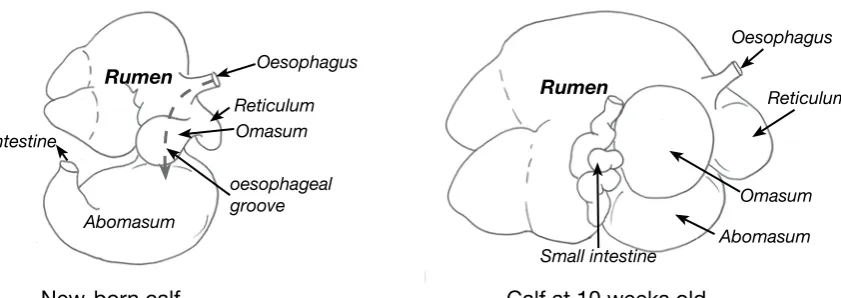
Feed eaten by cows is initially digested in the rumen by the mix of microbes present, and these rumen microbial lora must be kept healthy for the health and productivity ofthecow.Good-qualityforageprovidesthe
foundation of the ration; concentrates and by-products are added to provide additional energyandprotein.
Digestion is facilitated by continuous regur
-gitation (rumination) of plant ibre (cud) and chewingtoreduceparticlesize.Chewingpro
-motestheproductionofsaliva,whichcontains highlevelsofbufferingsaltsandsohelpsto maintainastablepHoftherumenluid.The rumen microbes break down plant cell con
-tentsandcellwalls,includingibres,fortheir ownmultiplication.Theyusetheplantprotein andderiveenergyfromsugarsandstarchs;in theprocess,theygeneratevolatilefattyacids (VFAs) that are absorbed through the rumen walltoprovidethemajorsourceofenergyfor thecow.ThemainVFAsareaceticacid(ace
-tate),propionicacid(propionate)andbutyric acid(butyrate).
The microbes are continually washed out of the rumen and are in turn digested further down the digestive system. This microbial proteinisanimportantsourceofenergyand proteinforthecow.
Thetypeandnumberofmicrobespresentin therumendependsonthetypeandqualityof feed in the ration. The microbes that break
-down ibre prefer a pH range of 6.2–6.8 whereasthemicrobesthatbreakdownstarch prefer a pH range of 5.2–6.0. Under normal conditions,thepHismaintainedat5.5–6.5by thebufferingactionofthesaliva.
Achieving optimal rumen function involves promoting maximum microbial growth, sur
-vivalandactivitywitharumenpHof5.8–6.4.
These cows will waste less than 5% of their feed.
Cows may trample and waste about 30% percent of hay fed in the field.
14 A guide to dairy herd management
Factorsthataffectruminationare: • orderinwhichtherationisfed • particlesizeoftheration
• numberoftimestherationisfedperday • typeofrationfed.
The stability of rumen pH is normally main
-tained by the inlow of saliva, the rapid absorption of VFAs from the rumen and the predominanceofaceticacidwithintherumen.
Order in which the ration is fed
There are numerous approaches to feeding cows.In‘componentfeeding’,ingredientsare fed separately; this gives variable intakes of differentcomponentsandresultsinanunbal
-anceddiet.Thegreatestriskassociatedwith component feeding occurs when concen
-tratesarefedbeforetheforagesasthisleads torapidfermentationintherumenanddisrup
-tionofthenormalrumenlora.
Foragesshouldalwaysbefedbeforeconcen
-trates,ortheingredientsmixedtogetherasa ‘Total Mixed Ration’ (TMR), to promote con
-sumptionofabalancedration.
Particle size of ration
Allforagepiecesmustbelongerthan11mm butwithonly10%oftherationbeinglonger than40mm.Thiswillstimulatebolusformula
-tion,increasechewingandsalivaproduction and hence increased buffering. The overall affectistoimprovetheruminationprocess. Iftheforageiscuttooshort,ruminationand saliva production will be reduced, with the increasedriskofthecowdevelopingruminal acidosis.Iftheparticlesizeistoolong,diges
-tion will slowed, reducing feed intake and limiting the availability of nutrients for milk production.
Number of times the ration is fed per day Feeding a cow more than once per day stimulates continuous saliva production and buffering, which helps maintain a stable rumenpH.Cowsarealsostimulatedtoeatby thepresentationoffreshfeed.
Type of ration fed
A ration high in roughage is associated with a rumen pH of 6.5 whereas a ration high in
concentrate is associated with a rumen pH of 5.5. Prolonged acidic conditions within therumenincreasetheriskofdamagetothe rumenpapillaeandtheircapabilitytoabsorb nutrients.
Nutritional requirements
The nutritional requirements of the cow changewithgrowth,pregnancyandlactation. Most health-related problems and deaths in mature dairy cows occur within 60 days of calving. Correct management of the ‘transi
-tion period’, which covers the month before and the month after calving, is particularly important. Good reproductive management withaccuratepregnancydeterminationestab
-lisheswhenthecowisduetocalveandthat thecorrectrationsarefedtotherightcowat therighttime.
Thedailymaintenancefeedintakeofanon-pregnant mature cow is about 1.2% of her body weight per day—a 600kg cow needs toeatabout7.2kgofgood-qualitydrymatter per day. The amount of dry matter fed to heavily pregnant non-lactating cows should bearound2%ofbodyweightor12kgDMto meettheneedsofthedevelopingfoetus.The cow’sappetitewilldeclineduringthelast3–4 weeks of pregnancy, particularly during the lastweekofgestationwhendrymatterintake maybereducedby50%.
Thusappetiteisdecreasingwhilethenutrient requirements of the developing calf and the cowareincreasing.
Threecommonnutritionalproblemsthatoccur aroundthetimeofcalvingare:
• negativeenergybalance(ketosisandfatty liver)
• hypocalcaemia • ruminalacidosis
Negative Energy Balance–Theirstaimofthe transitionrationistominimisetheenergydef
-icit experienced by the cow in the face of a decliningappetitebyaddingconcentratesto herrationduringthelast3–4weeksofpreg
-nancy.
Cows that experience excessive negative energybalancearemorelikelytoretaintheir placenta,developmetritis,anddisplacetheir stomach.Thesecowsalsotakelongertoget
pregnantincreasingtheriskofcullingdueto conceptionfailure.
Hypocalcaemia–High-producingoldercows are prone to experiencing a rapid decline in bloodcalciumaroundthetimeofcalving.This relects the large amount of calcium that is incorporated into the milk produced by the cow. The second objective of the transition rationistominimisethedeclineinbloodcal
-cium around the time of calving to prevent cowsfromgoingdownwithmilkfever(weak
-nesscausedbylowbloodcalcium).
Oldercowsaremorelikelytohaveproblems with milk fever than heifers. Cows that suc
-cumb to milk fever are more likely to have calving dificulty, retain their placenta, and have problems with mastitis than cows that donot.Lessthan2%ofcowsshouldexperi
-enceproblemswithmilkfever.
A high incidence of milk fever indicates a nutritionalmanagementproblem.
Strategiestopreventmilkfeverinclude: • ensuring that there is adequate magne
-siumintherationbyincluding50gramsof magnesiumoxideperheadperdayinthe feed during the last 3–4 weeks of gesta
-tion.
• keepingthefatcontentofthedietbelow 4% during the last 3–4 weeks as excess fat binds to magnesium preventing its absorptionintherumen.
• feedingadietlowincalcium,typicallyby feeding higher levels of cereal hays such as oaten or wheaten hay that are low in calcium. However, it is often dificult to
indfeedstuffsthatarelowincalciumbut provide enough energy and protein to overcomethenegativeenergybalance. • feeding a diet that contains low levels of
potassium and higher concentrations of chloride and sulphur by feeding forages that are low in potassium and adding salts such as calcium chloride or ammo
-nium sulphate to the feed. As the salts are not very palatable, it is important to monitor how much the cows are eating to avoid inducing negative energy bal
-ance. Commercial salt preparations such as Biochlor (Arm and Hammer Animal Nutrition) are reported to be more palat
-able.
Ruminal acidosis – Lactation dramatically increases the feed requirements of high-producing dairy cows. An extra 5kg of high-quality dry matter should be added to the maintenance ration per 10 litres of milk produced;high-producingcowscanconsume 4%oftheirbodyweightindrymatterperday at peak lactation when fed highly digestible feed.Abruptincreasesintheenergycontent of the ration causes excessive fermenta
-tion (ruminal acidosis) and disrup-tion of the microbes in the rumen. Gradual increases in theenergycontentoftherationbeforecalving promotegradualadjustmentsinthemicrobes intherumenallowingthecowtosafelyeatthe higherenergylactating-cowration.
Feeding the milking cow
Milkproductionisdrivenbydrymatterintake, whichisinluencedbythequality or digest-ibilityofthefeedfed.Poor-qualityfeedtakes
longer to digest and therefore limits the amountoffeedacowcaneateachdayand theamountofnutrientsavailabletoproduce milk.Whenthenutrientoutputinmilkexceeds theamountofnutrientsingestedduringearly lactation, cows lose weight. Excessive loss of weight or ‘Body Condition’ during early lactationisassociatedwithreducedmilkpro
-ductionandanincreasedriskofdisease.
Milk fat and milk protein
Rations high in starch or non-ibre carbohy
-drate are fermented to propionic acid and have the greatest inluence on milk protein.
Cows with milk fever need immediate injection with calcium boro-gluconate.
16 A guide to dairy herd management
Rations high in ibre are fermented to acetic acidandhavethegreatestinluenceonmilk fat.
Atleast60%oftherationshouldbeforageas lowerlevelswillreducemilkfatandincrease theriskofruminalacidosis.Thequalityofthe foragedeterminestheintakeanddigestibility ofaration.
Milkproteinisdependentonthetotalintakeof digestibleenergy.Acoweatinglargeamounts of high-quality feed will produce milk with a highmilkprotein(>3.3),whereasacowcon
-suming small amounts of low-quality feed willproducemilkwithaverylowmilkprotein (<2.9).
Theratioofmilkproteintomilkfatindicates the energy and ibre balance in the ration. A milk protein to fat ratio of 0.81–0.85 indi
-catesthatthecowiswellfedandtheration isbalanced.Aratiooflessthan0.75indicates insuficient energy; a ration above 1.00 sug
-gestsinsuficientibreintheration.
Manipulating nutrition to improve milk production
Themajorinluencesonmilkproductionfrom the herd are nutrition, cow comfort and the demographics of the milking herd, which is determinedbythereproductivemanagement of the cows. Dairy herds respond to nutri
-tionwhenthecowsarenotstressedbypoor comfortandtheherdisnot‘stale’withahigh proportionofcowsinlatelactation.
Feeding the non-lactating or ‘dry’ cow
Milk production over the cow’s lifetime is increased when she is not milked for 50–60 days between lactations. Stopping milking isreferredtoas‘dryingoff’andthenon-lac
-tatingperiodasthe‘dry’period.Ideally,cows should be dried off in the body condition in whichtheyshouldcalve;thisisabodycondi
-tionscoreof3.25onascaleof1to5(where1 isveryskinnyand5veryfat).Drycowsshould be heavily pregnant and should not lose weightduringthedryperiod.
Theamountofdrymatterfedtoheavilypreg
-nant non-lactating cows should be around 2% of bodyweight, or 12kg of good-quality drymatterfora600kgcow.
Thelossofappetitearoundcalvinghastobe minimised.Asaftershehascalved,thecow will be fed a high-energy ration, she should be fed increasing amounts of energy from 4 weeks before calving to allow the rumen to adjusttothenewdiet.
Useful resources
• NutritionresourcesontheDairyAustralia website. http://www.dairyaustralia.com. au/SpeciicresourcesincludeGrains2milk, Feeding systems, Home grown feeds, bought in feeds and nutrition manage
-ment.
• DairyCo'sFarmInfoCentercontainsinfor
-mation on a diversity of topics including nutrition. http://www.dairyco.org.uk/ about-us/what-is-dairyco.aspx
• TheUniversityofPennsylvaniaCooperative Extension site describes the equipment requiredforandtheprocessofmakinghay. http://bedford.extension.psu.edu/agricul
-ture/BeginFarmer/HayMakingEquipment. htm
• Theinfovetswebsiteonhowtocondition score dairy cattle. http://www.infovets. com/healthycowinfo/A084.htm
• The Nutrient Requirements of Dairy Cattle (Seventh Edition 2001) outlines the nutritional requirements of all classes of dairy stock and the nutrient values of common feedstuffs. It can be previewed attheNationalAcademiesofPressweb
-site. http://www.nap.edu/openbook. php?isbn=030906997.
Cow soon to calve. Note constant access to fresh water and feed and quiet low-traffic area to avoid disturbing the herd when she goes into labour.
Feeding high-production cows
Water
Lactating dairy cows need 60–70 litres (L) of water each day for maintenance, plus an extra 4–5L for each litre of milk produced. Water in-take is influenced by the size of the cow, dry matter intake, ambient temperature and hu-midity, and milk production. During hot weath-er, high-producing cows may drink up to 200 litres of water per day.
As cows drink 50–60% of their daily water intake immediately after milking, the water trough must provide 75cm of linear trough space per cow for at least half of the cows in the milking parlour when exiting the parlour. When cows are housed, there should be a minimum of two water sources per group in the areas where the cows are housed and they should never have to walk more than 20
metres to get a drink of water. Water sources should be close to feed bunks.
Clean water is especially important.
Filling capacity of water troughs
Cows should never have to wait for a slow-filling trough. Water pipes should be 75mm in diameter with sufficient pressure to provide 20L per cow per hour to cope with peak de-mand. Shallow troughs (15–30cm depth) are better than deep troughs as the more rapid turnover of water avoids stagnation; they are also easier to clean.
Feed intake and milk production are de-pressed when access to water is restricted.
3 Feeding management
Key points
•Good-quality feed and water should always be available.
•Sufficient feed bunk and water trough space will minimise competition at the feed bunk.
•Milking cows need a lot of drinking water— as much as 150–200 litres per day for high-producing cows during the hot season.
•Most forages will support only 6–8kg of milk/cow/day, and must be supplemented with high-energy concentrates.
•As a general guideline, feed 1kg
concentrate for every 2kg of milk produced above that supplied from forages.
•Better decisions can be made if the feeding value of the forages and concentrates, and their costs are known.
•Diets should be balanced for energy, protein, fibre and certain minerals for optimum cow performance and to prevent any metabolic problems.
•A well-balanced ration will give production only if enough is fed.
•Simple observations of the cattle can identify problems with feeding management.
•Maximise feed intakes around calving and in early lactation by providing enough high-quality feed.
•Avoid sudden changes in diet when cows calve and join the milking herd.
•Do not overcrowd cows before and after calving.
•Manage first-lactation cows as a separate group to reduce bullying by older cows.
•Cows are social animals, and frequent changes in cow grouping can be disruptive; for example, introduce cattle onto the pre-calving ration once a week rather than daily.
‘If you would not be prepared to drink water like that in the trough, it is not clean enough for the cows’.
18 A guide to dairy herd management Forages and supplements
Milking cows should be fed at least 30–40kg of fresh good-quality forage daily (equivalent to 6–8kg of dry matter) to provide enough fibre for optimal rumen function. For optimum rumen function and hence milk production, the non-fibre carbohydrate (NFC) proportion of the diet should be 35–40% of dry matter. Milk fat will be reduced if NFC is above 40%, and NFC must be balanced with degradable protein so that degradable protein is 35% of NFC.
Effective fibre in a diet will be helped if all for-age is more than 11mm long but with only 10% greater than 40mm long. The ratio of for-age NDF to rumen-degradable starch should be higher than 1.1:1 to support