e-Journal of English Language Teaching Society (ELTS) Vol. 4 No. 1 2016 – ISSN 2331-1841 Page 1
THE EFFECTIVENESS OF USING
GRAPHIC ORGANIZER TO INCREASE
STUDENTS’ VOCABULARY MASTERY
Ririn Suryadi1, Jamiluddin2, Hastini3
Abstract
The objective of this research is to find out whether the application of graphic organizer can increase the vocabulary mastery of grade VIII students at SMPN 19 Palu or not. This research wasintact design group that involved two groups; they were experimental group and control group. The research population was the grade VIII students at SMPN 19 Palu. The sample of this research were class VIII C as experimental class and VIII B as control class which consisted of 17 students for each. In collecting the data, the researcher used non-test (observation) and test (post-test). The data were analyzed descriptively and statistically. The results of data analysis showed that there was a significant difference between the achievement of experimental and control groups. In other word, the t-counted (22.16) is greater than t-table (2.120). In this case, the research hypothesis was accepted. Furthermore, the researcherconcludes that graphic organizer can increase vocabulary mastery of grade VIII students at SMPN 19 Palu.
Keywords: Effectiveness, Vocabulary mastery, graphic organizer
INTRODUCTION
The teaching of English mainly involves two basic fields; language skill and language components. Language skills consist of listening, speaking, reading, and writing. Meanwhile, language components consist of grammar, pronunciation, spelling, and vocabulary. The teaching of language skills and language components has similar purpose in developing students’ knowledge of English and the students are expected to be able to
use English to communicate.
Vocabulary is one of the language components which must be mastered firstly by the students who want to learn or master English. By having or knowing sufficient stock of words, they can communicate well. It will be easier for students to understand reading material or passage and what the speaker says as well as to convey their ideas or thought in
1
e-Journal of English Language Teaching Society (ELTS) Vol. 4 No. 1 2016 – ISSN 2331-1841 Page 2 English. Lack of vocabularies will make students feel difficult to master English. In the teaching of English, the teacher has to teach vocabulary to the students properly.
Vocabulary mastery influences the students’ ability in achieving their language
skills. The students cannot transfer their ideas and information to other people if they have less number of vocabularies. The teaching of vocabulary to junior high school students is actually to build students’ familiarity to English words and their meaning which valuable
for the students to write English sentences. Therefore, they can use the words in their daily life as well as possible.
Vocabulary is important for students. The students can speak English if they have more stock of vocabulary. Therefore to write in English, the students also need vocabulary to arrange sentences. Beside that to understand the content of a simple reading text, the students need vocabulary as well and to listen to the precise word in English. Nunan (1999) argues vocabulary is more than list of target language words. As part of the language system, Vocabulary is intimated interrelated with grammar. Nunan further explains that it is possible to derive the lexical system of most languages into grammatical words such as prepositions, articles, adverbs and so on, and content words.
Based on the preliminary research, the researcher found that the eight grade students of SMP Negeri 19 Palu, faced some problems in learning vocabulary. They got difficulties in memorizing words, the students had difficulty to understand the meaning of English text given by the teacher because they do not have sufficient vocabulary, they were not able answer the questions from the text because they find it difficult to construct the answer based on their own words.
To overcome the problems, the researcher applied graphic organizer in teaching vocabulary. Kang (2004) defines a graphic organizer as a creative technique used to present complex information and convert it into a simple and meaningful graphic display of the relationships between concepts. According to Merkley and Jeffries (2001) states
when implementing graphic organizer teachers can have students verbalize the relationship or links among concepts expressed by the visual to open the opportunity for student input.
e-Journal of English Language Teaching Society (ELTS) Vol. 4 No. 1 2016 – ISSN 2331-1841 Page 3 understand and learn. Based on the explanation by the experts above it means that graphic organizer can help students to access pieces information from the text given by the teacher.
The object of the research is the eight grade students of SMP Negeri 19 Palu. Based on the problem, the researcher formulated the research questions as follows “Can
the application of graphic organizer increase the vocabulary mastery of the eight grade
students of SMPN 19 Palu?” The objective of this research was to find out whether the
application of graphic organizer can increase the vocabulary mastery of grade VIII students at SMPN 19 Palu.
METHODOLOGY
The researcher used intact group design with one class as an experimental group and one class as a control group. In this case, there were two classes given by the same test for post-test. In intact group design, there is no pre-test and the treatment is only given to the experimental group while the control group is not. The design of the research as recommended by Hatch & Farhady’s model (1982:21) as follows :
G1 X T1
G2 T1
Where :
G1 : Experimental group X : Treatment G2 : Control group T1 : Post-test
Population is the group of people who has the same characteristics. Arikunto (2002:108) states, “The total number of individual subject in a research”. The Population is
considered as a research subject. It is a group of people, things or events which are going to be investigated like Best (1981:8) states, “population is any group of individual that
have one or more characteristics in common that are interest for the researcher”. It means that population is the object of the research that will be analyze by the writer.
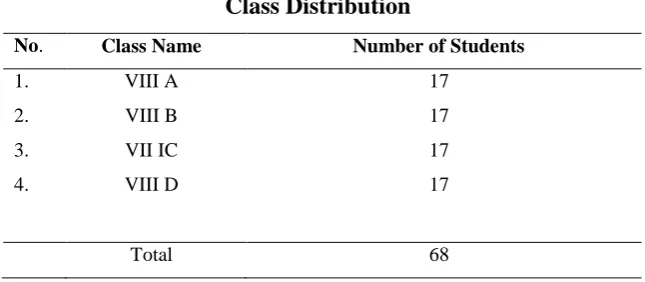
e-Journal of English Language Teaching Society (ELTS) Vol. 4 No. 1 2016 – ISSN 2331-1841 Page 4 Table 1
Class Distribution
No. Class Name Number of Students
1. (1981:8) explains , “ sample is a small proportion selected for observation and analysis”. In
taking sample of this research, the researcher used a purposive sampling technique. She
applied sampling technique because it is appropriate to the design of the research. Furthermore, the teacher of English at SMP Negeri 19 Palu recommended to conduct the research in those two classes because they still have problems in learning English vocabulary.
There were two variables: they were dependent variable and independent variable. Related to the title of this research, the effectiveness of using graphic organizer to increase vocabulary mastery of grade VIII students at SMPN 19 Palu. The dependent variable in this research was vocabulary of grade eight students at SMPN 19 Palu, while the independent variable graphic organizer.
In this research the data collected through observation and the test (post-test) as the research instrument. The data obtained from the observation are explained descriptively. The post-test are analyzed statistically. First, to count the individual score, the researcher used the formula stated by Purwanto (2008) as follow:
=
e-Journal of English Language Teaching Society (ELTS) Vol. 4 No. 1 2016 – ISSN 2331-1841 Page 5
formula written by Hatch and Farhady (1982:55) as follows:
=
The last, for getting the value of t-counted, the researcher computed the formula as follows as shown written by Arikunto 2002:275
t : significant difference between pre-test and post- test
: mean score of deviation ∑ : sum of square deviation
e-Journal of English Language Teaching Society (ELTS) Vol. 4 No. 1 2016 – ISSN 2331-1841 Page 6
FINDINGS
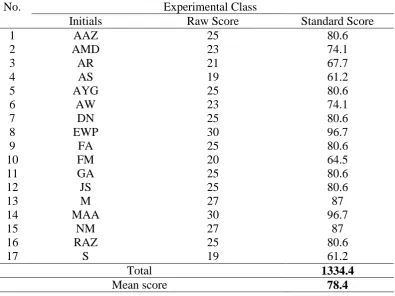
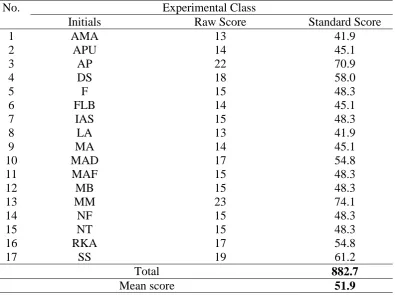
The researcher conducted post-test after the treatment in order to find out whether or not the use of Graphic Organizer was effective in increasing students’ vocabulary mastery. The post-test was given to the experimental and control group on 26thof October 2015. The results of the post-test are presented in Table 2 and 3.
It can be seen in Table 2, the highest score is96.7 and the lowest score is 61.2. After calculating the students score in posttest, the researcher computed students mean scores of experimental group post-test after treatment as follows
X =
X = 78.4
Table 2
The Students Score on Post-test in Experimental Class
No. Experimental Class
Initials Raw Score Standard Score
1 AAZ 25 80.6
2 AMD 23 74.1
3 AR 21 67.7
4 AS 19 61.2
5 AYG 25 80.6
6 AW 23 74.1
7 DN 25 80.6
8 EWP 30 96.7
9 FA 25 80.6
10 FM 20 64.5
11 GA 25 80.6
12 JS 25 80.6
13 M 27 87
14 MAA 30 96.7
15 NM 27 87
16 RAZ 25 80.6
17 S 19 61.2
Total 1334.4
Mean score 78.4
e-Journal of English Language Teaching Society (ELTS) Vol. 4 No. 1 2016 – ISSN 2331-1841 Page 7 the control group, the researcher computed the students’ mean score. The mean computation is presented as follows:
X
=
X = 51.9
Table 3
The Students Score on Post-test in Control Class
No. Experimental Class
Initials Raw Score Standard Score
1 AMA 13 41.9
2 APU 14 45.1
3 AP 22 70.9
4 DS 18 58.0
5 F 15 48.3
6 FLB 14 45.1
7 IAS 15 48.3
8 LA 13 41.9
9 MA 14 45.1
10 MAD 17 54.8
11 MAF 15 48.3
12 MB 15 48.3
13 MM 23 74.1
14 NF 15 48.3
15 NT 15 48.3
16 RKA 17 54.8
17 SS 19 61.2
Total 882.7
Mean score 51.9
From the counted data above, it shows that the post-test mean score of the experimental and the control groups are different. The mean score of the experimental group is 78.4 while the control group is 51.9. It proves that the students’ achievement of the experimental group after getting the treatment has greatly increased.
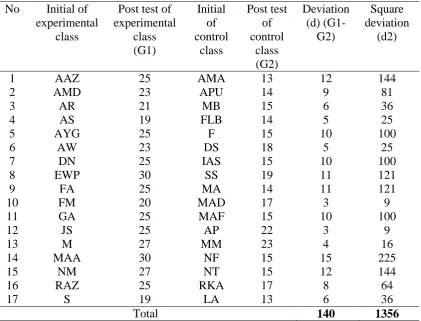
After calculating the mean score of students’ posttest for both experimental class and control class, the researcher computed the deviation and square deviation of the
e-Journal of English Language Teaching Society (ELTS) Vol. 4 No. 1 2016 – ISSN 2331-1841 Page 8 Table 4
Deviation of Experimental Class and Control Class
No Initial of
After computing the deviation score between experimental group’s posttest and
e-Journal of English Language Teaching Society (ELTS) Vol. 4 No. 1 2016 – ISSN 2331-1841 Page 9 x2d = d2 – ( d)2
N
x2d = 1356 – (140)2 17
x2d = 1356 – (19600) 17
x2d = 1356 – 1152.9
x2d = 203.1
To get the value of t-counted, the researcher computed the formula as shown below:
√
√
√
The result of the data analysis showed that the t-counted was 22.16 by applying 0,05 level significant with 16 degree of freedom (df) or 17-1 = 16, the researcher found that t-counted (22.16) was greater than t-table (2.120). It could be concluded that the research hypothesis was accepted.
DISCUSSION
e-Journal of English Language Teaching Society (ELTS) Vol. 4 No. 1 2016 – ISSN 2331-1841 Page 10 researcher did not used pretest, only posttest. In the process of treatment, the researcher used graphic organizer.
Graphic organizer is communication devices that show the organization or structure of concepts as well as relationship between concepts. It is a visual representation combining line, shape, space, and symbols to convey facts and concepts or to record information. The graphic displays which are designed to facilitate the teaching learning and textual material in the form of diagram that depict the relationships between fact, items, and ideas.
The researcher taught the kinds of vocabulary such as noun, verb, adjective include their meaning, and word use. During the treatment, the researcher used graphic organizer as a medium to improve the students achievement. In using the medium, the researcher gave the exercise to the students and asked them to identify the words in that exercise. After that the researcher asked them to make a simple sentence.
After conducting the treatment, the researcher gave the post-test to the students in the experimental class and the control class. The aim of posttest was to find out the improvement of students’ in vocabulary after the treatment. The result of posttest showed
that most of the students could get higher score than the students in control class. The mean score of post-test was 78.4 in experimental class the mean score of post-test in control class was 51.9. It showed that the mean score of the post-test in experimental class was higher than the post-test in control class. Graphic organizer is a great way to increase the students’ vocabulary mastery, it provide templates or frames for students or teachers to
identify pertinent facts, to organize information, and to record relationships between facts and ideas within a learning task that can improve the students’ vocabulary mastery.
Hall & Sabey, (2007) states Teachers should improve vocabulary instruction and provide strategies to help students deal with the increase in new and difficult words.Teaching vocabulary by using graphic organizer will help students to comprehend
information through visual representation of concepts, ideas, and relationships. The students will interested when learning English vocabulary because graphic organizer
represent line and picture.
In related to this research, other researchers also proved that the use of graphic organizer can increase the students’ English vocabulary mastery. The first research was
e-Journal of English Language Teaching Society (ELTS) Vol. 4 No. 1 2016 – ISSN 2331-1841 Page 11 by using graphic organizer has significantly better result than using conventional method. Febriansyah (2014) disscused about how to improve students reading ability using graphic organizer by applying classroom action research. The students’ achievement in pretest and posttest showed a significant improvement. The students’ mean score in the cycle 1 was
69. Meanwhile in the cycle 2, the students mean score was they got excellent score 82. Both researches showed that graphic organizer was effective to improve students English vocabulary mastery
CONCLUSIONS AND SUGGESTIONS
Having discussed and analyzed the data in the previously, the researcher draws conclusions. First, the use of graphic organizer is effective to increase the vocabulary mastery of the eight grade students of SMPN 19 Palu. Second, the result of test indicates that vocabulary of the eight grade students of SMPN 19 Palu is good enough. It can be seen from the mean score of post test between experimental and control class’. The mean score of the postest of experimental class’ (78.4) was greater than the mean score of control class’ post-test (51.9), it also was proved by t-counted value (22.16) which was
greater than t-table (2.120), it showed that applying by graphic organizer as a medium in teaching learning process can effectively improve the students vocabulary.
Based on conclusion above the researcher would like to offer some suggestions to improve the teaching and learning process in English particularly in vocabulary. Firstly for the students they should increase their words in English vocabulary in order to make them understand in learning English materials. They must develop their bravery in order to answer the questions from the teacher and ask the teachers’ instruction. Secondly for the teacher should motivate and encourage the students to be active in teaching learning process. Teacher should be creative to make the situation of class alive, in order to make the students enjoy in teaching learning process. Finally for the other researchers, the result
of this research can be used as input by those who to conduct about teaching vocabulary as reference.
REFERENCES
Arikunto, S. (2002). Prosedur Penelitian Suatu Pendekatan Praktik. Jakarta: Bina Aksara.
e-Journal of English Language Teaching Society (ELTS) Vol. 4 No. 1 2016 – ISSN 2331-1841 Page 12 Hall, K. M., & Sabey, B. L. (2007). Focus on the facts: Using informational texts
effectively in early elementary classrooms. Early Childhood Education Journal, 35, 261-268. http://dx.doi.org/10.1007/s10643-007-0187-2
Hatch, F and Farhady, H. (1982). Research Design and Statistic for Applied Linguistics. Los Angeles. New Houry Publisher Inc. University of California.
Kang, S. (2004). Using Visual organizers to enhance EFL instruction. Oxford University press.
Merkley, D. M. & Jeffries, D. (2001). Guidelines for implementing a graphicorganizer.
The Reading Teacher, 54 (4), 350-357.
Meyen, E. L., Vergason, G. A., & Whelan, R. J. (1996). Strategies for teaching exceptional children in inclusivesettings. Denver, CO: Love.
Nunan D. 1991. Language Teaching Methodology. Macquarie, University Sydney.