Financing social protection through debt
restructuring
Ecuador
Ecuador offers an excellent recent example of how restructuring sovereign debt can be used to create fiscal space for social development expenditures.
The idea of swapping debt for development has been around since the 1980s as a way out from the Latin American debt crisis. During the 1998-2008 decade, 18 debt swaps in 14 countries converted about US$608.8 million in debt into support for local development.
The Highly Indebted Poor Countries (HIPC) Initiative, launched in 1996 by the International Monetary Fund (IMF) and the World Bank, helped eligible countries reduce their debt service payments by about 1.8 per cent of gross domestic product (GDP) between 2001 and 2014. Linking debt relief to poverty reduction and social policies allowed these countries to increase their expenditures on health, education and other social services. On average, such spending is now about five times the amount of debt service payments.
However, only low-income countries could access HIPC. Other countries had to resort to debt restructuring. In recent years, more than 60 countries have successfully renegotiated and restructured debt, and directed debt servicing savings to development, including social programmes. It is now well accepted that countries can create fiscal space to increase social spending through debt restructuring linked to social programmes.
Main lessons learned
• Ecuador defaulted on its “illegitimate” debt and freed up public resources for expanding health care, education and social protection programmes. Social spending more than doubled from 4.8 per cent in 2006 to 10.3 per cent of GDP in 2011.
• The newly released public resources were also successfully used to help the economy recover from the 2008 financial crisis. GDP growth increased from 0.4 per cent in 2009 to 7.8 per cent in 2011, surpassing the pre-crisis growth rate of 7.2 per cent in 2008. • Debt restructuring enabled the
Government, through social and human development investments, to reduce poverty rates from 37.6 per cent in 2006 to 22.5 per cent in 2014, while the Gini coefficient (measuring inequality) declined from 0.54 to 0.47 during 2006-11.
• Contrary to critics’ expectations, Ecuador`s credit reputation did not suffer as its social investments are regarded as a developmental success. Ecuador was able to sell $2 billion worth of bonds in 2014 when it returned to the international capital markets.
S
o
cia
l P
ro
te
ct
io
n
in
A
ct
io
n
:
B
u
ild
in
g
S
o
cia
l P
ro
te
ct
io
n
F
lo
o
rs
A
u
g
u
st
20
1
6
1. Ecuador’s default on odious debt expands fiscal space
In 2008, Ecuador held an official audit to assess the legitimacy of its sovereign foreign debt. The government-commissioned, two-year investigation concluded that some of its foreign debts violated multiple principles of international and domestic law and were therefore deemed “illegitimate”. These were mostly private sector debts that had been nationalized by former Governments.
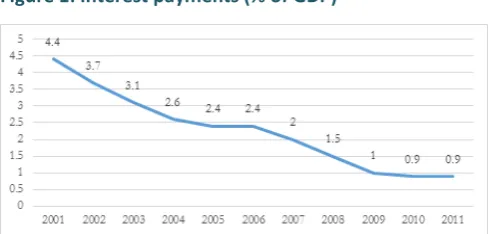
[image:2.595.305.544.61.199.2]While Ecuador respected all the debt that had contributed to the country’s development or the “legitimate” debt, it defaulted on two government bonds deemed “illegitimate”, by suspending payments, during the depth of the global financial crisis in December 2008. Ecuador then bought them back at the going price of 35 cents on the dollar and retired them. This resulted in a significant reduction in interest payments as a percentage of GDP (figure 1). The savings on principal and interest payments will amount to more than $7 billion over the period 2008-30. The freed up public resources were used for fiscal stimulus to cushion the impact of the 2008-09 global financial crisis and for expanding health care, education, social assistance and developing communications infrastructure.
Figure 1: Interest payments (% of GDP)
Source: Ray and Kozameh, 2012.
[image:2.595.36.284.415.532.2]One of the elements of fiscal stimulus was expanded access to housing financing through Bono de la Vivienda programmes and concessional mortgage loans issued through Ecuador’s Social Security Institute (IESS). The total housing loans in Ecuador grew by nearly 50 per cent in 2009, and IESS accounted for over half of all housing credit in 2011 (figure 2). This contributed to a construction boom in early 2010 and helped the economy recover quickly from the recession. The overall GDP growth rate increased from 0.4 in 2009 to 7.8 per cent in 2011, surpassing the pre-crisis rate of 7.2 per cent in 2008 and catching up its 20-year growth trend.
Figure 2: Expansion of housing credit by source (millions of US$)
Note: IESS = Loans issued through the Social Security Institute. Source: Ray and Kozameh, 2012.
2. Higher social spending
Public resources freed up in Ecuador through the debt write-down were invested in socio-economic development. Total social spending more than doubled from 4.8 per cent of GDP in 2006 to 10.3 per cent in 2011 (figure 3). Government spending on education doubled from 2.6 to 5.2 per cent of GDP during the same period. Social welfare spending, which included housing assistance programmes for low-income families and the cash transfer, Bono de Desarrollo Humano (human development bond), also more than doubled from 0.7 to 1.8 per cent of GDP. This resulted in the expansion of Bono de Desarrollo Humano’s coverage from 35.5 in 2005 to 44.3 per cent in 2010, the highest coverage rate among conditional cash transfer programmes in Latin America and the Caribbean.
Figure 3: Central Government public social spending (% of GDP)
Source: Ray and Kozameh, 2012.
3. Human development accelerates
The results of increased public social spending on human development made possible by debt restructuring are
[image:2.595.306.544.529.667.2]impressive. For example, the national poverty rate dropped from 37.6 per cent in 2006 to 22.5 per cent in 2014 (figure 4). This improvement is also reflected in the unemployment rate, which fell from 9.1 per cent in the 1st quarter of 2010 to 4.9 per cent in 2012.
Figure 4: Poverty rate and Gini coefficient
Source: Ray and Kozameh, 2012.
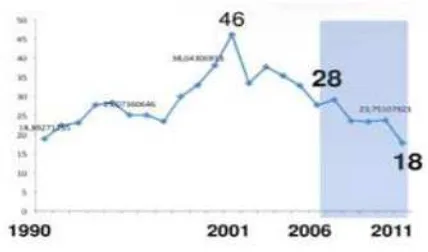
The Gini coefficient, a common measure of inequality, declined from 0.54 to 0.47 during 2006-11 (figure 4). The improvement in income distribution is also mirrored in the decline of the 90/10 income inequality ratio, which is the ratio between incomes of the richest 10 per cent and the poorest 10 per cent (figure 5).
Figure 5: 90/10 income inequality ratio
Source: Nehring, 2012.
The expansion of the Bono de Desarrollo Humano contributed to a sharp increase in the number of vaccinated children from 2.5 million in 2008 to 3.6 million in 2010. Between 2009 and 2015, 2,994,411 children under 5 years of age had preventive medical check-ups. More than 800,000 children received micro-nutrients and consumption of these nutrients has been monitored by children’s centres. During this period, 6,571,169 children under 5 years of age with medical issues were treated and 3,078,408 prenatal examinations were performed with the provision of micro-nutrients. Thus, infant mortality declined from 20.7 (per 1,000 live births) in
2006 to 17.6 in 2010, and child mortality fell from 26.6 (per 1,000 children under age 5) to 23.0 during the same period. There have also been dramatic increases in pre-primary and secondary school enrolment rates (figure 6).
[image:3.595.304.543.161.290.2]By the end of 2015, Ecuador had achieved 20 of the 21 Millennium Development Goals, some beyond the standard minimum target.
Figure 6: School enrolment ratios (gross)
Source: Ray and Kozameh, 2012.
4. Conclusion
Ecuador suffered repeated debt crises after the early 1980s and public external debt remained high (over 66 per cent of GDP) in 2000. “Structural adjustment” packages of liberalization, privatization and labour market reforms failed to reignite growth on a sustained basis while the country’s social and human conditions deteriorated significantly with more than 60 per cent of its population living in poverty in the late 1990s. Ecuador’s human development index (HDI) was 0.6 in 1980, which improved only marginally to 0.674 in two decades.
However, Ecuador’s socio-economic development since the beginning of the new millennium has been impressive. Ecuador’s HDI value for 2014 was 0.732, putting the country in the high human development category. Its social development accelerated since 2009 when it expanded its fiscal space by writing down its external debts that were deemed “illegitimate” in order to strengthen its social protection and increase social spending. Perhaps this explains why Ecuador’s credit reputation was not permanently damaged contrary to the general perception. It was able to sell $2 billion in bonds in June 2014 at its first return to the international capital market. Thus, Ecuador offers lessons for other developing countries on how to successfully restructure external debt for social development. Based on the experience of Ecuador, as well as Norway, a special United Nations
[image:3.595.46.260.414.540.2]Commission of Experts on Reforms of the International Monetary and Financial System came out in support of public debt audits as a mechanism for transparent and fair restructuring of debts. Debt audits are ongoing in several other countries, including Bolivia, Brazil, Greece, Ireland and the Philippines.
Debt management is one of the eight alternatives that countries have to expand fiscal space for social protection. Governments normally use a mix of taxes and social security contributions to fund social protection, combined with other options (Ortiz et al, 2015).
REFERENCES
Buckley, R. 2009. “Debt-for-development exchanges: The origins of a financial technique”, in The Law and Development Review, Vol. 2, No. 1, pp. 24-49.
European Report on Development. 2014. European Report on Development 2015: Financing and other means of implementation in the post-2015 context, Ecuador
country illustration. Available at:
https://ec.europa.eu/europeaid/sites/devco/files/erd5-country-illustration-ecuador-2015_en.pdf.
Fattorelli, M.L. 2014. Citizen public debt audit: Experiences and methods (Liège, CADTM and Geneva, CETIM).
IMF. 2016. Debt Relief under the heavily indebted poor countries (HIPC) initiative –
Factsheet (Washington, DC). Available at:
https://www.imf.org/external/np/exr/facts/hipc.htm.
Krugman, P. 1989. Market-based debt-reduction schemes, NBER Working Paper No. 1323. (Cambridge, Mass., National Bureau for Economic Research).
Nehring, R. 2012. Social protection in Ecuador: A new vision for inclusive growth, International Policy Research Brief, No. 28, August 2012, (Brasilia, International Policy Centre for Inclusive Growth).
Ortiz, I.; Cummins, M.; Karunanethy, K. 2015. Fiscal space for social protection: Options to expand social investments in 187 Countries, ESS Working Paper No. 48 (Geneva, International Labour Office).
Ray, R.; Kozameh, S. 2012. Ecuador’s economy since 2007 (Washington, DC, Center for Economic and Policy Research).
Salmon, F. 2009. Lessons from Ecuador’s bond default.. Available at: http://blogs.reuters.com/felix-salmon/2009/05/29/lessons-from-ecuadors-bond-default/
Building Social
Protection Floors
Country Note Series
August 2016
This note was produced by Anis Chowdhury. It was reviewed by Isabel Ortiz, Jeronim Capaldo, Hiroshi Yamabana and Stefan Urban of the ILO.
The editor of the series is Isabel Ortiz, Director of the Social Protection Department, International Labour Organization (ILO).
For more information, contact:
www.social-protection.org
INTERNATIONAL LABOUR OFFICE
4, route des Morillons 1211 Genève 22 Switzerland
Follow us on:
www.facebook.com/SPplatform www.linkedin.com/company/4835021 www.twitter.com/soc_protection www.youtube.com/user/ILOTV