ILO Social Protection Department | Botswana: Financing Social Protection through Taxation on Natural Resources
1
Financing Social Protection through Taxation
on Natural Resources
Botswana
Botswana has transformed from one of the poorest countries in the world at the time of its independence in 1966 to an upper-middle income country in 1989. It has avoided the adverse impacts of the “resource curse”, through appropriate policy and governance and set the foundation for balanced more inclusive development based on extending social benefits to the wider population, including a universal old-age pension.
Abundant natural resources of resource-rich countries can create the base for development, supporting social and socio-economic spending, technological advancement and overall economic growth. Yet, experience from around the world shows that being rich in natural resources may reduce a country’s development prospects (Sachs and Warners, 1995). This has been the case among countries in Africa such as Equatorial Guinea, Angola, Democratic Republic of Congo. This brief shows how Botswana successfully mitigated the risks encountered by resource rich countries and managed to translate resource wealth into socio-economic development.
Main lessons learned
• Natural resource rich countries can boost their social protection system through the taxation on natural resources, which increases government revenue and supports the expansion of social protection expenditures.
• The “resource curse” can be overcome by investing in social and socio-economic development, including social protection.
• Through the taxation on natural resources and the expansion of social protection spending, the government managed to reduce poverty rates, from 30.6 percent in 2003 to 16.3 percent in 2016, and improve health indicators far above average African standards.
• To mitigate the risk of depletion of natural resources and reduction of this source of income, the government of Botswana established a sovereign wealth fund, called “Pula Fund”, aiming at preserving part of the income from mineral exports for future generations.
The Recommendation on Social Protection Floors, 2012 (No. 202) stipulates establishing basic social security guarantees to ensure access to essential healthcare and income security for all, including children, people of working age and older persons.
The Sustainable Development Goal 1.3, part of the UN 2030 agenda, aims to implement nationally appropriate social protection systems and measures for all, including floors, supported by the Universal Social Protection partnership (USP2030).
This brief presents a successful experience of a country in extending social protection.
ILO Social Protection Department | Botswana: Financing Social Protection through Taxation on Natural Resources
2
1. Background
Botswana has been one of the world’s fastest
growing economies, averaging 5 percent per year over the past decade. Since independence in 1966, Botswana transformed from one of the poorest countries in the world to an upper-middle income country with a GDP per capita of around $7,000 in
2016. Mining has long been a dominant sector of the
Botswana economy and has been the largest contributor to GDP and government revenues. Yet, economic diversification is underway, with other sectors such as the services sector, construction and public investments playing an increasing role.
For most of the past 35 years, the mining sector has been successfully driving GDP growth, contributed significantly to government revenues and made up a large proportion of export earnings. Mineral revenues grew from 11 billion Pula (US$ 1.77 billion) in 2006 to 21 billion Pula (US$ 2.1 billion) in 2015 and amounted to 34 per cent of total government revenues in 2015.
Figure 1: Mineral and Government revenues as % of GDP and GDP growth, 2006-2015
Source: Central Bank of Botswana, World Bank.
Of the total government revenues stemming from the mining sector, 47.1 per cent was used to create fiscal space for social protection. Of this, 18 per cent was allocated to health, 22.3 per cent to education and 6.8 per cent to food and social welfare programmes, including community and social services.
This source of revenue helped to reduce the national poverty rate from 30.2 per cent in 2002 to 16.3 per cent in 2016, mainly through the financing of social protection programmes, including health care,
non-contributory old-age pension, school feeding programmes and various social assistance programmes.
Botswana collects revenues from the mining sector through various mechanisms. These include royalties, variable tax rates applicable to mining companies based on profitability, dividends and withholding taxes. The fiscal regime is laid out in various laws and has little scope for project-by-project negotiation contributing to the predictability and objectivity of the fiscal regime. Exploration contracts with mining companies have been typically set up as a 50/50 joint venture between the Government and the mining companies. In the case of diamond mining, for instance, the government has a 50 per cent share in the mining business that is run by an international mining company namely De Beers Group.
Figure 2: Composition of mineral exports, 2012
Source: Koitsiwe and Adachi, 2015.
Mining of diamonds has been the largest contributor to the GDP and exports. Diamonds have contributed on average well over 80 per cent of total export value within the last decade and 83 per cent in 2012. As seen in Figure 2, copper/nickel, soda ash, and precious metals (gold) also contribute to Botswana’s GDP and export value. While government revenues from diamond mining peaked in 2017, a sharp fall is projected from 2021 onwards due to the depletion of the resource. With the decline of diamond mining and the recent discovery of large coal deposits in the country, coupled with increasing global coal demand, especially from South East Asia, coal is likely to play an increased role for revenue generation in the future. At the same time diversification of the economy will
83% 9%
2%1% 5% Diamonds
Copper-Nickel Soda Ash
ILO Social Protection Department | Botswana: Financing Social Protection through Taxation on Natural Resources
3
continue, with other non-mineral sectors increasing their role in the economy and in government revenue.
To ensure a smooth transition into less resource rich times in the future, the government of Botswana established a sovereign wealth fund, called “Pula Fund”, in 1996. The fund aims at preserving part of the income from diamond exports for future generations. It currently holds investment assets at a market value of US $6.9 billion, with 63 per cent invested in long-term fixed income and 37 per cent in equities.
2. The natural resource curse
While being rich in natural resources is perceived an advantage, reality shows that it often reduces the development prospects of a country (Sachs and Warners, 1995). Natural resource rich countries often face the following four risks.
First, countries that heavily rely on natural resource exports can suffer due to the inflow of foreign currency. The foreign currency inflows lead to a national currency appreciation, making the export of other goods less competitive internationally. If the benefits of the booming natural resource extraction industry are not shared sufficiently with the rest of the population, it will lead to a lopsided development, benefiting a few and deteriorating the competitiveness of other industries. This risk is also referred to as the “Dutch Disease”. Possible measures to mitigate or overcome the effects of the Dutch Disease include public investments, investments to support the competitiveness of other industries, investments in human capital, including investments in social protection (e.g.: health, education, social security).
Second, the volatility in international prices and demand can lead to volatility in government revenues, creating uncertainty in medium and longer term budget planning, especially in countries where mineral resource revenues play a dominant role in government finances. Volatility will also affect foreign direct investment (FDI) inflows, as volatility is perceived as a risk, reducing both local and foreign investments. These volatility related effects are often referred to as “Volatility Risk”. A possible solution in this regard is to delink government expenditure and revenue, setting up, for instance, a stabilisation fund that serves as a
savings pool during boom, building reserves for times of economic downturn and effectively enabling the government to act in a contra-cyclical stabilizing manner. Another measure to mitigate the effects of the volatility risk is to diversify government income and to decrease the dependency on one particular income source.
Third, weak government institutions can increase the likelihood that natural resources and their respective government income will be mismanaged. The presence of natural resources may in fact weaken or corrupt government and lead to a lack of transparency and accountability. There is also evidence that natural resources provoke internal conflicts (such as civil wars and coups), which will eventually lead to additional scope for mismanagement. This risk is referred to as the “Governance Risk”. Fiscal and political decentralization as an institutional arrangement for natural resource rent-sharing within a country can be one way to contribute to internal stability.
Fourth, natural resources are often limited and can lead to an economic slump if no longer-term transition plans are put in place. As politics can often tend to be short sighted, limited by legislature periods, countries may not prepare sufficiently for when government revenues from natural resources end, underestimating the “Exhaustibility Risk”. Setting up stabilisation and sovereign wealth funds, saving for future consumption and building human and financial capacities can help in smoothening the transition into less fortunate times.
In the case of natural resource extraction being carried out by foreign companies, which is often the case in low and lower middle-income countries, it is furthermore important to highlight the risk of cooperation and mining agreements not reflecting the long-term interests of the mineral resource owning country. Ensuring that knowledge, technology and skills are transferred to the local labour market and that labour is employed locally, instead of importing staff from abroad is key in ensuring that the benefits from natural resources are shared among the population to the best possible.
ILO Social Protection Department | Botswana: Financing Social Protection through Taxation on Natural Resources
4
Botswana, being a resource rich country, managed to overcome the threats mentioned above and utilized its mineral resources for generating fiscal space for social and socio-economic development which at the same time helped the country to mitigate the resource curse in the first place, thus creating a reversed positive effect.
The Dutch disease was avoided by significant investments in human capital and public goods, including social protection and infrastructure. The volatility curse was overcome by establishing saving funds and using government instruments that dis-incentivise pro-cyclical government spending, thus de-linking public expenditure from revenue. The governance curse at the same time has been detained by building a transparent and law-abiding government. The exhaustibility risk is not yet overcome as resources are not exhaust. However, the government started diversifying its sources of revenue, decreasing its dependency on natural resources.
Most importantly the Government applies a strict policy principle according to which all mineral revenues must be saved or reinvested into economic, social and human capital, following the assumption that these types of investments offer higher rates of returns than financial assets. Allocating fiscal resources to social protection therefore has high priority and is used as an important policy instrument.
Figure 3 illustrates government expenditures in the area of health, education and the social sector. Unlike other African countries, where development partners are heavily involved in providing financial and technical support, Botswana finances its comprehensive social protection system out of its own domestic resources, with mineral revenues playing a key role.
In 2017, public social protection expenditure amounted to 4.4 per cent of GDP (UNICEF, 2017)), which in most part was covered through the general government budget (of which a part is financed through natural resource revenues) and social contributions to contributory schemes.
Figure 3: Health, education and social sector expenditure (as % of Gov. Revenue), 2015
Source: WDI, World Bank, UNICEF.
4. Overview of the social protection system in Botswana
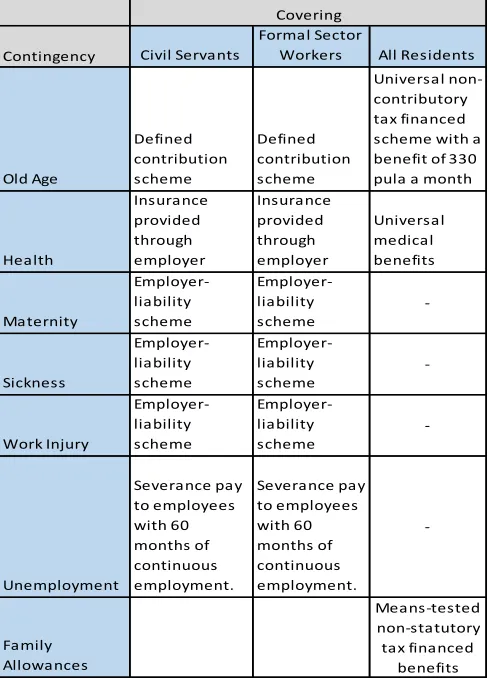
The social protection system in Botswana provides protection against a series of risks, Old-age, disability and survivors benefits are provided through a universal social assistance system, with the expenses fully covered by the Government.
Universal old-age pension (330 Pula per month (equivalent to 44 % of the 1.9USD per day poverty line) is provided to every citizen with a valid national identity card from age 65, while disability pension (300 Pula per month) is paid to persons registered with severe disabilities. Moreover, a monthly electronic food voucher worth 600 to 800 Pula, depending on the local authority, is also provided under the destitute program. In addition, the Government provides survivor benefits of 450 Pula a month (Morgan et al, 2017).
The Government moreover provides non-contributory universal medical benefits, as well as other benefits such as family allowances. There is also a work injury scheme in place as well as a sickness and maternity scheme, both operating under employer liability principals. Under the work-injury scheme, Sickness benefits are paid to 100 percent of the employee`s basic earnings for a minimum period of 20 days of certified sick leave per year. Civil servants and formal employees have access to a contributory pension scheme that is based on individual accounts.
ILO Social Protection Department | Botswana: Financing Social Protection through Taxation on Natural Resources
5
market programmes are in place to support workers re-integration into the labour market.
Figure 4: Provisions under Botswana`s Social Protection framework
5. Conclusion
Natural resources’ exploitation has been the backbone of the country’s economic growth and social development in Botswana.
Botswana’s success till date has been impressive. Botswana managed to overcome the threats of the resource curse and utilized its mineral resources to finance social development. Investing in social protection, including health and education and other social services played a vital role in setting the nation and the economy on an inclusive growth path and in ensuring that pitfalls of the resource curse are avoided. This inclusive growth path is also in line with the national “Vision 2016” statement of the government, expressing the need to maintain a compassionate and caring society. Social protection is a strong and central expression of this vision.
Poverty has been significantly reduced; health indicators improved far above average of African countries with maternal mortality rates being at 16 death per 10,000 live births compared to an average of 47.7 in Africa, and education is available to a wider population. Mineral revenues as a share of total government revenues amounted to 40-60 per cent over the last two decades and contributed significantly to Botswana`s development.
Although social protection provision in Botswana are more comprehensive than those in other African countries, there is still scope for improvement as the current provisions financed from the government budget consist of a mix of universal and targeted programmes with the risk of excluding people in need. Moreover, better protection could be provided in line with the economic development by raising existing standards, improving the adequacy of benefits, and by adding new social protection benefits to protect against risks that are currently not sufficiently covered. Under the current provisions, maternity, sickness, work injury and unemployment benefits are only provided to people working in the formal or public sector, thus excluding a large share of the population. The expansion of contributory benefits could moreover enable the system to formalize those in the informal economy. This should be accompanied by more social assistance cash transfers to raise living standards of low-income populations.
Since the global financial crisis of 2008-09, Botswana has faced several years of reduced economic growth and budgetary constraint. Future projected decline in diamond mining will pose a challenge. The government’s efforts in designing its long-term policy to manage its transition to a less resource dependent economy are crucial. Compensation by improved export revenues from coal and gold may ease the transition, but may not fully replace the decline in diamond exports. Continued economic diversification into other economic sectors, including renewable energy, seems to be unavoidable to ensure that the financing and implementation of social protection programmes can be sustained.
ILO Social Protection Department | Botswana: Financing Social Protection through Taxation on Natural Resources
6
REFERENCES
AfDB. 2016. Botswana`s Mineral Revenues, Expenditure and Savings Policy – A Case Study, African Natural Resource Center, Aftrican Development Bank Group, Abidjan.
Collier P. 2015. Social Protection in Resource-Rich Low-Income Countries, Centre for the Study of African Economies, Department of Economics, Oxford University. A paper prepared for the European Development Report, 2010
The Herald. 2018. “Population living below poverty line falls in Botswana”, 20. Jan, 2018. Available at: www.herald.co.zw/population-living-below-poverty-line-falls-in-botswana/
Koitsiwe K., Adachi T. 2015. Relationship between mining revenue, government consumption, exchange rate and economic growth in Botswana Akita University, Graduate School of Engineering and Resource Science, Japan. Lewin. M. 2011. Botswana`s Success: Good Governance, Good Policies, and Good Luck, World Bank, Washington DC.
Moran, T.H. 2013. Avoiding the “resource curse” in Mongolia, Policy Brief Number PB13- 18 (Washington, DC, Peterson Institute for International Economics).
Morgan R. et al. 2017. Universal old-age pension in Botswana. Universal Social Protection Interagency brief series (ILO, Geneva)
Ortiz, I., Cummins M. Karunanethy K. 2015. Fiscal Space for social protection: Options to expand social investments in 187 Countries, ESS Working Paper no. 48 (ILO, Geneva).
Stürmer M. 2010. Let the Good Times Roll? Raising Tax Revenues from the Extractive Sector in Sub-Saharan Africa During the Commodity Price Boom. Discussion Paper 7/2010, German Development Institute. UNDP. 2011. Managing Natural Resources for Human Development in Low-Income Countries. Working Paper, Regional Bureau for Africa, United Nations Development Programme.
UNDP - UNEP 2013. Policy Brief: Natural resource and poverty in Botswana: development linkages and economic valuation – Key findings, analyses and recommendations from an Economic Study. UNDP – UNEP Poverty – Environment Initiative (PEI), Poverty Eradication Unit, Office of the President, Gaborone, Botswana. UNICEF 2017. “Social Protection Budget Brief”, United Nations Children`s Fund, Botswana. Available at: https://www.unicef.org/esaro/UNICEF-Botswana-2017-Social-Protection-Budget-Brief.pdf
Global Partnership for Universal Social Protection. 2016. Universal Old-Age Pension in Botswana, Universal Social Protection Series (Washington, DC, World Bank; Geneva, ILO.
Social Protection
Floors in Action: 100
success stories to
achieve Universal
Social Protection
and SDG 1.3
This brief was written by Stefan Urban, and reviewed by Fabio Duran, Kelobang Kasiganyo and Hiroshi Yamabana of ILO.
The Social Protection Floors in Action brief series is edited by Isabel Ortiz, Valerie Schmitt and Loveleen De, Social Protection Department, International Labour Organization (ILO).
For more information, contact: [email protected]
www.social-protection.org
INTERNATIONAL LABOUR OFFICE
4, route des Morillons 1211 Genève 22 Switzerland
Follow us on: