INVENTORY POLICY OF MEDICINES AND MEDICAL EQUIPMENT IN
CENTRAL OPERATION THEATRE DEPOT OF XYZ GENERAL HOSPITAL
BANDUNG USING PERIODIC REVIEW (R,s,S) AND JOINT REPLENISHMENT
Valdy Septyano1, Dida Diah Damayanti2, Budi Santosa3
1,2,3Bachelor Program of Industrial Engineering, Industrial Engineering Faculty, Telkom University
1[email protected], 2[email protected], 3[email protected]
Abstract
XYZ General Hospital is an A class teaching hospital which is a referral hospital that serves primary healthcare in West Java province. To serve patients, XYZ General Hospital has pharmacy warehouse which provide fifteen depots in particular ward. This research is being carried in Central Operation Theatre (COT) depot that serves central surgery ward. Central surgery ward serve major and minor operation which needs
both medicine and medical equipment. To minimize cost, it is necessary to optimize inventory policy of
medicines and medical equipment. ABC-VED classification was performed to determine classification of medicines and medical equipment which results are I priority and II priority category. Periodic review and joint replenishment were performed to determine R (periodic interval), s (reorder point), and S (maximum inventory) and T (periodic interval) and Q (lot size). Using proposed model, XYZ General Hospital optimize cost up to 77.75% for I priority and 79.09% for II priority.
Keywords: ABC analysis, VED analysis, Hadley-Within, Periodic review (R,s,S), Joint replenishment.
1. Introduction
The existence of inventory in daily activity cannot be avoided whether in personal activity, household, social, or business activity. Inventory can be categorized as working capital in goods form. Its existence can be considered as liability because it is a waste, but also can be asset that has cash value [1].
The term of inventory is usually used in business realm such in manufacturing. Nevertheless, inventory is used not only in manufacturing but also in medical services such as in hospital. In hospital, inventory is used as a prevention act to avoid out of stock in supplies. Needs of supplies such as medicine and medical equipment are important for hospital to comply service level to patients as customers.
XYZ General Hospital is an A class teaching hospital which is a referral hospital that serves primary healthcare in West Java province. To serve patients, RSHS has pharmacy warehouse which provide fifteen depots in particular ward. Those fifteen depots are emergency room, intensive care unit (ICU), central operation theatre (COT), RWI 1, RWI 2, JKN, OPD, DOT, MDR, Metadon, ODS, RIK, DFP, and Teratai. Each depot makes their own policy to order supplies to warehouse.
This research was being carried in Central Operation Theatre (COT) depot that serves central surgery ward. Central surgery ward serve major and minor operation which needs both medicine and medical equipment. COT depot specifically serves major operation. There are thirteen operating rooms which nine are for elective surgery and four for emergency surgery. Elective surgery is a scheduled base surgery. The schedule is made one day before the surgery. In the other hand, emergency surgery is unscheduled surgery which the event is sudden and not known. To be able to give the best service to patients, COT depot are required to be able to make inventory policy in order to fulfill service level to patients. COT depot makes purchase order every once a month.
A
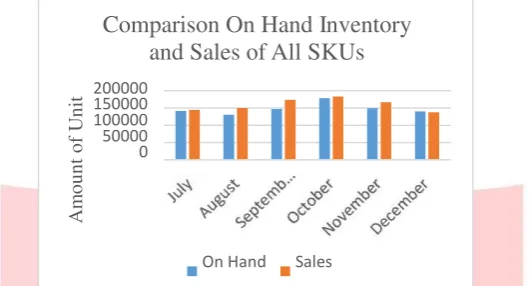
Figure 1 Comparison On Hand Inventory and Sales Of All SKU in COT in July-December 2014 (Source: XYZ General Hospital)
Figure 1 shows the overall difference between on hand inventory and sales in COT. In July, August, September, October, and November the amount of sales is higher than the on hand inventory which indicates some problem occur in COT depot. Higher amount of sales means that COT depot has shortage supplies and has to use other depot supplies which cause disruption to other depot inventory planning. Although the aggregate data show that every month shortage of supplies are occurred, in fact, overstock is the other problem occurs in COT depot as shown in
Figure 2 Comparison of Overstock and Out of Stock Supplies Of All SKU in COT in July-December 2014 (Source: XYZ General Hospital)
Figure 2 Total Value of Overstock Supplies (Source: XYZ General Hospital)
Figure 2 shows the condition of overstock supplies. Overstock supplies induce embedded cost as shown in Figure 3. Total value of overstock that occurred reach six hundred million Rupiah in July while that amount of money can be used to optimize other aspects in hospital such as infrastructure.
Figure 2 also shows the condition of shortage or out of stock supplies. Out of stock supplies affect other depot planning since COT depot will use other depot supplies to keep their service level to patients. The disruption of other depot inventory affects its inventory planning and will affect inventory planning of pharmacy warehouse as well. The disruption in warehouse planning results in an insurgency in inventory supplies in the hospital. The occurrence of overstock and out of stock caused by inappropriate method to determine the amount of order to warehouse. Method being used is by projecting on hand inventory and by considering personal judgment.
From “Pharmaceutical Inventory Management Issues in Hospital Supply Chains” journal[2] it is said that,
Classification A B C inventory policy by determining the amount of order quantity, safety stock, and also reorder point for each period.
.
2. Inventory Policy for COT Depot of XYZ General Hospital
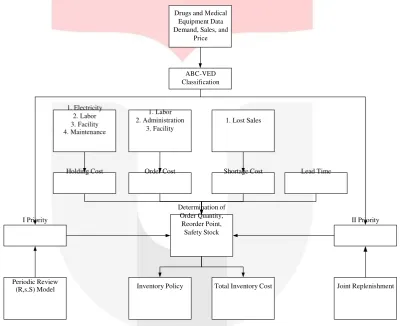
Data needed in this research are demand of medicines and medical equipment, sales of medicines and medical equipment, lead time, holding cost, shortage cost, and order cost. Those data are then to be used as input for policy calculation. First, data of medicine and medical equipment are classified into ABC-VED classification which later will be classified into two categories, I priority and II priority. I priority will be calculated using periodic (R,s,S) model and II priority using periodic (R,S) model. Expected output from calculation is inventory policy of both priority which are periodic interval, maximum order lot size, and safety stock.
Drugs and Medical
Holding Cost Order Cost Shortage Cost Lead Time
I Priority
(R,s,S) Model Inventory Policy Total Inventory Cost Joint Replenishment
Figure 4 Conceptual Model of Research
2.1 ABC and VED Classification
Medicines and medical equipment that have been classified into ABC and VED classification then are categorized into ABC-VED classification. The result of classification is I priority and II priority medicines and medical equipment. I priority is medicines that need more accurate controlling and II priority is less priority than I priority.
2.2 Periodic Model (R,s,S)
1. Cost Analysis
To calculate expected total cost can be used equation as follow[1]:
�� = �𝑏 + �𝑝 + �� + �𝑘
In order to find T*, Hadley-Within method is used. Interval period and maximum inventory can be obtained by: smallest total costs (OT)* is an optimal time interval (T*).
The optimal T0 will be used to calculate the R, s, and S formulation as follow[3]:
1. Determine the order interval (T)
The optimal order interval was obtained from previous calculation. 2. Calculate the value of (���) and (���+𝐿)
4. After calculating all the value above, the next step is to calculate the (Qp)
0.494 𝐴 0.506 �𝑇+𝐿2 0.116
�𝑝 = 1.30��� ( ) 𝑝� (1 + ��2
𝑇 ) (2.9)
5. To calculate (s), the value of (z) is necessary and can be calculated using following function,
𝑧 = √ ���𝑝�
𝑇+𝐿�𝑢
6. The (z) value is necessary to calculate (s) like the following function, 0.183
(2.10)
� = 0.973���+𝐿 + ��+𝐿 ( 𝑧 + 1.063 − 2.192��) (2.11)
7. The last policy is to calculate maximum inventory capacity (S), using following function,
� = � + �𝑝 (2.12) 8. Calculate safety stock (ss) and to complete the policy,
𝐴
the maximum inventory level (R). Calculate the total order cost (Op)
𝑘
� 𝐿
10. Calculate the total holding cost (Os)
� = ℎ (�−� + ��2) (2.15) 11. Calculate the shortage cost which in this case is cost of lost sales (Ok)
� = (�𝑢
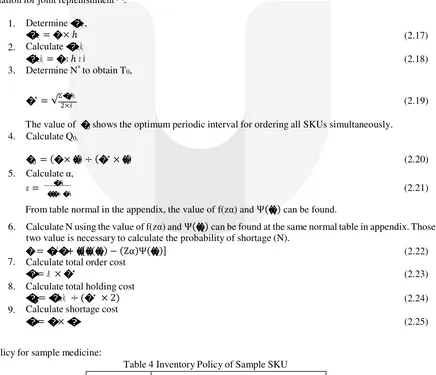
Joint replenishment is a method developed based on simple periodic review inventory model. The difference between those method is joint replenishment is used for products that have same supplier. Because the supplier is same and the purchase for every item happen at once, the order cost occur only one.
Formulation for joint replenishment [4]:
The value of �0 shows the optimum periodic interval for ordering all SKUs simultaneously. 4. Calculate Q0, two value is necessary to calculate the probability of shortage (N).
7. �
and II priority using periodic (R,S) model. Expected output from calculation is inventory policy of both priority which are periodic interval, maximum order lot size, and safety stock.
As the result of calculation are shown in Table 3 and Table 4 total cost of each SKU is calculated. Total cost of 3WAY STOPCOCK PO for proposed policy is Rp 391,888.92 and Rp 134,783.81 for ASAM TRANEXAMAT INJ 500MG/10ML each using (R,s,S) and joint replenishment. The improvement of I and II priority was obtained by comparing the existing condition with proposed policy. The improvement for I priority is 77.75% from Rp 340,350,600.10 to be Rp 75,729,717.15 and 79.09% from Rp 32.147.106,36 to be Rp 6,719,492.85 for II priority.
4. Conclusion
By using periodic (R,s,S) model for I priority and joint replenishment for II priority, XYZ General Hospital could minimize inventory cost of medicines and medical equipment. The improvement for I priority is 77.75% and 79.09% for II priority.
References
[1] Bahagia, S. N. (2006). Sistem Inventori. Bandung: ITB.
[2] Rachmania, I. N., & Basri, M. H. (2013). Pharmaceutical Inventory Management Issues in Hospital Supply Chains.
Management, 1-5.
[3] Silver, E. A. (1998). Inventory Management and Production Planning and Schedule. New York: John Wiley & Sons.
[4] Goyal, S. K. (1974). Optimum Ordering Policy for a Multi Item Single Supplier System. Operational Research