© 2010 Faculty of Humanities, University of Indonesia
Gender and the Indonesian pronouns
HEIN STEINHAUER
Abstract
The absence of a gender opposition in the Indonesian pronominal system requires special strategies in the translation from languages which do have such
an opposition illustrated in the first part opf this article. In the second part the
lexical and morphological means are discussed with which Indonesian expresses gender, culminating in a description of the use of perempuan and wanita, pria
and laki-laki. Keywords
(Semantics of) gender oppositions, personal pronouns, Indonesian.
It1 is the rule rather than the exception that the categorical semantic oppositions of languages belonging to different families do not match, or that semantic oppositions which permeate the grammar of language X seem to be neutralized or irrelevant in language Y. It obviously poses problems for the translator, if his/her target language obligatorily differentiates what is left to context or common sense in the source language. Or the other way around, especially if failure to make the particular distinction explicit would cause ambiguity.
No sex
A case in point is the limited function of most personal pronominal forms in Indonesian. Feminist observers of Indonesian have hailed the language for its failure to differentiate between men and women in its personal pronouns.
1 An earlier version of this paper was presented at the conference Langues d’Asie du
Sud-Est, Paris, 17-19 December 2009. As the majority in the audience was not familiar with Indonesian the paper still bears the traces of observations which will be trivial to the average Indonesian reader. I am grateful to the editors of Wacana, Jurnal Ilmu Pengetahuan Budaya that they are nevertheless willing to publish the paper without major further adaptations.
The fact that also actor nouns - in as far as these are formed with inherited morphology such as pedagang ‘trader’ and penjual ‘salesperson’ – are gender
neutral only endorsed the superficial impression that Indonesian in contrast
to European languages like Dutch, French, or Russian is a “non-sexist” language.
Whatever such qualifications may say about the language, the culture
or the observer, communication without reference ever to biological gender must be utopian: also in Indonesian most proper names and a number of
kinship terms are gender specific. In fact, the absence in the language of a gender specific personal pronoun for the third person singular turns out to
be a handicap in a variety of contexts. In the following scene, for instance,
(1) Michel men-cium Michèle. Dia sangat men-cintai=nya2 M. ACT-kiss M. 3s very ACT-love=3s 3 ‘Michel kissed Michèle.’
The second sentence is ambiguous since it can be translated as ‘he loved her very much’ or ‘she loved him very much’.4 To make up for this gap in the lexicon Indonesian has to use disambiguating strategies. A comparison of the
final pages of the first chapter of Lev Tolstoy’s short story Krejcerova Sonata5 of 1889 (Tolstoj 1964) with their Dutch and Indonesian translations (Tolstoj 1966 and Tolstoy 1979) may serve as an illustration.
Russian has three grammatical genders, traditionally called masculine, feminine and neuter. Nouns referring to biologically female entities are usually grammatically feminine, those referring to males masculine. Nominal
inflection presents a reasonably reliable clue for determining grammatical
gender,6 but a sure indication of the gender is found in forms which show agreement as to gender (in combination with number and case), such as
2 The Indonesian examples are in the official spelling, with two exceptions: the front
mid vowel is distinguished from schwa by an acute accent: é versus e; where relevant I add hyphens between morphemes within words, or a “=” sign to link a clitic.
3 Abbreviations used are: ACT = active, ART = article, CAUS = causative, coll =
colloquial, DAT = dative, EMPH = emphasis, -EMPH = non-emphatic, GEN = genitive, NOM = nominative, NOMs = nominative singular, OBL = oblique, PASS = passive, PAST = past tense, PASTs = past tense singular, POSS = possessive, PERF = perfective, REL = relative marker,
SUBJ = subject; 1, 2 and 3 = first, second, and third person, 1pe = first person plural exclusive, 1pi = first person plural inclusive, 3p = third person plural, 3s = third person singular; 0 (zero)
= neutral.
4 Since Indonesian verbs are neutral with regard to tense, the translations are arbitrary
in this respect.
5 I follow the Russian transliteration system commonly used in academic publications
outside Russia and the Library of Congress.
6 If the nominative singular ends in the palatalizing sign –Ь the noun is masculine or
feminine, if it ends in a consonant not followed by –Ь it is masculine, if it ends in –o or –e it is neuter, and if it ends in –a it is feminine. In the later case with a few curious exceptions, such as
demonstrative, relative and possessive pronouns, and adjectives. The forms of the third person singular personal pronouns and of independently used demonstratives correspond with the grammatical gender of the noun they are “pro-forms” of. The male/masculine and female/feminine forms may also directly refer to biologically male and female beings. The following fragments of singular noun phrases (all in the nominative case) illustrate the formal oppositions:
(2a)
moj rodnoj gorod, kotoryj1s POSS NOMs male native NOMs male town NOMs REL NOMs male
byl ...
be PASTs male
‘my native town which was …’
(2b)
moja rodnaja zemlja,1s POSS NOMs female 1s POSS NOMs female land NOMs
kotoraja byla ...
REL NOMs female be PASTs female
‘my native land which was …’
(2c)
mojo rodnoje selo, kotoroje bylo ...1s POSS NOMs 0 nativeNOMs 0 village NOMs REL NOMs 0 be PASTs 0
‘my native village which was ...’
The corresponding third person singular pronouns would be on, ona and ono
in the nominative, ego, eë and ono in the accusative, and emu, ej and emu in the dative.
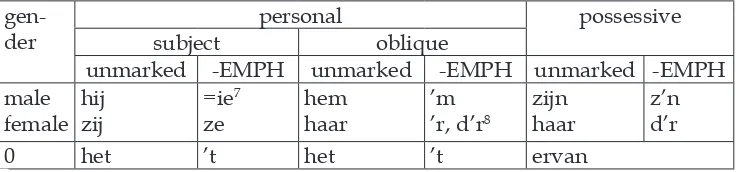
Dutch used to distinguish three grammatical genders as well, albeit much more covert than Russian (see Table 1). For nouns the distinction has practically been reduced to a binary opposition. In southern areas the traces of the threefold opposition appear to be more persistent. But in the standard variety of the Dutch the only marker of the grammatical gender of a noun is its
singular definite article: het for neutral nouns and de for non-neutral ones. The third person singular personal and possessive pronouns, however, maintain
a triple distinction, reflecting grammatical and biological gender.
gen-der
personal possessive
subject oblique
unmarked -EMPH unmarked -EMPH unmarked -EMPH
male
Table 1: Dutch 3s personal and possessive pronouns.
(3) Hij staat in de wei.
3smale stands in the meadow ‘He is standing in the meadow.’
As indicated above the Indonesian third person pronominal forms are not differentiated for grammatical gender nor for biological sex. The oppositions which are relevant are outlined in Table 2.
reference number function unmarked honorific9
human beings singular only subject ia
-all functions dia beliau
plural meréka beliau-beliau
unspecified unspecified all but subject =nya -9
Table 2: Indonesian third person pronouns.
Much more could be said about both Russian and Dutch pronouns and gender systems (compare for instance the discussion of the meaning of the Dutch 3s pronoun hij in Ebeling 2006: 359-368), but for the limited purpose of
the comparison between Russian, Dutch and Indonesian below, this simplified picture will suffice. Below I shall present a somewhat more detailed discussion
on the Indonesian system of personal pronouns.
The following fragments from Tolstoj (1964: 137) are followed by the Dutch translation (Tolstoj 1966: 13-14) and the Indonesian one (Tolstoy 1979: 14-15).
After the question in (4), in which the Russian [dative pronoun + infinitive]
construction is translated with an active verb phrase in Dutch and with an agentless passive in Indonesian, the main antagonist in the story answers with (5).
7 The enclitic ie is used post-verbally and after a subordinate conjunction, the use of
non-emphatic hij is not restricted.
8 Respectively after consonants and vowels.
9 The honorific forms are used to refer to people towards whom respect is due in the
(4)
Nu čto ž ej delat’ esli onawell what then 3s female DAT to do if 3s female NOM ne jubi-t muža?
not love-3s husband GEN
‘So what is there to do for her then, if she doesn’t love her husband?’
Wat moet zij dan doen als ze niet van haar
what must 3s female then do if 3s female not of 3s
man houdt?
POSS husband holds
‘What must she do then if she doesn’t love her husband?’
Apa lagi yang harus di-perbuat kalau bukan men-cintai suami=nya?
what again REL must PASS-do when not ACT-love husband=3s ‘What else is there to be done if it isn’t loving her husband?’
(5) Nebos’ poljubi-t!
necessarily PERF love-3s ‘(She) will necessarily love (him)’
Dan leert ze het maar!
then learns 3s female 3s0 just ‘Then she just has to learn it!’
Isteri itu harus belajar men-cintai suami=nya.
wife that must learn ACT-love husband=3s ‘The wife has to learn to love her husband.’
In (5) the Russian verb indicates that the agent is a third person singular, whose identity is retrievable from the immediate context (4). Dutch cannot do without an explicit subject, but since the context is indicative enough a non-emphatic pronoun (ze) is used. Since in (4) the Indonesian translation left the agent unexpressed, a pronominal agent in (5) would have had nothing to fall back upon. Consequently the agent in question is mentioned explicitly with a noun phrase (isteri itu).
In (6) Russian has again a [dative pronoun + infinitive] construction which
(6) Čto ž emu delat’?
what then 3s male DAT to do
‘What was there to do for him then?’
Wat moest hij doen?
what must 3s male SUBJ do ‘What should he do?’
Apa lagi yang harus di-lakukan si suami?
what again REL must PASS-carry out ART husband ‘What else should the husband do?’
The Russian pronoun in (7) can be interpreted as being contrastively emphatic or not. The latter was the solution of the Dutch translator. The former of the Indonesian one. He used a cleft construction and again a noun phrase (suami=nya) since the contrast (he vs. she) cannot be expressed pronominally in Indonesian.
(7) Potomu on durak.
because 3s male NOM fool ‘Because he is a fool.’
Omdat=ie een stommeling is. because=3s male SUBJ -EMPH a fool is ‘Because he is a fool.’
Itu karena suami=nya yang goblok.
that because husband =3s REL stupid
‘That is because her husband is the one who is stupid.’
In (8) finally, Russian and Dutch express the husband and wife relationship
again unambiguously by the pronouns used. Russian moreover indicates by the PASTs male ending (–l) of the verb who the actor is. Indonesian, lacking such resources, has to use at least one noun phrase (isteri=nya).
(8) Kaby on spervonačala ne da–l ej
If 3s male NOM from the start not give-PASTs male
xodu …
3s female DAT free opportunity
Als hij haar van het begin af aan kort
if 3s male SUBJ 3s female OBL from ART 0 start off on short
gehouden had …
be held had
‘If only he had kept her on a tight rein from the very beginning …’
Kalau sejak semula ia tidak mem-beri kesempatan kepada isteri=nya …
if since start 3s SUBJ not ACT-give chance to wife=3s ‘If he hadn’t given his wife any opportunity …’
What these examples illustrate is that Indonesian gender specific vocabulary is
used to make up for the impossibility to refer to a man or a woman by means of a third person pronominal form.
This holds in general also for regional varieties of Malay, with the interesting exception of Larantuka Malay (East Flores). The Malay “outlier” there developed from the Malay of the Portuguese and Malay refugees from Malaka when the Dutch conquered that city in 1641. Singular third person pronouns used in Larantuka Malay alongside gender neutral dia are bicu ‘he’ and bica ‘she’ (derived from the Portuguese masculine and feminine nouns
bicho and bicha ‘worm’) (see Monteiro 1975).
Lexicalized biological gender
A limited number of lexical roots is inherently gender specific. The fact that they do not always occur in perfect semantic pairs is a reflection of the cultural
importance of certain distinctive semantic features over others. Gender is lexically expressed in the terms for the two central kin in traditional Malay society (ego’s elder bother and ego’s mother’s elder brother), and in the terms for male and female progenitors (in the case of female progenitors also for animals):
(9) ayah ‘father’
bapak 1) ‘father’, 2) [usually written with a capital]
‘Mr., Sir’
abang ‘elder brother’
mamak ‘mother’s elder brother’
ibu 1) ‘mother’, 2) [usually written with a capital]
Mrs., Madame’
induk ‘mother (usually for other entities than human beings)’,
for example
In nominal compounds both ibu and induk are also used for such symbolic mothers as:
(10) ibu jari ‘thumb’ (literally ‘mother of fingers’) ibu kota ‘capital (city)’ (literally ‘mother of cities’)
ibu pertiwi ‘Mother Earth; native country’
induk administrasi ‘administrative centre’
induk cuka ‘essence of vinegar’
induk kalimat ‘main clause’
induk madu ‘honey comb’
induk padi ‘the first rice stalks harvested’
Curiously enough, there are no comparable compounds with symbolic fathers. But those with anak ‘child’ are frequent. Compare:
(11) ibu kunci ‘lock’ anak kunci ‘key’
ibu panah ‘bow’ anak panah ‘arrow’
ibu sungai ‘main river’ anak sungai ‘tributary’ induk
perusahaan
‘holding company’
induk perusahaan
‘daughter company’
Most given names, whether Muslim, Christian, Hindu or “traditional” are
gender specific. But only with a limited set of monomorphemic common nouns is gender specificity part of their meaning. Together with the items in (9), the
sets in (12) and (13) form a fairly comprehensive list of such common nouns. It may not be a coincidence that many of these items are of foreign (non-Malay) origin: Dutch (D), Jakartan (J), Javanese (Jv), Persian (Pers), Portuguese (P), Sanskrit (Skt). Presumably biological gender was once of minor prominence in the Malay perception of the world.
(12) laki-laki ‘man’ [also
lelaki]
perempuan ‘woman’
pria (Skt) ‘man’ wanita (Skt) ‘woman, lady’
jejaka (Jv) ‘young man’ gadis ‘girl; virgin’
cowok (J) ‘(adolescent) boy’
céwék (J) ‘(adolescent) girl’
raja (Skt) ‘king’ ratu (Skt) ‘queen’
laki (coll) ‘husband’ bini (coll) ‘wife’ suami (Skt) ‘husband’ istri10 (Skt) ‘wife’
duda (Jv) ‘widower’ janda (Skt) ‘widow’
bujang ‘bachelor’ perawan ‘virgin’
dara (Skt) ‘virgin, maiden, young girl’
bidadari (Skt) ‘nymph, houri’
permaisuri (Skt) ‘king’s wife’
pastor (D) ‘(Catholic) priest’
uskup (D) ‘bishop’
frater/bruder (D) ‘friar’ zuster/suster (D) ‘nurse; nun’
pater (D) ‘father (in a religious order)’
imam (A) ‘Muslim leader
in prayer’
biksu (Prakrit) ‘Buddhist monk’
ulama (A) ‘Islamic scholar’
jongos (D) ‘male servant’ babu ‘female
domestic servant’
tuan ‘Mr, sir, master’ nyonya (P?) ‘Mrs. Madam,
lady’
nona (P?) ‘miss’
kakék ‘grandfather’ nénék ‘grandmother’
paman (Jv) ‘uncle’ bibi (Pers?) ‘aunt’
om (D) ‘uncle’ tante (D) ‘aunt’
All these items are descriptive, but from tuan onwards they can also be used
as terms of address. Some further gender specific terms of address are listed in
(13). There are regional differences and preferences, varying grades of respect
and familiarity, but the first four are the most common and widely used.
(13)
Bapak ‘Mr.’ Ibu ‘Mrs.’Pak ‘Mr.’ Bu ‘Mrs.’
bung ‘older brother’; usi ‘older sister’; respectful term of
address to a man not much older than the speaker (Moluccas)
female equivalent of
bung
abang,
bang
‘older brother’
mas (Jv) term of address for a (mostly Javanese) man not much older than the speaker
mbak (Jv) term of address for young (mostly Javanese) woman
For more comprehensive glosses and further senses I refer to the major dictionaries, such as Stevens and Schmidgall-Tellings (2004) and Sugono et al. (2008).
Morphological differentiation of biological gender
The conclusion that biological gender in Indonesia is lexicalized to only a limited extent, is corroborated by the inherited Malay morphology for actor
nouns. These are productively derived from transitive verbs by prefixation of peN–11to the verbal root. Less productively they are formed from intransitive
verbs containing the prefix ber– “be characterized by doing [whatever the root
suggests]”; with these intransitive verbs actor nouns are formed by prefixation
of pe– to the root. Besides forming actor nouns both peN– and pe– have other derivational possibilities, but also then they often refer to human beings. Some examples are presented in (14) and (15).
(14) meninju ‘to hit (s.o.) with
one’s fist’ peninju ‘s.o. who hits (s.o. else) with his fist’
bertinju ‘to box’ petinju ‘boxer’
(15) besar ‘big’ pembesar ‘authority, big shot’
ténis ‘tennis’ peténis ‘tennis player’
All these derived nouns do not specify what the role is of the human referent in question in the procreation of man. In the perception of more orthodox feminist
observers this justifies a brevet of honor, certainly if Indonesian is compared
11 N is the regular symbol for the morphophoneme which is realized as 0 (zero) before
with languages such as French or Dutch with their “sexist” male ~ female sets like French conférencier ~ conférencière ‘lecturer’, locuteur ~ locutrice ‘speaker’,
parisien ~ parisienne ‘inhabitant of Paris’, comte ~ comtesse ‘count(ess)’, voleur ~
voleuse ‘thief’, avocat ~ avocate ‘lawyer’, fiancé ~ fiancée ‘fiancé(e)’, etcetera, and Dutch directeur ~ directrice ‘director’, regisseur ~ regisseuse ‘producer’, zanger
~ zangeres ‘singer’, boer ~ boerin ‘farmer’, Ier ~ Ierse ‘Irishman ~Irishwoman’,
dief ~ dievegge ‘thief’, verpleger ~ verpleegster ‘nurse’, musicus ~ musicienne
‘musician’, theoloog ~ theologe theologist’, violist ~ violiste ‘violinist’, classicus ~
classica ‘classicist’, etcetera. However, under the influence of such less laudable
languages, Indonesian has borrowed new morphological means to express biological gender. Examples of borrowings from Dutch, Arabic and Sanskrit are presented in Table 3.
source meaning male female
Table 3: polymorphemic gender specific nouns of non-Malay origin.
The word pairs of Dutch and Arabic origin are closed sets and borrowed in their entirety. The Sanskrit patterns, however, especially the one with
the suffixes –wan and –wati, have spread to other than Sanskrit roots. New
formations according to the former pattern (replacement of root-final –a by
–i, rather than suffixation) are restricted to the compounds muda-mudi ‘the young ones’ and pemuda-pemudi ‘young people’ (from muda ‘young’, and
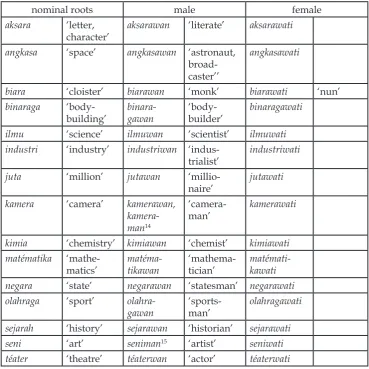
pemuda ‘young man, youth’). Some examples of other derivations with the
suffixes –wan and –wati are given in Table 4.
12 In addresing an audience; hadirin dan hadirat ‘ladies and gentlemen’.
13 Derived from warta‘news’. Many derivations with the suffixes -wan and -wati are in
nominal roots male female
biara ‘cloister’ biarawan ‘monk’ biarawati ‘nun’
binaraga
‘body-ilmu ‘science’ ilmuwan ‘scientist’ ilmuwati
industri ‘industry’ industriwan
‘indus-seni ‘art’ seniman15 ‘artist’ seniwati
téater ‘theatre’ téaterwan ‘actor’ téaterwati
1415
Table 4: Gender specific derivations with the suffixes –wan and –wati.
This list can perhaps be tripled. Quite a number of these forms are consciously created and may be felt somewhat unnatural by the average less sophisticated speaker. The current dictionaries appear to be hesitant inserting them all. Especially the forms in –wati tend to be omitted. Most of the forms in the female column of Table 4 could only be found on the Internet. Relative frequency and predictability rather than prejudice from the side of the lexicographer (“a woman can’t be a mathematician”) are the likely reasons for these gaps, but their absence has given rise to suspicion.
It should be noted that the nouns in –wati refer indeed to women. The same holds for the Sanskrit derived forms in –i and –wati of Table 3. In fact neo-Sanskrit
14 This is probably a borrowed form, but it happens to follow the deviating pattern of
seniman ‘male artist’ (see the next footnote).
15 The only nominal derivation with the suffix –man instead of –wan. There is also a
girl’s names in –wati are frequent, for example, Asmarawati (from asmara ‘love’),
Indirawati (an extension of the name Indira), Pancasilawati (from Pancasila, the
five-pillar state philosophy), Susilawati ‘Moralisa’ (compare susila ‘morality’).
Wati itself is a girl’s name. Names in –wan for men also occur, but they are less omnipresent. In any case it may therefore be questioned whether the forms in the male columns of Tables 3 and 4 always exclusively refer to men. For some items in the lists this cannot be denied: one has to be a man if one is a monk or a
binaragawan ‘bodybuilder’, but being a chemist has no relation to one’s sex. As a consequence the semantic feature |male| in words like kimiawan ‘chemist’ is latent and only actualized in contexts where kimiawan is contrasted with kimiawati. In other contexts kimiawan is semantically unmarked and its referent consequently sexually undetermined. Compare the following dialogue and exposition.
(16a) Berapa mahasiswa terdaftar di situ?
how many student registered in there
‘How many students are registered there?’
Dua ratus mahasiswa dan tiga ratus mahasiswi. two hundred student male and three hundred student female ‘Two hundred male and three hundred female students.’
(16b) Negara kita memerlukan banyak kimiawan baru.
state 1pi ACT need many chemist new
Pemerintah menyediakan ratusan beasiswa
government ACT provide hundreds scholarship
untuk calon kimiawan dan kimiawati.
for candidate chemist male and chemist female
‘Our country needs a lot of new chemists. The government has provided hundreds of scholarships for aspirant male and female chemists.’
Although suffixation with –wan and –wati is a semi-productive process, the possibility to form lexical pairs by morphological means or borrowings remains restricted. One reason is that the morphological expression of biological gender is sensitive. In the case of the names of professions it is felt as support for the prejudice that there is a (for women negative) relation between biological gender and professionalism. In Europe the fear for such biased inferences has led to the publication by the European Parliament of a gender neutral wordlist for professions, according to which a “stewardess” should henceforth
be addressed as “flight attendant” and a “fireman” as “firefighter” (see: www. taalunieversum.org/ terminologie/sekseneutrale_namen_in_de_beroepssfeer).16
Yet, the possibility to express gender can obviously not be suppressed. And if the necessity arises Indonesian has other – lexical – means available to make the dsitinction. These will be discussed in the next section.
Analytical identification of biological gender
For human beings the first five nouns of (12) are used as post-nominal specifications: laki-laki/lelaki and pria for men, perempuan and wanita for
women. For flora and (non-human) fauna biological gender is expressed by
the adjectives betina ‘female’ and jantan ‘male’:
(17) jagung ‘maize’ jagung betina ‘female maize’
papaya ‘papaya’ papaya jantan ‘male papaya’
kuda ‘horse’ kuda jantan ‘stud’ kuda betina ‘merry’
ayam ‘chicken’ ayam jantan ‘cock, rooster’ ayam betina ‘hen’
Jantan is also used to refer to human males with a strong masculine radiation ‘virile, macho’, as in the following example17 from the Internet
(18) Kita harus bangkit dari debu pemanjaan diri dan menjadi pria yangjantan!
1pe must rise from dust pampering self and become man REL virile ‘We must rise from the dust of our self-pampering and become virile men!‘
The sequence to this sentence is an example of the gender specifying use of
lelaki:
(19) Ini merupakan aspirasi … bagi anak lelaki yang akan menjadi pria déwasa.
this ACT be aspiration for child male REL shall become man adult ‘This is the aspiration of boys who are about to become adult men.’
The examples (20)-(23) illustrate the use of laki-laki, perempuan, pria and wanita as post-nominal specifiers.
(20) Lebih dari seperempat SD di Inggris … tidak memiliki guru laki-laki.
more than 1/4 primary school in England not ACT own teacher male ‘More than a quarter of the primary schools in England doesn’t have male teachers.’
17 All example sentences from (18) onwards are taken from the Internet, unless otherwise
(21) Déklarasi Petani Perempuan Internasional untuk Hak Asasi Petani:
declaration farmer female international for right basic farmer “Kami Petani Perempuan …”
1pe farmer female
‘Declaration of the International Female Farmers for Fundamental Farmers Rights : “We female farmers …”’
(22) Dalam film itu putra kandung [NN] … berperan sebagai pelacur pria.
inside movie that son womb have role as prostitute male ‘In that movie NN’s own child plays the role of a male prostitute.’
(23) Telah lahir présidén wanita, menteri wanita, pilot wanita,
PERF be born president female minister female pilot female
profésor wanita dan lain=nya.
female professor and other=3s
‘There have already come up female presidents, female ministers, female pilots, female professors and so on.’
Sentence (19) is also an example of the use of pria as an independent noun.
Pria is, like wanita, a borrowing from Sanskrit, presumably through (Old) Javanese.18 Today its semantic difference with laki-laki/ lelaki seems to be limited to the fact that only pria is found on doors of gender specific toilets (‘gents’).
In all other contexts, whether it is used as an attribute or as an independent noun, the difference seems to be a matter of style rather than meaning: in spoken language laki-laki and lelaki are preferred. In written language pria
and laki-laki interchange, presumably to avoid monotony, as in the following example:
(24) Di lapas ini R. bukanlah satu-satu-nya pegawai laki-laki, tapi pria yang in jail this R. not EMPH RED-one-3s official male but man REL berusia 27 tahun ini … paling sering berhubungan dengan penghuni.
have age 27 year this most often have.contact with inhabitant ‘In this penitentiary institute R. is surely not the only male official, but this 27-year old man has the most contacts with the inhabitants.’
19
Yet the choice for the one or the other is not completely free, since there are some collocations in which laki-laki is by far the most frequent option: anak laki-laki (child male) ‘boy, son’ (which on the Internet is one hundred times
18 In Zoetmulder (1982) priya is glossed as ‘friend, beloved’, but not specifically male.
Wanita on the other hand is glossed as ‘woman’.
19 Lapas is a euphemistic abbreviation of the euphemism lembaga pemasyarakatan ‘institute
as frequent as anak pria and ten times as frequent as anak lelaki; nafsu laki-laki
‘male lust’ is eighteen times as common as nafsu pria and about eight times as nafsu lelaki. The referents of laki-laki and lelaki appear to be closer to nature than someone referred to as pria.
The use of wanita and perempuan as specifiers of children’s sex runs
reasonably parallel to the one of pria and laki-laki / lelaki: anak perempuan ‘(little) girl, daughter’ is more than thirty times as common as anak wanita. Nafsu wanita
and nafsu perempuan ‘female lust’ on the other hand present a different picture:
nafsu wanita is about 1.5 times as frequent as nafsu perempuan.
Indeed, the difference between perempuan and wanita is more complicated, since for at least some Indonesians both words are not emotionally neutral. Also outside toilet doors, where it stands for ‘ladies’, wanita may have a ladylike connotation. The difference between perempuan and wanita potentially
or underlyingly mirrors the one between nature and nurture. The official
Muslim (and Christian) opinion in Indonesian is that men are by nature infected with feelings of lust (which is why some people insist that women should protect themselves by limiting the amount of epidermal tissue open to
the public view), but that women by nature would experience lust is difficult
to except. That would be the reason why the euphemistic nafsu wanita is preferred above nafsu perempuan. The former suggests a secondary product of culture, the latter an innate streak of bestiality.
The following quotation also seems to reflect this nature vs. nurture
difference.
(25) (It isn’t Islam which treats women as second rate human beings, but culture. “In fact there is ample proof …”)
… bahwa Islam sangat “mewanitakan” perempuan.
that Islam very ACT lady CAUS woman
‘that Islam treats women as ladies’ (that is as cultured creatures deserving respect).
In as far as wanita are a product of nurture, it is the mainstream culture
which defines when they deserve respect. And in the mainstream culture as
it developed during the regime of Suharto the ideology was that a woman had to become an ibu rumah tangga yang baik (mother house staircase REL good) ‘a good housewife’, who stimulated and supported her husband in
his career. Most outspoken was the role-confirming connotation of wanita in the institute of Dharma Wanita under the Suharto regime. Established in 1974, the organisation of wives of the civil servants of all government institutions mirrored the structure and the hierarchy of the latter and had as its aim to:
(26) “mensukséskan pembangunan sesuai dengan kodrat dan
kedudukan wanita Indonésia sebagai istri dan ibu rumah tangga” position woman Indonesia as wife and mother house staircase ‘make the development into a success in correspondence with the nature and position of the Indonesian women as spouses and housewives’ (Shadily n.d.: 808).
The ideology required that women adhered to the dictum
(27) Sepintar-pintar perempuan, suami tetap suami. as RED-clever woman husband remain husband
‘However clever a woman may be, a husband remains a husband.’
Proponents of women’s rights prefer the use of perempuan, because of the
connotations of cultivated subordination of the qualification wanita. The following are two examples of the use of perempuan with the opposite connotation.
(28) (introspection of a male blogger disgusted about the role of his fellow men in four movies in which women were raped and repudiated)
Saya masih seorang pria nista yang belum bisa memperempuankan
1s still a human man vile REL not yet be able ACT woman CAUS
perempuan.
woman
‘I am still a vile man still unable to tread women as female humans.’ (that is equal to men)
(29) Perempuan adalah sepadan dan setara dengan laki-laki, karena
woman is equivalent and equivalent with man because
begitulah Firman Tuhan. Ini saatnya kita memperempuankan,
such EMPH commandment God this time 3s 1pi ACT woman CAUS
perempuan.
woman
‘Woman is equal and equivalent to man, because such is the Word of God. This is the time to treat women as female human beings.’ (that is as the Lord had meant her to be) (Victoria Iriana 2005).
Whereas in the Suharto period the Kongrés Wanita Indonésia was an extension of the government, in the post-Suharto period emancipatory organisations
came up, such as Koalisi Perempuan Indonésia untuk Keadilan dan Démokrasi
(Coalition of Women of Indonesia for Justice and Democracy) and Aliansi
Masyarakat Sipil untuk Perempuan dan Politik (Alliance of the Civil Society for
However, for most speakers and in many situations wanita and
perempuan are still practically synonymous, wanita being somewhat less colloquial. But there do exist some standardized collocation with wanita and
perempuan, in which replacement by the other term sounds unusual, such as in the euphemisms wanita tuna susila ‘lady deprived of morals, prostitute’, euphemistically shortened again to WTS, and perempuan ékspérimén ‘woman of experiments’ (woman practising free love), euphemistically shortened to
pérék.
The noun phrases in which wanita etcetera specify the gender of the referent of the preceding noun N1 are semantically convergent: the appropriate referents of the noun phrase as a whole are those entities in which two sets of features converge, namely those typical for the appropriate referents of N1 and those which makes an entity an appropriate referent of wanita etcetera. For noun phrases consisting of two nouns convergence is relatively rare, though not restricted to the nouns indicating gender. The following are a few examples:
(30)
anak bayi 1. ‘baby child’, 2. (?) ‘child of a baby’anak anjing 1. ‘canine child’, 2. ‘puppy’ (lit. child of a dog)
anak gadis 1. ‘virgin child, little girl’, 2. (?) ‘a girl’s child’
anak raksasa 1. ‘giant child’, 2. ‘a giant’s child’
ayam petelur 1. ‘laying hen’, 2. (?) ‘chicken of someone who produces eggs’
As the translations show, these examples are all homonymic. The first meanings exemplify convergence, the second ones - though in everyday reality not equally likely to occur – are cases of the opposite of convergence: divergence. In these cases one entity is bearer of the features typical of the appropriate referents of N1 and another one of those of the second noun. The meaning of the construction is the relation between these entities, which is
not further specified and usually open to a variety of interpretations. The cliché example is something like potrét guru (portrait teacher) ‘portrait in
an unspecified relation to a teacher’, which can be interpreted as a portrait
representing a teacher, made by a teacher, possessed/ owned/ bought/ borrowed/ exhibited/etcetera … by a teacher. A curious example of the difference between a convergent and a divergent construction is the case of the Christian concept anak manusia ‘the son (of God) having the features typical of a human being’ (convergent) as opposed to anak orang ‘someone else’s child’ (lit. child of people) (divergent).20
In general it can be said that the constructions [N1 + wanita/…/laki-laki]
are convergent if N1 refers to a human being, with the systematic exception of N1 being a deverbal actor noun. It is unlikely that guru wanita will ever be
understood as a ‘teacher of women’; its first (and probably only) interpretation
will be ‘female teacher’. The deverbal actor noun pengajar ‘instructor’, on the other hand, if followed by wanita,has two meanings: ‘female instructor’ and ‘instructor of women’. Similarly:
(31)
penjual wanita 1. ‘saleswoman’, 2. ‘vendor/seller of women’pedagang wanita 1. ‘female trader’, 2. ‘trader of women’
penggemar laki-laki 1. ‘male fan’, 2. ‘lover of men’
pendaki perempuan 1. ‘female mountaineer’, 2. ‘climber of women’
Obviously these homonymic constructions may require disambiguation, which is achieved by reversion of the order of the constituents. Constructions such as wanita penjual can only be interpreted as ‘woman who is a salesperson, saleswoman’.
The difference between semantic divergence and convergence is also apparent when wanita, perempuan, pria, laki-laki and lelaki are used as specifier
with names of sports and their practitioners. Compare: ténis pria ‘men’s tennis’ (divergent) vs. peténis pria ‘male tennis player’ (convergent). In contrast to these constructions the language standardizers have introduced a productive pattern of compounds for sports and sportspersons with putri and putra
replacing the regular gender nouns pria, wanita etc. As indicated above putra
and putri originally meant ‘prince’ and ‘princess’, but putra is now mainly used (in polite speech) with the unmarked meaning of ‘child (offspring)’21 and with the marked meaning of ‘son’ in opposition to putri ‘daughter’. The absence of these meanings in the compounds results in a semantic opposition between [sport(sperson) + putra/ putri] and [sport(sperson) + wanita/…/laki-laki], the
former being compounds used as the more neutral technical term, the latter syntactic constructions emphasizing the biological gender of the athletes.
Once more: the spare use of personal pronouns
Whatever the comprehensive semantic description of the nouns for men
and women will be, it will be clear that Indonesian has sufficient means to make up for the lack of gender specific pronouns. With the consequence that
pronouns for the third person have a low text frequency in comparison to the major European languages.
This phenomenon is further strengthened by the fact that the free Indonesian third person pronouns (see Table 2) can only refer to human beings and hominids such as ogres, angels and speaking spiders. An independent equivalent for English ‘it’ does not exist. The contact derived Malay vernacular of Ambon (Moluccas) has developed an equivalent of ‘it’, namely akang (see
Minde 1997). But Ambon Malay is insufficiently known outside the Moluccas
and lacks status on the national level.
21 Also metaphorically: putra daérah ‘(offspring of the region), local person (for example
The Malaysians succeeded in creating a repair for the said gap, ianya (<
ia ‘3s SUBJ’ + =nya ‘3s’), and although sometimes used in Indonesian texts it has not gained popularity in the archipelago. Instead Indonesian uses noun phrases (repetitions or short paraphrases) or nothing. The latter is an option since Indonesian does not require subjects to be explicitly expressed if the
context is sufficiently disambiguating. A few sentences from an article on the Mexican flu in the newspaper Manado Post of May 1, 2009 may serve as
an illustration. The pronouns in the running English translations which are printed in bold do not have an equivalent in the Indonesian original.
(32) Bisa saja virus itu sudah bersinggungan dengan … bawaannya
can just virus that already in mutual touch with things brought 3s ‘It is quite possible that that virus has already been in contact with the luggage (of the incoming tourists)’
(33) Disebut fluMéksiko karena virus itu ditemukan di Méksiko. PASS call flu Mexico because virus that PASS find in Mexico.
‘It is called Mexican flu because the virus was discovered in Mexico.’
(34) Saat ditemui di ruang kerjanya … profésor … ini masih yakin
time PASS meet in space work 3s professor this still convinced flu Méksiko belum masuk ke Indonésia.
flu Mexico not yet enter to Indonesia
‘When he was met (that is, when we met him) in his office, this
professor was still convinced that the Mexican flu had not yet entered
Indonesia.’
(35) Karena itu, amat riskan bagi meréka yang bekerja di peternakan.
because that very risky for 3p REL work in cattle breeding
‘Therefore it is very risky for those working in the cattle breeding sector.’
As I once heard a rather racist West Indonesian putting it, speaking about some of his more eastern countrymen:
(36) Baru turun dari pohon, sudah mau ke univérsitas segala.
just descend from tree already want to university all
‘They have just come down from the trees and already theywant to go to the university and all that.’
Referring to speaker and hearer
and between Dublin and Magnetogorsk, intersected moreover by thousands of natural barriers, and with a history of human population of tens of thousands of years, it is only to be expected that Indonesia is characterized by a huge linguistic diversity. In fact an explanation is required (in historical and/or ecological terms) for the relative lack of diversity in several extended areas.
The estimated number of languages today varies between some 500 (Wurm and Hattori 1982) to 700 according to the latest count of the Pusat Bahasa (the National Language Center in Jakarta). Such calculations always depend on the number of communolects one is willing to lump together and call “language”, an imaginary entity of which the communolects subsequently are the “dialects”.
All these dialects and languages have their own codes of conduct in addressing people and referring to oneself. Much more than with third person pronouns, pronouns referring to the addressee and the speaker him/herself tend to explicitly express status relations between them. Status
defining parameters in this respect are relative age, family relations, and social
achievement. And of course the degree of formality of the speech situation. Biological gender usually is not expressed, but in some Malayic languages,22 such as Minangkabau (West Sumatra), there is a gender opposition in the pronouns for the second person singular: ang for men and kau for women.
Indonesian, as the national and official language of the country, has been standardized as a language to be used basically on official occasions and in
writing. The scores of Malay vernaculars (whether historically developed or contact derived)23 all have their own pronominal system, differing among
each other mainly with respect to the pronouns of the first and second person.
Their number may differ, their forms, but also their value. What is rough and unfriendly in one variety may be highly polite in another.
What is relevant in the context of the discussion on the third person
pronoun, is that the first and second person pronouns do not have the same
frequency either as in the major west European languages. The main reason
is that in Indonesian some of the pronouns insufficiently express status
differences between speaker and addressee. The obvious way out is again the use of nouns and noun phrases. Proper names, kinship terms, combinations with proper names of the latter and of such terms of address as given in (13) are the most frequently used alternatives. A few examples (taken from a novel of Hilman (1990), the forerunner of the current wave of teen-lit authors) will
suffice.
(37) Mbak Véra … berbisik …: “Ol, Mbak juga dengardesas-desus itu.” miss V. whisper O. miss also hear rumor that ‘Miss Vera … whispered …: “Ol, I also heard that rumor.”’ (Hilman 1990: 91).
(38) (Olga’s parents, Mami and Papi, are already in bed when someone calls at the front door: “Assalamualaikum!”. Mami urges Papi to have a stealthy look:)
“Siapa tahu Papi belum bayar iuran tipi.”
who know Daddy not yet pay fee TV
‘Who knows, you haven’t yet paid the television fee.’ (Hilman 1990: 93).
(39) (Telephone dialogue in Jakarta Indonesian between Olga and Ucup, her elder male colleague at the radio station where she works)
“Anting emas Olga ilang satu. Ketinggalan nggak di mobil Bang Ucup?”
earring gold O. lost one left not in car older brother U. ‘”I’ve lost a golden earring of mine. Was it perhaps left in your car?”’
“Gak tau, ya? Nanti deh, Bang Ucup cariin dulu.”
not know, yes in a moment be sure older brother U. search for first
‘” (You) don’t know, do you? A moment! I’ll find it (for you).”’ (Hilman 1990: 131).
That these noun phrases in the given contexts refer to the speaker or the hearer is purely a matter of interpretation not of meaning. Only in comparison with a western European language they may be felt as something like “pro-pronouns”, as some observers have called such cases. This is a misnomer. As elements of Indonesian they are just what they are: noun phrases, referring
to entities whose role in the speech act is not specified.
In the case of subjects an option is also to make no choice at all and leave it to the hearer, as in Gak tau in the sentence just quoted, or as in the following observed dialogue in which speaker A reacted on B’s haircut.
(40) A. Awii! Rambutnya! Tidak dingin? gee hair 3s not cold ‘Gee! Your hair! Aren’t you cold?’
Mau ke Timor kan. Takut panas.
want to Timor isn’t it fear hot
‘I want to go to Timor don’t I? I’m afraid I’ll be hot.’
The net effect of the use of noun phrases where western European languages
would use gender neutral first and second person pronouns is that Indonesian
A note =nya
Several of the example sentences above contain the enclitic =nya, invariably glossed as ‘3s’. In modern Indonesian it has a broad range of functions, which cannot be comprehensively discussed in this short paper.
Being an enclitic, =nya cannot be the head of a noun phrase and is subject to various other restrictions. It cannot be used for instance as a subject, nor can it occur after the basic preposition di ‘in’ and ke ‘at’ or after cardinal numerals, but it seems that in all other syntactic positions where a noun phrase is allowed
=nya may replace it.
The examples with suami=nya ‘her husband’ and isteri=nya ‘his wife’ show that features related to biological gender are not part of its meaning. The following sentence illustrates that =nya is used with reference to human beings, but also to lifeless objects.
(41) (I took a cigarette …)
dan menyala=nya sedang mata saya terus terarah pada=nya. and light=3s while eye 1s continuous directed at=3s
‘… and lighted it while my eyes were all the time directed at him.’ (Tolstoy 1979: 109).
The fact that =nya can replace the second NP in the possessive construction [NP1 + NP2] ‘NP2’s NP1’, combined with the fact that it may refer to any third person entity, entails that NP=nya may be interpreted as ‘the NP of it’, ‘it’ being
the situation at hand. In other words, it very much functions like the definite
article in western European languages. (42) and (43) are illustrations.
(42) Dari kemarén awan=nya rendah banget.
from yesterday cloud=3s low very ‘Since yesterday the clouds are very low.’
(43) (Being under a banyan-tree gave me the shivers, but because there were many children there who even …)
bergelantungan di akar-akar beringin=nya, aku cuék aja.
be hanging about in RDP-root banyan tree=3s 1s indifferent just
‘were hanging about at the roots of the banyan tree in question, I didn’t care.’
(44a) (In the scene following (38), Papi opens the door and a rather rowdy young man introduces himself as Olga’s future husband, addressing Papi with the Jakarta Indonesian babé and bé ‘father’)
Olga=nya ada, Bé?
O.=3s be there father
‘Is Olga (the one we are talking about) there, father?’ (Hilman 1990: 94).
(44b) (Reaction of a woman on the Internet to pictures of a family on a day out at a ranch near Bandung)
Wah asyik ya Mbak liburan= nya. Bandung=nya di mana Mbak?
wow pleasant yes Miss holiday=3s Bandung=3s in where Miss
‘Wow, that was pleasant wasn’t it Miss, the holiday (you were having). In Bandung where about was it, Miss?’ (I used to live there you know).
It also extended to independent personal pronouns. This latter usage is rather
typical of blogger language, which is heavily influenced by Jakarta Indonesian
and Javanese. The following is an example.
(45) Rencana=nya kami … mau luncur ke timur... tapi untuk saya=nya
plan=3s 1pe want slip to east but for 1s=3s
péngin=nya ke Bandung.
wish=3s to Bandung
‘Our plan was … to rush off to the east … but for me (in that situation) my wish (the wish in question) was to go to Bandung.’
The construction rencana=nya kami in this sentence would be rencana kami
in Standard Indonesian. The construction follows the regular Javanese
possessive pattern of [NPpossession + 3s possessive enclitic + NPpossessor].
In Standard Indonesian this construction is accepted only in as far as it has a disambiguating function, as in (46)a and b, and (47)a and b.
(46a) Ibu Berlusconi ‘Mrs Berlusconi’
(46b) ibu=nya Berlusconi ‘Mrs Berlusconi’s mother’
(47a) dihantam Suharto
‘hit was Suharto’, 2) ‘be hit by Suharto’
panas badan=ku
hot body=1s
tidur saya
sleep 1s
1) ‘asleep I was’, 2) ‘my sleeping’
(47b) dihantam=nya Suharto
‘the fact that Suharto was hit’ (literally, the being hit of Suharto)
panas=nya badan=ku
‘the fact that my body was hot’ (literally, the being hot of my body)
tidur=nya saya
‘the fact that I was asleep’ (literally, the sleeping of mine)
24
In the latter three constructions =nya has a nominalizing function, and it may be questioned whether this =nya still is a pronoun and an enclitic.
A final instance of the pronominal origin of =nya is its echo function. A noun phrase which is fronted as a topic or as the antecedent of a relative clause, and which can be seen as extracted from the following clause, requires the presence of =nya in the position from where the noun phrase was extracted, except when in that position it functioned as the subject. (48) is an example of =nya echoing a non-subject antecedent, whereas (49) and presumably also (50) are cases of topicalization.
(48) Ia lagi kéki sama mami=nya yang hobi=nya
3s SUBJ POGR irritated with mum=3s REL hobby=3s
ngelarang melulu.
ACT forbid merely
‘She was in an resentful mood towards her mum whose hobby it was to do nothing but imposing bans.’ (Hilman 1990: 91).
(49) (After the scene of (44)a Olga’s would-be husband presses her father to disclose her whereabouts)
Maap, Bé, tapi Olga pergi=nya ke mana? sorry father but Olga go=3s to where
‘Sorry father, but Olga, where did she go?’ (literally: Olga, her going) (Hilman 1990: 94).
(50) Sewaktu kuliah … seni, aku ambil=nya mata kuliah fotografi.
one time lecture art 1s take=3s school-subject photography ‘At the … art course, what I took was photography.’ (literally: me the taking in question …)
24 This construction with the proper intonation may also be read as a sentence: ‘hit by
Examples like the latter sentence (with a transitive verb root + =nya) are common in Jakarta-based varieties of spoken Indonesian and they are rather abundant on the Internet, maybe even typical of that medium.
Concluding note
It may be expected that the Internet will continue to influence the Indonesian
languagescape, together with other factors such as popular television, the wave of teen-lit, and the abolishment of censorship.
The stable diglossia in which standard Indonesian was used on official
occasions, in writing, and in the media, whereas a gamut of local varieties of Malay
was used in less official oral communication, now seems to be turning into an
acrolect-basolect continuum with common spoken Jakarta Indonesian tending to develop into a basolect koine. The case of =nya shows that the pronominal system has not remained unaffected. But whatever the future of Indonesian will be, it is not to be expected that its “non-sexist” character will change.
Bibliography
Adelaar, K.A. 1992. Proto-Malayic: a reconstruction of its phonology, and part of its morphology and lexicon. Canberra: Pacific Linguistics.
Adelaar, K. Alexander and D.J. Prentice. 1996. “Malay: its history, role and spread”, in: Stephen A. Wurm, Peter Mühlhäusler, and Darrell T. Tryon (eds), Atlas of languages of intercultural communication in the Pacific, Asia,
and the Americas, pp. 673-693. Berlin: Mouton de Gruyter.
Ebeling, C.L. 2006. Semiotaxis; Over theoretische en Nederlandse syntaxis. Amsterdam: Amsterdam University Press.
Hilman. 1990. Olga, sepatu roda. Jakarta: Gramedia.
Minde, Donald van. 1997. Melayu Ambong; Phonology, morphology, syntax. Leiden: Research School CNWS.
Monteiro, F. 1975. Kamus Dwibahasa Dialek Melayu Larantuka(Flores) – Bahasa Indonesia. Kupang. [Typewritten research report; iv + 131 pp.]
Shadily, Hassan. [n.d.]. Ensiklopedi Indonesia. Edisi Khusus, Vol.2. Jakarta: Ichtiar Baru – Van Hoeve.
Steinhauer, Hein (to appear). Indonesian. Amsterdam: John Benjamins. [London
Oriental and African Library, Theodora Bynon a.o. (eds).]
Stevens, Alan M., and A.Ed. Schmidgall-Tellings. 2004. A comprehensive Indonesian-English dictionary. Athens: Ohio University Press.
Sugono, Dendy et al. (eds). 2008. Kamus Besar Bahasa Indonesia Pusat Bahasa. Edisi Keempat. Jakarta: Gramedia Pustaka Utama. [First Edition 1988, Tim
Penyusun Kamus Pusat Bahasa, Jakarta: Balai Pustaka.]
Tolstoj, L.N. 1964. “Krejcerova Sonata”, in: N.N. Apokovoj et al. (eds), L.N. Tolstoj,Sobranie Sočinenij. Tom dvenadcatyj. Povesti i Rasskazy 1885-1902 gg,
pp.132-211. Moscow: Izdatel’stvo xudožestvennoj literatury.
Tolstoj, L.N. 1966. De Kreutzer Sonate. Translated from the Russian original by Marko Fondse Amsterdam: L.J. Veen.
Moh. Tadjuddin Jakarta: Dunia Pustaka Jaya.
Victoria Iriana. 2005. “Saatnya perempuan menjadi ‘Penolong yang sepadan’”.
(www.oikumeneindonesia.com/opinijan3).
Wurm, S.A. and Shirô Hattori. 1981-83. Language atlas of the Pacific area;Pacific
Linguistics. Canberra: Australian Academy of the Humanities. [Pacific Linguistics C66-67.]