•Importanceofmaintaininginformationsecurityinanorganization •Howtoestablishaninformationsecuritymanagementsystem(ISMS) •Bestpracticesforimplementingasecuritysystem
For your convenience Apress has placed some of the front
matter material after the index. Please use the Bookmarks
v
Contents at a Glance
About the Authors ...
xxi
Acknowledgments ...
xxiii
Introduction ...
xxv
Part I: Introduction
■
...
1
Chapter 1
■
:
Introduction to Security ...
3
Chapter 2
■
:
History of Computer Security ...
13
Part II: Key Principles and Practices
■
...
27
Chapter 3
■
:
Key Concepts and Principles ...
29
Chapter 4
■
:
Access Controls ...
63
Chapter 5
■
:
Information Systems Management ...
77
Part III: Application Security
■
...
113
Chapter 6
■
:
Application and Web Security ...
115
Chapter 7
■
:
Malicious Software and Anti-Virus Software...
141
Chapter 8
■
:
Cryptography ...
163
Part IV: Network Security
■
...
183
Chapter 9
■
:
Understanding Networks and Network Security ...
187
Chapter 10
■
:
Firewalls ...
205
Chapter 11
Chapter 12
■
:
Virtual Private Networks ...
245
Chapter 13
■
:
Data Backups and Cloud Computing ...
263
Part V: Physical Security
■
...
289
Chapter 14
■
:
Physical Security and Biometrics ...
293
Chapter 15
■
:
Social Engineering ...
307
Chapter 16
■
:
Current Trends in Information Security ...
325
Bibliography
■
...
331
xxv
Introduction
This book explains information security concepts in lay terms. The target audience is beginning users. At the same time, we also describe some of the concepts in detail in order for the content to be of interest to people in the information security field.
With the increasingly connected world revolving around the revolution of internet and new technologies like mobiles, smartphones, and tablets, and with the wide usage of wireless technologies, the information security risks have increased. Any information security vulnerability is possible to be widely exploited by the hackers and crackers who are looking for such opportunities. Both individuals and organizations are under regular attacks for commercial or non-commercial gains. The objectives of such attacks may be to take revenge, malign the reputation of a
competitor organization, understand the strategies and sensitive information about the competitor, simply have fun of exploiting the vulnerabilities through new means and claim superiority, misuse of information like credit card details, banking account details for monetary gains, and so on. Over a period of time exploitation from the perspective of making monetary gains has increased. While objectives may vary from attack to attack, the impact can be very severe in terms of reputation loss to business loss to monetary loss to loss of sensitive information of strategic / competitive value, or loss of intellectual property rights. The hackers are constantly looking for vulnerabilities in the software applications, protocols, and infrastructure. Hence, the need to protect information assets and ensure information security receives adequate attention.
This book considers various important aspects of relevance to information security both from the perspective of individuals and organizations. As assured at the beginning of this book we maintain the simplicity of the explanations without using high-tech jargons so readers can understand. We also provide a significant number of tips to the readers which they can follow to avoid them getting into the trap of attackers and becoming prey to the attacks.
Our book is organized in five sections:
Part I: Introduction •
We start the book with an interesting discussion on the need for security and highlight the value of information security programs to all the employees and relevant personnel like contractors and vendors. We then explore the history of information security and highlight what some of the major hackers / crackers did to circumvent the system and exploit them.
Part II: Key Principles and Practices •
Part III: Application Security •
We examine application security-related issues including web application security issues. We also explore the approach to be taken by the organizations to avoid these application security issues. We then explore the issues of malicious software like adware, spyware, viruses, worms, and Trojans. In this context we discuss the value of anti-virus software and provide details of some of the commercially available useful anti-virus software. We then explore the world of encryption and Cryptography. We describe Symmetric Key Cryptography and Asymmetric Key Cryptography.
Part IV: Network Security •
We explore network security, the fundamentals of networking, and the vulnerabilities related to network security and what needs to be done to ensure network security. We then describe Firewalls, Intrusion Detection and Prevention Systems, and Virtual Private Networks. We also touch upon data backups and cloud security.
Part V: Physical Security •
We discuss physical security, and explain important physical security related issues and how they can be handled effectively. In this context we discuss the role of biometrics and various biometric systems. We explain the social engineering aspects and how individuals and organizations can be impacted because of this. We also describe what individuals and organizations have to do to ensure that they do not become prey to the social engineering attacks.
What to Take From This Book?
This book is primarily intended to open up and make clear the aspects of information security to beginners in the field of information security. However, this book also brings in a newer perspective and the latest trends of interest to those who have a good understanding of the information security field, like the information security professionals who may be information security auditors, information security consultants, and information security officers. This book is intended to give a clear understanding of concepts and related information in simple terms rather than through complicated jargon and abstract theories. The approach used in this book is practical and straightforward, and clarity is the main focus of this book. Wherever possible, various aspects are demonstrated through the situational scenarios. The intention is not to get too technical, but as far as possible to elaborate on technical aspects in common terms so that most intended readers of this book can understand what is being conveyed.
As most of you are aware, technological advances are happening at a high speed and we cannot claim that we are the masters of a particular technology, or that we understand the intricacies of each technology. Everyone, including us, is exploring every day; learning either a new concept or getting more clarity on existing concepts. Hence, as learning is an everyday process, we proceed with our knowledge of information security and bring to you as many concepts as possible regarding information security in simple and clear terms.
How to Read This Book?
Although we suggest that you read the chapters in sequential order, from the introduction to the last chapter as concepts are built on each other, readers are free to go through any chapter of their liking as we have also made an effort to ensure that each chapter can be read independently. If readers are already well versed in information security, then we suggest that they go through the chapters of their own interest.
xxvii
information about some of the applicable standards and certifications such as ISO27001:2013, PCI DSS by PCI Security Standards Council, and COBIT from ISACA.Chapter 2 focuses on the history of computer security, including the purpose as to why computer security evolved, the role of the world wars in its evolution, the initial forms of security of communication, including initial cipher usage like the Caesar cipher and initial cipher machines like Enigma and the greatest hackers and crackers in the field of computer security.
Chapter 3 focuses on key concepts behind information security, such as confidentiality, integrity, availability, possession or control, authenticity, and utility as well as the principles of information security to be applied at the organization level, including key responsibilities and accountability. We also deliberate the role of processes, people, and technology in meeting information security needs.
Chapter 4 focuses on the important aspects of access controls, the need for those controls, the importance of control, and various access control models.
Chapter 5 focuses on aspects of information systems management such as risk management, incident response, disaster recovery, and the business continuity.
Chapter 6 focuses on software application security and web security. We also discuss the web browser, web server, and web applications related information security issues. We also provide the best practices to protect the individuals / organizations from such information security issues.
Chapter 7 focuses on an in-depth analysis of discussion on malicious software, different types of malicious software, how they propagate, and the historical aspects of malware. We also discuss what an anti-virus is, what its benefits are, and how to manage most effectively the anti-virus software and common anti-virus platforms that are used in the industry.
Chapter 8 focuses on cryptography, one of the important ways of preserving the confidentiality of the message or communication and also its authentication. In this chapter, we also focus on what is meant by cryptography, encryption, cryptoalgorithm, and encryption/decryption keys. We also discuss symmetric cryptography and asymmetric cryptography. In this context we discuss on public key infrastructure. We also discuss how these cryptography aspects are used, the value of the certificates like digital certificates and digital signature in the field of cryptography, various hashing algorithms, and the disk/drive encryption tools that are used.
Chapter 9 focuses on an introduction to basics of networking, communication concepts, networking models like OSI and TCP/IP models, comparison between them and the protocols used by different layers. We also discuss the information security issues related to networking.
Chapter 10 focuses on firewalls which are essential in today’s world to protect organizations. This chapter covers the basics of firewalls and their functionality, the importance of the firewalls, the types and different generations of firewalls, and how the firewalls are used. We also discuss best practices.
Chapter 11 focuses on an introduction to intrusion detection and prevention systems (IDS/IPS), their purpose and uses, various detection methodologies employed by these systems, types of IDS/IPS methodologies that are available and popular, and the typical responses by these.
Chapter 12 focuses on the introduction to the Virtual Private Network (VPN), their uses, types of VPNs, and the protocols used to make the VPNs effective.
Chapter 13 focuses on the importance of data backups, the benefits of using a backup, the dangers of not having backups, and various types of backups. This chapter also covers the current hot topic of cloud computing and related models, and issues of privacy and compliance that are related to them.
Chapter 14 focuses on physical security in general including fire safety and one of the important aspects of physical security: biometrics. This chapter introduces biometrics, why it is gaining popularity, its functionality, the multi-modal biometric systems, issues, and controversies pertaining to biometric systems.
Chapter 15 focuses on another important topic in the current world: social engineering. This chapter covers the introduction to social engineering, how social engineering attacks are made possible, and typical social engineering scenarios, We also discuss various techniques that are used in the field of social engineering, such as pretexting, phishing, baiting, and tailgating and the steps to be taken to avoid falling prey to social engineering.
Introduction
This section introduces the concept of security in general and information security in particular. The intention was also to provide a historical perspective about information security.
Chapter 1, “Introduction to Security,” highlights three examples of information security breaches recently published on the internet. The first example explains how the encrypted messages can be read by injecting plaintext into HTTPS request and measuring compression changes. The second example explains how the NSA was provided direct access to the networks of some of the big corporations like Google, Yahoo, and Microsoft and how the tapping of information from undersea cables where the information moves unencrypted was carried out. The third example explains the breach of 40 million credit and debit cards, which happened during the busy Christmas season at Target. We then generally describe what security is and describe it as protecting what one has. We also look into the fact that security not only applies to physical assets, but also non-physical assets like confidential information, research information with high value realization potential, intellectual property rights, and security of customers. We also highlight the role of terrorists and disgruntled employees in the breach of security. We then explore why security is important. In this context we look into how every individual and organization wants to preserve its societal status and how the compromise of information security can lead to misuse of the information at the wrong hands. We then look into the importance of protection of business information of value and protection of customer data and that information security should not be implemented for the sake of implementing it, but with all the serious consideration it requires. We also highlight how new technologies, new products, and new applications can also bring new security threats to the fore. We then discuss what happens if we do not care about security with examples from the current world. We then discuss the history of computers and information security. We then explore the information security scenario today. We also discuss how prevention is better than cure and explain the need to build in appropriate controls through risk assessment of what can go wrong. We conclude with information about some of the applicable standards and certifications like ISO27001:2013, PCI DSS by PCI Security Standards Council, and COBIT from ISACA.
2
technologies like firewalls, antivirus programs came into existing while on the other hand the viruses, Trojans, and worms were proliferating. We then explore the history of communications and in the context discussed Caesar cipher. We also highlight how the need for secure communications in the context of military information exchange led to cryptography.
Introduction to Security
Scenario 1: A post on http://threatpost.com, Threatpost, the Kaspersky Lab Security News Service, dated August 5th, 2013 with the title “BREACH Compression Attack Steals HTTPS Secrets in Under 30 Seconds” by Michael Mimoso, states1:
“A serious attack against ciphertext secrets, buried inside HTTPS responses, has prompted an advisory from Homeland Security.
The BREACH attack is an offshoot of CRIME, which was thought dead and buried after it was disclosed in September. Released at last week’s Black Hat USA 2013, BREACH enables an attacker to read encrypted messages over the Web by injecting plaintext into an HTTPS request, and measuring compression changes.
Researchers Angelo Prado, Neal Harris, and Yoel Gluck demonstrated the attack against Outlook Web Access (OWA) at Black Hat. Once the Web application was opened and the Breach attack was launched, within 30 seconds, the attackers had extracted the secret.”
Scenario 2: A post on http://threatpost.com, Threatpost, the Kaspersky Lab Security News Service, dated December 30th, 2013 with the title: “Most Surprising NSA Capability: Defeating the Collective Security Prowess of the Silicon Valley” by Dennis Fisher, states as follows2:
“Some of the earliest leaks to emerge from the Edward Snowden cache described a program called PRISM that granted the NSA “direct access” to networks run by Google, Yahoo, Microsoft, and many other companies. That direct access was quickly interpreted to mean that those companies were giving the agency data links to their servers through which the NSA could collect traffic information on targets. The affected companies quickly denied this; only later was it revealed that “direct access” came in the form of tapping undersea cables that carry unencrypted traffic between data centers around the world. The revelation triggered an immediate response from Google, Microsoft, and Yahoo, who said that they would be encrypting that traffic in the near future. In addition, some Google engineers had some choice words for the NSA’s in-house hackers. In the words of Google’s Mike Hearn, “The traffic shown in the slides below is now all encrypted and the work the NSA/GCHQ staff did on understanding it is ruined.”
What is Security?
4
information security in particular, with special emphasis on cybersecurity, is gaining momentum. With technological advances and the spread of technological know-how, information security is certainly a humongous task for everyone! That is, all computer users including the non-technical ones.
Our intention here is not to define the term “security,” but to explore the term so that it becomes crystal clear to the readers as to what it really means. A basic animal instinct is to ensure one’s own “safety.” Every animal, including a human, will fight for its safety. Everyone wants to be safe and preserve whatever they have with them whether that be assets, money, or otherwise. The security of the individual, company, assets, or security of their information and many more similar things are expected and seem to be quite in sync with nature’s laws. Security, in simple terms, is protecting what you or others have. This same idea applies to entities like government departments, agencies, companies, institutes, and so on, irrespective of their size or function.
The security of not only physical assets, but of non-physical assets as well are important and necessary. Some of these non-physical assets include confidential information and data; intellectual property; research data with the potential of high value realization and high investment; and the security of your customers or end users when at your facility or while using your systems. The security of the installations with high defense or strategic value, like nuclear installations, nuclear sources, chemical and biological laboratories, and areas with high-level political and administrative dignitaries, are of significance. Most terrorist threats are guided (or misguided) by so-called ideals or ulterior motives, making the security more important. Security is even more important with the recent rise in widespread use of technology such as mobile phones, the internet, tablets, and other mobile devices. Disgruntled or unhappy employees are also achieving significance by leaking information that is of strategic importance, either for exacting vengeance or for profit.
Why is Security Important?
Earning is difficult, but losing is extremely easy. You have to earn with your efforts, but you can lose because of others’ efforts. No individual or entity wants to lose what they have earned through hard work (or even otherwise!). If you lose what you have, you have to start over again, which is hard for anyone. Again, by nature, everyone wants to preserve their energy and secure their future for themselves and their children. Every organization wants to secure its bright future. Securing what you have and not losing it, while getting more of it, is important for societal status. Every individual or organization is a “social animal” and is conscious about their status. Status is what makes one distinct or different from others. Organizations or governments have a lot of information at their fingertips which is of strategic importance to them. They invest a lot in carrying out research in areas of strategic, military, or competitive significance to them. The loss of this information to a third party with the same interests may lead to their strategy being a complete waste, thereby leading to the waste of entire investments and years of effort. This may require them to restart their efforts, possibly using a new way of thinking. Information may be required by those who want it for the value of it, or who want to show their heroism. Some of the current generation of so-called computer hackers may just want to satisfy their ego or show their supremacy over the technology and may steal useful and valuable information and publish it to others. Others may want to mine for data of value so that they can sell the same to others, who want the information to either harm others or make commercial gains from it. Terrorists may want the information to either destroy the strategic or military capability of a country, or to threaten the economy of a country by using the information they steal. Also, 3D printers present a new possible threat by potentially being used by terrorists to create weapons! The primary reason for information security is the threat of information being misused if it lands in the wrong hands.
Some people feel that the need for information security is “hyped.” However, we in technology security do not think so. It is possible to think of information security as “hyped” only if our focus is on information security just for the sake of information security, and not based on the risks to the business of any information leakage, breakage, or loss. The protection of business information of value is the primary reason for information security. We must ask ourselves, “Can we risk the leakage of customer data held by us or to which we have access?” If the answer is “no,” then we have used basic Risk Management to justify a need for security because the leakage of customer data can only be at our own peril.
technologies are in the market, there is a possibility that somebody may accidentally or intentionally break through any of the inherent security flaws in the technology, product, or application. It is necessary that entities or individuals have the capability to be able to respond at such a speed that the chances of an exploitation of a security flaw are very minimal. Many times, it may not be possible to do so because of design or technical issues behind the flaw, or because of the extent to which the solution is required, sometimes across multiple systems and by multiple users. This means that some of the entities or users are open to the exploitation of such a security flaw. Oftentimes, users and entities may not apply the corrective actions immediately, either because of a lack of appreciation of the gravity of the issue, because of ignorance, or because of other priorities. This is very much true when there are deadlines to be met and many of the compulsory checks get skipped due to lack of time or personnel to perform those checks.
Science and technology provide many tools which are at the disposal of entities and people that can be used for either good purposes or bad purposes. Bad guys can always use such facilities or tools for bad purposes. For example, a security tool like Metasploit or Nessus or nMap, if placed in an auditor’s hands, can harden infrastructure, whereas in a cracker’s hands they become the go-to tools for criminal activity. A proper focus on information security allows only the required details about the entity or person to be known to the outside world. If any entity or person wants “peace of mind” in today’s connected world, information security is a MUST.
Note
■
Sometimes the book might appear to use the terms “cracker” and “hacker” interchangeably. However, they are
different. A cracker is the name given to a hacker who breaks into computers for criminal gain. A hacker, however, can
also be an internet security expert who is hired to find vulnerabilities in systems.
What if You Do Not Care About Security?
If you think you don’t need to care about information security, you are creating more risk than you bargained for. With advanced technologies at the disposal of many people, it is only a matter of time until you are robbed or your reputation is tarnished. Hence, at this time, no person or entity can ignore or take its own security lightly, making it hard to sleep at night! For example, you could find that if you doze off, and ten minutes have passed, your debit card could be stolen by someone and already, all the money in your account could be swindled by someone. Maybe your laptop is stolen and the new proposal of millions of dollars you have been working on quite painstakingly is already in the hands of your competitors. Maybe the innovative concept you have been discussing over the phone is overheard, recorded, and patented by someone else. There are unlimited possibilities as to what can go wrong. If you do not care about security, your existence itself will be at risk. Beware of this!
There are instances of Automated Teller Machines (ATMs) being towed away or otherwise hacked by thieves. There are many instances where information has been stolen from emails, laptops, or cell phones and used to blackmail the owners.
There have been instances of weak encryption being substituted by strong encryption, and entities/people have been blackmailed have had to shell out significant amounts of money to get the data decrypted. There have been instances where passwords have been changed or servers have been overtaken by others and then thieves demand a ransom to restore access. There have been instances where software applications have been pirated by overcoming built-in controls and thus, the entity that created the software loses a significant amount of revenue.
6
We have seen or heard of instances of hacking into banking accounts and initiating transactions or hacking into systems and obtaining credit card or debit card related information or credentials such as PIN or Telephonic PIN and misusing them. Phishing attacks are common as are instances of credit cards or debit cards being cloned. There have been instances of identity theft and fake profiles created on social media. Social engineering attacks, where attackers befriend persons and later misuse the information or relationship obtained, are becoming common.
Malicious software attacks through links or attachments in emails, through add-ins to the browser, or through the download of free applications or games is common. Tracking or hacking through mobile devices is a recent phenomenon that must be monitored. Exploiting the technical vulnerabilities of the applications, protocols, web browsers, web servers, or utilities is also a known phenomenon.
Eavesdropping on wireless communications or misusing wireless connections is on the rise. The rogue wireless access points set up by attackers attract many users which leads to the compromise of important information like login credentials.
In addition to the above, ineffective maintenance of the systems or utilities such as UPS or electrical cables can lead to system failure, thus reducing productivity.
There have also been instances of misuse of surveillance cameras, remote connection utilities used to hack into someone else’s system, and application errors not known or not fixed by the vendor organizations.
With a lot of information getting distributed easily across the globe because of Web and Cloud technologies, there are a lot of challenges to ensure that data and information of value are well protected so that they are not compromised.
The Evolution of the Computer and Information Security
If you glance through the history of computer security, you will find that the initial need was to physically protect the mainframe computers, which were used to crack the encrypted messages used during the world wars. Physical security was provided through security guards, identification cards, badges, keys, and other means. These regulated the access to sites and locations where the mainframe computers were hosted and were essential for protecting them from theft and destruction. This was the main scenario during the 1950s and 1960s.
ARPAnet, the precursor to the Internet, was started with the intent of sharing data between remote locations. With the primary intention of ARPAnet being a provision of connectivity across various locations and systems, information security does not seem to have been given much importance. However, as the days progressed and more data and more people came on to ARPAnet, linking many computers, the need for information security increased.5
The MULTICS, multi-users, and timesharing operating systems increased the need for information security. MULTICS (Multiplexed Information and Computing Services) operating system, true to its name, facilitated many different users to access the system simultaneously. The MULTICS was a research project started at MIT in 1964 and sponsored by Honeywell, GE, and MIT that allowed multi-user capability serving thousands in academic and research communities. This operating system provided much-needed focus on computer security and was built into the requirements for computer security. Honeywell then dropped out of the consortium to develop its own product. MULTICS systems were eventually sold for commercial use by Honeywell, with both the security and services.
Multi-user systems allow hardware and software applications to be accessed by multiple users. Multiple users can access the single system from the same location or a remote location using different computer terminals with different operating systems. These terminals are connected through wires and telephone networks. Since systems were shared by users who might not trust each other, security was of major concern and services were developed to support security features for file sharing via access control. MULTICS machines were developed to protect data from other users. Information co-existed on the same machine and the data was marked as ‘Confidential’, ‘Classified’, etc. Operating systems were designed to ensure that the right data is accessed by the right user.6
Unix became an ideal operating system for connecting different systems and providing e-mail services. It supported the TCP/IP protocol for computer communication. It also provided security features like user authentication mechanisms through user ID and password, different levels of access, and restrictions at the file level.6
In the mid 1970s, the invention of microprocessors led to a new age of computing with the introduction of Personal Computers (PCs). The 1980s gave rise to wider computer communication through the interconnection of personal computers, mainframe computers, and mini computers. This enabled resources to be available to all users within a networking community and led to the need for complex information security. As the popularity of PCs grew, networks of computers became more common as did the need to connect these computer systems together. This gave rise to the birth of the Internet. In the 1990s, the Internet was made available to the general public. The Internet virtually connected all computers over a pre-existing telephone infrastructure. After the Internet was commercialized, the technology became pervasive, connecting every corner of the globe. However, initial days of internetworking experienced many issues because of factors like incompatibility of the proprietary protocols not allowing proper communications between two systems/networks, different vendors using different technologies to ensure their stronghold on the technology, and difficulties in ensuring that the message intended reaches only the destination device. Routing technologies, standardization efforts on the protocols, and standardization of computer systems and logical addressing systems like IP changed the scenario over time and enabled easy communication between various devices on the internet.
Tim Berners Lee wrote the first web page and the first web server.7 He designed the World Wide Web (WWW) to link and share news, documents, and data anywhere in the network. By 1991, people outside CERN joined the web community and in April 1993, World Wide Web technology was made available to the public. Since that time, the web has changed the world. It has become the most powerful communication medium today. More than 30% of people in the world today are connected to the web. The WWW has changed the way we communicate with people, the way we learn new things, the way we do business, the way we share information, and also the way we solve problems. It has allowed everyone to not only be connected to one another, but also enables the sharing of information widely across the globe.8
The growth of the web has been phenomenal. There are more people communicating online today than any other medium. More shoppers buy and sell online today than in any other retail store. The rapid growth of the web and web usage has brought about many innovative developments. The web has several layers of technologies that all work together to deliver communication to the user. Today, the Internet has connected millions of “unsecured” computers together. This has been enabled through the growth of networking technologies and equipment like switches, multi-layered switches, and routers coupled with standardization of various protocols used. The switches enable connecting many machines within an organization and ensuring the frames are passed on appropriately to the intended destination computer whereas routers play a large role in routing the
messages/communications from one network to the other and also connect to the internet. Routers are intelligent equipment and route the messages/communications efficiently from the source to the destination and connect to the internet. Also, many of the routers are now built with firewall capabilities. Advanced routers may act as switches as well as router. DHCP, NAT, and DNS have made the configuration and routing easy.
The vulnerability of information on each computer depends on the level of security provided by each system and to the system to which it is connected. Recent cyber threats have made organizations and governments realize the importance of information security. Information security has now become one of the major technologies to support the smooth operation of the Word Wide Web and Internet.
With the invention of the World Wide Web and the Internet, millions of users are connected and communicating with each other. This has raised several concerns regarding the integrity of the user, confidentiality of data, types of data that are being shared in the system, who is accessing the data, who is monitoring the information that is being sent on the Internet, and many more concerns related to information security. With the advancement of technologies such as wireless and cellular, users are always connected and networked computing has become the prevailing style of computing. As information became more exposed to the outside world, securing information has become a major challenge in the era of Inter-networking.
8
policies, guidelines, procedures, governance, and other software functions. Information security consists of three main components: hardware, software, and a communication system.
Various tools are developed daily to combat the compromise of information security. Several standards and guidelines have been implemented to reduce the propensity for information security breaches. However, in a constantly evolving world, information security will always be a matter of concern that will need to be addressed for the good of the world!
Information security also spans to physical aspects like hardware and infrastructure, the operating system, networks, applications, software systems, utilities, and tools. Other important contributors (favorable or adverse) to the field of information security are human beings, particularly employees, contractors, system providers, hackers, and crackers.
Information Security Today
Let’s explore information security in today’s context. Information security is a matter of concern for organizations and individuals alike. Modern hackers are equipped with technological knowledge and tools to infiltrate the accounts of individuals and their credit and debit cards.
Thieves and the authorities are constantly at odds. Most often, thieves are beating the authorities. Many times, the police learn a new technique only after thieves have used it. Similarly, in the field of information, there is always a race between hackers and crackers and the information security personnel. With widespread use of Information Technology and related tools, particularly with the advent of the Internet, it has become a challenge for organizations and their employees to prevent the misuse of information.
Information in lay terms is anything that is communicated in any form, public or private. Any compromise of private information to others can have a significant impact on the parties involved, including the loss of reputation, finances, or other consequences depending upon the nature of the information. All forms of technology, including the Internet, credit cards or debit cards, ATMs, bank web portals, and so on, are all under attack; most times intentionally, sometimes accidentally.
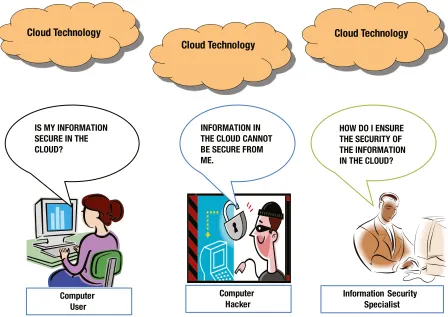
IS MY INFORMATION SECURE IN THE CLOUD?
INFORMATION IN THE CLOUD CANNOT BE SECURE FROM ME.
HOW DO I ENSURE THE SECURITY OF THE INFORMATION IN THE CLOUD?
Computer User
Computer Hacker
Information Security Specialist
Cloud Technology
Cloud Technology
Cloud Technology
10
Information security is an extension of computer security and extends beyond physical control to logical control, control over media, and control over a medium of communication. Information security should be one of the most important goals of everyone, including employees, contractors, suppliers/vendors, and other service providers. Even though there is growing recognition of this fact, there is still a lot more that needs to be understood and implemented by all the stakeholders involved.
In this fast-paced world, where information is an asset and the achievement of business objectives is everybody’s responsibility, ensuring that the information security risks are minimized with the appropriate controls in place, has become a top priority. Of course, it is not always possible to eliminate all the vulnerabilities and consequential threats, but it is necessary to identify the risks to minimize the overall risk to the organization. It is also necessary that organizational management understands the residual risks created by the controls they have put in place. A proper and appropriate risk assessment and management methodology is one of the prime necessities of an information security framework.
As the old adage goes, “An ounce of prevention is worth a pound of cure.” It is always better to put on our critical thinking caps and consider what can go wrong and have the appropriate solutions in place than to worry after an incident has taken place and cost us our reputation or significant monetary loss, either in terms of penalty or in terms of consequential damages.
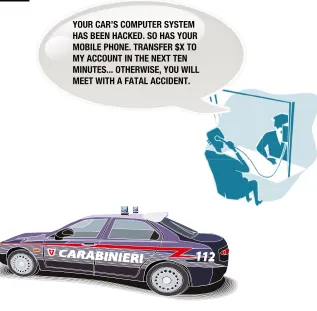
YOUR CAR’S COMPUTER SYSTEM HAS BEEN HACKED. SO HAS YOUR MOBILE PHONE. TRANSFER $X TO MY ACCOUNT IN THE NEXT TEN MINUTES... OTHERWISE, YOU WILL MEET WITH A FATAL ACCIDENT.
SCENARIO OF THE FUTURE?
Even with the utmost sincerity and tremendous efforts, it is not possible to have 100% foolproof information security, because while there may be many known issues, there may also be an equal number of hidden ones. However, if we do not make sincere efforts to at least contain known security flaws or security issues which are applicable to our organization, we do an injustice not only to ourselves and to our customers, but also to the world at large.
Customers have also started explicitly looking for information security being implemented whenever they purchase a system, software, or application. They will not be inclined to purchase any product with known security flaws. As such, product companies, as well as service companies, are required to focus more on information security. What better place to start information security than right at the requirements phase and carry it through during the design, development, testing, and deployment phases? Secure coding practices are gaining momentum and are going to be one of the focus areas of the future.
The following information sheds light on the current information security environment:
“The Norton Report3 (for 2013), now in its fourth year, is an annual research study, commissioned by Symantec, which examines consumers’ online behaviors, attitudes, security habits, and the dangers and financial cost of cybercrime.” The Norton Report highlights the following information3:
Consumers are more mobile than ever, but are leaving security behind. Despite the fact that •
63% of those surveyed own smartphones and 30% own tablets, nearly one out of two users don’t take basic precautions such as using passwords, having security software, or backing up files on their mobile device.
Cybercrime continues to be a growing global concern. Both the total global direct cost •
of cybercrime (US $113 billion; up from $110 billion) and the average cost per victim of cybercrime ($298; up from $197) increased this year.
As people are now constantly connected, the lines are blurring between their personal and •
work lives, across multiple devices and storage solutions. Nearly half (49%) of the respondents report using their personal devices (PCs, laptops, smartphones, tablets) for work-related activities.”
Information security is often not given adequate attention primarily based on the false theory that the risk is low. It is also possible that many times, we try to use complex solutions rather than simple solutions. Whatever the method of implementation, information security has become imperative.
Applicable Standards and Certifications
In order to ensure information security, various efforts have been made by the industry in the form of standards and certifications. Some of the popular ones are ISO/IEC 27001:20054 (revised in 2013) — Information Systems Security Management System — Requirements by the International Organization for Standardization (based on ISO/IEC 27002), Payment Card Industry Data Security Standard (PCI DSS) by PCI Security Standards Council, Payment Application Data Security Standard (PA-DSS) by the PCI Security Standards Council, Control Objectives for IT and related Technology (COBIT) by Information Systems Audit and Control Association, ISO 20000-1:20114 i.e. Information technology — Service Management — Part 1: Service management system requirements. These are the standards against which an organization or an application can get certified (as appropriate) to or adapted by an organization to improve itself and provide a base for the compliance check for others.
Some of the other related regulations/framework of importance are: Sarbanes-Oxley Act of 2002 also known as SOX, Committee Of Sponsoring Organization of the Treadway Commission (COSO) framework, the Health Insurance Portability And Accountability Act (HIPAA) of 1996, Federal Information Security Management Act (FISMA) of 2002, Federal Information Processing Standards (FIPS) released by the National Institute of Standards and Technology (NIST), just to name a few.
12
functional components4; ISO/IEC 15408-3 - Information technology — Security techniques — Evaluation criteria for IT security — Part 3: Security assurance components4; ISO/IEC 18405:2008 - Information technology — Security techniques — Methodology for IT security evaluation4. The International Organization for Standardization has also published many more guidelines for security professionals4. Furthermore, organizations like Information Systems Audit and Control Association in the U.S. have published many useful models and papers on information security.
We will elaborate on the above as it becomes relevant in subsequent chapters of this book.
The Role of a Security Program
Typically, a lack of awareness is one of the prime reasons for not adhering to requisite security guidelines and consequential security breaches. For instance, when a person ignores an advisory about how laptops left visibly in cars can be stolen or a travel advisory warning against travelling by taxi or other unknown vehicle, there is an increased risk for information security breach. Similarly, failure to create a strong password on your work computer can result in information security breaches at many levels, endangering you and your organization’s reputation.
Awareness is the number one step in ensuring security, both physical security and information security. Awareness ensures that the chances or risks of vulnerability and threats to security are reduced considerably. Toward this end, it is essential to provide organizationwide security awareness programs to all employees (permanent or temporary), contractors, suppliers/vendors, customers, and all other relevant stakeholders who have access to the organization or its information. In order to achieve this, organizations need to ensure regular security awareness programs spanning various aspects of their life in the organization, clearly explaining what can go wrong. However, to ensure that all these stakeholders understand why security is important, it is essential for the success of any security program. Still, as the saying goes, “Knowing but not doing is equivalent to not knowing at all”, and it is up to the individual participants of these programs to take the message and content of these programs seriously and implement them in letter and in spirit.
It is not enough that such a security program is in place and is conducted only once for the entire organization. This has to be an ongoing process to ensure that any new stakeholders, including new employees, are trained invariably. In addition, the organizational structure and environment (internal and/or external) may undergo changes which may lead to different vulnerabilities and threats. Hence, it is necessary that these programs are regularly reviewed, updated, and all the relevant stakeholders are trained on the changed scenarios and made aware of new risks.
All programs should take into account the risks the organization is currently undertaking and the controls they have painstakingly put in place for any security violation which defeats the very purpose of such controls. Involving each and every person is important for the success of any Security Program. Any person who is not aware of the security requirements, like a new security guard, employee, system administrator, or a new manager, can endanger the entire organization.
History of Computer Security
Introduction
The first events in the history of exploiting security date back to the days of telephony. Telephone signals were sent via copper cables. Telephone lines could be tapped and conversations could be heard. In the early days of telephone systems, telephone operators intentionally misdirected calls and eavesdropped on conversations. In the 1970s, a set of people known as phreakers exploited the weakness of digital switching telephone systems for fun. Phreakers discovered the signal frequency at which the numbers are dialed and tried to match the frequency by blowing a whistle and fooling the electronic switching system to make calls for free. Among these phreakers, John Draper found that he could make long-distance calls for free by building an electronic box that could whistle different frequencies.
During the 1960s and 1970s, telephone networks became the dominant mode of communication, connecting millions of users. Given the increasing importance of computers and the advent of time shared systems, it was natural to consider linking the computers on the telephone networks so that information could be shared among geographically distributed networks. Since telephones were analog and computers were digital, modem (modulator and demodulator) devices were used to connect computers over the telephone network. Connecting computers and sharing information was of major interest during the early days of network computing and the security of the information became weak. Since people already knew how to break and tap into the phone systems, it became a game for them to break into the computer system, which was connected over the telephone networks.
With the creation of Advanced Research Projects Agency Network (ARPANET), a limited form of a system break-in to the network began. ARPANET was originally designed to allow scientists to share data and access remote systems. E-mail applications became the most popular application to allow scientists to collaborate on research projects and discuss various topics over the network. Soon, a bulletin message board was created where people could post a topic and discuss various research topics together. Bulletin boards became the venue of choice for discussing a wide range of topics, including passwords, credit card numbers, and trade tips, which encouraged the bad guys to hack into the system. Some famous bulletin boards include Sherwood Forest and Catch-22.
WHAT IS ARPANET?
14
In the 1980s, the TCP/IP network protocol Transmission Control Protocol (TCP) and the Internet Protocol (IP), and Personal Computers (PC) brought computing to homes where more and more people connected to the Internet. The 1983 fictional movie, “War Games,” was watched by millions of people and popularized hacking and made it glamorous. In 1981, Ian Murphy broke into AT&T’s computers and changed billing rates of meters. He was later convicted.1 Kevin Mitnick stole computer manuals of Pacific Bells’ switching center in Los Angeles, California, and was prosecuted for this crime.1 Bill Landreth was convicted for breaking into NASA’s Department of Defense computers through GTE’s e-mail network. In 1988, Kevin Mitnick was held for stealing software that was worth $1 million, and also caused damages of around $4 million.
With increasing threats to security, government agencies in charge of ARPANET came up with the Computer Emergency Response Team (CERT): the first network security organization in 1988.2 The purpose of CERT is to spread security awareness among users and find ways to mitigate security breaches. As the Internet became popular, with more and more users becoming active, it became an appealing target for the “hackers” around the world. The 1990s saw more hacking activities such as the “Michelangelo” virus and the arrest of notorious hacker Kevin Mitnick for stealing credit card data, and the 1998 Solar Sunrise attack targeting Pentagon computers by Ehud Tenebaum.3
Today we are living in the Internet and World Wide Web (WWW) era, where everyone is connected. The Internet has changed the way we communicate with each other. The Web allowed information to be accessed instantly from anywhere in the world. First-generation web 1.0 was just a static web. Web 2.0, called interactive web, allowed the users to communicate by emphasizing online collaboration. Web 3.0 technology called ‘the intelligent Web’ emphasized machine-facilitated understanding of information to provide a more intuitive user experience. The Web has become a social medium where we can interact with one another, which has unfortunately resulted in many threats and vulnerabilities and an increasing number of security breaches. Some of the popular attacks include “Mellisa, the love bug,” the “killer resume,” and “The code red.”
Communication
Communication is about conveying messages to the other party or to a group. These messages carry certain information. The medium through which information is communicated can be words or signs. The basic need to communicate has evolved languages, and language is used as a medium to share information, ideas, and feelings. There are three main types of communication: oral communication, written or verbal communication, and non-verbal communication.
During oral communication, parties communicate through voice as a medium. The parties involved in the oral communication are expected to be able to convey the message, which clearly expresses all their feelings, needs, wants, values, beliefs, and thoughts. Again, both the sender and the receiver use the same language so that both can understand. The sender can speak and the receiver can listen and vice versa, in order to exchange information. The tone of voice or the gap of silence makes a huge difference in oral communication.
During non-verbal communication, the communication is through the use of body language, gestures, facial expressions, and signs. These expressions may be well structured or unstructured. The semaphores that were used by military, sign language used by deaf persons, and gestures, postures, facial expression, and eye contact used by humans are a few of the examples. Semaphore Flags are the telegraphy system that conveys information at a distance by means of visual signals with handheld flags, rods, disks, paddles, or occasionally bare or gloved hands. Information is encoded by the position of the flags and is read when the flag is in a fixed position. Semaphores were adopted and widely used (with hand-held flags replacing the mechanical arms of shutter semaphores) in the maritime world in the nineteenth century. It is still used during underway replenishment at sea and is acceptable for emergency communication in the daylight or while using lighted wands instead of flags at night. Even verbal communication may have underlying non-verbal signals like stress, rhythm, and intonation, which may convey a different meaning to the person tuned to such signals or intended recipients of such signals. Non-verbal communications can be considered coded and may have different meanings to different recipients. Many times, non-verbal communication or gestures complement or negate the words spoken and may emphasize the words spoken or give them a different meaning than the meaning of the words spoken. Strong observation and hearing is required to understand the
Sometimes, information needs to be communicated to only a few people and understood by only a few people, like the messages sent by kings, military commanders, diplomats, and other military people. Since the early days of writing, kings and commanders in India used secret codes to send messages to other kings and commanders outside the state. During war time, secret messages were sent by a network using simple alphabetic substitutions often based on phonetics. The ancient Chinese used the ideographic nature of their language to hide meanings of words. In the past, sensitive messages were transported through trusted persons, were guarded and were stored in a secure environment, thus ensuring the security of information. Julius Caesar (50 B.C.) is credited with the invention of cipher code to protect the confidentiality of information in order to prevent secret messages from being read by others. The Caesar cipher is named after Julius Caesar, who used simple coding techniques to protect messages of military significance. Caesar used a simple technique of replacing each letter in the plaintext by a letter shift of 3. He used this method for all his military communications.4
It is unknown how effective the Caesar cipher was at that time, but there are incidences in the nineteenth century where the personal advertisements section in newspapers would sometimes be used to exchange messages encrypted using simple cipher schemes. According to Kahn (1967), there were instances of lovers engaging in secret communications coded in Caesar cipher in The Times personal ads. More complicated Caesar cipher was also in use by the Russian army during war times because it was difficult for their enemies to decipher.5
The need for communication not only helped in the development of many languages, but also the basic need to communicate with those at a distance resulted in the invention of telegraphs and telephones. The telegraph is a communication system invented by Samuel Morse (1791–1872), in which information is transmitted over a wire through a series of electrical pulses called Morse code. Morse code is a series of dots and dashes.6 The pattern of dots and dashes were assigned to letters of the alphabet, numerals, and punctuation marks. Telegraph operators used Morse code to code the plain text messages before transmission over the electric cable and at the receiving end, where operators translated the Morse code back to plain English. The electric telegraphs transformed how wars were fought, and how military commanders sent their messages to distant soldiers and commanders. Rather than taking weeks to deliver messages by horse carriages and trusted messengers, information could be exchanged between two telegraph stations almost instantly. There are records of using telegraph systems during the Crimean war of 1853–1856. In the 1860s, the Russian army used telegraphs for communication between field officers and headquarters. After the telegraph, further inventions led to distance-based communication, such as radio and telephone.
During the early days of distance-based communications, messages were disguised to protect the confidentiality and to avoid them being revealed to others. It is natural that the messages sent through the telegraph, telephone, and eventually the radio, were also expected to be disguised in the form of codes. With the advent of distance communication methods using radio signals, the use of cryptography became very important, especially for
coordinating military operations. Historically, we know that the French, American, and German armies were actively using various kinds of cipher methods during World War I.
World Wars and Their Influence on the Field of Security
There is no doubt that the world wars had significant influence on the field of security. As the adage goes, “Necessity is the mother of invention.” In the interest that secrets are preserved and conveyed safely, new ways of securing the information were explored, invented, and practiced. These efforts have provided many solutions to today’s problems and had set things in the right direction for further invention and innovation. Many of today’s security practices originated somewhere during the world wars.
Cypher Machine: Enigma
16
and time for laying, and the same cable could not be used for both a telephone and telegraph. The invention of the radio became one of the greatest inventions in world history. Guglielmo Marconi was an Italian inventor who invented radio communication in 1895 which changed the world of communication, particularly in the military. However, messages sent through these devices were not protected and could be overheard by others. Messages sent over a telegraph line or radio link cannot be packed in an envelope and anyone who has access to the lines or a radio receiver could intercept messages and read everything without being identified. Thus emerged the need for secure communication for the military as well as civilians and has become essential that even when messages are heard, nobody other than the intended listeners should make out the contents.
Most pre-World War II military communication relied on the simple shuffling of words or a number
representation for each word. Other methods were easily decipherable using frequency analysis. During this time, Enigma emerged as a means of communication due to its complex encryption methods.
In 1919, Dutchman Hugo Alexander Koch constructed one of the world’s first electromechanical rotor machines for encrypting and decrypting messages called the Enigma. Initially, he thought he could sell these machines to banks to make secure transactions over regular telephone and telegraph channels. But neither banks nor the government showed any interest. After a few years, the patent went to Arthus Scheribus, who sold these machines to the German government.7
The strength of the Enigma, shown in Figure 2-1, gave Germans complete confidence in the security of their messages during military operations. In fact, Germans changed the coding keys every three months until 1935, and then monthly until 1936. During the war in 1943, keys were changed every eight hours. The “invincible” German secret machine was one of the most important milestones of World War II. Without breaking Enigma, World War II would have taken a different course and would have been extended for a few more years.7,8
During war time, Germans used Enigma to encode military commands over the radio. Enigma is an
electromechanical device where you can set the rotor to a certain position and type the message just like a typewriter, for a mechanically encoded message. The intended receiver needed to know the exact position of the rotor in order to decode the message. The basic three-rotor Enigma with a 26 X 26 X 26 had 17,576 possible combinations of rotor states. The Enigma had three normal rotors and one reflector that could be set in one of 26 positions. For ten pairs of letters connected to each rotor and six wheels, there could be as many as 150,738,274,937,250 possible states. This gave the Germans a huge advantage in the war. Each time the messages were generated using a different set of combinations and with billions of combinations, the German military thought that the Enigma messages would remain unbreakable.7
Bletchley Park
After Hitler was appointed Chancellor of Germany on January 30, 1933, the Nazi Party began to consolidate their power by conquering neighboring countries. Hitler invaded Poland in September 1939 and thus launched World War II in Europe. Germany conquered most of Europe by 1940, and then threatened Britain next. Britain and her allies were unable to understand the military strategy of Hitler and worried about the use of Enigma and the problem posed by this machine. Breaking the Enigma continued to be a major challenge during World War II. Even the early mainframe computers were put to use to try and break the Enigma code.
The Germans thought that the Enigma code was impossible to break because of the many key combinations. However, Poland’s Biuro Szyfrow, based on the Enigma codebook sold by the German spy Hans-Thilo Schmidt, attempted to break the Enigma messages. Three Polish mathematicians – Marian Rejewski, Henryk Zygalski, and Jerzy Rozicki – were convinced that they could break the Enigma. They also developed an electro-mechanical machine, called the Bomba, to break the Enigma code. During this process, they found two major flaws in the design. When Germans invaded Poland, the Polish Biuro Szyfrow passed on all the details and Bombe machines to the troubled French and British intelligence.
Alan Turing, widely known as the father of computer science and artificial intelligence, joined the British Government Code and Cypher School (GC &CS) and set up a secret code-breaking group called “Ultra” at Bletchley Park to break the Enigma code.10
18
Turing designed “Bombe” machines that were used to decipher Enigma. The Turing Bombe searched for the enigma settings for a given piece of plain and cipher text. Turing used his mathematical skills to decipher the Enigma codes. Initially, Turing and his colleagues relied on guessing the content based on external information. This helped them to reduce the strength of the key and finally they were able to break the Enigma codes. The Turing machine is one of the major inventions during the world war apart from atom bombs. It is estimated that this work by GC & CS shortened World War II by two years and Turing received the Appreciation Order of the British for the crucial role he played.
Code Breakers
The development of security has a military origin. Since the early days of World War II, breaking into any information is considered another technological challenge. As we described in earlier paragraphs, the German military relied on Enigma to encrypt all military communications in World War II, and to win the war, it became absolutely necessary for the allies to break the Enigma coded communication. The allies finally broke into it under the leadership of Alan M. Turing in Bletchley Park, who expanded further on the work done by the Polish mathematician and cracked the Enigma coded messages using a new machine designed by them known as “Bombe”. After winning the war, Winston Churchill reportedly said to George VI: “Thanks to Ultra that we won the war”.12 It was also believed that the war was shortened by two years because they were able to break the Germans’ military codes and spoil their strategies. The work done by Turing and his colleagues in Bletchley Park brought a new dimension to cryptography in the modern world. Cryptography required an understanding of logic, statistical theory, information theory, and advanced technology.
In the early days of computers, security was concerned only with the physical device and access to it. Early mainframe computers were used to store government records, personal information, and transactional processing. The security was to safeguard the data stored in the computers. Hence, physical access to the location was guarded and very few personnel had access to this location. Access was only achieved by authorized photo identification. The entry and exit to the computer rooms were monitored to ensure that the device, as well as the data stored in the device, was secured.
The security concerns increased as the technology advanced from single user mainframes to multiuser systems. The UNIX operating system evolved from MULTICS systems, which were originally designed for multi-user access.13 UNIX is a multi-user, multi-tasking operating system, which allowed multiple users to access the system remotely (multi-user), and each user can run multiple applications simultaneously (multi-tasking). UNIX brought in the concept of authentication for secure access of files and data in a shared environment. The UNIX system was designed to provide the security for accessing files with user IDs and group IDs using sophisticated security programs. However, the system needed to be configured properly. Misconfiguration of the system could lead to the exposure of data and files to other unintended users, thus creating security holes. Much of the UNIX system was developed by students as a research project by including many of networking utilities and protocols. Since these programs were not written with proper design and are not formally tested, earlier versions of UNIX were buggy and could be exploited easily.
The basic need of a computer network is to share information on the network. The TCP/IP protocol suite connects the computers; however, many utilities such as file transfer, remote login, remote shell, telnet, and send mail developed on top of the TCP/IP protocol support information sharing on the Internet. A File Transfer Protocol (FTP) allows files to be transferred from one remote computer to another. A Sendmail protocol allows for the sending and receiving of e-mails from one system to another. With the World Wide Web (WWW) and HTTP protocols, the Internet exploded beyond the sharing of information to doing business on the Internet. Today, the WWW has changed the way we live, how we interact with others, share information, how we buy and sell goods and do business. On the WWW, you can share texts, pictures, images, video, and audio files. To support different applications on the web, multiple utilities and protocols have been developed. With the rise in e-commerce, not only the good guys transact on the web, but we also find many bad guys out there attempting to steal information and make a profit. In response, expectations of information security have changed. Security is no longer just about protecting a physical device, it has now expanded to ensure confidentiality, integrity, authenticity, and availability.
Some Historical Figures of Importance: Hackers and Phreakers
While a set of scientists work toward securing the network and the information that flows on the network, there is another set of phreaks who challenge the scientists by breaking into the network and the information by cracking the security codes. Hackers are intruders who are as capable and knowledgeable as the scientists, but instead of securing the system, they break into the system, thus undoing all the hard work that the scientists have put in. However, there is a new category of security professionals known as ethical hackers, who try to help the industry and governments to unearth the security risks. These are the good guys and are known as the “white hats,” whereas the bad guys are typically known as the “black hats.”
20
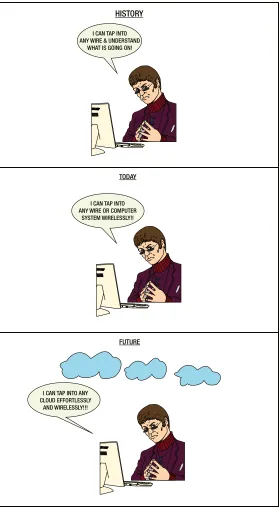
I CAN TAP INTO ANY WIRE & UNDERSTAND
WHAT IS GOING ON!
I CAN TAP INTO ANY WIRE OR COMPUTER
SYSTEM WIRELESSLY!!
HISTORY
TODAY
FUTURE
I CAN TAP INTO ANY CLOUD EFFORTLESSLY
AND WIRELESSLY!!!
Among the Phreakers, John Draper became famous because of a simple discovery. Earlier telephone systems used in-band signaling for sending control information such as dial tone, busy tone, receiver off-hook, and routing address to the switch in the same channel where the user’s voice was being transmitted. Table 2-1 shows the frequency of different control signals. These signals are generated by the Central Office (CO) switch. Subscribers are connected to the CO, and when the phone is off the hook, the CO transmits a 350 and 440 Hertz signal to the subscriber which is the dial tone. A 2600 Hertz frequency tone generates a call over signal and provides control over other signals to make another call again. Similarly, the CO transmits other control signals to the subscriber, which was made public in the Bell Systems Technical Journal.14,15
Figure 2-4. John Draper (Copyright © 2014 The Porticus Centre, Beatrice Technologies)16 Table 2-1. Network Call Progress Tone Frequencies