i
A Thesis
Submitted in Partial Fulfillment of the Requirements for the Degree of SarjanaPendidikan in English Education Department of
Tarbiyah and Teaching Science Faculty of UIN Alauddin Makassar
By
ITA TRISNAWATI Reg. No. 20400113005
ENGLISH EDUCATION DEPARTMENT
TARBIYAH AND TEACHING SCIENCE FACULTY
v
First of all, the researcher would like to thank Almighty God Allah SWT the only provider, the most merciful who grants her guidance, inspiration and good health all the time to conduct the writing of this thesis. Also Shalawat and Salam are conveyed to our great prophet Muhammad Saw who has brought us from the darkness to the lightness.
Having accomplished this thesis, she would like to acknowledge her deepest thanks and appreciation to the following individuals who have involved in completing this thesis for the valuable contribution, suggestion, advice, supporting and guidance for her to finish this thesis:
1. Prof. Dr. H. Musafir Pababbari, M.Si. as the Rector of State Islamic University Alauddin Makassar.
2. The researcher beloved father JUDIN. Her lovely mother HASNAWATI who have given much love, motivation, supporting, praying, moral and financial support for all the time for her success. And also for her beloved brothers SOHARTOYO and SULAEMAN for their greatest motivation to finish her study immediately.
vii
F. Operational Definition of Terms ... 6
CHAPTER II REVIEW OF RELATED LITERATURES... 7
A. Review of Relevant Research Findings ... 7
B. Some Pertinent Ideas ... 9
1.Definition of Motivation ………... 9
2. The Way to Give StudentsMotivation .………... 12
3. Types of Motivation ……….. 13
4. Impact of Motivation ………. 20
5. The Important ofMotivation ………. 21
6. Theory ofMotivation ……… 22
7. Definition of Rewards ………...…... 21
8. The Type of Rewards ... 24
9. The Aims of Rewards……… 25
10. The Principle ofRewards ……….. 25
11. The Kinds of Rewards ………. 26
12. The Advantages of Rewards ………. 26
13. The Disadvantages of Rewards ………... 27
C. Theoretical Framework ... 28
viii
C. Population and Sample ... 31
1. Population ... 31
2. Sample ... ... 31
D. Research Instrument ... 31
E. Data Collecting Procedure ... 33
F. Validity and Reliability ………. 34
G. Data Analysis Technique ... 35
CHAPTER IV FINDINGS AND DISCUSSION ... 37
A. Findings... 37
1. Mean scores and standard deviation of Experimental and Control class... 37
2. Test of significance ... ... 39
B. Discussion ... 39
CHAPTER V CONCLUSIONS AND SUGGESTIONS ... 42
A. Conclusions ... 42
B. Suggestions ... 43 BIBLIOGRAPHY
APPENDICES
ix
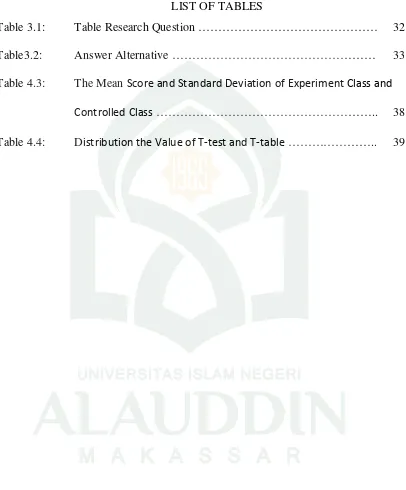
Table3.2: Answer Alternative……… 33
Table 4.3: The MeanScore and Standard Deviation of Experiment Class and
Controlled Class……….. 38
xi
Appendix 2: The Score of the Students Pre-test and Post-test in Experimental
Class ………49
Appendix 3: The Score of the Students Pre-test and Post-test in Control
Class……….50
xii
Department/faculty : English Education/Tarbiyah and Teaching Science Title : The Grant of Rewards toward Students Motivation in
English Learning at the Second Year Students of MTs Boro Jeneponto.
Consultant I : Dr. H. Nur Asik, M.Hum.
Consultant II : Dra. St. Nurjannah Yunus Tekeng, M.Ed., MA.
The main objective of this study was to find out the granted of rewards toward students motivation in English learning. Therefore, the main problem was the grant of rewards was effective in English learning. This research was conducted at the second year Students of MTs Boro Jeneponto.
The researcher applied quasi-experimental method with two groups the pre-test and the post-test design. There were two variables in this research; they were independent variable and dependent variable. The independent variable was rewards and dependent variable was student motivation. The population of this research was all the second year students of MTs Boro Jeneponto. There were 40 students altogether. The sample of the research consisted of 40 students were taken by using Purposive sampling technique, (20 students) from class VIII A as a experimental class and (20 students) from VIII B as a controlled class. The instrument in this research was questionnaire.
The result of the analysis indicated that there was a significantly different result between the post-test in experimental class and the controlled class. The mean score of the post-test (59.65) in the experimental class was categorized as good and the mean score of the post-test (55.25) in the controlled class it was classified as poor. Therefore the mean score of the experimental class was greater than the mean score of the controlled class. From t-test, the researcher found that the value of t-table obtained sig. value (2-tailed) = 0,000 < 0.05 H0was rejected. It meant that the grant of rewards was effective toward the students motivation at the second year students of MTs Boro Jeneponto.
1
This chapter dealt with research background, research problems, research objectives, research significances, research scope, and operational definition of terms.
A. Background
English is one a foreign language, it can be seen from the fact that English is included as one of the subjects to be learned by students in both junior and senior high schools. English is very necessary to be mastered by students both to verbal and written language. This is because English is an international language and is considered essential for the purpose of development of science, technologies, art and culture as well as fostering relationships with other nations.
Motivation in teaching and learning process is one of the supporting elements for the creation of educational goals. If one learns without any encouragement or motivation, the situation is unpleasant to learn and even faster bored. Ryan and Deci (2000) found that motivation means to be moved to do something. Someone who did not have inspiration to do something means that the students are unmotivated. While, someone who had inspiration to do something means the students are motivated.
To be successful in learning English depended on the motivation. In other word, learning and motivation are closely bound together and influence one another heavily. Yu-mei (2009) said that motivation is one of several important factors that may influence student English achievement. In addition, Motivation is a very important factor which determines the success or failure in second language learning because motivation can directly influence the frequency of using learning strategies, will power of learning, goal setting, and the achievement in learning (Li & Pan, 2009). Learning and motivation have the same importance in order to achieve something. Learning make the students get new knowledge and skills and motivation pushes or encourage them to go through the learning process.
other hand, some students felt an anxiety and bored in learning. Consequently, the teacher must have an idea to build the students motivation in learning English, because motivation is the one of important factor to the success of learning English.
So far, it is assumed that some teachers in Indonesia still used a traditional method like grammar translation method to teach English for example reading. The teacher only asked the students to read and translate the text into Indonesian language. It is not completely bad method but students need different atmosphere which makes them relaxed and motivated them in learning activities. According to Yusfiroh (2000) many of learning language process tends to be formal it can make students feel bored in learning. It is caused by a monotonous classroom and away from the natural atmosphere.
As the English teacher, the teacher has to create an interesting model of teaching and atmosphere of learning process which make the student relaxed and fun to learn English in the class. However, the researcher arranges to help and motivating students to learn English by giving rewards. Rewards is a consequence that increases the probability that a behavior will occur.
Therefore, based on the background above, the researcher interest to conduct the research by the title “The Grant of Rewards toward the Students Motivation in English Learning at the Second year of MTs Boro Jeneponto”. B. Problem Statement
Based on the previous statement, the researcher formulated the research question as follow; Is the grant of rewards effectiveness toward the students motivation in English learning at the second year Students of MTs Boro Jeneponto?
C. Research Objective
In relation to the problem statement above, the objective of the research was to find out the grant of rewards toward the students motivation n English learning at the second year students of MTs Boro Jeneponto.
D. Research Significance
The results of this research was expected to be theoretically and practically useful. Theoretically, it was expected to add an empirical evidence to support the learning theory of motivation by rewards.
Practically, it was expected to be valuable information and give a meaningful contribution for the students, teacher and the next researcher. So the significances of the research are as follows:
1. For the students
2. For the teacher
The researcher hopes that this research can help the teacher to make the students achievement. It was also expected to be useful for English teachers to provide an alternative solution to solve the problems in English learning.
3. For the next researcher
This research was expected to give great contribution to the other researchers as a reference for further studies on a similar topic.
E. Research Scope
To make the research clear, this research was focused on the students’ motivation in English learning. The researcher gave a topic to the students, and the researcher gave a reward to students who participate during English classes activity. The researcher was scope the variables in this research. Is the grant of this research can motivate students or not, especially with the grant of rewards in English learning. For the place, the researcher conducted in the second year students of MTs Boro Jeneponto.
F. Operational Definition of Terms
In this section, the researcher would like to give the operational definitions of motivation and reward.
1. Motivation
Keller (1987) through the model presented ARCS (Attention, Relevance, Confidence and Satisfaction). In psychology context, there are some indicators as follow: duration of activity, frequency, resilience, devotion, aspiration level, qualification level and attitude.
2. Reward
CHAPTER II
REVIEW OF RELATED LITERATURE
This chapter was divided into four main sections, namely review of related research finding, pertinent ideas, theoretical framework, and hypothesis.
A. Review of Relevant Research Findings
In this research, there are some reviews of related research finding from the previous researcher, as follows:
Andriani (2013) in her research with the title“Penerapan Reward Sebagai Upaya Meningkatkan Motivasi belajar siswa”.The objectives of her research was aimed at finding out that the teachers overlook little things like a lack of giving a reward to students who excel or infrequently gives praise to the students because teachers focus more on the material to be delivered. Reward is educational fun. Reward is not only a gift, but with praise, adding numbers and a thumbs-up could be given to students. With their teachers' attention to the students, the students will be excited and also can motivate the students learning.
Jannah (2013) in her research with the title “Pengaruh PemberianReward Guru terhadap Keaktifan Belajar Siswa Kelas XI dalam Mengikuti Mata
Pelajaran Al Qur’an Hadits MAN Tengaran Kabupaten Semarang tahun 2013”.
Reward is a means used by someone to give an award to someone because it is already doing something right, so someone can again in the spirit of doing the task.
Rewards can promote students’ motivation, participation, and achievement in learning English. It is proved by students’ participation through the activities, such as answering teacher’s questions, asking questions to the teacher, reviewing
the lesson, giving opinions in the group discussion, and presenting the result of the discussion in front of the class.
Suwazi with the title “Correlation between motivations in learning
English of the second grade students of SMUN 1 Rantau academic year
2001-2002”.It shows that motivation is some kind of internal drive date and encourages somebody to pursue a course of action. The result of the research shows that motivation and the achievement of language skills has tight relationship. SMP Negeri 14 Makassar is one of the SMP Negeri 14 Makassar that provides English. In learning English the student of SMP Negeri 14 Makassar is also influence by the motivation. The researcher wants to held a research about the effect of giving reward toward motivation in learning English in this place since the student motivation are still less according to the English achievement report.
B. Some Pertinent Ideas a. Motivation
1. Definition of Motivation
Pintrich (2003) stated that motivation is what makes people do something, and help solve their tasks. This means that the concept of motivation applied to explain the desire behave, and direction of conduct (optional). Brophy (2004) stated that the motivation to learn more priority cognitive response, is the tendency of students to achieve academic activities meaningful and beneficial and try to profit from the activity.
According to Santrock in Istianti (2013), “motivation is the process that energize, direct, and sustain behavior”. It means that motivation is the process in which pushes and shows students to do something and keep on the activity continuously. Motivated students will feel eager to achieve what they with strong desire. It is similar with the idea of Schunk in Nerfi (2013) that motivation is an essential of learning to achieve something. It is a process which directs students to achieve to get goals.
three elements. These include effort, desire, and affect. Effort refers to the time spent to study the language and to drive the learner. Desire indicates how much the learner wants to become proficient in the language, and affect illustrates the learner’s emotional reactions with regard to language study.
According to Vroom in Hong & Waheed (2011) define the motivation is derived from the Latin word movere, which means “to move”. Motivation is an internal force, dependent on the needs that drive a person to achieve. Ondabu (2014) states that motivation is concerned with the factors that influence people to behave in certain ways. Motivating other people is about getting them to move in a certain direction in order to achieve a desired results.
Schunk et al., in Rosalina (2014) define motivation is the process whereby goal-directed activity is instigated and sustained. Meanwhile, Melendy in Babaae (2012) states that from the latin root movere, motivation refers to a process that starts with a need and leads to a behavior that moves an individual towards achieving a goal. Pakdel (2013) states that the term of motivation derives from the Latin root which means Stimulus. Motivation is behavior, it is not a thing or special event that can be observed directly. It is a compound which describes specific behaviors.
According to Ngalim Purwanto (2004) states that motivation is derived from word ‘motive’ means everything that encouraging somebady too act or do
He further adds that if one is motivated, he/she has reasons (motives) for engaging in the relevant activities, expend effort, persist in the activities, attends to the tasks, show desire to achieve the goal, enjoys the activities, ect.
Motivation is an energy change with in the person characterized by effective arrausal and anticipatory goal reaction. According to on Makmun (2013:37) defined that motivation as power, forces and an energy or complex situation and readiness of the individual to move in the selected instruction.
In learning activity, it can be said that motivation is the main supporting to push the students itself to learn therefore the goal of learning is achieved. Learning motivation is a psycholigical factors with non intelectual characteristic which appears passion, comfortable and enthusiasm. The students who have learning motivation will learn seriously and they have much energy to focus on learning activity.
2. The ways to give students motivation
Sardiman, DjapriBasri (1989:12) proposes 12 ways to give students motivation to learn, they are:
a. Create learning situation that is enjoyable
The situation of learning must be enjoyable. The enjoyable situation can arouse students’ learning motivation.
b. Give prize
Giving prize to clever students can be motivation for students themselves and other students. It will encourage students to get good score.
c. Give praise
If there is a student who is successful in doing task well, it needs to be given praise. Because it is a positive reinforcement and can raise desire of student to study.
d. Competition
Competition is needed too, because it can raise achievement for individual or group competition.
e. Cooperation
In learning activity, cooperation can raise the students’ interest in learning
group. The cooperation can give encouragement to learn and help the students who is less clever.
f. Inform students there will be a test
g. Ego-Involvement
The students’ behavior can appear in tasks that they have done if the students feel the importance of tasks and receive it as challenge. So, they will do that task diligently.
h. To arrange the students’ seat variously
The arrangement of students’ seat will create the harmony of learning
situation. The teacher and students do not feel bored to use and occupy that class. i. Use various method in teaching to fit the material
By using various methods in teaching to fit the material, the role of students in learning can be increased.
j. To give comment to students work
Beside giving score, comment about mistake that have been made by students in learning is also important to encourage students to learn, such as “very
good work”, “next time will be better”, “actually you are able to do the task,but it is still less accurate.
k. To give comment to students’ work
For the students who make mistake, lazy and bad behavior in learning activity, the warning can be a tool to correct behavior. Example: The student who makes noise in the class.
3. Types of motivation
Self-determination involves a true sense of choice, a sense of feeling free in doing what one has chosen to do.
In Self-determination theory distinguished between different types of motivation based on the different reasons or goals that give rise to an action. Hence, self-determination theory proposes that there are two basic types of motivation: intrinsic and extrinsic motivation.
a. Intrinsic Motivation
According to Ryan & Deci (2000) state that intrinsic motivation is defined as doing f an activity for its inherent satisfaction rather than for some separable consequence. When intrinsically motivated a person is moved to act for the fun or challenge entailed rather that because of external prods, pressure, or rewards. Meanwhile, Vallerand (2004) states that intrinsic motivation refers to engaging in an activity for itself and for the pleasure and satisfaction derived from participation.
Santrock (2009) states that intrinsic motivation involves the internal motivation to do something for its own sake. For example, a students may study hard for a test because he/she enjoys the content of the course. Santrock also adds that students are more motivated to learn when the students are given choices, became that have informational value but are not used for control.
with the ball. Vallerand also add that there are at least three types of intrinsic motivation: intrinsic motivation to know (engaging in the activity for the pleasure of learning), intrinsic motivation toward accomplishments (engaging in the activity for the pleasure of trying to surpass oneself), and intrinsic motivation to experience stimulation (engaging in the activity out of sensory and aesthetic pleasure).
According to Lai & Conttia in Souriyawongsa et al. (2012) state that intrinsic motivation is defined to engage in activities of learners able to appreciate and satisfy to do something whereas extrinsic discusses to actions that can carry out in order to receive achievement. For instance, when students have free to select toact activity, they will pursue interesting situation where they can rise to the challenges that the activity presents.
b. Extrinsic Motivation
Santrock (2009) define extrinsic motivation is often influenced by external incentives such as rewards and punishments. For example, a students may study hard for a test in order obtain a good grade in the course. In this statement, there are factors from outside that influence someone to do something.
According to Ryan & Deci (2000) state that extrinsic motivation is a construct that pertains whenever an activity is done in order to attain some separable outcome. Extrinsic motivation thus contrast with intrinsic motivation, which refers to doing an activity simply for the enjoyment of the activity itself, rather than its instrumental value.
According to Dornyei in Babaee (2012) states that extrinsic motivation is related to doing an action in order to receive an extrinsic reward or to avoid punishment. Dornyei also adds that an example of extrinsic motivation would be the case of an employee who studies English because she/he will be sent to England for work, and if it were not for that sake, she/he would not study it. It is clear that extrinsic motivation born because from outside factors that stimulates someone to study English.
Dornyei in Himawati (2006) divides extrinsic motivation into four sub-types:
a. External regulation refers to motivation coming entirely from external sources such as reward or threats.
b. Interjection regulation involves externally imposed rules that the people accept as norms to be followed in order not to feel guilty.
c. Identification regulation occurs when the person engages in an activity because he/she highly values and identifies with the behavior, and see its usefulness.
d. Integrated regulation is involving chanceful behavior that is fully assimilated with the individual’s other values, need, and identity.
According to Harmer (2007), student in learning English have two motivation: intrinsic motivation and extrinsic motivation.
a. Intrinsic motivation
pleasure. In neither case does the students work on the task because there is some reward involved, such as a prize, a payment, or in the case of students, a grade. Another example, intrinsically will motivated student to get a good grade on an assignment, but if the assignment does not interest that student, the possibility of a good grade is not enough to maintain that students motivation to put any effort into the project.
b. Extrinsic motivation
Brown (2000) divided intrinsic motivation into two main types that are integrative motivation and instrumental motivations.
a. Integrative motivation.
Integrative motivation is employed when learner wish to integrate themselves within the culture of the second language group, to identify themselves and become a part of society. For example immigration or marriage. b. Instrumental motivation.
Learner wishes to achieve goals utilizing second language. Robert Gardner and Wallace Lambert states that refer to motivation to acquire a language as means for attaining instrumental goals furthering a career, reading technical material, translation and so forth. This is describes a situation in which the students believe that by mastering of the target language, they will be instrumental in getting a better job, position and statutes.
A. Tabrani (1992) there are four types of motivation, namely; a) Competition
It is divided into two, they are: achievement competition and competition to other people. In achievement competition, the students must know the result that is achieved then attempt to increase the result. Meanwhile in competition to other people, the students learn and compare the result achieved with other students.
b) Clear goal
c) Close the goal
If the students see that the goal is far, they will be lazy to achieve and increase the goal. On the contrary, the students will be motivated to reach the goal if it is close to the students.
d) Interest
Interest influences a process of achievement to a motivation. If someone is not interested in something, she or he will not do any activity. But if someone has interest in learning she or he will learn enthusiastically. Someone interest to learn something can be seen from her or his desire to study.
Extrinsic motivation does not mean, however, that a person will not get any pleasure from working on or completing a task. It just means that the pleasure they anticipate from some external reward will continue to be a motivator even when the task to be done holds little or no interest. An extrinsically motivated students, for example, may dislike an assignment, may find it boring, or many have no interest the subject, but the possibility of a good grade will be enough to keep the students motivated in order for him or her to put forth the effort to do well on a task.
4. Impact of Motivation in the English Classroom
a. Students should have positive feelings about present goals or activities
b. They must have enough self-confidence to perform present activities or to attain future goals.
c. They must pursue goals that provide immediate satisfaction after they are attained.
d. They should make sure present activities are not related to important goals or interfere with one another.
5. The Important of Motivation in Learning
Sahabuddin (2002) states the asters of educational psychology emphasize about the important motivation in the learning and teaching process, motivation has relation with need to motivate get satisfication. In relation with in the expand modern educational system. The master give that in learning and teaching process can use need approach and the student can just study with full attention if there are needing, interest, and expectation or ambition who will be got.
According to Damyati and Mudjiono (2006) states motivation in learning is so crucial to the students and teacher important of motivation in learning to the students namely:
1. Givinginformation about the strong of the students’ effort.
2. Setting up class position to begin learning process to find better last result.
3. Giving direction to study activity. 4. Expanding the spirit in learning.
These point the entire find important of motivation and beware by his individuals. The important of motivation must be known by teachers’ knowledge and undertanding about motivation in learning to the students’ the benefit to the
teachers is namely:
1) Arousing and keeping the students spirit to learn it order to success. 2) Knowing and understanding the students motivation to learn different
class.
3) Increasing and encouraging the teachers to choose one in the kinds of characters like counselor, facilitation, and instructor.
6. Theory of Motivation
Theory of motivation is the power of someone that will appears level persistence and its enthusiasm in conducting an activity which derives from the individual itself. How much the power of motivation that has been had by the person will determine the quality of behavior which is shown, even in learning context, working, or in the other situation of life. Generally, the theory of motivation is divided into three kinds are the theory of motivation with content theory, the theory of motivation with process theory, and the theory of motivation with reinforcement theory.
a. Duration of activity is relevant with how long the ability to use of the time. b. Frequency is how often learning activity is done in particular period.
c. Resilience is the ability to face the challenge and difficulty for achieving the goal of learning activity.
d. Devotion is sacrificing some money, energy, thought, even soul to achieve the goal of learning activity.
e. Aspiration level is the target which will be achieved with the activity that will be done.
f. Qualification level is achievement which will be achieved from learning activity.
g. Attitude is positive or negative student behavior in learning activity. c. Reward
1. Definition of Rewards
Kamin’s Blocking effect (1969) which postulates that a reward that is fully predicted does not contribute to the learning of o stimulus or action, even when it has been repeatedly paired with the stimulus or action. According to Vocabulary.com Dictionary, a reward is something you get for a job well done. If you study hard that vocabulary test, an “A” might be the reward in your future.
Allah says inQur’an Surah Al-Baqarah verse 261:
In Surah Al-Baqarah it can be concluded that the parable (income earned by) those who spend their wealth in the way of Allah as a seed which grows seven stalks, on every stalk there are one hundred seed. Allah multiply for whom he wants, and Allah is all knowing.
Based on the above verse can be concluded that rewards in the context of education is to be given to anyone who participates, with the reward that students will be more active in English learning. Because reward can motivated the students to always strive to be the best. Therefore, reward is very important applied in school.
2. Type of Rewards
J.R David (1976) said that the award can be done in various ways and appropriate opportunity. There are 3 types of reward: award in the form of words, award in the form of writing and goods.
b. Award in the form of writing, this can be done every day, when students do chores or homework. This award is given by way of teacher writes in a notebook or student assignments, be words of praise, especially for students who managed to get good grades (80-100). The compliment sentence including“congratulations, you are a good student”.
c. Award in the form of goods, various objects can actually be used as a tool awards, both objects already exist or have been modified / prepared. For example rewards in the form of: star, made of cardboard for students who scored high (80-100) both exercises, and homework assignments. Lessons medal necklace, made of cork that resembles a medal by using cord colors. Achievements made specifically for each subject, and given to students after each daily quiz. Students who received the highest score in the daily quiz entitled to receive a medal.
3. The Aims of Rewards
J.R David (1976) said that, there 3 aims giving rewards that are: a. Motivated students to be more active in learning.
b. Give appreciation for the student effort.
c. Fostering healthy competition among students to improve achievement. 4. The Principle of Rewards
a) Lead learners to become dependent on short term rewards
b) Coax them into a habit of looking to teachers and others for their only reward c) Forestall the development of their own internally administrated. Intrinsic
5. Kinds of Rewards
a. Smile face is one of the sign like a face and give for the students who can answer the question for the teacher.
b. Star is teacher give students a star if the students can give a right answer. c. Praise is the something can increase students motivation in English learning
like when the students can answers the question the teacher give praise. Examples teacher can say very good, you a smart, I you’re your answer. d. Score is the teacher gives a score to students can answer the teacher question.
6. The Advantages and Disadvantages of Rewards
Ahmad (2010), there are Advantages and disadvantages of reward. 1. Advantages of reward
a) Promote appropriate behavior
Extending a reward to students helps to promote positive and appropriate behavior among students in your class. Following class rules, being kind to one another and keeping safety a priority are just a few of the positive behaviors to be displayed in your classroom through the gifting of rewards to the students. Through appropriate student behavior, teachers are able to concentrate on lesson content and interactive activities to indulge students in learning opposed to focusing on classroom discipline.
b) Motivation for full effort on classroom tasks
duties and responsibilities. Motivating students to learn is part of the challenge that instructors face when teaching content and giving rewards will result in more effort on the part of the student.
c) Completed homework
Reinforcing subject matter is the primary goal of assigning homework for students and without homework completion, students are not able to practice accomplishing the content of the lesson. Promote a grasp of the lesson by rewarding the students for completed projects and homework assignments both in groups and individually.
d) Happy students
Successful students are happy students and in order to have a classroom of happy students, teachers may use a reward system. Encourage students to be productive in learning both at home and in school by offering rewards. Rewards tend to create a feeling of pride and achievement among students thus motivating them to be more productive.
2. Disadvantages of reward
a) The teachers are mostly and extrinsically in motivating the pupil toward winning a prize instead of cultivating a taste for the thing itself.
b) The students afford temptation to cheat.
c) The students encourage the wrong attitude, expecting something for nothing. d) In most instances only a few children may hope to win, those least needing
C. Theoretical Framework
Motivation was personal change someone marked by the emergence of feelings and reactions to achieve the goal in English learning. The results to be obtained between each individual was very different, someone who had a high motivation it was more persistent in achieving the desired objectives, thus the results obtained was better than someone who had medium motivation and low.
The purpose of the rewards system was to further develop and optimize the intrinsic motivation of extrinsic motivation, in the sense that the students perform an act, the act that arised from the consciousness of the students themselves. As well as mentioned above, that a rewards in addition to an educational tool repressive fun, rewards was a driving force or motivated for the students to learn better. Therefore, by effecting the rewards system was expected to increase students motivation at the second year students of MTs Boro Jeneponto, In order to learn the results obtained are also getting better.
C. Hypothesis
Based on the problem statement presented by the researcher, the hypothesis of this research was formulated as follow;
H0: The grant of rewards was not effected toward students motivation at the second year students of MTs Boro Jeneponto.
CHAPTER III
RESEARCH METHOD
This chapter deals with research method, population and sample, research variables, research instrument, data collection procedures, data analysis technique and statistic procedure.
A. Research Method
Research method was a procedure that used in research systematically. It starts from planning, collecting data, until step of interpretation of conclusion.
1. Research design
The design of this research was quasi experimental design research exactly Non-equivalent group design. According to Nunan (1991) stated that quasi experimental research was defined as experimental design which was conducted as if it was look like the real situation. In this case, the researcher wanted to know the significant effect of the grant of rewards toward student motivation in English learning.
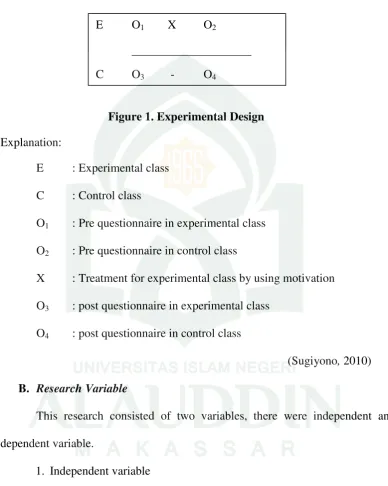
The model of Quasi-Experimental design, exactly Non-equivalent Control Group design:
Figure 1. Experimental Design Explanation:
E : Experimental class C : Control class
O1 : Pre questionnaire in experimental class O2 : Pre questionnaire in control class
X : Treatment for experimental class by using motivation O3 : post questionnaire in experimental class
O4 : post questionnaire in control class
(Sugiyono,2010) B. Research Variable
This research consisted of two variables, there were independent and dependent variable.
1. Independent variable
The independent variable (X) was rewards which the learning that help to motivate the students. Independent variable was affected dependent variable. It showed how the grant of rewards was motivate the students in English learning.
E O1 X O2
____________________
2. Dependent variable
The dependent variable (Y) was student motivation. Dependent variable affected through independent variable.
C. Population and Sample 1. Population
Arikunto (2013) states that, population was the total member of research respondents, while sample was a part or representation of population that was researched. The population of this research was the second year students of MTs Boro Jeneponto. The population consised of two classes VIII A and VIII B. The total number of population were 40 students.
2. Sample
The research applied the Purposive Sampling Technique. Purposive sampling was a sample of determining technique with the specific consideration in which two classes taken as sample. In this case, the researcher chosed the class VIII A as the experimental class which consisted of 20 students and VIII B as a controlled class which consisted of 20 students.
D. Research Instrument 1. Questionnaire
Table 3.1
Table of Research Question by Anna Kurnia (2013)
Aspects Indicators
Items
Favorable Unfavorable
Attention Duration activity 1, 4, 7 2, 5, 8
Frequency 3, 6, 9 10, 13, 16
Relevance Devotion ( sacrifice) 11, 14, 17 12, 15, 18
Confidence Persistence 19, 22, 25 20, 23, 26
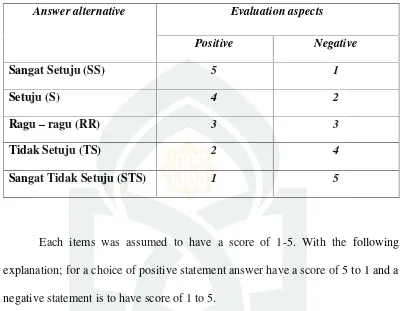
Table 3.2
Answer alternative by Likert Scale (2013)
Answer alternative Evaluation aspects
Positive Negative
Sangat Setuju (SS) 5 1
Setuju (S) 4 2
Ragu–ragu (RR) 3 3
Tidak Setuju (TS) 2 4
Sangat Tidak Setuju (STS) 1 5
Each items was assumed to have a score of 1-5. With the following explanation; for a choice of positive statement answer have a score of 5 to 1 and a negative statement is to have score of 1 to 5.
E. Procedure of Collecting The Data
Before conducting the research, the researcher first made a questionnaire to measure the students motivation and esearch design as follows:
1. Questionnaire
The pre questionnaire was distributed at the first meeting. This purpose was to know the students motivation achievement before the treatment (giving rewards to the students in their learning).
2. Treatment
The first, the researcher introduce herself and explained to the students the purpose of coming to the school. The second, the researcher did treatment (granting rewards in the class). Before granting rewards, the whole term of rewards were explained to the students including how to get the reward. Students’ reward were given to the students who participated during the English classes activity. The third, the researcher continued the research until the seventh meeting. The researcher treated with the same thing were granting rewards. The last, the researcher made a conclusion and closing the section. Then, the researcher take some pictures as a documentation.
3. Post-questionnaire
After giving the treatment, the researcher gave post-questionnaire to the students to measure the students motivation.
F. Validity and Reliability
According to the validity analysis of questionnaire, 14 from 42 items were valid (see the APPENDIX I). According to Sugiyono (2015) the criterion of the valid test was coefficient correlation (rxy) was higher or same with the r table idest 0, 3. There were 28 items of the questionnaire were not valid because, the t table of those items was higher than the distribution test.
G. Technique of Data Analysis
After conducting the pre-questionnaire and post-questionnaire in the experimental class and the control class, the result of both tests in each class was analyzed. N = the total number of subject
(Gay, 1981: 320) 2. Finding out the standard deviation by applying this formula:
= −
N = Total number of the subjects
∑ = The sum of all square; each score is squared and all the squares are added up
(∑ ) = The square of the sum; all the scores are added up and the sum was square, total.
(Gay, 1981: 321) 3. The formula that was used to finding out the difference between the students’ scorein the Pre-Questionnaire and in the Post-Questionnaire:
= x1 − x2
SS1 + SS2 n1 + n2 − 2
1 n1+
1 n2
Where:
t = test of significance
x1 = mean score of experimental group
x2 = mean score of controlled group
SS1 =sum square of experimental group
SS2 = sum square of controlled group
n1 = number of students of experimental group
n2 =number of students of controlled group
CHAPTER IV
FINDINGS AND DISCUSSION
This chapter consisted of two items, the findings of the research and the discussion of the research findings. In finding item, the researcher showed all of the data which were collected during the research. While in the discussion item, the researcher analyzed all of the data in finding item.
A. Findings
The findings of this research were based on the results of the data analysis. 1. The Mean Score and Standard Deviation of Experimental Class and
Controlled Class
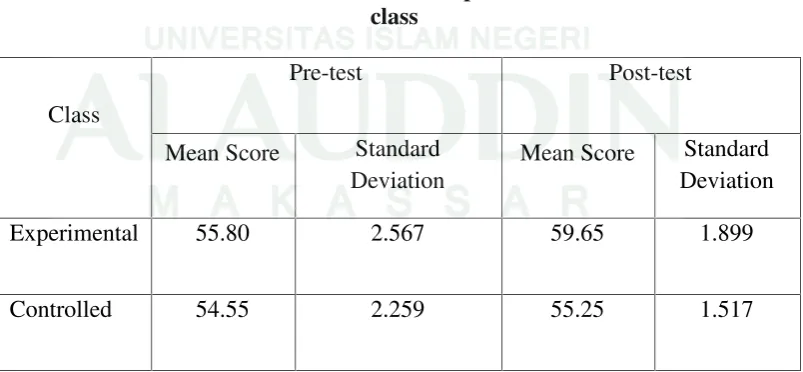
After doing calculation to the students score, the mean score and standard deviation from both the result classes was presented in the following table.
Table 4.3
of controlled class in the pre-test was 54.55 and the standard deviation was 2.259. While the mean score of the experimental class in the post-test was 59.65 and the standard deviation was 1.899, and the mean score of the controlled class in the post-test was 55.25 and the standard deviation was 1.517. It can be concluded from both of the tests; the experimental class gained greater mean score in the post test than the controlled group.
2. Test of Significance Testing
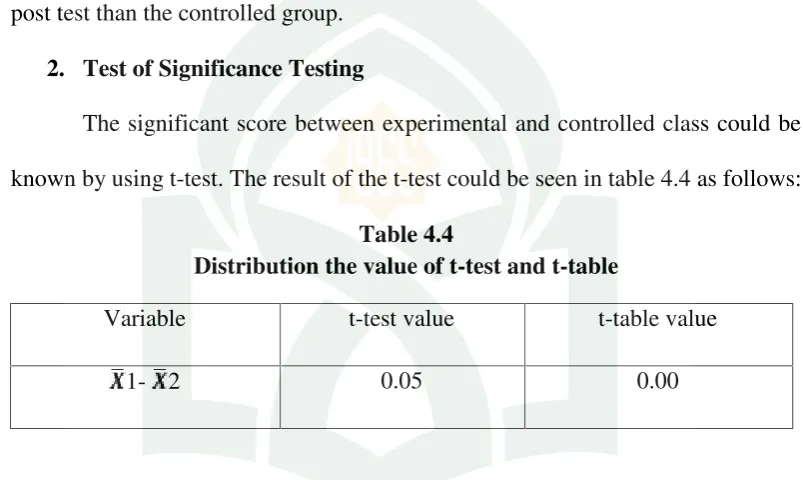
The significant score between experimental and controlled class could be known by using t-test. The result of the t-test could be seen in table 4.4 as follows:
Table 4.4
Distribution the value of t-test and t-table
Variable t-test value t-table value
1- 2 0.05 0.00
B. Discussion
Based on the findings of the research, it proved that the granting of rewards motivated the students to participate in the English learning classes.
The description of the data collected that rewards granting to the students had motivated the students in English learning. This has been proved by the result of the students score of the pre-test and the post-test. The students score after the treatment in English learning in the was better than before the treatment was given to the students. The analysis of the mean score gap in the post-test between the experiment class and the controlled class ensured if granting reward was effective toward the students motivation to learn English. The mean score of the experimental class was 59,65 and 55,25 for the controlled class. The explanation of the gap between the two classes indicated that the experimental class showed higher score compared the controlled class.
associations to repeat the desire act, the students generated interest and enthusiasm, and the students developed high moral.
CHAPTER V
CONCLUSION AND SUGGESTION
This chapter presented the conclusions as well as few suggestions of this study. Suggestions were taken based on findings and conclusions obtained in this research.
A. Conclusions
Based on the result of the data analysis, research findings, and discussion in the previous chapter, the researcher concluded that:
The grant of rewards toward students motivation was effective in English learning at the second year students of MTs Boro Jenepoto. The grant of rewards could motivate the students in English learning. The students motivation before applied rewards was still low. It was different from the students in English learning after granting reward. It was found in students post-test was higher than the pre-test, which proved that applied of rewards to the students was more effective in English learning.
students were more motivate their own. Rewards was effective to motivate the students in English learning at the second year students of MTs Boro Jeneponto. B. Suggestions
Based on the conclusion before, the researcher proposed the following suggestions:
1. For English teacher
The English teacher had to consider the students needs and interest for learning. It was also expected to be useful for English teachers to provide an alternative solution to solved the problems in English learning.
2. For the other researcher
BIBLIOGRAPHY
Ahmad.Advantages and disadvntages of rewards. 2010
Allport.Attitude definition,1985.
Arikunto, Suharsimi. ProsedurPenelitian: SuatuPendekatanPraktik. Cet. XV: Jakarta: RinekaCipta, 2013.
Aschabul Jannah.Pengaruh Pemberian Reward Guru terhadap Keaktifan Belajar Siswa Kelas XI dalam Mengikuti Mata Pelajaran Al-Quran Hadits MAN Semarang,2013.
Asrhuljuventini.The effect of giving rewards toward the motivation. 2013. Atkinson.Need definition,2003.
Babae, Naghmeh.Motivation in learning English as a second language,Canadian journal for New Scholars in Education, 2012.
Brophy, J.Motivating students to learning,2004. Brown.Two Types of Motivation,(2000).
Damopolii, Muljono. Pedoman Penulisan Karya Tulis Ilmiah: Makalah, Skripsi, Tesis, Disertasi, dan Laporan Penelitian.Makassar: Alauddin Press, 2013. Damyati & Muldjono.The Important of Motivation in Learning,2006.
David J.R. Strategi pembelajaran dengan metode pemberian reward. Bekasi, 2012.
Ella.Definition of Intrinsic Motivation,1984. Gardner.Definition of Motivation,1982.
Gay, L.R,.Education Research: Competence for Analysis and Apllications, Eight Editions. Columbus: Charles E. Meril. 2006.
Gilmer.Definition of Ixtrinsic Motivation,1973.
Harmer.Intrinsic Motivation and Extrinsic Motivation,2007.
Himawati, Nurma. Motivation in Jeanne Wakatsuki Housto Ferewell to Manzanar,2006.
Hong, T. T., & Waheed, A. Herzbeberg’s. Motivation –hygiene theory and job satisfaction in the Malaysian retail sector,2011.
Jamieson, Susan. “Likert Scale: How to (Ab) Use Them.” Medical Education,
2004.
Jannah. “Pengaruh Pemberian Rewards Guru terhadap Keaktifan Belajar
Siswa”, 2013.
Keller, John.The main component to measure the students motivation trough the model ARCS. 1987
John W. Santrock.Educational Psychology, America: McGraw Hill, 2011.
Kurnia, Anna. PROFIL MOTIVASI SISWA: Penelitian Deskriptif pada Sala Satu Rintisan Sekolah Bertaraf International Swasta Kelas XI di Bandung.2013. Kurnia, Anna.The Criteria of Scoring Guidance.2013
Li, P., & Pan, G.The relationship between motivation and achievement - a survey of the study motivation of English majors. University of Qingdao agricultural, 2009.
Mahadi, Tengku S. T., & Jafri, Sepideh M. Motivation, its types, and its impact in English Learning,2012.
Makmun, Abin Syamsuddin. Psikologi Pendidikan. Bandung: PT Remaja Rosdakarya, 2003.
Nerfi.Definition of Motivation,2013.
Nur Laily.The Use of Reward Improve the English Achievement of the First Yeart Students of SP 2 Grati Pasuruan.
Ondabu, IbrahimTarimba.A Theory of Human Motivation,2014.
Pakdel, Benaz. The Historical Context of Motivation and Analysis Theories Individual Motivation,2013.
Purwanto, Ngalim.Definition of Motivation,2004.
Rosalina, Viona. The Relation Between Students Motivation and Their English Learning Achievement,2014.
Ryan and Deci.Definition of motivation,2000.
Ryan, R. M., & Deci, E. L.Intrinsic and Extrinsic Motivation,2000.
Robert E. Slavin.Educational Psychology: Reward and Punishment (R & P) and Motivation.America: Pearson Education, 1986.
Sadirmanways to raise motivation in learning activity at the school, 2010. Sahabuddin.The Important of Motivation in Learning,2002.
Sardiman, A.M.Motivasi belajar,2005.
Santrock W. John.Psikologi Pendidikan.2013.
Skinner B.F.Teori Belajar/Teori Operant Condition1989.
Smith, Classroom: Goals, and students motivation. Journal of Educational Psychology, 1958.
Stipek.Impact of Motivation in the English Classroom,(2001). Sudjana, N. 2010.Penelitian Pendidikan. Sinar Baru. Bandung.
Sugiyono. Metode Penelitian Pendidikan: Pendekatan Kuantitatif, Kualitatif, dan R&D.Bandung; Alfabeta, 2010.
Susi Andriani. Penerapan Reward Sebagai Upaya Meningkatkan Motivasi Belajar Siswa,2013.
Suwazi.Correlation between motivations in learning English of the second grade students of SMUN 1 Rantau,2001.
Tabrani.Types of Motivation,1992.
Thomson in Widiyatmika.Definition of Rewards,2008.
P
P
E
N
D
I
X
E
Research instrument
The Grant of Rewards toward Students Motivation in English Learning at the Second Year Students of MTs Boro Jeneponto.
Petunjuk:
1. Tulislah terlebih dahulu nama, kelas, dan nomor absen anda.
2. Angket terdiri dari 14 butir pernyataan dengan 5 butir pilihan jawaban. 3. Bacalah setiap pernyataan secara teliti sebelum anda menjawab. 4. Waktu pengerjaan adalah 20 menit.
5. Jawablah semua butir pernyataan dengan sejujurnya sesuai dengan keadaan yang anda alami.
6. Pilihlah salah satu jawaban dengan cara memberi chek (√) pada pilihan yang sesuai. 7. Arti dari pilihan nomor 1-14
a. SS = Sangat setuju b. S = Setuju c. RR = Ragu-ragu d. TS = Tidak setuju e. STS = Sangat tidak setuju
8. Selamat mengerjakan dan terima kasih.
Nama :
Kelas :
2 Saya tidak pernah meluangkan waktu sedikitpun belajar bahasa Inggris meskipun saat ujian semester.
3 Saya jarang mengikuti pelajaran bahasa Inggris.
4 Setelah pulang sekolah saya mengikuti les bahasa Inggris. 5 Saya jarang masuk kelas saat jam pelajaran bahasa Inggris. 6 Tidak pernah menyerah hanya karena gagal dalam
kesempatan pertama.
7 Menyontek punya teman jika kurang yakin dengan jawaban saya.
8 Karena les bahasa Inggris mahal, maka saya tidak mengikutinya.
9 Saya tidak pernah bangkit kembali setelah gagal mendapatakan juara 1 lomba bahasa Inggris. 10 Saya bercita-cita menguasai bahasa Inggris. 11 Saya berusaha mahir dalam bahasa Inggris untuk
mendapatkan pekerjaan yang baik.
12 Saya kurang gigih dalam belajar bahasa Inggris.
13 Dikeluarkan dari kelas oleh guru karena saya mengganggu teman saat belajar bahasa Inggris.
Pre-test Post-test
1 ADRIAN 55 60
2 ANDIKA ADITYA PUTRA 60 64
3 DWI ASTRI JULIA PUTRI 58 58
4 HALIJA 59 61
5 IIS PRADINA 57 61
6 MASFIRA AL HUSNI 55 57
7 MISDAR 57 59
8 NUR HAERATUL NASRAH 54 58
9 NUR HAJRAWATI 57 61
10 NUR LAELA 54 58
11 RAHMAWATI 53 56
12 RISKA AMELIA 53 61
13 SASKIA 54 60
14 SRI REGINA PUTRI 50 58
15 SUDIRMAN 56 60
6 TAMSIR 55 61
17 TAUFIK AKBAR 60 62
18 TAUFIK DWI KURNIAWAN 57 60
19 WAHYUDI 54 62
NO NAME SCORE
Pre-test Post-test
1 AHMAD FIKRI 53 56
2 ANSAR 54 54
3 BURHAN 58 58
4 HAIDIR ALI 57 57
5 IRFANDI 53 54
6 IFVANDI AHMAD 55 55
7 KASMAWATI 57 57
8 MUH. RASUL 54 54
9 M. RUSLAN 56 56
10 NASTAIN 53 54
11 PATUR RAHMAN 52 54
12 RISNA 52 56
13 SRI RAHAYU 53 55
14 SRI WAHYUNI 50 55
15 TRI WIDYA 54 54
16 UMAR 55 53
17 WAHIDA 58 58
18 YULIANA DEWI 57 56
19 YANTI 53 53
May 30, 1995 in Jeneponto. She is the daughter of Judin and Hasnawati. She has two brother, Sohartoyo and Sulaeman.
The writer began her study in SDN 010 Muara Jawa Kalimantan Timur, and graduated in 2007. She continued her study in MTsN 01 Muara Jawa Kalimantan Timur and graduated in 2010. Then she continued her study in SMAN 01 Muara Jawa Kalimantan Timur and graduated in 2013.