Stability of Drugs
and Dosage Forms
Sumie Yoshioka
National Institute of Health Sciences Tokyo, Japan
and
Valentino J. Stella
The University of Kansas Lawrence, Kansas
Kluwer Academic Publishers
Print ISBN: 0-306-46404-7
©2002 Kluwer Academic Publishers
New York, Boston, Dordrecht, London, Moscow
All rights reserved
No part of this eBook may be reproduced or transmitted in any form or by any means, electronic, mechanical, recording, or otherwise, without written consent from the Publisher
Created in the United States of America
Visit Kluwer Online at: http://www.kluweronline.com
A thorough knowledge of the chemical and physical stability of drugs and dosage forms is critical in the development and evaluation of pharmaceuticals. Although a very large number of studies on the subject of stability have appeared in the primary pharmaceutical literature, books on the subject have not been comprehensive. Therefore, researchers and students have had to rely on individual papers for an in-depth analysis of the subject. The objective of this book is to bring together and analyze, in a systematic fashion, some examples relating to the stability of drugs from the work of others as well as from studies that have been performed in the laboratories of the authors.
This text is organized by first presenting the major mechanisms contributing to chemical instability, followed by discussion of factors affecting degradation based on kinetic theory and of ways in which problematic pharmaceutical products might be stabilized. Predictions of stability are covered, from basic theory to practical solutions.
Unlike earlier books in which chemical stability profiles and the effects of factors such as pH and other catalytic contributions on single substances were described extensively, the present text attempts to take a more global approach. Specifically, analysis of the factors affecting drug stability based on basic kinetic theory allowed for a sound theoretical treatment of available information. Furthermore, the bases for physical degradation kinetics, which have generally been treated empirically, are also covered, and sound bases for the observations are also presented and discussed.
The chemical and physical stability of protein and peptide drugs is considered in a separate chapter of this book. Although some newer texts have comprehensively addressed the difficult subject of protein stability, it was felt that no drug stability text would be complete without this subject.
Drug products are complex mixtures of drug and excipients, and, as such, their chemical and physical stability kinetics are complex. The chemical and physical stability of these complex dosage forms, starting with preformulation studies and continuing through to studies of the final products, including the role of packaging, are discussed. Information on the stability of novel drug delivery systems such as biodegradable microspheres is also included where possible. Issues of quality assurance, the estimation of shelf life, and the relevant regulatory requirements are described. The most recent information on International Harmonised Guidelines for stability testing is also provided, along with a brief discussion on conflicts that exist between the requirements of different countries.
As stated earlier, this book attempts to present a reasonably systematic and comprehen-sive approach to the subject of chemical and physical drug stability. Efforts have also been made to provide a fairly comprehensive listing of references that could be used by the reader to access the primary literature. Our understanding of the chemical and physical stability of drugs in solid dosage forms is still quite incomplete, and good comprehensive studies on the stability ofproteins are only now providing the type of information from which the prediction of physical and chemical stability of proteins might be possible. Additionally, we do not know what the stability problems of the drugs of the future, especially the products of genomic research, will be. Therefore, no book on the subject of drug stability should be considered complete. Opinions and interpretations of any scientific study also differ. The emphases presented here represent the biases of the authors, who welcome constructive comments and criticisms on any of the work presented in this text.
Finally, the authors would like to thank their colleagues for their contributions to the studies presented in this book. They would like to especially thank Drs. Aso and Izutsu, who contributed significantly to a number of the studies presented from Dr. Yoshioka’s laboratory. Contributors from Professor Stella’s laboratory include various students, technicians (espe-cially Ms. Waugh), and postdoctoral and visiting scientists. The authors would also like to thank Ms. Kawai and Ms. Nakamura of Nankoudo Publishers, who helped with the original Japanese version of this book.
Contents
1. Introduction . . . . 1
2. Chemical Stability of Drug Substances . . . . 3
2.1.1. Hydrolysis . . . 5
2.1.1.1. Esters . . . 5
2.1.1.2. Amides . . . 10
2.1.1.3. Barbiturates, Hydantoins, and Imides . . . 12
2.1.1.4. Schiff Base and Other Reactions Involving 2.1.1.5. OtherHydrolysisReactions . . . 17
2.1.2. Dehydration . . . 18
2.1.3. IsomerizationandRacemization . . . 18
2.1.4. Decarboxylation and Elimination . . . 22
2.1.5. Oxidation . . . 24
2.1.6. Photodegradation . . . 28
2.1.7. Drug-Excipientand Drug-Drug Interactions . . . 29
2.1.7.1. Reactions of Bisulfite, an Antioxidant . . . 30
2.1.7.3. Transesterification Reactions . . . 33
2.2.1. Basic Kinetic Principles . . . 34
2.2.2. The Role of Molecular Structure . . . 37
2.2.3. Rate Equations and Kinetic Models . . . 38
2.2.3.1. Kinetic Models to Describe Drug Degradation in Solution . . . 39
2.2.3.2. Kinetic Models Describing Chemical Drug Degradationin the Solid State . . . 52
2.2.3.3. Calculation of Rate Constants by Fitting to Kinetic Models 61 2.2.4. Temperature . . . 61
2.2.4.1. General Principles . . . 61
vii 2.1. Pathways of Chemical Degradation . . . 4
Carbon-Nitrogen Bond Cleavage . . . 15
2.1.7.2. Reaction of Amines with Reducing Sugars . . . 30
2.2.4.2. Quantitation of the Temperature Dependency of
Degradation Rate Constants . . . 62
2.2.4.3. Stability in Frozen Solutions . . . 78
2.2.5. pH and pH-RateProfiles . . . 80
2.2.5.1. V-Type and U-Type pH-Rate Profiles. . . 82
2.2.5.2. pH-Rate Profiles with Inflection Points Due to the 2.2.5.3. Bell-Shaped pH-Rate Profiles Due to Ionization of Multiple Groups or Change in Rate-Presence of One or More Ionized Groups . . . . Determining Steps . . . 94
2.2.5.4. Miscellaneous pH-Rate Profiles . . . 96
Catalysis . . . 97
2.2.7. Ionic Strength (Primary Salt Effects) . . . 99
2.2.8. Dielectric Constant of Solvents . . . 102
2.2.9. Oxygen . . . 104
2.2.10. Light . . . 106
2.2.11 . Crystalline State and Polymorphism in Solid Drugs . . . . 2.2.13. Excipients . . . 113
Excipients . . . 113
Excipients . . . . . . . . . 115
Excipients on Drug Degradation . . . . 2.2.13.4. Other Properties of Excipients . . . . 84 2.2.6. Buffer, General Acid-Base, and Nucleophilic-Electrophilic 107 2.2.12. Effect of Moisture and Humidity on Solid and Semisolid Drugs . . . 108
2.2.13.1. Effect of the Amount of Moisture Present in 2.2.13.2. Effect of the Physical State of Water Molecules in 2.2.13.3. Effect of the Mobility of Water Molecules in 117 120 2.2.14. Miscellaneous Factors . . . 124
2.3. Stabilization of Drug Substances against Chemical Degradation . . . 125
Drug Substances . . . 125
2.3.2. Stabilization by Complex Formation . . . 126
with Cyclodextrins . . . 128
or Emulsions . . . 133
Stabilization through the Use of Packaging 135 2.3.1. Stabilization by Modification of Molecular Structure of 2.3.3. 2.3.4. 2.3.5. Stabilization by the Formation of Inclusion Complexes Stabilization by Incorporation into Liposomes, Micelles, Addition of Stabilizers Such as Antioxidants and . . . . 3. Physical Stability of Drug Substances . . . . 139
3.1. Physical Degradation . . . 139
3.1.1. Crystallization of Amorphous Drugs . . . 139
3.1.2. Transitions in Crystalline States .. . . 141
3.1.4. Vapor-Phase Transfers Including Sublimation . . . 143
3.1.5. Moisture Adsorption . . . .
3.2. Factors Affecting Physical Stability . . . 144
3.3. Kinetics of Solid-Phase Transitions . . . 145
Stability of Dosage Forms . . . . 4.1. Preformulation and FormulationStability Studies . . . 151
4.1.1. Methods for Detecting Chemical and Physical Degradation . . . 151
4.1.1.1. Thermal Analysis . . . 152
4.1.1.3. Miscellaneous Methods . . . 156
4.1.2. Factorial Analysis . . . 157
4.2. Functional Changes in Dosage Forms with Time . . . 159
4.2.1. Changes in Mechanical Strength . . . 159
Changes in Drug Dissolution from Tablets and Capsules . . . . 4. 151 4.1.1.2. Diffuse Reflectance Spectroscopy . . . 155
4.2.2. 160 4.2.2.1 Effect of Formulation on Changes in Dissolution . . . . 160
4.2.2.2. Changes in Drug Release from Coated Dosage Forms . 162 4.2.2.3. Changes in Capsule Shells with Time and 4.2.2.4. Prediction of Changes in Dissolution . . . 165
Changes in Drug Release Rate from Polymeric Matrix Dosage Forms, Including Microspheres . . . . Storage Conditions . . . 163
4.2.3. Changes in Melting Time of Suppositories . . . 167
4.2.5. Drug Leakage from Liposomes . . . 170
4.2.6. Aggregation inEmulsions . . . 172
4.2.7. Moisture Adsorption . . . 174
4.2.8. Discoloration . . . 175
4.3. Effect of Packaging on Stability of Drug Products . . . 175
4.3.1. MoisturePenetration . . . 175
4.3.2. Adsorption onto and Absorption into Containers and Transfer of Container Components into Pharmaceuticals . . . 176
4.4. Estimation of the Shelf Life (Expiration Period) of Drug Products . . . . 178
4.4.2. Shelf-Life Estimation from Temperature-Accelerated Studies . . 180
4.4.2.1. Experimental Design of Accelerated Testing . . . 180
4.4.2.2. Estimation of Shelf Life Using Accelerated-Test Data at a Single Level of Temperature . . . 182
Estimation of Shelf Life under Temperature-Fluctuating Conditions . . . 184
4.2.4. 168 4.4.1. Extrapolation from Real-Time Data . . . 179
4.4.3. 5. Stabilityof Peptide andProtein Pharmaceuticals . . . . 187
5.1. Degradation of Peptide and Protein Pharmaceuticals . . . 187
5.1.1. Chemical Degradation . . . 187
5.1.1.1. Deamidation . . . 188
5.1.1.3. Hydrolysis . . . 190
5.1.1.4. Cross-Linking through Disulfide Bond Formation and Other Covalent Interactions . . . 190
5.1.1.5. Oxidation . . . 192
5.1.2. Physical Degradation . . . 193
5.1.3. Degradation in Peptide and Protein Formulations . . . 194
5.2. Factors Affectingthe Degradation of Peptide and Protein Drugs . . . 194
5.2.1. Moisture Content and Molecular Mobility . . . 194
5.2.2. The Role of Excipients . . . 196
5.3. Degradation Kinetics of Peptide andProtein Pharmaceuticals . . . 197
5.3.1. Quantitative Description of Peptide and Protein Degradation . . . . 197
5.3.2. Temperature Dependence of the Degradation Rate of Peptide and Protein Drugs . . . 199
6 . Regulations . . . . 205
6.1. ICH Harmonised Tripartite Guideline for Stability Testing of New Drug Substances and Products . . . 205
6.2 ICH Harmonised Tripartite Guideline for Photostability Testing of New Drug Substances and Products . . . 217
6.3 Major Concerns Raised by the EU, the United States, and Japan at the International Conference on Harmonisation of Technical Requirements for Registration of Pharmaceuticals for Human Use . . . 223
6.3.1. Storage Conditions for Stability Testing . . . 223
6.3.3. Bracketing and Matrixing . . . . References . . . . 227
Index . . . . 263
Chapter 1
Introduction
In this book, we define “pharmaceuticals” as drug substances having pharmacological effects and the dosage forms containing these drug substances, which are intended for therapeutic use. Drug substances used at the present time range from small-molecular-weight chemicals to polymers such as proteins. In the future, products derived from genomic research will have to be included. Some drug substances are susceptible to chemical degradation under various conditions owing to their fragility of their molecular structure. Other drug substances undergo physical degradation changes rather than chemical degrada-tion, leading to various changes in their physical state.
Chemical degradation and physical degradation of drug substances may change their pharmacological effects, resulting in altered efficacy therapeutic as well as toxicological consequences. Because pharmaceuticals are used therapeutically based on their efficacy and safety, they should be stable and maintain their quality until the time of usage or until their expiration date. The quality should be maintained under the various conditions that pharma-ceuticals encounter, during production, storage in warehouses, transportation, and storage in hospital and community pharmacies, as well as in the home. Therefore, understanding the factors that alter the stability of pharmaceuticals and identifying ways to guarantee their stability are critical.
Since the early 1950s, many studies on the stability of pharmaceuticals, degradation pathways, rates of reaction, and the means of stabilizing drugs have been well documented in the primary literature. Ongoing studies, especially those with complex new drugs such as proteins, are continuously adding to our knowledge base. New assay methodologies are being developed, and new ways of treating stability data are also evolving. This is especially the case with the newer complex drugs and dosage forms.
This book examines the stability of pharmaceuticals. In Chapters 2 and 3, the chemical and the physical stability of drug substances are described. In each of these chapters, degradation pathways, probable mechanisms, factors affecting stability, methods of stabili-zation, and prediction methodologies are discussed. Chapter 4 describes the physical and chemical stability of drugs in complex, heterogeneous dosage forms containing both the drug and excipients. Here, both prefomulation stability studies and those performed on the final dosage form, including the effect that packaging might have on the stability, are evaluated. Chapter 5 covers the rapidly changing area of protein and peptide pharmaceuti-cals. The physical and chemical stability of these newer biotechnology products is often difficult to characterize. Therefore, a range of methodologies is needed. The final chapter concerns regulatory requirements for stability testing.
Chapter 2
Chemical Stability of Drug Substances
The most easily understood and most studied form of drug instability is the loss of drug through a chemical reaction resulting in a reduction of potency. Loss of potency is a well-recognized cause of poor product quality.
In this chapter, the quantitation of chemical drug loss is discussed and analyzed. However, loss of drug potency per se by various pathways is only one of many possible reasons for quantitating drug loss. Identification of the product(s) formed provides a better understanding of the mechanism(s) of these chemical reactions as well as other valuable information. Other reasons for quantitating drug loss include the following.
1. The drug may degrade to a toxic substance. Therefore, it is important to determine not only how much drug is lost with time but also what are its degradants. In some cases, the degradants may be of known toxicity. For example, the drug pralidoxime degrades via two parallel, pH-sensitive pathways. Under basic pH conditions, the toxic product cyanide is formed (Scheme 1).1For other drugs, the toxicity of degradants is initially unknown. For example, a degradant of tetracycline is epianhydrotetracycline, known to cause Fanconi syndrome (Scheme 2). 2,3
Sometimes, reactive intermediates are formed that are known or suspected to be toxic. For example, penicillins rearrange under acidic pH conditions to penicillenic acids, which are suspected to contribute to the allergenicity of penicillins (Scheme 3).4Gosselin et al.
Scheme 1. Parallel degradation pathways for pralidoxime leading to cyanide formation under basic pH conditions. (Reproduced from Ref. 1 with permission.)
Scheme 2. Dehydration and epimerization of tetracycline, leading to formation of epianhydrotetracycline, known to be associated with Fanconi syndrome. (Reproduced from Refs. 2 and 3 with permission.)
proposed a protecting group for phosphates that produces episulfide, a sulfur analog of ethylene oxide of unknown toxicity.5
2. Degradation of the drug may make the product esthetically unacceptable. Products are presumed to be adulterated if significant changes in, for instance, color or odor have occurred with time. For example, epinephirine is oxidized to adrenochrome (Scheme 4), a highly colored red material. Any epinephrine-containing product that develops a significant pink tinge is usually considered adulterated.
Recently, one of the authors was asked to comment on the acceptability of a drug substance that degraded to volatile, odor-producing, sulfur-containing degradant. Even minor degradation of the drug produced an unacceptable odor. This was of specific concern because one intended route of drug administration was via a nasal spray.
3. Even though a drug may be stabilized in its intended formulation, the formulator must show that the drug is also stable under the pH conditions found in the gastrointestinal tract, if the drug is intended for oral use. Most drug substances are fairly stable at the neutral pH values found in the small intestine (disregarding enzymatic degradation) but can be unstable at pH values found in the stomach. Examples of drugs that are very acid-labile are various penicillins,4,6 erythromycin and some of its analogs,7 and the 2´,3´-dideoxypurine nucleoside anti-AIDS drugs.8 Knowledge of the stability of a drug in the pH range of 1-2 at 37°C is important in the design of potentially acid-labile drugs and their dosage forms.
2. 1.
Pathways of Chemical Degradation
Drug substances used as pharmaceuticals have diverse molecular structures and are, therefore, susceptible to many and variable degradation pathways. Possible degradation pathways include hydrolysis, dehydration, isomerization and racemization, elimination, oxidation, photodegradation, and complex interactions with excipients and other drugs. It would be very useful if we could predict the chemical instability of a drug based on its molecular structure. This would help both in the design of stability studies and, at the earliest
Scheme 4. Oxidation of epinephrine to the highly colored adrenochrome.
stages of drug development, in identifying ways in which problematic drugs could be formulated to minimize chemical degradation. The immense chemical and pharmaceutical literature is probably underutilized as a source of such information. Expert systems are also being developed for predicting stability.
Below, the major-degradation pathways in relation to molecular structure are discussed and examples provided.
2.1.1. Hydrolysis
For most parenteral products, the drug comes into contact with water and, even in solid dosage forms, moisture is often present, albeit in low amounts. Accordingly, hydrolysis is one of the most common reactions seen with pharmaceuticals. Many researchers have reported extensively on the hydrolysis of drug substances. In the 1950s, elegant studies, especially considering the lack of high-throughput analytical techniques, concerning the hydrolysis of procaine,9,10 aspirin,11,12 chloramphenicol,13-15 atropine,16-18 and methyl-phenidate19 were reported. Hydrolysis is often the main degradation pathway for drug substances having ester and amide functional groups within their structure.
2.1.1.1. Esters
Many drug substances contain an ester bond. Traditional esters are those formed between a carboxylic acid and various alcohols. Other esters, however, include those formed between carbamic, sulfonic, and sulfamic acids and various alcohols. These ester compounds are primarily hydrolyzed through nucleophilic attack of hydroxide ion or water at the ester, as shown in Scheme 5 for the case of a carboxylic acid ester.
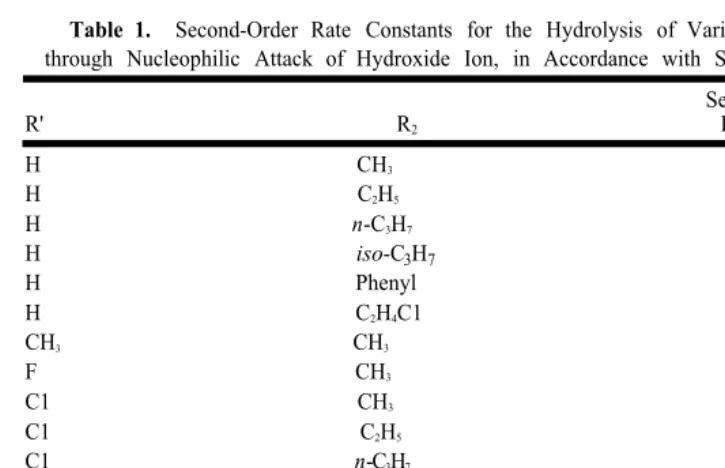
The degradation rate depends on the substituents R1 and R2, in that electron-withdraw-ing groups enhance hydrolysis whereas electron-donatelectron-withdraw-ing groups inhibit hydrolysis. As shown in Table 1, substituted benzoates having an electron-withdrawing group, such as a nitro group, in theparaposition of the phenyl ring (R1) exhibit higher decomposition rates than the unsubstituted benzoate. On the other hand, the decomposition rate decreases with increasing electron-donating effect of the alkyl group (in the alcohol portion of the ester (R2)) (e.g., it decreases in the order methyl > ethyl >n-propyl). Replacing a hydrogen atom
Table 1. Second-Order Rate Constants for the Hydrolysis of Various Benzoic Acid Esters through Nucleophilic Attack of Hydroxide Ion, in Accordance with Scheme 5 (R1 = R´
Second-order rate constant
R' R2 KOH (x 10
-4 M-1 s-1)a
H CH3 6.08
H C2H5 1.98
H n-C3H7 1.67
H iso-C3H7 0.319
H Phenyl 33.6
H C2H4C1 12.4
CH3 CH3 2.65
C1 CH3 19.1
C1 C2H5 6.51
C1 n-C3H7 5.11
C1 Phenyl 103
NO2 CH3 276
NO2 n-C3H7 76.0
NO2 iso-C3H7 19.6
NO2 Phenyl 1140
aIn 50% acetonitrile-0.02M phosphate buffer solution; 25°C.
F CH3 12.1
C1 iso-C3H7 1.21
NO2 C2H5 98.8
with an electron-withdrawing halogen such as chlorine, e.g., -C2H5 versus -C2H4C1, also increases the rate of decomposition.20
Another way of viewing this reaction is by considering leaving-group ability. The mechanism of ester hydrolysis can be considered an addition/elimination reaction, the leaving group being R2OH. The rate of the elimination step will be determined in part by the ability of the leaving alcohol to sustain the buildup of negative charge on the oxygen atom. This will also be reflected in the pKa of the alcohol. For example, hydrolysis of phenyl
benzoate is much faster than that of ethyl benzoate (Table 1) because the pKa values of
ethanol and phenol are 18 and 10, respectively.
Steric factors also play a role. Bulky groups on either R1 or R2decrease the decompo-sition rate. For example, when an iso-propyl group is substituted for an n-propyl group on R2, the decomposition is five times slower (Table 1).
Attack of hydroxide ion on an ester bond is also affected by the presence of neighboring charges. For example, the hydrolysis rates of all ester bonds within poly(butylene tartrate) are not equal; the ester bonds close to the negatively charged, terminal carboxylate group are less reactive toward hydroxide-ion attack than are the ester groups removed from the negatively charged carboxylate group.21
(NSC-Figure 1. Representative examples of carboxylic acid esters of pharmaceutical interest, susceptible to hydrolysis.
615985),25 aspirin,11,12 atropine,16-18,26 scopolamine,27 methylphenidate,19 meperidine,28 steroid esters such as hydrocortisone sodium succinate29,30 and methylprednisolone sodium succinate,31 and succinylcholine chloride.32,33 Cocaine has two ester bonds that hydrolyze to produce benzoylecgonine or ecgonine methyl ester, as shown in Scheme 6.34,35 It is said to undergo parallel pathways of degradation. Shown in all future reaction schemes are the primary reaction pathways. As such, these are not meant to be complete; that is, some compounds undergo other competing reactions.
Based on the structures of these various esters, it can be readily seen that having information on the reactivity of one ester should provide valuable insight into that of a second
ester. For example, ethylparaben and benzocaine are very similar in structure; both have a
para electron-donating group and both are ethyl esters. Therefore, information about the reactivity of one of them could be the basis for predicting the stability of the other. Similarly, ester group hydrolysis in atropine should be similar in rate and pH dependency to that in scopolamine. Is it not reasonable to expect the hydrolysis of methylprednisolone sodium succinate to be similar to that of hydrocortisone sodium succinate? Therefore, if one is presented with a new drug substance containing a hydrolyzable ester moiety, it should be possible, using appropriate literature examples of similar drugs, to make a good estimate of the sensitivity of the ester group to hydrolysis.
Lactones, or cyclic esters, also undergo hydrolysis. As shown in Fig. 2, pilocarpine,36-38 dalvastatin,39 warfarin,40,41 and camptothecin42 exhibit ring opening due to hydrolysis. Note that, unlike linear esters, lactones often exist in dynamic equilibrium with their carboxylic acid/carboxylate forms.
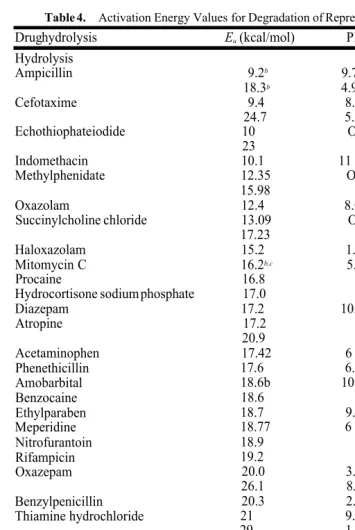
Apparent rate constants for the hydrolysis of various carboxylic acid esters are shown in Table 2 for the comparison of their reactivities. As these values were obtained under different conditions of temperature, pH, ionic strength, and buffer species, they are for rough comparison only. Nevertheless, they do point out the role that structure plays in the relative reactivity of the ester bond.
Table 2. Apparent Rate Constants for the Hydrolysis of Various Carboxylic Acid Esters
k (s-1) pH Reference
Camptothecin 6.0xl0-5(25°C) 7.13 42
Methylprednisolone sodium succinate 2.5xl0-7(25°C) 7.30 31
Oxathiin carboxanilide 1.8x l0-7(25ºC) 6.92 25
Aspirin 3.7x10⁻⁶(25°C) 6.90 12
Benzocaine 5.7x10⁻⁸(25°C) 9.2 4
Ethylparaben 4.2x10⁻⁸(25°C) 9.16 22
Cocaine 4.97x10⁻⁶(30°C) 7.25 34
Procaine 6x10⁻⁶(40°C)a 8 9
Succinylcholine 5.0x10⁻⁵(400ºC) 8.00 32
Pilocarpine 1.7x10⁻⁶(40ºC)a 8 36
Atropine 1.8x10⁻⁷(40oC) 7.01 17
Methylphenidate 3.2x10⁻⁶(50ºC) 6.07 19
Hydrocortisone sodium succinate 9.0x10⁻⁶(65.2ºC) 7.0 29
1x10⁻⁷(25ºC)b 29
Meperidine 1.8x10⁻⁷(89.7ºC) 6.192 28
aValue of k estimated from plots in the reference.
bValue of k estimated using the reported value of the activation energy ( E
a).
2.1.1.1.b. Other Esters. Carbamic acid esters such as chlorphenesin carbamate43 and carmethizole,44shown in Scheme 7, are known to undergo hydrolysis in strongly acidic and neutral-to-alkaline solutions, respectively. The two carbamate ester groups in carmethizole undergo hydrolysis at significantly different rates owing in large part to completely different mechanisms.44The first carbamate group is cleaved by more of an elimination reaction via carbonium formation whereas the second carbamate linkage appears to hydrolyze via a normal hydrolysis mechanism.
Cyclodisone,45 a sulfonic acid ester, and sulfamic acid 1,7-heptanediyl ester (NSC-329680),46 a sulfamic acid ester, have been reported to hydrolyze in the neutral-to-alkaline pH range (Scheme 8). Both hydrolyze via carbon-oxygen bond cleavage rather than sulfur–oxygen bond cleavage.45,46
Scheme 8. Representative sulfonic esters and sulfamic esters susceptible to hydrolysis.
Phosphoric acid esters such as hydrocortisone disodium phosphate47,48 and echothio-phate iodide49are known to hydrolyze (Scheme 9). Although nitric esters such as nitroglyc-erin50 and nicorandil51 undergo hydrolysis, nitroglycerin is relatively stable (Scheme 9). Phosphatidylcholine and phosphatidylethanolamine in intravenous lipid emulsion and aque-ous liposome dispersions have been reported to hydrolyze in the neutral pH range.52,53
2.1.1.2. Amides
Amide bonds are commonly found in drug molecules. Amide bonds are less susceptible to hydrolysis than ester bonds because the carbonyl carbon of the amide bond is less electrophilic (the carbon-to-nitrogen bond has considerable double bond character) and the leaving group, an amine, is a poorer leaving group (Scheme 10). Figure 3 shows the structure
Scheme 10. Hydrolysis of amides.
of acetaminophen,54 chloramphenicol,13-15 lincomycin,55 indomethacin,56-59 and sul-facetamide,60 all of which are known to produce an amine and an acid through hydrolysis of their amide bonds; moricizine, a derivative of phenothiazine, which undergoes hydrolysis of its amide bonds followed by oxidation61; and HI-6, a bis(pyridimium)aldoxime having an amide bond, which exhibits fast hydrolysis in concentrated aqueous solutions owing to the acidifying effect of a strongly acidic oxime group.62
β-Lactam antibiotics such as penicillins and cephalosporins, which are cyclic amides or lactams, undergo rapid ring opening due to hydrolysis. Ring opening of the β-lactam group has been reported for penams, such as, benzylpenicillin,63-64 ampicillin,65 amoxicillin,66 carbenicillin,67 phenethicillin,68 and methicillin69 (Scheme 11), and for cephems, such as cephalothin70 cefadroxil,71-72 cephradine,70 and cefotaxime73-75 (Scheme
12). These drug substances have both a lactam and an amide bond in their molecular structure, the former being considerably more susceptible to hydrolysis. Cephalothin and cefotaxime are also acetoxy esters, and opening of their lactam ring competes with hydroly-sis of the ester bond. Decomposition products produced by hydrolyhydroly-sis of penam and cephem
β-lactams are still reactive and undergo various side reactions. For example, condensation products were formed upon hydrolysis of cefaclor,76 and dimeric products were detected upon hydrolysis of loracarbef,77 as shown in Scheme 13, as well as of ampicillin.78 Cycloserine, which can be considered a cyclic amide, undergoes opening of its isoxazolidone ring due to hydrolysis in acidic media,79 as shown in Scheme 14. Like loracarbef and ampicilllin, it also undergoes self-condensation.
The reactivity of these amides toward hydrolysis depends on the substituents R1, R2, and R3 (Scheme 10), as shown in Table 3. The β-lactam antibiotics, including penicillins and cephalosporins, undergo surprisingly facile hydrolysis compared to other amides. The
Scheme 11. Hydrolysis of ß-lactam penicillins. This pathway is mostly seen in the neutral to alkaline pH range.
most likely contributors to this facile hydrolysis are electronic factors, the relief of ring strain (a four-membered ring coupled to a five- or six-membered ring), and the lower double bond character between the carbonyl carbon and the amide nitrogen.
2.1.1.3. Barbiturates, Hydantoins, and Imides
Barbiturates, hydantoins, and imides contain functional groups related to amides but tend to be more reactive. Barbituric acids such as barbital, phenobarbital, amobarbital, and metharbital undergo ring-opening hydrolysis, as shown in Scheme 15.80,81 Decomposition products formed from these drug substances are susceptible to further decomposition reactions such as decarboxylation. The hydrolysis rates of these substances depend on the substituents R1, R2, and R3. For some allylbarbituric acids, the effects of these substituents on hydrolysis rates can be explained in terms of Hammett’sσvalue.82
Scheme 13. Other degradation products of cefaclor and loracarbef.
Scheme 14. Hydrolysis of cycloserine.
Table 3. Apparent Rate Constants of Hydrolysis of Various Amides under a Variety of pH and Temperature Conditions
k(s-1) (temperature) pH Reference
Benzylpenicillin 1.5x10⁻⁴(25°C) 2.70 64
Acetaminophen 1.0x10⁻⁹(25°C)b 6 54
3.9x 10⁻⁶(60°C) 7 59
Cefotaxime 2.4x10⁻⁵(35°C) 8.94 73
3.9x10⁻⁶(60°C) 6.75 63
Indomethacin 2.2x10⁻⁴(25.8°C) 11 58
Cephalothin 5.6x10⁻⁵(35°C) 9.84 70
Cephradine 2x10⁻⁵(35°C) 10.00 70
Phenethicillin 3.3x10⁻⁶(35°C) 1.4 68
Cefadroxil 2.1 x 10⁻⁶(35°C) 7.20 71
carbenicillin 2.0x10⁻⁶(35°C) 7.00 67
Amoxicillin ~1.1 x 10⁻⁶(35°C)a 8.2 66
Ampicillin 2.5x10⁻⁷(35°C) 7.11 65
Moricizine 8.2x 10⁻⁶(60°C) 6.0 61
Chloramphenicol 6.0x 10⁻⁶(85,36°C) 6.00 15
Lincomycin 4.9x 10⁻⁶(70°C) 1 55
Sulfacetamide 9.3 x 10⁻⁶(120°C) 6.91 60
aValueofkestimated from plots in Ref. 54.
bValue ofk estimated using the reported value of the activation energy (E
Scheme 15. Hydrolysis of barbituric acids.
As shown in Scheme 16, the hydantoin allantoin83 is susceptible to hydrolysis, and the imide bonds in NSC-28435684 and (+)-1,2-bis(3,5-dioxopiperazinyl-l-yl)propane
(ICRF-187)85,86 are hydrolyzed by parallel and successive reactions. In the case of ICRF-187, the
reactivity of the imide groups is intramolecularly affected by the tertiary amine groups in its structure.85,86 This conclusion was drawn from the observation that model compound A
Scheme 18. Hydrolysis of chlordiazepoxide.
(Scheme 16) hydrolyzed, as expected, at approximately half the rate of ICRF-187, whereas the glutarimide, compound B, was significantly more stable.
2.1.1.4. Schiff Base and Other Reactions Involving Carbon–Nitrogen Bond Cleavage
Benzodiazepines such as diazepam,87 oxazepam,87 and nitrazepam88,89 undergo ring opening due to reversible hydrolysis of the amide and azomethine bonds, as shown in Scheme 17. Chlordiazepoxide is converted to a lactam form, which is then similarly hydrolyzed (Scheme 18).90,91 Triazolam, a triazole-condensed benzodiazepine, also under-goes ring opening due to hydrolysis, as shown in Scheme 19.92 Benzodiazepinooxazoles (oxazole-condensed benzodiazepines) such as oxazolam,93 flutazolam,94 haloxazolam,94 and cloxazolam94are not Schiff bases per se but undergo ring opening due to hydrolysis as shown
Scheme 19. Hydrolysis of triazolam.
Scheme 21. Representative drug substances having a reactive nitrogen in their structure that are susceptible to hydrolysis.
Scheme 20
Scheme 22. Hydrolysis of dihydrooxazines.
in Scheme 20. The oxazolidine ring of these drugs is known to exhibit an acid-base equilibrium reaction between ring opening and closing.95-97
Drug substances such as sulpyrine,98,99 furosemide,100,101 thiamine hydrochloride,102 diethylpropion,103 mitomycin C,104,105 zileuton,106 and cifenline107 have reactive nitrogens in their molecular structure and undergo hydrolysis, as shown in Scheme 21. The derivatives of 3,4-dihydro-1,3-benzoxazine and 3,4-dihydro-1,3-pyridooxazine undergo ring opening due to hydrolysis accompanied by elimination of formaldehyde (Scheme 22).108
Nitrofurantoin109-110 and rifampicin111 undergo hydrolysis of the iminelike structure as shown in Scheme 23. Similarly, chlorothiazide112 and hydrochlorothiazide113,114 undergo ring opening due to hydrolysis by acid-base catalysis (Scheme 24). Nucleosides115 such as 5-azacytidine116,117 and cytarabine118,119 form various hydrolysis products through different reactions (such as ring opening) depending on the conditions, as shown in Scheme 25.
2.1.1.5. Other Hydrolysis Reactions
Other drug substances susceptible to hydrolysis include chloramphenicol,13 chloram-bucil,120,121 spirohydantoin mustard,122 alkyl halides such as clindamycin,123 azathio-prine,124 sulfides such as thimerosal,125-126 and platinum compounds such as carboplatin,127 as shown in Scheme 26.
Drug substances with carbohydrate moieties, such as digoxin,128,129 eliminate the carbohydrate group(s) due to acid-catalyzed hydrolysis. Nucleosides such as 5-azacytidine
Scheme 24. Hydrolysis of chlorothiazide and hydrochlorothiazide.
and cytarabine (Scheme 25) exhibit sugar-elimination reaction130 in addition to the ring-opening reactions described earlier. Idoxuridine131 and 2´,3´-dideoxyguanosine132 undergo rapid hydrolysis in alkaline and acidic pH ranges, respectively (Scheme 27). 4´-Azi- dothymidine undergoes similar hydrolysis.133 O6-Benzylguanine hydrolyzes to benzyl alco-hol and guanine in an acid-catalyzed reaction.134
2.1.2. Dehydration
Sugars such as glucose135-137 (Scheme 28) and lactose138,139 are known to undergo dehydration to form 5-(hydroxymethyl)furural. Erythromycin is susceptible to acid-catalyzed dehydration as shown in Scheme 29,140,141 whereas prostaglandins E
1 and E2 undergo dehydration followed by isomerization as shown in Scheme 30. 142-145 Batanopride undergoes an intramolecular ring-closure reaction in the acidic pH range due to dehydration (Scheme 31),146 whereas streptovitacin A exhibits two successive acid-catalyzed dehydra-tion reacdehydra-tions, as shown in Scheme 32.147
2.1.3. Isomerization and Racemization
Reported examples of isomerization of drug substances includetrans-cis isomerization of amphotericin B (Scheme 33),148 N,O-acyl rearrangement of cyclosporin A (Scheme 34),149 and dienone-phenol rearrangement of steroids such as tirilazad (Scheme 35).150
Scheme 26. Other drug substances that are susceptible to hydrolysis, including alkyl halides, sulfides, and platinum compounds.
Scheme 27. Hydrolysis of nucleosides.
Scheme 29. Dehydration of erythromycin.
Scheme 30. Dehydration and isomerization of prostaglandin E2.
Scheme 31. Ring closure following dehydration of batanopride.
Scheme 32. Dehydration of streptovitacin A.
Scheme 34. N,O-Acyl rearrangement of cyclosporin A.
Scheme 35. Dienone–phenol rearrangement of tirilazad.
Scheme 37. Epimerization and hydrolysis of etoposide.
Racemization and epimerization, which are reversible conversions between optical isomers, have been reported for many drug substances. As shown in Scheme 36, pilocarpine undergoes epimerization by base catalysis,36-38 whereas tetracyclines151,152 such as rolitetracycline,153,154 and ergotamine155 exhibit epimerization by acid catalysis. Etoposide converts reversibly to picroetoposide, a cis-lactone, and then hydrolyzes to cis-hydroxy acid in the alkaline pH region, as shown in Scheme 37.156-157Epinephrine is oxidized (see Section 2.1.5) and undergoes racemization under strongly acidic conditions (Scheme 38).158 Other drug substances susceptible to racemization include benzodiazepines, penicillins, and cephalosporins. Oxazepam undergoes racemization through a rapid equilibrium reaction in the neutral-to-alkaline pH region (Scheme 39).159 Moxalactam exhibits epimerization of its side chain as well as hydrolysis of the ß-lactam ring (Scheme 40).160-162 Hetacillin exhibits epimerization of the lactam ring, hydrolysis of the side chain, and β-lactam ring cleavage (Scheme 41).163 Similar racemization and hydrolysis have been reported for carbe-nicillin,164,165 cefsulodin,166 cefotaxime,167 and dalvastatin.39
2.1.4. Decarboxylation and Elimination
Drug substances having a carboxylic acid group are sometimes susceptible to decar-boxylation, as shown in Scheme 42. 4-Aminosalicylic acid is a good example.168Foscarnet also undergoes decarboxylation under strongly acidic conditions, 169 whereas etodolac is susceptible to decarboxylation by acid catalysis.170
Other elimination reactions have been reported for various drug substances, as shown in Scheme 43. Trimelamol eliminates its hydroxymethyl groups and forms formaldehyde.171 Levothyroxine eliminates iodine.172 ADD-17014, a derivative of triazoline, eliminates nitrogen and forms a derivative of aziridine.173 Ditiocarb eliminates carbon disulfide.174
Scheme 39. Racemization of oxazepam.
Scheme 40. Epimerization of moxalactam.
Scheme 41. Epimerization and hydrolysis of hetacillin.
Scheme 43. Other drug substances that are susceptible to elimination reactions.
2.1.5. Oxidation
Oxidation is a well-known chemical degradation pathway for pharmaceuticals. Oxygen, which participates in most oxidation reactions, is abundant in the environment to which pharmaceuticals are exposed, during either processing or long-term storage. Oxidation of ascorbic acid (Scheme 44) was reported as early as 1940,175,176 and many factors affecting ascorbic acid oxidation have been discussed, including the role of metal ions. 177-179
Oxidation mechanisms for drug substances depend on the chemical structure of the drug and the presence of reactive oxygen species or other oxidants. Catechols such as methyl-dopa180 and epinephrine181 are readily oxidized to quinones, as shown in Scheme 45. 5-Aminosalicylic acid undergoes oxidation and forms quinoneimine,182 which is further degraded to polymeric compounds (Scheme 46).183 Ethanolamines such as procaterol are oxidized to formyl compounds (Scheme 47),184 whereas thiols such as 6-mercaptopurine,185
Scheme 45. Representative cathecol drug substances that are susceptible to oxidation.
Scheme 46. Oxidation of 5-aminosalicylic acid.
captopril,186 and NSC-629243 (a derivative of thiocarbamic acid)187 are oxidized to disul-fides (Scheme 48). Phenothiazines such as promethazine are oxidized via complex pathways and yield various products (Scheme 49).188,189As shown in Fig. 4, polyunsaturated molecules such as vitamin A,190 as well as other polyenes such as ergocalciferol, 191,192 cholecalcif-erol,192 fumagillin,193 and filipin194,195 are susceptible to oxidation. In additional, phenylbu-tazone,196-199 sulpyrine,200,201 morphine,202 tetrazepam,203 hydrocortisone,204 and prednisolone205 are oxidized to various products, as shown in Scheme 50. Spiradoline is susceptible to oxidative degradation, resulting in the formation of an imidazolidine ring in addition to hydrolysis of the amide bond (Scheme 51).206 Sulfur atoms are becoming more common in new drug candidates and present a particular challenge owing to their propensity to oxidize to the corresponding sulfoxides and ultimately sulfones (Scheme 52).
Scheme 48. Representative thiol drug substances that are susceptible to oxidation.
Scheme 49. Oxidation products of promethazine.
Scheme 51. Hydrolysis and oxidation of spiradoline.
Scheme 52. Oxidation of dialkyl sulfides to sulfoxides and sulfones.
2.1.6. Photodegradation
Photodegradation has been reported for a large number of drug substances. The mechanisms for these reactions are generally very complex. As exemplified by chloro-quine207 and primaquine,208 shown in Schemes 53 and 54, respectively, photodegradation
Scheme 54. Photodegradation of primaquine.
generally yields numerous products through complex pathways. Photodegradation is often accompanied by oxidation in the presence of oxygen. Thus, drug substances such as fumagillin,209,210 phenothiazines,211 and cholecalciferol,192 whose oxidation was de-scribed in the previous section, are degraded to different products in the presence and absence of light.
Representative photodegradation routes for drug substances include dehydrogenation of nifedipine,212-214 reserpine,215 and nicardipine216 (Scheme 55); dehydrogenation accom-panied by transmutation of a nitro group in nimodipine217 (Scheme 56); oxidation of a reactive methylene group to a carbonyl in 4-methoxy-2-(3-phenyI-2-propynyl)phenol (CO/1828),218 tiaprofenic acid,219 and KBT-3022 (a derivative of diphenylthiazole)220,221 (Scheme 57); and rearrangement of chlordiazepoxide222 (Scheme 58).
In addition, the following photoinduced degradation reactions have been reported: hydrolysis of mefloquine,223 furosemide,224 and LY277359 (a derivative of benzofuran carboxamide)225 (Scheme 59); elimination of hydrogen halide from meclofenamic acid226 (Scheme 60); oxidation of a hydroxyl group of 2 l-cortisol tert-butylacetate227 and a-[(dibutylamino)methy1]-6,8-dichloro-2-(3´,4´-dichlorophenyl)-4-quinoline methanol228 (Scheme 61); and rearrangement of benzydamine229 (Scheme 62). Oxidation of menadione is enhanced by light (Scheme 63).230
2.1.7. Drug-Excipient and Drug-Drug Interactions
Scheme 55. Photodegradation leading to dehydrogenation of nifedipine, reserpine, and nicardipine.
2.1.7.1. Reactions of Bisulfite, an Antioxidant
In the 1950s, it was reported that epinephrine, a catecholamine, undergoes displacement of its hydroxy group by bisulfite, as shown in Scheme 64.231 Dexamethasone 21-phosphate, anα/β-unsaturated ketone, is known to undergo addition by bisulfite (Scheme 64).232
2.1.7.2. Reaction of Amines with Reducing Sugars
Reducing sugars readily react with primary amines, including those of amino acids, through the Maillard reaction. Drug substances with primary or secondary amine groups
Scheme 57. Some unusual photochemically induced reactions.
Scheme 58. Degradation of chlordiazepoxide.
Scheme 60. Photodegradation of meclofenamic acid.
Scheme 61. Photodegradation leading to oxidation of a hydroxy group.
Scheme 62. Photodegradation of benzydamine.
Scheme 64. Representative drug substances susceptible to substitution and addition reactions by bisulfite.
undergo this addition/rearrangement reaction, also called the “browning” reaction because of the resulting discoloration. Examples are the reaction of amphetamine,233 isoniazid,234 dextroamphetamine sulfate,235,236 and norphenylephrine237 with sugars such as lactose and the degradation products of sugars, such as 5-(hydroxymethyl)furfural. Sulpyrine forms an addition product with glucose.238
In the presence of drug substances with hydroxy groups, aspirin undergoes a reversible transacylation reaction to form salicylic acid, while acetylating the drug substance. For example, codeine239 and sulfadiazine240 are acetylated by aspirin, as shown in Scheme 65. Similar acetylation reactions with aspirin have been reported for acetaminophen241 and the excipient polyethylene glycol.242,243 Another example of transesterification is the reaction of benzocaine with polyvinyl acetate phthalate (Scheme 66).244
Scheme 65. Representative drug substances susceptible to acetylation by aspirin.
Scheme 66. Interaction of benzocaine and polyvinyl acetate phthalate.
2.2. Factors
Affecting
Chemical
Stability
In the previous section, the chemical degradation pathways for many drug substances were classified according to various pathways and mechanisms. In this section, factors that affect the rates of chemical degradation are elaborated.
Factors determining the chemical stability of drug substances include intrinsic factors such as the molecular structure of the drug itself and environmental factors, such as temperature, pH, buffer species, ionic strength, light, oxygen, moisture, additives, and excipients. In the case of solid-state degradation, the solid-state properties of the drug such as melting point, crystallinity, and hygroscopicity are very important. In addition, mechani-cal forces such as pressure and grinding applied to drug substances may affect their chemimechani-cal as well as physical stability. By applying well-established kinetic concepts, it is possible not only to summarize, numerically, the role that each variable might play in altering the kinetics of degradation but also to provide valuable insight into the mechanism(s) of degradation.
2.2.1. Basic Kinetic Principles
to form a product P. This process is described by the following scheme:
The simplest concept of chemical and physical reaction is the case of a drug D reacting
P D
The extent to which D rearranges to P will depend on the free-energy differences between D and P. If P is of much lower free energy than D, then the reaction is better defined by
D→ P
Most drugs degrade by reactions that involve a so-called bimolecular reaction in which drug D collides with a reactant A to produce one or more products. This is illustrated in its simplest form by the following equation:
D + A P
P will be formed if D and A collide with sufficient energy (and an appropriate orientation) to result in a molecular rearrangement to form P. In this simple case, the rate of loss of D, -d[D]/dt, is said to be proportional to the activity (or, more simply, the concentration) of both D and A, as indicated by Eq. (2.1).
d[D]
[D][A]
(2.1)
dt
(2.2)
where kis the proportionality constant, usually referred to as the rate constant. If k is large, the reaction is fast; if kis small, the reaction is slow. In this case, the reaction rate (-d[D]/d t ) is said to be frrst-order in D and first-order in A.
If A is present in excess of D, that is, [A] >> [D], then even though some of A is consumed during the reaction, effectively only D is lost. Under these circumstances,
(2.3)
where kobs is said to be the observed rate constant, a pseudo-first-order constant. In most studies of the stability of pharmaceuticals, especially in aqueous solution, the kinetics can often be simplified to pseudo-fist-order conditions.
More generally, the degradation rate of a drug, D, depends on the drug concentration, [D], and the concentrations (more accurately, the activities) of chemical species participating in the reaction [A], [B], . . . . The rate at which [D] decreases, -d[D]/dt,is described by summing the terms for all the reactions that D might undergo:
(2.4)
where k0,AB... and k0,EF...etc., are rate constants of reactions in which species AB... and species EF..., respectively, react with D. The terms n, l, m, o, andp are reaction orders for each species, and the sum of these is considered to be the overall reaction order. For example, assuming that an ester is hydrolyzed by both hydronium ion catalysis and water attack, the rate can described by Eq. (2.5). If additional species participate in the hydrolysis, their terms would be added to this expression.
(2.5)
Assuming that degradation of drug D is a result of the direct reaction with a species A, the rate is proportional to the concentration of “activated complex,” often referred to as the “transition state,” X‡, formed between D and A:
(2.6)
In Eq. (2.6), [X‡] is the concentration of X‡andf
Figure 5. Free-energy diagram showing reactants proceeding to products through a transition state or activated complex.
(2.7)
where∆G‡, ∆S‡, and ∆H‡are the free energy, entropy, and enthalpy of activation, respec-tively. ∆G‡is the difference in free energy between the reactant state and the activated complex, as shown in Fig. 5. The termκis the Boltzmann constant,his the Planck constant, and Tis the temperature in degrees kelvin.
In descriptive terms, Eq. (2.7) essentially suggests that for chemical reaction to occur, molecules must first collide. The termκT/hrepresents a so-called universal collision number. Not only must the molecules collide, but they must collide with sufficient overall free energy for rearrangement of the molecules to occur. The term e -−−∆G‡ /RTrepresents the fraction of molecules colliding with sufficient energy to overcome the free-energy barrier to reaction. This free-energy barrier is made up of both an enthalpic term (∆H‡) and an entropic term (∆S‡).
Other kinetic theories, such as the collision theory, were proposed earlier. In the collision theory, proposed by Lewis, the reaction rate,v, was given by
(2.8)
where Z is the collision frequency, R is the gas constant, and E is the activation energy. Thereafter, Eyring developed the theory of absolute reaction rates by introducing the concept of the formation and breakdown of an activated complex. This so-called transition-state model, defined by the reaction illustrated in Fig. 5, is represented by
(2.9)
where QA, QB, and Q‡ are the partition functions of A, B, and the activated complex, respectively, andE0 is the energy required for the formation of 1 mol of the activated complex at 0°K. Replacing partition functions in Eq. (2.9) by thermodynamic functions yields Eq. (2.7).
reaction, ∆G‡, as represented by Eqs. (2.4), (2.6), and (2.7), the reaction rate is strongly influenced by those factors affecting ∆G‡.
With respect to degradation of drug substances in solutions, any observed rate or rate constant can be calculated according to Eqs. (2.4), (2.6), and (2.7), and factors affecting the degradation can be related to the terms in these equations. In other words, the stability of drug substances does not change unless the key parameters appearing in these equations change owing to changes in reaction condition/media, etc. For a more comprehensive review of chemical kinetics in solution, the book by Connors245 is highly recommended.
Equations (2.4), (2.6), and (2.7) are also applicable to the degradation of drug substances in the solid state. However, the factors affecting the reaction rates become more complex because reactions often proceed in heterogeneous physical states. For example, apparent reaction rates depend on solubility and dissolution rates of drug substances when degradation proceeds in water layers adsorbed on the surface of solid drugs. Therefore, these and other additional factors need to be considered.
In the following sections, factors affecting drug degradation in solutions are discussed, especially as they relate to basic kinetic concepts. Later sections discuss drug degradation in more complex heterogeneous states such as solid-state decomposition.
2.2.2. The Role of Molecular Structure
It has been noted earlier that the molecular structure of a drug substance determines its degradation mechanisms/pathways and that substituents around the reaction center can strongly influence its reactivity. For example, a drug substance having an electron-withdrawing functional group close to an ester bond will probably exhibit a higher propensity to nucleophilic attack by hydroxide ion than will a similar ester without that functional group. The increased rate of degradation can be explained by assuming that the electron-withdrawing group makes the carbonyl carbon of the ester group more susceptible to attack, as well as stabilizing the formed activated complex, thus decreasing ∆G‡, [see Eq. (2.7)]. This in-creased propensity would manifest itself in the form of an inin-creased rate. Similarly, the decreased hydrolysis rate of esters with bulky substituents near the ester group can be explained in terms of an increased ∆G‡.
Scheme 67. Cyclization of pilocarpic acid and isopilocarpic acid to pilocarpine and isopilccarpine, respectively.
2.2.3. Rate Equations and Kinetic Models
Drug substances undergo chemical degradation by various pathways and mechanisms, depending on their chemical structures. The rate of chemical degradation is determined by various factors contributing to the rate equations. Drug substances can be stabilized by inhibiting the degradation through control of these factors, as will be described in Section 2.3. Here, methods for describing the chemical degradation rate of drug substances on the basis of their kinetics are presented. Included are methods for kinetically analyzing an observed degradation curve under specific experimental conditions, obtaining rate constants, and predicting degradation rates under alternative conditions on the basis of this information. This section deals only with prediction of the chemical degradation rate of drug substances themselves. The prediction of the stability of dosage forms (for the purpose of estimating the shelf lives of drug products), in which physical degradation may also play a role, will be described in Chapter 4.
Obtaining reliable drug degradation data requires the development and validation of a stability-indicating assay. Once a stability study is initiated, one attempts to use a set of conditions that allows one to obtain a summary parameter, such as a rate constant, by kinetic analysis of a degradation versus time curve under these specific and controlled conditions. A kinetic model is selected to describe the degradation curve, and arate constant is calculated by fitting the observed degradation curve to a suitable rate equation according to the assumed model. This section describes the selection of the kinetic model(s) and the calculation of a rate constant.
2.2.3.1. Kinetic Models to Describe Drug Degradation in Solution
The generalized rate expression for drug degradation is represented by the rate equation that was given earlier (Eq. 2.4). When a drug substance, D, degrades via a certain mechanism in which reactants A, B, . . . participate, the degradation rate generally depends on the concentrations of the various reactants A, B, . . . and D according to Eq. (2.10), assuming that all the reactants are involved directly or indirectly in the rate-controlling step.
(2.10)
When the concentrations of A, B, . . . are maintained constant, that is, when the change in their concentrations during the reaction is negligible owing to their being present at much higher concentrations than drug D, or when these species are components that are maintained constant through the use of buffers, such as hydronium ion, the degradation rate is often described by
(2.1 1)
When n equals 0, 1, or 2, the reaction is said to be a pseudo-zero-, pseudo-first-, or pseudo-second-order reaction (pseudo-nth-order for higher order reactions), respectively. If the concentration of an additional reactant other than drug D is not constant during the reaction, the reaction order becomes n + 1.
Kinetic models generally used for drug stability prediction usually follow pseudo-zero-, pseudo-first-, or pseudo-second-order kinetics. Drug degradation higher than second order is rarely seen. Even complex degradation pathways involving multiple consecutive or parallel reactions can be represented by the combinations of zero-, first-, and second-order reactions. General kinetic models describing drug degradation are elaborated below.
2.2.3.1.a. Simple Pseudo-First-Order Reaction and Zero-Order Reaction
k D P
The differential rate equation for a pseudo-first-order reaction is
(2.12)
The integrated form of this equation is
(2.13)
where [D]0 is the initial concentration of the drug. From these equations, the degradation rate is seen to be proportional to drug concentration. Most drug degradation kinetics in solutions conform to apparent or pseudo-first-order kinetics, and the data are summarized by recording the apparent first-order rate constants, k.
(2.14)
(2.15)
In this case, the drug degradation rate is independent of drug concentration. A specific example of pseudo-zero-order kinetics can be seen with drug degradation in suspensions. If a drug degrades in the solution phase of a suspension according to pseudo-first-order kinetics but is stable in the solid phase of the suspension, the degradation rate is proportional to the drug concentration in solution. Because the drug concentration in solution is given by the saturated solubility [S] and is maintained constant while drug in excess of its solubility is present, the amount of total drug remaining, M,decreases according to a pseudo-zero-order equation:
(2.16)
Degradation of aspirin in suspension has been reported to follow zero-order kinetics (Fig. 7).249
2.2.3.1.b. Simple Pseudo-Second-Order Reaction
k k
D + A P or 2D P
The rate and concentration changes when drug D reacts with a reactant A are given by
(2.17)
(2.18)
where [A]0is the initial concentration of A. Equations (2.19) and (2.20), result when drug D undergoes a bimolecular reaction with itself.
(2.19)
(2.20)
2.2.3.1.c. Pseudo-First-Order Reversible Reaction
When drug D converts to product P according to reversible pseudo-first-order reactions, the rate is described by Eq. (2.21), which is integrated to Eq. (2.22) (Eq. 2.23) when the initial concentration of P, [P]0, equals zero.
(2.21)
(2.22)
(2.23)
Hydrolysis of triazolam (see Scheme 19) and racemization of oxazepam (see Scheme 39) conform to this kinetic model, as shown in Figs. 8250and 9159, respectively.
2.2.3.1.d. Pseudo-Second- and Pseudo-First-Order Reversible Reactions
When drug D reacts reversibly with A to form P according to a pseudo-second-order reaction, the rate expression for the loss of D is given by
Figure 8. Time course of formation of triazolam from its hydrolysis product (pH 2.30, 37°C). (Reproduced from Ref. 250 with permission.)
(2.25)
where [D]eis the concentration of D at equilibrium. Equation (2.25) can be simplified to
(2.26)
where [P]e, is the concentration of product formed at equilibrium. A similar equation is derived for the case of [D], = /[A]0and is used to describe the interaction of isoniazid and reducing sugars, as shown in Fig. 10.251
2.2.3.1.e. Pseudo-First- and Pseudo-Second-Order Reversible Reactions
Equation (2.27) represents the rate of reversible conversion of drug D to products P1and P2. When [P1]0= [P2]0= 0 at t= 0, Eq. (2.27) can be integrated to give Eq. (2.28).
(2.27)
(2.28)
The loss of hydrochlorothiazide follows this model,252 although a complicated mechanism including multiple reaction steps has been proposed for its degradation.253
2.2.3.1.f. Pseudo-First-Order Consecutive Reactions
Equations (2.29) and (2.30) represent the case when drug D converts to P1, which is subsequently converted to P2 according to consecutive pseudo-fist-order reactions.
(2.29)
Scheme 68. Consecutive loss of carbamate groups in carmethizole (NSC-602668). The reactivity of one carbamate group is greater than that of the other. (Reproduced from Ref. 46 with permission.)
(2.30)
A good example of consecutive reactions is the degradation of carmethizole (NSC-602668), an experimental cytotoxic agent (Scheme 68).44The hydrolysis of hydrocortisone hemisuccinate (Fig. 11)30and alkaline epimerization followed by hydrolysis of etoposide (Fig. 12)156,157fit this mathematical model even though their degradation pathways are more complex.
2.2.3.1.g. Pseudo-First-Order Reversible and Consecutive Reactions
When drug D is reversibly converted to P1, which is reversibly converted to P2 by apparent first-order kinetics, Equations (2.31) and (2.32) represent the rate and integrated expressions, respectively.
Figure 12. Time courses of epimerization and hydrolysis of etoposide (pH 10, 37°C). (Reproduced from Ref. 157 with permission.)
(2.31)
(2.32)
2.2.3.1.h. Pseudo-First-Order Parallel Reactions
k2 k1
P, D P,
Equations (2.33) and (2.34) pertain when drug D converts to P1and P2via independent first-order pathways.
(2.33)
(2.34)
Many drugs degrade to more than one product so this scheme is quite common. Often, more than two products are formed.
2.2.3.1.i. Pseudo-First-Order Reversible and Parallel Reactions
When both P1 and P2are capable of being converted back to D, Eqs. (2.35) and (2.36) adequately describe the kinetics.
(2.35)
where
Degradation of pilocarpine in the neutral pH region appears to conform to this model (Fig. 1 3).254Technically, however, isopilocarpine can also degrade to isopilocarpic acid; therefore, a more complete scheme for the degradation of polocarpine is
However, within the limits of the experimental conditions, this more complex scheme reduces to that defined by Eq. (2.35).
2.2.3.1.j. Pseudo-First- and Psuedo-Second-Order Reversible and Parallel Reactions
A reaction pathway similar to, but more complicated than, that considered above is one in which the conversion of D to P1 and P2 is reversible. Epimerization and hydrolysis of hetacillin apparently conform to this model, as shown in Fig. 14,163even though epihetacillin can also dissociate and the isomerization of hetacillin to epihetacillin should be considered reversible.
2.2.3.1.k. Pseudo-First-Order Parallel and Consecutive Reactions
k2 k1 k3
P, D P, P,
When P1 subsequently converts to P3 according to a first-order reaction in a pseudo-first-order parallel reaction, Eqs. (2.37) and (2.38) represent the rate and integrated expres-sions, respectively.
Figure 14. Time courses of epimerization and hydrolysis of hetacillin (pD 10.6, 35°C). (Reproduced from Ref. 163 with permission.)
(2.37)
(2.38)
The alkaline degradation of cefixime255 and pilocarpine38 appears to conform to this model, even though the actual pathways/mechanisms may be more complex than indicated by this scheme.
2.2.3.1.1. Pseudo-First-Order Reversible, Parallel and Consecutive Reactions
When P1is in equilibrium with D, Eqs. (2.39) and (2.40) can describe this model.
(2.40)
where
Isomerization and hydrolysis of chlorphenesin carbamate under strongly alkaline pH con-dition256 and epimerization and hydrolysis of carumonam (Fig. 15)257 and
moxalac-tam160,161 all appear to conform to this model. Hydrolysis of chlorothiazide, under alkaline
pH conditions,258is explained by this model when k
3is set to zero (Fig. 16).
A more recent example is the aqueous degradation of the neuraminidase inhibitor prodrug GS-4104, which, like chlorphenesin carbamate, undergoes an acyl migration and hydrolysis.259In the case of GS-4104, products P
2and P3are also capable of interconverting as in the scheme below.
Figure 16. Time course of hydrolysis of chlorothiazide ([OH-] = 0.1 N, 80°C). (Reproduced from Ref. 258 with permission.)
2.2.3.1.m. Pseudo-First- and Pseudo-Second-Order Parallel Reactions
When a reaction pathway involves toth pseudo-fist and pseudo-second-order path-ways, Eqs. (2.41) and (2.42) adequately describe the kinetics.
(2.41)
(2.42)
Under neutral-to-alkaline pH conditions, the degradation of ampicillin (Fig. 17),260 amoxicillin,261,262 cefaclor,263 and cefatrizine263 can be reasonably described by this model.
2.2.3.1.n. Equilibrium, Pseudo-First-Order Parallel Reactions
k1 K k 2
P1 D +A DA P2
This case obtains when a drug, D, forms a complex (DA) with A, which is defined by the equilibrium constant, K, and both D and DA are capable of undergoing independent pseudo-first-order reactions. When the concentration of A is significantly higher than that of D, the kinetics can be described by Eqs. (2.43) and (2.44).264
where
or
(2.43)
(2.44)
The degradation of carbenicillin in the presence of human serum albumin165 conforms to this model, as does the degradation of drugs in the presence of cyclodextrins (see Section 2


![Figure 16. Time course of hydrolysis of chlorothiazide ([OH-] = 0.1 N, 80°C). (Reproduced from Ref](https://thumb-ap.123doks.com/thumbv2/123dok/1391371.2022279/59.612.44.402.318.582/figure-time-course-hydrolysis-chlorothiazide-oh-reproduced-ref.webp)


![Figure 29. Degradation of ascorbic acid in the presence of mannitol ([ascorbic acid]:[mannitol] = 1:9) plotted according to the Weibull equation](https://thumb-ap.123doks.com/thumbv2/123dok/1391371.2022279/69.612.134.305.58.183/degradation-ascorbic-presence-mannitol-ascorbic-mannitol-according-weibull.webp)