The Relationship between Humanness and Knowledge
Sharing in Malaysia
Empirical Evidence from Malaysian Managers
Ilona H. Boom
Faculty of Economics and Business, University of Groningen
Bartjan W. Pennink
Faculty of Economics and Business, University of Groningen
Gadjah Mada International Journal of Business
Vol. 14, No. 2 (May - August 2012): 99 - 122
Abstract: This paper explores whether there is a relationship between humanness and the willingness to share knowledge in Malaysia. Furthermore, the differences between the Malay, Chinese and Indian ethnicities are researched for the presence of humanness and the willingness to share knowledge. Two hundred and fourteen respondents from privately owned companies participated in this research showing that there is a strong relationship between humanness and knowledge sharing. However, the differences between the three ethnicities are small, which is a surprising finding. It can be concluded that people-oriented managers (one of the ways to express humanness) are more willing to share knowledge, and differences between ethnicities have no influence in this matter. From these results, it can be recommended to managers and organizations in Malaysia that they pay more attention and be aware of their management style.Stressing the humanness aspects more as they are described could improve the knowledge transfer within compa-nies.
Abstrak: Artikel ini bertujuan untuk melihat apakah ada hubungan antara kemanusiaan dan keinginan untuk saling berbagi pengetahuan di Malaysia. Penelitian ini juga meneliti perbedaan antara etnis Melayu, Tionghoa, dan India untuk mengetahui keberadaan kemanusiaan dan kemauan dalam berbagi pengetahuan. Dua ratus empat belas responden dari perusahaan swasta yang berpartisipasi dalam penelitian ini menunjukkan bahwa ada hubungan yang kuat antara kemanusiaan dan berbagi pengetahuan. Namun, ada temuan yang mengejutkan bahwa perbedaan diantara tiga etnis tersebut kecil. Hal ini dapat disimpulkan bahwa seorang manajer yang peduli dengan anak buah (people-oriented managers) lebih bersedia untuk berbagi pengetahuan, dan perbedaan antar etnis tidak memiliki pengaruh dalam hal ini. Dari hasil penelitian, dapat dikatakan bahwa manajer dan organisasi di Malaysia lebih memperhatikan dan menyadari tipe atau gaya manajemen mereka. Penekanan yang lebih pada aspek kemanusiaan seperti yang telah digambarkan dapat meningkatkan transfer pengetahuan (knowledge transfer) dalam perusahaan.
Introduction
Sharing knowledge with colleagues or managers is important within organizations due to the innovative potential to generate new ideas and develop new business oppor-tunities through socialization and learning processes of knowledgeable workers (Darroch and McNauthon 2002). Addition-ally, the knowledge sharing literature states that the performance of an organization can only be increased when an organization is learning from the market (Slater and Narver 1995). To accomplish a knowledge sharing environment, organizations must face some tough challenges. According to Lin et al. (2009) some of these knowledge sharing chal-lenges are:1) the need to create mutual trust between actors;2) the ability and willingness to make explicit and formulized, highly per-sonal knowledge;3) to overcome resistance and realize that knowledge sharing behavior is voluntary and, finally;4) to share know-ledge means sharing of power, which can be seen as giving up a competitive advantage compared to colleagues.
Knowledge encompasses the utilization of information and data which is combined with people’s skills, competencies, their ideas, intuitions, commitments, and motivations to use information in a way that meets the ob-jective of individuals or an organization (Tan 2000). The learning process of knowledge sharing needs to be encouraged and improved by managers within the organization to de-velop a continuous experimental environ-ment. This means that the involvement of managers is key in the knowledge sharing pro-cess of organizations. Moreover, a certain style of leadership is needed to create a situ-ation where employees feel free to experiment
and exchange knowledge instead of being held responsible for possible failures.
As is mentioned previously, knowledge sharing is a human skill which stimulates busi-ness. Unfortunately, it is difficult to motivate employees to share their knowledge when the advantages are not a personal favor. Several scholars (Lin and Lee 2004; Lu et al. 2003; MacNeil 2004; Taylor and Wright 2004) found evidence that managers can act as lead-ers and mentors which will help stimulate em-ployees to begin sharing knowledge. Knowl-edge sharing will be influenced by the way in which managers manage. Thus, the reason why we pay attention to the management style they follow.
In the literature, an interesting phenom-enon is discovered which is called human-ness. This, from its origin in African manage-ment style, is based on the four fundamanage-mental dimensions, namely Solidarity, Survival, Com-passion and Respect and Dignity. A recent study (Scholtens 2011) found a strong rela-tionship between humanness and the willing-ness to share knowledge between managers and employees in Tanzania. The strong fo-cus of the managers on these important cul-tural factors stimulated employees to share information with others. How will this be in the Malaysian context? Additionally, how will this be influenced by the enormous cultural diversity within the Malaysian context?
Conceptual Model
Knowledge Sharing
With the fast moving global environ-ments, the storage of information or knowl-edge about opportunities and threats within markets becomes more important. The qual-ity of knowledge and the knowledge pro-cesses in organizations are seen as the key business activities that make an organization successful in competitive marketplaces (Housel and Bell 2001). Additionally, Slater and Narver (1995) state that the performance of companies can only be improved by learn-ing from the market. Accordlearn-ing to these au-thors, a ‘market-driven’ organization is able to anticipate the changing needs of consum-ers by using knowledge to develop innova-tive products and services. Using this know-ledge will create advantages for these market driven organizations as it enables them to respond quickly and effectively to opportu-nities and threats, which makes market ori-entation actually a learning oriori-entation pro-cess. To gain from these knowledge learning processes, knowledge sharing within the or-ganizations is important. Darroch and McNaughton (2002) define knowledge shar-ing as ‘a form of organizational innovation that has the potential to generate new ideas and develop new business opportunities through socialization and learning processes of knowledge workers.’ Furthermore, Lin, Lee and Wang (2009) define knowledge shar-ing as ‘a social interaction culture involvshar-ing the exchange of employee knowledge, expe-riences and skills through the whole depart-ment or organization.’ This implies that know-ledge sharing is influenced by cultural aspects and that cultural norms and values have an
impact on the willingness of employees to share knowledge within an organization. In their research about knowledge sharing, Lin et al. (2009) identified four dimensions which cap-ture the most influential factors of knowedge sharing which are; Corporate Culture, Ma-nagement and Leadership, Employee
Moti-vation and Information Technology.The
di-mensions of knowledge sharing are explained in Appendix 4.
Humanness
According to Mbigi (1997, 2000) who sees himself as the founder of the human-ness philosophy, Africa should stop imitat-ing the Western business styles and use its own heritage which is based in their culture. Moreover, ‘the African life emphasized hu-manity and relationships over material wealth’ (Shonhiwa 2006). The cornerstones of hu-manness define the management concept and are used and developed by several scholars (Broodryk 2005; Pooven et al. 2006; Sigger et al. 2010). These dimensions are Solidarity, Survival, Compassion and Respect and Dig-nity and are referring to the relationships be-tween people within communities. The di-mensions of humanness are explained in Appendix 5. Humanness(as labeled by Sigger et al. 2010) is a philosophy that brings people together regardless of their background or their access to wealth and can be seen as a unifying factor (Sithole 2001).
The Relation between Knowledge
Sharing and Humanness
This research is based on the findings by Scholtens (2011) in Tanzania, who found a strong relationship between the concepts of humanness and knowledge sharing. This means that, with the use of important cul-tural cornerstones, it is possible for manag-ers to encourage their employees to share knowledge.
The direct relationship between knowl-edge sharing is interesting, but a closer look at this relationship is also interesting when we realize that both concepts, humanness and knowledge sharing, can be described with the assistance of dimensions. These independent dimensions are influencing each other, though it is not clear to what degree.
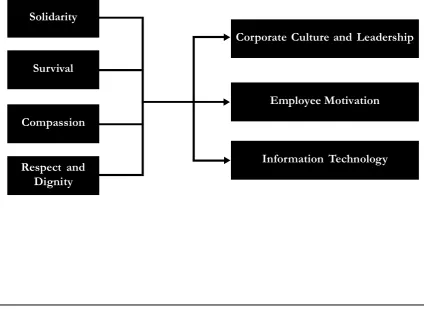
For example, how much influence does Solidarity have on Employee Motivation? Figure 1 illustrates the relationships this re-search will examine to determine whether there is a difference in influence of the in-dependent dimensions.
[image:4.595.81.506.446.755.2]Although a strong relationship was found between humanness and knowledge sharing, some negative relationships were also found by Scholtens. His findings indicated a negative relationship between solidarity and the willingness to share knowledge. Further-more, a low presence of humanness was found in the dimensions Information Tech-nology. Based on the findings of Scholtens, a comparison with the current study will be made. The data found by Scholtens will be useful to determine the degree of influence humanness has on knowledge sharing.
Figure 1.The Relation between the Dimensions of Knowledge Sharing and
Human-ness
Information Technology Employee Motivation
Corporate Culture and Leadership
Survival
Respect and Dignity Compassion
Solidarity
Setting the Research Scene (Malaysia) The relatively advanced developing countries, whose scope and scale of indus-trial production is growing rapidly and who have a highly competitive export sector, can be called Newly Industrialized Economies (NIE) (Sibert 2007). One of these NIE coun-tries is Malaysia.The country is developing rapidly after leaving the colonial heritage be-hind. Major changes have been carried out which are shown in the strong growth rates of 5-6 percent and the increase in GNP in 2010. Although these numbers are fasci-nating, the Malaysian Government wants more and has developed a plan to change the country from a production-based economy into a knowledge-based economy. These plans were already made in 2002 and rede-fined in 2005, however, only minor changes have been implemented, and Malaysia is still not seen as a knowledge hub (Syed-Ikhsan and Rowland 2004).
Furthermore, Syed-Ikhsan et al. (2004) state that the role of managers is an impor-tant factor to stimulate knowledge sharing within an organization. They need to create an environment where employees are ensured of sharing knowledge without the the nui-sance of cultural barriers. Furthermore, the results of Cheng et al. (2009) showed that the Malaysians are aware of the changes the government wants to implement to become a knowledge-based economy. However, their participation in this process is low, which implies that managers could have an impor-tant influence on this process. In a globalized world, it is good to learn more from other places in the world, and a focus on how people can work together and the way this is managed can be compared to the studies done on management styles in Africa.
Malaysia?
Within the Malaysian values, family is the most important aspect and members of a family help each other no matter what the issue is. This is in line with the studies of the Global Leadership and Organizational Be-havior Effectiveness (GLOBE) which com-pare cultures and attributes of effective leadership in 61 countries, including Ma-laysia (House et al. 2002; 2010). Accord-ing to these studies, Malaysia scores high on the GLOBE cultural dimension of human ori-entation, which entails that they have the ten-dency to see others, such as family, friends or the community,as more important. Human oriented societies are motivated by the need for belonging and affiliation where the values such as love, kindness, altruism and generos-ity are essential. Looking at the main cultural norms and values of Malaysian employees, they are similar to the dimensions of human-ness which are based on the strong commu-nal relationship and the need to help each other.
Although the Malaysian Government is campaigning with the slogan ‘1 Malaysia’ which means that,despite the cultural differ-ences between the inhabitants,everyone lives in harmony with each other; however, the opposite is true. This is the conclusion of the study conducted at Nestlé Malaysia by Zawawi (2008). In this research, several em-ployees from different backgrounds discussed their daily business and explained the diffi-culties they face in these practices. The re-spondents argued that miscommunications and misunderstandings were caused by the lack of cultural knowledge of other ethnic colleagues.
values of the main ethnicities present in Ma-laysia. For instance, the Malays are, by the Malaysian Constitution, Muslims which means that they strongly believe in the
con-cept of Allah the Almighty. In the Koran, it is
said that there is an equal benefit of resources for everyone that should be acquired right-fully and is in line with guidelines that busi-nessman take social goods into their consid-eration in business for reasons other than making a profit (Rice 1999). Therefore, Malays expect their managers/leaders to act as role models who value the religion and spirituality of the group (Zabid and Ho 2003).
Within the Chinese community, values such as ambition and being successful are more common. Factors such as education, wealth or prosperity, respect of face, improv-ing oneself and harmony are important (Zabid and Ho 2003). Furthermore, the Chi-nese are regarded as workers who are target oriented and motivated by financial rewards (Sendut 1991). The third large ethnicity present in Malaysia are the Indians who are living more according to rituals and traditions such as the caste system and the belief in re-birth (Nordin and Hussin 2004). With these beliefs, the Indians strive hard to gain author-ity, self-confidence and self-respect (Zawawi 2008). Within organizations, Indians are seen as loyal people who work hard. They have a high tolerance and are keen on adapting to the rules and structures of a company.
Research Methods
Sample
Questionnaires were distributed among managers from Malaysian organizations. From every industry, managers were asked to par-ticipate in the research.Managers from the
public sector, however, were lesswilling to respond to any e-mails or phone calls. The total response of the questionnaires is 214 which is, according to the statements of Thomas (2004), enough when the sample size is unknown. Of the participants, 125 (58%) are men and 89 (41.6%) women. Fur-thermore, the participants were asked to fill in their ethnicity which provided surprising results. The majority (47%) are Chinese, the Malay account for 22 percent and the Indi-ans 9.3 percent. Another large group were the managers who are not originally from Malay-sia (17.8%).
Scales and Measures
The presence of humanness and the willingness to share knowledge in organiza-tions was measured using a survey of 47 ques-tions (shown in Appendix 1). Respondents were asked to which degree they agreed with the statements, using a five-point Likert scale (ranging from 1= strongly disagree to 5= strongly agree). To avoid similarities in an-swers, the items were grouped randomly rep-resenting the four dimensions of humanness and the three dimensions of knowledge shar-ing. As is mentioned before, this study com-pares the results of humanness and the rela-tionship to knowledge sharing of Tanzania to Malaysia. In the study by Scholtens (2011), some adjustments were made because the di-mensions of Corporate Culture and Leader-ship and Management included many simi-larities and, therefore, these dimensions are seen as one.They are used in this study as well. Three dimensions for knowledge shar-ing remain.
Variability and Reliability
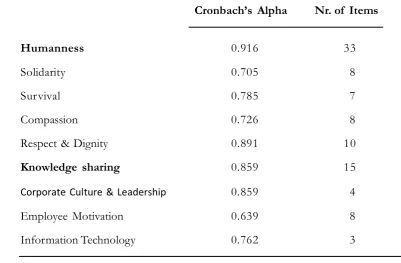
whether there is an internal consistency or average correlation of items. The perfect out-put of the Cronbach’s alpha coefficient has a scale above 0.7. In AppendixII, the tables of the Cronbach’s alpha coefficients of know-ledge sharing and humanness of both coun-tries are shown. Both councoun-tries show a higher score than 0.7 which indicates that the ques-tions measure the same underlying construct.
Analysis and Results
First the presence of humanness in Malaysia is investigated. This is done by us-ing the same measurement tool Scholtens (2011) used, which is developed by Sigger et al. (2010) to calculate the presence of hu-manness in a country. In this measurement tool, the means of the individual dimensions are used to measure the level of humanness.
Scores of 2.4 or less indicate a low level of humanness. Scores between 2.5 and 3.5 indi-cate a moderate level of humanness, and scores of 3.6 or higher indicate a positive high level. In this study, it is expected that, in the comparison to Tanzania, Malaysia will score lower on the humanness dimensions Solidar-ity, Survival and Compassion because these values are basics in the African culture. How-ever, it is expected that Malaysia will score higher on the dimension Respect and Dignity due to the high exposure of cultural differ-ences as is explained by the respondents in the study of Zawawi (2008).
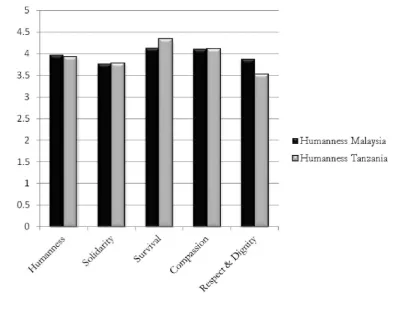
[image:7.595.115.527.433.747.2]Figure 2 visualizes the results of the Malaysian respondents compared to the man-agers of Tanzania. First, the results show that the Malaysian managers score more than 3.6 on all dimensions of humanness. In compari-son, the results for the Tanzanian managers
are, in general, the same. Although it was ex-pected to find larger differences, one assump-tion proved to be true. The Malaysian ma-nagers scored higher on the dimensions Re-spect and Dignity compared to Tanzanian managers, emphasizing the results of Zawawi (2008).
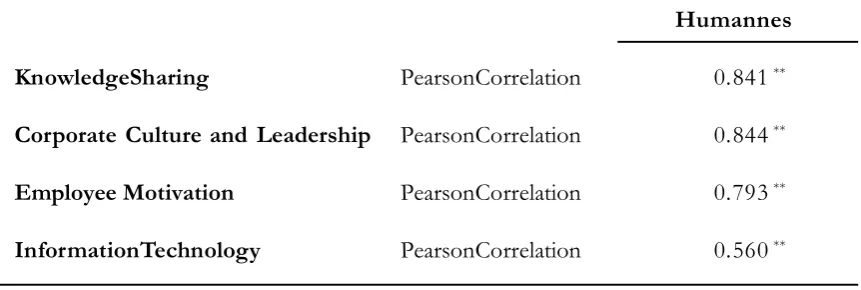
In line with the aforementioned find-ings, it is possible to research whether there is a relationship between the willingness to share knowledge and humanness in Malay-sia. To calculate this relationship, it is neces-sary to see if these variables correlate with each other. Using the Pearson correlation coefficient, a possible linear relationship be-tween the dimensions of knowledge sharing and humanness in Malaysia is calculated. In Appendix III, it is shown that there exists a moderate/strong linear relationship between most variables with the exception of the di-mension Information Technology. It is weaker than the others, suggesting that the relationship is minimal. The results makes it possible to use the one-on-one Regression Analysis and the Multiple Linear Regression Analysis to analyze to what extent the
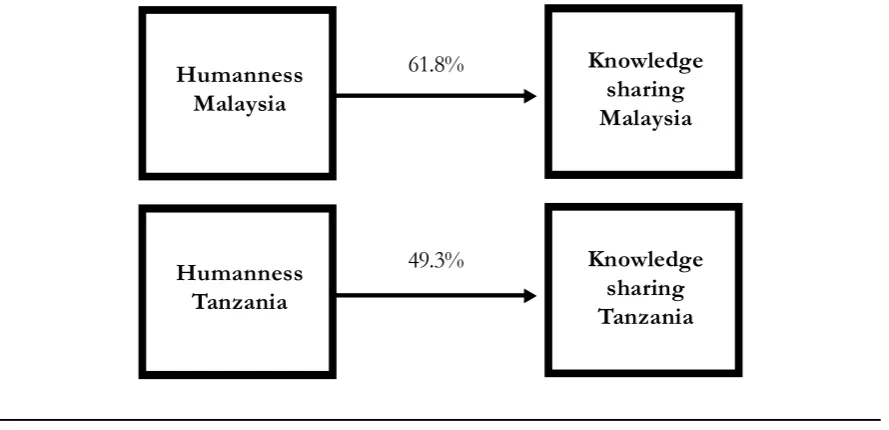
vari-ables knowledge sharing and humanness are related. First, the relationship between the variables knowledge sharing and humanness is studied. Looking at the coefficient of de-termination, the R-Square shows a value of 0.618, which is quite high for this kind of research. The degrees of freedom are F = 560.900 with a significance of p <0.000. From these results, it can be said that 61.8 percent of the variability of knowledge shar-ing is explained by the presence of human-ness (see Figure 3). The coefficient of
hu-manness shows a 0.786 which means that
humanness has a linear positive effect on knowledge sharing in Malaysia.
In comparison to Tanzania, the scores of the latter are slightly lower with a vari-ability percentage of 49.3 percent (Scholtens
2011). Additionally, the of Malaysia is
0.786 and for Tanzania the is 0.780. This
[image:8.595.73.518.541.756.2]means that the differences between the coun-tries in the relationship between knowledge sharing and humanness is not large. The dif-ference in explained variances between both countries might be a new research question for follow-up research.
Figure 3. Malaysia and Tanzania Compared in the Relationship between KS and H
Knowledge sharing Malaysia
Knowledge sharing Tanzania Humanness
Tanzania Humanness
Malaysia
61.8%
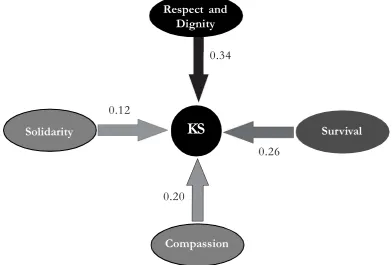
Now that the relationship between knowledge sharing and humanness is found, it is interesting to more closely inspect the dimensions of both concepts and analyze to what degree the individual dimensions influ-ence each other. First, the influinflu-ence of the individual humanness dimensions on knowl-edge sharing is investigated and is shown in Figure 4. The results from the Regression Analysis illustrate that all individual human-ness dimensions have a positive influence on knowledge sharing (Solidarity 0.12; Survival 0.26; Compassion 0.20; Respect and Dignity 0.34). From this information, it can be con-cluded that the humanness dimensions have influence on knowledge sharing, which means that cultural values are important fac-tors in the willingness of managers to share knowledge.
In addition to the influence of the indi-vidual dimensions on knowledge sharing, this study looks at the influence of the human-ness dimensions on the individual knowledge sharing dimensions of Corporate Culture and Leadership (CCL), Employee Motivation (EM) and Information Technology (IT).
[image:9.595.124.517.145.410.2]For Corporate Culture and Leadership, the Multiple Regression Analysis (Figure 5) shows an R-Square of 0.74, explaining 74.4 percent of the variability is explained by the individual humanness dimensions. However, it is notable that there is a negative relation-ship between Solidarity and Corporate Cul-ture and Leadership. Additionally, not all di-mensions have a significance of p < 0.01.
Figure 4.The Influence of the Humanness Dimensions on Knowledge Sharing
Survival Respect and
Dignity
Solidarity
Compassion
KS
0.340.12
0.20
Figure 5. The Influence of Humanness Dimensions on Corporate Culture and Leader-ship
Survival Compassion
Solidarity
CCL
Respect and Dignity
Figure 6. The Influence of Humanness’ Dimensions on Employee Motivation
Survival Compassion
EM
Respect and Dignity
Solidarity 0.38
0.07
0.30
0.31
0.43
0.04
0.11
[image:10.595.77.513.466.747.2]The dimension Employee Motivation, Figure 6, has a lower R-square than the pre-vious dimensions. The R-square is namely 0.65, which means that 65 percent of the variance in Employee Motivation is caused by the humanness dimensions. In contrast to the former dimension, all humanness dimen-sions have a positive relationship, though they are not very high; Compassion 0.43; Survival 0.28; Solidarity 0.11; Respect and Dignity 0.04.
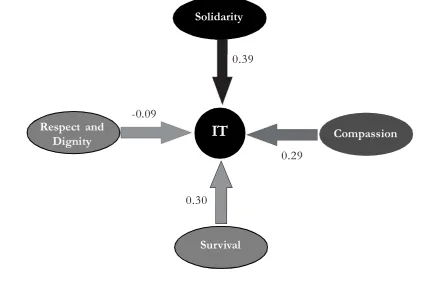
Finally, the variance of Information Technology is calculated. The R-Square is 0.34 which means that 34 percent of the vari-ability is explained by the humanness dimen-sions and is the lowest score of all know-ledge sharing dimensions which is illustrated by Figure 7. Furthermore, a negative relation-ship is found between Information Technol-ogy and Respect and Dignity indicating that modern technology does not have an influ-ence on human values. As shown in Figure 7,
the scores of the humanness dimensions on Information Technology are not high, which is similar to the low findings of the Pearson correlation coefficient.
[image:11.595.101.539.465.749.2]The diversity of cultures in Malaysia is unique and makes it an interesting topic for research. In this study, the respondents were asked to fill in their ethnicity which led to the aforementioned distribution of the par-ticipants. The high participation of Chinese managers is in contrast to the majority of Malays in Malaysia (60% versus 30%). How-ever, according to Arlès (1971), the dif-ferences between this research and the sta-tistics of Malaysia is due to the dominance of Malays in the public sector which is offset by the economic prominence of the Chinese. For this research, the Malaysian governmen-tal institutes were not able to participate and, therefore, this is a valid explanation for the differences in distribution.
Figure 7. The Influence of Humanness Dimensions on Information Technology
Compassion Solidarity
IT
Respect and Dignity
Survival 0.39
-0.09
0.30
As mentioned before, the differences between the ethnicities are found in their norms and values. Malays live according to the rules of Islam, Chinese are hard workers and entrepreneurial and the Indians live their lives to acquire a higher caste in rebirth. Dur-ing the data collection process, it became apparent that a fourth group should be in-cluded in the research indicated as the man-agers not from Malaysia. This group includes the international managers from around the world living and working in Malaysia and could not be ignored due to its large pres-ence (17.8%).
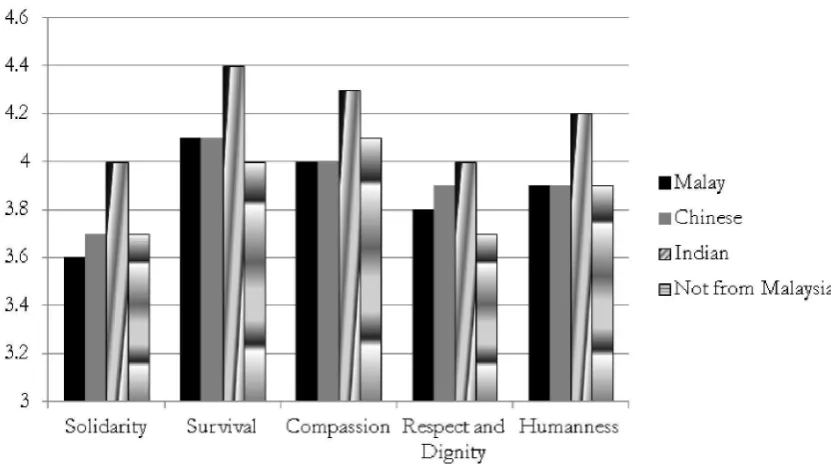
The four ethnicities were first examined for their presence of the humanness dimen-sions Solidarity, Survival, Compassion and Respect and Dignity using the one-way ANOVA. Although the literature suggests there are differences in viewpoints with re-spect to cultural norms and values, the Ho-mogeneity of Variances shows p > 0.05 indi-cating equality between the groups.
Further-more, the Levene’s test shows that the dif-ferences in variance are not attributed by chance and, therefore, the results can be used. Figure 8 shows that all the ethnicities have a score of 3.6 or higher, explaining the pres-ence of the humanness dimensions in all ethnicities and showing small differences be-tween the groups.
[image:12.595.84.500.142.375.2]Calculating the sum of squares between the groups and dividing this by the total sum of squares reveals the exact differences for the humanness dimensions which are 2.7 per-cent for Solidarity, 3.6 perper-cent for Survival, 1.8 percent for Compassion and 2.6 percent for Respect and Dignity. Even the use of dummy variables could not find any of the expected differences between the ethnicities. Furthermore, it was expected that the Malays and their Islamic norms and values were more in line with the humanness dimensions com-pared to the other ethnicities. In Figure 7, the opposite is true which means that the assump-tion is rejected and that the other ethnicities
score equally high or even higher than the Malays. Surprising is the high score of the Indians on all dimensions, which is in con-trast to the findings from the literature. From the data results, the Indians score highest on all humanness dimensions, suggesting that this ethnicity is most in line with the dimen-sions of humanness.
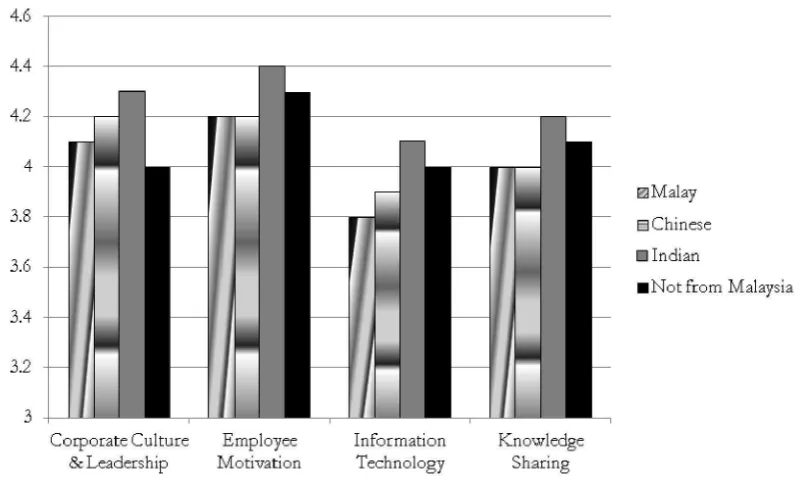
Along with investigating the presence of humanness, the presence of knowledge sharing is investigated, revealing similar re-sults to the humanness dimensions, as is shown in Figure 9. The Homogeneity of Vari-ance shows p > 0.05 and, according to the Levene’s test, the results are not found by chance. The findings are all above the scale of 3.6 and quite similar to each other, mean-ing that all managers of the ethnicities are willing to share knowledge with each other.
Even the dummy variable found an R-square of 0.017 showing 1.7 percent of the
plained by knowledge sharing. Furthermore, the Indians have a higher score on these di-mensions as well. Although the differences are smaller compared to the humanness di-mensions, the results suggest that Indians are more willing to share knowledge compared to the Malay, Chinese and managers not from Malaysia. Surprising is the conclusion that the ethnicities have a similar score for both hu-manness and knowledge sharing, indicating that mutually cultural aspects such as the willingness to share knowledge are highly present in Malaysia.
Conclusion
[image:13.595.121.519.153.392.2]The main objective of this study was to find a relationship between the humanness management style and the willingness to share knowledge of managers from Malaysia and the possibility of difference when the ethnic
Figure 9. The Knowledge Sharing Dimensions Compared between Ethnicities Using
count. Due to the findings of Scholtens (2011) in Tanzania, a strong positive relation-ship is expected between these two concepts. For a developing country such as Malaysia, knowledge is essential for the transformation from a production-based economy to a know-ledge-based economy. With the results of this research, it can be stated that human manage-ment or people managemanage-ment has a strong in-fluence on the willingness to share know-ledge within organizations. Therefore, it is important for companies to know that human aspects such as culture and norms and values influence a learning environment, which means that managers can encourage their employees to share knowledge with eachother. Furthermore, the regression analysis shows the relationships between the human-ness and knowledge sharing dimensions. How-ever, not all relationships proved to be posi-tive or high, and especially the relationships concerning Information Technology proved to be low. The relation with Respect and Dig-nity was even negative. From these relation-ships, it can be concluded that IT and human norms and values are correlating less com-pared to the other relationships which is sur-prising because digital communication is becomingmore popular every day. Therefore, it would be interesting to investigate this re-lationship in future research.
Although the literature suggests other-wise, minor differences were found between the four different ethnicities living in Malay-sia. The results show that the cultural heri-tage of Malaysian managers is not visible in the behavior of managers towards their em-ployees and, therefore,it can be concluded that different cultural backgrounds of man-agers does not influence the willingness to share knowledge in Malaysian organizations. The findings of this research do suggest that
managers should apply more human oriented management skills such as Solidarity, Sur-vival, Compassion and Respect and Dignity to encourage their employees to share more knowledge between each other. This leads to an environment where knowledge transfer between co-workers is encouraged and em-ployees no longer fear making errors or say-ing somethsay-ing wrong.
References
Arlès, J. P. 1971. Ethnic and socio-economic patterns in Malaysia. International Labor Review 104: 534. Broodryk, J. 2005. Ubuntu Management Philosophy. Randburg, South Africa: Knowres.
Cheng, M. Y., S. Hossain, and J. H. Guo. 2009. Social acceptance and readiness for the knowledge-based economy in Malaysia. ASEAN Economic Bulletin 26 (3): 253–65.
Darroch, J., and R. McNaughton. 2002. Examining the link between knowledge management practices and type of innovation. Journal of Intellectual Capital 3 (3): 210–222.
House, R. J., N. R. Quigley, and de M. Luque. 2010. Insights from Project GLOBE, Extending global advertising research through a contemporary framework. International Journal of Advertising 29 (1): 111-139.
House, R., M. Javidan, P. Hanges, and P. Dorfman. 2002. Understanding cultures and implicit leadership theories across the globe: An introduction to project GLOBE. Journal of World Business 37: 3-10. Housel, T., and A. H. Bell. 2001. Measuring and Managing Knowledge. New York: The McGraw-Hill
Compa-nies, Inc.
Lin H. F., and G. G. Lee. 2004. Perceptions of senior managers toward knowledge-sharing behaviour.
Management Decision 42 (1): 108–125.
Lin,H. F., H. S. Lee, and D. W. Wang. 2009. Evaluation of factors influencing knowledge sharing based on a fuzzy AHP approach. Journal of Information Science 35 (1): 25–44.
Lu, L., K. Leung, and P. T. Koch. 2006. Managerial knowledge sharing: the role of individual, interper-sonal, and organizational factors. Management and Organization Review 2 (1): 15–41.
MacNeil, C. M., 2004. Exploring the supervisor role as a facilitator of knowledge sharing in teams. Journal ofEuropean Industrial Training 28 (1): 93–102.
MacNeil, C. M. 2003. Line managers: Facilitators of knowledge sharing in teams. Employee Relations 25 (3): 294–307.
Mbigi, L. and J. Maree. 2005b. Ubuntu: The Spirit of African Transformation Management. Randburg, South Africa: Knowres.
Nordin, M., and H. Hussin. 2004. Pengajian Malaysia. Kuala Lumpur: FajarBakti Sdn. Bhd.
Poovan, N., M. K. A. Du Toit, and A. S. Engelbrecht. 2006. The effect of the social values of Ubuntu on team effectiveness. South African Journal of Business Management.
Rice, G. 1999. Islamic ethics and the implications for business. Journal of Business Ethics 18 (4): 345-358. Scholtens, C. 2011. The Innovative Value of Ubuntu: Knowledge sharing in African Organizations.
Sendut, H. 1991. Managing in a multicultural society? the Malaysian experience. Malaysian Management Review 26 (1): 61-69.
Shonhiwa, S. 2006. The Effective Cross-Cultural Manager: A Guide for Business Leaders in Africa. Cape Town: Zebra Press.
Siebert, H. 2007. The World Economy: A Global Analysis (3rd ed.). London: Routledge.
Sigger, D. S., B. M. Polak, and B. J. W. Pennink. 2010. ‘Ubuntu’ or ‘humannes’ as a management concept.
Sithole, J. 2001. Africa Can Only Use Own Culture to Influence Globalization. Afrol [African Online Services] News, http://www.globalpolicy.org/globaliz/cultural/ 2001/0515afr.htm. Accessed 14 May 2009. Slater, S., and J. C. Narver. 1995. Market orientation and the learning organization. Journal of Marketing 59:
63-74.
Syed-Ikhsan, S.O.S., and F. Rowland. 2004. Knowledge management in a public organization: A study on the relationship between organizational elements and the performance of knowledge transfer.
Journal of Knowlegde Management 8 (2): 95-111.
Tan, J. T. L. 2000. Knowledge management- Just more buzzwords? The British Journal of Administrative Management (Issue 19): 10-11.
Taylor, W.A., and G. H. Wright. 2004. Organizational readiness for successful knowledge sharing: Chal-lenges for public sector managers. Information Resources Management Journal 17 (2): 22–37.
Thomas, A. 2004. Research Skills For Management Studies. Routledge
Zabid, A. R. M., and J. A. Ho. 2003. Perceptions of business ethics in a multicultural community: The case of Malaysia md. Journal of Business Ethics 43 (1/2): 75-87.
APPENDIX I. QUESTIONNAIRE RESPONDENTS
What is your ethnicity?
What is your gender? o Malay
o Woman o Chinese
o Man o Indian
o Mixture
o I am not from Malaysia
For the following questions, please indicate in how far you agree with the statement, ranging from ‘I strongly disagree’ to ‘I strongly agree.’
Strongly Strongly
Disagree Agree N/A*
The organization encourages teamwork
When I share knowledge with my employees,
I believe that my future requests for knowledge will
be answered by them
Within my team, employees have reciprocal faith
in the behaviors and intentions of co-workers
Within my team all the employees are equal
My organization uses technology infrastructure
that allows employees to share knowledge with other
people inside the organization
My employees are friendly and helpful
I care about the well-being of my employees
I am willing to give up personal needs for the good
of the team/organization
I have to work closely with others to do my job well
I encourage diversity in opinions
Strongly Strongly
Disagree Agree N/A*
I enjoy helping others by sharing my knowledge
I encourage a high participation in sharing
knowledge and ideas among employees In the organization employees make extensive
use of the electronic storage (such as databases
and data warehouses) to access corporate knowledge
I respect the customs and beliefs of
my employees
I always put the interest of the whole
team before my own interest
I have confidence and trust in the team
Different ethnic groups work in harmony
within the organization
*Not applicable
Strongly Strongly
Disagree Agree N/A*
I respect the religion of my employees
I see myself as an active listener towards
my employees
A crisis in the team will always be solved
in a harmonious way
There is open communication in
the organization
All opinions have a fair hearing and
consideration within the team
I take the time to greet my employees
The organization provides all employees
Strongly Strongly
Disagree Agree N/A*
I value sharing what I have with my family
I provide equal opportunities to all within my team
I am confident in my ability to provide knowledge that others in the organization find valuable
*Not applicable
Strongly Strongly
Disagree Agree N/A*
I view employee training as an investment rather
than an expense
I receive increased promotion opportunities in
return for my knowledge sharing
Top management provides a clear organizational
vision and goals to employees
Long discussions take place in team meetings
My employees are people I inform about my
personal life
I encourage dialogue during meetings
In the organization ceremonies and personnel
parties are organized
*Not applicable
Strongly Strongly
Disagree Agree N/A*
In the organization employees use knowledge
networks (e-mail, intranet, etc.) to communicate
with co-workers
Encouraging knowledge sharing with co-workers
Strongly Strongly
Disagree Agree N/A*
I have the well-being of my employees as
a major objective
When a co-worker gets promotion and
I am not, I am happy for him/her
My employees and I get together outside
of work time
I feel I am really a part of the team
The employees and I are like a family
I encourage my team to suggest ideas for new
opportunities
I have the freedom to take my own approach
in my work
I have the right to say no to the team
I enjoy to work as a part of a team
My family is always welcome to visit
the organization
When I share my knowledge with employees the
people I work with respect me
*Not applicable
APPENDIX II: CRONBACH’S ALPHA
Table 1. Cronbach’s Alpha for Humanness and Knowledge Sharing Dimensions in
Malaysia
Cronbach’s Alpha Nr. of Items
Humannes 0.947 32
Solidarity 0.724 7
Survival 0.857 8
Compassion 0.819 8
Respect & Dignity 0.819 10
Knowledge sharing 0.879 14
Corporate Culture & Leadership 0.790 7
Employee motivation 0.750 3
Information Technology 0.674 3
Table 2. Cronbach’s Alpha for Humanness and Knowledge Sharing Dimensions in
Tanzania
Cronbach’s Alpha Nr. of Items
Humanness 0.916 33
Solidarity 0.705 8
Survival 0.785 7
Compassion 0.726 8
Respect & Dignity 0.891 10
Knowledge sharing 0.859 15
Corporate Culture & Leadership 0.859 4
[image:21.595.136.538.478.741.2]APPENDIX III: PEARSON CORRELTATION
Table 3. Correlations Humanness and Knowledge Sharing Dimensions
Humannes
KnowledgeSharing PearsonCorrelation 0.841**
Corporate Culture and Leadership PearsonCorrelation 0.844**
Employee Motivation PearsonCorrelation 0.793**
InformationTechnology PearsonCorrelation 0.560**
**Correlation is significant at the 0.01 level (2-tailed) All correlations have a significance of 0.00
N=214.
APPENDIX IV. KNOWLEDGE SHARING
The study by Lin, Lee and Wang (2009) uses four dimensions. However, Scholtens (2011) found that the dimensions corporate culture and leadership & management are too similar and need to be clustered together.
Corporate Culture & Leadership According to the study of Lin, Lee and Wang (2009) en-tities need a social-oriented organizational climate to encourage knowledge sharing among employees. Social networks or informal networks within organizations in-fluence knowledge sharing between employees. Accord-ing to O’Dell and Grayson (1998) both formal and infor-mal relationships and contacts between employees are important for the sharing process within organizations. Trust is important for managers to share their knowledge with others. Trust is one of the main aspects of the hu-manness dimensions because without trust there is no solidarity, survival, compassion or respect & dignity.
rewards’ accrue more likely to individuals who partici-pate actively in the sharing process and are willing to help others (von Hippen and von Krogh, 2003). Secondly, the reputation of employees is a factor in their motivation. According to the social exchange theory (Blau 1964) ‘in-dividuals engage in social interaction and expect social rewards such as approval, status and respect’. Therefore, it is expected that individuals actively participate in the perception to enhance his or her personal reputation in an established network.
Information Technology The final dimension refers to modern technology, which becomes more important with the development of Internet and information technology (IT). Moreover, ear-lier knowledge management research has indicated that IT can be seen as an important facilitator of knowledge sharing, which happens through the use of Internet, intranet, software agents, knowledge bases, and commu-nities of practices (Song 2002). The use of Internet and IT systems make it possible to share information quick to departments all over the world and to a large number of individuals (Powell et al. 1996).
APPENDIX V. HUMANNESS DIMENSIONS
Solidarity The dimension of solidarity is about the accomplishment of difficult tasks collectively. ‘The hallmark of the Afri-can philosophy is about being a good community mem-ber’ writes Mbigi is his paper (2005b). Tutu (1999) ex-plains that the solidarity of a person is the essence of being human. When a person is truly humanness this means he/she is generous, hospitable, friendly, caring, compassionate and share what they have. The persons within a community are inextricably bound to each other and appertain in a bundle of life.
Africans are dependent on each other. Therefore they need to share their resources and strengths to protect the community.Identically to solidarity, the dimension sur-vival is about sacrifices individuals need to take for the sake of the community or team. According to Magaliso (2001) this kind of survival result in some sort of kin-ship in organizations. Family members help each other to find jobs, but it is shown as well between people who graduated from the same university.
Compassion As compassion is about understanding the problems of others and feel the urge to help them. Magaliso (2001) states that one should treat others as members of their own family which is done by compassion, kindness and humility. To reach out to help others and feel compas-sionate towards their problems is the foundation on which relationships and friendships are based (Pooven et al. 2006). Within organization and team formations, a shared vision is important to increase the ability of teams to perform successful.
Respect & dignity Within the humanness management style people sense that they are treated with respect and dignity. These people show greater commitment to the goals of an organiza-tion and therefore work harder to achieve them (Mangaliso 2001). As is stated before, the utility of finding a deci-sion which is supported by all members of a team or or-ganization is more important than finding the best deci-sion. Furthermore, there is a deep respect for the elderly, authority and others who fulfill their obligations for the sake of the community (Mbigi 1997).