INTRODUCTION TO LINGUISTICS
OLEH:
SUSANA WIDYASTUTI NIP. 132 316 016
JURUSAN PENDIDIKAN BAHASA INGGRIS
FAKULTAS BAHASA DAN SENI
UNIVERSITAS NEGERI YOGYAKARTA
NOVEMBER, 2008
Kegiatan ini Dilaksanakan Berdasarkan Surat Perjanjian Pelaksanaan Penulisan Diktat Antara Pembantu Dekan I dengan
Preface
This module is aimed at introducing the basic concepts and essential terminology of linguistics. Linguistics is a highly technical field and technical vocabulary cannot be avoided. Therefore, a clear and brief explanation on each term is extremely needed to see the correlation between those terms.
This module is to be used by the third semester- students of English Department, as it gives fundamental concepts of linguistics before they take other courses of linguistics branches. This module is designed to assist the students to learn the nature of language and its function in daily life and linguistics as the study of language.
Contents
page
1.
Language 32.
Linguistics 103.
Theories of Linguistics 15Language
This chapter outlines some important ‘design features’ of human language, and explores the extent to which they are
found in animal communication. It also looks at the main purposes for which language is used.
Talking, shouting, whispering, lying, swearing, telling jokes or tales, in
short: communication of all sorts by means of articulate sound is something we are
so familiar with that we hardly ever come to think about it as something unique.
However, no other creature on this planet shows the ability to communicate verbally in the way we do. Take a minute to think about the immense impact spoken and
written language has on your everyday life! You could not possibly do without it in
situations where you meet other people, like in school, university, or at the breakfast table. The examples are innumerous.
In this section, we will take a look at the unique features of human language. As you will see when we proceed, the human curiosity concerning language is no
modern phenomenon. Language has been examined by linguists and philosophers
for several millennia. Therefore, we can look back on a respectable stock of literature
on the topic originating from the times of Ancient Greece until the present day. The
result is a compendium of linguistic disciplines that are interwoven with the domains of, among others, philosophy, psychology, neurology, and even computer science: a
vast and fascinating network of knowledge.
To keep you fascinated (which I hope you are) and to keep you from becoming intimidated (which I hope you are not), we will start right away with the
The Origins of Language
Language is highly developed form of animal signaling, but how and when
did we start to talk? Until recently, most linguists regarded this fascinating topic as
outside linguistics, many agreeing with the 19-th century linguist William Dwight Whitney that ‘the greater part of what is said and written upon it is mere windy talk’.
Language probably developed in east Africa, around 100,000 years ago.
Three preconditions must have existed. First, humans had to view the world in
certain common ways: they noticed objects and actions, for example. Second, they were able to produce a range of sounds – a spin-off of walking upright, according to
one view. Third, they must have attained the ‘naming insight’, the realization that
sound sequences can be symbols which ‘stand for’ people and objects. For example, human make some agreement to use some vocal symbol, for example “lion” to
describe a big hairy animal like cat. The ability of communication using language
gives some benefit for human civilization.
These preconditions enabled early humans to build up a store of words. But
how about linguistic rules, conventional word arrangements? In all probability, rules came about among early humans in much the same way as new rules emerge in any
language today. Briefly, preferences tend to become habits, and habits become ‘rules’.
What is human language?
Language is a highly elaborated signaling system. We call the aspects that
are peculiar to it the design features of language. Some of these we find only with the language of human beings, others we have in common with animals. Another
Design features of language
• A principle feature of human language is the duality of patterning.
It enables us to use our language in a very economic way for a virtually infinite production of linguistic units. How does this principle work?
All human languages have a small, limited set of speech sounds. The limitation derives from the restricted capacity of our vocal apparatus. The speech sounds are referred to as consonants and vowels. Linguistically speaking, the distinctive speech sounds are called phonemes,
which are explained in more detail in the chapter on phonology.
You cannot use isolated phonemes for communication, because phonemes are
by themselves meaningless. But we can assemble and reassemble phonemes
into larger linguistic units. These are commonly called "words". Although our capacity to produce new phonemes is limited, we frequently coin new words.
Hence, our capacity to produce vocabulary is unlimited.
• Displacement
In contrast to other animals, humans have a sense of the past and the future. A
gorilla, for example, cannot tell his fellows about his parents, his adventures in
the jungle, or his experience of the past. The use of language to talk about things other than "the here and now", is a characteristic of humans. Displacement is
thus our ability to convey a meaning that gently repeats the same patterns in its
dance, whereas humans are able to invent ever new contexts.
• Open- The ended-ness
Humans have the ability to transcend the immediately perceptible sphere of
space and time. Although some animals seem to possess abilities appropriating those of displacement, they lack the freedom to apply this to new contexts. The
dance of the honey-bee, for instance, indicates the locations of rich deposits of
language, except for a lack of variation. The bee freq say things that have never been said before, including the possibility to express invented things or lies, is
also a peculiar feature of human language.
• Stimulus-freedom
This is another aspect that distinguishes human language from animal
communication. The honey-bee must perform its dance, the woodchuck must cry
out in order to warn his fellows when it beholds an eagle. Humans have the
ability to say anything they like in any context. This ability is only restricted in certain ceremonial contexts such as church services, etc., where a fixed form is
expected to be followed. The possibility to violate this fixed linguistic behavior is then the source of jokes, such as a bride's "no".
• Arbitrariness
Why is a table called "table"? Obviously, the thing never told us its name. And
tables do not make a noise similar to the word. The same applies to most of the words of our language. Hence, words and their meaning have no priori
connection. We cannot tell from the sound structure which meaning is behind it.
Language is not motivated, as we can also put it. There are, however, exceptions to this rule: language can be iconic, which means that there is a direct correlation
between form and meaning. The length of a phrase, for example, could represent
a length of time the phrase refers to, like in "a long, long time ago". Here, the extension serves to visually represent the semantic emphasis. Iconicity in
language can be found frequently. Another example for non-arbitrariness are
onomatopoeia. These are words that seem to resemble sounds. There are many examples for onomatopoetic words, like splash or bang. Some names for animals are also onomatopoetic, for example, "cuckoo". Still, since animals such
• The human vocal tract
An elaborated language requires a highly sophisticated speech organ that will
enable the speaker to produce the many differentiated sounds. Only humans are endowed with a speech organ of this complexity
The Role of Language
But why did language begin? Social chit-chat, the meaningless small talk of
everyday life, may have played a key role, as it does today: “Hallo, how nice to see
you. How are you? Isn’t the weather terrible?” Keeping in touch via talking could have replaced the friendly grooming indulged in by primates, according to one view.
It has been called ‘grooming talking’.
The use of language for persuading and influencing others has probably always been important. Language can of course communicate feelings and
emotions, though this aspect of language is not well developed. Humans, like other
primates, can convey emotions via screams, grunts, sobs, gestures, and so on. So
they need language only to confirm and elaborate these more primitive signals. These days, various other biologically less important functions of language are also
found. Humans may use language for purely aesthetic reasons. In writing poetry, for
example, people manipulate words in the same way as they might model clay and paint a picture. Or they may in order to release nervous tension, a function seen
when people mutter to themselves in anger and frustration.
L
L
a
a
n
n
g
g
u
u
a
a
g
g
e
e
a
a
s
s
a
a
M
M
e
e
a
a
n
n
s
s
o
o
f
f
C
C
o
o
m
m
m
m
u
u
n
n
i
i
c
c
a
a
t
t
i
i
o
o
n
n
There is more to communication than just one person speaking and another
one listening. Human communication processes are quite complex. We differentiate verbal and nonverbal, oral and written, formal and informal, and intentional and
Verbal communication involves the use of linguistic symbols that mean
something to those who take part in the process. These symbols are spoken words
in oral communication and their realization as alphabetical units in written communication.
Oral communication refers to messages that are transmitted "out loud" from
one person to another. We all participate in this process every day, for example, as speakers or listeners when talking, watching TV, or answering the phone. The most
prominent feature of oral communication is that it is not permanent unless it is recorded.
Written communication is primarily verbal but involves also other elements due to the variations in writing. In contrast to oral communication, it is not transitory,
but permanent. Thus, written messages enable us to keep exact records of language
and communication. Living in a purely oral culture would limit our capacity of cultural development enormously.
Elements of the communication process
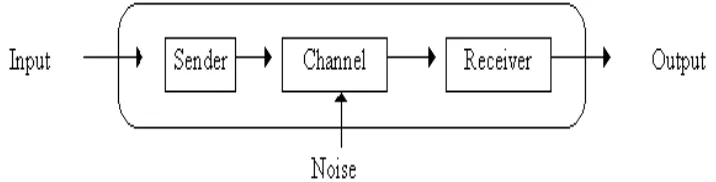
Here are the various components of the communication process in detail.
• Input. The sender has an intention to communicate with another person. This intention makes up the content of the message.
• Sender. The sender encodes the message, e.g. the idea of "piece of furniture to sit on" = . Thus he gives expression to the content.
• Channel. The message is sent via a channel, which can be made of a variety of materials. In acoustic communication it consists of air, in written
communication of paper or other writing materials.
• Noise. The channel is subjected to various sources of noise. One example is telephone communication, where numerous secondary sounds are audible.
Even a solid channel such as paper can be crushed or stained. Such
• Receiver. The receiver decodes the incoming message, or expression. He "translates" it and thus receives the
• Output. This is the content decoded by the receiver.
• Code. In the process, the relevance of a code becomes obvious: The codes of the sender and receiver must have at least a certain set in common in
order to make communication work.
Figure 1.1 Communication process
Questions:
1. Suggest at least three properties of language which are rare or absent in animal communication.
2. What do you understand by the role of language? 3. Suggest some reasons why people talk.
4. Language is a means of communication. Explain this statement.
Linguistics
This chapter explains how linguistics differs from traditional grammar studies and outlines the main
subdivisions of the subject.
Linguistics is the scientific study of language. It endeavors to answer the
question--what is language and how is represented in the mind? Linguistics is a
social science that shares common ground with other social sciences such as psychology, anthropology, sociology and archaeology. It also may influence other
disciplines such as English, communication studies and computer science.
Linguistics for the most part though can be considered a cognitive science. Along
with psychology, philosophy and computer science, linguistics is ultimately concerned with how the human brain functions.
Linguistics try to answer the basic questions ’what is language?’ and ‘How
does language work?’. It probes into various aspects of these problems, such as
‘What do all languages have in common?’, ‘What range of variation is found among languages?’, ‘How does human language differ from animal communication?, ‘How
does a child learn to speak?’, ‘How does one write down and analyze an unwritten
language?’. ‘Why do languages change?’, ‘To what extent are social class
differences reflected in language?’ and so on.
of a piece of paper (and the paper is the linguistic sign); you can distinguish between the two, but you can't separate them.
Saussure proposes the terms langage, langue and parole. He (and other structuralist and post-structuralist theorists) talk about language in general as
langage, the system of a certain language as langue (from the French word for language), and the language of an individual as parole.
What is a Linguist?
A Linguist is someone who engages in studying linguistics. He focuses on describing and explaining language; not concerned with the prescriptive rules of the
language. A Linguist is not required to know many languages and is not an
interpreter. The underlying goal of the linguist is to try to discover the universals
concerning language. That is, what are the common elements of all languages. The linguist then tries to place these elements in a theoretical framework that will
describe all languages and also predict what can not occur in a language.
How Does Linguistics differ from traditional Grammar?
One frequently meets people who think that linguistics is old school grammar
jazzed up with a few new names. But it differs in some basic ways. First, and most important, linguistics is descriptive, not prescriptive. Linguists are interested in what is said, not what they think ought to be said. They describe language in all its aspects, but do not prescribe rules of ‘correctness’.
Second, linguists regard the spoken language as primary, not the written. In the past, grammarians have over-stressed the importance of the written word, partly
because of its permanence. Linguists look first at the spoken word, which preceded the written everywhere in the world, as far as we know. Moreover, most writing
systems are derived from the vocal sounds. Although spoken utterances and written
overlapping systems, which must be analyzed separately: the spoken first, then the written.
Third, linguistics does not force languages into a Latin-based framework. In
the past, many traditional textbooks have assumed unquestioningly that Latin
provides a universal framework into which all languages fit and countless school
children have been confused by meaningless attempts to force English into foreign patterns. In short, linguists are opposed to the notion that any one language can
provide an adequate framework for all the others.
Disciplines within linguistics
Linguistics cover a wide range of topics and its boundaries are difficult to
define. Below are several different disciplines within linguistics. The fields of
phonetics, phonology, morphology, syntax, semantics and language acquisition are considered the core fields of study and a firm knowledge of each is necessary in
order to tackle more advanced subjects.
Phonetics
Phonetics is the study of the production and perception of speech sounds. It is concerned with the sounds of language, how these sounds are articulated and
how the hearer perceives them. Phonetics is related to the science of acoustics in
that it uses much the same techniques in the analysis of sound that acoustics does.
Phonology
Phonology is the study of the sound patterns of language. It is concerned
with how sounds are organized in a language. Phonology examines what occurs to
speech sounds when they are combined to form a word and how these speech sounds interact with each other. It endeavors to explain what these phonological
processes are in terms of formal rules.
Morphology
Morphology is the study of word formation and structure. It studies how words
are put together from their smaller parts and the rules governing this process. The
elements that are combining to form words are called morphemes. A morpheme is the smallest unit of meaning you can have in a language. The word cats, for example, contains the morphemes cat and the plural -s.
Syntax
Syntax is the study of sentence structure. It attempts to describe what is
grammatical in a particular language in term of rules. These rules detail an
Semantics
Semantics is the study of meaning. It is concerned with describing how we represent the meaning of a word in our mind and how we use this representation in
constructing sentences. Semantics is based largely on the study of logic in
philosophy.
Other Disciplines
• Sociolinguistics: Sociolinguistics is the study of interrelationships of language and social structure, linguistic variation, and attitudes toward
language.
• Neurolinguistics: Neurolinguistics is the study of the brain and how it functions in the production, preception and acquistion of language.
• Historical Linguistics: Historical linguistics is the study of language change and the relationships of languages to each other.
• Anthropological Linguistics: Anthropological linguistics is the study of language and culture and how they interact.
• Pragmatics: Pragmatics studies meaning in context.
Questions:
1. How would you define linguistics?
2. Point out three ways in which linguistics differs from traditional school grammar.
3. What is a linguist?
Theories of Linguistics
This chapter explains various linguistic theories and views proposed by some linguists.
In linguistics, any one of several schools of 20th-century linguistics committed to the structuralist principle that a language is a self-contained relational structure,
the elements of which derive their existence and their value from their distribution
and oppositions in texts or discourse. This principle was first stated clearly, for linguistics, by the Swiss scholar Ferdinand de Saussure (1857–1913). Saussurean
structuralism was further developed in somewhat different directions by the Prague
school, glossematics, and other European movements.
In the United States the term structuralism, or structural linguistics, has had much the same sense as it has had in Europe in relation to the work of Franz Boas
(1858–1942) and Edward Sapir (1884–1939) and their followers. Nowadays,
however, it is commonly used, in a narrower sense, to refer to the so-called post-Bloomfieldian school of language analysis that follows the methods of Leonard
Bloomfield, developed after 1930. Phonology (the study of sound systems) and
morphology (the study of word structure) are their primary fields of interest. Little work on semantics has been done by structural linguists because of their belief that
the field is too difficult or elusive to describe.
Ferdinand de Saussure
Semiotics, the study of signs and sign-using behaviour, was defined by one
of its founders, the Swiss linguist Ferdinand de Saussure, as the study of “the life of
signs within society.” Although the word was used in this sense in the 17th century by the English philosopher John Locke, the idea of semiotics as an interdisciplinary
early 20th centuries with the independent work of Saussure and of the American philosopher Charles Sanders Peirce.
Peirce's seminal work in the field was anchored in pragmatism and logic. He
defined a sign as “something which stands to somebody for something,” and one of his major contributions to semiotics was the categorization of signs into three main
types: (1) an icon, which resembles its referent (such as a road sign for falling rocks);
(2) an index, which is associated with its referent (as smoke is a sign of fire); and (3) a symbol, which is related to its referent only by convention (as with words or traffic
signals). Peirce also demonstrated that a sign can never have a definite meaning, for
the meaning must be continuously qualified.
Saussure treated language as a sign-system, and his work in linguistics has supplied the concepts and methods that semioticians apply to sign-systems other
than language. One such basic semiotic concept is Saussure's distinction between
the two inseparable components of a sign: the signifier, which in language is a set of speech sounds or marks on a page, and the signified, which is the concept or idea
behind the sign. Saussure also distinguished parole, or actual individual utterances, from langue, the underlying system of conventions that makes such utterances understandable; it is this underlying langue that most interests semioticians.
This interest in the structure behind the use of particular signs links semiotics
with the methods of structuralism, which seeks to analyze these relations.
Saussure's theories are thus also considered fundamental to structuralism (especially structural linguistics) and to poststructuralism.
Modern semioticians have applied Peirce and Saussure's principles to a
variety of fields, including aesthetics, anthropology, psychoanalysis, communications, and semantics. Among the most influential of these thinkers are the
French scholars Claude Lévi-Strauss, Jacques Lacan, Michel Foucault, Jacques
Derrida, Roland Barthes, and Julia Kristeva.
Until the beginning of the 20th century, scholars were occupied with research
importance. Saussure stated this in the first decades of this century and thus formed the fundament of modern linguistics.
Diachronic versus synchronic view
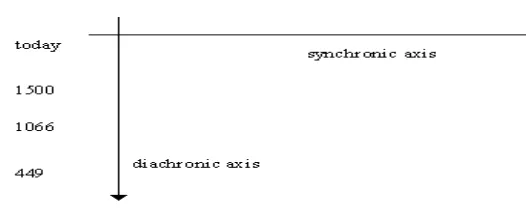
Figure 3.1Diachronic and Synchronic view
Diachronic linguistics views the historical development of a language. Thus, on the diachronic axis we can go back and forth in time, watching the language with all its features change. Synchronic linguistics views a particular state of a language at some given point in time. This could mean Modern English of the present day, or the systematic analysis of the system of Shakespeare's English. However, no
comparisons are made to other states of language or other times. Modern linguistics, following Ferdinand de Saussure, is primarily interested
in the synchronic point of view. Saussure postulated the priority of synchrony: no
knowledge of the historical development of a language is necessary to examine its present system. He arrived at this radical viewpoint due to his conviction that
linguistic research must concentrate on the structure of language. Later, the whole paradigm was hence called structuralism.
The two axes of the synchronic view
When we look at the structure of language, we find sentences and words.
This is, however, a very rough view. A grammar of a language must be more precise. One axis of the synchronic view is syntagmatic analysis. Here we examine the relationships of all elements of a sentence to one another. We ask ourselves
exactly what element appears where and under which condition in a sentence. For example, where do nouns appear? Where are auxiliary verbs applied? All word
analysis, a method that classifies elements according to their appearance within the logical order of a sentence.
Let's have a look at an example:
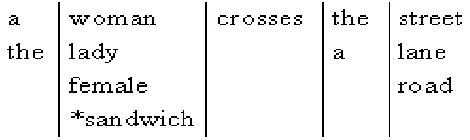
A + ______ + crosses + the + street
Obviously, a noun must appear in the blank space, for example:
A woman crosses the street.
Of course, nouns and verbs are not all the same. They do not fit into contexts
freely. Hence we apply paradigmatic analysis. In our example, the idea of a sandwich crossing the street is impossible. As you can see, the elements of
language obviously evince paradigmatic relationships. Elements can be substituted by others of the same paradigmatic class, such as street, lane, road, etc. Articles can also be exchanged. Words that belong to the same paradigmatic class thus belong
to the same grammatical class. They also belong to the same lexical field. The following diagram shows the two axes of synchronic analysis:
Figure 3.2 two axes of synchronic analysis
Noam Chomsky
The other famous linguist is Noam Chomsky, who joined the staff of the
Massachusetts Institute of Technology in 1955 and in 1961 was appointed full
professor in the Department of Modern Languages and Linguistics (now the Department of Linguistics and Philosophy). From 1966 to 1976 he held the Ferrari P.
Ward Professorship of Modern Languages and Linguistics. In 1976 he was
It was during this time that Chomsky became more publicly engaged in politics: he became one of the leading opponents of the Vietnam War with the
publication of his essay "The Responsibility of Intellectuals" in The New York Review of Books in 1967. Since that time, Chomsky has become well known for his political views, speaking on politics all over the world and writing numerous books. His
far-reaching criticism of US foreign policy and the legitimacy of US power has made him
a controversial figure.
Chomsky has in the past received various death threats because of his
criticisms of U.S foreign policy. He was on a list created by Theodore Kaczynski, better known as the Unabomber, of planned targets; during the period that Kaczynski
was at large, Chomsky had all of his mail checked for explosives. Chomsky also
states that he frequently receives undercover police protection, in particular while on the MIT campus, though Chomsky himself states that he does not agree with the
police protection.[4]
Despite his criticisms, Chomsky has stated that he continues to reside in the
United States because he believes it remains the "greatest country in the world,"[5] a comment that he later clarified by saying, "Evaluating countries is senseless and I would never put things in those terms, but that some of America's advances,
particularly in the area of free speech, that have been achieved by centuries of
popular struggle, are to be admired." Chomsky travels frequently, giving lectures on politics. His lectures are often criticized as being unmoving. Chomsky has
acknowledged this criticism, seeing it more as a virtue: "I'm a boring speaker and I
like it that way…I doubt that people are attracted to whatever the persona is…People
are interested in the issues, and they're interested in the issues because they are important. In 2003 he was elected as a member of Serbian Academy of Sciences
and Arts.
Contributions to linguistics
(largely) characterised by a formal grammar; in particular, a Context-free grammar extended with transformational rules. Children are hypothesised to have an innate
knowledge of the basic grammatical structure common to all human languages (i.e.
they assume that any language which they encounter is of a certain restricted kind). This innate knowledge is often referred to as universal grammar. It is argued that
modelling knowledge of language using a formal grammar accounts for the
"productivity" of language: with a limited set of grammar rules and a finite set of terms, humans are able to produce an infinite number of sentences, including
sentences no one has previously said.
The Principles and Parameters approach (P&P) — developed in his Pisa
1979 Lectures, later published as Lectures on Government and Binding (LGB) — make strong claims regarding universal grammar: that the grammatical principles underlying languages are innate and fixed, and the differences among the world's
languages can be characterized in terms of parameter settings in the brain (such as
the pro-drop parameter, which indicates whether an explicit subject is always
required, as in English, or can be optionally dropped, as in Spanish), which are often likened to switches. (Hence the term principles and parameters, often given to this
approach.) In this view, a child learning a language need only acquire the necessary
lexical items (words, grammatical morphemes, and idioms), and determine the appropriate parameter settings, which can be done based on a few key examples.
Proponents of this view argue that the pace at which children learn
languages is inexplicably rapid, unless children have an innate ability to learn
languages. The similar steps followed by children all across the world when learning
languages, and the fact that children make certain characteristic errors as they learn their first language, whereas other seemingly logical kinds of errors never occur
(and, according to Chomsky, should be attested if a purely general, rather than
language-specific, learning mechanism were being employed), are also pointed to as motivation for innateness.
More recently, in his Minimalist Program (1995), while retaining the core
linguistic machinery involved in the LGB model, stripping from it all but the barest necessary elements, while advocating a general approach to the architecture of the
human language faculty that emphasises principles of economy and optimal design,
reverting to a derivational approach to generation, in contrast with the largely representational approach of classic P&P.
Chomsky's ideas have had a strong influence on researchers investigating the acquisition of language in children, though some researchers who work in this
area today do not support Chomsky's theories, often advocating emergentist or
connectionist theories reducing language to an instance of general processing mechanisms in the brain.
Generative grammar
The Chomskyan approach towards syntax, often termed generative
grammar, though quite popular, has been challenged by many, especially those
working outside the United States of America. Chomskyan syntactic analyses are
often highly abstract, and are based heavily on careful investigation of the border between grammatical and ungrammatical constructs in a language. (Compare this to
the so-called pathological cases that play a similarly important role in mathematics.)
Such grammatical judgments can only be made accurately by a native speaker,
however, and thus for pragmatic reasons such linguists often focus on their own native languages or languages in which they are fluent, usually Spanish, English,
French, German, Dutch, Italian, Japanese or one of the Chinese languages. However, as Chomsky has said:
Sometimes generative grammar analyses break down when applied to languages which have not previously been studied, and many changes in generative
grammar have occurred due to an increase in the number of languages analyzed. It
is claimed that linguistic universals in semantics have become stronger rather than
weaker over time. The existence of linguistic universals in syntax, which is the core of Chomsky's claim, is still highly disputed. Still, Richard Kayne suggested in the
1990s that all languages have an underlying Subject-Verb-Object word order. One of
approach or linguistic typology (often associated with Joseph Greenberg), is to base hypotheses of linguistic universals on the study of as wide a variety of the world's
languages as possible, to classify the variation seen, and to form theories based on
the results of this classification. The Chomskyan approach is too in-depth and reliant on native speaker knowledge to follow this method, though it has over time been
applied to a broad range of languages.
Chomsky’s hierarchy
Chomsky is famous for investigating various kinds of formal languages and
whether or not they might be capable of capturing key properties of human
language. His Chomsky hierarchy partitions formal grammars into classes, or groups, with increasing expressive power, i.e., each successive class can generate a
broader set of formal languages than the one before. Interestingly, Chomsky argues
that modelling some aspects of human language requires a more complex formal
grammar (as measured by the Chomsky hierarchy) than modeling others. For example, while a regular language is powerful enough to model English morphology,
it is not powerful enough to model English syntax. In addition to being relevant in
linguistics, the Chomsky hierarchy has also become important in computer science (especially in compiler construction and automata theory).
His best-known work in phonology is The Sound Pattern of English, written with Morris Halle (and often known as simply SPE). Though extremely influential in its day, this work is considered outdated (though it has recently been reprinted), and
Chomsky does not publish on phonology anymore.
Questions:
1. List down Saussure’s major contributions in linguistics. 2. List down Chomsky’s major contributions in Linguistics.
3. Mention some other linguists discussed in this chapter and the theories they proposed.
The Languages of the World
This chapter explores the languages in the world and their groupings into language family. It also discusses the history
of English language.
How many languages are spoken in the world?
Ethnologue lists 6,912 living languages in the world today. Keep in mind, however, that the number of languages may never be determined exactly.
Languages are not always easily treated as discrete entities with clearly defined
boundaries because they represent a continua of features extending across
geographic, political and social boundaries. Not all scholars agree on the criteria that clearly distinguish "language" from "dialect". At the same time, estimates of how
many people speak a given language can vary considerably. Some surveys include
only first language (native) speakers, others include both first and second language speakers (i.e., those who use the language in daily life but are not native speakers of
it).
As a result of such indeterminacy, some mutually intelligible varieties such as
German and Dutch are considered to be separate languages because they are
spoken in different countries (political considerations), while mutually unintelligible Mandarin and Cantonese are considered to be varieties of Chinese because they
are spoken in one country, share a common writing system of great antiquity, and
are perceived to be one language by speakers of distinct varieties (historical, political
result, it has not been possible to establish whether they are separate languages or dialects of other languages.
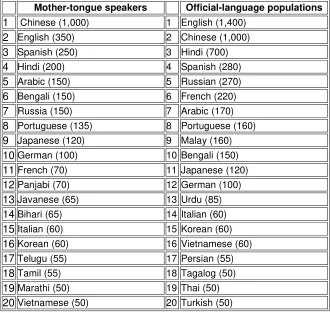
Top 20 Languages
The table below presents speaker estimates for the world's top 20 languages
(given in millions). The first column lists the languages on the basis of the number of
mother-tongue (first-language) speakers they have. The second column gives
population estimates for those countries where the language has official status.
Mother-tongue speakers Official-language populations
1 Chinese (1,000) 1 English (1,400)
2 English (350) 2 Chinese (1,000)
3 Spanish (250) 3 Hindi (700)
4 Hindi (200) 4 Spanish (280)
5 Arabic (150) 5 Russian (270)
6 Bengali (150) 6 French (220)
7 Russia (150) 7 Arabic (170)
8 Portuguese (135) 8 Portuguese (160)
9 Japanese (120) 9 Malay (160)
10 German (100) 10 Bengali (150)
11 French (70) 11 Japanese (120)
12 Panjabi (70) 12 German (100)
13 Javanese (65) 13 Urdu (85)
14 Bihari (65) 14 Italian (60)
15 Italian (60) 15 Korean (60)
16 Korean (60) 16 Vietnamese (60)
17 Telugu (55) 17 Persian (55)
18 Tamil (55) 18 Tagalog (50)
19 Marathi (50) 19 Thai (50)
Language Isolates
A language isolate is a language that does not have another language related to it. Many languages are related to other languages, because they both
come from an older language, and are similar to other languages. These groups that
are similar are called language families. Most languages belong to a language
family, but some are not related to other languages. These languages are called language isolates. Some language isolates are Basque, Japanese, Ainu and Zuni.
Language Families in the World
The comparative method allows us to establish relationships among
languages common ancestors for different existing languages, and patterns for historical development. It also makes possible the groupings of language into
language families. One such family is Indo-European family, the ancestor of such
diverse living languages as English, Russian, Persian, Hindi, Irish, and Albanian, and of languages that are no longer spoken, such as Latin, Sanskrit, Tocharian, and
Gothic. The language families in the world are as follows.
• The Indo-European Family
The largest family of languages and the family with the largest number of speakers. Languages include English, Spanish, Portuguese, French, Italian,
Russian, Greek, Hindi, Bengali; and the classical languages of Latin, Sanskrit,
and Persian.
• The Uralic Family
A family found in Europe (Hungarian, Finnish) and Siberia (Mordvin) with
complex noun structures.
•••• The Altaic Family
A family includes Europe (Turkish) through Centra Asia (Uzbek), Mongolia
•••• The Sino-Tibetan Family
An important Asian family of languages that includes the world's most spoken
language, Mandarin.
•••• The Malayo-Polynesian Family
A family consisting of over 1000 languages spread throughout the Indian and
Pacific Oceans as well South East Asia. Languages include Malay, Indonesian,
Maori and Hawaiian.
•••• The Afro-Asiatic Family
This family contains languages of northern Africa and the Middle East. The
dominant languages are Arabic and Hebrew.
•••• The Caucasian Family
Georgian and Chechen are the main languages. They are known for their large number of consonants.
•••• The Dravidian Family
The languages of southern India (in contrast to the Indo-European languages of
northern India). Tamil is the best known of these languages.
•••• Austro-Asiatic Family
Languages include Vietnamese and Khmer.
•••• Niger-Congo Family
This family features the many languages of Africa south of the Sahara. The large
Where is English?
History of English language
Looking at a living language, one of the most interesting aspects is language
change. All languages, except for the extinct ones, change permanently. Usually we
do not notice the change that takes place during our own time because it happens
quite slowly. But if we take a look back over a considerable span of time, language change becomes more obvious. Of course there were no textbooks in the beginnings
of language, but fortunately linguists have developed certain methods to trace back
words even beyond earliest records. Thus we have knowledge not only of the last 1500 years of English. We can even make an assumption about the very roots of the
language.
English is an Indo-European language. Indo-European was discovered to be the parent language of most European, Anterior-Asian, and Indian languages. As a rule, according to prototypical features of some of these languages, two main branches are defined in the Indo-European language tree, namely an eastern branch
and a western branch. However, scholars have disputes about where the divisions
within the Indo-European language family are to be placed. For example, in Indo European languages
Germanic
Indo Iranian Armenian Albanian
Baltic Celtic
Italic
Slavic German, Dutch, English, etc
examining languages other than the prototypical, it has been found that not all languages can be classified into one of the two main branches, the eastern and
western branches, of language families.
Old English Period
In 449, Germanic tribes invaded Britain. It gives some effect on language.
Characteristic of Old English is that the vocabulary is almost purely Germanic, for example many words have sound sk like skiff, skirt, etc. But in 858, the Danes started to invade Britain. The Danish rule lasted from 1014 until 1042. It makes
changing on language. Germanic style changes to Danish style. For example, the
sound sk change to sh (skirt-shirt, skiff-ship). In 1066, the Normans invaded England. Through the influence of Norman, Old English Period gradually ended.
Middle English Period
In 1066, the Normans attacked England. The Norman invasion had an effect
on England’s institutions and language. About ten thousand French words had been taken over by English and most of them have remained in the language until now.
Therefore, many French terms were borrowed. One example is the name of animals and their meat.
Animal Meat
Sheep Mutton
Cow Beef
Swine Pork
Modern English Period
Modern English began in 1500 and lasts until now. There is an important phonological change of English vowel in Modern English. There is some changing in
short vowel from Middle English to Modern English. In Middle English there is sak
English Language Imperialism
Example of language imperialism was seen in post-independence India. The powers-that-be started off trying to make Hindi as the sole "National language" of
India, but due to protests from southern states (where Dravidian languages like
Kannada, Telugu, Tamil, Malayalam, Konkani, Tulu, etc are spoken), the "National
language" policy did not take off. Hindi, along with English has been made the "Official Languages of the Indian Union Government". However after start of
economic liberalization in 1991, English has become the lingua franca of business, higher education and research.
Questions:
1. Explain the history of English language. 2. Why does language change?
3. How would you define language isolate?
4. Explain the language family of English language.
Phonetics
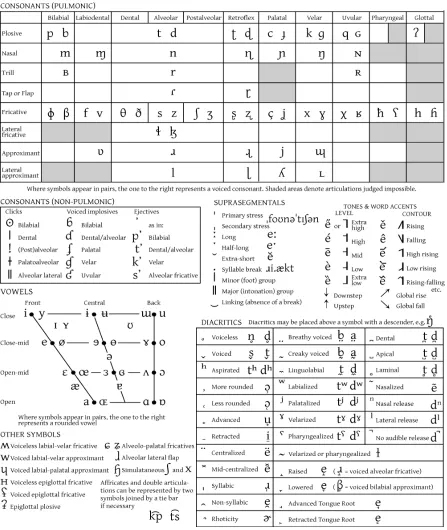
This chapter explains how linguists represent the flow of speech, and outlines the main symbols used for the
sounds of English.
Phonetics is the study of the sounds of human speech. It is concerned with
the actual properties of speech sounds (phones), and their production, audition and
perception. Phonetics deals with the sounds themselves rather than the contexts in which they are used in languages.
Phonetics has three main branches, they are:
articulatory phonetics, concerned with the positions and movements of the lips,
tongue, vocal tract and folds and other speech organs in producing speech; acoustic phonetics, concerned with the properties of the sound waves when we
speak; and
auditory phonetics, concerned with speech perception, principally how the brain forms perceptual representations of the input it receives.
Units of Representation
Anyone who hears a language spoken for the first time finds it hard to break up the flow of speech into individual units of production. Even when hearing our own
language spoken, we do not focus attention on individual sounds as much as we do
on meaning of words, phrases, and sentences. Many alphabets, including IPA represent speech in the form of feature, segment and syllable.
Feature is the smallest building blocks of phonological structure. Segments are produced by coordinating a number of individual articulatory gestures (e.g. jaw movement, lip shape, tongue placement); features refer to these individual activities.
Segment is an individual speech sound. It is the portion of speech with relatively constant phonetic features. There are several kinds of evidence that
suggest that speakers have the linguistics knowledge that makes it possible to break
down a stream of speech into sound segments. Errors in speech production provide one kind of evidence for the existence of segments. Slips of the tongue such
Kolacodor for Kodacolor and melcome wat for welcome mat show segments shifting and reversing position within words. This suggests that segments are individual units of linguistic structure and should be represented individually in a system of
transcription.
And the last is syllable. Syllable can be defined phonetically as a peak of sonority surrounded by less sonorous segments. For example, the words a and go
each contain one syllable, the word laughing two syllables, and the word telephone
three syllables. In counting the syllable in these words, we are in effect counting the
vowels. A vowel is thus said to form the nucleus of a syllable.
The sound Producing system
Sound is produced when air is set in motion. Think of the speech in production mechanism as consisting of an air supply, a sound sources that sets the
air in motion in ways specifically relevant to speech production and a set of filters
that modifies the sound in various ways. The air supply is provided by the lungs. The
sound source is in the larynx, where a set of muscle called vocal folds are located. The filters are the organs above the larynx; the tube of the throat between the oral
cavity and the larynx which is called the pharynx, the oral cavity, and the nasal
Figure 5.1 Organs of speech
Sound Classes
The sounds of language can be grouped into classes, based on the phonetic
properties that they share. Sounds fall into two major classes, vowels and
consonants. Another class, the glides, share properties of both vowels and consonants. They can be distinguished on the basic differences in articulation, the
acoustic properties, and their function as syllabic or non-syllabic elements.
Vowels, Consonants and Glides: Articulatory Differences
• Consonantal sounds, which may be voiced or voiceless, are generated by stopping or pressing the airflow (i.e., with either a complete closure or
narrowing of the vocal tract).
• Vowels, which are voiced, are produced by modulating the phonational stream.
• Glides, which are voiced, are produced with a vowel-like articulation
Vowels, Consonants and Glides: Acoustic Differences
Acoustic Differences: result of different articulation of vowels and consonants
Sonority scale: vowels > glides > liquids > nasals > fricatives > obstruents
• Glides are les sonorous than vowels, but more sonorous than consonants
More Differences: Syllabic and Non-syllabic Sounds
Another distinction between sound classes: ability to function as syllabic or
non-syllabic elements. Syllable is peak of sonority surrounded by less sonorous
segments. Due to their greater sonority, usually vowels form the basis (nucleus) of
syllables (i.e., in counting syllables in words, we are in fact counting vowels). Think of vowels and consonants not simply as types of articulations but as elements that
may or may not be syllabic.
Place and Manner of Articulation of Vowels and Consonants.
ConsonantsConsonant is phonemes marked by constriction or closure in the breath channel – letter other than a, e, i, o and u.
1. Places of Articulation
Place of Articulation is point at which the airstreams can be modified to produce a distinctive sound. Places of articulation: lips, oral cavity, pharynx, glottis
Labial: phones produced with the lips participating.
Dentals: phones produced with the teeth participating.
Alveolar: phones produced with the alveolar ridge participating (Alveolar ridge:
small ridge protruding from just behind the upper front teeth).
Alveopalatal (Post-alveolar): phones produced with the alveopalatal (=post-alveolar) area participating (Alveopalatal/ post-alveolar area: area just behind the
alveolar ridge where the roof of the mouth rises sharply).
Palatal: phones produced with the palate participating (Palate: highest part of the
roof of the mouth).
Velar: phones produced with the velum participating (Velum: soft area toward the
rear of the roof of the mouth).
Pharyngeal: phones produced with the pharynx participating (Pharynx: area of the throat between the uvula and the larynx) [note: not found in English ].
Glottal: phones produced using the vocal folds as primary articulators.
2. Manners of Articulation
Manners of articulation is the manner how organ and place of articulation
make contact. For any place of articulation, there may be several manners, and therefore several homorganic consonants.
a. Nasal: Sound produced when the velum is lowered to allow air to pass through
the nasal passages (both consonants and vowels can be nasal).
b. Oral: Sound produced when the velum is raised, cutting off the airflow through the nasal passages. Oral sounds are
Stops: produced with a complete and momentary closure of airflow. In the
world’s languages: bilabial, dental, alveolar, palatal, velar, uvular and glottal stops; English: bilabial, alveolar and velar stops [p b t d k g ŋ m n].
Fricatives: produced with a continuous airflow passing through a very narrow
opening, accompanied by a continuous audible noise English: bilabial, dental, alveolar and postal veolar fricatives.
Sibilants: type of fricative for which the airflow is guided by a groove in the
tongue toward the teeth, creating a high-pitched and very distinctive sound
(acoustic criterion).
Affricates: produced when a stop articulation is slowly released of the
closure. Implosion of the stop, but no explosion; instead of an explosion, the
homorganous fricative (=same organ and place of articulation) is produced. Liquids: Generic term for the sound classes laterals and rhotics.
Laterals: produced in a way that air escapes through the mouth along the
lowered sides of the tongue (generally voiced).
Rhotics: r -sounds. “Being r-like“are a strangely elusive feature, and the very same sounds that function as rhotics in some systems may pattern with
Vowels
Vowel is a sonorous voiced sound produced by modulating the phonational
stream. It is characterized by an open configuration of the vocal tract (i.e., there is no
build-up of air pressure above the glottis). Vowels are syllabic elements: they form the nucleus (peak) of syllables.
2 major types of vowels are simple vowels and diphthongs
• Simple vowels: no noticeable change in quality during articulation.
• Diphthongs: change in quality within a single syllable (in contrast to hiatus) due to tongue movement away from the initial vowel articulation toward a glide
position. Longer than the simple vowels. Diphthongs are treated as single vowels
(they form a single syllable).
Processes
• Articulatory process: articulatory adjustments that occur during the production of connected speech; the articulation of one sound affecting that of another sound. there are two basic effects of articulatory processes:
Efficiency: some articulatory processes result in a more efficient (easier)
articulation of a series of sounds (precise timing and coordination of speech is relaxed)
Clarity: other articulatory processes result in a more distinct output, which makes
the utterance easier to perceive.
• Assimilation: articulatory process by which a sound changes to match another sound in a word.
Questions:
1. How would you define phonetics?
2. Distinguish between vowels and consonants. 3. Explain the sound producing process.
4. Mention human’s organs of speech.
Phonology
This chapter explains how sounds are organized and patterned.
Phonology is the study of how sounds are organized and used in natural languages. It is the study of the sound patterns of language. Phonology is the
component of a grammar which includes the inventory of sounds (phonetic and
phonemic units) and rules for their combination and pronunciation. Phonology
examines what occurs to speech sounds when they are combined to form a word and how these speech sounds interact with each other. Phonology is just one of
several aspects of language. It is related to other aspects such as phonetics,
morphology, syntax, and pragmatics. The phonological system of a language includes an inventory of sounds and their features, and rules which specify how sounds interact with each other.
At one extreme, phonology is concerned with the anatomy and physiology - the organs of speech and how we learn to use them. At another extreme, phonology shades into socio-linguistics as we consider social attitudes to features of sound such as accent and intonation. Here is an illustration that shows the place of phonology in an interacting hierarchy of levels in linguistics:
Phoneme
A phoneme is a speech sound that helps us construct meaning. That is, if we replace it with another sound (where this is possible) we get a new meaning or no meaning at all. If we replace the initial consonant (/r/) from rubble, we can get double
or Hubble (astronomer for whom the space telescope is named) or meaningless forms (as regards the lexicon of standard English) like fubble and wubble. The same thing happens if we change the vowel and get rabble, rebel, Ribble (an English river) and the nonsense form robble.
The amazing discovery is that people systematically ignore certain properties
of sounds. They perceive two different sounds as the same sound. We call the
stored versions of speech sounds phonemes. Thus phonemes are the phonetic
alphabet of the mind. That is, phonemes are how we mentally represent speech; how we store the sounds of words in our memory.
Though the phonetic alphabet is universal, we can write down the speech sounds actually uttered in any language, the phonemic alphabet varies from
language to language. For example, English has no memorized front rounded
vowels like German or French, and French has no [θ]. This leads to seeming contradictions when we consider both actual productions of speech sounds as well
as their memorized representations. English has no memorized nasal vowels, but
English speakers do make nasalized vowels when vowels and nasal consonants come together in speech.
Minimal pairs
How do we find out what's in someone's mind? How do we figure out how
people store the sounds of words in their memories? One trick that we can use is to
look for minimal pairs of words. A minimal pair is a pair of words that have different
meanings and which differ in only one sound. Since the difference between the two sounds is meaningful, the words must be stored differently in memory. Since the
words differ in only one sound, this difference must be stored in memory. Thus the
tell when a contrast would yield a distinct possible word, even if this is not an actual word.
In English, [sɪp] and [zɪp] is a minimal pair. These two words are different
words of English. But they differ only in their initial sound. Therefore, the [s]/[z]
difference is significant for English speakers. Therefore both [s] and [z] are stored in
the memory. Thus, [s] and [z] are part of the English mental alphabet. We notate elements in the memory by putting them in-between slashes / /. In this case /s/ and
/z/ are part of an English speaker's alphabet for memorizing words. [ræm] and [ræn]
and [ræŋ] are all distinct words of English. Therefore, the speech sounds (in the
mouth) [m], [n] and [ŋ] are all significant to the mind. And therefore, English includes the phonemes /m/, /n/ and /ŋ/.
The phonetic context (or frame) [b_t] can be used to find minimal pairs for
many English vowels:
• [bit] ("beat") /i/ • [bɪt] ("bit") /ɪ/ • [bet] ("bait") /e/ • [bɛt] ("bet") /ɛ/ • [bæt] ("bat") /æ/ • [but] ("boot") /u/ • [bot] ("boat") /o/
• [bɔt] ("bought") /ɔ/ (You may have [ɑ] here.) • [bʌt] ("but") /ʌ/
This minimal set establishes all these vowels as mentally distinct, and therefore phonemic.
Allophones
An allophone is a phonetic variant of a phoneme in a particular language. In English, each vowel phoneme has both an oral nasalized allophone. The choice of
[p] and [pH] are allophones of the phoneme /p/. The aspirated variant [ph] and the unaspirated one [p] are both allophone of the phoneme /p/, and each occurs in a different and predictable set of environments. For example, words spot, spill, pot, and pill. This can be tested by holding a sheet of paper in front of the mouth and saying these words. In the case of spot and spill, the paper remains motionless. But, when pot and pill are pronounced, the accompanying puff of breath makes the paper billow out.
[t] and [tH] are allophones of the phoneme /t/. The examples of these allophones are till, tar, still and star. Like as in words pill and pot, the accompanying puff of breath makes the paper blow up if words till and tar are pronounced. In other hands, if we pronounce words still and star, the paper remains motionless
Complementary Distribution
Complementary distribution is the mutually exclusive relationship between two phonetically similar segments. It exists when one segment occurs in an environment where the other segment never occurs. When oral vowels occur, nasal vowels do not occur and vice versa. It is in this sense that the phones are said to complement each other or to be in complementary distribution. Here are some examples of complementary distribution.
bee → [bi] → [bĩ]
lay → [le] → [l ]
bang→ [bǽŋ] → [bæŋ]
As these words illustrate, in English, oral vowels occur in final position and
before non-nasal consonant; nasalized vowels occur only before nasal consonants. [i] and [ĩ] are in complementary distribution. Of course, there is a difference between
their distribution and the two allophones of the phoneme / i/ can occur in the same environment, whereas [i] and [ĩ] never occur in the same environment or under the
Free Variation
Free variation in linguistics is the phenomenon of two (or more) sounds or forms appearing in the same environment without a change in meaning and without
being considered incorrect by native speakers. The word economics may be pronounced with /i/ or /ǫ/ in the first syllable; although individual speakers may prefer one or the other, and although one may be more common in some dialects than others, both forms are encountered within a single dialect and sometimes even
within a single idiolect. Another example is the comparative of many disyllabic adjectives which can be formed either with the word more or with the suffix -er, for example more stupid or stupider.
When phonemes are in free variation, speakers are strongly aware of the fact, and will note, for example, that tomato is pronounced differently in British and American English, or that either has two pronunciations which are fairly randomly distributed. However only a very small proportion of English words show such
variations. In the case of allophones, however, free variation is exceedingly common and along with differing intonation patterns is the most important single feature in the
characterizing of regional accents.
Syllable
A syllable is a unit of organization for a sequence of speech sounds. It is typically made up of a syllable nucleus (most often a vowel) with optional initial and final margins (typically, consonants). Syllables are often considered the phonological "building blocks" of words. They can influence the rhythm of a language, its prosody, its poetic meter, its stress patterns, etc. There are some types of syllable, they are:
• A word that consists of a single syllable (like English cat) is called a monosyllable, for examples: cat, dog, book, etc.
• A words that consists of three syllables is called trisyllable. For examples, indigent , index, induce
• A words that consists of more than three syllables is called polysyllable. For examples, inimical , interim, interfere
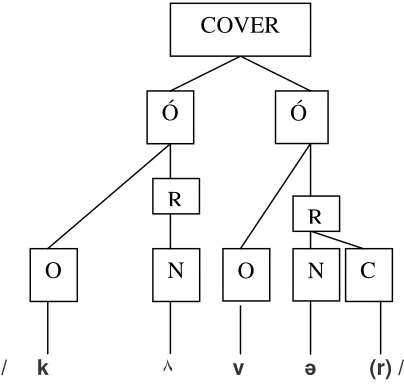
The general structure of a syllable consists of onset and rhyme. Onset is obligatory in some languages, optional or even restricted in others. Rhyme consist of nucleus which is obligatory in all languages and Coda which is optional in some languages, highly restricted or prohibited in others.
[image:44.595.288.490.294.489.2]/ k ٨ v ə (r) / Figure 6.1 syllable structure
Tree representation of a CVC syllable
In some theories of phonology, these syllable structures are displayed as tree diagrams (similar to the trees found in some types of syntax). The syllable nucleus is typically a sonorant, usually making a vowel sound, in the form of a monophthongs, diphthong, or triphthong, but sometimes sonorant consonants like [l] or [r]. The syllable onset is the sound or sounds occurring before the nucleus, and the syllable
coda (literally 'tail') is the sound or sounds that follow the nucleus. The term rhyme
covers the nucleus plus coda. In the one-syllable English word cat, the nucleus is a,
O N O N C
R R
Ó Ó
the onset c, the coda t, and the rhyme at. This syllable can be abstracted as a
consonant-vowel-consonant syllable, abbreviated CVC.
Syllable and Stress
Syllable structure often interacts with stress. In Latin, for example, stress is
regularly determined by syllable weight. A syllable counts as heavy if it has a long
vowel in its nucleus, or a diphthong in its nucleus, or one or more coda(e). Although English does not have tones, it possesses important non-segmental features – characteristics whit exist alongside the phonemes. In particular, each word and group of words has in its own rhythm, an interplay of stressed and unstressed syllables.
Happy happiness unhappiness
* * * * * * * * * * * * * * * * * *
*
In the words above, the most stressed syllable have the most stars, and the
least stressed the smallest number of stars. The actual quantity of stress given to a
syllable does not matter very much. The important point is the relative amount given to each. In happiness, for example, it is essential to give the greatest amount of
stress to hap-, and the least to-pi-
Feature
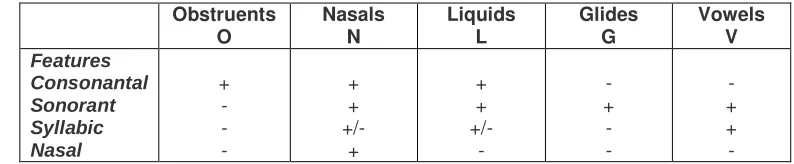
The non nasal stop, and the fricatives form a major class of sound. Because the air stream can not escape through the nose, it is either full obstructed in its passage through the vocal tract, as in non nasal stop and affricates, or partially obstructed production of fricatives. These sounds are called obstruents and are distinguished from the other major class of sound, which are called sonorants.
[image:46.595.118.515.265.347.2]Feature specification of major natural classes of sound is represented as follows. Obstruents O Nasals N Liquids L Glides G Vowels V Features Consonantal Sonorant Syllabic Nasal + - - - + + +/- + + + +/- - - + - - - + + -
Figure 6.2 Features of major natural classes of sound
Questions:
1. What do you know by the term phoneme?
2. What is a minimal pair? Suggest at least ten examples of minimal pairs in English.
3. What is an allophone? Give examples. 4. What are distinctive features?
Morphology
This chapter looks at the problems encountered in identifying and defining the notion ‘word’. It then discusses the identification and description of morphemes. Finally, it looks at <