Thermal postharvest treatments for improving pomegranate
quality and shelf life
Francisco Arte´s *, Juan A. Tudela, Raquel Villaescusa
Posthar6est and Refrigeration Laboratory,Food Science and Technology Department,CEBAS-CSIC,P.O.Box4195,
Murcia E-30080,Spain
Received 17 May 1999; accepted 17 December 1999
Abstract
Sweet pomegranates (Punica granatumL. cv Mollar de Elche) were cold-stored for 90 days. Curing at 33°C and 95% RH for 3 days before continuous storage at 2 or 5°C and 95% RH was tested for reducing chilling injuries. Alternatively, cycles of intermittent warming (IW) of 1 day at 20°C every 6 days at 2 or 5°C were tested. Control fruits were conventionally stored at 2 or 5°C and 95% RH, and a shelf life of 6 days at 15°C and 75% RH was included in the trials. At the end of the storage and shelf life periods, IW fruits showed the highest anthocyanin concentrations and titratable acidity, and the best visual appearance. After shelf life, IW during 2°C storage was the only treatment that resulted in fruit with flavor similar to that at harvest. Main losses were due to decay (Penicillium
spp.) in treatments at 5°C, with the least loss being in the IW2°C treatment. Chilling injuries (pitting and husk scald) were strongly reduced by curing at 2°C but only after cold storage. The lowest chilling injuries were found in the IW treatments. Severity of husk scald development was not directly related to low storage temperature. IW during 2°C storage has proved to be the best treatment for minimizing chilling injuries and maintaining pomegranate fruit quality. © 2000 Elsevier Science B.V. All rights reserved.
Keywords:Pomegranate (Punica granatumL.); Curing; Intermittent warming; Quality attributes; Husk scald; Pitting; Weight loss; Fungal attacks
www.elsevier.com/locate/postharvbio
1. Introduction
Pomegranates (Punica granatumL.) are widely grown in many tropical and subtropical countries, especially in the moderate climate of the Mediter-ranean region (Salaheddin and Kader, 1984). This
fruit has an extended harvest period (between September and November in Spain). Studies on cold storage of pomegranate have received little attention, although refrigeration is the only method for extending its shelf life for up to 3 months (Arte´s, 1992; Arte´s et al., 1998a).
When stored for more than 2 months at a temperature below 5°C, pomegranates are suscep-tible to chilling injuries (CI) (Elyatem and Kader, 1984; Arte´s, 1992). The most common symptoms
* Corresponding author. Tel.:+34-968-215717; fax:+ 34-968-266613.
E-mail address:[email protected] (F. Arte´s)
of CI in pomegranates are surface pitting, brown discoloration of the skin, husk scald, pale color of the arils, brown discoloration of the white seg-ments separating the arils, and a higher sensitivity to fungal development (Elyatem and Kader, 1984; Kader et al., 1984; Kader, 1985; Hardenburg et al., 1986; Arte´s, 1992). Heat treatments have been shown to reduce sensitivity to low temperature damage in many fruits (Arte´s, 1995; Lurie, 1998), and intermittent warming (IW) has also proved to be effective in lemons (Arte´s et al., 1993), grape-fruit (Martı´nez et al., 1987), oranges (Arte´s et al., 1998b), peaches (Ferna´ndez-Trujillo and Arte´s, 1998), nectarines (Lill, 1985) and tomatoes (Arte´s and Escriche, 1994). To reduce CI in pomegranates, IW cycles of 1 day at 20°C every 6 days at 0 or 5°C have been successfully applied, although CI development at 0°C was not com-pletely inhibited (Arte´s et al., 1998a). Pre-treat-ments at moderate temperatures (15 – 25°C) for 2 – 4 days as conditioning or curing treatments, are also effective methods of reducing CI in sev-eral fruits (Arte´s, 1995), but this has not been reported for pomegranates. In addition, little is known on changes in pigments, chemical quality attributes and sensory quality of pomegranate under thermal treatments.
The aim of the present work was to study the efficacy of IW and curing in reducing CI and the subsequent effects on changes in pigmentation and keeping quality of sweet pomegranate fruits.
2. Materials and methods
2.1. Fruit characteristics and handling
Sweet pomegranates (P.granatumL. cv Mollar de Elche) were harvested on 9 October in a com-mercial orchard in Elche (Alicante), on the Med-iterranean coast of Spain. Fruits were transported about 60 km by ventilated car to the laboratory at Murcia, where those with defects (sunburns, cracks, cuts and bruises in the husk) were dis-carded. Sound fruits were kept at 5°C and 95% RH. The following day fruit of uniform size (axial diameter 8694 mm; longitudinal diameter 949 10 mm, weight 338938 g; mean9S.D.;n=10),
external color and appearance were chosen at random.
2.2. Posthar6est treatments
Neither washing nor postharvest chemical treat-ments were applied. Pomegranates were packed in plastic boxes in single layers and placed in stain-less steel gas-tight chambers of 150 l equipped with a renewal-humidification system with an air-flow of 60 l h−1
and RH about 95% (Arte´s and Escriche, 1994). These chambers were kept in cold rooms at 2 or 5°C for 12 weeks. The temperature of 2°C was selected to induce CI, and 5°C as a theoretically safe temperature.
Samples of eight fruits per treatment were eval-uated for physical and chemical attributes at har-vest and at the end of both storage and shelf life periods (six additional days at 15°C and 75% RH, to simulate a reasonable retail sale period). IW cycles of 1 day at 20°C every 6 days of storage at 2 or 5°C (IW2°C and IW5°C, respectively) were studied. Warming cycles were applied by remov-ing the correspondremov-ing boxes from the cold room to another room at 2091°C and 95% RH to reach 20°C in the husk of the pomegranates (Arte´s and Escriche, 1994). After 1 day of warm-ing, the fruits were returned to 2 or 5°C. A curing treatment of 3 days at 33°C was applied before starting the continuous storage at 2 or 5°C. Con-trol fruits were conventionally stored at 2 or 5°C.
2.3. Fruit characteristics
2.4. Loss e6aluation
Decay was considered as loss whatever the level of damage. CI (pitting and husk-scald) were de-termined for each fruit, and scored on the follow-ing scale: 0, none; 1, slight; 2, moderate and 3, severe. Slight to moderate injuries corresponded to the presence of pitted areas of less than 5-mm diameter which only seldom occurred. Severe in-juries were those where fruits showed numerous dark areas of pitting of more than 5-mm diameter on their surface. Moderate and severe injuries were considered commercially unacceptable. An index of severity of CI on the skin was calculated by multiplying the scores of severity by the num-ber of fruits affected and dividing the result by the number of total fruits, according to Cohen et al. (1994) and Arte´s et al. (1998a).
2.5. Juice characteristics
Pomegranates were hand-peeled and the arils weighed. The arils were then homogenized in a commercial turmix blender (Moulinex, Barcelona), and the juice analysed for soluble solids content (SSC), titratable acidity (TA) and pH. SSC was measured with an Atago N1 (Tokyo, Japan) hand refractometer (reading at 20°C). A Crison Model 501 digital pH meter was used, and TA was determined by titrating 10 ml of juice with 0.1 M NaOH to pH 8.1.
2.6. Anthocyanin analysis
The juice sample was centrifuged (15 min at 10 000 rpm), filtered through a 0.45-mm filter and
stored at −20°C until analysis. HPLC analysis was performed with a Merck-Hitachi L-4200 de-tector and AS-2000 autosampler (Darmstadt, Germany) using a Li-Chrochart 100 RP-18 column (12.5 cm×0.4 cm; 5 mm particle size).
The mobile phase was 5% formic acid (A) and methanol (B) in a linear gradient starting with 15% B to reach 35% B at 15 min then isocratic until 20 min. The flow rate was 1 ml min−1 and
detection was at 520 nm.
The different anthocyanins were identified and quantified according to Gil et al. (1995). Cyanidin
3-rutinoside (Apin Chemicals, UK) was used as the external standard. Total anthocyanins were calculated by adding together the amounts of the six individual anthocyanins detected in each chromatogram.
2.7. Sensory analysis
Visual appearance and flavor were evaluated by five trained people at harvest and after both stor-age and shelf life periods. Evaluation was scored on a 10-point scale (0, very bad; 5, acceptable for commercial purposes; and 9, excellent).
2.8. Experimental design
The experimental design was completely ran-domized. Groups of four replicates of seven fruits per treatment for the cold storage period, and groups of three replicates of five fruits per treat-ment for the shelf life period were used. Analysis of variance (P=0.05) and the LSD Multiple Range Test were applied when appropriate.
3. Results and discussion
3.1. Changes in chemical quality attributes
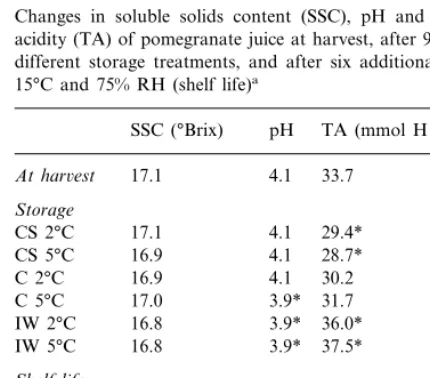
A slight, but not significant decrease in SSC was found after cold storage in almost all treat-ments (Table 1) in agreement with Kader et al. (1984). After shelf life, storage at 2 and 5°C with prior curing resulted in SSC values higher than those obtained at harvest. At the end of the cold storage there was a decrease in pH in fruit from curing 5°C and IW treatments. After shelf life, fruit in the cured 2°C and IW2°C treatments had higher pH values than those at harvest. Only the IW5°C treatment resulted in a decrease in pH at the end of this last period.
parame-ters confirm our previous results with conven-tional and IW storage at 0 or 5°C of ‘Mollar’ fruit (Gil et al., 1996; Arte´s et al., 1998a).
3.2. Changes in pomegranate color
Values of L*, C* and H° parameters were higher in the skin than in the arils, as previously reported (Arte´s et al., 1996, 1998a). Skin color did not change during storage or after shelf life, and was generally unaffected by treatment. The trend of the skin color to become yellowish after shelf life, which was observed previously (Arte´s et al., 1998a), was not confirmed in the present experi-ment. However, slight or negligible changes inC* and H° values after both storage and shelf life confirmed our previous results with ‘Mollar’ fruit (Arte´s et al., 1998a).
3.3. Changes in pomegranate juice pigmentation
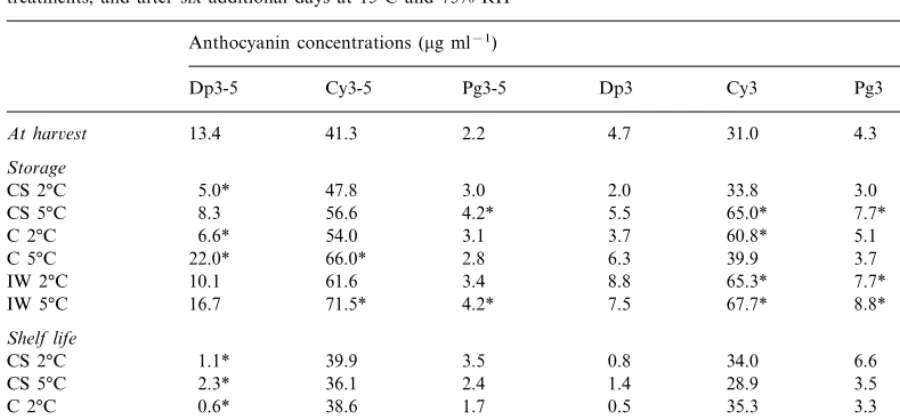
No relevant changes in anthocyanin concentra-tions were found with the different treatments (Table 2). Only some increases in total an-thocyanin content were detected in IW and 5°C control fruit after the cold storage period, due mainly to Cy and Pg 3 contents. After shelf life, no differences were observed between values mea-sured at the end of shelf life and those at harvest in any treatments, although all treatments showed a decrease in the total anthocyanin concentra-tions. These results correspond to slight or negli-gible changes in aril color as measured by the Minolta color-difference meter.
3.4. Sensory analysis
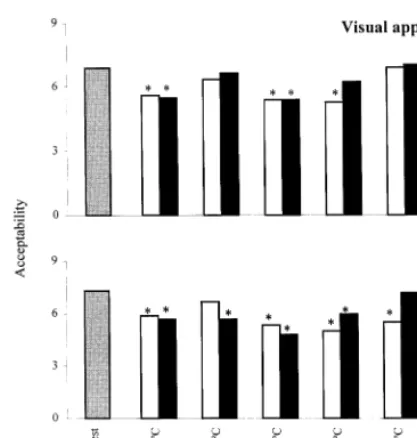
After cold storage, the visual appearance of pomegranate arils was less acceptable in the con-ventionally stored fruit at 2°C, and in the cured fruit (Fig. 1). The best results were obtained in IW5°C fruit, with a score similar to that assigned at harvest, confirming our recent results with other warming cycles on pomegranate (Arte´s et al., 1998a) and tomato (Arte´s et al., 1998c). The second best treatment was conventionally stored fruit at 5°C. After shelf life, only curing 5°C showed an increase in visual appearance. Visual appearance acceptable for commercial purposes was recorded in all treatments after both periods. All treatments, except conventionally stored fruits at 5°C lost flavor after cold storage (Fig. 2). Curing with 5°C storage was the treatment that showed the lowest flavor at the end of cold stor-age. At the end of shelf life, fruits from the IW2°C treatment were the only ones that retained the same values as those at harvest. Only the cured fruit at 2°C had unacceptable flavor after shelf life.
3.5. Weight losses, fungal attack and chilling injuries
Higher weight losses (Table 3) after cold stor-age occurred in fruit stored at higher temperatures (IW and curing treatments). However, no symp-toms of shriveling were observed after either cold
Table 1
Changes in soluble solids content (SSC), pH and titratable acidity (TA) of pomegranate juice at harvest, after 90 days of different storage treatments, and after six additional days at 15°C and 75% RH (shelf life)a
aCS, conventional cold storage; C, curing; IW, intermittent
warming.
Table 2
Changes in individual and total anthocyanin concentrations of pomegranate juice at harvest, after 90 days of different storage treatments, and after six additional days at 15°C and 75% RHa
Anthocyanin concentrations (mg ml−1)
Cy3-5 Pg3-5 Dp3 Cy3
Dp3-5 Pg3 Total
41.3 2.2 4.7
At har6est 13.4 31.0 4.3 97.0
Storage
47.8 3.0
CS 2°C 5.0* 2.0 33.8 3.0 94.6
56.6 4.2* 5.5
8.3 65.0*
CS 5°C 7.7* 147.3*
6.6*
C 2°C 54.0 3.1 3.7 60.8* 5.1 133.3
66.0* 2.8 6.3 39.9
C 5°C 22.0* 3.7 140.7
61.6 3.4 8.8
10.1 65.3*
IW 2°C 7.7* 156.9*
16.7
IW 5°C 71.5* 4.2* 7.5 67.7* 8.8* 176.4*
Shelf life
39.9 3.5 0.8
1.1* 34.0
CS 2°C 6.6 85.9
2.3*
CS 5°C 36.1 2.4 1.4 28.9 3.5 74.6
38.6 1.7 0.5
C 2°C 0.6* 35.3 3.3 80.0
36.8 2.1 10.7
2.2* 19.4
C 5°C 1.9 73.1
17.4
IW 2°C 44.8 1.6 8.3 44.6 4.2 120.9
64.3* 2.6 4.6 52.8 4.6 140.9
IW 5°C 12.0
aDp3-5, delphinidin 3,5-diglucoside; Cy3-5, cyanidin 3,5-diglucoside; Pg3-5, pelargonidin 3,5-diglucoside; Dp3, delphinidin
3-glucoside; Cy3, cyanidin 3-glucoside; Pg3, pelargonidin 3-glucoside. For other abbreviations, see Table 1. Values are means of triplicate analysis,n=6.
* Significant differences between at harvest and treatment values (P=0.05).
storage or shelf life periods. The lowest weight losses were found in control fruit. A notable increase in weight loss after shelf life was found in all treatments, the highest one being observed in the cured 5°C fruit. These results are better than those previously reported (Arte´s et al., 1998a), where weight loss after shelf life reached 9% in IW5°C fruit. This was probably due to a higher RH during shelf life (75 vs. 70%), and a lower shelf life duration (6 vs. 7 days) in the current experiment.
After 12 weeks of storage, decay (due toPeni -cilliunspp.) only appeared in conventional storage in 5°C and IW5°C fruits. After shelf life, some fruit from all treatments decayed (Table 3). As expected, fruits stored at the lower temperature (2°C) suffered less fungal attacks. After shelf life, the lowest fungal attacks were found in IW and conventional storage at 2°C (about 3%).
The CI symptoms were mainly pitting and husk-scald, confirming previous reports (Kader et al., 1984; Ben-Arie and Or, 1986; Arte´s, 1992;
Arte´s et al., 1996, 1998a). After cold storage and shelf life, IW resulted in reduced pitting and husk scald development (Fig. 2) in agreement with our previous results with ‘Mollar’ fruit (Arte´s et al., 1998a). Injured IW fruits after cold storage and shelf life were not considered as losses because they were still marketable.
After shelf life, an increase in pitting and husk scald was observed in all treatments. Our results suggest that severity of this physiological disorder is not directly related to the low temperature since the CI was higher at 5 than at 2°C. The higher development of husk scald at higher temperature, probably due to an increase in PPO activity, was in agreement with results reported by Ben-Arie and Or (1986) with ‘Wonderful’ fruit.
4. Conclusion
he-Fig. 1. Changes in visual appearance and flavor of pomegranate arils at harvest, after 90 days of different storage treatments, and after six additional days at 15°C and 75% RH. Score: 0, very bad; 5, acceptable; 9, excellent. CS, conventional cold storage; C, curing; IW, intermittent warming. Asterisks denote significant differences between at harvest and treatment values (P=0.05).
Table 3
Weight loss (expressed as percentage of initial fresh weight) and decay of pomegranates after 90 days of different storage treatments, and after six additional days at 15°C and 75% RHa
Treatments Weight loss (%) Decay (%)
Storage
CS 2°C 0.14cd 0.0b
CS 5°C 0.12d 12.3a
0.0b
C 2°C 0.38b
0.0b 0.33bc
C 5°C
IW 2°C 0.98a 0.0b
0.90a 3.1b
IW 5°C
Shelf life
CS 2°C 1.34b 3.1c
CS 5°C 1.15b 11.7ab
8.7b
C 2°C 1.38b
C 5°C 3.91a 28.7a
2.7c
IW 2°C 1.91b
19.6ab 1.95b
IW 5°C
aValues are means of four replicates (n=7). For
abbrevia-tions see Table 1. For each period, means in a column followed by the same letter were not different (P=0.05).
maintaining pomegranate quality and shelf life for up to 13 weeks were obtained with the IW2°C treatment.
donic test (particularly the best flavor after shelf life), the high total anthocyanin concentrations and the lowest total losses, the best results for
Acknowledgements
The authors are grateful to Fundacio´n Se´neca de la Regio´n de Murcia for financial support and to J. Pastor, manager of Agrudeco S.A., for providing the pomegranates.
References
Arte´s, F., 1992. Factores de calidad y conservacio´n frigorı´fica de la granada. In: II Jornadas Nacionales del Granado, Octubre 1984. Univ. Polite´cnica de Valencia, Valencia. Arte´s, F., 1995. Innovaciones en los tratamientos fı´sicos
mod-ulados para preservar la calidad hortofrutı´cola en la postrecoleccio´n. I. Pretratamientos te´rmicos. Rev. Esp. Cienc. Tecnol. Alim. 35, 45 – 64.
Arte´s, F., Escriche, A.J., 1994. Intermittent warming reduces CI and decay of tomato fruit. J. Food Sci. 59, 1053 – 1056. Arte´s, F., Escriche, A.J., Marı´n, J.G., 1993. Treating Pri-mofiori lemon in cold storage with intermittent warming and carbon dioxide. HortScience 28, 819 – 821.
Arte´s, F., Marı´n, J.G., Martı´nez, J.A., 1996. Controlled atmo-sphere storage of pomegranate. Z. Lebensm. Unters. Forsch. 203, 33 – 37.
Arte´s, F., Tudela, J.A., Gil, M.I., 1998a. Improving the keep-ing quality of pomegranate fruit by intermittent warmkeep-ing. Z. Lebensm. Unters. Forsch. A 207, 316 – 321.
Arte´s, F., Vela´zquez, P., Marı´n, J.G., 1998b. Reduction of decay and chilling injuries in cold stored oranges. In: Bertolini, P., Sijmons, P.C., Guerzoni, M.E., Serra, F. (Eds.), COST 914-915 Proc.: Non Conventional Methods for the Control of Postharvest Disease and Microbiological Spoilage. Bologna, pp. 243 – 248.
Arte´s, F., Garcı´a, F., Marquina, J., Cano, A., Ferna´ndez-Tru-jillo, J.P., 1998c. Physiological responses of tomato fruit to cyclic intermittent temperature regimes. Postharvest Biol. Technol. 14, 283 – 296.
Ben-Arie, R., Or, E., 1986. The development and control of
husk scald on ‘Wonderful’ pomegranate fruit during stor-age. J. Am. Soc. Hortic. Sci. 111, 395 – 399.
Cohen, E., Shapiro, B., Shalom, Y., Klein, J.D., 1994. Water loss: a nondestructive indicator of enhanced cell membrane permeability of chilling-injured Citrus fruit. J. Am. Soc. Hortic. Sci. 119, 983 – 986.
Elyatem, S.M., Kader, A.A., 1984. Post-harvest physiology and storage behaviour of pomegranate fruits. Scientia Hor-tic. 24, 287 – 298.
Ferna´ndez-Trujillo, J.P., Arte´s, F., 1998. Chilling injuries in peaches during conventional and intermittent warming storage. Int. J. Refrig. 21, 265 – 272.
Gil, M.I., Garcı´a-Viguera, C., Arte´s, F., Toma´s-Barbera´n, F.A., 1995. Changes in pomegranate juice pigmentation during ripening. J. Sci. Food Agric. 68, 77 – 81.
Gil, M.I., Sa´nchez, R., Marı´n, J.G., Arte´s, F., 1996. Quality changes in pomegranate during ripening and cold storage. Z. Lebensm. Unters. Forsch. 202, 481 – 485.
Hardenburg, R.E., Watada, A.E., Wang, C.Y., 1986. The commercial storage of fruits, vegetables, and florist and nursery stocks, U.S. Department of Agriculture, Agricul-ture Handbook No. 66, 130 pp.
Kader, A.A., 1985. Postharvest biology and technology: an overview. In: Postharvest Technology of Horticultural Crops. Cooperative Extension University of California, pp. 50 – 70.
Kader, A.A., Chordas, A., Elyatem, S., 1984. Responses of pomegranates to ethylene treatment and storage tempera-ture. California Agriculture, July – August, pp. 14 – 15. Lill, R.E., 1985. Alleviation of internal breakdown of
nec-tarines during cold storage by intermittent warming. Scien-tia Hortic. 25, 241 – 246.
Little, A.C., 1975. Off on a tangent. A research note. J. Food Sci. 40, 410 – 411.
Lurie, S., 1998. Postharvest heat treatments. Postharvest Biol. Technol. 14, 257 – 269.
Martı´nez, J.M., Mateos, M., Cuquerella, J., Navarro, P., 1987. Improving life of citrus fruits by temperature management. XVIIth Int. Congr. Refrig. 3, 321 – 326.
Salaheddin, M.E., Kader, A.A., 1984. Post-harvest physiology and storage behaviour of pomegranate fruits. Scientia Hor-tic. 24, 287 – 298.