World Health House Indraprastha Estate, Mahatma Gandhi Marg, New Delhi-110002, India
Website: www.searo.who.int SEA-TB-345
Updated Regional Strategic Plan
for TB Care and Control
2012–2015
This update of the Regional Strategic Plan for TB care and control 2006-2015 describes the future directions and focus of work for TB control in the WHO South-East Asia Region. The targets, strategies and interventions in this document are consistent with the Stop TB Strategy and the Global Plan to Stop TB 2011-2015, but focus on priorities most relevant to the Region.
SEA-TB-345 Distribuion: General
Updated Regional Strategic Plan
for TB Care and Control
© World Health Organizaion 2012 All rights reserved.
Requests for publicaions, or for permission to reproduce or translate WHO publicaions – whether for sale or for noncommercial distribuion – can be obtained from Publishing and Sales, World Health Organizaion, Regional Oice for South- East Asia, Indraprastha Estate, Mahatma Gandhi Marg, New Delhi 110 002, India (fax: +91 11 23370197; e-mail: [email protected]).
The designaions employed and the presentaion of the material in this publicaion do not imply the expression of any opinion whatsoever on the part of the World Health Organizaion concerning the legal status of any country, territory, city or area or of its authoriies, or concerning the delimitaion of its froniers or boundaries. Doted lines on maps represent approximate border lines for which there may not yet be full agreement.
The menion of speciic companies or of certain manufacturers’ products does not imply that they are endorsed or recommended by the World Health Organizaion in preference to others of a similar nature that are not menioned. Errors and omissions excepted, the names of proprietary products are disinguished by iniial capital leters.
All reasonable precauions have been taken by the World Health Organizaion to verify the informaion contained in this publicaion. However, the published material is being distributed without warranty of any kind, either expressed or implied. The responsibility for the interpretaion and use of the material lies with the reader. In no event shall the World Health Organizaion be liable for damages arising from its use.
Contents
Abbreviaions ... v
Preface ... vii 1. Why there is a need to update the Regional Strategic Plan to Stop TB ...1
2. Introducion ...3
3. Current situaion ...7
3.1 Global targets and the Stop TB strategy ... 7
3.2 Progress towards TB control – the global perspecive ... 10
3.3 Progress towards TB control – current situaion in the SEA Region ... 14 4. Challenges and opportuniies ...21
4.1 Inefecive and delayed diagnosis of persons with TB, including children ... 21
4.2 Slow progress in scaling up programmaic management of drug-resistant TB ... 23 4.3 Slow progress in scaling up TB–HIV collaboraive aciviies ... 25 4.4 Inadequate laboratory capacity ... 26 4.5 Weak health systems and limited programme management capacity .... 27
5. Guiding principles ...33
5.1 TB control as part of health system strengthening, based on primary health care principles...33
5.2 Fostering partnerships at all levels ...34
7.3 Scale up TB-HIV collaboraive aciviies ...48 7.4 Strengthen laboratory capacity ...50 7.5 Contribute to health system strengthening ...53
8 Targets and indicators ...62
9 Cost of planned TB control aciviies in the
Region: 2012–2015 ...66
10 Conclusions ...68
Annex 1: Resoluion of the Regional Commitee for
South-East Asia ...69
Annex 2: Esimated incidence and cases noiied
in Member States of the WHO SEA Region, 2010 ...72
Abbreviaions
ACSM advocacy, communicaion and social mobilizaion AFB acid-fast bacilli
AIDS acquired immunodeiciency syndrome ART aniretroviral therapy
ARV aniretrovirals BCE Before Common Era
CPT co-trimoxazole prevenive therapy DOT directly observed therapy
DOTS the internaionally recommended strategy for TB control and the foundaion of the Stop TB Strategy introduced in 2006
DRS drug resistance surveillance DR-TB drug-resistant tuberculosis DST drug suscepibility tesing EQA external quality assurance FDC ixed-dose combinaion FLD irst-line ani TB drugs GDF Global (TB) Drug Facility
GF Global Fund to Fight AIDS, Tuberculosis and Malaria HBC high burden (TB) country
HRD human resource development HRH human resources for health HSS health system strengthening IC infecion control
IPT isoniazid prevenive therapy IQC internal quality control
PAL pracical approach to lung health
PMDT programmaic management of drug-resistant tuberculosis PPM public–private mix
SCC short course chemotherapy SEA South-East Asia
SEAR South-East Asia Region (of WHO) SLD second-line ani TB drugs TB tuberculosis
Preface
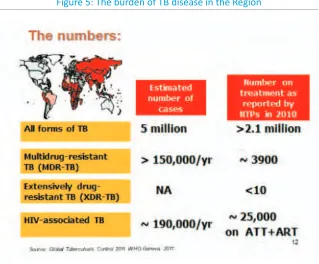
Substanial progress coninuous to be made by the Member States of the WHO South-East Region (SEAR) in combaing tuberculosis (TB). However, the Region sill bears more than one third of the global burden of tuberculosis. It has a pool of nearly 5 million cases to which more than 3 million are added each year. This is despite a more than 25% decrease in prevalence rate since 1990.
The mortality rate among TB paients has decreased by more than 44% during the same period. However, the absolute number of TB deaths is sill close to half a million. This is mainly because of the populaion momentum. With good performance in the implementaion of DOTS the level of muli-drug-resistant (MDR) TB among newly detected cases is low. Nonetheless, due to the large number of the total TB cases, the Region accounts for an esimated 105 000 MDR-TB cases. This is nearly one third of the world’s esimate.
HIV–TB coinfecion is a serious problem in the SEA Region. Naional TB Control and Naional AIDS Control programmes in most countries in the Region are jointly implemening a comprehensive package of intervenions against this problem. This is helping them cover an esimated 600 million people.
The long-term goal of TB control is to eliminate the disease as a public health problem. With this perspecive in view, increased and coninued commitment is needed from all stakeholders and partners. In the process of implemening the control programmes with external inputs, special atenion should be paid to country capacity strengthening in order to achieve long-term, sustainable self-reliance. In this context, we need to recognize that improvement in the overall social and economic development of a country will contribute importantly in its long-term, sustained success in TB eliminaion or eradicaion. A comprehensive and holisic package of intervenions for TB control must involve mulispectral and mulidisciplinary eforts.
This Updated Regional Strategic Plan for TB Care and Control: 2012–2015
aims to support Member States in their coninued eforts to reach the TB-related Millennium Development Goals; making universal access to quality TB prevenions, care and control services a reality to all persons living in the Member States of the South-East Asia Region.
1
Why there is a need to
update the Regional
Strategic Plan to Stop TB
The launching of the Regional Strategic Plan to Control Tuberculosis (TB) 2006–2015 marked the transiion from the DOTS strategy to the Stop TB Strategy as the regionally accepted strategy to control TB. This was reconirmed by the WHO Regional Commitee for South-East Asia held in 2007, which urged the Member States to “fully implement the naional plans for
TB control, in line with the New Stop TB Strategy
revising the scope of the scale-up of intervenions needed to reach the 2015 targets;
policy changes related to HIV and ART and recognizing the
development of the Regional Health Sector Strategy on HIV 2011-2015 (SEA-AIDS-187);
the development of the South-East Asia (SEA) Regional Response
Plan for Drug-resistant TB Care and Control 2011-2015;
the need to give a higher proile for laboratory strengthening and
progress in diagnosics, in paricular the substanial progress in development of new diagnosics made since 2005;
the need to relect revised epidemiological projecions including the
update of the burden of TB among people living with HIV in 2008 and an update of the burden of MDR-TB in 2010;
the need to relect the increased importance of TB in children;
and
the need to put addiional emphasis on early and intensiied case
noiicaion.
Tuberculosis has been present in humans since antiquity. Skeletal remains show prehistoric humans had TB, and researchers have found tubercular decay in the spines of Egyptian mummies dating from 3000 to 2400 BCE*. “Phthisis” is a Greek term for consumpion; around 460 BCE, Hippocrates ideniied phthisis as the most widespread disease of the imes. It was said to involve fever and the coughing up of blood, which was almost always fatal.
In 1991, the Forty-fourth World Health Assembly recognized the growing importance of TB and the potenial for cost-efecive control
Introducion
Two years later, in April 1993, recognizing that TB is one of the most neglected global health crises and that the TB epidemic is out of control in many parts of the world, TB was declared by WHO to be a global emergency.1
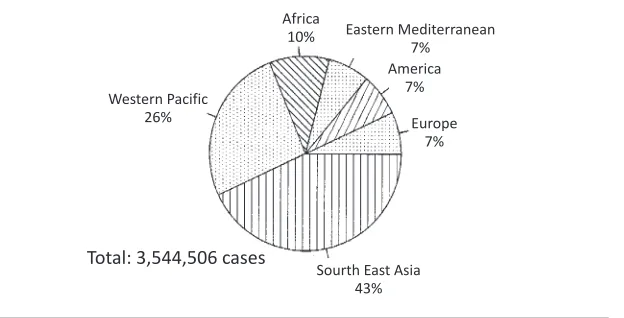
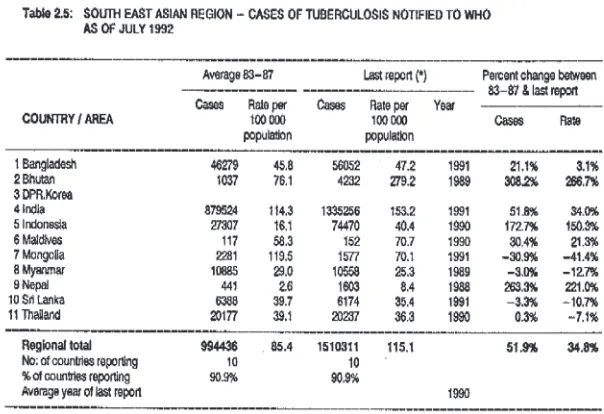
In the Tuberculosis Noiicaion Update,the Tuberculosis Programme, Division of Communicable Diseases; World Health Organizaion (WHO), Geneva, published data in July 1992 showing that the WHO South-East Asia Region had noiied 43% of the global total noiied cases. Country-by- country data from the Region showed that 994 436 cases of TB were noiied, of which 88% were noiied in India (Figure 1a and 1b).
Much progress has been made in the SEA Region since. However, too many people sill have undetected TB for too long; late detecion of TB increases their risk of transmiing the disease to others, having poor health outcomes, or that they and their family will sufer distress and economic hardship. TB remains a major cause of morbidity and mortality in many countries in the Region and a signiicant public health problem worldwide despite the availability of highly eicacious treatment for decades.
Achieving the goals and objecives of TB Control will require acions not only by and beyond TB control programmes, but also by and beyond the health sector. Where general health services are inadequate or absent, it is not possible to scale up even basic DOTS; TB programmes will not be able to scale up MDR-TB treatment without adequately equipped laboratories, competent health-work force, and without abolishing inancial barriers paients encounter in seeking services; if ani TB drugs coninue to be available over the counter and used irraionally by private providers, eforts of TB programmes to provide care based on internaional standards will have limited impact; if TB is not systemaically noiied and vital registraion systems remain weak, it will coninue to hamper naional and global TB surveillance. It is oten beyond the capacity of TB programmes alone to address these and other systemic issues.
This update of the Regional Strategic Plan for TB Care and Control 2012-2015 describes the future direcions and focus of work for TB control in the
South East-Asia Region (SEAR). The targets, strategies and intervenions in this document are consistent with the Stop TB Strategy and the Global
1 WHO Tuberculosis Programme: Framework for Effective Tuberculosis Control (WHO/
Plan to Stop TB 2011-2015,2however it focuses on focussing prioriies most relevant to SEAR. A range of intervenions are proposed. These are aimed at acceleraing progress in the context of evolving challenges, and the requirements of naional TB control programmes in efecively meeing the challenges. Developing these further will require lexibility and adaptaion to suit the varying country contexts, the TB burden and the speciic situaions in Member States in the Region. This document is intended for policy-makers, naional programme managers and their staf, members of technical advisory groups, inter-agency coordinaing commitees or similar bodies and all partners.. The South-East Asia Regional Response Plan for Drug-Resistant TB Care and Control 2011-2015 (SEA-TB-334) and the Regional Health Sector Strategy on HIV 2011-2015 (SEA-AIDS-187) should be seen as supporing and complemening documents, as are the Report of the Naional TB Control Programme Managers and Partners Meeing in Bangkok, Thailand, 6-9 December 2011 (SEA-TB-339) and the Report of the Fourth Meeing of the SEAR Technical Working Group on Tuberculosis (TWG-TB) 11-13 April 2012.
Figure 1a: Tuberculosis in SEAR 1990
Africa
10%
Eastern Mediterranean
7%
America
7%
Europe
7% Western Pacific
26%
Sourth East Asia
43%
Figure 1b: Tuberculosis in SEAR 1992
3.1 Global targets and the Stop TB
strategy
Recognizing the scale of the problem, global targets for reductions in the burden of TB disease (measured as incidence, prevalence and mortality) have been set within the context of the Millennium Development Goals (MDGs) and by the Stop TB Partnership (Box 1). The target
set within the MDGs is to halt and reverse the incidence of TB by 2015. In addiion, the MDGs include three
other
indicators for measurement of progress in TB control: prevalence and death rates, and the proportion of cases that areCurrent situaion
prevalence and death rates by 2015, compared with 1990 levels; and, looking further into the future, the target of eliminaing TB by 2050.
Box 1: Goals, targets and indicators for TB control: 2015 and 2050
TB MDG GOALS (set for 2015)
Goal 6: Combat HIV/AIDS, malaria and other diseases
Target 6c: Halt and begin to reverse the incidence of malaria and other major diseases
Indicator 6.9: Incidence, prevalence and death rates associated with TB Indicator 6.10: Proporion of TB cases detected and cured under DOTS
STOP TB Partnership targets (set for 2015 AND 2050)
By 2015: Reduce the prevalence and death rates by 50%, compared with their levels in 1990
By 2050: Eliminate TB as a public health problem, deined as the global incidence of acive TB of less than one case per 1 million populaion per year
In 2006, WHO launched the Stop TB Strategy (Box 2) as the
internaionally-recommended approach to reducing the burden of TB in line with global targets set for 2015. The goal of the strategy is deined as: “To dramaically reduce the global burden of TB by 2015 in line with the Millennium Development Goals and the Stop TB Partnership targets”. The Strategy has six major components (Box 2). The Stop TB Strategy was developed as a successor
to the DOTS strategy. The DOTS strategy is the basic package consising of ive elements (see Box 2, under the irst component) that underpins the Stop TB Strategy, and was the principal globally recommended approach to TB
control from the mid-1990s up to 2006.
Box 2: The Stop TB Strategy at a glance3
Vision A TB-free world
Goal To dramaically reduce the global burden of TB by 2015
in line with the Millennium Development Goals and the Stop TB Partnership targets
Objecives Achieve universal access to high-quality care for all people with TB
Reduce the human sufering and socioeconomic
burden associated with TB
Protect vulnerable populaions from TB, TB/HIV, and
drug-resistant TB
Support development of new tools and enable their
imely and efecive use
Protect and promote human rights in TB prevenion,
care and control
Targets MDG 6, Target 6.c: Halt and begin to reverse the
incidence of TB by 2015.
Targets linked to the MDGs and endorsed by the Stop
TB Partnership:
By 2015: reduce the TB prevalence and death rates •
by 50% relaive to 1990.
By 2050: eliminate TB as a public health problem •
(<1 case per million populaion).
Components
1. Pursue high-quality DOTS expansion and enhancement
Poliical commitment with increased and sustained inancing •
ensure early case detecion and diagnosis through quality-•
2. Address TB/HIV, MDR-TB, and other needs of poor and vulnerable populaions
Scale up collaboraive TB/HIV aciviies •
Scale up prevenion and management of MDR-TB •
Address the needs of TB contacts, and of poor and vulnerable •
populaions
3. Contribute to health system strengthening, based on primary health care
Help improve health policies, human resource development , •
inancing, supplies, service delivery and informaion
Strengthen infecion control in health services, other congregate •
seings and households
Update laboratory networks , and implement the Pracical •
Approach to Lung Health (PAL)
Adapt successful approaches form other ields and sectors and •
foster acion on the social determinants of health
4. Engage all care providers
Involve all public, voluntary, corporate and private providers •
through public-private mix (PPM) approaches
Promote the use of the Internaional Standards for Tuberculosis •
Care (ISTC)
5. Empower people with TB and communiies through partnerships Pursue advocacy, communicaion, and social mobilizaion •
Foster community paricipaion in TB care, prevenion and •
health promoion
Promote the use of the Paients’ Charter for Tuberculosis Care •
6. Enable and promote research
Conduct programme-based operaional research •
Advocate for and paricipate in research to develop new •
diagnosics, drugs and vaccines
3.2 Progress towards TB control – the global perspecive
100 000 populaion in 2010, ater peaking in 2002 at 141 cases per 100 000. The rate is falling but very slowly. The number of people who died from TB fell to 1.4 million in 2010, including 350 000 people with HIV, equal to 3 800 deaths a day. In 2009, 9.7 million children were orphaned by TB. It is among the three greatest causes of death among women aged 15-44, 320 000 women died from TB in 2010.
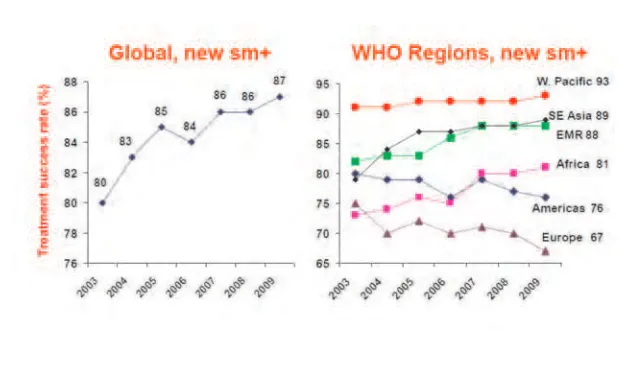
The TB death rate has fallen by 40% since 1990, and the number of deaths is also declining. In 2010, 5.7 million TB cases were noiied through TB DOTS programmes. Globally, the percentage of people successfully treated reac hed its highest level at 87% in 2009. Since 1995, 46 million people have been successfully treated and up to 6.8 million lives saved through DOTS and the Stop TB Strategy.
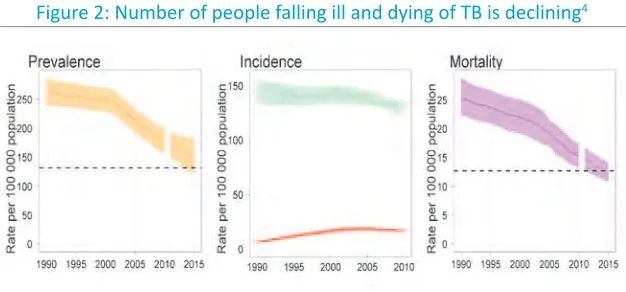
Figure 2: Number of people falling ill and dying of TB is declining4
Global trends in esimated incidence rate, including HIV-posiive (top) and esimated incidence rate of HIV-posiive (lower) TB.
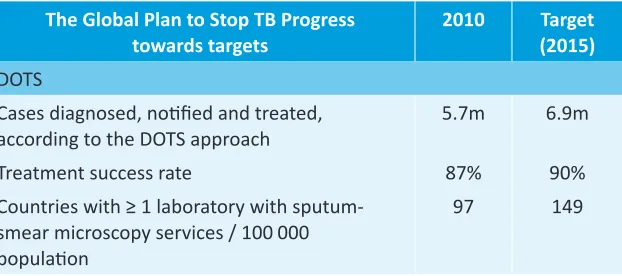
In 2010, 2.1 million TB paients knew their HIV status compared with 1.6 million in 2009, with the highest HIV tesing rates of TB paients in Europe (80%) and Africa (59%). In 68 countries, including 22 in Africa, at least 75% TB paients knew their HIV status. In 2010, 77% HIV-posiive TB paients who were started on co-trimoxazole prevenive treatment were enrolled on aniretrovirals (ARVs).. The progress made towards targets laid out in the Global Plan to Stop TB is illustrated in Table 1.
As of July 2011, 26 countries were using Xpert MTB/RIF, a rapid molecular test that accurately diagnoses TB and MDR-TB in 100 minutes. The test was endorsed by WHO in December 2010, with 145 countries eligible to purchase the kits at a concessional price.
In the areas of research and development, “point-of-care” tests are in the pipeline, 10 TB drugs in trials, and there are 10 vaccine candidates for the prevenion of TB in Phase I or Phase II trials.5
Worldwide, the share of domesic funding for TB provided by afected countries rose to 86%. But most low-income countries sill rely on external funding, with the Global Fund being the largest external donor. It provide 82% of internaional TB funding for 2012. Countries reported a US$ 1 billion TB funding gap for 2012 with donor funding at US$ 600 million. There was a US$ 200 million funding gap for MDR-TB in 2012 (Figure 3).
Table 1: Global progress towards targets
The Global Plan to Stop TB Progress towards targets
2010 Target (2015) DOTS
Cases diagnosed, noiied and treated,
according to the DOTS approach 5.7m 6.9m
Treatment success rate 87% 90%
Countries with ≥ 1 laboratory with sputum-smear microscopy services / 100 000 populaion
97 149
5 WHO Report 2011: Global Tuberculosis Control; World Health Organizaion, Geneva
The Global Plan to Stop TB Progress towards targets
2010 Target (2015) Drug-resistant TB
% of previously-treated TB paients tested for
MDR-TB 6% 100%
% of new bacteriologically-posiive paients
tested for MDR-TB 1.8% 20%
Countries among the 22 HBCs and 27 MDR-TB burden countries with ≥ 1 culture laboratory/5 million populaion
20 36
Conirmed cases of MDR-TB enrolled on
treatment 46 000 ~270 000
Treatment success rate among conirmed cases
of MDR-TB 53% ≥ 75%
TB / HIV
% of TB paients tested for HIV 34% 100%
% of HIV-posiive TB parients treated with CPT 77% 100% % of HIV-posiive TB paients treated with ART 46% 100% % of people living with HIV atending HIV care
services, screened for TB at their last visit 58% 100% % of people living with HIV atending HIV care
Figure 3: TB investment and funding gaps
3.3 Progress towards TB control – current situaion in the
SEA Region
are among the 22 countries with the highest burden of TB in the world and India alone accounts for more than 25% of the world’s incident cases.
However, countries in the SEA Region have made signiicant progress towards the TB-related MDGs. The esimated rates of incidence, prevalence and mortality of all forms of TB coninue to show a downward trend. Figure 6
shows trends in esimated TB prevalence, incidence and mortality rates from 1990 to 2010. Most countries in the Region have been observing an incremening or stabilizing trend of smear-posiive case noiicaions.
Figure 4: Esimated proporional contribuions of WHO Regions to global incidence of all forms of TB, 2010
Figure 5: The burden of TB disease in the Region
Figure 6: Trends in esimated TB prevalence, incidence and mortality rates from 1990 to 2010 in the SEA Region
Source: Global Tuberculosis Control: WHO report 2011, World Health Organizaion, Geneva 2011. WHO/HTM/TB/2011.16
Noiicaions coninue to rise, relecing case-inding eforts in Member States over ime, with a sharper increase in noiicaions of all forms of TB (especially from 2000 to 2008), possibly due to increasing registraion of smear-negaive and extra-pulmonary cases following the involvement of the private sector and medical teaching insituions (see also Figures 7, 8
Figure 7: Trends in TB cases noiied by type of case,
1993 1994 1995 1996 1997 1998 1999 2000 2001 2002 2003 2004 2005 2006 2007 2008 2009 2010
Year
All cases NSP
Sources: Tuberculosis control in the South-East Asia Region, Annual Reports 1996-2011, WHO/SEARO; Annual Reports, Naional TB programmes, SEAR Member States, 2011
Figure 8: Proporion of smear-posiive pulmonary TB (PTB), smear-negaive PTB and extra-pulmonary TB cases out of all new
noiied cases, Member States, SEA Region, 2010
New
The treatment success rate among new smear-positive cases has coninued to increase (Figure 9).
Figure 9: Treatment success rate
Source: Global Tuberculosis Control: WHO report 2011, World Health Organizaion, Geneva 2011. WHO/HTM/TB/2011.16
and geographical areas within individual countries. Regionally, the number of new infecions every year is showing a downward trend in four of the ive high HIV burden countries, namely India, Myanmar, Nepal and Thailand; in Indonesia, the HIV epidemic is sill on the rise (Figure 10).
Figure 10: Esimated number of new HIV infecions in the South-East Asia Region and in ive Member States in the Region, 1990-2010
Source: Spectrum model using surveillance data reported by naional AIDS programmes, Member States,, South-East Asia Region
Substanial progress has been made in countries of the SEA Region in implemening the Stop TB strategy towards achieving the TB-related MDG targets. However, there is a long road ahead to travel to eliminate TB in the Region as well as globally. The Region faces signiicant challenges; however there are also new opportuniies.
4.1 Inefecive and delayed
diagnosis of persons with TB,
including children
While the geographical/administraive DOTS coverage in the Region has been reported at
Challenges and
opportuniies
the esimated incident TB cases in the Region are either not detected or not noiied (Figure 11).
Figure 11: Case noiicaions by WHO region, 1990-2010
Source: Global Tuberculosis Control: WHO report 2011, World Health Organizaion, Geneva 2011. WHO/HTM/TB/2011.16
4.2 Slow progress in scaling up programmaic
management of drug- resistant TB
Despite commitments made at the ministerial meeing of high M/XDR-TB burden countries in Beijing, China in April 2009, that brought together high-level representaives from the 27 high MDR-TB burden countries, which collecively account for around 85% of the world’s cases of MDR-TB, the scale up of programmaic management of drug-resistant TB (PMDT) has been slow. In May 2009, the World Health Assembly resoluion WHA62.15 urged the Member States “to achieve universal access to diagnosis and treatment of mulidrug-resistant and extensively drug-resistant tuberculosis”. The World Health Assemby called on all countries to implement the measures needed to achieve universal access to diagnosis and treatment of MDR-TB by 2015, including strengthening of basic TB control, development of laboratory capacity for diagnosis, establishment of comprehensive paient management and care programmes, efecive collaboraion with HIV programmes, strengthening of health informaion and surveillance systems and acceleraion of research and development related to new tools for prevenion, diagnosis and treatment.
In the SEA Region relaively low levels of muli drug-resistance (1.7-2.5%) are reported among newly detected cases but higher rates (17%) among previously treated cases. However this translates into around a fourth or nearly 105 000 of the world’s MDR-TB cases esimated to occur annually in the Region. Extensively drug-resistant TB (XDR-TB) has also been reported from ive countries in the Region, making the situaion alarming.
Several overriding challenges are faced in the Region with regard to addressing the DR-TB issues:
The PMDT is at various stages of implementaion in Member States
A substanial amount of addiional resources is required to provide
adequate human resources and training to create a pool of skilled, moivated and available personnel, to provide quality infrastructure for diagnosis, paient management including adequate quality-assured, second-line ani TB medicines, and surveillance.
The costs of containment of the already exising MDR-TB are high—
each MDR-TB paient requires drugs that cost 100 imes more than drugs for drug-suscepible TB paients. Other costs that have to be borne by the system and paient are addiional. Poliical commitment is oten not suicient to ensure required resources.
There is insuicient involvement of professional socieies and their
members;
The capacity of naional pharmaceuical regulatory authoriies to
assure quality of irst-line ani-TB drugs (FLDs) and second-line ani TB drugs (SLDs) is limited.
Community based organizaions and civil society partners have not
yet been fully involved.
Muli center research in new treatment protocols for TB and MDR-TB
management is insuicient.
Figure 12: Esimates versus noiicaions for MDR-TB
4.3 Slow progress in scaling up TB-HIV collaboraive
aciviies
About three quarters of TB cases in the Region do not know their HIV status; only 23% of the 2 126 414 noiied TB paients have been tested for HIV; 9.5% of those tested were ideniied as HIV posiive; 87% of ideniied HIV-posiive TB paients were started on CPT while 57% were started on ART.6
imposed on the TB-and HIV-infected paients and the fear on part of health workers are sill prevalent.
A regional response plan for TB-HIV collaboraive aciviies is under development. It will offer new opportunities to address identified challenges.
4.4 Inadequate laboratory capacity
The current laboratory capacity in the Region remains inadequate to reach global and regional targets for the diagnosis of drug-resistant TB and HIV- associated TB. Although major progress had been made in 2010, three of the countries in the Region sill did not meet the target of 1 microscopy centre per 100 000 populaion. However, even in countries that meet the target, country-speciic condiions such as geographically challenging situaions mean that microscopy services are currently not available to all in need. Eight of the countries in the Region had less than the recommended capacity of 1 laboratory to perform culture and DST per 5 million populaion. All but one country have designated naional reference laboratories; however, only four countries have second-line DST available.
Earlier and improved detecion of TB cases and the expanded capacity to diagnose cases of MDR-TB are regional priorities, requiring new diagnosics tests, clear policies on which tests to use, and when not to use, and strengthened laboratories in which tests can be safely and efecively carried out. Following the WHO endorsement of the Xpert MTB/RIF assay in December 2010, six countries in the Region have started using the machines. However, several operaional challenges need to be addressed for successful implementaion of the test including revised diagnosic algorithms, deiniion of risk groups and levels for the health system in which the test should be used irst, and analysis of logisic consideraions to opimize the use and beneits of technology. The biggest challenge to countries however remains ensuring the availability of access to treatment services once MDR-TB disease has been diagnosed.
most countries. Such challenges include aciviies to overcome the current insuicient coordinaion at country level between NTPs and other government structures responsible for overall laboratory strengthening.
Table 2: Implementaion of WHO policy guidance for diagnosis in high-burden countries in SEAR, 2012
Convenional drug suscepibility tesing
(DST)
Liquid Culture and rapid
speciicaion test
Line-probe assay for
detecing resistance to
Rifampicin
Algorithm for the diagnosis
of TB in HIV-posiive people
Incorporated
(Bangladesh, India, Indonesia, Myanmar, Thailand)
Source: Global Tuberculosis Control: WHO report 2011, World Health Organizaion, Geneva 2011
4.5 Weak health systems and limited programme
management capacity
4.5.1 Weak health systems
burden of HIV/AIDS, DR-TB as well as non-communicable diseases. The rapid scaling-up of HIV, TB, malaria and immunizaion programmes has reinforced awareness of the well-known weaknesses in health systems and services (Box 3), that require new strategies and new funds in addiion to those
serving the urgent needs to address priority public health condiions. There is consensus that strengthening health systems is essenial if the health MDGs are to be achieved. The need to urgently address the weaknesses of the health system was also reiterated at the ministerial meeing of High M/ XDR-TB Burden Countries organized in Beijing in April 2009.7
Many challenges in health system strengthening are beyond the influence of TB control programmes alone. Challenges relate to fiscal issues for expanding resources for the health sector, building development, planning and budgetary frameworks that prioriize poverty reducion and development objecives, civil service structures, broad health sector reforms and decentralizaion policies.
An increasing number of countries in the Region are implemening various models of health sector reforms and decentralizaion policies to develop effective and equitable health services to achieve favourable health outcomes, including for TB. There are examples of strengthening of the regulatory framework with a number of laws and regulaions relevant for TB control. These reforms provide for an expanded network, as well as increased capacity for providing services closer to communiies. They also help to strengthen linkages with related programmes, and in the adaptaion of effective approaches used by various other health programmes. All this leads to greater sustainability in the longer term. It is criical that TB services are efecively posiioned and streamlined within basic health-care services during the process of health systems development to opimize both the implementaion of TB prevenion, care and control services and their contribuion to the strengthening of health services as a whole. Opportuniies are there for NTPs to join forces with other health-care programmes and stakeholders involved in health systems development to strengthen human resources, increase health inancing and improve health system management including funcioning referral, transfer and informaion-sharing mechanisms between various public and private health-care providers.
7 The Ministerial Meeing of High M/XDR-TB Burden Countries, 1-3 April 2009, Beijing, China
Box 3. Health system weaknesses with implicaions for TB control
Leadership and governance (stewardship)
Weak capacity for health policy analysis, priority-seing, sector
policy development and central health sector management. This may involve limitaions in the quanity of human resources for health, and their capacity, as well as limitaions related to planning, decision-making and management structures.
Poor coordinaion between diferent parts of ministries of health,
for example between diferent public health programmes (e.g. AIDS and TB), and/or between departments responsible for public health, curaive and diagnosic services, drug supply and other logisics, informaion systems, etc.
Poor coordination between different public sector entities
involved in health care planning and implementaion, including limited coordinaion between diferent ministries and between naional, provincial and local governments.
Decentralizaion with increased subnaional/local autonomy,
without suicient legislaion and central coordinaion to secure adequate disease control measures.
Weak health sector regulation and limited mechanisms and
resources for enforcing exising regulaion.
Non-existent or weak policy on the role of the private health care
sector, including limited informaion on the private sector and poor regulatory framework.
Limited engagement with civil society in the design, operaion
Weak mechanisms for tracking inancial lows and poor capacity
for naional health accouning.
Weak mechanisms for strategic resource allocaion and purchasing
of services.
Health workforce
Lack of basic informaion about the number, composiion and
geographical distribution of all health providers (public and private) and the type and quality of the services they provide. Insuicient coordinaion of human resource development across
diferent parts of the health system and between diferent public health programmes, e.g. TB and AIDS programmes.
Inadequate size and competence of the health workforce.
Weak structure and poor quality of educaional systems for
health professionals, including coninuing medical educaion and in-service training.
Absent, unclear or non-performance-based career
opportuniies.
Poor supervision and quality control mechanisms.
Perverse incenives linked to employment policies, salary structure
and payment mechanisms.
Medical products (including drugs and diagnosic faciliies)
Weak regulaion of medical products and/or weak enforcement
mechanisms
Weak systems for procurement, distribuion and management of
drugs and equipment.
Weak mechanism for promoing raional use of drugs.
Informaion (including monitoring and evaluaion)
Poor quality of vital staisics and demographic informaion.
Weak general systems for disease surveillance and poor disease
noiicaion system.
Lack of data on paterns of health care uilizaion.
Limited skills for analysing exising data at service and supervisory
levels.
Limited capacity for health systems research and operaional
research.
Service delivery (including health-care provision and management/ supervision of services)
Lack of informaion and/or resources for improving and expanding
health service infrastructure.
Lack of integraion of service delivery between diferent levels
of the system and between diferent public health programmes. Lack of comprehensive policy and plan for opimal uilizaion of
exising health providers.
Limited capacity to plan and manage health-care provision,
including contracing, ceriicaion and accreditaion of public and private providers.
Limited use of quality standards and evidence-based guidelines.
Poor systems for referral and informaion exchange between
of health inancing. Of all health expenditures in countries of the SEA Region, 66% are out-of-pocket, of which a substanial proporion is spent on the purchase of drugs. And, esimates suggest that as much as 30% of new poverty in some countries in the Region is caused by the catastrophic cost of accessing health care.
In decentralized health system, inancing of TB prevenion, care and control depends largely on funding allocaion from central and local governments. In general, local budget and expenditure allocaion for TB control is low due to large inancial contribuion from external sources and budget needs for other compeing health programmes. Funds for TB prevenion care and control services rely to a large extent on external funding. Low poliical commitment from local governments therefore is a serious threat for coninuity of TB prevenion, care and control services. Moreover, the recent funding cuts by the Global Fund (GF) have added to this concern.
4.5.3 Limited programme management capacity
Member States in the Region are facing the growing challenges of improving quality of existing services, expanding services to uncovered, often geographically challenging areas, and at the same ime adding new services to the services already being provided e.g. PMDT. Staing, whether clinical or managerial, is not increasing in numbers at a pace necessary to match the growing needs, and the frequent turnover makes the maintaining of competencies increasingly diicult. It is clear that implementaion and expansion of all components of the Stop TB strategy requires substanial investments in the quanity and quality of management and supervisory staf at all levels.
5.1 TB control as part of health
system strengthening, based
on primary health care
principles
The inclusion of “Contribution to Health Systems Strengthening (HSS)” in the Stop TB strategy explicitly acknowledges that efecive and sustainable TB control services rely on the general health system, especially on well-funcioning primary health care (PHC). Weak health systems pose many barriers to efecive TB control. TB control services are an important part of health systems, and TB programmes
Guiding principles
(PPM), as well as community-based DOTS in response to speciic health systems barriers. NTPs can further contribute to strengthening of the general health system by promoing and engaging in:
harmonizaion of TB control planning and budgeing process with
sector-wide planning frameworks;
opimizaion of the management of human resources for health;
reducion of duplicaive structures and systems;
promoion of collaboraion and coordinaion with other programmes
and intervenions for service delivery aiming at universal access to quality care.
5.2 Fostering partnerships at all levels
Without partnerships there is no TB control. TB partners are every person or group, public or private, who has awareness, willingness, ability and high commitment to support and contribute towards TB control in their own capacity and potenial. Partnership is an arrangement where paries agree to cooperate to advance their mutual interests. Partnership means a formal agreement between two or more paries that have agreed to work together in the pursuit of a common goal.
It is essenial for TB control to reach out with partnerships across diferent health sectors and foster a more holisic approach towards health, as all aspects of health, including sigma, are interrelated. Every partner needs to share the same understanding of the purpose of the partnership, i.e. successful acceleraion of TB control in an efecive, eicient and coninuous manner, and all players as equal partners, regardless of who they are.
5.3 Promote ethical values and human rights principles
6.1 Vision and goal
The vision for TB control in the SEA Region is to eliminate TB as a public health problem [Regional Commitee resoluion SEA/RC60/R5 (2997)], deined as an incidence rate of acive TB of less than one case per 1 million populaion per year.
The overall goal for TB control in the SEA Region is to reduce morbidity, mortality and transmission of TB unil it is no longer a public health problem.
6.2 Objecives
The overall objecives of the plan are in line with the objecives of the Global Plan to Stop TB 2011-2015:
achieve universal access to high-quality
care for all people with TB;
Vision, goal and
reduce the human sufering and socioeconomic burden associated
with TB;
protect vulnerable populaions from TB, TB/HIV, and drug-resistant
TB;
support development of new tools and enable their imely and
efecive use;
protect and promote human rights in TB prevenion, care and
The strategies and intervenions to reach the overall goal, vision, objecives and targets for TB control are grouped under the following ive key strategies:
Ensure universal access to quality (1)
TB diagnosis and treatment services for all persons with TB including children.
Scale up the programmaic (2)
management of drug-resistant TB. Scale up TB–HIV collaboraive (3)
aciviies.
Strengthen laboratory capacity. (4)
Contribute to health system (5)
strengthening.
Strategies and
intervenions
7.1 Ensure universal access to quality-assured diagnosis
and treatment for all persons with TB
The irst strategy focuses on intensiied and early detecion of all cases of TB. Countries in the Region need to coninue and intensify eforts to strengthen the capacity of the public health system to provide high-quality services for early and intensiied case noiicaion. This includes eforts to improve the quality and capacity of health workers to provide quality care. Diagnosis and treatment should be easily accessible with no, or minimal inancial or geographical barriers to care. Access to services needs to be improved through strengthening and expansion of basic primary healt-care services, especially for hard-to-reach populaions. Paricular eforts including outreach aciviies and selecive acive case-inding are needed to detect TB earlier in groups that are disproporionately afected. These may include pregnant women and young children, the urban poor, contacts of TB cases, migrants, prisoners, alcohol users, drug users, displaced people, smokers and people with diabetes. Ensuring that private providers, whether individuals or hospitals provide quality TB care, based on naional guidelines, is a major challenge in the Region. Disseminaion and implementaion of the Internaional Standards for Tuberculosis Care need to be intensiied. Figure 13 provides a framework for analysis and systemaic acions to improve early case detecion.9 Countries
need to use this framework to analyse the local situaion and develop intervenions tailored to each country’s unique situaion. The framework was endorsed by the SEAR Technical Working Group on Tuberculosis (TWG-TB) at its fourth meeing in April 2012.
7.1.1 Improve community knowledge and awareness of TB
Any strategy to inluence the demand side should be based on a good understanding of local knowledge and aitudes towards health and health care in the community. Therefore, acively engaging community members and civil society is essenial to plan and execute efecive strategies and intervenions. A powerful way to increase uilizaion is to ensure that high-quality, accessible and afordable services are in place.
Peoples’ health-seeking behaviours are largely influenced by the experiences and aitudes of family, the local community and peers. Ensuring client saisfacion is the key to increasing uilizaion of available TB prevenion, care and control services. Cured TB paients are efecive advocates and can be acively involved in increasing awareness in the community, and also be formally engaged in idenifying and referring people with TB symptoms.
The Regional Framework for Advocacy, Communication and Social Mobilizaion (ACSM)10 developed by WHO-SEARO provides further details on
ACSM strategies and intervenions adapted to the regional context.
Figure 13: Framework for analysis and systemaic acions to improve early case detecion
10 Regional Framework for Advocacy, Communication and Social Mobilization
7.1.2 Minimize barriers to health care
The basic principle for NTPs is to provide all essenial diagnosic tests, as well as the full treatment course, free of charge to paients and without consultaion fees. NTPs should also aim to decentralize delivery of services and simplify diagnosis and treatment procedures to ensure access, and minimize direct and indirect costs for paients and their families. Enablers for accessing health care, such as condiional or uncondiional inancial or food transfer, should be considered. Some of these acions can be pursued by NTPs alone. However, many of these aciviies require collaboraion with actors engaged in general health system strengthening as well as with nongovernmental organizaions, the private sector, civil society and communiies engaged in improving health services for poor and vulnerable populaions. These improvements include beter training and supporive supervision for health workers to improve paient centered aitudes and approaches.
The poorest of the poor and those living in geographically inaccessible areas, conlict zones and urban slums without basic health-care infrastructure oten have poor access to quality-assured diagnosic and treatment services. Disempowered, poorly educated, marginalized, informal or illegal residents and internally displaced people may have greater diiculies in both accessing care and fully availing themselves of such services, even if they can reach the appropriate facility. Women face special access barriers in many seings, related to, among other things, disempowerment, sigma and lack of inancial resources. Intervenions include enablers targeing speciic vulnerable groups and targeted outreach aciviies combining health informaion with mobile diagnosic services for vulnerable populaions. Such outreach aciviies can also be organized jointly with other health-care programmes such as EPI and maternal care.
7.1.3 Strengthen ideniicaion of people suspected of having
TB
All health staf in all parts of the health system should be alert to and know how to ask paients about TB symptoms and refer them for TB diagnosic tesing as per guidelines. This entails training (pre-service and in-service), supervision of and support to all health-care providers, public and private. (See also Secion 7.5.3 below).
Actively asking all outpatients in primary health-care facilities and hospitals about cough (including those who do not mention cough spontaneously) can yield ideniicaion of a substanial addiional number of cases. Expanding implementaion of such screening pracices can also mean involving non-health-care staf as symptom surveyors; such staf may include clerks managing registraions in the outpaient department, who may ask a simple quesion about cough to all atendees and send eligible paients directly for a diagnosic test.
All people living with HIV should be screened for TB. All adults and adolescents living with HIV who have any of the following symptoms (current cough, fever, night sweats, or weight loss) should be carefully evaluated for TB and other diseases. Children living with HIV who have any one of the following symptoms (poor weight gain, fever, current cough or contact history with a TB case) should also be evaluated for TB.
The Pracical Approach to Lung Health (PAL) aims to improve the quality of management of respiratory paients, and to ensure coordinaion among diferent levels of health care and between TB control programmes and general health: implementaion of this approach can improve the technical capaciies of primary health-care workers to manage respiratory paients, including people with suspected TB.
individual clinical management of these condiions to systemaically ask for TB symptoms, at least in high TB burden seings. Tesing all people in a paricular risk group (contacts, clinical, insituional, occupaional, residenial, demographic and socioeconomic risk group) for TB is an approach that is part of the screening pathway (Figure 13-Page 40). This type of screening needs
prioriizaion based on feasibility and capacity of the health system and other stakeholders to implement screening aciviies.
7.1.4 Ensure quality-assured diagnosis
Sputum smear microscopy should be used as an iniial diagnosic tool for pulmonary TB, except among people living with HIV. The test ideniies those individuals who are most infecious, at a low cost to health services. Opimal quality of sputum smear microscopy should be ensured through internal quality control (IQC) and external quality assessment (EQA) systems. The deiniion of smear-posiive TB has been changed so that one posiive sputum smear is now suicient with posiivity deined as at least one bacillus per smear. Only two sputum specimens are required and they may be performed on the same day, providing that AFB (acid-fast bacilli) microscopy is quality-assured through EQA systems. This can help to reduce the risk of defauling during the diagnosic process, as well as the indirect costs of diagnosis to paients.
Good access to quality-assured chest X-ray diagnosis combined with effective communication strategies that minimize drop-out during the diagnosic phase can improve early case detecion of sputum smear-negaive cases. TB diagnosis should be expedited in people living with HIV by using all available invesigaions, including Xpert MTB/RIF as the irst diagnosic test, if available, culture and chest X-ray. Culture or Xpert MTB/RIF as a follow-on test for HIV-negaive individuals with either a negaive sputum smear and/or a posiive chest X-ray can dramaically improve detecion of pulmonary TB.
Wide implementation of quality-assured culture services can help increase bacteriologically-conirmed case detecion. It can also be used to provide feedback on diagnosic accuracy to the diagnosing physician. However, the method is expensive and requires an advanced laboratory network. Convenional culture also takes a long ime (up to eight weeks). Liquid culture increases the case yield by 10% over solid media, and automated systems reduce the diagnosic delay to days rather than weeks. Liquid systems are, however, more prone to contaminaion, and the manipulaion of large volumes of infecious material mandates appropriate and adequate biosafety measures.
TB diagnosis would be considerably simpliied with the availability of new, sensiive, speciic and cost-efecive diagnosic tools that are also applicable at point-of-care in ield condiions in resource- poor seings. Xpert MTB/ RIF and other new tests in the pipeline have the potenial to become point-of-care tools suitable for widespread use, provided that challenges with implementaion can be overcome and that costs are suiciently low. However, currently the test is recommended by WHO for use at the intermediate laboratory level. Xpert MTB/RIF has the advantage of detecing TB in a very short ime (less than two hours). Another advantage is that it performs equally well among HIV-negaive and HIV-posiive individuals. It is therefore a useful tool to improve early case detecion of MDR-TB and HIV-associated TB. AFB microscopy and culture remain essenial tools for monitoring paients’ response to therapy. Convenional drug suscepibility tesing of second-line ani TB medicines remains an important tool to determine addiional drug resistance among rifampicin-resistant strains (see also Secion 7.4 below).
7.1.5 Improve referral and noiicaion pracices
independent TB faciliies. Public hospitals, medical colleges, special health insurance-ailiated health faciliies, and health faciliies belonging to special health services of the armed forces, prison system and police service, etc., are oten not fully linked to the NTP. All public and private providers that are consulted by people with TB symptoms, and who diagnose and/or treat TB, should be engaged in naional TB control eforts in order to ensure early diagnosis, appropriate treatment and full noiicaion of all TB cases. Countries should endorse and implement mandatory noiicaion for all care providers diagnosing TB.
7.2 Scale up the programmaic management of
drug-resistant TB
The second strategy focuses on intervenions to rapidly scale up PMDT in the Region. There is an urgent need for increased eforts to scale up the PMDT as currently about 4 000 out of an esimated 105 000 MDR-TB cases in the Region are noiied and put on treatment annually. A response plan to address the MDR-TB challenges has been developed by the Region: South-East Asia Regional Response Plan for Drug-resistant TB Care and Control 2011–2015.11
The plan provides an overview of planned regional response to M/XDR TB and draws a roadmap for regional contribuion to achievement of global targets set forth for M/XDR TB in Global Plan 2011-2015. The response plan was endorsed by the SEAR Technical Working Group on Tuberculosis (TWG-TB) at its fourth meeing in April 2012. As the Regional Response Plan for Drug-resistant TB Care and Controlis a freestanding document, intervenions listed under each of the eight strategic areas overlap with the ive broader strategies listed in the comprehensive Regional Strategic Plan for TB Control.
The strategies in the regional response plan are outlined below: Prevening the emergence of resistance through sustained and (1)
Strengthening surveillance, including recording and reporing of (4)
drug-resistant TB.
Strengthening health systems to ensure capacity for PMDT (5)
integrated into primary health care.
Forging partnerships and ensuring coordinaion with stakeholders (6)
to mobilize the requisite resources. Supporing PMDT through ACSM. (7)
Undertaking research. (8)
This secion summarizes the strategies and intervenions as outlined in the South-East Asia Regional Response Plan for Drug-resistant TB Care and Control 2011–2015.
7.2.1 Prevening the emergence of resistance through
sustained and enhanced eforts to reach all TB paients with
quality care
The main intervenions under this strategic component include:
strengthening basic TB control services to improve case noiicaion
and promoing early case detecion;
promoing adopion of Internaional Standards of Tuberculosis Care
by all care providers;
promoing raional use of drugs and pharmacovigilance;
strengthening TB-HIV collaboraion.
7.2.2 Scaling up the programmaic management of
drug-resistant TB
The intervenions under this strategic component include:
screening and tesing for resistance to irst-and second-line aniTB
medicines, as well as HIV tesing among conirmed cases of MDR-TB; access to efecive treatment for drug-resistant TB.
7.2.3 Implemening TB-infecion control in health-care
faciliies and congregate seings
The intervenions under this strategic component include:
advocacy for awareness at all levels of the importance to address
TB-IC;
implementation of administrative, personal protection and
environmental measures for TB-IC following assessments of the current situaion;
periodic TB screening for staf of health faciliies and monitoring
of trends.
7.2.4 Strengthening surveillance, including recording and
reporing of drug-resistant TB
The intervenions under this strategic component include:
surveillance of drug resistance (DRS) through rouine tesing of
paients and/or surveys;
development and implementaion of electronic tools, associated
guidelines and standard operaing procedures;
capacity building to strengthen monitoring and evaluaion.
7.2.5 Strengthening health systems to ensure capacity for
PMDT integrated into primary health care
The intervenions under this strategic component include:
integraion of PMDT into the exising systems and structures of the
NTP;
development and implementaion of an HRD plan;
7.2.6 Forging partnerships and ensuring coordinaion with
stakeholders to mobilize the requisite resources
The intervenions under this strategic component include:
involving all health-care providers in MDR-TB response;
strengthening partnerships with various stakeholders to support
the PMDT scale-up.
7.2.7 Supporing PMDT through advocacy, communicaion
and social mobilizaion
The intervenions under this strategic component include:
advocacy activities to place MDR-TB high on the political and
development agenda;
communicaion aciviies to generate awareness about TB and
TB and the services available for its detecion and treatment; social mobilizaion aciviies to bring together stakeholders to raise
awareness and create demand for services.
7.2.8 Undertaking research
The intervenions under this strategic component include:
capacity building to conduct operaional research;
networking between research institutions and other relevant
agencies.
7.3 Scale up TB-HIV collaboraive aciviies
is under development to relect global policy in the context of the Region; to provide addiional guidance for prioriizaion of aciviies and to relect lessons learned in TB/HIV since original policy developed in 2003- 2004 and 2012. The intervenions listed below will be further elaborated. Mobilizaion of HIV groups and afected communiies to advocate for the provision of TB prevenion, treatment and care services to all people living with HIV will be crucial for the successful implementaion of the listed intervenions.
7.3.1 Scale up access to HIV tesing among TB paients
Countries need to insitute naional policies for HIV tesing in people with acive TB or those suspected of having TB (if these do not yet exist), and ensure that training for health workers on HIV tesing and counselling is provided.
7.3.2 Scale up access to CPT for HIV-posiive paients
according to internaional guidelines
By 2015, all HIV-posiive TB paients should be treated with CPT.
7.3.3 Scale up access to ART for HIV-posiive paients
according to internaional guidelines
Provision of ART needs to be expanded, such that by 2015 all HIV-posiive TB paients are enrolled on ART. Naional policies need to be updated so that all HIV-posiive TB paients are eligible for ART and to ensure that access to TB and HIV services is promoted among the populaions that are most at-risk.
7.3.4 Scale up TB screening among people living with HIV,
according to internaional guidelines
7.3.6 Scale up the implementaion of
measures for TB
infecion control in health-care
faciliies
providing services to
people living with HIV.
People living with HIV are at a higher risk of developing TB. In health-care faciliies where people living with HIV are receiving care, a high priority is to prevent the transmission of TB. The scale and eicacy of TB infecion control measures in health-care faciliies providing services to people living with HIV can be assessed according to the raio of new TB cases per 100 000 health-care workers to the noiicaion rate of TB in the general populaion: the raio should be around one. Measures to reduce the spread of TB in health-care seings should include annual surveillance for TB disease among health-care workers, and implementaion of an infecion control plan.
7.3.7 Scale up implementaion of interlinked paient
monitoring systems for TB/HIV and recording of TB deaths
among people living with HIV
Development of interlinked monitoring systems is criical to measurement of progress and strategic planning. All countries that have been ideniied as prioriies for TB/HIV level should be reporing TB deaths among people living with HIV by 2015.
7.4 Strengthen laboratory capacity
The fourth strategy focuses on intervenions to substanially improve the availability and quality of laboratory services to diagnose TB and monitor the treatment of TB. Intervenions have been deined such that they relate very clearly to the other elements of the regional plan. Laboratory diagnosis of TB through microscopic examinaion of sputum for the presence of acid-fast bacilli (AFB) has been the cornerstone of the diagnosic process for people suspected of having TB. Ensuring the availability of laboratories in which a reliable diagnosis of TB can be made through quality-assured AFB microscopy is essenial for efecive TB control. This requires strengthening of basic laboratory services in many countries. This will beneit not only TB control, but will also help to strengthen health systems as a whole.
of TB and it cannot be used to detect drug-resistant forms of TB. Smear-negaive pulmonary TB is especially common among people who are HIV posiive. To diagnose these cases, sputum specimens can be cultured (grown) in laboratories, ater which it is possible to diagnose or rule out TB. In the past, cultures were grown on solid media and it took four–eight weeks to obtain a result. More recently, liquid culture and molecular technologies have been recommended to enable a substanial reducion in diagnosic delays. Diagnosis of drug-resistant TB involves idenifying Mycobacterium tuberculosis from clinical specimens and conducing drug suscepibility tesing (DST) to conirm or exclude resistance. Recently, rapid tests for drug resistance have become available e.g. Xpert MTB/RIF (also see Secion 7.1.4).
The SEAR Technical Working Group on Tuberculosis (TWG-TB) at its fourth meeing in April 2012, recognized the uility of the Xpert MTB/ RIF and welcomed the eforts for rapid implementaion of this innovaive technology as well as the development of other new diagnosic tools. The group acknowledged the challenges regarding the implementaion of the Xpert MTB/RIF, in paricular at what level in the health system the machine should be made available as well as for the cost of the machine, cartridges, reagents and maintenance. The group noted the concerns to ensure the availability of adequate treatment capacity, especially when the Xpert MTB/ RIF diagnosic test is used with the prime purpose of diagnosing TB in people living with HIV/AIDS in HIV seings, and other seings where PMDT services are not yet established. There is a need for coninued operaional research as new technologies are rolled out.
quality assurance; and
data management.
7.4.1 Increase access to quality-assured AFB microscopy with
efecive external quality assurance (EQA)
Member States need to maintain and further strengthen the existing laboratory networks with more laboratories where needed to support intervenions for increased and earlier case inding. By the end of 2015, all countries in the Region should have at least one laboratory per 100 000 populaion able to perform AFB microscopy with efecive EQA. More than 90% of AFB laboratories assessed for quality assurance should meet international standards. In recognition of the new technologies now available, 20% AFB laboratories should have replaced convenional bright ield microscopes with light-emiing diode (LED) microscopes. These LED microscopes enable enhanced diagnosic accuracy (and increased detecion of smear-posiive cases of TB) by allowing laboratory staf to visualize TB bacilli much more easily.
7.4.2 Improve the diagnosis of TB among AFB smear-negaive
TB cases, especially among people living with HIV
Countries should improve the diagnosis of smear-negaive cases by using culture and/or molecular-based tests. By 2015, countries that are in one or both lists of the 22 high-burden and the 27 high MDR-TB burden countries should have at least one culture laboratory per 5 million populaion, or equivalent capacity to diagnose smear-negaive TB using rapid molecular tests.
7.4.3 Increase access to rapid laboratory diagnosis of
drug-resistant TB among TB paients considered at risk of M/XDR-TB
90% tests among previously treated paients should be done using rapid tests by 2015. Among conirmed cases of MDR-TB, at least 90% should have a DST test result for a luoroquinolone and a second-line injectable drug.
7.4.4 Establish laboratory quality management systems
By 2015, more than half of all naional reference laboratories (NRLs) should be implemening a quality management system that meets internaional standards, at least 95% should have appropriate biosafety measures in place and ideally half should have an accredited quality management system in place.
7.5 Contribute to health system strengthening
The ith strategy focuses on intervenions contribuing to strengthen the health systems to ensure equitable access to quality TB prevenion care and control services.
Many of the health system weaknesses listed in Box 3 in secion 3.5.1 are beyond the direct inluence of NTPs; they are determined by broader public health policy and by poliical and economic trends at local, naional and internaional levels. Nevertheless, NTPs need to plan and implement realisic strategies within the limits set by such policies and pracice. The NTPs should also seek to become more proacively involved in processes aimed at improving the general health system.