
ren(e of
ci:sease."
Microorganisms
alsc
interact
by
the
useof
chemical signalI
icroorganism
Inte!'actions and
Microbial
Ecology
Concepts
.
Most
microorganisms
in
complex communities
have not
been grorvn
or
characterized.This
haslimited our
under-standing
of
microorganism interactions and
their
roles
innature and
disease.Molecular techniques are
providing
abetter
uncierstandingof
theseuncultured
organisms..
Theterm
syrnbiosis,or "together-life,"
can be
usedto
de-scribemany
of the
interactions between
microorganisms,and
alsomicrobial interactions
with
higher
organisms.in-gtuding
plants and animals. Theseinteractions
may bepos-itive or
negative..
Microbiai
ecology is
the study
of
microbial
relationshipswith
other
organismsand
alsowith
their
nonliving
envi-ronr..er+s.ihese
relationships, basedon interactive
usesof
resources, haveeffects extending
to
the
global
scale..
Symbiotic interactions
includd'
mutualism,
cooperation,
commensalism.
parasitism, predation,
amensalism,
andcompetition-
Theseinteractions
are
important in natural
processesand
inthe
occurrenceof
dis-ease.
The
interactions
canvary
de-pending
or
the
envi;'cnment
andchanges
in ihe
interaciing
or-ganisms.l,'i;:'ccrga',s.ias,
a!:1e, ir:eral:,
<aniorm
con-rp!exo::i,sir;i
assern-blages
that
incluoe
particularly
bicfilms.
Ti-:eseforn
cn iiving
andineri
surfaces andha;e
,'najor impactson microbial
survivai andthe
occur-molecules, r.,;hich
-
lov.'the microbial
popula-tion to
respondto
increasedpopulation
density. 5uch responses incluce quorum sensing,which
con-trois
a wicie varietyof
nricroorganism properties.llicrrr.-rganisnir iir
in!
in c;., ironnrcnt\ $ herentost knotln trr-girnisttts cann()t \un i\ e are
imporlant tor understandin,r m:e robial diversitr. Thcrc :lrands of iron-oridizinS Fct'ntplu:nttt $ ere discole red
:rroi
ng atpH f) in an abandoncd rnine near Ret-lding.
Calitirrnia. This hardv micrrxrrcanisni ..:r: onlv
a plasma nre rrbrane to pr()te.t itsell'tionr the
rigors oi this h:,irsh envinrnme nt.
{
a'@
i Jt''f
L
I
.\
+
Energy, electrons,
and nutrients
must beavailable in
a suit-aUte "pfrvsicatenvironment
{or
microorganismsto function'
Microbesinteract'.'.'ith
their
environment
to
obtain
energy(from light or
chemical
sources),electrons'
and
nutrients'
r..vhich iJads
to
a p,'ocess called biogeochemicalcyciing
Mi-croorganisms chanqe
the
physical
state and mobility of
many-nutrients
asihey
usethem
intheir growth
processes',
Microorganisms
a'e
an important part
of
ecosystems' orsel{-regrJlating
biological
communities
and
their
physicalenvironments. Mictoorganisms
play an important role
insuccession,orthecredictablechangesthatoccurinecosys.
tems
when
theY aredisturbed'
,
Extremeenvironments
restrictthe
rangeof
microbial
typesabletosurviveancfunction.Thiscanbeduetophysicalfac-tors such as
temperature,
pH, pressure, orsalinity'
Manymi-croorganisms
iound in
"extreme"
environments
are"rp".Ltty
adapteo
not
only
to
survive,
but
to
function
metabolically
under- theseparticular conditions'
.
Methods
usedto
sluciymicrobial interactions
and microbial ecologyprovide
lnfcrmation
onenvironmental
characteris-tics;
riicrobial
biomass, numbers, types,activity'
and
com-munity structure-
Microscopic, chemical,
enzymatic'
and moleculartechniques
are used in these studies'.
lt
isnow
possibleto
determine
the
nucleic acid sequencesof
specif ic microcrganismsor
organelles isolatedfrom
nat-ural environmer:s
and
tc
study
the
phylogeny
of
uncul-tured
microorEanlsms. Tnis shoulci leadto
important
new advances in:re
s',,-:dyot
rr'icrobial
ecology'Et
eniItitt? ls r'i tn
i; -/irtr , tite cnvirottttre'$ selects'-il.\V
Beijerinck
Chapter2ShlicroorganismlnteractionsandMicrobialEcology
28.2the area
of
n.ricrobial ecologv(Nlicrobial Diversitl
&
E'cologl'28.1i.
The ternr sl,rnbiosis is useclin
itsoriginal brr.iJcst
sen:e.
fr
its an associationof
t\\'o ()r ntore clillerent speciesr)i
trrganisl-lls.,\rlJ\
as susgesteclbr
H.A.
cleBaryin
1879.
;;
V"
\licroorcanisnls
function aspopulations
t)l
11\\ii.llirlrtgt':'rt
sirnilar organisnts. ancl ascommunities.
or ttlixture> trf c1itl'erentrnicr,--rbial
populations. These tllicrotlrganistrts
hrLre
e voir edwhile
interacting rvith the
inorganic*'orld
andrvirh higher
trr-ganisrns. andthel'
Iar-ue11' play beneficial and Yitalrtrle::
disease-causi,tg organisnis are rtnly a minor colllponent
ol
therlicrobial
world.
if,licroorganisnts. as thcy inte ract u ith tlther trr{;.lt.tisttts aridtheir
enr.ironnlellt. also contribute to the ful-rctit'rnin:of
ecos)'s-tems.or
self-regulatingbiological cotllutunitics
an'itheir
phl:i-cai enr.ironnrent (pp. 603_.+). Knou'leclge ot- litcse i1i3;1161ipn: isimportant
in
understandingboth microbial
cotttribr,iiiolls tt-r tire natural u'orld and nricrobial roles in diseaseprocessi:'
.\
major prtiblet-tl in understandin-rr nricrobial interr'-iit]ns is lhi]tmost microscctpicalll, obserVablc nticrclorganisnls cannrrt be -9ro$'n.
The
,lifl'erences between observable and culturable nicroorsen-isms. $,hichlimit
this field even today. har,e beennotei
tbr at least 70 years. This problem $.as discussed inI
1931 textbcxrk ort soil nli-crobiology u.ritten bl.Selman waksrnan, the discorer:r
of strepto-mYcin. anci advances continuein
this in-rponant:Ircl
'-\rg
-rc'( ''i()ri6.-5). \''lolecular rechniclues and sequence data provitle valuable in-tbmrution on rhc-re uncultured
nlicr!)olganislrlr
Pr.,be: .dn be u>r-dto bt-rrh identit-r specitrc
t'rlrirnisn>r;$ilqk{
r-ttrr]er'tlndphi:i-'rii
relationships het* een nticrohes.
(ttentpt!y'r,r :lrtr*
liiesc uticul-turedmicr.tes
re'rainsr
cL-rltrirl.ffiln
rnicroL'.iui ecol.Srt4
P'c0a-b'vw
1nt
)
{/
n prci
n,it. chaptcri
nitcrt>ors.rnirtnsusuallr
h:* e io-en.,,,r.,,,.rcJ
3.i:oiriiirl
crltirier. Thc basic ch-'irailcri\ticsJl.i.rn.,rg"tii.;tl-.
inciuiiiilg
lh:
structurt' enii l'unctiitnof
micro-bial
cell>.rltcl:ti.,rli:i-,.
Sr,-,rilhanil
the a()ntr()lol
grorrth'
have beendiscti::cd. ln iridrtion.
nlL'labolisnl' gcnetics' and molecular aspectsol
micrilorganisms.inciuding
genoniics' har.e beende-scribeci.Intiiirch;.ipier.riliertlbiliiintcr'ictiotl.rrithbilththephl,s.
ical environtlle nl itnd g
ilil
t'r.her t'rrgatristtl: rrili
be contidcred'Fzar
FoUNDATIoNS
oF MlcRoBlAL EcoLoGY
\,
Tuo
major therllc>riill
be developedin
this chapter: (1) the na-ture of microbial relationship: u ith otherliving
organisrns' or the natureof
sl.mbioses. andtl
r tl-ic intc'ractitlns ot-tile.e
organismsrriih
each other and $ ith their nonliYing phy'sical environment' orI=ZeZ
MICROBIAL
INTERACTIONS
\,'ry
Ir{icroorganislns can
b,--phl'sicallr
ass0ciatt:tiri:ih
oiher
'-rr-ganisrns
in
avarietr oi
r"ltr.s. Oneorg]ni:rll
cirtl
n-- lrr''11!-d t'n ttre:urfacc rrl-lnotltcr.
ls
rin ectoslnrhiont'
i1iilli'
;l.:'c''!h'
'J-tosl'mbiont usuailr
is a snlalier organism located on the surtaceof
a
larger orsanisnt.
ofren.
clissinrilar
tlrranisn'.\ (rl'sirnilar
size arein phlsical
c()lllllcl.
Thererrl consortium
can br- u>cdto
describc'this phrsical relationship. Consortia
ir
aqurtticcn-vironments
arefrequentll
complex. involrin-u
nluit'iplc
lircrs
of
similar-looking
rnicroorganisms
that oiten
haie
conlple-mentar)'ph1
siological
properties.
In
contrast'
Lrr'
(r-!lLnL\nl can be locatedrrithin
anotherorganisnl
as anendosl'mbiont'
There also are rllanv
casesin uhich
microorgenitms
lire
on both the inside and rhe outsideof
another or-eanism- aphert\rrll-enon
calleti
ecto/endos)'mbiosis.
Irlteresting erarnple: of
ecto/endosvlrlbioscs i ncl Lrcle it T h i rtt h r i-r specics';
:ulfur-''r'
i n gbacteriurn.
$hich
is
ettachedto
the surfaceoi
ri
navtlr
lar!a
and
u'hich
itscll'corttairls
a parasiticbiicterium'
Fungi
as''"i-ated
u,ith plant roots
(nrvcorrhiz-alfungi) often contain
en-dosl
mbiotic
bacteria. as ri,e11 as havinc bacteria 1ir ing ontheir
surfaces (see PP. 6-t-t--t6).These
phlsical
associations can beinterrnittent
andc"clic
or permanent. E,xarnples of
intermittent
andc}'clic
associatitlns28.3
Microbial
lnteractio.i
579
r$
v
\rersus
Environment
The ternr "microbial ecology"' is
nor
used in a gcncral *'av to describethe presence and contributions of microorglLnirnls. through their actil'-ities, to the places uhere they'are l'ound. Studtnts of microbiologl' should be a\\'are that mr-rch of the intbrnration
rx
microbial presence and contributions to soils. \\'aters. anrl associittions *'ith plants. nonde-scribed
bl
this term. u.ould havc bL'L'n con\iLiL-red as "enr ironment:rlnricrobiologl" in the past. Thornas D. Brock. rhe discorerer of Tlu:r'
ntus utluaticus, rvhich is kno*n the ri'orld
o\-r
as the sourceof
IarTpr:rl1'nrerase for the poll merasc chain reaction r PCR). hl.s civell a de
t'-inition oimicrobial ecologl'that n3\'be useiui: "\licrobial ecologf is
the studl' of the behavior and actir itics of nricr.rorganisms in their nat-ural environments." The important operator in this sentence is r/reir
en-vironment instead of
lle
environnrent. To emphesize this poinr. Bro:kha.s noted that "microbes are small: their environments also are small." In these small environments or "micr<xnvironments." other kinds of microorganisms (and macrcx.rrganisms) oftr'n also are present- a critical point that w'as emphasized by' Sergei Winogradsky in
19'r.
Environmental microbiolo-u1'. in comparison. reletes prir:i:iriIr t,r
all-over micrc.bial pr(rcesses that occur in a soi[. \\ i"]ter. or tbt.d. us er-amples.
It
is not concerned u'ith the ptnicular "microenr ir..nrnertt" *,here the microorganisms actually' are tunctioning. but s i15 15.'broader-scale effects
of
microbial presence and activities. Onc cairstudl these microbialll" mediated prL)cesses and their possiblr' globai impacts at the scale of "environmental microbiologl " n ithout ktxrrr
-in-s about the specihc microenvironment (and the or.-si.rnisnr.
t'Lrnu-tionin,q there) s-here these pr@esses actually' trke place. Ilorr cr er. it is critical to be aware that microbes function in their localizeJ cnr
i-ronments and affect ecos),stems at greater scales. including cuusing
global-level effects. In the last decades the term "microbial
-.ol()S)"
\
largely has lost its original meaning, and recentll the statenrent h:rrbeen made that -microbial ecology has become a 'catch-all' teiin." -{s
you read various textbooks and scientilic papers, possible ditlerences bet$'een "microbial ecology" and "environmental microhirrlogr'" should be kepr in mind.
in table
-Z[1.],Irnportilnl
htltt)lin !ii\L-li\L's. 1:i.,!1olnSlisteriosis.
rnalaria. leptospirosis.legioncllo:i:.
atrd \itinosi:
alsrrinr
oir csuch
intcrrnitlent
and c)clic
s)mbiosl\.
ThL-i. tliscrt:c':
riill
ht
discussed
in
chaptcrs
-19 and J(-).Intertsi:;tg perrllan.nl
relr-tionships also occur betrveen ba.-terialnd
riiliitttlis. a:
shori n intable 28.2.
Hostsincluclc
sqLrirl. leechcs.aphids.
ncnlaitrdi-s. enrj moilu-.ks.In
eachof
thcsc'clr:as. un ir:rirortantCl-rri-aJlr'rt.-tic of
thc
hos{llnintli
i\
conierred bv the n.'rttlancnt
h:1--t.riaisvmhionl.
1Alth0ugh
it
is
pt,..ihi.' li)
()i\cr\a
Illt-a\!\)r!.tr::.1:..
::l
lit-'t
varicrJpirl:iiel
ass,,.i-rii,rti.
',r i'.hi'iilcl
L':--..lli:lli\.
lilL-l::-l
iii.ritherL'is \(rmc tYpe 01'phrsical coniact pror
ii;.
tltrir:it'rltt:Ii'.rtl
t'n thc lr 1ri'. ()i'inl.racli,)it.
til:rt
rrliSi:l l.ct,:ii:-inS.
T1':c':
iililrr,i-tirtnr
incllde
ntutuali\nt.
;trqrpgr'.r'.ir\n. !L)rttitr-'nsalisnr.!-rciltitrn.
parasitirnr. un)enslllr\rn. ilnd.orrlcc't;tiott
,tigure
2!i.l:.
In
llriscp3n.
thJ\
\\ L'rc f-ir\t tic:e ribetl ilitd rle f ined 'c;' bioit,rgist::turil
ingSrmtrimis
H6t
Cvclical SvmbionrPlant-bacterial
l\{arine animak
Gurncra (tropical
angiosperm)
Azollalrict, paddy fern)
Pruseo{us (bean)
Adisia (angiosperm)
Cmal ccle*tcrares
I-uminots fish
Squid
.\'os;,,c i Cr anobaaia:;un )
Anubatnu 1r\ 3lr\r-.. lrriunl !
Rlii:.rtitiu.nt i \. llrg: .
Prtfi tb.tL lt t iiqt:
Sltnhiro!:tiut:
{ dinillmari ir'rtl ,
llhrio- P ltoit,i,,r. :. ., :,'r
Phrtnit:;:t ri:t,r: ;: ':, ,t
AdaFed 116 L $*frrtis std lf- J. at lrua 1998. Erd*;.,mbios: Ct.llal anJ rtr.rt.r in c\
\Eri@-Treadsin,rit al,i,t og; Atf32--46,t bles I,Zaei3.
Examples
of
Permanent Bacterial-Animal Symbioses and
the
Characteristics
Contributed by
the
Bacterium
to the
Symbiosis
Animal
Host
Svmbionl
S!'mbionl Contributionlntermittent
and
Cyclical
Symbioses
of
Microorqanisms
with
Plants and Marine Animals
Sepiolid squid iErpnrrrrrtt scolttltts\
l\'ledicinal leech I H i rudo med ic i na I i s\
Aphid (Sclu:nplt i s I rlil i tl um )
Nemattxle *orm (lteterurltabditis spp. t
Ship*'onn mollusk (Llrorhs pedlt ellatus i
Luminous bacteriu'
Enteric bacteriu m ( A e mn n tuts re ronii)
Bacterium t B uchne ra aph id i colal
Luminous bacterium ( I
'.otorhabdus luntinescens)
Gill cell bacterium
Luminescence (\/i b rirL
-fi.t I t t' ri :
Blood digestion
Amino acid synthesis
Predation and antibiotic s1 ntheris
Cellulose digestion and nitrogen fixation
lnteraction
type
lnteraction exampleMutualism
Cooperation
Commensalism
Predation Predator
J\e
->
Parasitism
Amensalism
Comp€t,tion
One outc$mpetes the
other for the site's resources
^
a
!.-____--__
A.-}4E
\J
-Both coexist at i"c:yer leveis. cue to
their sharing the limiting resource
Figure28.1
llicrobial Interactions.
Basicchareitclr.ii.:.,i
sr nrbiotic inic-ractions that can tx'cur betr'* een diftcr.-nt ()r!r1i'ri.nt\.
piants. aninrals. and
easilr
ob:cn
ahlc
nicrobill
:r:scnri-l:,ri..
H.A. deBarl's
uork
uith
lichens is an er--ellcnt e rrirttplc.'I
.
Definethe
terms symbiosis and microbial ecoiogy. Ho,,'., arethey similar and different?
2.
Define the terms population, communit\,, and ecosystem. -1. ln what ways can different microorganisrns be in phr,sical contact?4.
List several important diseasesthat
involve cyclic and inter-mittent symbioses.saG
Chapter28
Microorganism lnteractions and Microbial
Ecology zo4/---7
prey(__S**
\Iutualisnr ILatin
rrrrrrrrrr.r. lrorrnuc'clor
reciprocalIdefinc'r tit:
rci.,iirrr)shipin
uhich
5ir111g pggiprl-i'rcal bcnr'fit
lc(-ru.':
to
b.'::rIriiriilirs.
J-hiri.
an ohliSatrrtv relatitrnslripin
rvhich thc nrutual-ist rrnri tircho.t
are nlctuh()licalll'clepcndent on c-ach othcr.\\'hr':t
\c|.rratLrd.in
nrenr
cascs. the rndit idual organisnrs \\ill
not\u:-vir e. Sevcral e\anrplr's
of
rnutLlalisrlr are presented next.Microorganism-lnsect Mutualisms
\lLrrullistic
r-issi)ciuti()rls are conrmon in the insects. This isrclat:;
tothl
iirods usedbt
insects. rvhich oticrr includc Irlunt siip orar',i-nlil
llirids
lrckinq
in
esscntial vitanrins and anrino acids.l'hc
i-.,-rlulr'.J
\itartiin:
:.rndanritto acids
lire
provitl.-d
hr
bactcri;r\-\ nlirronts in erchange
lirr
a secure phi'sical habitat and anrple nl.,rricir!..
The aphid is an c'rce Ilent exanrplcoi'this
nrutualisticr.'lr,-tirrnrhip.
This
insect
cclntains [Juclurcru
rtpitilicttlu
in
il.
irtopiasrn.
anJ a rnature insc-ct containsliteralll
nrillions ofthe':
brrit.'ria
in
its kxJl'.
The Buclttrcra providesits
hostuith
anrin.r ricids.particularll
tryptophan. andif
the insect is treated rvith an-tibicrtics.it
dies. I1/o/1-rrrt'ltiu ltipietttis. a rickettsia. is a cvtoplasn',i; cndrrsvmbiont tbundin
15 to 209t of insect species and can Cofltr-trltii.- r:prtiducLi(rn
of
its host. J'his microbial association is thouSr: t() i1ail
nra.ior tactorin
the el'olr-rtionof
r-'r
:r.r.l s, e - ia.,or.ir.
.1.-i-irl::iii!
rr usp:. II?r/lrzrr'1rirr ul:o cun c:.lusc cvtoplx\nric ine(,ntptr::-rililr
in irt:r';i:.
parthcn()SL'nesisin
butterllies. antl the lcnriniz.-t.i,r.,,i
SCn.iii
nralesin
i\()p()ds.\\'hat
could bc Ihr- adrantasc ti,,.i-':
\il,lltti'ltitr
'Br
limiting
sexualvirrirbilitt'.
thcblcteriunt
rliS'i::i-'rnclli
br
e rc.iting a nt()rc stablc a\L'xLlal enr ironnrenttbr
it\
o\\ ili,,n iL-
j'-lcrril
li:;irrtcnancc-.Our
undL'r:trndingof
rricrobe-i nsc.-t:ruiLi-rli\nrs.
il;luding
thc'role ol'lIi;lDirr'lirir
in
irt.ects.ir;,.;-,-.lrrir'il\
.\Funiir:l
u ithlht
incrca:c'd u\c of molL'cLtlar techniuuc:. -l-irc1-1'.,11,;,111n-terrtritc
rclationship
ir
a
clus'ic
exantirlc
,,:.'
.:::r,,li.lr
ir: ri hichtlrt
ll:r:.:lllitcLl
pr-(-rtrr./()ir lir eir
iirc .-gul lJit.:
;..;t:.
::n.irrr'.,.i
ro::cltc:tfigure
28.h\.
Thesclltscilutcs
criri
i,:,.
.ii'-t t.i'c:iri'.'h,rdralc\.
iicquircd
uscriluloic
inucrt.-dh'.
thcl:
t:,-:
ll_lLtri 1..11:).I
lt.
lr()tr)loi.rcnrLrlt
rioirtj
nuriiclr-s.tiirc.:
i:ri .rllui,i.c.
urd
nrct.ihtrlize it to acctalr'anrl otherL)rodu.t\.-fa:-r':rr,-:'
r.ridizr
llic
uccta!c rclca.ed b_i thcirlluscllutc'.
BcclLuseti::
ir,,.t
I'
lilnro.l
al*'ar
s incapableof
:r
nthesizing cellulasr's(cl
/\ nri\
thul
cr:lLIVsc th.-hrJrolrsis
ol'c.-llulose).
it
is depentier:
\,:1
i-ili
nr.rtui.rii-tic prot0zoalirr
its existcncL'.T:rjr
nrutLi:,li.tierclation:hip
can be readil_r'tcst!,d in thellt,-i);;ri{)r-\ i1'*tr,'.1 roacher arc placc'tl in a
bcll.jar contarnin! \\(),,*
riri1..
1,r',.i ahrth
conccntrati()ncll'O..
Bccausc-O.
isto\ic
t()iitj
ll:i.:.'llatcs. thr'_r tlic. Thcsood
r()ucitcs arc unallcctc'd b1 thc hig:.().
e.,ltecltlratr,'li;.rrtr-l u()t)tinue to in_cest r|ortd. Lrutthc\
sooniiic
()1
\tiir\
ation duc to a Iack of celltrlases.Zooxanthellae
\l:Lnr
ntrrine
inrertebrates
(sponges.jclll'tish.
sea anenrone:.e
orril..
ciliatc': r harhor endost'ntbic'rtic. sphcrical algal ceils call.-.i zoo.ranthellae*
ithin
their tissue(figure
28.3a t. Bccause the dc-greerrf
host dependencvon
the
rnutualisticalga
is
sonte*hai
r ltri:thlc.
trnlr
one ,'r'ell-knog n exantple is presentcd.Parasite
@ --->
-+
.,,^:.
--- 8
,\_,'
/:
\o
8,,
-t
2 8.5 M
icrobial lnteractions
Figure
28.2
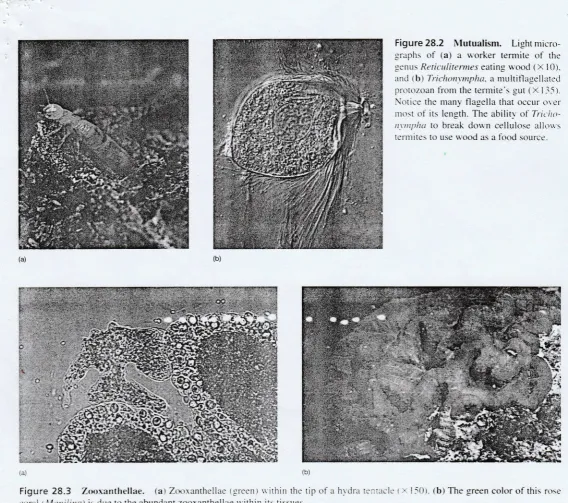
N{utualism.
Light n.ricro-graphsof
(a) a
s'orker termite
of
the senus Relicrr litenrtes eating $'ood ( Xl0).
and(b)
Trit'hotttmplta.
a multillagell::tr.d protozoantiom
the termite's gut(x
I-l-i). Notice the rnanyflagella
that occurtrrer
nrostof
its
length. Theabiliq ol
Trit-ittt-tttrrtphu
to
break do,'r,n cellulo5g iillorvs ternrites to use wood as a fbod source.{a) (b)
Figure
28.3
Zor-rxanthrllae.
(a ) Ztxrranthellae igrc-en t uithin
rhetip of
a hvdratt:ieclc
i.;
1-i())(b)
The greencolor
of
this rore etrral ,1/ruiiliirlt
i.
due to the abundant z,ooxanthL'llae*ithin
its tissues.'l
i:r
it,:r';:trrtrpl-
rl.s1l-[llildinei
cirrals(ligurc -S.i/ri :liii'i-'
iri{r\i
(,:tht:r
cner:,r
rctluircrttents usins thcir l()()\l.inthal1.ic.P;i
iIcnl.
ar(\i,.i-,:.i
irr thl
u()rrrl pr()tcct thc algaefrtltrt
thchltrtl,iul
c11c.i.
ii1- r-rll:-lrrilict rridiltion. Clearlr
Ihe
zor,rlrtiitcllae
:rl.rr 1...'r::ll llrt' .,'r-itltr':,.iu.e
the calcille uli()n r:.ltc is lrt l.-ustl0 til:l::
!r..rlui
irrtl.ir irgirl
ihrrrrirt thc
dtrk.
Hcrntatrpic
c!rrrrlslx.l.inr
/!)(\\ilillire
ll.ri
hlir.'l
r crr.los
rate o1'calcitlcatiolt. B:r:ctl ttn lhrr'it'\ilirl.
aurb(,n j*1rlrrpic crrrnposition.it
has heen dcterrninr'd Iirat nr\)\l (,1 thei,rllini.'curhon
inthr'tissue:
of thehcrntatvpi!
e()rel\llrs
uornc 1'roir thc ziroranthellae. Becnusc of this corel-algal nru-tLrlrli.tierclriti,rrrr[iip-c:r|lpt;jpo.
crrrtra-11 jp-o.lnd crc]inq
nuirt-inlr
urrJcncr:-)
!(ri-al rcL'1s are iinl()nS the nlost prrrdLrctir.e lnci \uauc..tLllot'kn0$
n ec()s\ stems.Sulfide-Based Mutualisms
Tube u'orm-bacterial relationships exist several thousand meters below the surface
of
the ocean, where the Earth's crustal plares are spreadin-e apan (,figure 28.4;. Ventfluids
are anoxic, contain high concentratilrns of h; Jrogen sulfide, and can reach a temper-ature of -3,50'C. The sea\\'ater surrounding these vents has sulfide concentrations around 2-5CpM
and temperaturesl0
to
20'C
above the normal seawater temperatureof
2.1"C.\
5$2
Chapter28
Microorganism lnteractions and Microbial
EcologyFigure
28.4
RasicStructure of
a
Hl.drothermal
inciLlJinq :ult'i.-it
tra
rL'i.il\eJ
lls \e3\\'ater penetrates crL'aIing L'uvir()nrlteni\ tirr -crtlu.thof
the tube lvorrnsIr,
.i:rrt
eli ltlcmpt. io
cltlture
these isolatedbacteria-likc
or-gllil,:.ir:
i.ilii ci.':ctl tln\llaaa\\iill.
J'l::
tLrl.l ,.i(rnrii.ii.\
upitrtlrogen:ultltlc
irtrtrl thc \ca\\lltLrr anrl i-.iild\ it 1rrh;litlrlrrhiri
ttilc
rea:Lrn the$orll'ls
are brightrcdi
'l-hchldror:cn
'ultide
i.
thcn transPonedin
thi:
lirrm
to thcbac-tc'ri-.
rlhici-r r.r\ctlrc
\Lllfide-reducing pou'erto
llr
carbondiox-itl.'ir
thcCelrirt r.
cli
(.,t'r'ligttrt'
1{t.1).The
COl
requiredlirr
thi: ire
lr
is t1'r1r1>p(rried t,) the bacteriain
three $'a1's:freell
dis-solretl
in thc t lot-,ti. bound to hen-rogiobin. and in thetirnn
ot'or-garic
aci.ls \ttch
1:
tttalale
and \uccinate. Thes.'acids
arc dL:ciri-h()\\'liiie il t() rclcuse CO. in the trophosome. the tissuecrln-tainin!
Iracicrtal\\ Il,r':i)itl\.
Using the:e mechanisnls. thebactc-ria
l\
ntir.\ilc
lcr.iuccti ()rganic
nlaterial
fronl
inorganicsub\ttnce\. Thc o|cani-
ntaterial
is
then supplied
to
the
tLlbc\\'()rnr
lhroush
itscirculatorv
svstem and sen'es as the mainnu-tritional
soLtrccfor
the tissL''
cells.A
.inriIur
nrutualistic relationship occurs in Ridge iu pisc'c.tttt'.I
tuh,c*ornr
lound in the north.astern Pacitlc. This aninlalrnain-rain:
its
cndosrnrbiotic sull'ur-oxidizing
bacteriain
specializccltissue
:.
sinrilar to the nutritional strategv of Riliirr.\-ent
u'ith
its
\Iutualistic
)licrobr-.{ninral Associations.
Reduced chetnicals the fracturetlhlsaltic,)ccr,l
li,,,,.-
:'
itr'lrtct1. irttti returnsr\
\'antlluiil
to thc- txt-an. and their procarrotic
lnulr,rali.t..Methane-Based Mutualisms
Other unique
tr,>rd chainsinrolr'e
rnethane-fixins
nricroorgan-isnts as thellr.t
rtci) in
pror idingorglnic
nlatter tor consuflrers. i\{ethanotrophs- bacteria capubleof
using rlrethanL-. rru-cur as in-tracellul:rr sr nraiontsof
methanr'-r'ent mussels. In these rnussels thethick fleshr gills
aretllled
ri'ith bacteria. ln addition. methan-crtrophic carnivtrrous sponces have been discovered in a mud vol-canoat
a depth ,ri' -1.9-1-1nr
in
the Barbados Trench. Abundant methanotrophic.r
mbionts u ere contlrmcdbr
the presence of en-zymesrelated
lo
nr-thaneoxidation
in
sponse tissues. These sponges are notratisllcd
to
use bacteriato
suppon themselves: thel' also trap sr,."iinrnin-sprc\
to give rurietr
to their diet.1.
V/hat is thel'lical
characieristic of a mutualistic relationship?2.
What areirir'lrtant
rcles of bacteria, such as Buchnera and Wolbachia in insects?3.
How do tube .', crms obtain energy and organic compounds fortheir growth?
4.
What is the s:urce of the rvaters released in a deep hydrother-mal vent, anci how isit
heated?28.6
hydroxides and iron silicates f.om
rising vent fluid precipitate in seawater
forming white and black "smoke.'
precipitate inside vent and chimney
Seawater seeps through
6.t
he Rumen
Ecosystem
Luminants urc
r
gri.',i!r,,i^l:ri-b:ro1 ,r1.1.;1,;jv-r11il. ihrili:lre
a\t{rlll-:h
dir iderl int0iirit:
a\)nriiliiiriteili\
:1il!i.llc\\
u e ud crrnsistingtli
:gurgitated.
partialrr
digc-t.-ri li.lo.i. Eranrplr-. include
cattle.ier,
alk.
calll!'l\.
bur'iilr'-:1lJCi'.
-!r':rt'':rnrl r:lliic:
The pllrntialcrill: u.td
asthcir
rtllritt iqrqrli:qr11;-3il.ili!ill'
.rlc(tl
P.)ornLl--itionll
qu;litr
:lar:;
iolturt';.
(\l-lllri-r-lil\
ttlLi.l l-c rttscsteti ilnd r'(\]c\:ed in thc gLrt.ir
co0lrll:.riii,r':i,';llt
e olttfl.:r
ttritrrlhiltl
eonl-runities. I{r nrect the nirtritii,rr:ii ncc.1. ir1'lhe
lt:inllrl..'\r
liotrld
hi
\p.ctrrl. thr'Sttt in lhc.c.,tll:il:rl' i:
LlrlitlLrtlr :rilllJrlgll l'rrr p;o---:sirtg plant lllatr-fi:r1..Br
Lr.:rll
11,i.i,,ir191i11l.itl: tt, cielrlidc lhe rick ccllu]rrrc r,r, allsot
!fli\-
.:ild ()lhai \ t'!cl:.lti{)ll, fLlnlinanl\di-r\l
\ir\t
ililt!)Llnlsof
itthcrui\d
urtli\lillrhlc
ti)i-ugL'. Ilcultuscnt-)in!nts
cannot
s\nthe\irc ccllulu'cs. ihet hlrc
c:tablisitcd
arutualistjc
relntionrhip
\\ilh
rnacr()bic nricroorsertislrts that pro-ucethes.
L-nr)'nrc\.Cellulrrc. Itrclrllrzc
the [3tl+Jt
lirrkages Jt\\'r-cn\uaccssi\e Ir-!lLtco:,;
rt:idrte.
ol'ccllulrlsc
lnd
rclcasc lr:cos.-. r" hich is the n tcrntc'nl.'tl to ttrulrnicacitl:
sttclt lr\ aceliile.Microbia I
lnteractions
543
Gill plume Girl
plume o2 CO, H,S
o2
Co.
H,S
HSHbC-Transloc:'ion products
Sulfide
oxidation
Calvin
cycle
Vestimentum
Circulatory sys'iem
Coelom Trophosome cell
Bacteria Capillary Capillary
Nutrients
Endosymbiotic bacteria Opisthosome
igure
28.5
TheTuht
\\ornt-lJacttrial
Relationship.
(a)A comnrunitl of
tubc \\'()rrns(Ri.liiti
1t.it'ltt1)tilot ,\t the Galirpart-r:Rift
vdrothcmralrent.iic
rrlepqll.-i-ilt
r:r.,. F-lch\\orrn
i\
more than a nleterin
length and has a a0 cntsiil
plume. 1b.c)Sclrernatic
ilirrs-menturn..{t its
itni.ii():
r:tLl
is ri ii.;riritt():-\
r:il1plunre. Insidc
thc trunk
r-rfthe
uornr
is
a
trophosonre ccrr)sistin!:primlrily
of
ndosvntbirrtic
bacrtria.
lrs:r,gilitcd .ellr.
aird L,ltrrd rersels.At
the p()sterior endof
the animal is thc opisthi)sonte.\\hi.h
ancht)rs thelrbon
c\lrrpoLlnd..);ithr\i.,;'!j Lr ,ir.
.;l1iirrr rir)i(rn1i\
trllnsl(rrrled
to thc aninlal'S tissues.o2
co.
Hr"
(d) (c)
(b)
hutr rate. and pro;ritrnatc
{.\('('./i(i/r(
9. /r/r. -I'ticsL'():glLnicrJii:
iiri
thc' trur' enL-rg\ s()urcc'fitr
thcruntiitilnt.
OrganicIr:ltler
[]i!)ac\\-ing can cither
stop
at
the
aictlle
lc-rel
()r
continLlettr
forrnlnethane as a major end product. These
trio
pattL'rn\of
process-inr
rppear lt,r he undcr genctiL'iind
ph\ loScnetic cLrntroi as dis-cussed in\Iicrobial
f)irersitl
&
Ficologl 2t1.2.The uppc'r porti()n of a
rurlinlnt'\
stonrJch crpuncls tolornr
alaruc'pouch
calledtire
rumen
({igure
2lJ.6l anrl al:ror,t.nraller
honelcornb-likc
rcticulr-rnr.The
bottonrportion
,r1' the si.rnrach consistsof
an antcchnrnhcr call3(l tha ornusurn. r,.lth
thc
"trr-re"stonrach (abonrr:urn) behind it.
The
insolublc polvsacchliridcr
andccllulosc
catenb\
the rurninant arenrircd
qith
saliva and enter the rllmen.\\'ithin
the rumen.lood
is churnedin
a constantrotiirv nrriiit.rn;lni
eren-tuallv
reduced to apulpy'mas\.
\\'hich ispartialll
diqested and f'ernrcntcdbl
lnicroorganisrns.Later the
1'ood nrovesinio
thereticulunr.
It
is
thc'nrcgu|uitated
asa "cud." $'hich
i:
thor-ouchl\
cherr'edforthe
tlrst
tirrc-. Thc t'ood is nrixeclriith
saliva.584
Chapter28
Microorganism lnteractions and Microbial
EcologyOrganisms with digestive tracts had to make an interesting el'olution-ary choice: rvill the microbial conimunitl' procluce methane or not? The use of plant materials as a major firod sourcc does not alrval s iead
to methane production in the di-gestiYe tract. For exaniple. kan-qrrt'ns
do not produce methane. u'hereas sireep and cattle do. The kangaroo
has a distinct advantage in terms of nutrition. \\'hen complex plant nla-terials are degradetl only to organic acids such as acetate' the aninl:rl's digestive system can <lirectl;'absorb thc acids. In sheep and cattl--' the
microbial communitl is more complex and conr erts acetate-ler''-i
:ub-strates tLr methane and carbon dioride. Ieading to nutrient los: 1-'om
the original plant material. This loss can be substantial. u ith l 0 to I 59i
of the r.-rganic matter in the feed lost to the atntc'sphere as meth:rne'
An
eraminationof
over
2'i0
reptiles. birds. and maninalsshou,ed that their nraintenance of methanogenic nlicrftrr,eanisms and
methane production
is
under phvlogenetic and not dietary control(see Box figure). Although low levels of methanogens can b.'
de-tected
in
venebrates that do not produce muchof
this imp()rtantgreenhouse gas, the lack of methane production seenls to result troul
absence
of
methanogen receptor sitesin
the digestive svst!'nl. As shou'n in this figure, the ability to maintain methanogens otten hasbeen lost. A similar situation occurs s ith a(hropods: nltthane is
pr()-duced by only a t'erv organisms, including tropical millipedes. ctrck-roaches. termites, and scarab beetles. If the presence of nrethanoqens
results
in
u'asteof
nutrients, '*'hv have so many venebrates andanhropods maintained rhis "energerically rvasteful" process.) It is an
interesting question that relates back to the basic nature of venebrate-gut microbial communiry evolution.
Cervidae
26.6
Dan uacaca- /
v
papioCercopitnecinue
/
\1
Galagonidae
! I t
1
i
fdtoae - r
I I
r,
'.. ,'
TalPaTenrecidae
_----_._,
r.
Caprinae Bovidae
Tragelaphinae Choreopsis
Equidae
Tapiridae
Rhinocerotidae Loridae
Suidae
Tupaia
ChiroqteG Tayassuidae\
Dolphinapterus
----g--
rurs,apsTrichechus
OrycteroPus LoxoContaCholeopus
Elephas Dasypodinae
Procayia
Myrmacophagidae
\Iicrobial
Dirersit-v-and Ecolog1.
Cloerolurion
of
animals
and their gut microbial
communities:
the
methane choicc. lUethane-producing \.ertcbrate s are noted rvirhsolitl
recl iines and roman letters; nonmethane producers are notedu'ith
blue dot-ted lines and italics.r.\\\
rllo+
r'd. and reclltcr\ tite rtttncll rr hile atlothcr cudi:
pas'*J u1lro the mouth. As
thi:
pr()ccss colltillLlcs. thc pirrrialh di"csted trlant rnarerial becorrtes ntore liqtridin
nllture. Theliquid
ihcnbegrr:
ttrt']ou,out
of
the reticulLrnt und into thelouer
pli.rtsoithc
ston,uch:irst
the onrll\urn and then the atrotttasunr. ]t is in the abtlnlasur:', that theltxxl
encounters the host's nortrlltl digestircellz\nlei
andth:
di-gestive pr(Eess continues in thc regular manlmaliltn rr ar.The rumen clt'methane-producin! anintitls such as eattlc criil tains a large and diverse microbial
ctlnrnlunitl'(about
l(lir,'t!.tit
i"n:
permilliliter).
including
procarvotcs. anaerobic ir.tn!'i:tr.ir
as ,\'eocullim.lsll.r. ciliates.iind
other protozoans. Ftxrdentcrirlr
the,lnren
isquicklt'altacked
br
theceliulolvtic
aneerohic prt''carlotes. fungi.
and protozoa.Although
the nlasscsol
procarr otes and protozoaare apprtlrinlatelv equal. the
prt,ues:it.t': , rlHomo
Gorilla
Giraffidae
Camelus
28 -o
Omasum
lmall intestine
AbomasLm
(true stcrach) Reticulum
Figure
28.6
Ruminant
Stomach.
The
stotnach c()rlrplrt-mentsof
a co*'- The microorganisms are activemainlv
in therLr-rnen.
Arrou
s indicate directionof
food molen')ent.runren contents
is
carriedout mainll'
bl
the procarrotc:.
\li-croorganisms breakdo$n
the plant material. Bc'ceuie thcritiue-tion
potcntial
in
the
rumen
is - 30
nr\-.
ail
indigc;r',1r. n:icrtrrrrqanismi engagein
anaerobicmL'ubolisnl. Thc
hlrctcl'irrIt'ilncnt
carbtlhrilrates to tatt-r' acids. carbirnclioxi.ll.
al.ttiil,r.:r,'-!rn.
The
archaea {nrethano-eens} produce methanetC}l-rir"r:l
ru.atiltL'. CO1. and H1.Dic'tarl' carbrrh)'drates degraded
in
thl-nlnlen
include :,'l'-ri'l'-:\Lllilrs.
starch. FEctin. hemicellulose. and cellulose.Thi
ilLi-gc'l lL-rccntaseof
each carboh)'drateis
fermentedto rollilil':
i.:l1rruids
(acetic.propionic. butyric. formic.
andvalcric;.
C()r.
i{--rn,J m.-thane- Fanl'acids producc-d b1'the rumen trrsanisltt: rir.:!b-.rlrbcd into the bloodstream and are oxidized
bl
theanilrrrl
:r' ilr
nrain source of energ)'. TheCOl
and methanc.produicti
lli
l
l".rteoi ltXl
to -100liters
perdaf in
aco*',
are rcleaserihr
'-rttcl:,l:ott I,l-lrtinenrt'turc.
to
ht'lch].
a continuous.scarcell eudihlc
icl;cr
prL)ce\\ sinrilar to roLlching. ATP produced duringtcrnlclllirl;,'rl
r\ u\rLl to \upport the grou'thof
rumennlicrt,organitttt'.
-l-ht>.: llli-cr()organismsin
turn proiJuce nlostof
the Iitlnlins
nc'!'d.(lb\
ih.
runlinant'
In
the renlaining
tuo
stomachs'the
nlicr' r( )iq'rrrl\rlr\'h:.ir
in.
performe.J thcir s1 ntbiotic lask. are digr-stcd to ritltl
r,::lIil"
acids. sugars, and other nutrients
tirr
ruminanl use.Cooperation
Cooperation and cotrlnlensalisln are
t$o f\)5iti\c
btti
lltrtol'll:rr
tor\
I\
pesof
sr ntbioscstirund
riidc-lr
in thc nlicrobial
rl, '; 1i.1.J'hese involve
slntrophic
relationships. 51ntrophisnr
IGreci
'rr;. togcther. ant) tntplte. nottrishment] is ana':ociation
in u llie 1-r thr:tirr\\.!h
ol
one organismeither depend\
Linor is inlplCrc.l
ltrgro\\'rh
factors. nutrients.or
substrates pror idedbr
rnothr-r or ganism grou'ing nearh\'. Sometinles both c.rgiinisnls hent'l'it.As
notedin
ll.,ure
2E.1.cooperation
benefits bt'tl.i ttticrLrot-sanisms. but
this
relationship is notobligaton.
Beneflcjalcotrr-tr,iroJen \.----l\ /
fixer i \
,/ Azotobactei / \
tuvtv@elatt /
\-
ctucosei
N2
Microbial
lnteractions5a5
coa
H,S
Light
Chromatium Desulfovibria
//+NH4'
/
/
/ \t
/\
tl
\t
l.riroSen \.-r--l\
(b)
Figure
28.7
Iiramplcs
of
Cooperative 51mbiotic
Processt's.iarThr'org:rnic
nratler (O\1 ) and sultate required b,vDcsul.fovib-r.il
are prrrdu;ed b1 the Cltrtnnatiranin
its pholost'nthesis-drirenr.riLre tir)n o1'CO. 1o organic mattc-r and
oridation
of sulfide to sui-i;.rl'.:. i ttI
.-\;1t!rltLtc-t€r usesglucose
prorided
bt
a
ecllult,.t-.i-:::i:-rrlitt!
ir::i,xrrg;ritisrlr
suchltt
Ccllulomrtrtri.t. uhicit
tt\cs lhL',,:trorcn
Irrc.i
h1.\:otoltot
!t'r.;lcilrcntarr
r.>()urces areprovided
b1
eachof
thc
paired
rIi-!t'{)()rqallislr\
-flrc irrsanirrlls irrr.olYed inthi\ t\
pe 01're iliti0nship.en
he scparatcd.anil
il'thc'
resources pror ided b1 thecorttplc--rlcntan
nici-oorganism are supplied in thesro$th
enYironnlent..ilih
nlie ro(rrSanisrn ,,r'ill 1'unction independentlr. Tu'o cranrplcs',;
thi:
t_\ pc()l
rclatiortshrp :rrc the as\(rciationol
I)cstrl.fttviltritt'.\ril
C.'ltr()nttilllorr{tigure
28.7a t.in
u hich thc carbon and sult-r.rr.\
clL-sarc
iinkcd.
andthe intcraction
oi
a
nitroSctr-tlrin::
rtri-ulrrrrr-irnirlir
"i
itlt
li
e e llLrlrrlrtic
ttrpanisnl suchts
C.'tlltrlrtrrtttr:rt';, r
i!,.rrc
lS.-l,,. ln
thc
sccond exarrtple.thc
ccllulose -tlcuradinSiriir..r()ilrqani.nr
lihcrltc:
glucosefiont
the ccllr-rlrrse. ri hiclt can 'oeri\a(l
h\
nitrrrrcn-t'iring
tnicrobes..-\n
crccIlcnt
crlinr!lc
of acoopcratire biodegraclatircassoci-ririon
ir
slro,.in in
{igure 2fl.tl.
In
this
casei-chlort)beilzr)r1-.ilsradatitin
dcpend.
i,rt thc functionin-cof nticrtlorgani.rlls
rr ith a()nrplL-nrcntlrr caplrhilitic-s.It'anv
oneol
thc- threetnicr,r)r!rtll-i.ntr
i:
11()l present and actiVe. the degradation o1- the subslratc\\
ill
not ()ce ur.\":::)
5a6
Chapter28
Microorganism lnteractions and Microbial
EcologyDesulfomonile tiediei
3-chlorobenzoate
\\
\*
.,
/
/
MethanosPirillum sP.
Figure
28.8
Associationsin
a Defined Three-IVlemberedCooperative and Commensalistic Community
That
Can Degrade3-Chlorobenzoate. If
any member is missing' degra-.iation$ill
nor take place. The soiid arro[,s denronstrate nutrienttlo*
s. anci the dashed Iines represent hyp:the:i
:d
ll^n
'l
l
otirc r . urpcra!i r c relations. .ul f iclc-drper,.1g11i 3Ll11111 oirh i-liii.rll.nt()u5
rnie rot,rgunisltlstlx
carbttnditrridc
lltd
sr nthc;iz-c-()i-I11tlie ntal!aithtt
:e r\ cs as a carbon and energr s0ttrceftlr
ii ilsi-.r ()'rr()piric organisnt. Solneof
the ntosl intcrcstillg
inclucle thc pirl'. chrtc'tc \\ ()rlns.'\lt'inella
pontpejatru(figure
2tl'9t'
thc
I)orn-peii
irtrnrr.
:.,rrlltlr,,
PLtrulvittellu Pttlrtti.lltt'ttti.s, thePaltll
ut'rrn'
il,,ih
ir ar c tl ;l:l lc tl i, , Ll. bae Icrilt oI) the ir dorsal :r-trl ace-' 'l-hc:e
Ill-28.1 0
Figure
28.9
A
N{arine\\brm-Bacterial
Cooperative
Relationship.
Alt'i'telltt
potnpejana, al0
cm lon-s worm- formsa cooperative reiationship u'ith bacteria that grou' as Iong threads on the
\\'orrn's
surface.The
bacteria andAlrinellu
arefound
in 'unnels near lhe black s.-roker-heated watertonts-ilnrent()ri. hecrcria can
ilileralc high lerels
of
rn.-tals such a-s ar senic. cadtttiurrt. uttd copPer. \\'her,gro*'illg
()n thc surl'aceol
thLaninral.
ther
nlir prorii:
proteclionlrom
thesetoric
nielals. a'',rcll
ltsthcrnlal
pl'()lL'cti()n: in addition.ther
appear to be used a'il
tilod
5()urcc. -'\ dL'eP-\aa crtlstaceanhat
beendiscolercd
thau:e,s suli'ur-oridizirtg ar-riotropiric bactcria as iis tbod source. Thi .1rrrrill.-.
liirirrtrrrr.r
('.\i)'-itl(tt(t
ttigurt
lll.10r
has
tllamentoup/
s/
s'i
Sr
I
I
I
s's
,EI
Figure2g.10 AltarineCrustacean-IlacterialCooperatireRelationship.
ra)Apicture,-rf thenlarineshrinlp
Rintir:urisetoculututhi.
t1-rirt SCill'ri1.587
28 11 l'vl icrobia I lnteractionsFigure
28.'11 ,\
\Iarinc
\ernutodr-Ilacterial Cooperatire
Relationsliip.
\Lu-ine i.ru..-li:'irr
IiJ;i:r,i,,11;'..\\hich
:.:rtrrrat
thc(b)
(a)
-LrllL:r.-rrritl:,:irl.t
b.,-al;-ii !rr,,r
1;;;,,;l
ii:
:urlace
(trgure 18.1i)hl.\\-htir
therc
rrc
t1i-i.,.j-lc,,iilrr
.hli
irt:-r ingr--sts them.This
ntlrni-nuilr
"blilrj"
.h"ii:rl
!:,1 1-J\ii,iri
!,,iir:
Slou r'mitted b1 thcbllck
\:il(riii'. t-t.:l!
l,l,li-:J-i:"r
(ri'ii.:ilr,ll ils
hack. ThL'()rgani\.1-ll\i-ii..r'to
l
iishi
r'.iirtllltlih
lil.1'!i:
tt,rl tlct.-cteble bv humans..\nolire:
intcrc:i:r:
c\unrlllaoi
brictc'rial epigro\\'th is shor"n brncnliiode\.
in;iudin: Etittt:tririrtt'
l)uru:iti.f(ru.\. thatlire
at the in-tcrliraL- bL-i\\cJrlirr'ii,5i. llll!..rllit.roiria
sulilde-t-ttntaininsn'lunnr-:e.ilnr.-nts
tfigurc
2E.1lri,Dt. -l-hr'rc animrls are covered b1 sultidc-ti;.lizing
b,ectcrilriililt
.rreri(\.nt
ir,
intncatc- pafierns ttigure:\.
1 1 /) ). Thc b:rctcrii ni)t r)nl\ tir'.rcirrc ler els oftoric
sultlde. rl hich(1itdn \Urrcr,-rnLl
thJiteillltode:.
irllt th!-\llso
sen-e as a t-ood supplr.In
I 9!)i r. hr t1r,,',i::r-nlrl 13
.
\\ r-i'i Jr:coveredin
a fieshu atcrcni
ilrnrnciri.
at titi''t:r.rttonroi
L-lrke Ueikal. the oldest (15million
-\u-ar':
oldr
rntl
iir'c'p::rt lakcin
ti.-
uorld.
This
lakeis
located inth-r far
cr\i
()1Ru..i:r
rfigure
28.1kt.h.cl
and ha\ the largestvol-ur,-re
ol'an\
ire sh\\rtcr
lakc (rt()tlitr
'rrgest
area-\\.hich
is LakeSup.'r-ior). Thc
hlcterial gplrriih:.
uith
ltrngr"hite
strands. are in th!. ecntL-r r.r1'therr-nt
field
,,ihc'rcthc
,righesttclrperaturcs
areior,rnd (t'igurc 18. I
li
i. At tltr- .d!c
()t'th.
r enttlcld.
ri here thc \\'a-tar te rrperrti.irci'
liri.er.
thcbrite
rill
nrrt ends. and sponces.gas-trlirlils.
rrr,l
otlier
. rrgirlli\t11.. ',rlliilt
:..i tit:
:uliur-rlridizing
bactcria 11 1 |irr,11 11
,r.;;---though
le sscicr.l(,i).d
Lake. \\"r'e,nrin!:.
A
hr r-irogci:.Lliil,i.:
',.rrt.i
'.'a, !\-',\i.ll'.
lr.r\h:iiil tii:.'ilr
crc.i
tti Southem Ri,ttt:rltili tituii- -1',.:r
tirl,:rr- [--l::l::'.tl:1ii-C. (-l',es ili
thc areacontlin n1li.
L)tnii-lL,or!nr.ti:ilr iirili
i:\
cirrh()ndioxidc'u.in!
h) drogen sultldels
lhc .1!-ctron 111 )n\lr. Fon-\ -ci-sht sp-'cic-s of cart-ldrptcd
inrcn.'5:-lic:
ilr.
\ir:i irild(l
rt\
iiti.
jl'rc nl()xLrt\ ltr!'lrhicb]:a.
.-\
ittfill
()1'uil{)ll(fil'rir,ti iri.r} t}-.i-:t':ril;:ir
li it(}pLlliilir)t)(]l'.int-ilar
nlier-tltlrsLrli:rll:
Ill,,-rii()i\ i:. \,\\Ii
r:.'ii.itr. lhc procc:r
o1'quorunt sat)sinS. r', itich ri ir.
tiirJl-i..r.l
itt.r--iiolt
6.-<.l'ire
lrticrttrr-canisrts produ!'a specilri iliri(rin(iuaJi-c(,il)1 )Linii\.
lntl
ar the3rp-Lillriit,il incrcli..' trnti litc !!1it!aiililllir,:-r,1
liic.r'.irlltPirLinJs
rcacha\
criiical
1r'rel:.
.rrr.iiit i-rJs :i:r
.\Prd\:ci.I. l-lrcsc
rc-spon\csllrc
intn\)rltintl\)i
illi.l-r)(\iL:inisn,.ihitt lirrnt
lrrsociatirrnr*ith
plants antlininral..
lurrlIliuli.ulxr'lr
1,,; hunran pilth()!cn\.\1-rcorrhizai
t fungal-yrlerrtr(ii)i
intcr-:lalir)n\)prc\cnt
u\pe-cial
casc c.rf a ci,opcreti\c lL-ilili(rn.hip
i .3s- chapter
-1() t."\or-Inal"
chlorophrll-contrrinrnr Ii1n1. i:.;r
--rr,)\\
$ithout
thc l'uncus.plrrticularl\
in the rlee nhLru:e .in.licutins thiit
this is not an oLrligat()r\ rc-1:rtion:hip. Sonrc 1unqi.ln contra\t.
d() n()tsur-rircuithoLttLrJil{u.\().ililttl
',',;ti,lrIi.1',1
l-hcu.lll',tlirirrlloLi:
i.
l::-' j)re \-:ji
,ll:::r lr 1}
,- Silrtilar;"ri-lirclL:
hrrt
ir.:cir
lr)un!1in
Ycllou'slcrnr'l-Frolikha
Bav
Lake t'
5aa
(c)
Figure
28.12
Hrclrotliernrul
\ent
l--eos-rstemsilt
l.'resh*uter
Environntent.s.
LakeIlrikal
rin Rlr..ili
rlli:
hce n tiruntiii,
irar clo*
tentperliturc
hvdtort-:rnrlil
r.r'tt\.
t:l)
l-ocutiorr
oi
L,lLkcBlikal.
sitc
oi
the
hr drL'rhcnnulr:nr
ilcld.
rbr
lJactcriril
nrii
near
the
ccnt:r
o1'thc
...n1
tieitl.
rcr
Iltrctt'riul lllurntnt.
unrl sPt)nSes at thr- adsC o1'tit.:rcnt
i'ititi.
/iri.\,/t//i.
l)riiti
tnttrt tlit \'.rri, t:.tl C,,,r
. . '
\,,Chaoter'
28
lilrcr-oorganism Interactionsand Microbial
Ecology5.
28.1 2
monotropoid
plants (scr, 1t. 656). horvever. aredilt'ereni.
These plants depend greatl), on thellycorrhizal
funeal net\\,ork ro pro-vide nutrients"taken"
frorn otherchlorophl ll-containinS
plants.1.
What structural features of the rumen makeit
suitable for aherbivorous type of diet? Why does a cow chew its cucj?
2.
What biochemical roles do the rumen microorganisms play inthis type of symbiosis?
3.
What is syntrophism? ls physical contact required for this rela-tionship?Why are Alvinella. Rimicaris. and Eublstric,tus good ex::r.lples of cooperative microorganism-animal interactions?
Where is Lake Baikal located, and why is this unique
rr
ierms of its microbial communities?6.
Why do chlorophyllous and achlorophyllous plants have differ-ent degrees of dependence on mycorrhizai fungi?Commensalism
Commensalism ILatin
(.)//1. to-sether. atrclnlt,it.rl.
tab]r-li:
ure-lationship in u'hich one
sr,nrhiont.the
comnrensal. :;nc1rr:
*
hile the other (sontctinrcs callcd the host)i\
naithe r hrir;::e.i nor hclped. as shou nin tlgule
lS.l.
l-his
is li Ltnitlirectionlil r:,r.-cs..Otien
both1't- ''a' t
I t,' Il,- r
rit-l.
1,.,1
r^i.ti. ihc \...1..
:
'rla."I-hc
spatitl
prorintitl
Lrtllie tir()
put-tltci'\I.tl-;lits
the.:,:t-.ilr'rr-.lrl
ttr
lced!)il \ulr\llnae\
altJrtLrfaLl t,r'iri-9c:i.:.1br
tite
i:,.i.
llnri thccomntenial
ol'tcn obtair.r: shcitcr b-r Iir i:t:: tither,,n ,.:
:n thc host.'fhc- corr-intcrr:lilir
notdircctll
clcpenclr.ni ()n thclt{,-:
ntflli-boiicallr
and caLlsL'\it
no palticrrilirlrlrnt. \\'ltcn
tite e()ii-..1-iJnslli:
separatc'diront
its htrslcxpcrintcntlillr.
ii
crr|r :rrrrir.,
...ititi,itl
hcing pror idcd sr-rnte t'rctor or f iictttrs
oi'Ittrsi
rr;itin.
Conrnrensalistic
rclatitrnsliips
[.etrrc.-n
rjti.l-,,, ,r-!lLir
-
.,:
iniludt
sitr.rations in*lti.:h
titc \\11.ia pr()rlLtet (r: Lrit;.nliLl{.,.'i.rtri.i.,
ir
thc subsireir'tiri'anrr:hi.r sP.-i::'.. L)lt-:tt,,,.i
U\-iiltIle ;.
:t.::iii,.,,-lrrrn. thc oridatton ot arrtn.l(rrtiurri ir)n t()ltitritc
i.) nIri,,,,--_.i:l\nl.
:uch
3\
\tilrut:otttoiltt.r. lrntl thc\!b\cLilrcitt
t,tij.:iioi.r ()l-riJ lltlriic
Ir)nitrJtehr
-\'irrzrlrrrr'llrantlsiltillrhuetcrill
t..r-ti)lt.7r.\-.'-,r..\;,
inrixtcter henctlts 1rtln;ri:
lrssiit iull0rt\
itlt .\'rlr|r,ri?(/,f :.r,.\^l!]U\e
il
Lr:c: nitritc ttrobtlin rncrS\
lor::r'truth. ,-\:C-rriiii erlintl.:
,,l tltir
tvpe
()l'relationship is
fbundin
.rn:ierobic ntL-tilunr)lcriiu=-,,\\
\-lc'rtt\ SUCh a-s sludge digesters (.r(,(, .\(,('/1r,i 1ltl./r
r. lLr.ttrcrol-l: il-c'slt\\ atcr Jquiltic seditttcnt.. anrl tlootle rl
:cil:.
ln tirc:c e rrr ir,,..-lr-nls.iuttr
acids cun r-+ dcsnrrlctj ttr jtr rrrluceH.
antl iltcthuna ir..:ltt
in-tcnleti()n o1'trrrrrlillcrcnl
hltetcrirrl tr()ups. \lc,titaneprotlii.:r.,n
br nlcthanogcn\ dtpcn,.i. t,n interspecic.s h-r'drogentranslcr.
.\
lcr-nle ntati\ c hactcriurn
!ancilrlc\
h\ !ln,gan Llis. i-inLj thc rilcLi:..:,.r-gcr;tr:es it quickl-r
J\
lt\ub\lrillt'
lor-ntctiilute -!lt\ irr\)LiLlctii)nVarious terntentatir c bactcria protiuce i().,\ ntol!.e ulr:r '.', JiSltt
lattr
acidsthat cltn
hcdesrailctj
[rr lnucrol-i.
hticteriu-:.ait
ir\ SvtrtroltltohaLlcr
io
produceH. a: lirliou
s:Propionic acid
+
acetate+
CO.
-
H,
St'tttropltobut'Ier- uses protons (H
- +
H-
J
H. ) as ternrinalelec-tron
acceptorsin
ATP synthesis. The bacteriumgaini
surilcient(a)
lyrt4-.
fotdW'gl-ttvt
re
4
1
f,r.,lM
\
{..*"L\v
W)*t<rv'
'J'--8*ltbp"t
*y
energv tbr grorvth
onlr
u'hr-n theH.
it generiites is consunle.l. The productsH,
anclCO-
are useclbv
tllethanogenic archaea te.g.. lvlatItatutspi ril/trrrr)a:
tollou's:-lH.
+
co,
--+ CH.*+
lH.O
B1 s-rnthesizing Itrethane. Mellrttrtrt.tpirililrrrr
ttraintlitls
alt-q'H'
concentrationin
lhe
ilnnlediatu-enVirotttllellt
of
htltll
bacteria. Continut'rus rentovalot'H.
prornotes furtirerfattl'
aciclf-r'rtllentil-tion
anciH.
production.
Because increasedH.
production
and consumption stimulate the grorr,'th ratesof
S.t'ilIntpItrthttttcr- and il[ e t hu n o s p i ril1rorr. both particiP]nts i n the re lationsh i p br-nefi t.Conrmensalistic associations also
occur
whentlrle
tlricr,rhial group nrodifies the cn\.ironrllent to makeit
tllore suite,-l forlntrtiter
organism. For eranrple. in the intestine the ctrtt-ttt.ttltt. nollPathouellic strain of Eschericltiutrrli
lives in the hurnan colon. btlt ltlstlsrous
quite u'ell outside the host. and thus is anprcal
corllnletlsal.\\'hcn
ox\'-qenir
used upbt
the tacultativelv anaertlbic E.t'ttli.
trbligate anaerobes such as Bcrctentides are able to Sro\\'in
the colon. The anaerobes benet]ttiom
their associationuith
the host and E.toli.
but
E
c'oll derives no obvious benetrtliom
the anaerobes.[n
t.h;sc&se the commensal
E
Cr.,1i contribuies io the ri eltare trl- othersYm-bionts. Comnrensalism can involve other cnvironnlental
nltvjitlca-tir.rns. The svnthcsi\ o1'acitlic rraste
Irt'ltt'-':
cluringlcrnlentrtiotl
stinrulate the prolileratitrtt o1'llrore acid-ttliL-r.rntilliar('\'l--iil,\lll\.
rrhich arconlr
a lninor part of thc nlicrobiai ct,rntttiuniir xt Il.'.rtl'i.rlpl{s.
A
scxrt! exarnple is the successitln c'rInlicroorgitni.trl: ililring
rnilk spxtilage.
A:
ittitrthcr exalnpie. rl hen biolllmstrc
lonrl:i
t:ec-tion lti.-1 ). the colonizrtiott of a neri
ll'
e.rpo:etl surilicebr
orre t} peol
nricroorganisnr (aninitial
coionizer) nlakL'sit
pilssiLrl.'tilr
c'iher nticrtnrganisnrs to attach to thcnlicrobiaill
nloclitieri:uri-r.tce
t'Cornmensalisrtt
alro
is itllportant
in
thecolorlization
oi
ti,ehun-ian
bodl
and the surfaces cll'other unirnal: and plant:. Thc rni-crrxrrganisnts assoeialedriilh
ltn
anirtlal:Lin
ani
i'L'dr
t'riilit'
aan Ll\crolatilc.
strlublc. and panicr.rlatc t'rSlrltie ao:l)Ir()i-li'ld\ ii-()n1rhe htrst as
nutricnts
I see sectitttt -11.1t. L'ntler III()\l
condilion\
there nticrobes tlrt n(ri cattst-' hltrnl. othc'r thlinpos:ihlr
contrihLtl-in-r: to hrix11'uior. Sontclintcs
$hcil
theho:t trrglni-':tl
i::ire::crl
or thc skin is punctured. thesenornllllr
ctrtt.tltlenslilnicroorgan-isms
nrar
bcconie
palhogcnic. These interactionsriill
be
dis-cussed in chapter 3 1.1.
How does commensalism d!ffer from cooperation?2.
Why
is
nitrification
a
good
exampleof
a
commensalisticprocess?
3.
What is interspe(ies hydrogen transfer, and why canthis
bebeneficial to both the producer and consumer of hydrogen?
4.
Why are commensalistic microorganisms importantfor
hu-mans? Where are these found in relation to the human body?28.1 3
Microbial lnteractions
Predation
Predation
is a u idespread phL-nomenon u here gulfs or attacks the pre). as sht)* n in figure 28. I(a\ Bdeilovibrio
(b\ Vampirococcus
(c) Daptobacter
Figure
28.13
Eramples
ofPredatory Bacteria Found
in\ature.
talBdcllovibrio.
a peripla-srnic predatorthlt pcnctrrit.
rhc'
ceil
uall
and grou's outside the plasma menrbrane.(bt
li;r,;
;,jp,i
1r1-1'11.s x ith its unique epibiotic nrtxle of attackinSl
prcr
lrr,i-lcriunr.
and (c) Duplobacler shou'ing its cytoplasmia ioeltlir,ttl:
it
rttlckr
x su\ceptihlc bacteriunt.lrrser
or smaller ihan the predator. and this nomrallY re\ults inth.
deathof
the pre).An interesting arra)' of predatory bacteria are acti\ e itr trrtLtrc. Sereral
of
the best exanrples areshoun in
tigure
28.13. incltrd-ingBdcllovibrio.
Vutrt1tiroc'occus, and Duptobactcr: Eech of tlte:c
''lt\
a
unique
modeof
attack
againsta
susceptible hactcrituir.Bdellovibrio
penetrates thecell u'all
andmultiplies
'oelseentlit
s'l-
and the plasma membrane. a periplasmic ntodeoi
attack. fol-Irrrredb1'l1'sis
of
the pre,'- and releaseof
progenr
rsec.fi,r,urt'l-1.-lJ
This bacterium has an interestinglife
cycle. u hich is di:-cussedin
section 22.4.Nonl_,
tic forms
also are observed.
Vampiroc'ttt'c it.s atlache:to the
surfaceof
theprey'(an
epibiotic relationshipi
artd thcn\ecretes
enz\.mesto
releasethe
cell
contents. Di;ptobacter
the prcdatoren-The prt-'r' e an be
t :,'.
:
Cl-.apier
28
Microorganism lnteractions and Microbial
Ecology 28.1 4The Many
Facesof
Predation
te 5i irr n
-'te ntion
.ri!'clion and increased fitncss
The nricrobial loop. Soluble orgrni. nlriler tiont prirnrn pr()du.c,-\ i\ nLrnlirll) u'e.i br bacteria. $hich hcconre a prrticulale tirod siturce
for higher consumeF. Flagellates end ciliates prer rrn thr':c' h:r.lcri.r rrnil djr:rrt thrr':t. rrakin-c the nutrients they c()nl3in available again in
mineral form for use in primary production- crc-ating th!- nllgsqrir irrl l1r 'p. I'r tlii: rr :r r larle portion of the carbon fired b-v.' the
photosl.nthetic microbes is minerelized and rc'c}cletl (thu: tht tcrrr rriicrr,l.ill lot,pi rtnd d(^-s nr)t reach the higher trophic levels of the
ecos)'stem lsee figure )9.J r.
than *'ould rrccur if the predator \\ ere not a.ti\e.
Bacteria retained s.ithin rhe predaror serve a useful purp()\c. ris in lltc trrl.iLrmriru(';', .ri toric h)drosen produced by ciliatcs in the rumen
toharmlessmethane.Also.trapping()fchloroplasts(klcptLrirlrrroirlr\l\ib\ prolo/,riiproridestheprc'clatorlvithphotosl'nthate.
The intracellular sun'ir.al of Legionelltt ingested hr ciliatcs pr()tccL\ it li,,i.-r :lr.\\d. \:.h as heating and chlorination. ln-gc'stion also results
in increase6 pathogenicit), when rhe prel is again rele rscd 11r tir. . \ l.in-:: ctt r r ronn::nl. and this ma1' bc required ftlr infection of human:.
Tbe predator sen'es a-s a resen'oir host.
Nanoplanktonmaybeingestedby'zotrplanktonandgro$ inthcl()Llil.rftL1.,udigcstire\\stem.Thc)'areth!'nrelcasedlotheenYironment
in r t'itter state. Dissemination to neu locations also rtccur..
ietrates
a
susceptible host and
usesthe
c)'toplasmic
con-ts as anutrient
source.Ciliates are excellent examples
of
predators thatengull
their\. rnJ
based on \\'ork $ ithfluorescenll)
marked pre)' bacteria. 'r-rleciliatc
can in-sest 60 to 70 Pre)' bacleria Perhourl
Preda-I
on
bactL-riais
importantin
the aquatic environment and in .irS!'trcltnrclrl
\\here
thc ciliates remo\.e suspEnded bacteria'. har c- ntrl sr'itled.
.{
:rirpririnS tlnding
is that predation hasman} bcnellcial
c1-l:.
crpr'ciullr
uhen
one considersinteractil'e population\
()t'.-i;.i'rrrr: unii
prc\.
as sumrnarizedin table
2t1.3.Simplc
ingc':-r
lnJ
lr\\iiiliiation ol
apre)
bacteriunr can leadto incrt-rt'trl
r*r'l'
n1111'1.'i11clciing. critical tbr
the iunctioninq
ol'the
rni-,hial
ltxrp
r tt't'st'ttirttt
29.1 urulfigttrt' )9.1).
In
thi:
prtrcc-"..r.ri.
ntriiir-
producedthrough
photos\nlhetic and
chcnl$-.hr;
rr;lir
ri\
is
n)ineralized beloreit
reaches thehi!hcr
corr-'i-.'ir. 3li1ru ing the mincrals to be made arailable to thePrillrrn
.1ii,l;-.. in
u "itxrp."'This is important
in
ircshu;rtcr.
nlltriil.-. rigrc.irilri
.n\
ironrncnts.Inccslion 3nJ
\hon-icrlll
retL-nti\)11'ir!.t.ri.r .i!..,
arecritical for ciliate functioning
in
therunlett-lrr
rnrthxnLrgcnic bacteria contribuleto
the health ol"Ihcciii-.
L'] decreasin-s toxic h)'dro-sen levels through usineH'
to prt'-re .,]ethrne.\\hich
then is passedtiom
therumen-Pr.-ilation also can provide a protective- hieh-nutrie nt etlr ir.'i'l-nt i()r panicLrlar pre)'. Ciliates ingest Lr',qirrnt'lltr and protc'ct
thi:
ronlnt
paiholen from
chlorine.uhich
orieni\
u\eJ
in
anat-'tp'i t(r c()ntr()l
lteit)nellu
in cooling to\\'ers and air-conditioningt:. L;c
ciliatc
sen.cs asa
reservoir
hr):1. 1,2'1j1t11a'1111ltrit,it-,'rltrltr also lias been tbund to have a sreater potential to inrade
.r(rphr,!is
and epithelial cellsatier
predation.indicating
thate.Iion
notonlr
provides protcction but alsonlar
nlakc the hac-unr a betle. ,)uthogcn. A similar phenonlenon of surr ir al inpro-rra has hccn rrbserred for !v'{vobacteriunt avirrrrr. a pltthogen ()f
rltlrridc
conccrn. These protective aspo-ctsoi
pr.'dlltion
harcjor
intplications tbr survival and control o1'di:eatc--e uLtsipop11-,()rglnisnrs
in
thebiofllrrl\
frc\ent
in
rrrtr'r
:rrpplies
andair-contlitroning
s\stenrs.
In
marine
s)'stems
the
ingestion of
rllilr,,rplenktor.rbl
zooplankton providesa
nutrient-rich
enYiron-nr!-lrt thirt allo$ s nlnoplanktcrn reproduction in the digestil'e tract Iili(i irl',\nlote\
dis.enrination in the enYironment. A sinlilar processi
ri;::i' llir-i
bli;trnu
rrc
ing!'\lL-db1
ptlll'chac'tes (segnlen!!-d\\ r,: Ill\ li,ul'ti ttt, r.ll) ll) Il)lrnllC CnvirollmCnt: l.
I'r:;l'ii i,li..n
sl',,,,,iintereslinr
prc-riatorr skills. Sonlelunci
canii.:i:
i',:(1'.()1\r:iirr
li-,r'u:r-
rli
rtiekr
h1 phaeor
knobs.stickl
n':t-r,.
' :i.. t,i
lt', rhac. {)ai(\n\trii--ling
r)rnonc()n\lrictinl
rings. Acles-\ia
e\.:ilniria
t>.\,t:i;rttltrtins.
\\'hich
traPs nenlat()desb1
tlsL- ol'.i,it:ii-ictinl
l.ir;-1...-\ticr thc
nematodeis
trappcd. hvphar' grou :t:,
..
rrrir: ,"il;/-'J
prcr
und theclt0plarnr
is used as anlltricnl.
(
)ir.';
tirnSi hurt
i..iriJia
that. af ier incc'stion hv ltn un:urpc'cting i1.ir\. ,jt.,\\i. :,itrj trii.r.jl,th.:.u'ceftiblg
fiost I'rrrnt inside tlrcintcs-i;;r.ii
iiit!i.
i:,lit;. .;lulrii'ril Ih.
Iun-gusp.'nclrliia\
thchtlrl
ccllr
ir-tli. '::,Il-'1
:jiai:r-'.:\- ff(\a\\
I
iru.
pretliriir.i:.
u hie hu.uiill)'
has a l'atal andtjnal
outconlei,';
,:r
in.1ir;!irilrli.i.\ (,r-!rni.nl.hasauitlcrangcof
henct-icilrlcl'-' cl'-'. ,:,
!,._ :','
.'r,\ir\.
lrn.: r. critie:rl lnthi
l'utltti()tlin'j
()l n;rl-tii:!l en\ irir;lrtlitli..Pa
rasitis
m
I'arasiti-snr !s onr
ol'thr
rlrost eLlntple\ nricrobial interaclions: thelin.'
h.'rri r-cn pararitisrn and predation isdifficult
to def rne tlig-Lrr.l:i,1.
'ti
,r/.r,, .\('(ti()n -iJ.lr.
l'his
is u relationshipin rihich
()nurrl'ri
irilir bdlr.flts tiont thc
othcr.
andthe host
is
usuallY hrr-nrr:ti.l-hi.
rrin
ir.:r,rlrc
nutrient acquisition
and,/orphr:ical
nririn!alllnlc
in or on tlie- hosl.ln
parasitism there is a degreeol
ci'e r.isicnie r)1'th. p.lrasite
in
a:sociation ,'r'ith the host.Depend-ilrl
on the ctlrriiihrir-inr betueen thctuo
organisms. this ma1':hift
anrl ri Irrt rrriSht hlir c becn a \tablc parasitic relationship ntav then bccoilr.'r
prth()sL-nic one \\'hich can be dellned as predation.Microbial
lnteractions
591 28.15Figure
28.14
l-ichens.
Crustose (encrusting) lrcherlt gro\\ rns{,11 ir !
l:!nili
Po:t-:,r\iJr 1rr!,!lilation
hr
Crrnrrellocleritutt
tliphtltcriut (\"t
\"(Irr)/r\
,'-.-i
,,,,,,' -i+--it. itai-eriiic
fungi
include
Rhi-oplttdiurttspltttttti-.ir.,ri.r,r. .,',
rllt
rhellLl
.!;,.r'rp1,.'1i. ,\l:'.'.
Rlri:.octt;ttirt sr'/itrrii'
lta,,,,.,,.',. r,i'
l/:tt
lt-llllti
P.r'I/titirrl' u hichi:
itllport:rnt intriocontrol
1rr,ra"rt"r.
iiir-tt'i'
rrj li;11- 111i611 'rrr!lLIlislllltl
Crrntrol an()thct-Hr'l-,;t,,ii
.::..-..:' -iiil.ari
irqi
i111sgr. nlicletia. l'ungi. i1nd pr()t();/()ltltr'
l-iehens irle
til.
:-l:\(t.iJtion {L*l\\cen r1e-cilica''eolll\ccte:
(ih!'l.:n-!:ii.
.:i,!j .lil-1lliir rana:-li oi-'lihci
!:rL-'n algiie ()r L\ itnrlbitctcriit'i,t,,
li.i",'.111r
lu:lSr'i irlll1 ncri\ l'rllleJ
thenllcribiont
und tlleli--:..r1
i'r -\iril,'a,li.tirilil
f:11111cr- rht-phlcobiont'
[-icht-'ns
i]rL'illl
c\-..iic,,t;r.,r,1lie
t''tii
c()rllrolied parlt:itisnrttigure 2ti'lJl ln
thcir:!\tti)cliilicn.rnltrio\i\\\'as(jollsideredttlbeanlutualisticinler-,,-li,,l.
ir iirLtn,rl\ he. i'ccrr lil,rnJ thlrr lr lichen \\ill
i()rlll
t'lilr
shcn
',ltriiio
Ir\riarlljlti fr:il-rllcir ',13 nr;1fi1iottltllidcprired
Untlcrtltlrtltll
-,,;,,liiti,t't. lllc
l)t)tanlilrlf.lnncr'
:'1rcll't interl-sted in eachuherl
-fltl
rcrllarkllhlc illpe.l ()l lhi) ll::ociatii)n is
that
it:
ttlor-'r1,,11,,1.. i.iit.1
tllatilt'()lii
i"eiatit'il'hif \
are so c()nstant thatlichcn'
.,:. tr..i:rtr'J 'lallil'la
iirrrl'Pccir'' Il:tlllc\'
'l-hcchl'rlrclr--rirtit
tll"r-:r,,,i.,1r
,,1"
lit,:rl
liche rl is x!l()pert\ tlf
the asstlciatitln andis
:r'.r
.'rhihireLl
br citilc; srtrllionl irldiridtralll''\':
:
ilte aute rhe phr coiriont
i\
a ph()tL)autotroph--depcndent onlr,,r
lirht.
earhorltliori,lt-
lrnd cenainnlinerll ntltrients-the
l'un--,.,r J,,,, qctit\
()rqunic e lrb()ndirectlr ironl
the aiga orcr.anobac-1., i,,,,r.
Tlrt
lLrtlgus olten
ttblirins llutrients
frorn
its
panner
b\ hlrurtor-ialf
roicctions o1' l-unqrl hvphae) that penetrate the phl-Cr\tir.ri.tI
ccli rrull.
lt iil\o
Llsc\ thco.
ploclscer.l dtrring pfi1'cobi6ntIrl-i,)ir)lth()\iittr;t
llitigtt
itt e .trtritr!
,rttt I'Cipirlllir)ll. In turn theful-rr.t\
prolccl\
tIc
pltr cLriri(.)ttt l'l'prlr highlight iltensitits.
prgyi'-1esr,. .::r-f
lllttl
,,'rincrals 1.,it.
lilt(i
cielltts ll t'irtll
strhslr'atutrl $ithitl
\\:'rJh thc
i.it)c0hiotll
ciill qr()\\
Pr()tcctctifrrlitt
c-nr irtlnnlentel\itj>\.
-fhe
-,i.ilin'
ot-thc tirtlsLt: to pal'asitizc' thc' alga orcvanobJC-t.;-iulil undir
\Llch lonscr-tcl't'll ctlrtditiotls alst'r has bec'n tlescribedii:
.rli)rIIl r,i
ir-rlt gal -,.i i rL-ctccl "ili gliclr I{ trre"'
.\tr
irttp.,rtlitltrsJ'eit
o1'I)lil'ilsitisll'l is that tlr't-rtinle'
thepara-.il;'.
trttceit hls
cstahlishc-il a relatiorlship r'r'ith the host'\\'ill
tend to .1i:cat'tl e \ccss.tilttt:cil gcllolllic inf



![Figure 28.15 \)i:tr:us!iptlitle Internction. agr.irr ant\ Amensalism: An Adverse ]licrobe-\licrotre(a r .-
tihiotic produclion and inhibition ol grouthbr;1,.it,,tl on:rll agar ri-iediurn](https://thumb-ap.123doks.com/thumbv2/123dok/1646750.1560611/16.612.330.570.63.395/iptlitle-internction-amensalism-adverse-licrotre-produclion-inhibition-grouthbr.webp)
