THE EFFECT OF COLLABORATIVE WRITING STRATEGY ON STUDENTS’ ACHIEVEMENT IN WRITING RECOUNT TEXT IN MTS
ALWASHLIYAH TEMBUNG 2016/2017
THESIS
Submitted to Tarbiyah Faculty and Teacher Training UIN-SU Medan as a Partial Fulfillment of the Requirements for S-1 Program (S.Pd)
By:
AULIA RIZKY RAMADHANI NIM: 34.13.3.126
DEPARTMENT OF ENGLISH EDUCATION
FACULTY OF TARBIYAH AND TEACHER TRAINING STATE ISLAMIC UNIVERSITY OF NORTH SUMATERA MEDAN
THE EFFECT OF COLLABORATIVE WRITING STRATEGY ON STUDENTS’ ACHIEVEMENT IN WRITING RECOUNT TEXT IN MTS
ALWASHLIYAH TEMBUNG 2016/2017
THESIS
Submitted to Tarbiyah Faculty and Teachers’ Training UIN-SU Medan as a Partial Fulfillment of the Requirements for S-1 Program (S.Pd)
By:
AULIA RIZKY RAMADHANI NIM: 34.13.3.126
Advisor I : Advisor II :
Dr. Abdillah, M.Pd Drs. H. A Ramadhan, MA
NIP. 19680805 199703 1 002 NIP. 19660115 199403 1 002
DEPARTMENT OF ENGLISH EDUCATION FACULTY OF TARBIYAH AND TEACHER TRAINING STATE ISLAMIC UNIVERSITY OF NORTH SUMATERA MEDAN
Nomor : Istimewa Medan, Mei 2017
Lamp : 6 (Enam) sks Kepada Yth;
Prihal : Skripsi Bapak Dekan Fakultas Tarbiyah
a.n Aulia Rizky Ramadhani UIN-SU di –
Tempat
Assalamualaikum Wr.Wb
Setelah membaca, meneliti, dan memberikan saran-saran perbaikan
seperlunya terhadap skripsi mahasiswi :
Nama : Aulia Rizky Ramadhani NIM : 34.13.3.126
Jur / Prodi : Pendidikan Bahasa Inggris
Judul : “The Effect of Collaborative Writing Strategy on Students’ Achievement in Writing Recount Text in Mts. Al- Washliyah Tembung of 2016/2017 ”.
Maka kami menilai bahwa skripsi ini sudah dapat diterima untuk di
munaqosyahkan dalam sidang munaqosyah skripsi Fakultas Tarbiyah UIN – SU
Medan.
Demikian kami sampaikan, atas perhatian Bapak kami ucapkan terima
kasih.
Wassalam,
Advisor I Advisor II
Dr. Abdillah, M.Pd Drs. H. A Ramadhan, MA
PERNYATAAN KEASLIAN SKRIPSI
Saya yang bertanda tangan di bawah ini :
Nama : Aulia Rizky Ramadhani
NIM : 34.13.3.126
Jur / Prodi : Pendidikan Bahasa Inggris
Judul : “The Effect of Collaborative Writing Strategy on Students’
Achievement in Writing Recount Text in Mts. Al- Washliyah Tembung of 2016/2017 ”.
Menyatakan dengan sebenarnya bahwa skripsi yang saya serahkan ini
benar-benar merupakan hasil karya sendiri kecuali kutipan-kutipan dari
ringkasan-ringkasan yang semuanya telah saya jelaskan sumbernya.
Apabila di kemudian hari terbukti atau dapat dibuktikan skripsi ini hasil
jiplakan, maka gelar ijazah yang diberikan Universitas batal saya terima.
Medan, Mei 2017
Yang Membuat Pernyataan
i ABSTRACT
AULIA RIZKY RAMADHANI, THE EFFECT OF COLLABORATIVE WRITING STRATEGY ON STUDENTS’ ACHIEMENT IN WRITING RECOUNT TEXT IN MTS ALWASHLIYAH TEMBUNG IN THE ACADEMIC YEAR 2016/2017
Thesis, Medan: Tarbiyah Faculty UINSU of North Sumatera, Medan 2017. Keywords: Writing Recount Text, Collaborative Writing Strategy
This study was focused on the effect of collaborative writing strategy on students’ achievement in writing recount text. The objective of this study was to find out if there was a significant effect of collaborative writing strategy on students’ achievement in writing recount text. It was conducted by using experimental research design. The population of this study was the second grade student of junior high school in Mts. Al-Washliyah Tembung. Two classes was taken as the sample of this research. The class VIII-1 was as the experimental group and the class VIII-5 was as the control group. The experimental group was taught by using Collaborative writing strategy, while the control group was taught by using conventional method. The instrument of collecting data was writing test. The data were analyzed by using t-test formula. The result showed that the value
of t-observed is higher than the value of t-table. (17.02 > 1.667 (α = 0.05)) with
ii
ACKNOWLEDGEMENT
All praises to Allah SWT who always gives me blessing, power, strength
and love in my entire life and in terms of my study, especially in completing this
thesis entitled: “The Effect of Collaborative Writing Strategy on Students’
Achievements in Writing Recount Text” as one of the requirements for the degree
of Sarjana Pendidikan (S1) at English Department, Tarbiyah Faculty in State
Islamic University of North Sumatera.
During the process of writing and conducting the research, the writer was
assisted and supported by many peoples. This thesis could have not been
accomplished without guidance, suggestion, and comment from them, for which
the writer would like to express her sincere appreciation directed to:
The Dean Faculty of Tarbiyah and Teacher Training State Islamic
University of North Sumatera.
Dr. Sholihatul Hamidah Daulay, S.Ag, M.hum, as the Head of English
Educational Department.
Dr. Abdillah, M.Pd as my advisor I who has given me advice and
suggestion in completion of this thesis.
Drs. H. A Ramadhan, MA as my advisor II who has given me advice and
suggestion in completion of this thesis.
All Lecturer of Educational English Department
My beloved mother and father who always give me supporting, praying,
and loving. So, I can finish my bachelor degree. I dedicated this thesis for
iii
Mhd. Zubir, S.Ag, the Headmaster of MTs. Al-Washliyah Tembung
Titiek Atika, S.Pd, the English teacher in Mts Al-Washliyah Tembung
All of my students in MTs. Al-Washliyah Tembung
My only one brother (Habib Widi Firdausi) who always give me supports
indirectly.
My greatest cousin, Nanda, Riza, Uun, Wiwi who always besides me, give
support, and help me to finish this thesis. I love you girls.
My dearest friend of PBI 4. Especially, Wilda and Nurul who always
beside, help, support, and remind me to finish this thesis until the end.
Say and the gang, Amel, Bobob, Dora, Patrick, Elen, Beh and others who
always make a joke every time.
Medan, 27 April 2017
The Writer
iv
CHAPTER I INTRODUCTION ... 1
A. Background of the Study ... 1
CHAPTER II THEORITICAL REVIEW ... 7
A. Theoretical Framework ... 7
1. Achievement ... 7
4. Collaborative Writing ... 16
a. The Definition of Collaborative Writing ... 16
b. The Advantages of Collaborative Writing ... 17
v
d. The Step of Collaborative Writing... 21
B. Conceptual Framework ... 23
C. Related Study ... 24
D. Hypothesis ... 24
CHAPTER III RESEARCH METHODOLOGY ... 26
A. Time and Place of the Study ... 26
B. Population and Sample ... 26
C. Research Method ... 28
D. Instrument of Collecting Data ... 29
1. Content ... 30
2. Organization ... 31
3. Vocabulary ... 31
4. Language Use ... 32
5. Mechanics ... 32
E. Technique of Collecting Data ... 33
1. Pre-Test ... 33
2. Treatment ... 34
F. Technique of Analyzing Data ... 34
CHAPTER IV RESEARCH FINDING AND DISCUSSION ... 36
A. Data Description ... 36
B. Analysis Requirement Testing ... 40
1. Testing Normality ... 40
2. Homogeneity Testing ... 43
3. T-Test ... 43
C. Testing Hypothesis ... 44
D. Discussion ... 45
BAB V CONCLUSION AND SUGGESTION ... 47
A. Conclusion ... 47
B. Suggestion ... 47
vi APPENDICES
LIST OF TABLES
Page
Table 2.1 The Function Generic Structure of Recount Text ... 15
Table 3.1 The Population of Research ... 27
Table 3.2 The Sample of Research ... 27
Table 3.3 The Formulation of Research ... 29
Table 3.4 Standard Achieve ... 33
Table 4.1 Achievement in Writing Recount Text in Experimental group .. 36
Table 4.2 Achievement in Writing Recount Text in Control Group ... 39
Table 4.3 Testing Normality Post Test in Experimental Group ... 41
Table 4.4 Testing Normality Post Test in Control Group ... 42
vii
LIST OF APPENDICES
Appendix
I The Lesson Plan (RPP) in Experimental group
II The Lesson Plan (RPP) of Control Group
III Pre-Test For Experimental Group and Control Group
IV Post-Test For Experimental Group and Control Group
V The Score of Pre and Post in Both Classes
VI Table for Distribution of Frequency in Experimental Group
VII Table for Distribution of Frequency in Control Group
VIII Test for Homogeneity of Variance
IX The Calculation of the Mean (M) and the Standard Deviation
(SD)
X The Calculation of T-Test
XI List of Critical Value Of Liliefors Test
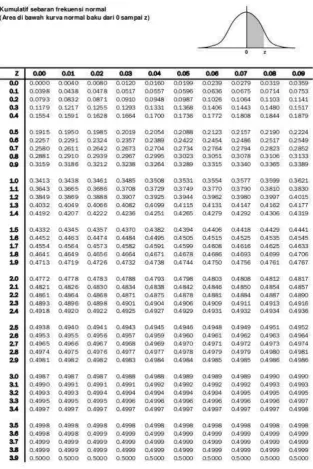
XII Table of Large Under Normal Curve 0 to Z
XIII List of Percentage Value T Distribution
XIV List of Percentage Value F Distribution
1
Regulation Number 22 in 2006), tujuan dari belajar dan mengajar Bahasa
Inggris di Indonesia adalah untuk mengembangkan kecakapan siswa (the
goal of English teaching and learning in Indonesia is to develop students’
competence discourse). It concerns with producing both oral and written
texts conveying in four integrated skills consisting of listening, speaking,
reading, and writing.
Writing is the expression of language in the forms of letter,
symbols, or words.1At the most basic level, writing is the physical act of
committingwords or ideas to some medium, whether it is hieroglyphics
inked onto parchment or an e-mail message type into a computer. On the
other hand, writing is the mental work of inventing ideas, thinking about
how to express them, nad organizing them into statements and paragraphs
that will be clear to a reader.2
The writer is focusing on writing because writing is one of the four
language skills that has a very important role in learning and it takes an
1
Utami Dewi, How to Write, (Medan: Latansa Press, 2013), p. 2 2
important part in communication. The writing skill is more complex and
difficult, requiring the mastery not only the grammatical and theoretically
devices but also the conceptual and judgment. Through writing, everybody
is not only able to express feeling and ideas, but also to communicate with
others and have remembering facts and ideas. People need to learn English
writing because it is a process of transforming thoughts and ideas into
written form. Writing is influenced by some elements such as vocabularies,
grammar, organization, spelling, and punctuation.
Based on the syllabus of curriculum in Junior High School,
students are required to be able to write a various types of genres. They are
narrative, recount, procedure, news item, descriptive, report, spoof,
analytical exposition, hortatory exposition, explanation and discussion.
The purpose of this research is to see the effect of collaborative writing on
student achievement especially in writing recount text.
One of genres that should be mastered by the students in the
process of learning English is recount text. The Recount text is a text that
tells events or experience in the past, the social function is to retell events
for the purpose of informing and entertaining. This text uses simple past
tense, conjunction, and past adverbial time. The generic structures of
recount text are: orientation (introducing the participants, place and time);
events (Describing series of event that happened in the past);
Re-Orientation (Stating personal comment of the writer story).
Based on the writer’s experience during the field experience
ability in writing recount text . Many students not able to understand the
language features and determining the generic structures of recount text.
The students had some problems in writing recount text. Firstly, they did
not use simple past tense. Secondly, they did not use conjunctions, and
past adverbial correctly. Thirdly, they could not understand to identify and
different the generic structures of recount text.
Travers states that achievement is the result of what an individual
has learned from some educational experience.3 There are several factors
that can cause the low achievement in writing: internal and external factor.
The internal factors that can influence the students’ achievement are:
motivation, interest, personality, IQ, learning style, they seldom study at
home. English language is not their mother tongue, so they think that
English lesson is difficult and they seldom discuss with their friends, and
the external factors are English teachers not creative in applying teaching
strategy, environments, parents, teacher seldom applying strategy.
Moreover, strategy can be defined as a forming part of plan or an
aim to achieve a specific purpose to gain an advantage. There are many
kinds of strategy in teaching English such as KWL, Number Head
Together, Index Card, Diary, Brainstorming, Think Pair Share, Everyone
is Teacher Here, True and false strategy, collaborative writing, Active
Knowledge Sharing, Crossword, Jigsaw, and etc. But in this research the
writers only focus on using Collaborative Writing strategy in writing
recount text.
3
Collaborative writing offers an authentic learning environment
where students do not only develop their writing skills but also critical
thinking and decision making skills. So, The collaborative writing strategy
was selected because it was believed to be able to stimulate the students to
be more involved in the writing activities especially to write recount text.
Considering the statement as mentioned above, that is why the
writer plans to conduct a research with the title “The Effect Of
collaborative writing strategy on students’ achievement in writing recount
text in Madrasah Tsanawiyah Al-Washliyah”
B. The Identification of the Study
In line with the background of the study, there are many problems
that can be identified in writing text among others;
1. The teacher had taught recount text, but students’ achievement in
writing recount text was still bad.
2. The teacher had taught recount text, but student do not understand the
generic structures and language features of recount text
3. The teacher had given motivation, but the students still have less
motivation to learn about writing recount text.
4. The teacher lecturing the material well, but teacher seldom to use
various strategies in teaching writing especially in writing recount text.
C. The limitation of the Study
Based on the identification of study, the writer would be like limit
the study on two factors, they are: Writing skill especially in recount text,
and using the strategy of collaborative writing in writing recount text.
D. The Formulation of Study
Based on the identification of study and the limitation of the study,
so the research question of the study in this research: Is there any
significant effect of collaborative writing strategy on students’
achievement in writing recount text?
E. The Objectives of the Study
In relate to the formulation of study above, the aim of problem is:
To know the significant effect of collaborative writing strategy on
students’ achievement in writing recount text.
F. The Significance of the Study Theoretical Significance :
The significance of the study are expected to contribute can useful
to develop their writing achievement especially on recount text with
collaborative writing strategy, and also can provide for other researcher to
conduct similar researcher in order to improve the students’ writing
achievement and language skills generally by using collaborative writing
Practical significance:
1. For the student, this research can give the effect to the student’s to
improve students’ English achievement, particularly in writing recount
text by using collaborative writing strategy.
2. For the teachers, this research can be used as the input and information
of how to learn writing recount text. So that, the students can get high
achievement in writing skill especially in writing recount text by using
collaborative strategy.
3. It will be use to other researcher as a comparison in reaching the same
CHAPTER II
REVIEW OF RELATED LITERATURE
A. Theoretical Framework
In conducting this research, there are some theories which are
needed to explain through some concept and terms applied in the research
concerned. In this case, it was important to avoid misunderstanding
between writer and the readers. The following terms used will be
presented in the following part.
1. Achievement
Travers states that achievement is the result of what an individual
has learned from some educational experience.4 While Johnson states
achievement tests are useful to the teacher as well as the student. They
indicate how well teaching has succeeded and where improvements need
to be made.5
Based on the opinions above the writer concludes the achievement
in the result, the successfulness, the extent or ability, the progress in
learning educational experience that the individual indicate in relation with
his educational learning. In other words, achievement is a success in
reaching goal or standard by skill, courage, effort, and so on. In students’
achievement, the achievement will be measured by the teacher. The
4
John P Travers. 1970. Fundamental of education psychology. (Pensylvania: International Textbook Company) p. 447
5
measuring will be seen based on the reaching from the test that given by
the teacher.
2. Writing
a. The Definition of Writing
Writing is the one of the four language skills. The four language
skills have a close meaning with each other.
Allah Said in Holy Al-Qur’an Surah Al-Jumu’ah Verse 2:
*
ا
ي
*
ا
ي
The meaning:
“He Who taught [the use of] the pen. Taught man that which he
knew not.”6
Based on the verses, Allah explains that He taught man with a pen
(Qalam). Whereas with a pen, people can write and transfer their
knowledge to the next generation. and by creating a writing pen is a tool to
convey ideas. It shows the tool of writing and writing itself have important
roles. You can explore all your idea on your mind become article,
paragraph or text and make you understand about a new something.
In holy Al-Qur’an, writing is also important skill should be learned
and there is verse that state the existence of writing that be stated in
Al-Qur’an that is surah Al-Qalam:1
6
The meaning:
Nuun. By the Pen and the (Record) which (men) write.
(Al-Qalam:1)7
Based on the those verses, Allah SWT explained that He taught
human being by pen (qalam). Discovery of pen and writing are the greatest
gift from God. By writing, one generation can transfer their knowledge to
the next generations. It shows that the tool of writing itself have important
roles.
There are so many different definition of writing. Writing is
expression of language in the form of letters, symbols, or words. The
primary purpose of writing is communication. People have used many
tools for writing including paint, pencil, pens, typewrites, and computers.
The writing can be formed on the wall of cave, a piece of paper, or a
computer screen.8Writing is one of the four language skills after listening,
speaking and reading.9
At the most basic level, writing is the physical act of committing
words or ideas to some medium, whether it is hieroglyphics inked into
parchment or an e-mail message type into a computer. On the other hand,
writing is the mental work of inventing ideas, thinking about how to
Utami Dewi. 2010. How to write. (Medan: La Tansa) p 2-3
9
will be clear to a reader.10 In the article the author develops ideas thought
to the reader indirectly. The author outlines the intention (of ideas) in
detail through writing11.
As Meyers said that writing is a way to produce language which
does naturally when someone speaks. Writing is also an action process of
discovering and organizing the ideas, putting them on a paper and
reshaping and revising them. 12 Writing is central to our personal
experience and social identifies, and we are often evaluated by our control
of it.13
Writing is a peculiar activity, both easy and difficult. The more you
think about how you do it, the more difficult it becomes. Everyday writing
tasks, such as composing a shopping list or jotting down a reminder seem
to be quite straightforward. You have an idea, you express it as a series of
words and you write them down on a piece of paper. It is a natural and
effortless process.14
Randal states that writing is an ability to make a form of words that
in general it may have a higher truth value than the fact that it has set it
Gorys Keraf. 20055. Argumentasi Dan Narasi, Jakarta : Gramedia, Page. 11 12
Alan Meyers. 2005. Gate Away to Academic. Writing : Efective Sentences, Paragraph and Essays. (New York: Longman) p. 1
13
Ken Hyland. 2002. Teaching Researching Writing. (London: Longman), p. 1 14
the readers. Besides, it must contain meaningful values so that the readers
can get the benefits from the writing.15
Based on the quotation above, it can be said that writing is a
process of putting thoughts, ideas or opinion in written form involves
some aspect such as a word choice, grammar, mechanics and context.
b. The Process of Writing
According to Harmer, there are four main elements in writing
process. Those are:
1) Planning. Planning is before starting to write, the writer has to decide
what is they are going to say. When planning, writers have to think about
three main issues. In the first place they have to consider the purpose of
their writing. Secondly, experienced writers think of the audience they are
writing for, it is formal or informal. Thirdly, writers have to consider the
content structure (how be sequence the facts, ideas, or argument which
they have decided to include.
2) Drafting. Drafting is when the writer can refer to the first version of
piece of writing as a draft. As the writing process proceed into editing. A
number of drafts may be produced on the way to the final version.
3) Editing. (Reflecting and Revising). Editing. (Reflecting and Revising) is
after making a draft, usually the writer reads what they have written in
drafts to see whether it is correct or not. Perhaps the order of the
15
information is not clear. Perhaps the way something is written ambiguous
or confusing.
4) Final version (Publishing). Final version (Publishing) is the last process
of writing. After editing the draft, the writer produces their final version,
and the writer is now ready to send the written text to its intended
audiences.16
3. Recount Text
a. Definition of Recount Text
Recount text can be considered as the most common kind of text
we can find in our everyday life. The main goal of this text is to retell an
event happened in the past. This is the basic form used in many story
books or story telling texts and also in non-fiction usually used to make
factual accounts of events, current or historical ones.
Recount texts can function to inform and to tell stories of past
events. In our lives, it is a common thing to tell a story to someone both in
spoken and written forms. If students are able to speak it up fluently, it is
possible for them to write it down with the same flow of fluency. This
kind of texts where they share with others can also add references for them
to read which also improving the skill of reading.
Recount text is included in narration text genre. In the
communication context, sometimes we want to tell to other people about
some points or activities that we have done in the past, for instance about
16
activities holiday. In the written text, that information can be packed in a
recount text.
According to Pardiyono, recount text is a text retell events or
experience in the past, the social function is to retell events for the purpose
of informing and entertaining. It social function is to reconstruct to record
events or activities.17
To begin making a recount text firstly we should understand the
rhetorical structure, which is orientation, which is text element consider to
the topic that will be informed to the reader, and the followed by record of
event which consist of chronological event and ended by orientation.
Moreover we should also follow the language the language features of
recount text as the characteristic to build up a good text. The generic
structure of recount text is Pardiyono states these are three elements in
recount text which have been arrange based on the rhetorical structures
which ae: orientation: introducing the participant, place and time. Events:
describing series of evet that happened in the past. Reorientation: it is
optional stating personal comment of the writer story.18
According to Pardiyono, orientation consist of an activities or
event that will told, meanwhile the function of orientation is for catch the
attention to all readers and focus them attention record of event content of
the record of activities or which shows chronologically. Then,
re-orientation consist of simply conclusion from what we have produced in
17
Pardiyono. 2007. Pasti bisa!! Writing Clues for Better Writing Competence. (Yogyakarta: ANDI), p. 64
18
record of events. The language feature of recount text are: some
characteristic of recount text, which this text always used. It is called
language features which are: introducing personal participant: I, My, and
etc. Using chronological connection: then, first, eventually, next, later,
meanwhile and etc. Using linking verb: was, were, saw, heard, and etc.
using action verb: look, go, change and etc. Use simple past tense.19
Pardiyono add the language feature of recount text is by using of
adjective with the purpose is for showing the personal attitude: For
example: it was wonderful, we enjoy it very much, it was fun, it was
terrible, we are really happy. 20
b. Writing Recount Text
In making a recount text, there is an important point which is worth
knowing. According to Andersons’ theory a recount text has three main
parts (Generic Structure). They are:
1) Orientation: the opening of the text, the introduction of the topic of the
text. It give background information about who, what, where, and when.
2) Event: It is usually told in a series of paragraphs which retell the events
in the order of sequence when they happened.
3) Reorientation: it ifunctions as the closing statement. It is a paragraph
which contains a personal comment of the writer.
chronological order, using time connectors that signal the order of
sequences or events, for example, then, next, after, meanwhile, they
functions as connectors; 4) The use of adjectives and adverbs for details. 21
To make an effective writing recount text we should understand
more the function of generic structure of recount text, the function each
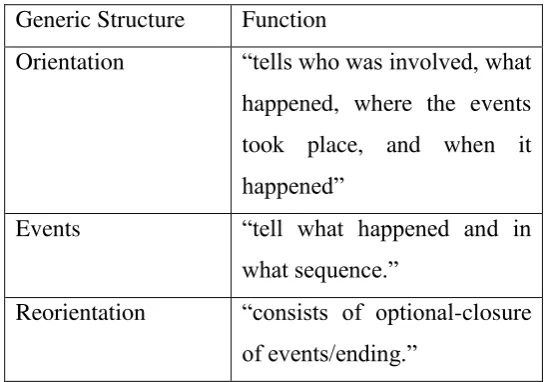
generic structure will be showed in this table below:
Table 2.1: The Function of Generic Structure
Generic Structure Function
Orientation “tells who was involved, what
happened, where the events
took place, and when it happened”
Events “tell what happened and in
what sequence.”
Reorientation “consists of optional-closure
of events/ending.”
c. The Example of recount Text Orientation
Last year, I and my family went to Parangtritis Beach. We went to
Parangtritis Beach by my car. I was very excited to go there.
Events
Our trip to Parangtritis beach spent time for 2 hours on the way. I
slept in the bus during the trip. We arrived at 3 pm at Pangandaran Beach..
21
After that I and my family went to replace our clothes to swim and we
walked to the beach together.There were so many activities that we did in
the beach, such as swimming, water playing, chasing each other on the
seashore, and banana boat riding. We played on the beach about 1 hour.
Right at 5 pm, we all had a rest and prepared to go home. We felt family
and togetherness atmosphere at that time. That moment is so unforgettable.
Reorientation
That was my short holiday in Parangtritis beach. But, I was very
happy because that was my first experience to go to the beach
4. Collaborative Writing
a. The Definition of Collaborative Writing
Collaborative has close meaning with cooperative and we also say
that they can be combined. Based on Janes Bauwens and Jack J. Hourcade,
they suggest three approaches to implement in collaborative teaching
writing: team learning, supportive learning activities, and complementary
instruction. Firstly, Bauwens and Hourcade describe team learning as
educated subject join planning and present subject content. Secondly,
supportive learning activities reinforcement, enrichment, and enhancement
in writing learning for all students. Thirdly, complementary instruction as
one educator takes primary responsibility for teaching content material and
the other for teaching functional how to skills to understand for all
Collaborative writing is a nonthreatening approach for students that
results in purposeful usage of the target language across skills and
demonstrable improvements in writing. By providing methodical
guidelines and lending support, the teacher can execute this approach
b. The Advantages of Collaborative Writing
The collaborative writing has widely been studied by researchers
and educators interested in analyzing the benefits that these experiences
bring to the language classroom. Harmer defines the collaborative writing
experience as an opportunity to enhance writing and increase academic
achievement in groups. Harmer affirms that “successful collaborative
writing allows students to learn from each other.”23
In examining the positive comments provided by students, we
noticed that they could be placed clearly into five discrete categories. The
categories we identified from their comments were: (1) social skills
development; (2) stress reduction and time-saving benefits; (3)
22
Mulligan & Garofalo. 2011. A collaborative writing approach: Methodology and student assessment (Ritsumeikan University), p.9
23
motivational effects; (4) improvement in the content of their writing; and
(5) gains in grammatical and structural proficiency.
As for social skills development, student remarks indicated that
they developed a greater sense of responsibility through the collaborative
effort and that it helped them to get along with others and gave them an
opportunity to get to know their classmates better. In terms of stress
reduction and time saving benefits, students wrote that the pair-work
approach gave them less pressure to do a good job, eased their burden as
they could share the work load, and allowed them to save time because of
the shared effort. The motivational benefits included the fact that because
they were being given a single grade, it made them try harder, thus
reflecting the role social responsibility played in their output.
One student even remarked that this process helped him stay awake
in class. Concerning actual improvements in the content of their writing, it
was clear that the collaborative approach enabled some of them to create a
richer body of content. One student noted that through the initial
brainstorming tasks, their arguments became deeper and stronger because
one student challenged the other to think more carefully about the topic at
hand. Another student noted that the collaborative approach allowed them
to develop the topic from different points of view, thus strengthening the
quality of the content. By sharing ideas, another student remarked, their
topic had more depth.
Lastly, one student reported she was able to write more than usual.
proficiency thanks to this approach. Among the comments was the remark
that they could find mistakes more efficiently. Another wrote that it
improved the accuracy of their paper. The approach helped another to
organize and edit papers well. Lastly, through the process of revising each
other’s drafts, they could learn words and phrases that they did not know
beforehand.24
c. The Activities Type of Collaborative Writing
a. Using The Board
One way of making collaborative writing successful is to have
students write on the board. This gets them out of their chairs; it is
especially appropriate for those who respond well to kinesthetic stimuli. It
also allows everyone to see what is going on. It has two activities how the
board can be used in this way:
1) Sentence by Sentence. The students built up a letter in reply to
an invitation on the board, sentence by sentence. Each time a new student
goes up to the board in such activities, the rest of the class can help by
offering suggestion, corrections, or alternatives. This kind of writing
activity has the great advantages of creating a clear focus for everyone in
the classroom, and can create a feeling of shared.
2) Digtogloss. Students recreate a text or story that the teacher read
to them. One purpose of the activity is to focus the students’ attention on
24
specific items of language by getting them to analyses the difference
between their written recreations and the original which they have heard.25
b. Writing in groups and pairs
There are many activities which are suitable for students writing in
pairs and groups. Some of them depend on a scribe to write the final
version of the piece, while some of them involve every single person
writing their own version of the text.
Rewriting Sentences. Rewriting activity, students are presented
with a stereotypical statement and asked to amend it to reflect the opinions
of the group. This provokes discussion not only about topic but also about
how to write a consensus opinion appropriately. The teacher has chosen a
topic for the students to consider. The students are then presented with
some example of stereotypical statements. Or they rewrite the sentences so
that they accurately reflect the views of the group.
First Lines, Last Lines. First and last lines of possible stories can
also be used to get students’ imagination going. Students can be given
either the first line of a story or the last lines. They then have to write a
story to include one or the other. They discuss the situation in their pairs or
groups and create a story which follows on from the first lines or ends with
the last lines.
Directions, Rules, Instructions. Students can be asked to write the
four, five, or six principle rules of a game they like and know how to play
25
in groups. They are told that the rules must be as clear as they can make
them so that there is no uncertainly about what is meant. This kind of
writing is clearly not suitable for beginners.
Story Reconstruction. In their new groups students have to work
out a sequence for the four pictures and then create a written text which
tells the story of that sequence. This activity works well. It provokes a lot
of discussion which, in turn, gets students to write with enthusiasm.26
d. The Step of Collaborative Writing
To minimize any confusion, we provided students with an outline
of the entire process beforehand. The steps of the procedure were as
follows:
(1) students chose their partners themselves, and exchanged contact
information to facilitate meeting outside of class;
(2) in class, pairs brainstormed ideas about the target topic and organized
the information into coherent groupings;
(3) pairs arranged to meet outside of class to do research and
information-gathering to support their paper;
(4) in class, pairs did outlining, planning, and crafting of the first draft.
Students were required to hand in a detailed outline before submitting the
first draft;
(5) the instructor handed back the outlines with pertinent comments;
26
(6) work on the first draft commenced. Student A typed the first draft and
completed a detailed checklist provided by the instructor. After that, the
draft was sent as an email attachment to Student B, who was then
responsible for editing the draft. The editing had to be done with different
colored ink to highlight the revisions. After finishing this, Student B
completed another checklist to make sure the work was proofread
carefully. The detailed checklists were provided to help students in the
writing and proofreading process. They helped students to eliminate
simple grammar mistakes, spelling and typographical errors, as well as to
ensure correct format, organization of ideas within each paragraph, and
sound essay structure. The first draft was then submitted in class along
with both checklists;
(7) the instructor checked the drafts, pointing out structural and
organization errors, and providing comments and suggestions;
(8) work on the second draft commenced. Student A and B switched roles
for this part. That is, this time Student B had to type the revision and
Student A had to edit it. The second draft was then submitted;
(9) students received a single grade based on their overall effort and the
B. Conceptual Framework
Writing is one of the most important skills in language beside
reading, speaking and listening. In writing, student must understand the
text and passage. Writing is one linguistics competence form which
expressed in written language using from, besides in oral language form.
The goal of writing is to produce and reproduced written message, it
means that writing is one of language skills that transforming information
we think in our mind be a literary work.
Writing is very important but it is not easy to teach the students to
be able to write. There are many kinds of writing, such as descriptive,
narrative, argumentative, expository, recount, spoof, news item, report and
etc. One of the texts that learned by student at junior high school is recount
text. Recount text is a kind of text genre which a text that telling an events
or experience in the past, the social function is to retell events for the
purpose of informing and entertaining. Recount text is contains three
elements of text, such as: orientation, events, and reorientation.
Although the students find difficulties in writing, it is proved by
the score of student is low. There are many factors that influence the
student writing achievement on recount text such as the student did not
have confidence to produce their writing, because they can’t organize their
ideas and information about the topic. When they had some ideas to write,
they did not express it because they have lack vocabulary.
There is some solution to solve the problem. Strategy is one of
teacher’s strategy can help the student the student to understand the lesson
easily.
By using collaborative writing strategy teaching on recount text
was help to engaging the students in writing activity. Increase the students’
motivation to participate actively in writing class. Help the students to
contract their writing. Providing ways for the students to discuss or
interact with their friends.
C. Related Study
This research is similar to the previous research which had conducted
by Ayu Febriana on the title: The effect of collaborative writing strategy
on students’ ability in writing recount text in SMAN 1 Babalan Pangkalan
Brandan, whereas my research title: The effect of collaborative writing
strategy on students’ achievement in writing recount text in Madrasah
Tsanawiyah Al-Washliyah Tembung. The differences is only the location
of the study and grade of the students. She conducted the research in
SMAN 1 Babalan Pangkalan Brandan and I conducted this research in
MTs. Al-Washliyah Tembung.
D. Hypothesis
Based on the theoretical and conceptual framework, so the writer
Ha = There is a significant effect of using Collaborative strategy on the students’ achievement in writing recount text.
H0 = There is no a significant effect of using Collaborative strategy on the
26 CHAPTER III
RESEARCH METHODOLOGY
A. Time and Place of the Study
This research was conducted at Madrasah
TsanawiyahAl-Washliyah. Which located in Tembung, North Sumatera. This research
was focused in the students of junior high school especially in eight grade.
The reason for choosing this school because: (1). The writer found the
problem that the student still had low achievement in writing recount text.
(2). Suitable of ability and limitation of time and finance because the
location is close to my house.
B. Population and Sample
1. Population
The population of the entire unit which has the same characteristics
according to the criteria of the research being conducted.28 Population is
the object to be examined29.
Based on the above it can be concluded that the population is the
whole object is to be investigated.
28
Masgianto Sitorus. (2011). Metodologi Penelitian Pendidikan Islam, Medan : IAIN Press, Page. 44
29
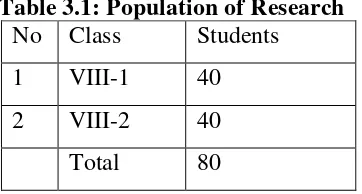
The population of this research at Madrasah
TsanawiyahAl-Washliyah is the eighth grade students of 2016/2017 academic year which
consist of 72 students in two classes. It can be seen from the table:
Table 3.1: Population of Research
This research use total sampling. The sample of this research is 80
students that take by Suharsimi’s statement. She said that if the population
is less than 100. So, all the population become sample (total sampling).
But if in the population is more than 100 so, the sample can be taken
10-15%, 20-25%30
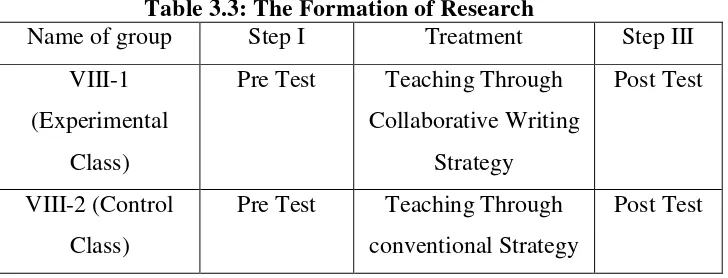
control group. Class VIII-1 as the experimental group was taught by using
Collaborative strategy, and class VIII-2 as the control group as taught
without using Collaborative strategy
30
C. Research Method
The research method is a method to find the truth which is also a
critical thinking31.
Thus the research method is a way to reach the truth by collecting
and analyzing the data needed to achieve the goal. Based on the problem
and research objectives, we used the experimental method.
Experimental method is the most fully quantitative approach, in the
sense of fulfilling all the requirements for test of causation32. In the
experimental design there is a group called the experimental group: the
group deliberately influenced by certain variables, and the control group,
which were not affected by the variables. The control group as mentors to
change as a result of the experimental variables. This research study have
experiment about collaborative writing strategy.
Based on the experimental method mentioned above, the group is
considered as the experimental group, the students who had learning to
write a paragraph using Collaborative writing strategy, while the other
group was the control group which students acquire conventional strategy
in writing recount text. Although these groups were treated differently,
giving the material, the length of the time and the teacher were exactly
same, looked at the table below:
31
Masgianto Sitorus. (2011). Metodologi Penelitian Pendidikan Islam, Medan : IAIN Press, Page. 50
32
Table 3.3: The Formation of Research
The writer used the students as the participant in doing the test. The
writer used a written test and the students were asked to write a narrative
text. The data was taken from the students’ writing score and the test was
constructed in an essay form. The teacher controls the class during the test
going on.
The steps to do the test were, first, teacher distributed the test to the
students by explaining the instruction. Then, teacher explained that the
students were given a limited time to do the test. After that, students hand
in their works when the time was over. Finally, teacher evaluated the
students’ writing to give score.
In analysis scoring, scripts are rated on several aspects of writing or
criteria rather than given a single score. According to Sara Wigle,
feature as content, organization, cohesion, register, vocabulary, grammar,
or mechanics.33
In the Jacobs et al, scales, script are rated on aspects of writing:
content, organization, vocabulary, language use and mechanics. The five
aspects are differentially weighted to emphasize first content (30 points)
and next language use (25 points), with organization and vocabulary weight
equally (20 points), and mechanics very little emphasis (5 points).34
The following below is the Jacobs et al.’s scoring profile in Sara
Cushing Weigle’s book (2002):
1. Content
The score of the content depends on the students’ ability to write ideas,
information, in logical sentences. The criteria of scoring are as determined
by ranges of the scores as following:
30-27 EXCELLENT TO VEY GOOD: knowledgeable, substantive,
through development of thesis, relevant to assigned topic.
26-22 GOOD TO AVERAGE: some knowledge of subject, adequate
range, limited development of thesis, mostly relevant to topic,
but lacks detail.
21-17 FAIR TO POOR: limited knowledge of subject, little substance,
inadequate development of topic.
16-13 VERY POOR: does not show knowledge of subject,
non-substantive, not pertinent, or not enough to evaluate.
33
Sara Cushing Weigle, Assesing Writing, (United Kingdom: Cambridge University Press, 2002), p.114
34
2. Organization
20-18 EXCELLENT TO VEY GOOD: fluent expression, ideas
clearly stated/supported, succinct, well-organized, logical
sequencing, cohesive.
17-14 GOOD TO AVERAGE: somewhat choppy, loosely organized
but main ideas stand out, limited support, logical but
incomplete sequencing.
13-10 FAIR TO POOR: non-fluent, ideas confused or disconnected,
lack logical sequencing and development.
9-7 VERY POOR: does not communicate, no organization, or not
enough to evaluate.
3. Vocabulary
20-18 EXCELLENT TO VEY GOOD: sophisticated range, effective
word, idiom choice and usage, word form mastery, appropriate
register.
17-15 GOOD TO AVERAGE: adequate range, occasional errors of
words/idiom form, choice, usage but meaning not obscured.
13-11 FAIR TO POOR: limited range, frequent errors of words/idiom
form, choice, usage, meaning confused or obscured.
9-7 VERY POOR: essentially translation, little knowledge of
English vocabulary, idioms, word form, or not enough to
4. Language Use
25-22 EXCELLENT TO VEY GOOD: effective complex
construction, few errors of agreement, tense, number, word
order/function, articles, pronouns, prepositions.
21-18 GOOD TO AVERAGE: effective but simple construction,
minor problems in complex constructions, several errors of
agreement, tense, number, word order/function, articles,
pronouns, prepositions but meaning seldom obscured.
17-11 FAIR TO POOR: major problem in simple/complex
construction, frequent errors of negation, agreement, tense,
number, word order/function, articles, pronouns, prepositions
and/or fragments, runons, deletion, meaning confused or
obscured.
conventions, few errors of spelling, punctuation, capitalization,
paragraphing.
4 GOOD TO AVERAGE: occasional errors of spelling,
punctuation, capitalization, paragraphing but meaning not
3 FAIR TO POOR: frequent errors of spelling, punctuation,
capitalization, paragraphing, poor handwriting, meaning
confused or obscured.
2 VERY POOR: no mastery of conventions, dominated by errors
of spelling, punctuation, capitalization,, paragraphing,
handwriting illegible or not enough to evaluate.35
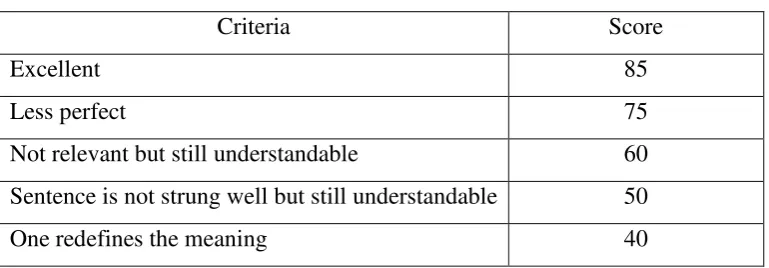
Table 3.4 : Standart Achieve
E. Technique of Collecting Data
1. Pre-Test
The procedures of conducting pre-test. Firstly, the test was given
before learning process or activity of the class treatment. Pre-test was
given for experimental and control groups. It was to know the
Not relevant but still understandable 60
Sentence is not strung well but still understandable 50
2. Treatment
The treatment was conducted after giving pre-test. The aims of
treatment were:
a. To find out the effectiveness of using collaborative writing
strategy on students’ achievement compared with the
conventional method.
b. To organize the treatment of two groups in class meeting
The treatment was done in experimental and control groups for
three times. Each class was treated by using same topics which
related into the English lesson.
3. Post Test
The procedures of conducting post test. The test was given after in
the last activity, after gave pre test and did the treatment. Post test was
given for experimental and control group.
F. Technique of Analyzing Data
The Data analyze by using data normality test by liliefors,
homogeneity testing, and hypothesis testing.
F =
Furthermore comparing with Ftable: Identically, if observed< Ftable,
then both of samples are homogeneous:
Mx –My
to =
SEMx- SEMy
Information :
t0 : t observations
Mx : mean results of post-test experimental class
My : mean result of post-test control class
SEMx- SEMy : standard error of the difference two groups
Analyzing data with the following steps:
a. Tabulate the test data of experimental class
b. Tabulate the test data of control class
CHAPTER IV
RESEARCH FINDING AND DISCUSSION
A. Data Description
The primary data in the writer’s research come from the
respondents, the second grade students of Madrasah Tsanawiyah
Al-Washliyah Tembung. There were two classes namely VIII-1 and VIII-5.
There were 40 students in VIII-1, and 40 students in VIII-5. VIII-1 as
experimental group, and VIII-5 as control group. Then, the writer gave the
test to the students to get the data about the students’ achievements in
writing recount text. The test is post-test after given a treatment and
pre-test. The goal of this research is to know the students’ achievements in
writing recount text. The complete data of the students’ achievement in
writing recount text in experimental group that were taught by
Collaborative Writing strategy can be seen in the following table
Table 4.1 : Achievement in writing recount text in experimental group that through Collaborative writing strategy
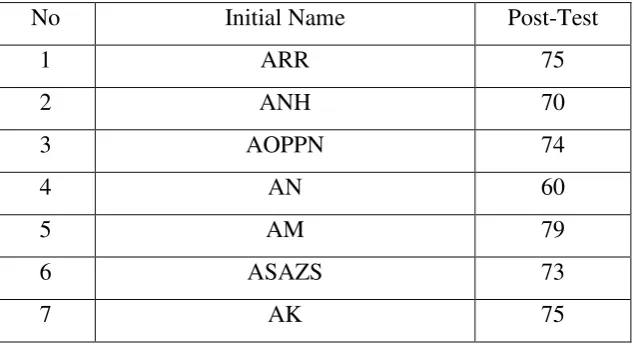
No Initial Name Post-Test
39 ZF 80
40 ZPS 75
Total 3104
Table 4.2 : Achievement in writing recount text in control group that through
conventional method
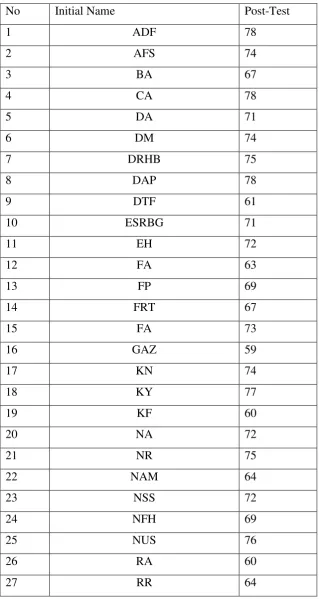
No Initial Name Post-Test
28 RP 73
Analysis requirement testing test has done ass follows: Normality test
and Homogeneity test. Normality test was use Liliefors test while
homogeneity test was uses Fcount all the test as follows:
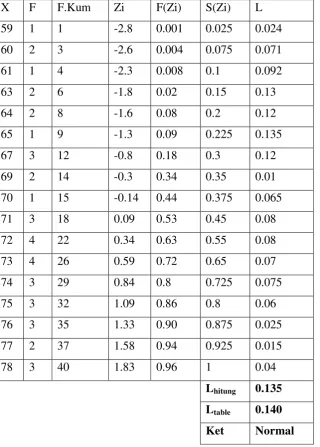
1. Testing Normality
To test of the data normality testing of the students’ achievement in
writing recount text was taught by using collaborative writing strategy.
After giving the treatment in experimental group by applying collaborative
writing strategy and in control group by applying conventional strategy,
the researcher gave the post-test. Post-test data were used to measure the
learning strategy. Samples in experimental group that was taught by
applying collaborative writing strategy had average score 77.6 and
standard deviation 5.2, whereas control group that taught by applying
conventional strategy had average score 70,6 and standard deviation 4.03.
Table 4.3: Testing Normality Post-test in Experimental Group
From the table above, it showed that Lhitung = 0.117, and N = 40,
using liliefors testing Ltabel = 0.14. Lhitung < Ltabel = 0.117 < 0.140 and it concluded that the data of post-test is normal. As shown by the table.
Table 4.4: Testing Normality Post-test in Control Group
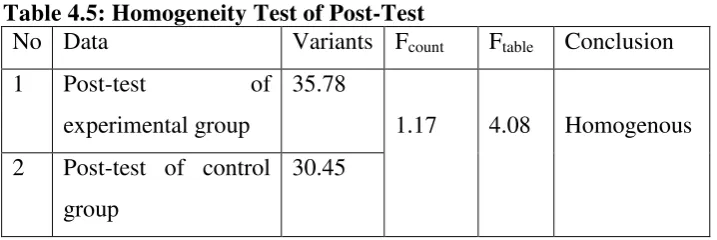
2. Homogeneity Testing
Data homogeneity examination of students’ achievement in writing
recount text that was taught by using collaborative writing strategy and the
students’ achievement in writing recount text that was taught by using
conventional strategy used F test (test equality of two variants) by using
the formula as follows:
F =
Table 4.5: Homogeneity Test of Post-Test
No Data Variants Fcount Ftable Conclusion
1 Post-test of
significant effect on students’ achievement in writing recount text, the
writer used t-test formula as follows:
t =
Where: t : total score
Mx : The mean score of experimental group
My : The mean score of control group
dx2 : The standard deviation of experimental group
Nx : The total number sample of experimental group
Ny : The total number sample of control group
The calculation showed that:
Mx = 18,1 My = 11,675
dx = 127,6 dy = 94,775
Nx = 40 Ny = 40
From the calculation of the data, it can be seen that there was the
differences score of pre-test and post-test between the two groups;
experimental group and control group. In order to find out the significant
differences of using collaborative writing strategy and without treatment
(use conventional method), the writer analyzed the data by applying t-test
formula to prove the hypothesis of this study. It was obtained that the
value of tobserved was 17.02.
C. Testing Hypothesis
The basic of testing hypothesis in this research were:
If t- observed > t-table, the hypothesis will be accepted
If t- observed < t-table, the hypothesis will be rejected.
In this research, the value of t-table for degree of freedom (df) 78 at
level of significance (α) 0.05 was 1.66.
The result computing t-test shows that t-observed (t-obs) is higher than
t-obs > t-table (α=0.05; df = 78)
17,02 > 1.66 (α=0.05; df = 78)
D. Discussion
In this study, the writer used collaborative writing strategy to find out
whether or not the significantly affects of students’ achievement in writing
recount text on second grade of MTs Alwashliyah Tembung. Before
conducting collaborative writing strategy, pre-test was given to both of
groups, and the data in experimental group were: the total score was 2380,
the highest score was 70, the lowest score was 50, and the mean score was
59.5. the data showed that the students score still low.
After conducting collaborative writing strategy, the writer gave
post-test to students in order to obtain their score. The data which had been
obtained in post-test of experimental groups were: the total score was 3104,
the highest score was 92, the lowest score was 60, and the mean score was
77.6. the data showed that collaborative writing strategy was effective to
be applied in teaching and learning process, especially in writing recount
text.
Furthermore, to find out the significant differences of using
collaborative writing strategy and conventional method in writing recount
text, the writer analyzed the data by applying t-test formula to prove the
hypothesis of this study, and the writer found that t-observed was 17.02.
whether the hypothesis is acceptable or rejected. After calculating the data,
the writer found that t-observed (17,02)was higher that t-table (1,667)
By using the statistical analysis on the data analysis and continued
with testing hypothesis, it was found that the alternative hypothesis Ha was
accepted and Ho was rejected. It means that the collaborative writing
strategy was significantly affect the students’ achievement in writing
BAB V
CONCLUSION AND SUGGESTION
A. Conclusion
After analyzing the data, it was conclude that there is a significant
effect of teaching writing by using collaborative writing strategy on
students’ writing achievement. Teaching writing by using collaborative
writing strategy gives better result than using conventional method.
The result showed that the value of t-observed is higher than the
value of t-table. (17.02 > 1.667 (α = 0.05)) with the degree of freedom (df)
= 78. Based on the data analysis of the study, the result indicates that the
alternative hypothesis (Ha) was accepted. It means that there is the
significant effect of using Collaborative writing strategy on student
achievement in writing recount text.
B. Suggestion
Based on the conclusion above, the researcher gives suggestion as
teaching by using collaborative writing strategy is provided effectively in
upgrading students’ achievement, so the researcher suggests that English
teacher should use the suitable strategy for students. So students can
understand about the teacher’s explanation and they can share the ideas,
48
REFERENCES
Anderson , Mark and Kathy Anderson. 1997. Text type in English. Australia:
Macmillan
Alan Meyers, 2005, Gate Away to Academic. Writing : Efective Sentences,
Paragraph and Essays, New York: Longman
Arikunto, Suharsimi. 2006. Prosedur Penelitian Suatu Pendekatan Praktik,
Jakarta:; PT. Rineka Cipta
Dewi, Utami, 2013, How to Write, La-Tansa Press: Medan.
Gorys Keraf. 2005. Argumentasi Dan Narasi, Jakarta : Gramedia
Harmer, Jeremy, 2004. How to Teach Writing. Malaysia: Longman
Harmer, Jeremy, 1998, How To Teach English, Harlow, Edinburgh Gate:
Longman
Hyland, K, 2002, Teaching and Researching Writing, Harlow, Pearson Education:
Longman
Johnson, K, 2001, An introduction Foreign Language Learning and Teaching,
New York: Pearson Education
Mulligan, and Gufallo, 2011, A collaborative writing approach: Methodology
and student assessment Ritsumeikan University
Nunan, David, 2003, Practical English Language Teaching, New York: Mc
Craw Hill
Pardiyono. 2007. Pasti bisa!! Writing Clues for Better Writing Competence.
Pardiyono. 2007. Pasti bisa!! Teaching Genre – Based Writing Yogyakarta: ANDI
Pulvness, A., Spratt,M., and Williams, M, 2005. Teaching Knowledge Tst Course.
New York: Cambridge University Press
Randal, H, 2004. Literacy an Introduction. Edinburgh: Edinburgh University
Sharples , Mike, 2003, How We Write Writing As Creative. New York : Routledge
Sitorus , Masgianto, 2011, Metodologi Penelitian Pendidikan Islam, Medan :
IAIN Press
Surah.My. Tafseer Alqur’an In English
Syahrum dan Salim. (2016). Metodologi Penelitian Kuantitatif, Bandung :
Citapustaka
Travers, John P, 1970. Fundamental of education psychology. Pensylvania:
International Textbook Company
Weigle , Sara Cushing, 2002, Assesing Writing, United Kingdom: Cambridge
Appendix I
Understand the meaning of essay text in the form of recount text in
daily life.
II. Basic Competence
Express the meaning and rhetorical steps of written essay accurately,
fluently, and understandably in the form of recount text.
III.Indicators
Identify the generic structure of recount text
Students are able to write a recount text.
IV.Objectives Learning
Students are able to make a simple recount text appropriate with the
social function, generic structure, and language features.
V. Materials
Social Function
To retell us about an events, an experience, or an action that
happened in the past
Generic Structure
a. Orientation, gives background information about who, where,
b. Record of events, tells event in chronological order, named:
Event 1, event 2, event 3.
c. Re-orientation, “rounds off” the sequence of events or retell
about what happened in the end.
Language Features
a. The use of nouns and pronouns
b. The use of action verbs
c. The use of past tense
d. The use of time conjunction
e. The use of adverb and adverb of phrases
f. The use of adjective
b. Techer checks the attendance list
c. Teacher introduces the material to student with some question
related to material before
d. Teacher explains recount text by using collaborative writing
strategy
2. Main Activities
Exploration:
a. The teacher ask the students understanding about recount text
b. The teacher divides student into group A and group B.
c. Teacher ask the student to exchange the information about
recount text
d. The teacher gives the topic “Visiting Parangtritis Beach” for
each groups.
e. The teacher ask the student to share information about the topic
in groups
Elaboration:
a. Teacher instruct students to mention generic structure and
grammatical features of recount text
b. Teacher asks students to write a recount text based on the part
of the text (orientation, events, and reorientation) in groups.
c. In groups, teacher instruct the students do outlining, planning,
and drafting of the first draft
d. Teacher instruct the student to make their based on the
information who they found
e. Students were required to hand in detailed outline before
submitting the first draft.
f. Teacher instructs group A to write the first draft and group B
will check it
g. Teacher checks the first draft and provide some comments and
suggestions.
h. Work on the second draft commenced. Group A and B
switched roles for this part. That is, this time student B had to
write the revision and student A had to edit it. The second draft
then submitted.
i. Teacher checks the second draft and provides some comments
and suggestion for better result.
Confirmation:
a. Teacher asks students to write a recount text based on their