Table of Contents
Volume 5 | Issue 1
Spring 2012
From the Editor Dr. Bruce E. Winston
ii
Article Abstracts iii
The Development and Use of the Theory of ERG: A Literature Review Jane R. Caulton
2
Leadership Behavior and Organizational Climate: An Empirical Study in a Non-profit Organization
Joseph B. Holloway
9
Acts 2: An Example of the Divine Empowerment of Leaders Wayne R. Sass
36
A Review of the Literature Concerning Ethical Leadership in Organizations Kelly Monahan
56
Divine Empowerment: An Intertexture Analysis of Acts 2 Bruce E. Watley
67
Development of Moral Reasoning at a Higher Education Institution in Nigeria James D. Rose
81
Divine Empowerment of Leaders: An Intertextual Analysis of Luke’s use of Joel
2, Psalm 16 and Psalm 110 in Peter’s Sermon in Acts 2
Edward W. Hatch
Volume 5, Issue 1
Spring 2012
Emerging Leadership Journeys (ELJ) is an academic journal that provides a forum for emerging scholars in the field of leadership studies. Contributors to this journal are Ph.D. students enrolled in the Organizational Leadership program in Regent University’s School of Global Leadership & Entrepreneurship. Representing the multidisciplinary field of leadership, ELJ publishes, bi-annually, the best research papers submitted by Ph.D. students during the first four terms of their doctoral journey. These selected papers reflect the students’ scholarly endeavors in understanding the phenomenon of leadership and in advancing the field of leadership studies ontologically, epistemologically, and axiologically.
EDITORIAL STAFF
Dr. Bruce E. Winston Editor
Regent University
Mrs. Eileen DesAutels Wiltshire Managing and Production Editor
Regent University
Mrs. Joy Henley Copy Editor
Regent University
EDITORIAL MEMBERS
FACULTY, SCHOOL OF GLOBAL LEADERSHIP & ENTREPRENEURSHIP
Dr. Corné Bekker
Regent University
Dr. Paul Carr
Regent University
Dr. Dail Fields
Regent University
PRODUCTION STAFF
Mrs. Julia Mattera
Communications Specialist
Regent University
Mrs. Sarah Stanfield Website Production
Regent University
Mr. Adam Woods Web Support
From the Editor
Dr. Bruce E. Winston
Volume 5 | Issue 1
Spring 2012
elcome to Volume 5, Issue 1 of Emerging Leadership Journeys (ELJ). This issue contains seven of the best research course projects submitted by students in their first, second, third, and fourth semesters of the Ph.D. in Organizational Leadership program. The Ph.D. in Organizational Leadership program has, as one of its objectives, to prepare students to conduct research and publish the findings. During the first year of the program, the focus on research is more on the conceptual, literature review and model/proposal side, thus the focus in ELJ on these types of papers. I am pleased to present these seven articles for your reading and consideration.
Article Abstracts
Volume 5 | Issue 1
Spring 2012
The Development and Use of the Theory of ERG: A Literature Review Jane R. Caulton
This literature review discusses twenty-three articles that have contributed to the development and understanding of the theory of existence, relatedness, and growth (ERG). The theory is traced from its outgrowth of Maslow’s Hierarchy of Needs through efforts to further understand and expand its implications. ERG is mostly applied to the study of human motivation in the workplace as a tool for increasing morale and productivity. It has helped researchers to understand what constitutes job satisfaction and to identify incentives. The literature includes empirical studies, mostly quantitative, and discussions of ERG as a means for promoting a cause. The range of literature shows that the theory has broad relevance, including sociological, psychological, and organizational.
Leadership Behavior and Organizational Climate: An Empirical Study in a Non-profit Organization
Joseph B. Holloway
The following control variables were collected from the sample and were statistically controlled in the data analysis: age, educational level, gender, job rank, and job tenure. The results of the study show that certain leadership behaviors do have an impact on a few dimensions of organizational climate.
Acts 2: An Example of the Divine Empowerment of Leaders Wayne R. Sass
The Holy Bible reveals the pre-existent nature of leadership, provides examples of divinely ordained leader-follower relationships, and forms the basis for leadership theory. Through intertexture analysis of the second chapter of the Acts of the Apostles, this paper explores the use of the gift of prophecy, through the Holy Spirit, to communicate God’s divine empowerment of leaders in the early Christian church as in the Old Testament. Through summary examinations of contemporary leadership theories, early Christian leaders’ behaviors are compared to the salient leadership behaviors associated with each of the theories as revealed in Acts chapter 2. The present piece demonstrates that, while the theoretical description and classification of these theories may be contemporary, their practice is ancient. Following a pattern that is evident in Scripture from before the beginning of time, Jesus Christ and subsequent leaders of the early Christian church divinely received their authority and empowerment to lead believers from God through the Holy Spirit.
A Review of the Literature Concerning Ethical Leadership in Organizations Kelly Monahan
The following article explores the literature regarding the topic of ethical leadership. Thirty-eight articles were identified that are written by authors who focused on four main topics. These topics are the definition of ethical leadership, the personal integrity and morality of a leader, how a leader ethically influences followers, and current challenges facing ethical leaders. These four topics are explored in further detail within the literature review. Overall, it is found that ethical leadership is complex and a relatively newer field of study. Yet, common themes include the need for establishing trust and gaining ethical knowledge by way of study and application. Also, major organizational failures, such as Enron, have ignited an interest within the field. Possible further research is recommended at the end of this review.
Divine Empowerment: An Intertexture Analysis of Acts 2 Bruce E. Watley
Using socio-rhetorical criticism analysis, and more specifically, oral-scribal, historical, social, and cultural intertexture, we are able to identify unique layers within the text. This aids in developing a richer meaning to aspects of the text that individuals often overlook when reading. God, through the Holy Spirit, gives divine empowerment to help individuals develop specific leadership styles. This article builds the case for (a) where divine empowerment comes from, (b) how it manifests in authentic Christ-centered leaders, and (c) how it applies to transformational leadership. Transformational leadership involves leaders who use idealized influence, intellectual stimulation, individual consideration and inspirational motivation with the sole intent of developing the follower to accomplish what they once believed was impossible. The result is a follower who develops through (a) vision, (b) empowerment, (c) motivation, (d) morality, and (e) individual growth. When a follower is fully developed they begin to change others through the same process.
Development of Moral Reasoning at a Higher Education Institution in Nigeria James D. Rose
The growing number of Nigerian higher education institutions should improve development of moral reasoning in Nigeria, assuming these institutions have a similar impact as institutions have had in the United States. To test this hypothesis, this study completed a cross-sectional survey of a Christian higher education institution in Nigeria using the Defining Issues Test (DIT2), a proven tool for measuring moral reasoning. The survey confirms that moral reasoning improves during undergraduate studies when students have contact with their professors outside of class. Although DIT2 scores were lower than United States norms, results indicate that the DIT2 N2 index can be used to measure relative moral reasoning levels in Nigeria. Additional research is needed to determine whether the lower Nigerian DIT2 scores are due to lower moral reasoning or other factors such as cultural differences.
Divine Empowerment of Leaders: An Intertextual Analysis of Luke’s use of Joel 2, Psalm 16 and Psalm 110 in Peter’s Sermon in Acts 2
Edward W. Hatch
1333 Regent University Drive, Suite #102 Virginia Beach, VA 23464-5048 757.352.4550 | [email protected]
A key factor in advancing the field of leadership and improving the leadership skills of professionals worldwide is the timely dissemination of relevant and innovative research. All of our publications are designed to stimulate scholarly debate, as both secular and Biblical principles are integrated to advance the field of leadership. Subscriptions to all of our online publications are provided at no charge.
Our journal articles may be reprinted in accordance with the doctrine of fair use as described in the U.S. Copyright Law. Anyone wishing to reprint School of Global Leadership & Entrepreneurship articles for commercial use or monetary gain must request permission and pay the associated fee. Please request reprint permission by completely and submitting the form located at the end of this journal, along with a check for any applicable reprint fee.
The Development and Use of the Theory of
ERG: A Literature Review
Jane R. Caulton
Regent University
This literature review discusses twenty-three articles that have contributed to the development and understanding of the theory of existence, relatedness, and growth (ERG). The theory is traced from its outgrowth of Maslow’s Hierarchy of Needs through efforts to further understand and expand its implications. ERG is mostly applied to the study of human motivation in the workplace as a tool for increasing morale and productivity. It has helped researchers to understand what constitutes job satisfaction and to identify incentives. The literature includes empirical studies, mostly quantitative, and discussions of ERG as a means for promoting a cause. The range of literature shows that the theory has broad relevance, including sociological, psychological, and organizational.
he theory of existence, resistance, and growth, commonly known as ERG, is the subject of this literature review. ERG is a motivational construct concerned with understanding the factors that contribute to individual human behavior. It is one of four content approaches that consider the intrinsic factors that cause a person to take specific actions (Ivancevich, Konopaske, & Matteson, 2008). Such understanding is useful to business students and practitioners seeking to understand and improve performance in the workplace. An outgrowth of Maslow’s Hierarchy of Needs, ERG may be used to explain and/or predict workplace issues, relationship paradigms, and personal development choices. According to Ivancevich, Konopaske, and Matteson (2008), “ERG has not stimulated a great deal of research,” so there is not a lot of empirical information available (p. 116). As a model of human need, however, ERG theory has been validated by human experience (Ivancevich, et al., 2008). The construct has been discussed in philosophical and empirical studies, and is often included with other content approaches to motivation. This literature review presents twenty-three articles from the following databases: ABI/Inform, Academic OneFile, Academic Source Complete, and JSTOR, as well as Library of Congress databases, especially Primo ArticleFinder. The selected articles fit into the categories of theory development, job performance, and advocacy.
Theory Development
The ERG Theory was developed between 1961 and 1978, during which the theorist empirically tested data to hone the theory’s major tenets and published scholarly material, according to Alderfer (1989). The article describes how the theory was developed, while contrasting the backgrounds of its author, Alderfer, with Maslow. Alderfer explains how the empirical study that validated ERG was conducted at an Easton, Pennsylvania, factory and further developed later with the construction of another empirical study at a larger facility, where measurements were improved and presented in a dissertation.
Wanous and Zany (1977) conducted a study that supported the integrity of ERG categories. Assessing the relationship between need satisfaction, importance, and fulfillment, they found that need fulfillment moderated satisfaction and importance. In other words, the importance of the need was based on the manner of its fulfillment. In addition, this phenomenon was more likely to exist within the categories of existence, relatedness, and growth, rather than between them.
From a military perspective, Wilcove (1978) found ERG lacking two critical categories: “respect for the organization and respect for one’s supervisor” (p. 305). The added categories, along with a third (the need for personal freedom), were vetted through the administration of a questionnaire to “630 Navy male enlisted personnel in 11 types of organizations” (p. 305). A factor analysis identified the need components and was used to develop scales, regression analysis determined the use of the scales, and a cross-validation correlation analysis validated the stableness of the predictor. The study supported the respect for organization need. However, mutual respect, social receptivity, and organizational respect also emerged from the study as relatedness needs. Wilcove suggests that future research should examine growth and relatedness needs in terms of family, and organizational impact on personal rights.
ERG has also been studied from the perspective of cultural application. Song, Wang, and Wei (2007) conducted an empirical study to determine if motivational preferences were influenced by culture, and if they could be characterized by ERG. The researchers surveyed 150 nonmanagerial employees in Jiangsu Province, east China. They found support for their hypotheses, also learning that motivational preferences differed between genders and personality types. They did not find, however, a correlation between gender and personality types. They recommend studying why and how motivational preferences correlate with needs and the relationship between esteem and performance. They also recommended that the study be conducted in other areas.
ERG was also used with the Hierarchy of Needs and hygiene factors in a dissertation examining job satisfaction of information technology (IT) leaders. This qualitative study condensed the categories of motivators to two: relatedness and tasks (Fismer, 2005). The researcher interviewed 20 Generation X (people born between 1961 and 1981) IT leaders to understand how job satisfaction was perceived in their industry. The aforementioned content-approach motivational theories provide the framework for the study. Fismer (2005) found that job satisfaction was related to extrinsic rewards.
ERG has even been used to improve technology. Chang and Yuan (2008) built a synthetic model combining ERG with the Markov Chain model, which predicts outcomes based on a series of interrelated points, to determine how customers would interact with a web-based project. The model was mapped to user behavior to simulate expected interaction. The simulation included 40 behavioral points coded to motivation levels of ERG and Maslow. The researchers concluded that the model accurately predicted customer needs in real-time. The study found ERG superior to Maslow in measurements of precision, recall, and F1 measure.
Job Performance
ERG Theory, along with the three other content approaches to observing motivation, provided the theoretical underpinnings for an empirical study of motivational factors in the workplace. Wiley (1997) explains that the survey was first conducted in 1946, and again in 1980, 1986, and 1992, respectively. Factors from the 1946 tool were used as variables in the 1992 survey, which was issued to 550 employees “in industries such as retailing, services, manufacturing, insurance, utilities, health care, and government agencies” (para. 22). Results indicated that the top five motivating factors for employees of the 1990s were “good wages, full appreciation for the work done, job security, growth in the organization, and interesting work” (para. 49). Future studies should consider what motivates people to high performance.
wages, good working conditions, promotion, job security, interesting work, and full appreciation of work done. The authors recommend that programs focused on developing managers also include factors affecting employee work life.
These results rang true for Kaliprasad (2006), who observed practices in China and South Africa. Kaliprasad discussed a meta-analysis of workplace motivation based on the content-approach motivation theories, including ERG. The technical article presented nine employment needs, which included “pay, job security, nice coworkers, recognition, and credit for work well done, a meaningful job, opportunities for promotions/advancement, comfortable, safe and attractive working conditions, competent and fair leadership, and reasonable order and directions” (p. 24). It recommended that employers listen to their staffs, value and respect the staff, value a free and clear mind, and provide information, support, and resources, among others.
Arnolds and Boshoff (2002) investigated the influence of need satisfaction on esteem and job performance intention based on ERG through surveying top-level executives and frontline employees in a variety of industries in South Africa. They received 517 responses from the 2,500 surveys that were mailed. The results confirmed that “esteem as a personality variable exerts a significant influence on the job performance of both top managers and frontline employees” (p. 697). The study noted that top managers are motivated by growth needs and their performance intentions are influenced by their perception of opportunities for growth and advancement. Arnolds and Boshoff also found that frontline employees find satisfaction in peer relationships and compensation, but pay and benefits did not influence esteem. Frontline employees’ need for growth did influence performance . They recommended a study investigate the relationship between self-esteem and job performance.
Esteem was also a factor emerging from a study of the career choice of teachers in Rawalpindi, Pakistan (Ud Din, Khan, & Murtasa, 2011). Another study using the content approach theories of motivation, including ERG, found that 90 teachers from 30 schools in the district chose their profession because of job satisfaction, rewards, recognition, and other growth needs. Researchers distributed and collected questionnaires by visiting secondary schools and colleges. They reported 100% participation in this empirical study.
Advocacy
The articles reviewed in this section included several that used ERG and other content approaches as a basis for advocating change in a variety of circumstances and environments. In a philosophical argument, Argarwal (2010) used ERG, along with Maslow and Hertzberg, to advocate for cash compensation for executives in India rather than benefits. The argument held that ERG empirical data supports compensating executives with cash instead of perquisites. Argarwal suggests that, as people fulfill their growth need, they regress to the lower existence need, which can only be satisfied with money. Liu and Zhang (2008) advocated that the agricultural community’s existence, relatedness, and growth needs could be enhanced by recruiting educated, upwardly-mobile talent. The authors note that the loss of talent was negatively affecting the agricultural community.
Mulder (2007) took another tack in using ERG for advocacy. The author applied the theory of ERG to explain his observance of students in a vocational school in the Netherlands. Mulder found that students seemed to be trapped in a frustration-regression phase called Demotivation Cycle. He suggested that student relatedness needs were tied to their existence needs. Their need to belong placed an emphasis on possessions and keeping up with trends. This focus distracts the youth and young adults from preparing for the future, resting in the shadow of their immediate concern: materialistic prosperity. He conceded that frustration-regression may also be triggered by academic failure and acknowledged that youth will vacillate between frustration-regression and satisfaction-motivation.
Linder (2007) spun the content approach theories to explain why some companies avoid post-completion audits. According to the article, implementing post-completion audits may negatively impact staff morale, impacting their senses of affiliation, self-esteem, and competence. Linder advised organizations considering a post-completion audit to allow employee participation, avoid tying extrinsic rewards to the audit, and to manage intensity during the procedure in order to maintain morale and motivation.
Conclusion
economic conditions, and even countries. Consistently, these studies show that extrinsic values are a prime influencer of human needs.
The research covered sociological, psychological, and organizational issues and noted many areas where the construct of ERG may be used as a study. These included studying the relationship between needs and family, esteem and performance, and the need for human rights. It was suggested that future work examine the process of motivational preference: what causes it and why.
About the Author
Jane R. Caulton is a student of organizational leadership at the Regent University School of Global Leadership & Entrepreneurship. Correspondence regarding this article may be addressed to Jane R. Caulton, Library of Congress, Washington, DC 20542. Email: [email protected]
References
Agarwal, A. S. (2010). Motivation and executive compensation. IUP Journal of Corporate Governance, 9(1), 27-46. Retrieved from http://vlex.in/source/iup-journal-corporate-governance-5174
Alderfer, C. (1989). Theories reflecting my personal experience and life dent. The Journal of Applied Behavioral Science, 25(4), 351-351/ Retrieved from
http://jab.sagepub.com/
Alderfer, C., & Guzzo, R. (1979, September). Life experiences and adults' enduring strength of desires in organizations. Administrative Science Quarterly, 24(3), 347-361. Retrieved from http://www2.johnson.cornell.edu/publications/asq/
Arnolds, A., & Boshoff, C. (2002, June). Compensation, esteem valance and job performance: An empirical assessment of Alderfer's ERG theory. International Journal of Human Resource Management, 13(4), 697(23). Retrieved from
http://www.tandf.co.uk/journals/routledge/09585192.html
Chang, W., & Yuan, S. (2008). A synthesized model of Markov chain and ERG theory for behavior forecast in collaborative prototyping. Journal of Information
Technology Theory and Application, 9(2), 45-63. Retrieved from http://aisel.aisnet.org/jitta/
Chen, T. (2008). The empirical research on the scientific and technical personnel's income motivation based on ERG theory: The analysis based on the 2600
Science. 2008-01. Retrieved from
http://en.cnki.com.cn/Article_en/CJFDTOTAL-KXYJ200801033.htm#
Fismer, E. (2005). Generation X leadership styles and job satisfaction in the information technology consulting industry. (doctoral dissertation). Retrieved from ProQuest Dissertations and Theses database. (UMI No. 3172511).
Islam, R., & Ismail, A. Z. (2008). Employee motivation: A Malaysian perspective.
International Journal of Commerce & Management, 18(4), 344-362. doi:10.1108/10569210810921960
Ivancevich, J., Konopaske, R., & Matteson, M. T. (2007). Organizational Behavior and Management (8th ed.). New York: McGraw-Hill Higher Education.
Kaliprasad, M. (2006). The human factor I: Attracting, retaining, and motivating capable people: A publication of the American Association of Cost Engineers. Cost
Engineering, 48(6), 20-26.
Linder, S. (2007). Dysfunctional motivational effects of post-completion audits. Cost Management, 21(1), 36-41.
Liu, C., & Zhang, Y. (2008). On brain drain in new countryside construction—from the perspective of ERG yheory. Journal of Jiangxi Agricultural University. (Social Sciences Edition), 2008-01. Retrieved from
http://en.cnki.com.cn/Article_en/CJFDTOTAL-JNDS200801009.htm
Mulder, L. (2007). Motivation cycles. Boise State University.
Song, L., Wang, Y., & Wei, J. (2007). Revisiting motivation preference within the Chinese context: An empirical study. Chinese Management Studies, 1(1), 25-41. doi:10.1108/17506140710735445
Ud Din, M., Khan, F., & Murtaza, A. (2011). Exploring motivational factors in the professional development career choice of a teacher. Interdisciplinary Journal of Contemporary Research in Business, 2(9), 501-510. Retrieved from
http://ijcrb.webs.com/nov09.pdf
Wanous, J., & Zwany, A. (1977). A cross sectional test of need hierarchy theory.
Organizational Behavior and Human Decision Processes, 18(1), 78-78. Retrieved from http://www.sciencedirect.com/science/journal/07495978
Wilcove, G. L. (1978). The ERG model: Expansion and application to Navy personnel.
Journal of Vocational Behavior, 13(3), 305-316. doi: 10.1016/0001-8791(78)90057-X
Leadership Behavior and Organizational
Climate: An Empirical Study in a Non-profit
Organization
Joseph B. Holloway
Regent University
The primary purpose of this research paper is to present an empirical study framed by the theory that task-oriented and relations-oriented leadership behaviors are positively related to the employees’ perceptions of organizational climate. The study examined the following research question: Are task-oriented and relations-oriented leadership behaviors related to different dimensions of organizational climate in a non-profit organization? The study introduces the theoretical perspective and examines the relevant literature that supports the significance of leadership behavior and organizational climate. The methodology for collecting the data was through the combination of two quantitative instruments into a web-based questionnaire consisting of 79 questions aimed at determining the relative contribution that the independent variables (task-oriented and relations-oriented leadership behaviors) have on the dependent variables (the different dimensions of organizational climate). The following control variables were collected from the sample and were statistically controlled in the data analysis: age, educational level, gender, job rank, and job tenure. The results of the study show that certain leadership behaviors do have an impact on a few dimensions of organizational climate.
on-profit organizations have a more central role in society’s response to social problems than ever before (Smith, 2002). Many non-profit organizations are small, ill equipped, and undercapitalized to respond to the growing demands of public funders for accountability. Non-profit organizations around the world are functioning in an increasingly competitive and complex world as they fiercely compete for funding sources, qualified staff, and clients (Jaskyte & Kisieliene, 2006; Trautmann, Maher, & Motley, 2007). This shortfall of available resources has increased the reliance that non-profit organizations have on corporate sponsorship, which has impacted the governance of their organizations (Gray & Bishop Kendzia, 2009).
organizations are responsible for their staff, customers, Board of Directors, multiple funding sources, and to their own particular clients and projects (Brinkerhoff & Brinkerhoff, 2002; Malloy & Agarwal, 2010). Even though planning for multiple constituencies may lead to differences in leadership behavior (Phipps & Burbach, 2010), Drucker (1990) reported that the toughest, most important task that non-profit leaders face is getting the different groups of constituencies to agree on the long-term goals of the organization. This task alone can create differences in how leaders of non-profit organizations behave.
Without positive daily interactions with their employees, or the human side of their work, the other aspects of a leader’s responsibilities will suffer (Cangemi, Burga, Lazarus, Miller, & Fitzgerald, 2008). Leadership is a two-sided engagement between leaders and employees to achieve a common goal (Antelo, Henderson, & St. Clair, 2010; Eagly, 2005; Northouse, 2010). This engagement actuates leaders to influence their employees’ behavior while simultaneously influencing their employees’ perceptions. This leads to expectations of appropriate conduct that becomes ingrained in the organizational climate (Grojean, Resick, Dickson, & Smith, 2004).
In many cases, effective leaders possess both a concern for the task while establishing an individual relationship with their employees. Since there is a relative direct connection between employees, their productivity, and the organization’s performance (Wang & Shyu, 2008), it is essential for leaders to maintain a positive work environment to maximize and enhance their employees’ efforts to reach organizational efficacy. Kouzes and Posner (2010) found that a leader’s behavior explains nearly 25 percent of the reason that people feel productive, motivated, energized, effective, and committed in their workplaces. As a result, the specific research question that addresses the theory in this paper is:
Research Question 1: Are task-oriented and relations-oriented leadership behaviors related to different dimensions of organizational climate in a non-profit organization?
Theoretical Perspective
The central importance of the study lies in the concept that employees are potentially the highest value within organizations (Chien, 2004). Although the research domains of leadership and organizational climate are implicitly entwined (Kozlowski & Doherty, 1989), there has been little theoretical development or empirical research that addresses the impact that task-oriented or relations-oriented leadership behaviors have on organizational climates in non-profit organizations. Hui, Chiu, Yu, Cheng, and Tse (2007) found that some authors conceptualize leadership behavior as a precursor to organizational climate (e.g. Dickson, Smith, Grojean, & Ehrhart, 2001; Koene, Vogelaar, & Soeters, 2002; Litwin & Stringer, 1968). Momeni (2009) found that more than 70% of employees’ perceptions of organizational climate are shaped directly by their leader’s style of leadership and behavior.
Kozlowksi & Doherty (1989) noted that early theorists (e.g. Blake & Mouton, 1964; Indik, 1968; Lewin, 1951; Likert, 1967; Litwin & Stringer, 1968; McGregor, 1960) regarded leadership as an important organizational factor that affected employees’ perceptions of climate. Momeni (2009) concluded that a leader’s behavior has a great influence on employees’ attitudes, behaviors, emotions, morale, and perceptions. Thus, it is perceived through the examination of the literature that a leader’s behavior can potentially lead to the creation and continual survival of a positive, thriving organizational climate in a non-profit organization.
Leadership Behavior
Hooijberg, Lane, and Diversé (2010) explained that there has been an extensive collection of theories studied that give emphasis to behavioral approaches to leadership ranging from Fiedler’s (1967) LPC theory to House’s (1971) path-goal theory to Quinn’s (1988) competing values framework (CVF) and Bass’ (1985) transformational leadership theory. A leader’s behavior is a powerful display of mannerisms that convey the expectations and values of the organization that sets the tone for the organizational climate (Grojean et al., 2004). According to Yukl (2006), researchers have spent more time and energy conducting research on leadership behavior than on any other aspect of leadership. Research in leadership behavior falls into one of two categories: the first line of research examines how leaders spend their time throughout the day, their particular pattern of activities, and their job responsibilities. The second line of research focuses on identifying effective leadership behavior. Despite the fact that there could potentially be numerous leadership behaviors, Farris (1988) identified two specific kinds of leadership behaviors: task-oriented behaviors and relations-oriented behaviors.
lines, and showing how the goals are to be achieved. As a rule, task-oriented leaders use a one-way communication method to clarify what needs to be done, who is responsible for doing it, and how it needs to be done. Task-oriented leaders coordinate, plan, and schedule work-related activities. They provide their employees with the necessary motivation, equipment, supplies, and technical assistance for completing the task (Northouse, 2010).
Task-oriented behaviors include clarifying roles and objectives, monitoring individual performance and operations, and short-term planning (Yukl, O’Donnell, & Taber, 2009). Clarifying behaviors include assigning tasks, explaining job responsibilities, and setting performance expectations. Monitoring behaviors include inspecting the progress and quality of work. Planning behaviors include determining staffing requirements and how to fittingly use them to reach the goals and objectives of the organization.
Relations-oriented leadership behaviors. Relations-oriented leaders, on the other hand, are more concerned with developing close, interpersonal relationships. They involve a two-way communication method to show social and emotional support while helping their employees feel comfortable about themselves, their co-workers, and their situations (Northouse, 2010). Relations-oriented leaders demonstrate an understanding of their employees’ problems. They help to develop their employees’ careers. They provide their employees with enough information to do the job, they allow individual autonomy in work, and they show appreciation.
According to Yukl (2006), relations-oriented leadership behaviors include supporting behaviors, developing behaviors, and recognizing behaviors. Supporting behaviors include showing acceptance, concern, and confidence for the needs and feelings of others. Developing behaviors provide potential benefits to new, inexperienced supervisors, colleagues, peers, or subordinates. Recognizing behaviors show praise and appreciation to others for effective performances, significant achievements, and important contributions to the organization. Table 1 includes additional explanations of task-oriented and relations-oriented leadership behaviors.
Table 1
The 12 Leadership Dimensions According to Stogdill
Task-oriented behaviors Relations-oriented behaviors
Production emphasis– applies pressure for productive output.
Tolerance of freedom– allows staff members scope for initiative, decision, and action.
Initiation of structure– clearly defines own role and lets followers know what is expected.
Tolerance of uncertainty– is able to tolerate uncertainty and postponement without anxiety or upset.
leadership role rather than surrendering
Predictive accuracy– exhibits foresight and ability to predict outcomes accurately.
Superior orientation– maintains cordial relations with superiors, has influence with them, and strives for higher status.
Integration– maintains a close-knit organization and resolves intermember conflicts.
Note. Adapted from “Preferred leadership style differences: Perceptions of defence industry labour and management,” by P. R. Lucas, P. E. Messner, C. W. Ryan, and G. P. Sturm, 1992, Leadership & Organization Development Journal, 13(7), p. 19.
Organizational Climate
Although the concept of organizational climate stemmed from McClelland-Atkinson’s theory or human motivation, Litwin and Stringer (1968) defined organizational climate as the set of measurable properties of the work environment that is either directly or indirectly perceived by the employees who work within the organizational environment that influences and motivates their behavior. According to Litwin and Stringer (1968), the operational definition of organizational climate is the sum of individual perceptions working in the organization. Reichers and Schneider (1990) explained that it is the shared perceptions of “the way things are around here” (p. 22). Organizational climate is a molar concept that pinpoints the organization’s goals and means to obtain these goals. Organizational climate is the formal and informal shared perceptions of organizational policies, practices, and procedures (Schneider, 1975). In terms of relationships among organizational members, organizational climate focuses on its members’ perceptions of the way things are. It is the employees’ perceptions and attitudes toward their organization at any given time (Momeni, 2009).
way, then the results of these changes or differences could produce a different organizational climate (Muchinsky, 1976).
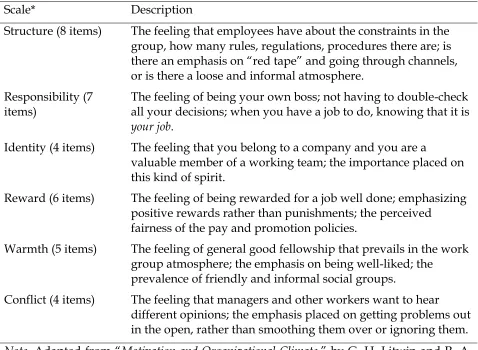
Litwin and Stringer (1968) established nine separate a priori scales for organizational climate. The six dimensions used in this study and their descriptions are described below in Table 2.
Table 2
Dimensions of the Litwin and Stringer Organizational Climate Questionnaire
Scale* Description
Structure (8 items) The feeling that employees have about the constraints in the group, how many rules, regulations, procedures there are; is there an emphasis on “red tape” and going through channels, or is there a loose and informal atmosphere.
Responsibility (7 items)
The feeling of being your own boss; not having to double-check all your decisions; when you have a job to do, knowing that it is
your job.
Identity (4 items) The feeling that you belong to a company and you are a
valuable member of a working team; the importance placed on this kind of spirit.
Reward (6 items) The feeling of being rewarded for a job well done; emphasizing positive rewards rather than punishments; the perceived
fairness of the pay and promotion policies.
Warmth (5 items) The feeling of general good fellowship that prevails in the work group atmosphere; the emphasis on being well-liked; the
prevalence of friendly and informal social groups.
Conflict (4 items) The feeling that managers and other workers want to hear different opinions; the emphasis placed on getting problems out in the open, rather than smoothing them over or ignoring them.
Note. Adapted from “Motivation and Organizational Climate,” by G. H. Litwin and R. A.
Stringer, 1968, pp. 81-82. Copyright 1968 by Boston: Division of Research, Graduate School of Business Administration, Harvard University.
*Only these six dimensions were used to study the organizational climate within the non-profit organization.
Shepard, 1994). Litwin and Stringer (1968) found that the leaders that assign roles and tightly define employees’ spheres of operation maintain order and structure within the organization. Through these behaviors, leaders set the tone for the organizational structure, which sets the order for the structure’s atmosphere.
Responsibility. Whereas it is the leader’s responsibility to provide support and
employee development, Badawy (2007) explained that it is the employees’ responsibility to take the opportunities provided and build his or her career upon them. Although task-oriented leaders are concerned with the job and reaching their goals, they are inclined to promote individual responsibility so that the organization can reach its goals. Litwin and Stringer (1968) found that leaders that value goal-oriented results encourage their employees to take personal responsibility for their specific job tasks and the results of these tasks. By doing so, employees set high standards for themselves and for the organization. In a sense, it is as they feel as though they are their own bosses.
Identity. Employees tend to fear discouraging behaviors such as being put down, humiliated, disrespected, and talked to sarcastically (Cangemi et al., 2008). These types of behaviors create mistrust in the organization. Caldwell, Hayes, and Tien Long (2010) found that an employee’s trust increases in his or her leader when the leader’s behavior is perceived as trustworthy. Leaders that fail to display trust tend to set negative tendencies for organizational climates as their employees struggle to properly discern truths from everything else. The display of truth and respect fosters a sense of moral fiber that employees are able to identify with.
H1: Task-oriented leadership behaviors are positively related to organizational climate dimensions of structure, responsibility, and identity.
Reward. Reward is the feeling that a leader’s encouragement and humanitarian efforts
are important factors of the reward system (Downey et al., 1975). Successful leaders adjust their behavior in accordance with the organizational requirements or according to the demand of the situation (Bodla & Nawaz, 2010; Bruno & Lay, 2008; Goleman, Boyatzis, & McKee, 2001). Leaders that behave according to the moment or situation help to create an organizational climate with less stress and worry. When leaders adjust their behavior accordingly, they reduce employee turnover and burnout, which as Momeni (2009) stated, allows organizations to operate more efficiently and maximize performance. This helps to create the perception of fairness within the organization.
warmth dimension of their organization’s climate often create an atmosphere where friendly attitudes and perceptions prevail (Day & Bedeian, 1991). These coincide with Litwin and Stringer’s (1968) description of the warmth dimension of organizational climate.
Conflict. An open climate describes the authenticity and openness of interaction between leaders and their employees (Raza, 2010). Leaders that are open and honest in communications and relationship build trust over time (Hess & Bacigalupo, 2011). Leaders that fail to establish an open and honest environment create organizational climates that lack the strategic data conducive for taking proper risks and making proper decisions (Cangemi et al., 2008). Although openness is one of the Big Five Personality Factors, Northouse (2010) explained that it was the tendency to be creative, curious, informed, and insightful. Leadership behavior that is open leads to transparency, and transparency promotes organizational intelligence, which fosters a positive organizational climate. Leaders help by uniting their employees to create and maintain a close-knit bond.
H2: Relations-oriented leadership behaviors are positively related to organizational
climate dimensions of reward, warmth, and conflict.
Method
Sample
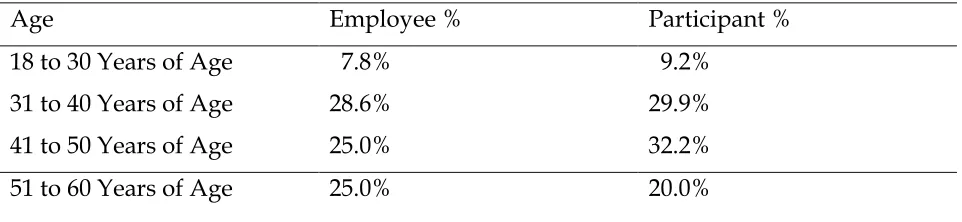
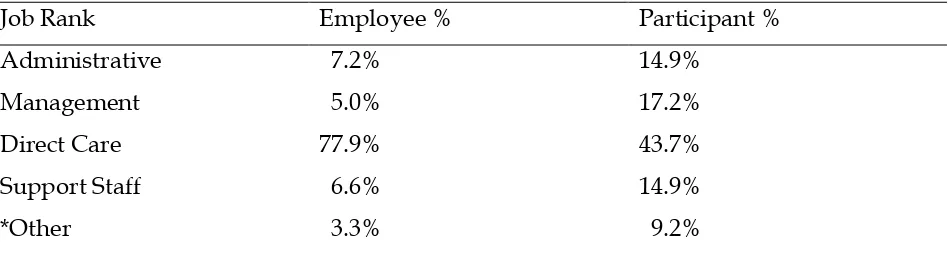
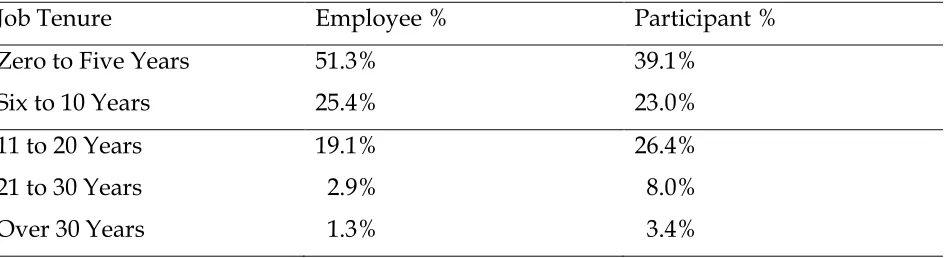
The data were collected from a sample of employees of a non-profit organization in southeast Georgia that provides human services to the residents within its allotted catchment area. Of the 303 employees, 89 participated in the survey. Since two of the 89 completed surveys lacked sufficient data, they were discarded; thus, the study sample contained 87 employees (N = 87). The response rate was 29 percent. Participation was voluntary and their identity remained anonymous. The participants were not compensated in any way for their participation in the study. Table 3 through Table 7 provides demographic information for the non-profit organization and participants.
Table 3
Demographic Information (Age)
Age Employee % Participant %
18 to 30 Years of Age 7.8% 9.2%
31 to 40 Years of Age 28.6% 29.9%
41 to 50 Years of Age 25.0% 32.2%
Over 60 Years of Age 12.0% 8.0%
Table 4
Demographic Information (Education Level)
Education Level Employee % Participant %
High School Graduate 57.8% 24.1%
Associate’s Degree 8.9% 18.4%
Bachelor’s Degree 15.5% 16.1%
Graduate Degree 9.6% 18.4%
Advanced Degree or Licensure
8.3% 23.0%
Table 5
Demographic Information (Gender)
Gender Employee % Participant %
Male 33.0% 20.5%
Female 67.0% 79.3%
Table 6
Demographic Information (Job Rank)
Job Rank Employee % Participant %
Administrative 7.2% 14.9%
Management 5.0% 17.2%
Direct Care 77.9% 43.7%
Support Staff 6.6% 14.9%
*Other 3.3% 9.2%
Table 7
Demographic Information (Job Tenure)
Job Tenure Employee % Participant %
Zero to Five Years 51.3% 39.1%
Six to 10 Years 25.4% 23.0%
11 to 20 Years 19.1% 26.4%
21 to 30 Years 2.9% 8.0%
Over 30 Years 1.3% 3.4%
The demographic information for the non-profit organization and the participants provided in Table 3 through Table 7 show that the sample percentage was relatively consistent with the organization’s percentages in terms of age and gender. In terms of education level, there was an overweight of employees with a higher level of education. Additionally, there was an overweight in administrative employees. And finally, there was an underweight in direct care staff compared to the other job rank categories.
Procedure
The methodology for collecting the data was through the combination of the Leader Behavior Description Questionnaire (LBDQ) and Litwin and Stringer’s (Form B) (1968) Organizational Climate Questionnaire (LSOCQ) into a web-based survey using the website http://www.surveyqizmo.com. Each of the 303 employees from the non-profit organization was invited to participate in the study via an organizational wide email that contained a link to the web-based questionnaire. The initial email was sent on May 24, 2011, with a follow up email on June 1, 2011. The data were collected June 6, 2011.
Measures
this sample for task-oriented leadership behaviors was .78 and .91 for relations-oriented leadership behaviors.
Organizational climate. The instrument used to measure organizational climate was the LSOCQ (Appendix B). Using a four-point Likert scale anchored by (Definitely Agree to Definitely Disagree), this questionnaire consists of 50 statements about an organization, which are comprised of nine separate a priori dimensions. Of the nine separate a priori dimensions, only six dimensions were used in this study resulting in 34 statements. As mentioned above, the six dimensions used within this sample were: (a) structure, (b) responsibility, (c) identity, (d) reward, (e) warmth, and (f) conflict. Sims and LaFollette (1975) found that these six dimensions of Litwin and Stringer’s organizational climate questionnaire actually measured a general affect tone toward other people and management rather than structures or standards; thus, these six dimensions are appropriate for this study since the hypotheses are aimed at leadership behavior and organizational climate rather than structures or standards. The Cronbach alpha in this sample for structure was .76, responsibility .50, identity .75, reward .81, warmth .75, and conflict .48. Only the second and third items of the conflict were used since the combination of the four items resulted in a Cronbach alpha value of .23.
Control variables. Prior research has shown that there are differences among gender perceptions regarding organizational climate. For example, Phillips, Little, and Goodine (1996) found that organizational climate impacts a woman’s personal projects and degree of satisfaction with work to a much greater degree than their male counterparts. Also, women are more attuned and responsive to the organizational climate than men, and they tend to operate with a different perspective as well. Additionally, Iqbal (2011) found that researchers must consider other personal factors such as age, educational level, job rank, and job tenure when studying organizational climate as they were all found to have a positive and significant relationship with various organizational climate dimensions. Kerlinger and Lee (2000) explained that anything that affects the controls of a research design presents a problem for internal validity. As a result, personal demographics such as age, educational level, gender, job rank, and job tenure were statistically controlled in the data analysis.
Results
Descriptive Statistics
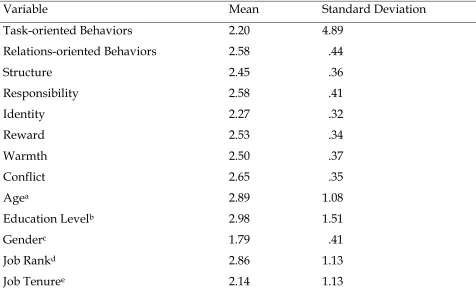
Table 8
Descriptive Statistics (N = 87)
Variable Mean Standard Deviation
Task-oriented Behaviors 2.20 4.89
Relations-oriented Behaviors 2.58 .44
Structure 2.45 .36
Responsibility 2.58 .41
Identity 2.27 .32
Reward 2.53 .34
Warmth 2.50 .37
Conflict 2.65 .35
Agea 2.89 1.08
Education Levelb 2.98 1.51
Genderc 1.79 .41
Job Rankd 2.86 1.13
Job Tenuree 2.14 1.13
Note.aAge was measured in years (1 = 18 to 30 Years of Age, 2 = 31 to 40 Years of Age, 3 =
41 to 50 Years of Age, 4 = 51 to 60 Years of Age, and 5 = Over 61 Years)
bEducational level was measured on a five-point Liker scale (1 = High School Graduate, 2 = Associate Degree, 3 = Bachelor Degree, 4 = Graduate Degree, and 5 = Advanced Degree or Licensure)
cGender was measured by (1 = Male, 2 = Female)
dJob rank was measured on a five-point Likert scale (1 = Administrative, 2 = Management, 3 = Direct Care, 4 = Support Staff, and 5 = Other)
eJob tenure was measured in years on a five-point Liker scale (1 = Zero to Five Years, 2 =
Six to 10 Years, 3 = 11 to 20 Years, 4 = 21 to 30 Years, and 5 = Over 30 Years)
Correlations
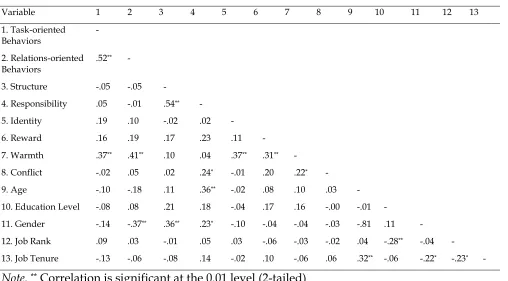
Task-oriented leadership behaviors and structure, responsibility, and identity. There is a negative and insignificant correlation between task-oriented leadership behaviors and the organizational climate dimension structure (r = -.05, ns). There is a positive and insignificant correlation between task-oriented leadership behaviors and the organizational climate dimension responsibility (r = .05, ns). There is a positive and insignificant correlation between task-oriented leadership behaviors and the organizational climate dimension identity (r = .19, ns).
Relations-oriented leadership behaviors and reward, warmth, and conflict. There is a positive and significant correlation between relations-oriented leadership behaviors and the organizational climate dimension reward (r = .19, p = .06). There is a positive and significant correlation between relations-oriented leadership behaviors and the organizational climate dimension warmth (r = .41, p < .01). There is positive and insignificant correlation between relations-oriented leadership behaviors and the organizational climate dimension conflict (r = .05, ns).
Other correlations. There is a positive and significant correlation between age and responsibility (r = .36, p < .01), and there is a positive and significant correlation between age and job tenure (r = .32, p < .01). There is a negative and significant correlation between gender and relations-oriented leadership behaviors (r = -.37, p < .01); thus, as the number of females (Female = 2) increases, the mean for the relations-oriented leadership behavior decreases. There is also positive and significant correlation between gender and the organizational climate dimension structure (r = .23, p < .05).
Table 9
Intercorrelations (N = 87)
Variable 1 2 3 4 5 6 7 8 9 10 11 12 13
1. Task-oriented Behaviors
-
2. Relations-oriented Behaviors
.52** -
3. Structure -.05 -.05 -
4. Responsibility .05 -.01 .54** -
5. Identity .19 .10 -.02 .02 -
6. Reward .16 .19 .17 .23 .11 -
7. Warmth .37** .41** .10 .04 .37** .31** - 8. Conflict -.02 .05 .02 .24* -.01 .20 .22* -
9. Age -.10 -.18 .11 .36** -.02 .08 .10 .03 -
10. Education Level -.08 .08 .21 .18 -.04 .17 .16 -.00 -.01 -
11. Gender -.14 -.37** .36** .23* -.10 -.04 -.04 -.03 -.81 .11 -
12. Job Rank .09 .03 -.01 .05 .03 -.06 -.03 -.02 .04 -.28** -.04 -
13. Job Tenure -.13 -.06 -.08 .14 -.02 .10 -.06 .06 .32** -.06 -.22* -.23* -
Note.** Correlation is significant at the 0.01 level (2-tailed) * Correlation is significant at the 0.05 level (2-tailed)
Hierarchical Regression Analysis
Hierarchical multiple regression was conducted on each of the six organizational climate dimensions to examine the contribution of specific theory driven variables in explaining the hypotheses. In order to control for possible confounding influences of extraneous variables, age, education level, gender, job rank, and job tenure were first entered into the hierarchical procedure and represent Step One in each of the six organizational climate dimensions. Table 10 through Table 15 provides the regression analysis results.
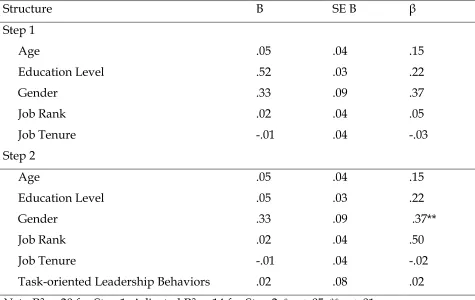
with a significant contribution to this organizational climate dimension. Task-oriented leadership behaviors do not cause a unique or significant contribution to the organization climate dimension structure; thus, this portion of H1 is not supported. The regression analysis results for structure are shown in Table 10.
Table 10
Hierarchical Regression Analysis – Structure (N = 87)
Structure B SE B β
Step 1
Age .05 .04 .15
Education Level .52 .03 .22
Gender .33 .09 .37
Job Rank .02 .04 .05
Job Tenure -.01 .04 -.03
Step 2
Age .05 .04 .15
Education Level .05 .03 .22
Gender .33 .09 .37**
Job Rank .02 .04 .50
Job Tenure -.01 .04 -.02
Task-oriented Leadership Behaviors .02 .08 .02
Note. R2 = .20 for Step 1. Adjusted R2 = .14 for Step 2; *p < .05, **p < .01
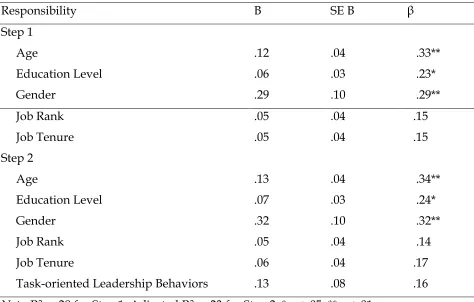
only two variables with a significant contribution as p < .01. Education level was significant as p < .05. Task-oriented leadership behaviors do not cause a unique or significant contribution to the organizational climate dimension responsibility; thus, this portion of H1 is not supported. The regression analysis results for responsibility are shown in Table 11.
Table 11
Hierarchical Regression Analysis – Responsibility (N = 87)
Responsibility B SE B β
Step 1
Age .12 .04 .33**
Education Level .06 .03 .23*
Gender .29 .10 .29**
Job Rank .05 .04 .15
Job Tenure .05 .04 .15
Step 2
Age .13 .04 .34**
Education Level .07 .03 .24*
Gender .32 .10 .32**
Job Rank .05 .04 .14
Job Tenure .06 .04 .17
Task-oriented Leadership Behaviors .13 .08 .16
Note. R2 = .28 for Step 1. Adjusted R2 = .23 for Step 2; *p < .05, **p < .01
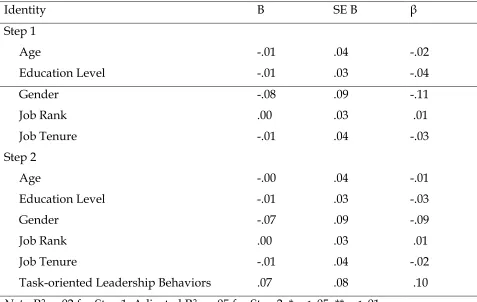
leadership behaviors contribute the most explanation for this organizational climate dimension, they do not cause a unique or significant contribution to the organizational climate dimension identity as p > .05; thus, this portion of H1 is not supported. The regression analysis results for identity are shown in Table 12.
Table 12
Hierarchical Regression Analysis – Identity (N = 87)
Identity B SE B β
Step 1
Age -.01 .04 -.02
Education Level -.01 .03 -.04
Gender -.08 .09 -.11
Job Rank .00 .03 .01
Job Tenure -.01 .04 -.03
Step 2
Age -.00 .04 -.01
Education Level -.01 .03 -.03
Gender -.07 .09 -.09
Job Rank .00 .03 .01
Job Tenure -.01 .04 -.02
Task-oriented Leadership Behaviors .07 .08 .10
Note. R2 = .02 for Step 1. Adjusted R2 = -.05 for Step 2; *p < .05, **p < .01
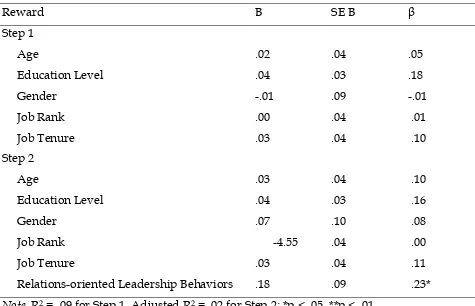
organizational climate dimension. Since the significance level is approaching p ≤ .05, it is considered significant at p = .06 because it would probably reach the significance level of p < .05 with a larger sample; thus, this portion of H2 is supported. The regression analysis results for reward are shown in Table 13.
Table 13
Hierarchical Regression Analysis – Reward (N = 87)
Reward B SE B β
Step 1
Age .02 .04 .05
Education Level .04 .03 .18
Gender -.01 .09 -.01
Job Rank .00 .04 .01
Job Tenure .03 .04 .10
Step 2
Age .03 .04 .10
Education Level .04 .03 .16
Gender .07 .10 .08
Job Rank -4.55 .04 .00
Job Tenure .03 .04 .11
Relations-oriented Leadership Behaviors .18 .09 .23*
Note. R2 = .09 for Step 1. Adjusted R2 = .02 for Step 2; *p < .05, **p < .01
significant contribution to the organizational climate dimension warmth as p < .01; thus, this portion of H2 is supported. The regression analysis results for warmth are shown in Table 14.
Table 14
Hierarchical Regression Analysis – Warmth (N = 87)
Warmth B SE B β
Step 1
Age .05 .04 .13
Education Level .04 .03 .15
Gender -.04 .10 -.04
Job Rank -.01 .04 -.02
Job Tenure -.04 .04 -.11
Step 2
Age .08 .04 .23
Education Level .03 .03 .11
Gender .14 .10 .15
Job Rank -.01 .04 -.04
Job Tenure -.03 .04 -.08
Relations-oriented Leadership Behaviors .41 .09 .50**
Note. R2 = .24 for Step 1. Adjusted R2 = .18 for Step 2; *p < .05, **p < .01
the organizational climate dimension conflict as p > .05; thus, this portion of H2 is not supported. The regression analysis results for conflict are shown in Table 15.
Table 15
Hierarchical Regression Analysis – Conflict (N = 87)
Conflict B SE B β
Step 1
Age .01 .04 .02
Education Level .00 .03 .00
Gender .16 .10 .18
Job Rank .00 .04 .01
Job Tenure .03 .04 .09
Step 2
Age .02 .04 .05
Education Level -.00 .03 -.01
Gender .21 .11 .24
Job Rank .00 .04 .00
Job Tenure .03 .04 .10
Relations-oriented Leadership Behaviors .12 .10 .15
Note. R2 = .05 for Step 1. Adjusted R2 = -.02 for Step 2; *p < .05, **p < .01
Hypothesis Testing Results
Discussion
The results of this present study indicate a positive and significant relationship between relations-oriented leadership behaviors and the organizational climate dimension reward (r = .19, p = .06) and warmth (r = .41, p < .01). These results confirm Litwin and Stringer’s (1968) finding that distinct organizational climates can be created by varying leadership styles. These findings demonstrate that, if leaders want their employees to be more committed to the organization, which ultimately reduces turnover and the numbers of absent days, then they must develop close and interpersonal relationships with their employees. Relations-oriented leaders socialize and build relationships (Yukl, 2006), and through the formalization of relationships, leaders foster a sense of teamwork and cohesion that promotes positive relationships throughout the organization’s atmosphere.
It is noteworthy that task-oriented leadership behaviors were found to have a positive and significant relationship with the organizational climate dimension warmth (r = .37, p < .01). Based on almost polar opposites of task-oriented and relations-oriented leadership behaviors, it appears that the organizational climate dimension warmth is receptive to both types of leadership behaviors. If task-oriented leaders are aware that their behavior impacts the warmth dimension of organizational climate, he or she could promote his or her goal, method of reaching this goal, and timeline for completion in such a way that creates a pleasant and friendly work environment. Just because a leader may be more task-oriented than relations-oriented does not mean that he or she cannot fully grasp the concept that his or her behavior can ultimately impact the organizational climate. And, if he or she would act accordingly within their task-oriented behaviors, they could, just as this study’s results indicate, easily increase the employees’ perception of the organizational climate dimension warmth.
Limitations and Future Research
The first potential limitation to the study is that the tested theories were within a sample of employees at one non-profit organization in which the sample had a higher educational level average than organizational average. This limitation could likely lead to a common method variance, which, according to Podsakoff, MacKenzie, Lee, and Podsakoff (2003), is a variance that is attributable to the method of measurement rather than constructs the variables represent. A second limitation was the procedure utilized for collecting data. As previously mentioned, the method of collecting data was through the combination of the two quantitative instruments into a web-based survey using the website http://www.surveyqizmo.com that was sent via email to each of the 303 non-profit organization’s employees at multiple sites. As a result, the response rate was only 29 percent. Future researchers could correct both of these limitations by collecting data from multiple sources and multiple samples because he or she would have independent assessments of the variables (Podsakoff & Organ, 1986).
Another limitation of solely studying the behavior of a leader having an impact on organizational climate is because it limits its focus on task situations and personality traits of the leader (Farris, 1988). The final limitation to this study is the potential threat to the internal validity through repeated testing. Some of the employees of the non-profit organization participated in an organizational climate survey in October 2010, and although the instruments and the intent of the study were different than initially used, there is the possibility of the participants developing a bias of taking numerous surveys without the organization’s leaders taking appropriate actions to improve the employees’ perceptions of the organizational climate.
Organizational climate is impacted by numerous factors and dimensions (Iqbal, 2011), and as a result, future research can study the impact that task-oriented and relations-oriented leadership behaviors might have on other dimensions of organizational climate. Future studies could also examine potential relationships between other leadership dimensions, traits, or characteristics with different organizational climate dimensions. Additionally, future studies could examine whether or not, and to what extent, the full-range leadership theory might have on the different dimensions of organizational climate. Finally, future studies could go beyond a non-profit organization and examine whether, and to what extent, leadership behaviors might impact the organizational climate of for-profit organizations.
Conclusion
research results revealed that relations-oriented leadership behaviors have a positive and significant relationship with the organizational climate dimensions reward and warmth. The research also revealed that task-oriented leadership behaviors have a positive and significant relationship with the warmth organizational climate dimension. The sample used was a non-profit organization.
About the Author
Joseph B. Holloway is a doctoral student studying organizational leadership at the Regent University School of Global Leadership & Entrepreneurship. Correspondence concerning this article should be addressed to Joseph B. Holloway, 3408 Wren Drive, Waycross, GA 31503. Email: [email protected]
References
Antelo, A., Henderson, R. L., & St Clair, N. (2010). Understanding the process model of leadership: Follower attribute design and assessment. Journal of College Teaching and Learning, 7(4), 9-14.
Badawy, M. K. (2007). Managing human resources. Research Technology Management,
50(4), 56-74.
Bass, B. M. (1985). Leadership and performance beyond expectations. New York, NY: The Free Press.
Blake, R. R., & Mouton, J. S. (1964). The managerial grid. Houston, TX: Gulf Publishing. Bodla, M. A., & Nawaz, M. M. (2010). Transformational leadership style and its
relationship with satisfaction. Interdisciplinary Journal of Contemporary Research in Business, 2(1), 370-381.
Brinkerhoff, J. M., & Brinkerhoff, D. W. (2002). Government-nonprofit relations in comparative perspective: Evolution, themes and new directions. Public Administration & Development, 22(1), 3-18.
Brown, R. B., & Brooks, I. (2002). Emotion at work: Identifying the emotional climate of night nursing. Journal of Management Medicine, 16(5), 327-344.
Bruno, L. F. C., & Lay, E. G. E. (2008). Personal values and leadership effectiveness.
Journal of Business Research, 61(1), 678-683.