© 2015, American Marketing Association Journal of Marketing
PrePrint, Unedited
All rights reserved. Cannot be reprinted without the express permission of the American Marketing Association.
Better Not Smile at the Price:
The Differential Role of Brand Anthropomorphization on Perceived Price Fairness
Hyokjin Kwak*
Phone: (215) 895-6006 Fax: (215) 895-6975 E-Mail: [email protected]
Phone: (610) 758-2540 Fax: (610) 758-6941 E-Mail: [email protected]
Phone: (732) 263-5713 Fax: (732) 263-5518 E-Mail: [email protected]
Acknowledgements: The authors are thankful to the editor, V. Kumar, the former editor, Gary Frazier, the AE, and three anonymous JM reviewers for their insightful comments and helpful suggestions. Special thanks go to Trina Larsen Andras, Michaela Draganska, Avi Goldfarb, Brett R. Gordon, James Arthur James III, Yang Li, Jisoo Park, and
Reo Song for their invaluable input during the various stages of the development of this article. The authors are also grateful for the financial support provided by the LeBow College of Business, Drexel University and College of
Business and Economics, Lehigh University.
Better Not Smile at the Price:
The Differential Role of Brand Anthropomorphization on Perceived Price Fairness
This research showsthat brand anthropomorphization increases the perceived unfairness of price
increases and the perceived fairness of price decreases. First, analyzing a household panel data set,
the authors demonstrate the real-world consequences of brand humanization on consumers’ price
sensitivity. Second, building on the theoretical premise that fairness judgments depend on
consumer focus on the self versus others, they find that brand humanization enhances perceived
unfairness of price increases for agency-oriented consumers, who tend to maximize their own
self-interests. However, for communion-oriented consumers, who generally consider the needs of
others, brand humanization increases perceived fairness of both price increases and decreases.
Furthermore, as consumers’ focus on the self versus others also depends upon relationship goals,
the nature of consumer–brand relationships interacts with agency–communion orientation to
influence the effect of brand humanization on perceived price fairness. For example, exchange
relationship norms reduce the power of brand anthropomorphization to enhance perceived fairness
of price changes for communion-oriented consumers. In contrast, the communal nature of these
relationships makes both agency- and communion-oriented consumers infer greater positive intent
from a humanized (vs. non-humanized) brand, thus leading to a more positive effect of brand
humanization on price fairness for price decreases.
Unfavorable consumer reactions to price changes perceived as unfair may lead consumers to resist
purchasing a product and, as a result, lower firm profits (Campbell 1999a; Kahneman, Knetsch, and
Thaler 1986b). Thus, many studies have investigated the factors that facilitate or attenuate perceptions of
price fairness. In this regard, the behavioral pricing literature suggests that the perceived motive for a
price change has an important influence on consumer judgments of price fairness (Homburg, Hoyer, and
Koschate 2005). It is well established that when consumers believe that a firm’s motive is to take
advantage of or exploit them, they view the price as unfair (Campbell 1999a). In this realm of research,
prior work has shown that consumers infer negative motives for unjustified price increases (Kahneman,
Knetsch, and Thaler 1986b). Importantly, even in situations of cost-justified price changes, consumers
tend to perceive price increases as unfair when the increases are in volitional control of a firm
(Vaidyanathan and Aggarwal 2003). However, more recent research reports that positive brand equity
can lead consumers to give the benefit of the doubt to the firm and, therefore, can trigger inferences of
more positive motives for the seller’s price changes (Homburg, Hoyer, and Koschate 2005).
Nevertheless, still missing from prior research is an understanding of the effect of particular
brand positioning strategies on consumer inferences of perceived price fairness. For example, Michelin,
the world’s second-largest tire maker, recently claimed that it was forced to raise prices to offset an
increase in costs. In the chocolate industry, Mars, the producer of M&Ms, had to implement transitional
price increases. In these examples, the brand positioning strategies included endowing the Michelin and
M&M brands with humanized features. Such brand anthropomorphization strategies are likely to lead to
consumer perceptions that the brand has humanlike characteristics, including motivations and intentions
(Epley and Waytz 2009). Considering that consumers are likely to infer a brand’s motives for price
changes and that brand anthropomorphization leads to the perception that a brand has humanlike
intentions, it is logical to expect that an anthropomorphic brand positioning strategy can influence
consumer perceptions of motives for price changes and, as a result, price fairness. In this research, we fill
consumers’ judgments of perceived price fairness.
This research offers several theoretical and managerial contributions to the brand
anthropomorphization and price fairness literature. This study is the first to demonstrate that brand
anthropomorphization has important implications for perceptions of price fairness, a unique context that
entails judgments of whether a person has been exploited or not (Graham et al. 2011). As such, this
research extends the work of Puzakova, Kwak, and Rocereto (2013), which shows a negative effect of
brand anthropomorphization in a different substantive domain, product wrongdoings. Furthermore, in
this research, we investigate a different moderator—namely, agency–communion orientation—that is
particularly relevant to the context of price fairness because judgments of fairness depend on the focus
on the self (vs. the needs of others; Skitka 2009). In contrast, Puzakova, Kwak, and Rocereto (2013)
examine consumers’ beliefs in personality malleability (i.e., implicit theory) that predicts the extent to
which one instance of negative brand behavior is an indication of future wrongdoings; however, it does
not define consumers’ focus on the self vs. others. Therefore, in this research, we show that when
consumers are self-focused (i.e., agency-oriented), they are inclined to perceive greater exploitation
from a brand and a price increase as more unfair. Conversely, when consumers are other-focused (i.e.,
communion-oriented), they are more likely to make inferences of a more positive brand’s motive and,
thus, to view price changes as more fair when a brand is humanized (vs. non-humanized). Next, our
research goes beyond investigating the interaction effect of brand anthropomorphization and individual
differences (e.g., Puzakova, Kwak, and Rocereto 2013) to shed more light on the role of consumer–
brand relationship norms, a firm-level variable. To that end, because both relational (communion vs.
agency) orientation and salient relationship goals (maximization of self-interest vs. consideration of
interests of others) affect fairness judgments, our research provides new insights into how the interplay
of these two constructs influences the effect of brand humanization on price fairness.
Our research also differs from that of Campbell (2007), who shows that, compared with
influences perceived price fairness. Specifically, Campbell (2007) focuses only on the main effect of the
human versus non-human source of information on price fairness, without delving deeper into boundary
conditions of this effect. In contrast, our research adds substantial insights into relational-based
consumer- and firm-level boundary conditions of the effect of brand anthropomorphization on price
fairness. The consideration of relational contingencies is important because humanizing a brand triggers
consumers’ tendencies to perceive the brand as a vital partner in the relationship dyad (Fournier 1998).
In addition, our research provides a more nuanced understanding of the underlying processes of this
effect by examining consumers’ cognitive responses that reveal the occurrence of spontaneous
judgments about the motives behind price changes.
Finally, to the best of our knowledge, prior studies examining either the downstream effects of
brand anthropomorphization (e.g., Aggarwal and McGill 2007; Puzakova, Kwak, and Rocereto 2013) or
the consequences of price unfairness (e.g., Bolton and Alba 2006; Campbell 2007) have conducted their
investigations in experimental settings. In contrast, our work demonstrates critical evidence of the
real-world consequences of the brand anthropomorphization effect on price sensitivity by exploring a
large household panel data set. Overall, because price unfairness is related to a lower likelihood of
purchasing a product (Kahneman, Knetsch, and Thaler 1986a), our research serves as a quasi-external
validity check of the effect of brand humanization on actual purchasing behavior.
In summary, the main objectives of this study are threefold. First, this research demonstrates the
role of brand anthropomorphization in the domain of price fairness using methodological triangulation
(i.e., mall intercept interviews, household panel data analysis, and experiments). Second, this study
examines consumers’ price sensitivities in the marketplace between humanized and non-humanized
brands. Third, this research provides substantial theoretical and managerial insights by identifying
important mediators and consumer-level (agency–communion orientation) and firm-level (consumer–
Price (Un)Fairness
Price fairness refers to consumers’ perceived judgments of a price as just, legitimate, and reasonable
(Campbell 2007; Haws and Bearden 2006). Given the negative impact of perceived price unfairness on
firms’ profits (Homburg, Hoyer, and Koschate 2005; Sen, Gürhan-Canli, and Morwitz 2001),
researchers have taken significant strides to address this topic. Evaluations of price fairness are
comparative in nature (Homburg, Hoyer, and Koschate 2005); that is, consumers may compare prices
they paid previously with current prices, with the prices paid by other consumers, or with the prices
charged by competitors. Studies examining consumer responses to price discrimination are theoretically
based in social comparison research and generally demonstrate that paying a higher price than another
customer triggers perceptions of inequality and, as a result, greater price unfairness evaluations (Haws
and Bearden 2006; Wu et al. 2012). Our research focuses on the situation when a consumer’s reference
price is the price he or she was exposed to earlier in time.
Many studies in this stream of research have explained price unfairness with the dual entitlement
principle (Campbell 1999a; Homburg, Hoyer, and Koschate 2005). This principle suggests that a
consumer is entitled to a fair price and a firm is entitled to a certain profit. If this balance is violated,
consumers perceive a firm as gaining greater profits and view the price as unfair. Thus, the core notion of
this fairness judgment is that one person should not receive a gain by imposing an equivalent loss on
another entity (Kahneman, Knetsch, and Thaler 1986b). This assumption is based on the premise that
any concern about fairness is interpreted in terms of self-interest and the goal of maximizing one’s
outcomes (Kahneman, Knetsch, and Thaler 1986a). Along these lines, when consumers observe unfair
prices, they are willing to incur costs to punish unfair actions (Kahneman et al. 1986a). In this
framework, research has shown that a firm’s inferred motives for increasing a price play a causal role in
consumers’ perceptions of price fairness (Bolton, Warlop, and Alba 2003). For example, consumers
view prices as less fair when they perceive a firm’s motive for a price increase as exploiting growing
consumers assume that a seller is responsible for the perceived inequity when a price change is
unjustified (Xia et al. 2004). However, consumers tend to be more forgiving of price increases that are
commensurate with an increase in a seller’s costs (Bolton, Warlop, and Alba 2003; Kahneman, Knetsch,
and Thaler 1986b). Prior research has also found that consumers tend to underestimate the effects of
inflation and an increase in the seller’s costs and, as a result, continue to view price increases as unfair
(Bolton and Alba 2006). Research provides empirical evidence that consumers perceive even
cost-justified price increases as unfair when they believe that the price increase is in volitional control of
the seller (Vaidyanathan and Aggarwal 2003).
However, another stream of research indicates that positive brand equity leads consumers to give
the benefit of the doubt to the firm and to infer more positive motive for a price increase. In general, a
firm’s positive reputation, consumer trust in a firm, and satisfaction with the purchase reduce evaluations
of price unfairness (Campbell 1999a; Homburg, Hoyer, and Koschate 2005). Relatedly, brand loyalty
also causes consumer attributions of a price increase to be based on more positive underlying reasons
(Martin, Ponder, and Lueg 2009). Our research adds a critical contribution to this body of work by
investigating whether a certain type of brand positioning strategy—that is, brand
anthropomorphization—influences consumers’ inferences of a firm’s motives to change the price and,
thus, affects their evaluations of price fairness.
Effects of Brand Anthropomorphization on Price Changes
In general, anthropomorphism involves attributing thoughts, intentions, emotions, and behaviors to
nonhuman objects (Epley, Waytz, and Cacioppo 2007). Anthropomorphization of an entity activates
human schemas (i.e., knowledge about an attribute formed on the basis of past experiences; Epley,
Waytz, and Cacioppo 2007). As a result, by applying activated human schemas, people tend to evaluate
a humanized entity’s actions in a manner similar to how they evaluate actions by other humans
characteristics, such as mind, to a non-human target leads to the perception that this target is capable of
performing intentional actions (Puzakova, Kwak, and Rocereto 2013). For example, people perceive
even slight movements by geometrical figures in a goal-motivated direction as intentional (Schultz et al.
2004). These perceptions of intentionality in anthropomorphized entities are responsible for changes in
attitudes and beliefs toward humanized targets. For example, Kim and McGill (2011) demonstrate that
consumer attributions of intentions to skin cancer result in greater beliefs that this entity is detrimental to
consumers. Attributions of mindfulness also lead to perceptions that behavior is driven by thoughtful
underlying reasons and is under the control of an actor (Caruso, Waytz, and Epley 2010). Thus,
intentional actions are interpreted as a target’s motives for performing these actions because inferring
motive gives meaning to an action and shapes further impressions of a target (Reeder 2009).
Furthermore, according to equity theory (Adams 1965), the concept of fairness involves
judgments about the ratio of one’s inputs to outcomes in exchanges. Price increases are likely to have a
negative impact on consumers’ input/outcome ratio assessments, because consumers must pay higher
prices for the same outcome (i.e., product quality). As consumers try to maximize their own interests
(Kahneman, Knetsch, and Thaler 1986a), they are more likely to focus on their own input/outcome ratio
and to perceive the firm as taking advantage of them (Homburg, Hoyer, and Koschate 2005; Xia,
Monroe, and Cox 2004). As mentioned previously, when consumers make negative inferences about the
motives for a price increase, they evaluate price increases as unfair (Campbell 1999b). Overall, factors
that augment consumers’ perceptions of a negative motive for a price increase should also affect
evaluations of price fairness. For example, consumers tend to attribute more negative motives to a price
increase when they learn about it from a salesperson (vs. a price tag; Campbell 2007). Thus, if consumers
view negative reasons for a price increase, and brand humanization intensifies their tendencies to view
greater motives for a behavior, they are likely to deem a price increase as less fair when a brand is
anthropomorphized (vs. non-anthropomorphized).
(Campbell 2007). This is because consumers possess particular levels of skepticism about any
marketer’s intentions (Forehand and Grier 2003). In general, consumers tend to consider both positive
(e.g., the price decrease is due to lower costs of new technology) and negative (e.g., the product is
outdated) motives for marketers’ “positive” actions (Campbell 2007). Although consumers consider
both positive and negative motives for a price decrease by a non-humanized brand, we expect that
consumers are likely to perceive more positive motives for a price decrease on the part of a humanized
brand. In line with this contention, people generally expect positive behaviors from other people and
judge these behaviors as driven by positive intent (Ybarra 2002). Similarly, the phenomenon of
person-positivity bias (Moon and Conlon 2002) suggests that people’s favorable performances are given
more credit than actions on the part of inanimate objects (e.g., machines). Given that the motives for a
non-humanized brand’s price decrease are mixed and that the motives for a humanized brand’s price
decrease are more positive, we hypothesize that brand anthropomorphization is likely to have a more
favorable effect on price fairness in a price decrease condition.
H1: Brand anthropomorphization increases the perceived (a) unfairness of price increases and (b)
fairness of price decreases.
Pilot Study
The goal of this qualitative pilot study is to explore consumers’ reactions to price increases on the part of
either a humanized or a non-humanized brand. We conducted 14 mall-intercept interviews in front of a
national retail store (7 women, 7 men; age range: 27–70 years). Respondents were paid $10 each for their
participation. Each respondent viewed one of two versions (i.e., humanized vs. non-humanized) of an
advertisement (see Web Appendix W1) for an actual brand of a three-dimensional 3D HD webcam,
Logitech (with the price shown as 15% lower in the advertisement than the actual price listed in the
store). We manipulated brand humanization using either humanized or non-humanized communications.
After viewing the ad, respondents were asked to visit the store, locate the advertised product, interact
recorded all interviews, which lasted from 40 to 50 minutes per informant, and then transcribed them.
We analyzed the interview data using the constant comparative technique (Strauss 1987).
The first observed theme is that respondents who were presented with a humanized (vs.
non-humanized) brand had more negative reactions to a price increase. They described being frustrated
and disappointed, as well as perceiving the brand as trying to take advantage of them (“This brand is
trying to take advantage of me, just trying to get me in, without caring about giving me a good price”). In
contrast, in the non-humanized brand condition, informants tended to perceive the price increase as
something expected, common, and rather typical (“I expect discrepancies in price, particularly with
technology”). Furthermore, in the non-humanized condition, participants explained the discrepancy in
the price between the ad and the store by providing more positive reasons. The themes were also
different for female and male consumers. The emergent pattern of data shows that females tended to
report less negative emotional reactions to a price increase by a humanized brand than men; they also
tended to explain the price increase with more positive attributions. Web Appendix W2 provides a
summary of the findings. Overall, the Pilot Study implies that there may be gender-driven variations in
the effect of brand humanization on price fairness. We further conceptualize and test this possible gender
interaction effect in Studies 2–4.
Study 1
Our main hypothesis (H1) predicts that consumers are more sensitive to price changes for
anthropomorphized (vs. non-anthropomorphized) brands. That is, we expect that price increases reduce
demand for a brand and that price decreases enhance demand for a brand to a greater extent when it is
humanized (vs. non-humanized) because of greater perceived unfairness. In other words, price elasticity
of anthropomorphized brands should be higher than that of non-anthropomorphized brands. Although
prior research is mostly absent of field studies focusing on the impact of perceived fairness on actual
manufacturer increases the price and customers perceive the price as unfair. In their work, Anderson and
Simester (2008) directly measure the impact of both perceived price unfairness and the pure effect of
increasing the price. They find that perceived price unfairness of price increases leads to an
approximately 20% loss in demand for an apparel retailer. Kahneman, Knetsch, and Thaler (1986b)
show that the perceived unfairness of a price triggers a search for alternative products and that
consumers are even willing to incur costs to avoid transacting with a firm whose prices they deem as
unfair. Similarly, other research shows that price unfairness reduces consumers’ likelihood of shopping
at a store (Campbell 1999a), affects their willingness to pay and conduct business with the firm (Xia,
Monroe, and Cox 2004), and can lead to lower sales and even customer boycotts (Homburg, Hoyer, and
Koschate 2005). Draganska and Jain (2006) show that retailers strategically do not charge higher prices
for different product flavors, because doing so increases the elasticity of demand, due to the perceived
price unfairness. Overall, because perceived price unfairness reduces demand for a product and brand
anthropomorphization increases perceived unfairness of price increases and perceived fairness of price
decreases, it is crucial to show that the price elasticity of anthropomorphized brands is greater than that
of non-anthropomorphized brands. To do so, we use a large household panel data set to compare price
sensitivity between humanized and non-humanized brands. As such, Study 1 serves as a quasi-external
validity check before we examine the relationship between brand anthropomorphization and perceived
price fairness in a more controlled setting.
Data and Model Specification
To estimate price elasticity of humanized and non-humanized brands, we used the IRI marketing
data set (see Bronnenberg, Kruger, and Mela 2008), which Gordon, Goldfarb, and Li (2013) also analyze.
These household panel data include purchasing information from residents of Eau Claire, Wis., and
Pittsfield, Mass. Consistent with prior brand choice research, we constructed the IRI data set on the basis
of the following parameters: First, we aggregated universal product codes into brands to have an
of approximately 80% for analysis (for details on data set construction, see Gordon, Goldfarb, and Li
2013). While Gordon, Goldfarb, and Li (2013) explore product category-level price elasticities in
conjunction with economic growth, we restructured the data set on the basis of individual brands in the
time frame of 24 quarters between January 2001 and December 2006. We estimated price elasticity of
demand by adopting Gordon, Goldfarb, and Li’s (2013) nested multinomial logit model with random
coefficients, with the upper nest representing a household’s decision to purchase in the product category
and the lower nest representing the household’s decision on brand choice (see Gordon, Goldfarb, and Li
(2013) for further model specifications). Depending on category incidence (yit = 1), the random utility of
household i that purchased brand j = 0, 1, …, J during week t is
1 U | β α α I t ∈ q p γ I s j δ x ε ,
where рjt is the price and sjt = {0, 1, …, J} indicates the brand purchased on shopping occasion t. To parse
out any promotional effect from the price elasticity, xijt contains marketing promotion controls (i.e., the
feature/display compounds, coupons). A period represents a week-store visit, and I represents 23 quarter
indicators (Q = 24). The outside option (j = 0) for the brand-choice decision is to purchase a composite
outside brand, formed as the collection of smaller brands in the category, which has a normalized utility
of εi0t.
For the category-incidence decision, the household receives utility from purchasing in the
category of
2 U ρ w ψIV v , if y 1,
where wit includes an intercept and the number of weeks since the household’s last purchase, IVit is the
inclusive value from the lower decision nest, and vit1 is an i.i.d. logit error. The utility of not purchasing
in the category (yit = 0) is normalized to vit0.
Price endogeneity is handled by using control functions. First, price, pjt, is decomposed as the
3 p θ Z ξ .
Second, the error term is decomposed such that εijt = ε1jt + ε2ijt and ξjt are distributed jointly normal and
independent over j. The second component of the error term, ε2ijt, is the distributed i.i.d. extreme value.
These assumptions yield a brand choice utility with the control function in the following form:
4 U | β α p α I t ∈ q p γ I s j δ x λξ ση ε ,
where ηjt is an i.i.d. standard normal error integrated out through simulation in the maximum likelihood
estimation.
Prices of the brand in other markets are used as instruments. With this setup, first, the
reduced-form pricing regression in Equation 3 is estimated by ordinary least squares to recover the
residual ξjt. Second, these residuals are included as an additional regressor (control function) in the
brand-choice utility equation (Equation 4), which is estimated by a mixed logit model using simulated
maximum likelihood. Third, given the parameter estimates from this brand-choice stage, the category
purchase incidence model in Equation 2 is estimated.
Analysis and Findings
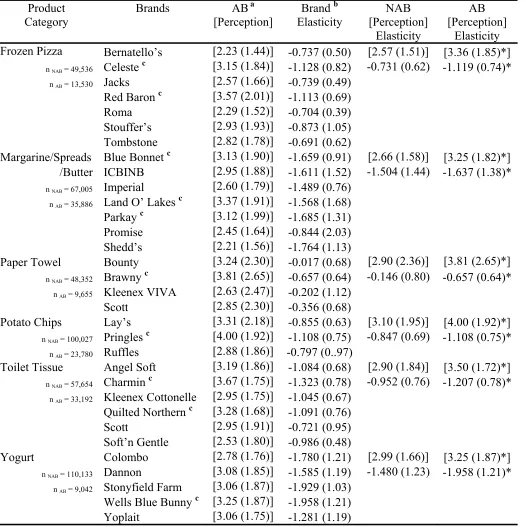
For our main analysis, we included only the product categories in which at least one of the brands
in a product category has been consistently humanized in the marketplace. To categorize the brands as
either humanized or non-humanized, we used two judges who independently coded each brand on the
basis of several indicators used in prior research (Kim and McGill 2011): (1) the use of a human (vs.
object) brand name (e.g., Celeste vs. Tombstone), (2) the use of human (or humanized) images on a
package (e.g., Red Baron vs. Roma), and (3) the use of humanized brand communications (e.g., the
disagreements were resolved by discussion. In the end, we identified six product categories that met the
criteria: frozen pizza, margarine/spreads/butter, paper towel, potato chips, toilet tissue, and yogurt.1
Next, in order to provide a more rigorous validation of our brand anthropomorphization
categorization scheme, we recruited 599 nonstudent participants using Amazon’s Mechanical Turk
online panel. All participants were U. S. residents. For the assessment of brand anthropomorphism,
participants provided their level of agreement with the following statements: “It seems almost as if
[brand] has (1) its own beliefs and desires, (2) consciousness, (3) a mind of its own” (1 = “strongly
disagree,” and 7 = “strongly agree”). Participants then rated the extent to which [brand] had come alive
(like a human). We summed the responses to these four items, which showed acceptable reliability
coefficients across all six product categories (αfrozen pizza = .95; αmargarine/spreads/butter = .93; αpaper towel = .97;
αpotato chips = .91; αtoilet tissue = .96; αyogurt = .95). The results confirm our brand anthropomorphization
categorization scheme; participants reported significantly higher scores on the scale for the brands
categorized as humanized than for those categorized as non-humanized in all six product categories (for
details, see Table 1). Furthermore, in contrast with Gordon, Goldfarb, and Li (2013), we excluded
private-label and outside brands from each product category in our data analysis. The number of
remaining brands in each product category ranged from three to seven, and we included all these brands
in the final analysis. The number of purchase incidences ranged from 63,066 for frozen pizza to 123,807
for potato chips during the six-year time frame (Table 1).
With this brand anthropomorphization categorization, the results show a consistent pattern of
consumer price sensitivity to anthropomorphized versus non-anthropomorphized brands. The overall
price elasticities for humanized brands were significantly higher than those for non-humanized brands
(frozen pizzaanth = –1.119 vs. frozen pizzanon-anth = –.731; margarine/spreads/butteranth = –1.637 vs.
margarine/spread/butternon-anth = –1.504; paper towelanth = –.657 vs. paper towelnon-anth = –.146; potato
1
chipsanth = –1.108 vs. potato chipsnon-anth = –.847; toilet tissueanth = –1.207 vs. toilet tissuenon-anth = –.952;
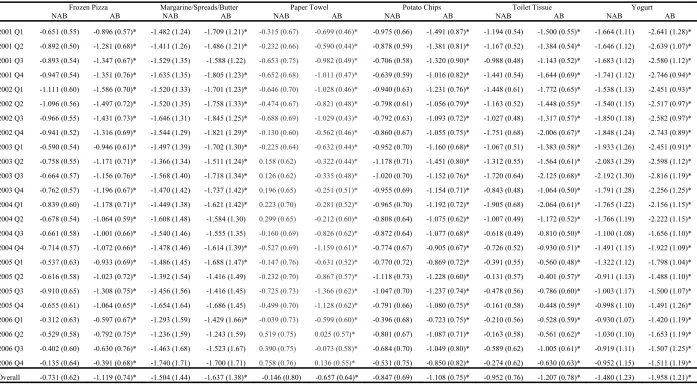
yogurtanth = –1.958 vs. yogurtnon-anth = –1.480; ps < .05). An additional quarterly analysis of price
elasticities (Table 2) reveals a similar pattern; in general, humanized brand elasticities were greater than
those of non-humanized brands across 24 quarters.
[insert tables 1 and 2 about here]
Discussion
Study 1 provides critical real-world evidence in support of H1. Analysis of the household panel
data reveals that humanized brands have significantly higher price elasticities than non-humanized
brands across all six product categories. Although the household panel data set did not include a direct
measure of price fairness as the linkage between brand humanization and brand choices during instances
of price changes, our findings show that perceived price fairness is a primary driver of the magnitude of
price elasticities. That is, we find that higher price elasticities associated with humanized brands are a
strong indicator that consumers perceive price increases by these brands as less fair and price decreases
as more fair than price increases by non-humanized brands. We further examine the important role of
brand anthropomorphization on price fairness in the subsequent controlled laboratory experiments.
Effects of Agency–Communion Orientation on Perceived Price Fairness
H1 assumes that consumers strive to maximize their self-interests and focus on their own input/outcome
ratio in evaluating prices (Homburg, Hoyer, and Koschate 2005). That is, consumers are likely to believe
that a price increase has a negative impact on their input/outcome ratio because they must pay higher
prices while their outcome remains the same. This view is consistent with the core premise of the equity
principle that people strive to maximize their self-goals and interests and expect that a balance should be
maintained in the ratio of contributions to outcomes among those involved in the interactions
(Kahneman, Knetsch, and Thaler 1986a).
driven by the motive to maximize their self-interests and more likely to consider the perspectives,
interests, and needs of both parties involved in the exchange (Skitka 2009). In this regard, justice
reasoning theory posits that how people think and interpret fairness is contingent on which values they
are using to understand the current situation (Skitka 2009). Overall, prior research indicates that people’s
motivations and values are organized and regulated by their views of self (Skitka and Wisneski 2012).
Specifically, people’s values can range in focus from the self (i.e., one’s own interests and goals) to
other-oriented values and goals (Skitka 2009). In this research, we concentrate on agency–communion
orientation, which determines the extent to which people put relative emphasis on self- or other-oriented
goals and values (Helgeson 1994; Kurt, Inman, and Argo 2011). Agency orientation refers to a person’s
tendency to hold a view of the self that reflects his or her individuality and emphasizes internal attributes
and the separateness from others (Helgeson 1994). In contrast, communion orientation reflects a
person’s view of the self as being embedded in the fabric of social relationships and in the connectedness
of the self with others (Kurt, Inman, and Argo 2011). Accordingly, agency orientation includes
characteristics such as self-assertion, instrumentality, and self-confidence, whereas communion
orientation manifests itself in qualities such as selflessness, cooperativeness, and concern for others
(Spence, Helmreich, and Holahan 1979). In summary, agentic people strive to differentiate themselves
from others and put more emphasis on their self-interests (Wiggins 1991), whereas communion-oriented
people attend to and are concerned about relationships with others; they are motivated to maintain
interpersonal harmony and to protect the unity with others (Kurt, Inman, and Argo 2011).
Overall, justice reasoning theory states that people are more likely to focus on maximizing their
own self-interests in evaluating the fairness of a situation when they are motivated by their immediate
and rational self-goals (Skitka and Wisneski 2012). In contrast, when the dominant motivation is
building harmonious relationships with others, people are less likely to emphasize their own goals and
interests in judging fairness and, instead, are more to likely to consider the needs and interests of others
fairness should be viewed not in terms of maximizing one’s own interests but rather in maintaining the
continuity of interpersonal relationships. Prior studies have also exemplified this contingency. For
example, males (more agency-oriented; Kurt, Inman, and Argo 2011) tend to allocate resources based on
the equity principle (i.e., maximizing self-interests) to a greater extent than females (more
communion-oriented; Murphy et al. 1984). Similarly, considering others’ needs in allocating resources
is more prevalent in more relational societies (e.g., China) because of the greater stress put on
interdependence among people (Murphy et al. 1984). In contrast, in individualist societies (e.g., the
United States), people are less apt to consider others’ needs in distributing resources because of the
cultural importance of independence and self-sufficiency.
Given that the view of self influences fairness judgments, we expect that when agentic people
observe a price increase, due to a greater emphasis on their self-interests, they are more likely to be
concerned with the inequity in their own input/outcome ratio and to infer that the brand is taking
advantage of them. As discussed previously, anthropomorphism enhances perceptions of intentionality
and underlying motives. Thus, agentic people are more likely to infer a brand’s motive to take advantage
of them and, as such, are more likely to view a price increase by a humanized (vs. non-humanized) brand
as more unfair. In contrast, communion-oriented people are more likely to assess fairness not to establish
blame and to punish, but rather to maintain the continuity of interpersonal relationships in the long run
(Lerner 1975). Because communal people are more likely to consider the perspectives and needs of the
other person involved in the relationship, we anticipate that they also care about the humanized (vs.
non-humanized) brand’s needs, such as the brand’s own input/outcome ratio (e.g., a supplier had to
increase costs of materials). This is also in accord with anthropomorphism theory, which indicates that
anthropomorphizing a non-human entity enables people not only to infer intentions in this entity and
blame it for its actions but also to perceive this humanized entity as having certain experiences and needs
that are usually viewed only in humans (Epley and Waytz 2009). Tam, Lee, and Chao (2013) argue that
anthropomorphized than when it is not. As such, we expect that communion-oriented consumers are
more likely to give a humanized brand the benefit of the doubt and are more likely to make more positive
inferences about motives for a price increase for an anthropomorphized (vs. non-anthropomorphized)
brand. Note that we do not expect communal consumers to evaluate the fairness of price increases
through greater consideration of a brand’s input/outcome ratio when a brand is non-anthropomorphized.
This is consistent with (1) justice theory, which postulates that the equity principle of evaluating fairness
is applied in the context of impersonal exchanges (Skitka 2009), and (2) anthropomorphism theory,
which indicates that people consider an entity’s needs only when it is humanized. Thus, if
communion-oriented consumers are more likely to consider a humanized brand’s input/outcome ratio
and to infer more positive motives for a price increase, they are more likely to view price increases as
more fair when a brand is humanized (vs. non-humanized).
Furthermore, with respect to a price decrease, we argued previously that consumers are more
likely to attribute more positive intent to a humanized (vs. non-humanized) brand. However, individual
differences in agency–communion orientation suggest that communion-oriented people are more likely
to consider others’ positive intent regarding a positive action than agency-oriented consumers. This
reasoning is based on prior research that indicates that communion-oriented consumers possess a greater
propensity to recognize acts of goodwill by others and to express their appreciation of positive actions
than their agency-oriented counterparts (Kashdan et al. 2009). These dissimilarities emanate from
differences in socialization practices. In particular, communal people tend to engage in more caretaking
roles and to perceive interdependence, maintenance, and harmony in relationships as important. In
contrast, agency-oriented consumers are more self-focused and tend to be less sensitive to positive
interpersonal cues (Eagley and Crowley 1986). In support of these claims, prior research has also shown
that communion-oriented people express more gratitude (i.e., a feeling induced when people credit
others for a positive action) in social relationships (Kashdan et al. 2009). Overall, because
anthropomorphization is more likely to increase their perceptions of fairness of price decreases. In
contrast, because agency-oriented consumers tend not to view greater positive intent from others’
positive actions, we expect to find no differences in price fairness evaluations for agentic consumers
when a brand is either humanized or non-humanized.
H2: Agency–communion orientation moderates the interaction effect of brand
anthropomorphization and price change on price fairness. (a) For agency-oriented consumers, brand anthropomorphization (i) increases the perceived unfairness of price increases and (ii) does not influence the perceived fairness of price decreases. (b) For communion-oriented consumers, brand anthropomorphization increases the perceived fairness of both (i) price increases and (ii) price decreases.
Study 2
First, Study 2 aims to establish internal validity of the brand anthropomorphization effect on price
fairness (H1) in a controlled experimental setting. A second goal is to examine the moderating role of
agency–communion orientation (H2). Study 2 uses gender as a proxy for this orientation. According to
prior research (Guimond et al. 2006; Kurt, Inman, and Argo 2011), agency orientation is more
characteristic of males, whereas communion orientation tends to be descriptive of females. Third, Study
2 aims to investigate the underlying mechanisms of this effect in greater detail by analyzing participants’
spontaneous cognitive responses. Finally, Study 2’s goal is to demonstrate the marketing consequences
of differences in fairness perceptions by including a behavioral intentions measure (i.e., purchase
intentions).
Participants, Design, and Procedure
One hundred fifty-seven undergraduate students participated in Study 2 in exchange for extra
credit. Participants were asked to imagine a purchasing situation in which they were searching for a
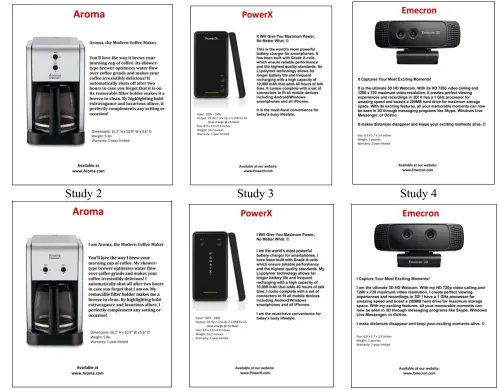
coffeemaker. Then, respondents viewed one of two (i.e., anthropomorphized vs.
non-anthropomorphized) versions of an ad for a fictitious brand of coffeemakers, Aroma. Next, they
reported their brand attitudes. On the following page, they were asked to imagine that they had decided
coffeemaker was priced at $54.99. After looking at the website, half the participants learned that the
price had increased (by 20%), and half learned that it had decreased (by 20%) (e.g., “A week later you
decide to visit the Aroma.com website again and discover that the price has changed from $54.99 to
$65.99”). These price changes are consistent with prior research (Homburg, Hoyer, and Koschate 2005)
and within the range of market price distributions for coffeemakers. After being exposed to the price
change, participants provided their evaluations of price fairness. Next, we collected participants’
open-ended thoughts in an effort to investigate the processes underlying fairness judgments. After the
thought-elicitation task, we collected a measure of purchase intentions. Finally, we administered the
manipulation check on anthropomorphism and the price change and then collected demographic
variables. The survey ended with a demand probe; none of the participants correctly guessed the true
research question.
Stimulus Materials
Consistent with prior research (Puzakova, Kwak, and Rocereto 2013), we manipulated brand
anthropomorphization using the combination of visual and verbal humanlike elements (Figure 1). In
doing so, we also recognized that an anthropomorphization manipulation could have inadvertently
created a more lighthearted brand personality than a non-humanized brand and that this could have led to
the perceptions that a humanized brand’s price increase is more disingenuous. Thus, we conducted an
additional experiment to ensure that this confounding effect did not occur. To ensure that participants did
not perceive a price increase as inconsistent with a more friendly and lighthearted anthropomorphized
brand, we measured brand lightheartedness, friendliness, and disingenuousness (i.e., the extent to which
a brand’s actions appear inconsistent with its personality; Wood et al. 2008). However, including the
main and interaction effects of these variables in our analysis as covariates failed to alter the findings.
Measures
We measured price fairness with four items (i.e., 1 = “unfair, unjust, unreasonable,
We assessed purchase intentions with two items (i.e., “It is likely that I will buy the Aroma brand of
coffeemakers” and “I can imagine buying an Aroma coffeemaker”; r = .75, p < .05). For the
manipulation check on anthropomorphism, we used the same items as in Study 1 (α = .88). We measured
brand attitude with four items (e.g., 1 = “unfavorable, unpleasant, bad, dislike,” and 7 = “favorable,
pleasant, good, like”; α = .94).
Results
Manipulation checks. We conducted a 2 (price decrease vs. price increase) × 2
(anthropomorphized vs. non-anthropomorphized brand) between-subjects analysis of variance
(ANOVA) on the perception of the brand as a human. As we expected, participants in the humanized (vs.
non-humanized) brand condition perceived the brand as more humanlike (Manth = 3.85, Mnon-anth = 3.39;
F(1, 152) = 4.16, p < .05). No other main or interaction effects were significant (p > .10). The results also
showed no significant differences in brand attitudes between the two conditions (Manth = 5.28, Mnon-anth =
5.20; F(1, 154) = .23, p > .10).2 All participants correctly noted the prices presented both in the ad and on
the website. They reported that the price of the Aroma coffeemaker on the website had increased from
the price in the ad in the price increase condition (M = 6.37; t(89)diff from 4 = 23.85, p < .05) and had
decreased in the price decrease condition (M = 6.05; t(64)diff from 4 = 13.41, p < .05).
Hypothesis tests. We performed a 2 (price change: increase, decrease) × 2 (brand
anthropomorphization: anthropomorphized brand, non-anthropomorphized brand) × 2 (gender: females,
males) ANOVA on price fairness as the dependent variable. Consistent with H1, we found a significant
interaction between price change and brand anthropomorphization (F(1, 149) = 9.19, p < .05). We
followed up with an analysis of planned contrasts. In the price increase condition, participants evaluated
the price as less fair when they were exposed to an anthropomorphized (vs. non-anthropomorphized)
2
brand (Manth = 2.91, Mnon-anth = 3.35; F(1, 149) = 4.92, p < .05). In the price decrease condition,
consumers evaluated the price as more fair when the brand was anthropomorphized (vs.
non-anthropomorphized) (Manth = 5.77, Mnon-anth = 5.29; F(1, 149) = 4.36, p < .05). Furthermore, a
three-way interaction among brand anthropomorphization, price change, and gender was significant (F(1,
149) = 4.85, p < .05). Planned contrasts showed that males viewed a price increase as less fair when the
brand was humanized (vs. non-humanized) (Manth = 2.56, Mnon-anth = 3.97; F(1, 149) = 20.08, p < .05).
The opposite was true for females (Manth = 3.25, Mnon-anth = 2.73; F(1, 149) = 4.29, p < .05). When the
price decreased, females evaluated the price as more fair when a brand was humanized (vs.
non-humanized) (Manth = 6.05, Mnon-anth = 5.28; F(1, 149) = 5.17, p < .05), whereas the effect was
nonsignificant for males (Manth = 5.49, Mnon-anth = 5.30; F < 1).
[insert figure 1 about here]
Cognitive responses. Two judges coded open-ended thoughts independently. We employed two
schemas for thoughts coding. First, we coded thoughts as 1 when a participant provided any motives for
a price change (e.g., “Increase in production costs?”) and as 0 when no inferences of a motive were
generated (e.g., “I will be upset and not buy this product”). Second, we coded thoughts as negative (e.g.,
“I felt betrayed by the seller”), positive (e.g., “The product is selling well and more people have probably
heard good things”), or neutral (e.g., “I personally do not drink coffee”). The total number of thoughts
generated was 327. The level of agreement between the two judges was 93%, and disagreements were
resolved by discussion.
Consistent with our expectations, there was a significant association between brand
anthropomorphization and whether or not participants spontaneously inferred motives for a price change
(χ2(1) = 4.39, p < .05). Overall, the cognitive response data showed that 56.3% of participants who
viewed a humanized brand spontaneously generated reasons for a price change, whereas only 39.5% of
those exposed to a non-humanized brand did so. Next, we created a cognition valence index by
assess not only the direction of thoughts but also the relative magnitude of each participant’s thoughts.
Greater values on this index indicate more negatively valenced thoughts, whereas lower values reflect
more positively valenced thoughts. To examine the mediating effect of the cognition valence index, we
ran an integrated regression model using a bootstrapping approach, with brand humanization, price
change, gender, and all possible interactions among them as the independent variables, price fairness as
the dependent variable, and cognition valence index as the mediating variable. We tested the moderated
mediation model using the PROCESS macro (model 12; Hayes 2013). The results revealed a significant
indirect effect of a three-way interaction among brand humanization, price change, and gender on price
fairness through the cognition valence index (a point estimate of the effect = .13; 95% confidence
interval [CI] [.02, .29]). Next, we found that males generated more negative thoughts and females
reported more positive thoughts in the price increase condition when a brand was humanized (vs.
non-humanized). That is, the bootstrapping mediation analysis revealed a significant indirect path from
brand anthropomorphization to price fairness through cognition valence for males (a point estimate for
the effect = –.25; 95% CI [–.44, –.10]) and for females (a point estimate for the effect = .09; 95% CI
[.002, .23]) in the price increase condition. This path was also significant for females in the price
decrease condition (a point estimate for the effect = .14; 95% CI [.02, .32]). That is, females generated
more positive thoughts when a brand was humanized (vs. non-humanized) in the price decrease
condition.
Purchase intentions. We used the aforementioned model to examine the mediating role of price
fairness on purchase intentions. The results showed a significant indirect effect of a three-way
interaction among brand humanization, price change, and gender on purchase intentions through
perceived price fairness (a point estimate of the effect = .16; 95% CI [.02, .36]). We found a significant
indirect path from brand humanization to purchase intentions through perceived price fairness for male
participants in the price increase condition (a point estimate of the effect = –.35; 95% CI [–.58, –.17])
[.04, .42]). The indirect paths for female participants in the price increase condition and for male
participants in the price decrease condition were nonsignificant.
Discussion
Study 2 shows that brand anthropomorphization increases perceived unfairness of price increases
and perceived fairness of price decreases. These findings extend Campbell’s (2007) research insofar as
they (1) provide evidence of the effect of humanized brand positioning (vs. the source of information) on
price fairness, (2) outline the role of consumers’ spontaneously generated cognitive thoughts in
mediating the effect of brand humanization on price fairness, and (3) shed light on the moderating effect
of gender as a proxy for agency–communion orientation. With regard to the last point, our research
indicates that firms targeting male (vs. female) consumers should expect more negative reactions to price
increases. Thus, male and female target audiences may require different communication approaches
regarding price changes. In addition, Study 2 addresses a call from prior research (Homburg, Hoyer, and
Koschate 2005) by delivering further insights into the conditions under which consumer are more likely
to spontaneously generate motives for price changes. Because a humanized entity’s actions are viewed
as more intentional (Epley and Waytz 2009), consumers are more likely to spontaneously generate
motives for a price change. Furthermore, although the results show that higher perceptions of fairness of
price decreases when a brand is humanized (vs. non-humanized) translate into higher purchase intentions
for communion-oriented consumers (i.e., females), we do not find a mediating effect of price fairness on
purchase intentions when there is a price increase for this group of consumers. This finding, however, is
consistent with prior research that demonstrates that people high in communion orientation tend not to
act on an unfair or negative situation, because they are concerned with building harmonious interactions
Study 3
First, the objective of Study 3 is to directly measure individual differences in consumers’ agency–
communion orientation. Second, Study 3 investigates the effect of brand humanization on price fairness
in a different product category (i.e., battery charger) and in a different price change range (i.e., 10%).
Participants, Design, and Procedure
Three hundred twenty-seven undergraduate students participated in Study 3 in exchange for extra
credit. Participants were asked to imagine that they were shopping for a battery charger and were
presented with one of two versions (i.e., humanized vs. non-humanized brand) of an ad depicting a
fictitious brand of battery chargers, PowerX. After viewing the ad, participants filled out the brand
attitude measure. We administered the manipulation of price change in a manner similar to that of Study
2 (the price change was 10%; e.g., from $79.95 to $87.95). After that, we collected price fairness,
open-ended thoughts, and purchase intentions measures. Next, we administered manipulation check
(i.e., brand anthropomorphization and price change direction) variables. Finally, we measured
participants’ agency–communion orientation, demographic variables, and an open-ended suspicion
probe; none of the participants guessed the true nature of the study.
Measures
We measured brand attitude (α = .94), price fairness (α = .97), and purchase intentions (r = .85, p
< .05) with the same items as in Study 2. To measure agency–communion orientation, we used a 16
five-point bipolar adjective scale from the extended version of the Personal Attributes Questionnaire
(Spence, Helmreich, and Holahan 1979). We averaged the responses to create a respective orientation
score (αagency = .80, αcommunion = .88). As prior research indicates, a person can possess both agency and
communion traits (Kurt, Inman, and Argo 2011). Thus, a high score on agency or communion does not
mean a low score on the other dimension. As such, consistent with prior research (Kurt, Inman, and Argo
2011), we created a relative agency orientation (ACDIF) by subtracting each person’s communion score
Results
Manipulation checks. The results of a 2 (price increase vs. price decrease) × 2
(anthropomorphized vs. non-anthropomorphized brand) ANOVA, with the scale measuring the extent of
brand anthropomorphization as the dependent variable, showed that participants who viewed an
anthropomorphized brand perceived it more as a human than those who viewed a
non-anthropomorphized brand (Manth = 3.57, Mnon-anth = 2.98; F(1, 222) = 8.91, p < .05). No other
significant main or interaction effects emerged (p > .10). There were no significant differences in brand
attitudes between the two conditions (Manth = 5.50, Mnon-anth = 5.56; F(1, 224) = .17, p > .10). All
participants also correctly identified the price and the direction of price change.
Hypothesis tests. First, to ensure that gender is a proxy for agency–communion orientation (a
point-biserial correlation with gender: r = –.21, p < .05), we used an ANOVA model to examine whether
the pattern of the effect of brand anthropomorphization on perceived price fairness for both males and
females is the same as in Study 2. The three-way interaction was consistent with the pattern of Study 2
(F(1, 219) = 9.57, p < .05). That is, brand humanization enhanced perceived price unfairness of price
increases for males (Manth = 2.40, Mnon-anth = 4.39; F(1, 219) = 41.57, p < .05) but increased perceived
fairness of both price increases (Manth = 3.46, Mnon-anth = 2.92; F(1, 219) = 4.02, p < .05) and price
decreases (Manth = 5.54, Mnon-anth = 4.76; F(1, 219) = 6.98, p < .05) for females. In the price decrease
condition, the effect of brand humanization on price fairness for males was nonsignificant.
Second, we examined the role of agency–communion orientation. We conducted a multiple
regression analysis that included brand anthropomorphization (1 = brand anthropomorphization, –1 = no
brand anthropomorphization), price change (1 = price increase, –1 = price decrease), relative agency–
communion orientation, all two- and three-way interactions among agency–communion orientation,
brand anthropomorphization, and price change as independent variables and price fairness as the
dependent variable. Consistent with H1, the analysis showed a significant two-way interaction between
effect was qualified by a significant three-way interaction among price change, brand
anthropomorphization, and ACDIF (β = –.22, t(219) = –2.34, p < .05). To examine the nature of this
three-way interaction, we performed a series of tests at values one standard deviation above (i.e., agency
orientation) and below (i.e., communion orientation) the mean score of ACDIF (Aiken and West 1991;
Hayes 2013). In accord with the findings of Study 2, we found that high-ACDIF participants regarded a
price increase as less fair when the brand was humanized than when the brand was non-humanized (+1
SD;a point estimate of the effect = –.91; 95% CI [–1.22, –.61]). In contrast, low-ACDIF participants
viewed a price increase as significantly more fair when the brand was anthropomorphized than when it
was non-anthropomorphized (–1 SD;a point estimate of the effect = .27; 95% CI [.003, .53]). We also
found that in the price decrease condition, brand anthropomorphization significantly increased price
fairness judgments for communal participants (–1 SD;a point estimate of the effect = .51; 95% CI [.17,
.85]); however, we observed no significant effect for agentic participants.
Next, we coded open thoughts in a way that was similar to the coding schema of Study 2. Overall,
779 thoughts were generated. We found a significant association between brand humanization and
whether or not participants spontaneously inferred motives for a price change (χ2(1) = 3.89, p < .05). The
data showed that 52% of those who viewed an anthropomorphized brand spontaneously generated
reasons for a price change, whereas 39% of those who viewed a non-humanized brand reported possible
motives for a price change. Furthermore, we used a similar integrated model as in Study 2 and the
PROCESS macro (model 12) to test (1) the mediating effects of the cognition valence index on the
relationship between brand humanization and price fairness and (2) the mediating effect of price fairness
on the relationship between brand humanization and purchase intentions for agency- and
communion-oriented consumers. The mediating effects that emerged for agency- and
communion-oriented consumers resemble the pattern found in Study 2 for males and females. The
details and the conditional direct and indirect path coefficients from the integrated regression model are
Discussion
The results of Study 3 extend the findings of Study 2 by establishing the moderating effect of
agency–communion orientation on the relationship between brand humanization and price fairness. In
accord with our theoretical argument that agentic consumers are more self-focused, Study 3 finds that
agentic consumers view price increases as more unfair when a brand is humanized (vs. non-humanized).
In turn, this effect results in lower purchase intentions. In contrast, communion-oriented respondents
perceive both price increases and decreases as more fair when a brand is anthropomorphized (vs.
non-anthropomorphized). These empirical findings add support to our theorizing that people with a
communion orientation are less self-focused and are more likely to consider the perspective of others
(Skitka and Wisneski 2012). Overall, the findings of Study 3 contribute to research on the role of social
schemas in processing humanized brands (Kim and McGill 2011; Puzakova, Kwak, and Rocereto 2013).
That is, Study 3 sheds more light on a different moderator (i.e., agency–communion orientation) that is
particularly relevant to the context of price fairness, as fairness judgments depend on consumers’ focus
either on the self or on others.
Effects of Relationship Norms on Perceived Price Fairness
Thus far, our findings are consistent with the notion that people’s construction of fairness is contingent
on their motivational concerns (i.e., self-goals for agency-oriented consumers and other-directed goals
for communion-oriented consumers). However, prior research has also demonstrated that the
interpretation of fairness depends not only on people’s relational orientation (i.e., communion vs. agency
orientation) but also on relationship goals. Two types of interpersonal relationships (i.e., exchange vs.
communal) differ in the extent to which different goals (i.e., to maximize one’s interests or to attend to
others’ needs) are emphasized (Clark and Mills 1993). Specifically, exchange relationships are those in
which all the benefits offered to a partner are given in exchange for equal return (Aggarwal and Larrick
needs and welfare (Clark 1986). Prior research establishes that firms can invest effort in establishing
consumer–brand relationships that mirror interpersonal communal or exchange relationships (Aggarwal
2004). Firms develop a certain type of relationship with consumers by using specific types of consumer–
brand communications (e.g., communal: “Let Whole Foods Market help you enjoy more time with loved
ones”; exchange: “Value for your money”); providing additional services, either free of charge
(communal) or for an extra fee (exchange); or creating brand communities. Furthermore, consumers
value distinct outcomes and form different expectations in these two relationship types. That is, people in
exchange relationships emphasize self-interest and the equal allocation of resources, whereas communal
relationships are based on the care and genuine concern for each other’s needs (Clark and Mills 1993).
The key expectation in an exchange relationship is that all inputs and outputs are balanced. When a
“balance of payments” is breached in exchange relationships (i.e., a partner receives either more or less
than what was expected), the person might believe that an implicit relationship contract has been
violated and that the relationship partner no longer conforms to established norms. In contrast, the
tracking of each other’s contributions and prompt repayment of benefits are less expected in communal
relationships (Aggarwal and Law 2005). Furthermore, prior research suggests that relationship goals
interact with people’s relational orientation. For example, being in exchange relationships attenuates
Chinese participants’ (high in communion orientation) tendency to consider the needs of others and
increases their propensity to use an equity principle in distributing resources (i.e., quid pro quo; Chen,
Chen, and Portnoy 2009). Relying on this logic, we next discuss how the nature of relationship goals
changes the pattern of effects of brand humanization on price fairness for (1) agency-oriented and (2)
communion-oriented consumers.
Given that the agency orientation and the exchange relationship goal both focus on maximizing
one’s self-interests in relationship exchanges, agency-oriented consumers are likely to view an unfair
outcome (i.e., price increase) as violating the balance of benefits and contributions in exchange
price increases for agency-oriented consumers in exchange relationship with a brand (consistent with the
findings of Studies 2 and 3). Relatedly, when partners in exchange relationships are concerned with the
balance of each other’s inputs and outcomes, the decrease in one person’s input (i.e., a price decrease) to
the relationship should lead to the expectation that his or her outcome (or benefit) should also decrease
(Clark 1986). As we discussed and demonstrated in Studies 2 and 3, in a price decrease situation, when a
type of relationship norms is not salient, agency-oriented consumers are likely to consider both positive
and negative reasons for a price decrease from both an anthropomorphized and a
non-anthropomorphized brand. However, the nature of exchange relationships should increase
agency-oriented consumers’ perceptions of the negative reasons to decrease the price when a brand is
humanized (vs. non-humanized). In other words, when agency-oriented consumers’ inputs to
relationships decrease (i.e., a price decrease), they are more likely to infer that they should receive less of
a benefit owing to the quid pro quo principle of exchange relationships. Thus, we expect that agentic
consumers in exchange relationships with a brand will be more likely to infer more negative reasons for
a price decrease and to perceive a price decrease as less fair when a brand is humanized (vs.
non-humanized).
Next, we discuss the expected effects for communion-oriented consumers in exchange
relationships with a brand. As we argued previously, communion-oriented consumers are other-focused
(vs. self-focused; Kurt, Inman, and Argo 2011) and thus are likely to consider the perspective of the
other party involved in the relationship. In other words, communion-oriented consumers are likely to
both consider a humanized brand’s own input/outcome ratio in a price increase situation and view a
greater positive intent from a humanized brand’s price decrease than from a non-humanized brand’s
price decrease. When relationship norms are not salient, these effects result in greater perceived fairness
of both price increases and decreases when a brand is humanized (vs. non-humanized) for
communion-oriented consumers (Studies 2 and 3). However, emphasizing the exchange nature of the
self-interests in the relationship (Skitka 2009). As such, we expect that an exchange relationship with the
brand will reduce communion-oriented consumers’ tendency to consider the brand’s input/outcome ratio
in a price increase condition as well as their tendency to view greater positive intent from a brand’s price
decrease when a brand is anthropomorphized (vs. non-anthropomorphized). Thus, we expect that the
exchange nature of the relationship is likely to attenuate the positive effects of brand
anthropomorphization on the perceived fairness of both price increases and decreases for
communion-oriented consumers.
What outcomes will arise with regard to communion- and agency-oriented consumers’ reactions
to price increases when they are in a communal relationship with the brand? One intuitive expectation is
that being in a communal relationship should enhance consumers’ tendency to consider the needs and
interests of the other party. This is because communal relationships increase perceived importance and
relevance of relationships to the self, even for agency-oriented consumers (Clark 1986; Clark and Mills
1993). Therefore, being in communal relationships may lead a person to be more forgiving of a partner’s
violation of relationship norms. However, the argument that people in communal relationships are more
forgiving of a partner’s wrongdoing is explicitly disputed. For example, Clark, Dubash, and Mills (1998)
demonstrate that people in communal relationships are sensitive to the needs and welfare of both parties
in the relationship. In other words, under communal norms, people have a stronger desire to take care of
others and a stronger desire to be taken care of. Thus, they could actually be less forgiving if others are
expected to take care of them but do not (Clark, Dubash, and Mills 1998). This proposition is also
consistent with recent research that shows that people in highly self-relevant relationships react more
negatively to a relationship transgression than people in less self-relevant relationships (Johnson,
Matear, and Thomson 2011). Bringing these findings to the context of price increases, we argue that
consumers in communal relationships with a brand will also expect a humanized brand to take care of
their own needs to a greater extent than a non-humanized brand. As such, they are likely to perceive a