ILO Social Protection Department | Ukraine: Ratification of ILO’s Convention No. 102 1
Ratification of ILO’s Convention No. 102
Ukraine
A commitment to minimum standards of social security as a social response to the current crisis On 6 June 2016, at the occasion of the 105th session of the International Labour Conference, Ukraine ratified the Social Security (Minimum Standards) Convention, 1952 (No. 102) and accepted the entire set of protection established by all nine social security
branches, i.e. medical care, sickness, unemployment, old-age, employment injury, maintenance of children, maternity, invalidity and survivorship. Due to its unique features, Convention No. 102 is the main international treaty setting out minimum standards for the establishment and governance of comprehensive social
security systems providing adequate protection against the entire range of social risks that people face throughout their lives.
Ukraine became the 53rd country to ratify Convention No. 102, committing to providing minimum levels of protection for all nine social risks listed by the
Convention. The ratification of this global benchmark comes as a concrete answer to some of the challenges that the country is facing with regard to the maintenance of living standards of the population.
The Social Security (Minimum Standards) Convention, 1952 (No. 102)
ILO standards provide the normative substance to implement the human right to social security. The Social Security (Minimum Standards) Convention, 1952 (No. 102) represents a global reference providing the core set of principles and minimum benchmarks for building and maintaining progressively comprehensive social security systems. As of June 2018, 55 countries had ratified Convention No. 102 and the ILO is actively campaigning to promote its ratification with a view to reaching 60 ratifications in 2019, the year of its centenary.
Mr Pavlo Rosenko, Vice Prime-Minister of Ukraine
depositing the legal instrument of ratification of Convention No. 102 with Mr Guy Ryder,
Director-General of the ILO during the 105th session of the International Labour Conference, 6 June 2016
“By accepting the Convention in all its nine Parts covering all major social risks, Ukraine made an important step forward in guaranteeing the level of social protection along the principles of social solidarity, accessibility, adequacy and financial sustainability.” Guy Ryder, Director General of the ILO
The commitment to maintain existing levels of health and income protection expressed by the ratification constitutes a legal but also a political response to sustain a well-functioning social protection system that
ILO Social Protection Department | Ukraine: Ratification of ILO’s Convention No. 102 2 THE CONTEXT
The ratification of Convention No. 102 intervened in a context of deep and prolonged economic downturn, marked by falling levels of economic activity, an
erosion of the currency and growing inflation, when the need for social security was greater than ever. A significant part of the population was affected by the events and experienced income insecurity and vulnerability due to precarious living conditions and internal displacements.
Under severe fiscal pressure the government had started implementing several reforms affecting the social security system. These included reorganization of the institutional set-up for the administration of various schemes, changes in entitlement conditions and in benefits levels, as well as changes in financing
(in particular, the change of the contribution rates).
Against this background, the ratification of Convention No. 102 represents a major step towards strengthening Ukraine's social protection system by reference to the internationally agreed minimum standards of protection of the population.
Convention No. 102 indeed sets out principles that guide the design, financing, governance and monitoring of national social security systems and aim at guaranteeing its durability and sustainability while at the same ensuring that the minimum level of
protection established is guaranteed even during economic crises and downturn. Once ratified and implemented by law and applied in practice, Convention No. 102 greatly contributes to securing decent work through comprehensive and adequate social protection as well as poverty alleviation,
objectives that are set out in the 2030 Sustainable Development Agenda.
TECHNICAL SUPPORT PROVIDED BY THE ILO
Although efforts had initially started in the early 2000s, the actual ratification was the result of the Government’s third attempt to place the ratification of Convention No. 102 on the agenda together with
that of the European Code of Social Security, which is largely based on Convention No. 102.
ILO support was provided as part of an integrated response to assist the Government and social
partners in effectively formulating and implementing appropriate measures to sustain the existing social security system under the unfavourable socio-economic and political circumstances. This response
included a broad range of technical assistance, policy dialogue, awareness raising and capacity building for Parliamentarians, tripartite constituents, academia.
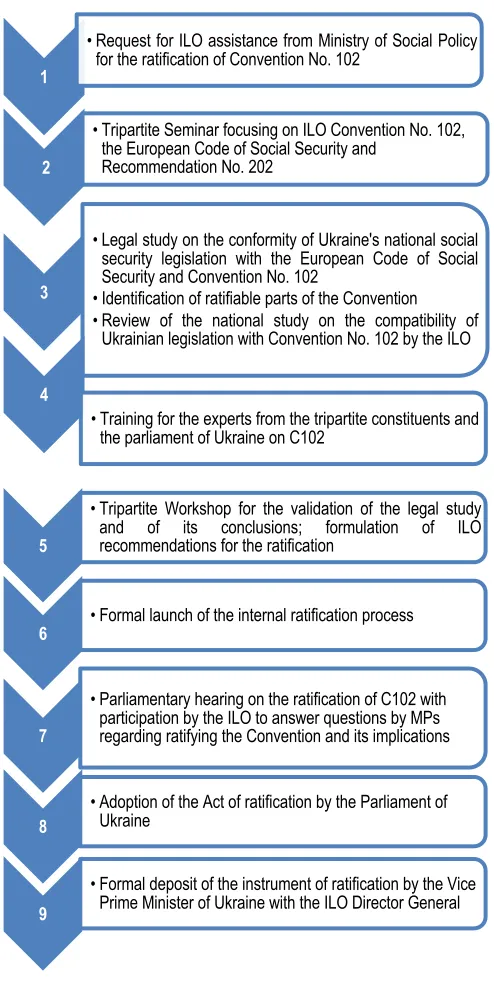
At all stages, the ILO’s technical assistance for the ratification of Convention No. 102, was based on constructive social dialogue with support from
national and international experts (see Figure 1).
Figure 1: Summary of the steps leading to Ukraine’s ratification of Convention No. 102
1
• Request for ILO assistance from Ministry of Social Policy for the ratification of Convention No. 102
2
• Tripartite Seminar focusing on ILO Convention No. 102, the European Code of Social Security and
Recommendation No. 202
3
• Legal study on the conformity of Ukraine's national social security legislation with the European Code of Social Security and Convention No. 102
• Identification of ratifiable parts of the Convention • Review of the national study on the compatibility of
Ukrainian legislation with Convention No. 102 by the ILO
4
• Training for the experts from the tripartite constituents and the parliament of Ukraine on C102
5
• Tripartite Workshop for the validation of the legal study and of its conclusions; formulation of ILO recommendations for the ratification
6
• Formal launch of the internal ratification process
7
• Parliamentary hearing on the ratification of C102 with participation by the ILO to answer questions by MPs regarding ratifying the Convention and its implications
8
• Adoption of the Act of ratification by the Parliament of Ukraine
9
ILO Social Protection Department | Ukraine: Ratification of ILO’s Convention No. 102 3 UKRAINE’S SOCIAL SECURITY SYSTEM
Ukraine has a long tradition of social security. The country’s first system dates from Soviet times. Since its independence in 1991, its institutional foundation
was remodelled on the principles of social insurance, involving a mix of contributory and non-contributory provisions achieving nearly universal coverage.
The Constitution of Ukraine of 1996 (amended in 2014) provides a legal basis for the development of social protection following a rights-based approach. It
lays down the right of every citizen to social security, notably income security in the event of incapacity for work, loss of a breadwinner, unemployment, old-age as well as in other cases envisaged by law (art. 46). The Constitution further enshrines the right to housing (art. 47), and to an adequate standard of
living (art. 48). These provisions have been given effect through an extensive legal framework setting out the scope of population and contingencies coverage as well as the rights and obligations of the persons covered, of employers and of the State.
Figure 2: Social protection expenditures in Ukraine
and select EU countries, 2016
Source: State Statistics Service of Ukraine; ILO 2017.
According to the State Statistics Service of Ukraine,
the total social security expenditure in 2016 was higher than those of any of the new EU member countries neighbouring Ukraine (see Figure 2). It was characterized by the relatively high expenditures on benefits for families and children (2.7 per cent of GDP or 11.2 per cent of the total expenditure) which was slightly higher than the EU average and dominated by
expenditure on old-age, disability and survivor benefits (16 per cent of GDP or nearly two thirds of the total).
The social protection system of Ukraine includes a
combination of contributory social insurance and non-contributory social benefits of universal or categorical nature. At the same time, targeted social assistance schemes have recently been expanded. Benefits in kind, which secure access to services or goods at subsidised prices, are also provided.
Non-contributory social benefits include maternity, disability, social pension and child benefits in cash, as well as social assistance benefits and subsidies. They play a major role in poverty reduction. Approximately 60 per cent of households are receiving some kind of social transfer. In the case of the poorest quintiles,
coverage by these benefits is above 70 per cent (World Bank, 2014).
A large part of these benefits are categorical, mainly directed to families with children (Law on State Social Aid to Indigent Families, 2000). In the context of the Poverty Reduction Strategy adopted in 2016, the
government aimed to expand the role of targeted social assistance for low-income families (called the Guaranteed Minimum Income programme). Non-contributory social benefits are financed through subsidies from the state budget to local budgets.
The contributory social insurance system is comprised of old-age, disability and survivor pensions as well as maternity, sickness, unemployment and employment injury benefits, covering employees and in some cases the self-employed. These benefits, financed by employers’ contributions, come under
the Pension Fund, the Unemployment Insurance Fund and the Social Insurance Fund of Ukraine.
THE ADEQUACY CHALLENGE
Although the coverage of the population is high if not close to universal for some types of benefits, in the last few years, there has been an erosion in the level
ILO Social Protection Department | Ukraine: Ratification of ILO’s Convention No. 102 4 ad hoc basis, and the indexation was frozen in
2014. In 2016, the national legislation was amended and currently provides that pensions need to be indexed in line with 50 per cent of wage increase, 50 per cent of the inflation for the period 2019-2020 and 50 per cent of the average inflation from 2021 onwards. The important reforms carried out with a view to modernizing and securing the
financial sustainability of the social protection system have resulted in a notable reduction of the rates of all types of contributory benefits, notably old-age, invalidity and survivors pensions and social assistance benefits. Indeed, the average benefit rates currently remain at the minimum subsistence level and are
often only slightly higher than the poverty line (see Figure 3).
The ratification of Convention No. 102 represents an important guarantee that the minimum protection levels to which Ukraine has committed will indeed need to be observed and the Government will need
to demonstrate compliance with these minimum standards in its periodic reports under the Convention.
Figure 3: Benefit levels in Ukraine (UAH), 2016
Source: State Statistics Service of Ukraine, Ministry of Social Policy of Ukraine, Institute of Demography and Social Studies
SIGNIFICANCE OF RATIFYING CONVENTION NO. 102
The ratification of this landmark instrument is expected to generate positives outcomes for Ukraine and its people.
1. Making the human right to social security a reality in Ukraine: Through the ratification of Convention No. 102, Ukraine undertakes to ensure the alignment of its legal system with the instrument that is at the core of the international social security legal architecture and which serves as a global reference in
the field of social security. Convention No. 102 is also recognized under international law as one of the key instruments giving the most guidance for the concretization of the human right to social security, laid down in major human rights treaties signed by Ukraine. These include the International Covenant on
Economic, Social and Cultural Rights, the UN Convention of the Elimination of Discrimination against Women, the Convention on the Rights of the Child and the Convention of the Rights of Persons with Disabilities. It can also be observed that Convention No. 102 is referenced by the European
Social Charter and the revised Charter which require State Parties to maintain their social security systems at a satisfactory level at least equal to that necessary for the ratification either Convention No. 102 or the European Code of Social Security.
2. A necessary step toward accession to the
European Union: By ratifying Convention No. 102, Ukraine progresses towards meeting the requirements of the Association Agreement signed with the European Union on 21 March 2014:
“enhancing the level of social protection and
modernizing social protection systems, in terms of
quality, accessibility, and financial sustainability”. The
ratification of the Convention represents a guarantee for the further development of the national social security system, thus helping Ukraine on the road to accession to the European Union. Convention No. 102 has served as a model for most regional social security instruments, including the European Code of
ILO Social Protection Department | Ukraine: Ratification of ILO’s Convention No. 102 5 3. Showing the political will to achieve the 2030
Agenda on social protection: The ratification of Convention No. 102 shows the Government’s commitment to further develop its social protection
system and observe at least internationally agreed minimum levels of protection in the context of a globalized economy thereby promotes fair and sustainable globalization. In a broader context, the ratification of the Convention is also conducive to achieving the Sustainable Development Goals,
including the SDG 1.3 on social protection but also SDGs 3 (Good health and well-being), 8 (Decent work and economic growth), 10 (Reduced inequalities) and 16 (Peace, justice and strong institutions). This can be facilitated through technical cooperation with ILO and other UN agencies and was prioritized in
programming frameworks such as the Decent Work Country Programme for Ukraine (2016-2019) and the UNDAF (2018-2022).
“It encourages closer coordination of our efforts with the ILO and other organizations of the UN system, attaching a strong social dimension to our international cooperation.”
“It also provides an opportunity, through the UN global initiative for establishing national social protection floors along the lines of ILO Recommendation No. 202, to put the national dialogue on these issues on a solid foundation of international social security standards.” Pavlo Rozenko, Ukrainian Vice Prime Minister
4. Contributing to social peace and stability: The
Government’s commitment to apply the standards and good governance principles laid down in Convention No. 102 is conducive to building confidence of the population in the social security system and in its administration, and in the political system of the country in general. Hence, the
ratification contributes to social peace and stability and achieving a better social equilibrium in Ukraine.
“Ratification of Convention No. 102 should become for Ukraine a starting point for further development of social policy focusing on a higher level of social protection and social security of citizens.” Pavlo Rozenko, Ukrainian Vice Prime Minister
“Business has seen three strategic advantages of this ratification: decrease of social tension, motivation to legal employment and promotion of decent work as alternative to labour migration” Olexiy Miroshnychenko, Deputy-Chairman of the Federation of Employers of Ukraine
5. Protecting the social protection system in times of
crisis: Convention No. 102, through its ratification, acts as a powerful tool for the maintenance of minimum standards of social security and ensures international, national and public supervision over the process of the reforms that are underway. In this way, it provides a guarantee that the country’s social
security system will continue to rest on sound governance principles and to ensure effective access to adequate medical care and income security for all.
“Ratification of this key Convention provides a firm legal basis for strengthening the social protection system in Ukraine in conditions of economic crisis and external threats.” Pavlo Rozenko, Ukrainian Vice Prime Minister
6. A means to address the adequacy challenge: The ratification provides a safeguard against the erosion of benefit levels and their maintenance at adequate levels guaranteeing at least life in health and decency, while supporting the extension of
population coverage and promoting a better access to social protection benefits and assistance.
7. A sound basis for the future development of social protection in Ukraine: In recent years, the ratification of Convention No. 102 has been of particular importance for countries undergoing reforms. For Ukraine, Convention No. 102 has a huge
potential to serve as a catalyst for improvement of the current system based on internationally agreed principles of good administration and financing. The ratification of Convention No. 102 allows Ukraine to benefit from priority technical assistance from the
ILO Social Protection Department | Ukraine: Ratification of ILO’s Convention No. 102 6
REFERENCES
Government of Ukraine – United Nations Partnership Framework 2018–2022.
ILO. 2017. World Social Protection Report 2017-19: Universal social protection to
achieve the Sustainable Development Goals (Geneva).
―. 2016a. Social Security System of Ukraine in 2014–15 and Beyond: Towards effective
social protection floors (Budapest).
―. 2016b. Challenges in long-term care of the elderly in Central and Eastern Europe
(Budapest).
―. 2016c. Child benefits in Central and Eastern Europe: A comparative review
(Budapest).
―. 2013. Ensuring social security benefits for Ukrainian migrant workers (Budapest).
―. Social Security for All: The Strategy of the International Labour Organization: Resolution and conclusions concerning the recurrent discussion on social protection (social security), adopted at the 100th Session of the International Labour Conference,
2011 (Geneva).
― 2008. Setting Social Security Standards in a Global Society (Geneva).
ILO. Social Security (Minimum Standards) Convention, 1952 (No. 102).
― NORMLEX database.
―. Decent work country program of Ukraine 2016-2019.
World Bank. 2014. Ukraine – Social Security Nets Modernization Project (Washington,
D.C.).
100 success stories to
achieve SDG 1.3
Country Note Series
September 2018
This note was prepared by Emmanuelle St-Pierre Guilbault, Kroum Markov, and Leslie Bruguière with contributions from Valeria Nesterenko, Sergiy Savchuk and Kenichi Hirose of the ILO. It was reviewed by Isabel Ortiz, Valérie Schmitt and Loveleen De of the ILO.
The editor of the series is Isabel Ortiz, Director of the
Social Protection
Department, International Labour Organization (ILO).
For more information, contact: [email protected]
www.social-protection.org
INTERNATIONAL LABOUR OFFICE
4, route des Morillons 1211 Genève 22 Switzerland
Follow us on:
www.facebook.com/SPplatform
www.linkedin.com/company/social-protection-platform www.twitter.com/soc_protection