MENINGKATKAN KEMAMPUAN BERBICARA SISWA KELAS XI IPA 2 SMAN 1 BATUKLIANG TAHUN PELAJARAN 2012/2013 DENGAN
MENGGUNAKAN STRATEGI FISHBOWL By
Armazi Yahya [email protected]
Pendidikan Bahasa Inggris Fakultas Keguruan dan Ilmu Pendidikan Universitas Mataram Jalan Majapahit No. 62 Mataram, 83125
ABSTRAK
Penelitian Tindak Kelas ini dilatarbelakangi oleh permasalahan dalam kemampuan berbicara siswa kelas XI IPA 2 SMAN 1 Batukliang yang rendah. Sumber-sumber permasalahan tersebut adalah (a) proses berbicara didalam kelas didominasi oleh guru (teacher-centered) dan beberapa siswa; (b) siswa memiliki kosa kata yang kurang pada isu yang dibicarakan; (c) siswa memiliki kesempatan yang sedikit untuk mempraktekkan berbicara.
Guna meningkatkan kemampuan berbicara siswa, peneliti menerapkan “Strategi Fishbowl”. Ada tiga langkah utama dalam strategi ini: (i) pemahaman, dengan menyediakan teks atau bacaan sebagai alat untuk membantu siswa memahami isu atau topic yang dibicarakan sebelum mereka berdiskusi dalam fishbowl; (ii) diskusi, setelah siswa memahami dan menciptakan pandangan, opini, ide dan kepedulian terhadap isu, mereka dapat terlibat dalam diskusi fishbowl; dan (iii) komentar teman, setelah berdiskusi, siswa yang duduk dilingkaran luar memberikan komentar pada penampilan siswa yang didalam lingkaran fishbowl.
Penelitian ini bertujuan untuk meningkatkan kemampuan berbicara siswa. Penelitian ini dilaksanakan pada kelas XI IPA 2 SMAN 1 Batukliang dihadiri oleh 34 siswa. Penelitian ini dilakukan dalam 2 siklus. Tiap siklus dilaksanakan dalam 4 jam pelajaran dan 2 jam pelajaran. Prosedur penelitian sesuai dengan prosedur penelitian tindakan kelas yang berisi (i) perencanaan; (ii) tindakan dan obserbasi; dan (iii) analisis dan refleksi. Data yang dikumpulkan dengan observasi, wawancara, refleksi, dan nilai siswa dianalisis secara kualitatif dan kuantitatif.
memperoleh respon positif karena mampu menciptakan situasi baru bagi siswa; dan (iii) strategi fishbowl memberikan keuntungkan untuk guru dan siswa.
IMPROVING STUDENTS SPEAKING SKILL OF CLASS XI IPA 2 SMAN 1 BATUKLIANG ACADEMIC YEAR 2012/2013 BY USING FISHBOWL
STRATEGY By Armazi Yahya [email protected]
English Department of Faculty of Teacher Training and Education University of Mataram Majapahit Street No. 62 Mataram, 83125
ABSTRACT
This action research was inspired by the problem of students' speaking skill in the class XI IPA 2 SMAN 1 Batukliang. The problem in speaking skill class XI IPA 2 SMAN 1 Batukliang was low. The sources of the problem are (a) process of speaking in the classroom which is dominated by the teacher (teacher-centered) and some invited students; (b) students had limited vocabulary on the issue being talked, and (c) students had little time to practice the speaking.
In order to improve students' speaking skill, the researcher applied “Fishbowl Strategy”. There are three main steps of this strategy: (i) comprehension, by providing text or passage as the means to help them understand the issue or topic discussed before they come to the fishbowl; (ii) discussion, after students understand and create their own judgment, opinion, idea and concern, they can engage in a discussion in form of fishbowl; and (iii) peer-comment, after having discussion, students who sit in the outer circle give comment to the inner circle students' performance.
This research aims at improving students' speaking skill. This research was conducted at class XI IPA 2 SMAN 1 Batukliang, attended by 34 students. The research was conducted in two cycles. Each cycle ran in 4 hours of meeting and 2 hours of meeting. Research procedures followed those of classroom action research, in which each cycle consists of (i) planning; (ii) action and observation; and (iii) analysis and reflection. Data collected using observation, interview, reflection and students' scores were analyzed qualitatively and quantitatively.
From the analysis, it is concluded that (i) applying fishbowl strategy could improve students' speaking skill. Average score of cycle I is 60,13 with the indicator achievement of 32,35%, and cycle II 69,81 with the target achievement of 79,41%; (ii) applying fishbowl strategy had received positive response because it creates new environment for the students; and (iii) fishbowl strategy gives benefits for teacher and students.
A. INTRODUCTION
Based on the observation in English class and interview with the English teacher, there was a problem found on students' speaking skill. Students' speaking skill at class XI IPA 2 SMAN 1 Batukliang academic year 2012/2013 was categorized low. The sources of this problem are (a) process of speaking in the classroom which was dominated by the teacher (teacher-centered) and some invited students; (b) students had limited vocabulary on the issue being talked, and (c) students had little time to practice the speaking. All of these problems affected students' confidence in exploring their speaking skill in the class.
a) Speaking skill was still dominated by the teacher and some invited students. Based on the observation, it can be seen that speaking activities at class XI IPA 2 SMAN 1 Batukliang seemed to be dominated by the teacher within the teaching speaking conventionally. Teaching speaking conventionally by asking the same students questions and answering the question did not invite the whole students to speak up. By applying conventional speaking strategy, it only made some students (not the whole students) take part in the conversation and made other students (who just listen as the listeners) without getting involved in the conversation. This conventional teaching might impact on the lack of students speaking skill. Also, classroom activity could be said to be a teacher-centered because mostly the teacher acted and controled the students without giving opportunity for the students to express and give their opinions. Students just sat and paid attention to the teacher's speech. This often affected the students' participations in the classroom. On the other hand, teacher considered that classroom must be totally handled as appropriately as he plans. And if it was inappropriate, then, teacher failed to apply the planning to teach. As a result, only some invited (talk-active) students showed their activeness in participating in the class activity.
b) Students had limited vocabulary on the issues being talked. Based on the observation, students seemed to get confused when being asked what the information contained in the conversation. This happened because of their limited vocabulary to understand the issues being talked. As a result, students seemed to get confused when having question asked related to the conversation.
All of those problems require appropriate solution because those problems brought negative effects on the students' achievement and students' speaking skill. As a researcher, it is part of my responsibility to help students improve their achievements and speaking skill. Therefore, one proposed technique as a way to help them is by using fishbowl strategy in the class.
Learning speaking in senior high school emphasizes on the use of expression to utter meaningful expression in transactional and interpersonal conversation and sustainable to the context of daily life (Kemenbud, 2013). If it is the target of learning English, the speaking skill that needs to be developed is speaking that gives opportunity to the students to utter orally meaningful expression to explore their daily life, not speaking because of reading and repeating a dialogue or text.
This research is an attempt to improve students' achievement and students speaking skill through the use of “Fishbowl Strategy”. Before the students come to the speaking, the will be directed to understand the topic or issue being discussed by using a text or a passage. Then, they come to the discussion by bringing understanding, ideas, feelings, thoughts, and concerns about the topic or issue. And finally, comments from their friends in the outer circle (peer-comments) about their performance while having discussion closes the students performance in the fishbowl.
Based on the background, statement of problem this research is the way fishbowl strategy improves students' speaking skill at class XI IPA 2 SMAN 1 Batukliang academic year 2012/2013. The objectiveness of this study is to improve students' speaking skill by using fishbowl strategy at class XI IPA 2 SMAN 1 Batukliang academic year 2012/2013.
There are several expected significance from this study as follows:
For students, by applying fishbowl strategy, it can improve students' speaking skill.
For teacher, the result of this study can be used as an alternative way in order to improve students' speaking skill.
For other researchers, this result can be used as stimulant information to conduct further research for developing other skill.
For school, the result can be used to be an innovation and motivation for other teachers to improve teaching and learning environment in SMAN 1 Batukliang.
B. RESEARCH PLANNING
form of disciplined inquiry, in which a personal attempt is made to understand, improve, and reform practice.
This research was conducted in XI IPA 2 SMAN 1 Batukliang in 2 cycles. There were several steps that the writer followed in this study, such as: a) Planning
There were several activities in this phase;
1. Designing lesson plan for applying fishbowl strategy in speaking skill. 2. Designing materials and instruments.
3. Making assessments and evaluation. b) Action and Observation
In the stage of action, the researcher was acted as the English teacher while observer observed the researcher by using observation sheet. The action was carried out and applied based on the planning.
c) Reflection
Reflection was carried out after the action was completed. In this stage, the researcher examined the planning and action processes as part of preparation for the following cycle. The data taken from previous step was used as inputs to create planning for the next cycle.
1. DATA COLLECTION a) Kinds of Data
Kinds of data collected in this research were qualitative and quantitative consisting of:
The observation sheet and teacher's reflection towards the students speaking skill.
Students' achievements. b) Source of Data
Sources of data in this research were (i) students of class XI IPA 2 SMAN 1 Batukliang academic year 2012/2013; (ii) English teacher of XI IPA SMAN 1 Batukliang academic year 2012/2013.
c) Instrument of Data Collection
The data was collected from students class XI IPA 2 SMAN 1 Batukliang. The techniques of collecting the data were:
1. Observation
The researcher observed the classroom activity to know the students' participation in speaking.
2. Reflection
3. Test
Oral test was the instrument used in this research. The data was collected from activity on every cycle. The factors examined were accuracy, fluency and comprehensibility.
After collecting the data, the researcher then analyzed the data. The analysis followed these steps:
1. Data collecting procedures:
a) Data of the results were taken by looking at the students' speaking activity in the fishbowl.
b) The teaching-learning situation data were taken by using observation sheet.
c) Reflection data and the changing which happened in the class were taken from the activity.
d) The data about the relevancy between the planning and the implementation were taken from the lesson plan.
2. The researcher determined the mean score of the students by using the following formula:
(Statistika Dasar, cited in Anggraini, 2011) 3. In determining the students' score, the researcher used the following
formula as:
Students' score = Students' Total Scale Score X 100 18
4. In determining the percentage of students' pass, the researcher used the following formula:
Percentage of students' pass = Number of Students' pass X 100% Total respondent
5. Data of Students Activities
a) The score of students activities each assessed aspect. Score 1 is given if A ≤ 25%
Score 2 is given if 25% ≤ A ≤ 50% Score 3 is given if 50% ≤ A ≤ 75% Score 4 is given if A > 75%
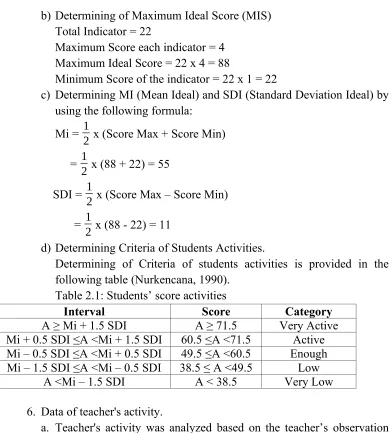
b) Determining of Maximum Ideal Score (MIS) Total Indicator = 22
Maximum Score each indicator = 4 Maximum Ideal Score = 22 x 4 = 88
Minimum Score of the indicator = 22 x 1 = 22
c) Determining MI (Mean Ideal) and SDI (Standard Deviation Ideal) by using the following formula:
Mi = 1
2 x (Score Max + Score Min)
= 12 x (88 + 22) = 55
SDI = 1
2 x (Score Max – Score Min)
= 12 x (88 - 22) = 11
d) Determining Criteria of Students Activities.
Determining of Criteria of students activities is provided in the following table (Nurkencana, 1990).
Table 2.1: Students’ score activities
Interval Score Category
A ≥ Mi + 1.5 SDI A ≥ 71.5 Very Active
Mi + 0.5 SDI ≤A <Mi + 1.5 SDI 60.5 ≤A <71.5 Active Mi – 0.5 SDI ≤A <Mi + 0.5 SDI 49.5 ≤A <60.5 Enough Mi – 1.5 SDI ≤A <Mi – 0.5 SDI 38.5 ≤ A <49.5 Low
A <Mi – 1.5 SDI A < 38.5 Very Low
6. Data of teacher's activity.
a. Teacher's activity was analyzed based on the teacher’s observation sheet.
b. Determining the percentage of teacher’s activities by using the following formula:
G =
∑
Yg n x100 Notes:G : Percentage of teacher’s activities
∑
Yg : Teacher’s total score on the teacher’s observation sheet n : Score maximum.Table 2.2: Percentage of teacher’s activities One cycle was categorized successful if:
75 % of students achieved minimum standard of score 65. Student’s learning activity achieved minimum score of 60.5.
C. FINDING AND DISCUSSION 1. CYCLE I
The action was carried out on 20 and 22 of May, 2013 based on planning. The researcher was acted as the English teacher.
The first material in cycle I was hortatory exposition text (Appendix 4). The researcher explained expressions used in the hortatory exposition text. The expressions were agreement and disagreement, annoyance and proposing ideas (Appendix 3). After explaining the expression, the researcher came to the fishbowl. The researcher and collaborator performed fishbowl simulation by the topic “Students' Cheating”. There were three main stages that students carried out for fishbowl: (i) comprehension; (ii) discussion; and (iii) peer-comment (Miller: 2010).
The result of students’ observation sheet is provided in the following table:
Table 3.1: The score of students' observation sheet in cycle I Cycle Total of
The table shows that the student’s activity was categorized active. The student’s achievement in cycle I is provided in the following table: Table 3.2: The students' achievement in cycle I
No Student's Score Total %
1 < 65 19 Students 55.89
2 ≥ 65 15 students 44.11
2. CYCLE II
The action was carried out on May 27, 2013 based on planning. The researcher taught the class. Cycle II of the research was conducted based on the analysis and reflection of cycle I because of the unsuccessful achievement of the performance indicator of 75% of the students' pass within minimal score of 65.
The result of students’ activity is provided in the following table: Table 3.3: The result of students' activities in cycle II
Cycle Total of
The table shows that the student’s activity in cycle II was categorized very active within score of student’s activity of 76.
The student’s achievement in cycle II is provided in the following table: Table 3.4: The students' achievement in cycle II
No Student's Score Total %
1 < 65 7 Students 20.59
2 ≥ 65 27 students 79.41
Based on the table, the result shows that 79.41% of the students had achieved score ≥ 65. It means that the performance indicator of 75% and minimal score of 65 had been achieved. This also shows that students' achievement in cycle II had improved compared to cycle I.
3. DISCUSSION
Speaking is a language skill that needs to be practiced. Before someone speaks, at least she/he must know what to say and how to say it (Shastri, 2011). In teaching speaking, it is necessary to introduce to the students what they would say and how they say it. Also, it is important to give opportunity for them to express their ideas orally. By using fishbowl strategy, it was expected to create a situation where students could speak and express their ideas, thoughts, feelings, and concerns about an issue. Fishbowl strategy is a strategy that creates an environment for the participants (students) to have a discussion. Through discussion, students can speak and express their ideas in terms of topics that they have in the discussion.
passage, text and any other kind of reading that help them recognize. Based on their understandings, students can create judgment, opinion, idea, and concern.
The second stage is discussion. After students understood and created their own judgment, opinion, idea and concern, they could engage in a discussion in form of fishbowl. And the last stage was peer-comment. After having discussion, students who sat in the outer circle gave comment to the inner circle students' performance. The comment was additional ideas to support one’s statement, clarification, conclusion, and comment on the fishbowl applied itself.
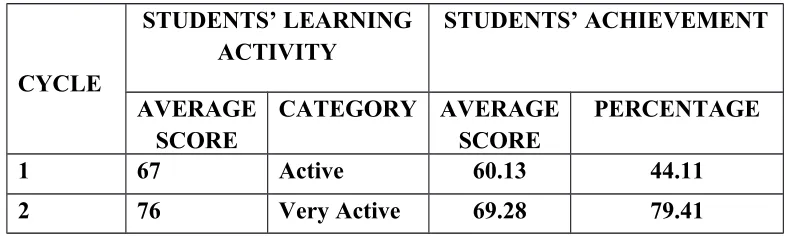
From two cycles ran, it could be seen that fishbowl strategy gave maximum time for students to speak. Based on the analysis, it was obtained score for students’ activity and score of students achievement in speaking. In cycle I, the score of students’ activity of 67 with the category of active. While the average score of students’ achievement of 60.13 with the percentage of pass students of 44.11%. In cycle II, there was improvement of both students’ activity and students’ achievement. The score of students’ activity of 76 with the category of very active. While the average score of students’ achievement of 69.28 with the percentage of pass students of 79.41.
The following table provides the score of students’ activity and students’ achievement in 2 cylces.
Table 3.5: The score of students’ activity and students’ achievement in 2 cylces
question. However, when they were in the fishbowl, they were not as capable as when they gave the comment.
However, overall of the application, fishbowl strategy received positive responses from the students. They always wanted to have new innovation in every learning. They also realized that, in order to be able to speak, they should have the words to say and opportunity for them to speak. Students’ motivation to engage in discussion would be higher and higher if they were given more controversial issues.
D. CONCLUSION
BIBLIOGRAPHY
[1] Anggraini, S.W. 2011. Improving English Graders’ Speaking Ability in English Class at Mts. Nurul Haramain Putri Narmada through Cooperative Learning Strategy. Mataram University Library. Unpublished Thesis.
[2] Cohen, L. 2010. Research Design in Academic Purposes. Pennsylvania: University of Pennsylvania Press
[3] Kemenbud.2013. Perencanaan Pembelajaran menuju 2013. An E-Book, retrieved on 21 April 2013 from http://www.kemdiknas.go.id/kemdikbud/uji-publik-kurikulum-2013-Perencanaan_Pembelajaaran_meuju_2013.pdf
[4] Miller,R.L. 2010. Journal of Instructional Psychology, Vol. 35, No. 1. Retrieved on March 19, 2013 from: http://www2.tec.ilstu.edu/students/tec_307/ Spring_2010/Unit1_Teaching_Lessons/1.7/Fishbowl%20Article.pdf
[5] Nurkancana, W., PPN. Sunartana. 1990. Evaluasi Hasil Belajar. Surabaya: Usaha Nasional.