JML-2017 by Suryadi Ismadji
17%
Internet Sources:Publications: 9%16% Student Papers: 6%Q. H. Hu, S. Z. Qiao, F. Haghseresht, M. A. Wilson, G. Q. Lu. "Adsorption Study for Removal of Basic Red Dye Using Bentonite", Industrial & Engineering Chemistry Research, 2006
1% match (publications)
Kurniawan, A.. "Utilization of rarasaponin natural surfactant for organo-bentonite preparation: Application for methylene blue removal from aqueous effluent", Microporous and Mesoporous Materials, 201106
1% match (Internet from 05-Feb-2015)
http://133.5.167.202/~nakano/papers/2014_jml-200-32.pdf
1% match (publications)
Shella Permatasari Santoso, Artik Elisa Angkawijaya, Felycia Edi Soetaredjo, Suryadi Ismadji, Yi-Hsu Ju. "Complex equilibrium study of some hydroxy aromatic ligands with beryllium ion", Journal of Molecular Liquids, 2015
1% match (publications)
L.K. Ong, F.E. Soetaredjo, A. Kurniawan, A. Ayucitra, Jhy-Chern Liu, S. Ismadji. "Investigation on the montmorillonite adsorption of biocidal compounds incorporating thermodynamical-based multicomponent adsorption isotherm", Chemical Engineering Journal, 2014
1% match (publications)
Santoso, Shella Permatasari, Artik Elisa Angkawijaya, Suryadi Ismadji, Aning Ayucitra, Felycia Edi Soetaredjo, Tran Nguyen Phuong Lan, and Yi-Hsu Ju. "Complex Formation Study of Binary and Ternary Complexes Including 2,3-Dihydroxybenzoic Acid, N-acetylcysteine and Divalent Metal Ions", Journal of Solution Chemistry, 2016.
1% match (publications)
Mane, V.S.. "Use of bagasse fly ash as an adsorbent for the removal of brilliant green dye from aqueous solution", Dyes and Pigments, 2007
1% match (publications)
9
wastewater", Journal of Hazardous Materials, 2011
1% match (publications)
Amjad El-Qanni, Nashaat N. Nassar, Gerardo Vitale, Azfar Hassan. "Maghemite nanosorbcats for methylene blue adsorption and subsequent catalytic thermo-oxidative decomposition: Computational modeling and thermodynamics studies", Journal of Colloid and Interface Science, 2016
1% match (student papers from 04-Feb-2017)
Submitted to UCSI University on 2017-02-04
1% match (publications)
Livy Laysandra, Meri Winda Masnona Kartika Sari, Felycia Edi Soetaredjo, Kuncoro Foe et al. "Adsorption and photocatalytic performance of bentonite-titanium dioxide composites for methylene blue and rhodamine B decoloration", Heliyon, 2017
< 1% match (Internet from 20-May-2018)
https://hal.archives-ouvertes.fr/hal-01793205/document
< 1% match (publications)
Chandra, I. K., Y.-H. Ju, A. Ayucitra, and S. Ismadji. "Evans blue removal from wastewater by rarasaponin–bentonite", International Journal of Environmental Science and Technology, 2013.
< 1% match (publications)
Shella Permatasari Santoso, Artik Elisa Angkawijaya, Yi-Hsu Ju, Felycia Edi Soetaredjo, Suryadi Ismadji, Aning Ayucitra. "Synthesis, characterization, thermodynamics and biological studies of binary and ternary complexes including some divalent metal ions, 2, 3-dihydroxybenzoic acid and N -acetylcysteine", Journal of the Taiwan Institute of Chemical Engineers, 2016
< 1% match (Internet from 26-Jun-2018)
https://digitalcommons.wustl.edu/cgi/viewcontent.cgi? amp=&article=7908&context=open_access_pubs
< 1% match (publications)
Fikret Inal. "Activated Carbon Adsorption of Fuel Oxygenates MTBE and ETBE from Water", Water Air and Soil Pollution, 03/17/2009
< 1% match (publications)
Yi Liu. "Removal of Congo Red from Aqueous Solution by Sorption on Organified Rectorite", CLEAN - Soil Air Water, 07/22/2010
< 1% match (Internet from 16-Jun-2018)
19
< 1% match (Internet from 13-Jul-2010)
http://farmacia.ugr.es/ars/pdf/472.pdf
< 1% match (student papers from 10-Apr-2016)
Submitted to UCSI University on 2016-04-10
< 1% match (student papers from 09-Jan-2014)
Submitted to Universiti Kebangsaan Malaysia on 2014-01-09
< 1% match (Internet from 17-Jun-2016)
http://www.slideshare.net/ijtra/equilibrium-kinetic-and-thermodynamic-studies-on-basic-dye-adsorption-using-composite-activated-carbon
< 1% match (Internet from 20-Jan-2016)
http://digitalassets.lib.berkeley.edu/etd/ucb/text/Klemm_berkeley_0028E_13091.pdf
< 1% match (publications)
Al Bakain, Ramia Z., Rund A. Abu-Zurayk, Imad Hamadneh, Fawwaz I. Khalili, and Ammar H. Al-Dujaili. "A study on removal characteristics of o-, m-, and p-nitrophenol from aqueous solutions by organically modified diatomaceous earth", Desalination and Water Treatment, 2014.
< 1% match (publications)
Kushwaha, Atul Kumar, Neha Gupta, and M.C. Chattopadhyaya. "Enhanced adsorption of methylene blue on modified silica gel: equilibrium, kinetic, and thermodynamic studies", Desalination and Water Treatment, 2014.
< 1% match (publications)
Quanzhou Chen, Kanggen Zhou, Yan Chen, Aihe Wang, Fang Liu. " Removal of ammonia from aqueous solutions by ligand exchange onto a Cu( )-loaded chelating resin: kinetics, equilibrium and thermodynamics ", RSC Advances, 2017
< 1% match (publications)
Youssef Habibi, Lucian A. Lucia, Orlando J. Rojas. "Cellulose Nanocrystals: Chemistry, Self-Assembly, and Applications", Chemical Reviews, 2010
< 1% match (publications)
Chang, Binbin, Daxiang Guan, Yanlong Tian, Zhichong Yang, and Xiaoping Dong. "Convenient synthesis of porous carbon nanospheres with tunable pore structure and excellent adsorption capacity", Journal of Hazardous Materials, 2013.
< 1% match (publications)
30
31
32
33
34
35
< 1% match (student papers from 26-Jul-2018)
Submitted to Pacific University on 2018-07-26
< 1% match (Internet from 13-Jun-2015)
http://www.science.gov/topicpages/p/provincias+habaneras+iii.html
< 1% match (Internet from 20-Mar-2011)
http://www.hindawi.com/journals/bca/2010/603978/
< 1% match (publications)
Xiong, L.. "Adsorption behavior of methylene blue onto titanate nanotubes", Chemical Engineering Journal, 20100115
< 1% match (publications)
Advanced Structured Materials, 2015.
< 1% match (publications)
Rajesh, Yennam, and Uppaluri Ramagopal. "Effect of surfactant and sonication on Pd(II) adsorption from synthetic electroless plating solutions using commercial activated charcoal adsorbent", Desalination and Water Treatment, 2016.
paper text:
3Journal of Molecular Liquids 233 (2017) 29 –37 Contents lists available at ScienceDirect Journal of Molecular Liquids journal homepage:
www.elsevier.com/locate/molliq
1Preparation of nanocrystalline cellulose-montmorillonite composite via thermal radiation for liquid-phase adsorption Shella Permatasari Santoso a, Livy Laysandra b, Jindra Nyoo Putro a, Jenni Lie b, Felycia Edi Soetaredjo b, Suryadi Ismadji a,b,, Aning Ayucitra b, Yi Hsu Ju a, a Department of
4Chemical Engineering, National Taiwan University of Science and
Technology, 106-07 Taipei, Taiwan b Department of Chemical Engineering, Widya Mandala Catholic University,
15article info Article history: Received 12 December 2016 Received in
revised form 21 February 2017 Accepted 21 February 2017 Available online 24 February 2017 Keywords:
Adsorption Composite Montmorillonite Nanocrystalline cellulose Methylene blue abstract Nanocrystalline cellulose (NCC) is an excellent binding agent used in various kinds of manufactures. Herein, NCC was used as a binding agent for montmorillonite (MMT) clay before producing composite (NcMMT), which will be utilized as an adsorbent for methylene blue. The morphology of the composite was investigated
32by using field emission – scanning electron microscopy (FE-SEM) and transmission electron microscopy (TEM), while the
char- acterization was conducted by using Fourier transform infrared spectroscopy (FTIR) and X-ray diffraction (XRD). Two adsorption isotherm models,
30Freundlich and Langmuir models were used to evaluate the adsorption equi-librium. Adsorption kinetics was assessed by using pseudo- first and second order models. The
result indicates that NcMMT is better adsorbent than MMT and NCC; as evidenced by the adsorption capacity (Qm) which is 183.8, 140.6
29and 96.8 mg/g (at 60 °C) for NcMMT, MMT, and NCC, respectively.
The adsorption kinetics was more reasonable described by the pseudo second order. © 2017 Elsevier B.V. All rights reserved. 1. Introduction Nanocrystalline cellulose (NCC) is the nano-sized cellulose obtained through the removal of amorphous regions (hemicelluloses) through direct
27acid hydrolysis of cellulose fibers [1–3]. The removal of
amor- phous regions causes the crystalline regions to be exposed and encoun- tered
27a rapid decrease in its degree of polymerization (DP). The
34for many applications such as optical devices [5], regenerative medicine
[6], and composite materials [7]. 3,7-bis(Dimethylamino)-phenothiazin-5-ium chloride or methy- lene blue (MB) is a heterocyclic aromatic compound which is conven- tionally used as a staining agent for animal cells and bacteria [8–11]. Despite its role as popularly used staining agent, MB is also known to be effective in some health applications; for instance, prevention and treatment of fungal infection of freshwater and saltwater fish [12], treat- ment methemoglobinemia [8] and potassium cyanide poisoning of human [13]. However, MB can be a potentially hazardous material since it is highly soluble in water and easily metabolized in animal tis- sues [12,14]. Accumulation of MB in biological tissues led to serious
Corresponding authors. E-mail addresses: [email protected] (S. Ismadji), [email protected] (Y.H. Ju). health effect due to its carcinogenicity [15–18]. Up to now, adsorption is still the most efficient methods for the environmental recovery from various contaminants [19,20]. Over the years, many studies have been conducted in search of var- ious effective, cheap and environmentally friendly adsorbents [21–23]. Clay minerals are found to be the best candidate and potential adsor- bents for the removal hazardous
substances [24–26]. Clay minerals are highly demanded adsorbent since they are high adsorptive, low cost and abundant reserve [22]. Montmorillonite (MMT) is one of the clay minerals piled up as the result of the volcanic rocks alteration. MMT is classified as smectite which possess an octahedral layer containing alu-minum ions between two tetrahedral silica layers [27,28]. Numerous studies have demonstrated that the adsorption capability of clays can be improved by modifying the surface of clay with synthetic or natural organic substances [22,23,25]. To the best of our knowledge, surface modification of MMT by using NCC to produce composite for the removal of hazardous substances in aqueous solution is still very rare, even though this composite can be a promising new adsorbent. A rapid heating method by microwave ther- mal radiation was used for composite preparation. This method is quick and efficient compared to the
conventional heating method. High ener- gy from the radiation produced by microwave is absorbed and induced rapid heating of MMT and NCC molecules. The heated molecules will move rapidly and collide each other. As a result, the molecules are stranded together to produce a composite. In this work, the adsorption capability of the composite against MB has been evaluated by using two
18http://dx.doi.org/10.1016/j.molliq.2017. 02.091 0167-7322/© 2017 Elsevier B.V. All rights reserved.
well-known adsorption isotherm models namely
35Langmuir and Freundlich models. The adsorption kinetics also has been evaluated by using pseudo first order and second order models.
82. Materials and methods 2.1. Materials MMT clay was obtained from
6Sodium hydroxide (NaOH, 96% purity) was pro- vided by Yakuri Pure Chemical (Kyoto, Japan).
6Sodium chloride (NaCl, 99.5% purity) was obtained from Showa Chemical (Tokyo, Japan). The chemicals were
directly used as received without any treatment. The water used for dissolving the chemicals was
4distilled deionized water (resistance 18.3 MΩ·cm).
2.2. Preparation of NCC NCC was produced from the acid hydrolysis of filter paper (Whatman #1) in 65 wt% H2SO4 at 45 °C for
231 h. Distilled water was added to quench the
reaction. The obtained NCC
13was separated from the acid supernatant by centrifugation (Hettich Zentrifugen EBA-20)
at 13,000 rpm for 10 min; centrifugation was repeated for several times until the supernatant reached pH 5. In this state, supernatant will become turbid since the acid groups on the surface of NCC are washed by water. The loss of acid groups amends surface contact be- tween NCC and water thus NCC become stable in water and remains as suspension. The final suspension was then washed by using dialysis against distilled water. The suspension was solidified
14in a − 40 °C refrig- erator and then subjected to lyophilization.
2.3. Preparation of homoionic clay MMT was purified from organic impurities by soaking it in hydrogen peroxide for 24 h and then rinsed several times with distilled water. The wet MMT was dried in an oven at 110 °C for 24 h. For the preparation of homoionic clay, dried MMT was suspended in 3 M NaCl solution for 48 h with constant stirring at a solid to liquid ratio of 1:10 g/mL. The suspen- sion and sedimented-solid were separated. The suspension was then collected by centrifugation and washed several times with
MMT was then screened with 200 mesh sieve and kept in desiccators before used. 2.4. Preparation of NCC-MMT composite NCC-NCC-MMT composite was prepared by mixing the NCC and NCC-MMT suspensions. Firstly, NCC suspension (1 g NCC in 100 mL distilled water) was adjusted to the pH of 5.0 by using
145 M NaOH. The suspension was allowed to react with NaOH for 2 h with a constant stirring.
Mean- while, MMT suspension (3 g MMT in 900 mL distilled water) was pre- pared and initially homogenized by ultrasonication for 1 h. MMT suspension was added slowly to NCC suspension with a constant stir- ring. The mixture was then reacted for 12 h at 50 °C. Thermal radiation was applied to the mixture for 1.5 min by microwave (InexTron) at a maximum heating power of 700 W. The intercalated NCC-MMT was then
centrifuged to collect the solid, and then dried in an oven at 50 °C for 24 h to obtain the composite. All adsorbents used were crushed into powder and sieved with 200 mesh sieve. 2.5. Potentiometric procedure Potentiometric titration was conducted at 25 °C with a constant ionic strength of 0.1 mol dm−3 KCl to a solution containing 0.2 wt% of NCC in water. Before titration, 0.003 mol dm−3 HCl (in 0.1 mol dm−3 KCl) was added to acidify the solution. Carbonate-free NaOH 0.05 mol dm−3 in 0.1 mol dm−3 KCl (standardized against potassium hydrogen phosphate) was used as the titrant. The titrations were car- ried out within the pH range of 2.5 to 11.0. 2.6. Adsorbent characterization Qualitative analyses
11were conducted on FTIR Shimadzu 8400S by using KBr method in spectra range of
4000–400 cm−1. The patterns of adsorbent powder were characterized by X-ray diffraction (XRD) using a Rigaku Miniflex Goniometer instrument at 30 kV and 15 mA, using Cuα K radiation. The morphology of the adsorbents was observed by using a JEOL JSM-6500F field emission scanning electron microscope (FE-SEM) with Pt coating at 5.0 kV; and by using Tecnai F20 G2 FEI-TEM
23transmission electron microscope (TEM) at 80 kV, the samples were
prepared on a 300 mesh Cu grids with 2% uranyl acetate staining. 2.7. Adsorption studies All the adsorption studies were done in triplicate. Batch adsorption isotherm studies
5were conducted by adding various amounts of each adsorbent into a series of Erlenmeyer flasks
each
three different tempera- tures (30, 45 and 60 °C). After equilibrium had been reached, the Fig. 1.
Potentiometric titration curve, structure, and deprotonation of NCC. (a) The deprotonation of NCC at pH 5.0 indicated by the occurrence of inflection point. (b) The deprotonation of NCC occurred at C number 6, resulting in the formation of negative charged NCC. Fig. 2. Proposed formation mechanism of NcMMT, a monomer of NCC and MMT was used to simplify the illustration. solution was centrifugated at 4500
5rpm for 5 min to separate adsorbent from the supernatant. The concentration of MB was measured in a Shimadzu UV/Vis-1700 spectrophotometer at 664 nm. The percentage of
MB removed (R) was calculated by using Eq. (1). R ¼ ðC0−CtÞ 100% ð1Þ C0 where C0 and Ct (mg/L) are the concentration of MB in solution before and after adsorption. The
33amount of MB adsorbed at equilibrium was calculated by
using Eq. (2). Qe ¼ ðC0−CeÞ V m ð2Þ where Qe (mg/g adsorbent)
11is the amount of MB adsorbed at equilibri- um condition, C0
10and Ce (mg/L) are the concentration of MB in solution at the beginning and at equilibrium, V (L) is the volume of MB solution and m (g) is the mass of
adsorbent used. Adsorption kinetic studies were
studied by adding 0.25 g adsorbent into
11a series of Erlenmeyer flask each containing 100 mL MB solution
at various concentrations (100, 200, and 400 mg/L). The solutions were shaken in a water bath shaker at 30 °C. The sampling of MB was taken at a certain time interval of 30 min until 300 min. The amount of MB adsorbed at certain time interval was calculated by using Eq. (3). Qt ¼ ðC0−CtÞ V m ð3Þ
20where Qt (mg/g adsorbent) is the amount of MB adsorbed at certain time t, Ct (mg/ L) is the concentration of MB at time
containing 0.2 wt% of NCC. As shown from the titration curve in Fig. 1a, an inflection point is occurring at pH 5.0. This
6inflection point occurs when the mol base added is ade- quate to deprotonate
H atom of the NCC [29,30]. Based on the structure Fig. 3. Solid phase of (a) MMT, (b) NCC and (c) NcMMT. FE-SEM of (a′) MMT, (b′) NCC and (c′) NcMMT at 15.000 magnification and accelerating voltage of 5.0 kV. Fig. 4. Solution of (a) NCC and (b) NcMMT at 0.5% wt.
34TEM images of (a′) NCC and (b′)
NcMMT solution at 0.05 wt%. (a″) Variation of crystals size of NCC, measurements were done in the unit of nm.
12(For interpretation of the references to color in this figure, the reader is referred to the web version of this article.) of NCC, the
deprotonation more likely occurred at the H atom of CH2OH group (C6, Fig. 1b). The deprotonation of H atom caused CH2OH group to become charged negatively as CH2O−. The alumina octahedral layer (in the center) and two tetrahedral sil- ica layers of MMT are bound together through van der Waals forces [27, 31]. Since van der Waals forces are weak forces, water can easily pene- trate and attack the hydroxyl group of the silicate layers thus causing cation imbalance. Further cation imbalance led to the protonation of OH group in silicate layers and produced positive charges OH+2 groups. Henceforward, the addition of negative charged NCC into positively charged MMT promoted the surface charges balancing through the in- teraction of CH2O– with the OH+2 leading to the formation of composite NcMMT, as proposed in Fig. 2. Table 1 Selected functional groups of NCC. Functional groups Wavenumber (cm−1) O
19\H Stretching C \H Stretching C_O Stretching C \H Bending C \O Stretching C \H Wagging O \H Out of plane bending
3313 2895 1659 1427 1058 896 667 Table 2 Selected functional groups of MMT and NcMMT. Functional groups Wavenumber (cm−1) MMT NcMMT O \H O \H O \H C \H Si \O \Si Al \Al \OH Al \O \Si Stretching (water molecules) Stretching (Si \OH) Bending Bending Stretching Bending Bending 3627 3272 1660 – 1137 909 569 3630 3320 1633 1425 1038 908 522 Fig. 5. FTIR spectra of MMT, NCC, and NcMMT measured on KBr disk at wavenumber 4000–400 cm−1. 3.2. Characterization of MMT, NCC, and NcMMT
adsorbents at their solid phase. MMT indi- cates a heterogeneous coarse surface which showed the characteristic of smectite group crystals as shown in Fig. 3a and a′. Freeze drying process caused fluffy texture of NCC as shown in Fig. 3b, FE-SEM image revealed the needle-like crystals of NCC at the packed structure as shown in Fig. 3b′. The film of composite NcMMT was produced from the mixture of NCC and MMT suspension. The film was fragile since small sized mole- cule NCC was used to compose large-sized molecule MMT as shown in Fig. 3c. The surface morphology of NcMMT in Fig. 3c′ showed a weakly foliated surface due to the intercalation of NCC onto the surface of MMT. A recent study by Keshavarzi et al. [32] regarding composite material showed a similar morphology with NcMMT. In their study, composite (CNF-composite) was produced by sonicating the dispersions of Fig. 6. XRD patterns of MMT, NCC, and NcMMT. cellulose nanofibrils (CNF) and zeolite. After drying process, both CNF- composite and NcMMT are formed into a film. The CNF-composite film is tougher than that of NcMMT film; this is because the cellulose
nanofibril used in CNF-composite preparation is having longer size and more elastic compared to NCC. The SEM observation of CNF-com- posite indicates porous surface. Meanwhile NcMMT surface is smoother. The smooth surface of NcMMT is the result of joining the short sized cel- lulose, therefore, the space
between each cellulose particle is narrow and produced less porous surface. To clarify the structures of NCC and NcMMT, transmission electron microscopy (TEM) observation was conducted. The stock suspensions of NCC and NcMMT were prepared at 0.5 wt% as shown in Fig. 4a and b, it is demonstrated that the NCC suspension is in translucent white color while the NcMMT is slightly yellowish. The stock suspensions were then diluted at a dilution factor of 10 to deposit the suspensions as a very thin layer on the TEM grid. 10 μl of the diluted solution was placed on the top of glow discharged copper grid. To obtain a good Fig. 7. Effect of contact time on the adsorption of MB by different adsorbents at an initial concentration of 200 mg/L. Fig. 8. Adsorption isotherm curves of MB onto MMT with Freundlich and Langmuir fittings. Fig. 9. Adsorption isotherm curves of MB onto NCC with Freundlich and Langmuir fittings. image resolution, 2% uranyl acetate was applied on the sample. The staining process was done for 1 min. As shown in Fig. 4a′, NCC has a nee-dle-like crystal structure. The NCC crystals size ranged from 56 to 461 nm as shown in Fig. 4a″. As for the composite NcMMT, the pow- dered NcMMT was suspended in the water prior for TEM observation. The TEM image in Fig. 4b′ indicates an event where the molecules of MMT were held by NCC to form NcMMT. FTIR peaks of NCC are summarized in Table 1 while the spectra of MMT and NcMMT are summarized in Table 2, all the peaks data are based on information obtained spectrums in Fig. 5. All three spectra pos-sess O\\H stretch band at 3630–3313 cm−1 which corresponds to the hydroxyl group of water only for NCC, meanwhile for MMT and NcMMT the bands correspond to water molecules and hydroxyl at the silanol groups. The C\\H bending band at 1425–1427 cm−1 appeared only in NCC and NcMMT indicating the intercalation of NCC into MMT in the formation of composite NcMMT. The other bands of NcMMT shifted slightly compared to those of MMT and NCC. The Si\\O\\Si band for MMT and NcMMT is different in appearance, where the Fig. 10. Adsorption isotherm curves of MB onto NcMMT with Freundlich and
Langmuir fittings. Table 3 Freundlich and Langmuir adsorption isotherm parameters of MB. T(°C) Freundlich Langmuir KF n r2 KL aL Qm RL r2 MMT 30 45 60 30.49 42.05 55.09 NCC 30 45 60 8.58 11.17 12.42 NcMMT 30 40.82 45 42.92 60 53.69 3.79 3.93 4.46 0.94 0.98 0.99 2.72 2.72 2.87 0.92 0.98 0.99 3.13 4.01 3.52 0.96 0.95 0.95 9.04 20.73 52.48 0.08 0.15 0.37 1.54 2.32 3.80 0.02 0.03 0.04 22.32 26.17 43.18 0.12 0.19 0.23 113.3 5 × 10⁻⁴ 134.1 2 × 10⁻⁴ 140.6 9 × 10⁻⁵ 68.6 3 × 10⁻³ 84.6 2 × 10⁻³ 96.8 1 × 10⁻³ 178.2 2 × 10⁻⁴ 134.7 2 × 10⁻⁴ 183.8 1 × 10⁻⁴ 0.73 0.79 0.81 0.90 0.96 0.98 0.99 0.97 0.97 Parameters unit: KF (mg/g)·(mg/L)1/n;
NcMMT band is stronger than MMT. The strong band transmission of NcMMT is might be due to the stretching of the hydroxyl group in MMT caused by the binding between MMT and NCC. The diffraction patterns of the powdered MMT, NCC and NcMMT samples are presented in Fig. 6. The diffraction pattern of MMT indi- cates the presence of quartz at 2θ = 26.731 and beidellite at 2θ = 19.944 and 28.149. The basal spacing d(001) in MMT could not be ob- served which is probably due to collapse of the crystallite structure. The collapse was induced by the pretreatment of raw MMT, specifical- ly grinding and the NaCl submersion process which promotes crystal size reduction [28]. NcMMT, as well as NCC, possessed major peaks at 16.1° and 22.5° which indicates 101 and 002 lattice planes [33]. However, the peaks of NcMMT are weaker than that of NCC which is affected by the presence of MMT. The peak of NcMMT at 2θ = 26.730 is similar to that peak of MMT which indicates the presence of quartz mineral. 3.3. Adsorption study 3.3.1. Effect of adsorption time The adsorption of MB onto adsorbents
16increased with time until equilibrium was reached which represents that the
adsorbent has reached its maximum adsorption capacity. The estimation of minimum contact time needed for the system to reach equilibrium condition is an important aspect of designing an effective adsorption process [24]. The effect of contact time on the adsorption of MB by different adsorbents is given in Fig. 7. All curves leveled off as equilibrium was reached. Equilib- rium condition of MMT and NcMMT was reached at 120 min of adsorp- tion. At this equilibrium condition, 99.6% of MB can be adsorbed by NcMMT while MMT adsorps 95.6% of MB. Meanwhile, for NCC, longer time of 150 min is needed to reach the equilibrium condition. The per- centage of MB that can be removed by NCC at its equilibrium is 42.9%. 3.3.2.
22Adsorption isotherm The relationship between the amounts of absorbed MB on the
adsor- bent (Qe) and MB equilibrium concentration in the liquid phase (Ce) can be conveniently correlated by adsorption isotherm [15]. Two well- known adsorption equations namely Freundlich [34] and Langmuir models [35] were chosen to describe this relationship. The parameters for both equation models
9were determined by using non-linear least square
fitting. Freundlich
28model can be represented by this following equation, Eq. (4) Qe
¼ K FCe1=n ð4Þ
temperature dependent parameters
25KF and n are related to adsorp- tion affinity (mg/g)(mg/L)1/n and adsorption intensity of the
adsorbent, respectively. The constant n also represents the important characteris- tics of the Freundlich model, where n N 1 indicates a favorable non-lin- ear adsorption and n b 1 indicates unfavorable adsorption [22]. Langmuir
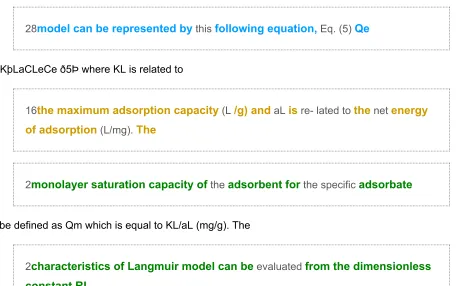
28model can be represented by this following equation, Eq. (5) Qe
¼ 1 KþLaCLeCe ð5Þ where KL is related to
16the maximum adsorption capacity (L /g) and aL is re- lated to the net energy of adsorption (L/mg). The
2monolayer saturation capacity of the adsorbent for the specific adsorbate
can be defined as Qm which is equal to KL/aL (mg/g). The
2characteristics of Langmuir model can be evaluated from the dimensionless constant RL,
determined from Eq. (6) RL ¼ 1 þ KLC0 1 ð6Þ A favorable adsorption is indicated by 0 b RL b 1 while unfavorable adsorption by RL N 1 [36]. MMT was intercalated with NCC through thermal irradiation to en-hance its adsorption capacity. MB was used as the adsorbate before an- alyzing the adsorption capacity of the prepared adsorbents. The adsorption isotherm was conducted, and the data were fitted by using
Freundlich and Langmuir models. The adsorption profiles of MMT, NCC, and NcMMT are presented in Figs. 8, 9 and 10, respectively, while the fitting parameters of Freundlich and Langmuir models are summarized in Table 3.
26Fig. 11. Adsorption kinetics of MB onto MMT with pseudo first and second order
fittings.
pseudo first and second order fittings. The adsorption capacity of the adsorbents is more apparently exam-ined by Langmuir parameter Qm instead of Freundlich parameter KF. The Qm parameter directly indicates
22the amount of adsorbate that can be adsorbed per gram of adsorbent,
in other word Qm is showing adsorp- tion capacity value. Meanwhile, KF parameter only indicates the adsorp- tion affinity which expresses the tendency of the adsorbate to adsorb by the adsorbent. The Qm parameter shows that the NcMMT possesses higher adsorption capacity than MMT and NCC, pointing out that NCC promoted the adsorption capacity of MMT. One possible explanation is that NCC widens the surface area and functions like extra hands of MMT thus making the attachment of MB onto surface easier.
2Temperature is one of the important factors in adsorption, in which the
results indicate that higher temperature promotes the attachment of MB onto the adsorbent. In the case of MMT and NcMMT, since MMT possesses
2a lattice with positive thermal expansion coefficient,
the in- crease in temperature
2will promote penetration of adsorbate onto the surface
of adsorbent [22,37]. Meanwhile, in the case of NCC, higher tem- perature leads to faster deprotonation which causes the organic acid compound (NCC) is negatively charged [38,39]. Meanwhile, MB tends to be protonated (positive charged) in solution. The opposite charge of NCC and MB promote the attachment of the two compounds. 3.3.3. Adsorption kinetics Adsorption kinetics modeling can lead to the most suitable estima- tion of adsorption rate. Lagergren
24pseudo first-order and pseudo second order models were used to express the adsorption kinetics [40]. The pseudo-first-order equation is given
by Eq. (7) Qt ¼ Qe½1− expð−k1tÞŠ ð7Þ while for pseudo 2nd order the equation is given by Eq. (8) Qt ¼ 1 þ Qek2t Q2ek2t ð8Þ
7where Qt is the amount of MB adsorbed at time t (mg/g), Qe is the ad- sorption
capacity at equilibrium (mg/g), k1 is the pseudo 1st order rate constant (1
pseudo 2nd order rate constant (mg/g min). The adsorption kinetics profiles of MB onto MMT, NCC, and NcMMT with Lagergren pseudo first order and second order fittings are given in Figs. 11, 12 and 13,
respectively and the fitting parameters are listed in Table 4. The pseudo first order and pseudo second order plots show good fitting with experimental data. Based on adsorption kinetics stud- ies, pseudo first order rate constant k1 usually decreased with increas- ing initial solute concentration [41]. This can be explained by the higher the initial solute concentration, the longer the time is needed to reach equilibrium. The pseudo
second order rate constant k2 was also affected by initial solute concentration as the pseudo first order rate constant k1 [22,41]. Good competency with the theory is obtained from the k2 parameter, where k2
decreased with increasing initial sol- ute concentration. It is indicated that initial MB concentration is influenced adsorption process, wherein higher initial MB concentration is leading to higher ad- sorption of MB. The initial adsorbate
2concentration provides a driving force that affected mass transfer between the solid phase (adsorbent) and
liquid phase (adsorbate) [22]. The increase in initial adsorbate con- centration leads to smaller mass transfer resistance thus
17the mass trans- fer driving force becomes greater, resulting in higher
adsorption of
33MB. Fig. 13. Adsorption kinetics of MB onto
NcMMT with
21pseudo first and second order fittings. Table 4 Pseudo first order and second order parameters for adsorption of MB
29and 96.8 mg/g for NcMMT, MMT, and NCC, respectively.
Lagergren
17pseudo second order model gave more reasonable adsorption kinetics modeling than the pseudo first order.
Acknowledgement
4This work was supported by the National Taiwan University of Sci- ence and Technology (RP09-01) and the
Widya Mandala Catholic Sura- baya Catholic University through a joint research project with contract number RP09-01. The authors thank to Dr. David Barkley for help in En- glish correction. References [1] J. Fan, Y. Li, Maximizing the yield of nanocrystalline cellulose from cotton pulp fiber, Carbohydr. Polym. 88 (2012) 1184–1188. [2] Y. Habibi, L.A. Lucia, O.J. Rojas, Cellulose nanocrystals: chemistry, self-assembly, and applications, Chem. Rev. 110 (2010) 3479–3500. [3] M.L. Normand, R. Moriana, M. Ek, Isolation and characterization of cellulose nanocrystals from spruce bark in a biorefinery perspective, Carbohydr. Polym. 111 (2014) 979–987. [4] B.L. Peng, N. Dhar, H.L. Liu, K.C. Tam, Chemistry and applications of
nanocrystalline cellulose and its derivatives: a nanotechnology perspective, Can. J. Chem. Eng. 9999 (2001) 1–16. [5] J.F. Revol, L. Godbout, D.G. Gray, Solid self-assembled films of cellulose with chiral nematic order and optically variable properties, J. Pulp. Pap. Sci. 24 (1998) 146–149. [6] K. Fleming, D.G. Gray, S.
Matthews, Cellulose crystallites, Chemistry 7 (2001) 1831–1835. [7] M. Avella, E. Martuscelli, B. Pascucci, M. Raimo, B. Focher, A. Marzetti, A new class of biodegradable materials: poly-3-hydroxy butyrate/steam exploded straw fiber composites, Appl. Polym. Sci. 49 (1993) 2091–2098. [8] M.I. Greenberg, A review of: “critical care toxicology: diagnosis and management of the critically poisoned patient.”, Clin. Toxicol. 43 (2005) 593. [9] B.H. Hameed, A.T. Din, A.L. Ahmad, Adsorption of methylene blue onto bamboo- based activated carbon: kinetics and equilibrium studies, J. Hazard. Mater. 141 (2007) 819–825. [10] J.A. Kiernan, Classification and naming of dyes, stains and fluorochromes, Biotech. Histochem. 76 (2001) 261–278. [11] L. Wang, X. Pan, F. Wang, L. Yang, L. Liu, Structure–properties relationships investi- gation on the azo dyes derived from benzene sulfonamide intermediates, Dyes Pig- ments 76 (2008) 636–645. [12] R.C. Chen, K.J. Wei, T.M. Wang, Y.M. Yu, J.Y. Li, S.H. Lee, W.H. Wang, T.J. Ren, C.W. Tsai, Simultaneous quantification of antibiotic dyes in aquatic products and feeds by liquid chromatography–tandem mass spectrometry, J. Food Drug Anal. 21 (2013) 339–346. [13] M.M. Brooks, Methylene blue as an antidote for cyanide and carbon monoxide poi- soning, J. Am. Med. Assoc. 43 (1933) 585–586. [14] J.A. Tarbin, D. Chan, G. Stubbings, M. Sharman, Multiresidue determination of triarylmethane and phenothiazine dyes in fish tissues by LC– MS/MS, Anal. Chim. Acta 625 (2008) 188–194. [15] C.A. Almeida, N.A. Debacher, A.J. Downs, L. Cottet, C.A. Mello, Removal of methylene blue from colored effluents by adsorption on montmorillonite clay, J. Colloid Inter- face Sci. 332 (2009) 46–53. [16] H. Cherifi, B. Fatiha, H. Salah, Kinetic studies on the
revisited of extended Langmuir model, Chem. Eng. J. 189-190 (2012) 264–274. [19] H. Deng, J. Lu, G. Li, G. Zhang, X. Wang, Adsorption of methylene blue on adsorbent materials produced from cotton stalk, Chem. Eng. J. 172 (2011) 326–334. [20] H. Yan, W. Zhang, X. Kan, L. Dong, Z. Jiang, H. Li, H. Yang, R. Cheng, Sorption of meth- ylene blue by carboxymethyl cellulose and reuse process in a secondary sorption, Colloids Surf. A Physicochem. Eng. Asp. 380 (2011) 143–151. [21] G. Annadurai, R.S. Juang, D.J. Lee, Use of cellulose-based wastes for adsorption of dyes from aqueous solutions, J. Hazard. Mater. 92 (2002) 263– 274. [22] A. Kurniawan, H. Sutiono, Y.H. Ju, F.E. Soetaredjo, A. Ayucitra, A. Yudha, S. Ismadji, Utilization of rarasaponin natural surfactant for organo-bentonite preparation: ap- plication for methylene blue removal from aqueous effluent, Microporous Mesopo- rous Mater. 142 (2011) 184–193. [23] A.C. Suwandi, N. Indraswati, S. Ismadji, Adsorption of N-mthylated diaminotriphenilmethane dye (malachite green) on natural rarasaponin modified kaolin, Desalin. Water Treat. 41 (2012) 342–355. [24] F.A. Banat, B. Bashir, S. Al-Asheh, O. Hayajneh, Adsorption of phenol by bentonite, Environ. Pollut. 107 (2000) 391–398. [25] A.K. Rahardjo, M.J.J. Susanto, A. Kurniawan, N. Indraswati, S. Ismadji, Modified Ponorogo bentonite for the removal of ampicilin from wastewater, J. Hazard. Mater. 190 (2011) 1001–1008. [26] J.P. Soetardji, J.C. Claudia, Y.H. Ju, J.A. Hriljac, T.-Y. Chen, F.E. Soetaredjo, S.P. Santoso, A. Kurniawan, S. Ismadji, Ammonia removal from water using sodium hydroxide modified zeolite mordenite, RSC Adv. 5 (2015). [27] Z. Darvishi, A. Morsali, Synthesis and characterization of nano-bentonite by solvothermal method, Colloids Surf. A Physicochem. Eng. Asp. 377 (2011) 15–19. [28] C. Volzone, L.B. Garrido, Changes in suspension properties of structural modified montmorillonites, Ceramica 47 (2001) 4–8. [29] S.P. Santoso, A.E. Angkawijaya, S. Ismadji, A. Ayucitra, F.E. Soetaredjo, P.L.T. Nguyen, Y.H. Ju, Complex formation study of binary and ternary complexes including 2,3- dihydroxybenzoic acid, N-acetylcysteine and divalent metal ions, J. Solut. Chem. 45 (2016) 518–533. [30] T.T.D. Nguyen, S.P. Santoso, T.T.B. Nguyen, A.E. Angkawijaya, P.L.T. Nguyen, Y.H. Ju, Solution equilibrium study of divalent metal ions with phenylpropanoid derivatives and acetylcysteine ligands, Chem. Pharm. Bull. 64 (2016) 1560–1569. [31] Q.H. Hu, S.Z. Qiao, F. Haghseresht, M.A. Wilson, G.Q. Lu, Adsorption study for remov- al of basic red dye using bentonite, Ind. Eng. Chem. Res. 45 (2006) 733. [32] N. Keshavarzi, F.M. Rad, A. Mace, F. Ansari, F. Akhtar, U. Nilsson, L. Berglund, L. Bergström, Nanocellulose–zeolite composite films for odor elimination, Appl. Mater. Interfaces 7 (2015) 14254–14262. [33] S. Park, J.O. Baker, M.E. Himmel, P.A. Parilla, D.K. Johnson, Cellulose crystallinity index: measurement techniques and their impact on interpreting cellulase perfor- mance, Biotechnol. Biofuels 3 (2010) 10. [34] H. Freundlich, Of the adsorption of gases. Section II. Kinetics and energetics of gas adsorption. Introductory paper to section II, Trans. Faraday Soc. 28 (1932) 195–201. [35] I. Langmuir, The constitution and fundamental properties of solids and liquids. Part I. Solids, J. Am. Chem. Soc. 38 (1916) 2221–2295. [36] E.K. Putra, R. Pranowo, J. Sunarso, N. Indraswati, S. Ismadji, Performance of activated carbon and
bentonite for adsorption of amoxicillin from wastewater: mechanisms, isotherms and kinetics, Water Res. 43 (2009) 2419–2430. [37] A.S. Özcan, B. Erdem, A. Özcan, Adsorption of acid blue 193 from aqueous
solutions onto BTMA-bentonite, Colloids Surf. A Physicochem. Eng. Asp. 266 (2005) 73–81. [38] I.K. Chandra, A.E. Angkawijaya, S.P. Santoso, S. Ismadji, F.E. Soetaredjo, Y.H. Ju, Solu- tion equilibria studies of complexes of divalent metal ions with 2-aminophenol and 3,4-dihydroxybenzoic acid, Polyhedron 88 (2015) 29–39. [39] S.P. Santoso, I.K. Chandra, F.E. Soetaredjo, A.E. Angkawijaya, Y.H. Ju, Equilibrium studies of complexes between N-acetylcysteine and divalent metal ions in aqueous solutions, J. Chem. Eng. Data 59 (2014) 1661–1666. [40] S. Lagergren, About the theory of so-called adsorption of soluble
1Journal of Molecular Liquids 233 (2017) 29–37
S.P. Santoso et al. /
1Journal of Molecular Liquids 233 (2017) 29–37
31 32 S.P. Santoso et al. /
1Journal of Molecular Liquids 233 (2017) 29–37
S.P. Santoso
3et al. / Journal of Molecular Liquids 233 (2017) 29 –37 33
34 S.P. Santoso et al. /
1Journal of Molecular Liquids 233 (2017) 29–37
S.P. Santoso
3et al. / Journal of Molecular Liquids 233 (2017) 29 –37 35
36 S.P. Santoso et al. /
1Journal of Molecular Liquids 233 (2017) 29–37
S.P. Santoso