Chapter 4
Current approaches and teaching methods. Bilingual
programmes.
Gabriel Tejada Molina, María Luisa Pérez Cañado, and Gloria Luque Agulló (Faculty of Humanities and Education, University of Jaén)
1. INTRODUCTION
2. TERMINOLOGICAL INTRODUCTION
3. THE GRAMMAR-TRANSLATION METHOD: TRADITION, REACTION
AND COMPROMISE.
4. EMPIRISM AND TECHNOLOGY IN FL TEACHING
5. COGNITIVE THEORY
6. THE SECOND LANGUAGE ACQUISITION TRADITION 7. HUMANISTIC APPROACHES OR DESIGNER METHODS 8. COMMUNICATIVE LANGUAGE TEACHING
9. THE POST-COMMUNICATIVE PERIOD: TOWARDS AN ENLIGHTENED ECLECTICISM
10. RECENT APPROACHES TO LANGUAGE TEACHING 11. BILINGUAL PROGRAMMES
12. SUMMARY
1. INTRODUCTION
DI SCUSSI ON 1
a) W it h a par t ner , br ainst or m f or a f ew minut es and dr aw up a list of f ive met hods accor ding t o which you t hink f or eign languages can be t aught .
b) W hich par t icular met hod has pr edominat ed in your own exper ience as a st udent ? Did it wor k f or you?
c) Ar e you f amiliar wit h any r ecent appr oaches t o language t eaching? Can you br ief ly char act er ize t hem?
d) W hich appr oach t o language t eaching do you t hink is pr edominant at pr esent in gener al f or eign language classr ooms? And in Spanish schools?
e) Ar e t her e good t eacher s or good met hods? Ar e t her e good lear ner s or good met hods?
f ) List a ser ies of f act or s af f ect ing FL t eaching. W hich ones ar e t he most r elevant ? Can we est ablish a r at ing or impor t ance?
g) The most expensive t ext book is t he guar ant ee f or a met hod t o wor k. Do you agr ee wit h t his st at ement ? Ar e t her e ot her mat er ials as ef f ect ive as t ext books? h) I t makes no sense t o spend t ime and ef f or t on t heor et ical discussions. Discuss
t his st at ement .
i) Resear ch r equir es many r esour ces. FL t eaching ex per ience is mor e usef ul t han complex r esear ch pr oj ect s. Do you believe t his st at ement is t r ue? I f so, why?
The pedagogical tendencies which have characterized second and foreign language teaching have been profuse and varied. As Stern (1983: 453) phrases it, “The conceptualization of language teaching has a long, fascinating, but rather tortuous history”, which Brown (1994: 52) portrays as the “changing winds and shifting sands of language teaching”. This history has been formulated mainly in terms of diverse teaching methods, each of which has attempted to find more effective and efficient ways of teaching languages and each of which has been based on different views of what languages are and of how they are best taught. And the aim of this chapter is precisely to review such a methodological history of language teaching; framing recent approaches to language teaching against the backdrop of a general historical overview which evolves from the Grammar-Translation Method to the post-communicative period.
Behind any teaching enterprise there always exist some theoretical assumptions. We may refer to them as guiding lines or principles. Sometimes not even teachers can state them as such explicit foundations. But these principles do work and influence their everyday teaching activity. As Stern (1983: 24-5) puts it, “A language teacher can express his theoretical conviction through classroom activities as much as (or indeed, better than) through the opinions he voices in discussions at professional meetings”.
how to teach the FL and adapt them, if it is the case, to more rigorous and contrasted assumptions. History shows different trends or models which evince how a variety of choices and options have been followed (Howatt, 1984). Throughout time, FL teaching has changed and it is interesting to discover our own contradictions or quests about the issue in parallel to historical development so that a solid conclusion is drawn. Some may think that all traditional methods are similar and, thus, obsolete. Or, what is worse, some may think that new technologies are a genuine panacea to solve methodological problems of any type. An open and receptive attitude to analyse our own teaching conceptions upon the best methodology to follow is the key to construct solid foundations.
The aim of this chapter is to help Secondary teachers to study the different trends and to draw valid conclusions about an effective FL teaching methodology. It is not enough to know the FL, but to combine that knowledge with a conscious reflection on how to carry out a successful teaching experience. All this will lead us to establish a new theoretical set of foundations. As many factors come into play, certain criteria to develop them must be present. Below are the criteria which Stern considers are “particularly relevant to theory development in language teaching”, (1983: 27-31):
Usefulness and applicability: Practical effects on FL learning Explicitness: Principal assumptions stated and defined
Coherence and consistency: Elements ordered and organized within a system Comprehensiveness: Capacity to accept other special theories
Explanatory power and verifiability: Capacity to predict events and admit research Simplicity and clarity: Easy to understand and direct
These are the main ideas:
1. All teachers follow theoretical principles though they are not explicitly stated 2. Beliefs and convictions on the most effective teaching method must be
reviewed and tested
3. As many factors influence the FL teaching process, a global theory is required 4. Throughout history, controversial trends on methods have been used. All may
have a positive contribution. 5. A good theory is most of all practical
6. Research and reflection improve the consistency of a good teaching method
2. TERMINOLOGICAL INTRODUCTION
Perhaps the first step in order to fully understand this historical overview is to establish a set of clear-cut definitions of key terms in this area.
Corpus and Computational Linguistics, Lexicology and Lexicography, and Translation, to mention the most relevant. Though they are theoretical, a practical conclusion or application can be drawn.
Approach: Within the teaching method framework, the approach is constituted by those theoretical principles on which the curricular design is based (Richards and Rodgers, 1986). Thus, an approach is usually understood as the body of linguistic, psychological and pedagogical theories which inspire the teaching practice. Stern (1983: 43-50) refers to foundations/theoretical assumptions and to a level -interlevel- between theory and practice where the educational linguistics theory and research take place.
Curricular design: A new term which substitutes both programme and syllabus as old limited references to contents and bibliography. Within Richards and Rodgers’ outline (1986), the design includes objectives, linguistic content, activities, learner roles, teacher roles, and the role of instructional materials. According to Stern (1983: 43-50), the practice level of a “general model for second language teaching” includes methodology -objectives, content, procedures, materials and evaluation of outcome- and organization; thus, the term methodology includes design and procedures.
Curriculum: As defined by Nunan (1988), it comprises the principles and procedures for the planning, implementation, evaluation and management of an educational programme.
Method: This general term includes the approach, design and procedures in Richards and Rodgers’ model.
Methodics and Method analysis: Terms used by Halliday, McIntosh and Strevens (1964) and Mackey (1965), respectively, in order to consider the whole teaching processes. Special emphasis is placed on selection, grading, presentation, repetition and testing.
Methodology: Stern’s (1983) concept of methodology can be identified with design, according to Richards and Rodgers (1986). It involves content, objectives, materials, procedures and assessment –under the acronym of C.O.M.P.A.-. Together with organization, it constitutes the practical level of the general model for second language teaching (Stern, 1983: 44).
Procedures: Those “techniques, practices, and behaviours observed when the method” is taken to the classroom, as Richards and Rodgers summarize (1986).
Syllabus: Similar to programme, it contains what is to be taught with a clear reference to selection and grading of content.
Strategies: Learning strategies are those procedures used by the learner in order to cope with the problems faced. The knowledge of these “attack plans” is supposed to be taken to the classroom so that they become a new resource to make teaching work.
Teachers’ guide: First attempts to place traditional methods within a broader pedagogical framework “in the view of modern theorists-practitioners language teaching” (Stern, 1983: 477). The most relevant contribution comes from the teacher’s own experience. Rivers’ guide (1981) requires special mention due to her recommendation of an eclectic position.
Techniques: Teaching activities. They must be referred to the broader frame of curricular design to which they belong.
Theoretical principles: See approach.
3. THE GRAMMAR-TRANSLATION METHOD: TRADITION, REACTION
AND COMPROMISE
3.1.Introduction
Looking back at the history of FL teaching is very interesting. It allows us to know the different trends and, what is more important, to ask some questions about the best way to teach the FL. Stern (1983: 75) recommends we “look to ourselves and ... explore to what extent our second language teaching has been influenced by our own language learning and language teaching experience”. This overview will help us determine which aspects have affected our learning experience when facing academic settings or less formal situations. Our past and present teaching experience will offer good reasons to discuss and draw renewed conclusions. (Discussion highly recommended, see Stern: 1983: 75).
Howatt (1984) provides a very complete historical perspective. The first aspect to pinpoint is how the FL can be learnt in two different settings: as a result of a natural immersion experience -backed by the need to use the new language for trade and surviving purposes-, or after a formal and systematic academic process. These two axes will show not just different linguistic varieties to refer to the FL, but different goals, materials and activities. And different are the roles played both by teachers and learners. The closer these two perspectives are, the more effective the FL teaching turns out to be.
Theoretical principles
FL TEACHING
LANGUAGE: Linguistics What
LEARNING: Psychology How
3.2.Academic tradition: The Grammar-translation method
A long tradition in teaching the FL according to academic and formal trends is present in the Grammar-translation method. The knowledge of grammar constitutes the core, and translation is the most important type of exercise. The study of written texts of classical languages exerts a great influence.
3.2.1. Theoretical background
Language is reduced to the grammatical system. The sentence is the main unit of reference, and its morphological elements must be organized according to a series of prescriptive rules. Logico-semantic criteria are used to describe the linguistic model.
Learning is understood as a result of a great intellectual effort where the memorization of rules and vocabulary is necessary. This mental discipline is taken to a general social conduct.
3.2.2. Methodological features
Content
Linguistic notions: Rules and exceptions Morphology of words
Syntax: Parts of the sentence Simple and complex sentences
Objectives The study of literary works is the ultimate goal
The reaching of conversation is postponed and underestimated Extra-linguistic goal: mental gymnastics
Materials The grammar book The dictionary
Procedures
Explanations in the mother tongue by the teacher, who has a central role Meta-language used for grammatical notions
Practice exercises to apply the notions in a deductive way Memorization of long vocabulary lists
Reading comprehension and vocabulary exercises of a text Translation of literary texts
Compositions
Assessment Exams to evaluate the capacity to understand written texts and to translate sentences
The criticism expressed by Roulet (1972) is outstanding. The following table summarizes the main gaps:
• No account of present-day language usage is presented • Secondary grammatical points receive a lot of attention • Morphology is given a predominant place
• It gives an exaggerated importance to faults to be avoided
• Translations are often unsatisfactory, as they are done word by word
• Too many notions are learnt and students may feel frustrated when unable to use the FL
3.3.The oral reaction: Gouin, the Direct Method and the Reform movement
The criticism of the traditional Grammar-translation method has a response in the second half of the 19th century. Several authors react against an excessive theoretical and academic tradition which did not prove to be efficient in everyday language conversation. Howatt (1984: 161-206) provides a broader view of this reaction, whose principal facts are treated here.
Particularly outstanding is Gouin (1880), a French teacher of Latin who decided to study German as a foreign language. He followed the same Grammar-translation methodology he had applied in his lessons. He studied the grammar rules and a great amount of vocabulary, and even translated literary works. But he could not understand a single word when he took part in conversations. The failure made him search for the reason underlying those negative and frustrating results. To make things worse, after going back home, he observed how his three-year-old nephew had acquired his mother tongue and was able to speak without any problem. These sorts of observations took him to the insights that, after listening, children conceptualize meanings and develop a capacity of thinking and speaking in that language. Thus, importance was attached to the exclusive use of the target language as a direct methodology and an easy sequence of concepts to present and practice the content. Gouin created the series method, where sequenced actions as such concepts are taught step by step. Learners will associate each sentence to the specific movement to which it refers.
A similar conclusion on how first language is acquired takes Berlitz to an immersion or direct methodology. The features of the Direct Method can be summarized along the following lines:
• Only the target language is used • Everyday language is the first goal
• Questions and answers are the main vehicle for a graded oral progression • Inductive techniques so that learners discover rules
• Correction is not neglected
1. Foreign language study should begin with the spoken language of everyday life. 2. Pupils must be familiarized with the sounds of the FL. Conventional spelling is postponed.
3. The most common sentences and idiomatic phrases must be introduced at a first stage. Dialogues, descriptions and narratives will follow in a natural, easy way.
4. Inductive way for first levels. Grammar must be postponed.
5. The FL meaning must be explained with direct reference to objects or concepts and not to the native language.
6. When writing is introduced, a sequence is recommended from reproduced texts to free composition. Translation belongs to the most advanced stage of the course.
3.3.1. Theoretical background
Language is referred to a conversational and less formal variety. Phonetics receives special mention when a systematic and explicit study of the linguistic elements is carried out.
Learning takes the natural acquisition of the mother tongue as the main model. It emphasises simple mechanisms as association and memorization. We should refer to the associative learning proposed by Sweet (1899,1964), where the need for repetition and memorization was emphasized (Stern 1984: 317):
General principles:
1. Present the most frequent and necessary elements first. 2. Present “like” and “like” together.
3. Contrast “like” with “unlike” till all sense of effort in the transition ceases. 4. Let the associations be as definite as possible.
5. Let the associations be direct and concrete, not indirect and abstract. 6. Avoid conflicting associations.
3.3.2. Methodological features
Content Spoken everyday language Gradual sequence
Objectives Capacity to ask questions and to answer Listening and speaking communicative skills
Materials Posters, real objects, realia and texts
Procedures Direct techniques with no use of L1: immersion Questions and answers
Small groups and native speakers Assessment Conversation and interview exams
Both the Grammar-translation and the Direct methods have influenced FL methodology. Without doubt, the admittance of a less formal variety of the FL is widely accepted. The age factor could determine the complexity of cognitive tasks when teaching the new language: an oral treatment was thought as most appropriate in early stages, without completely rejecting the advantages of using reading, translations and references to the mother tongue. The use of reading texts should not neglect the spoken activity. The controversy has found a compromise solution which responds to “the needs for better language learning in a new world of industry and international trade and travel”, as Stern (1983:457) puts it. The right balance between the opposite poles has been difficult to determine. Circumstances have leaned the pointer towards one or the other side, which is a positive pragmatic perspective.
DI SCUSSI ON 2 a) W r it t en or Or al FL?
b) W hat ar e t he disadvant ages of using only t he FL in t he classr oom? c) Not ions as pr escr ipt ive r ules or abilit y t o under st and and speak?
d) Have you exper ienced bot h appr oaches in your second language lear ning exper ience?
e) W hat kind of compr omise? A bit of ever yt hing? A balanced menu?
West (1926), who taught English in India, without neglecting speaking, recommended reading for its practical utility. Learners were trained in reading strategies. And graded readers were prepared so that students faced textual models (not just disconnected sentences) and progressive varieties of the FL starting with the most basic level (made up of just 300-500 vocabulary items) up to more advanced ones. Ogden (1930) insisted on the value of a first stage or Basic English. Stern (1983:161) pinpoints its functional and educational orientation: “...based on the thought that, at an elementary level of language use, a learner requires above all the spoken language of everyday life”.
Similar conclusions were put forward by Coleman (1929) for American High School students and by Bond (1953) for College students at Chicago University. Reading would become a foundation stone for a complete FL language learning process where the spoken side was postponed but not forgotten.
3.4.1.Theoretical background
Everyday language varieties and levels of use are the linguistic perspectives adopted. Studies on vocabulary frequency, such as the ones carried out by Thorndike (1921), are the basis for graded readers.
3.4.2.Methodological features
Content Controlled vocabulary within reading texts Basic grammar
Objectives Learner needs
Basic language and reading
Materials Graded readings texts
Procedures Oral introduction
L1 is permitted for explanations and meaning Intensive and extensive reading exercises Assessment Ability to use the FL
3.4.3.Results
The pragmatic background supporting the Reading Method is an advantage and becomes its great contribution to FL teaching. Needs are transformed into goals, something which makes teaching methodology more concrete and useful in terms of skills. Vocabulary and grammar are also subordinated and sequenced according to a progressive advance in the learning process.
Within this section, a first general view is presented. Three FL methodological trends belonging to the situation at the beginning of the 20th century illustrate a series of relationships and conclusions. The compromise solution that the Reading Method evinces is just a sample of how different methods can be complementary proposals. But what must be underlined is that the linguistic factor is not the only one, and, most of all, when it is reduced to a very formal written variety. It is outstanding that communicative needs are the guiding principles of the Reading Method among other trends which appeared at the same time.
Towards a learner-centred approach Grammar-Translation Method
Written literary texts
Direct Method
Everyday oral language
Reading Method Learners needs
4. EMPIRISM AND TECHNOLOGY IN FL TEACHING
Language and learning are the two issues which will focus the attention of new method designers. An empirical perspective is assumed so that those old beliefs based on subjective and intuitive notions are substituted. Linguistics and psychology become guiding areas of study with a clear propension to inspire the FL methodology as applied studies.
use of technologies. Recordings and visual filmstrips are presented as the tool which will cause a change in FL teaching. With these scientifically-based programmes and innovative technologies, the road to success is paved.
4.1.Structures and habits: The Audiolingual Method
As for the teaching of foreign languages in Europe and in America, the distance for students to practice oral skills had a great influence. European students did not have to travel very far to do it. This situation was not the same in the U.S.A. International events made FL methodology change. As Brown (1983:70) points out, “Then World War II broke out and suddenly the United States was thrust into a worldwide conflict, heightening the need for Americans to become orally proficient in the languages of both their allies and their enemies. The time was ripe for a language teaching revolution”. Again a new reaction to the traditional method takes place, but now firmly inspired on the supposedly most valid linguistic and psychological descriptive theories. Brooks (1960), Stack (1960), Lado (1964) and Rivers (1964) compile and analyse this influential method.
4.1.1. Theoretical background
Thus, structuralism, which started facing the logico-semantic ambiguity of traditional grammars, adopted the empirically scientific description of languages based on form and distribution without taking meaning into consideration, as traced by Bloomfield and other linguists. The subjective reference to words was replaced by the objective precision of morphemes as the units which shape phrase and sentence structures. The current spoken language was the subject of description and a corpus of data was required to carry out the study.
From the psychological point of view, Skinner’s behaviourism and Osgood’s neo-behaviourism have provided an empirical perspective for language as a set of verbal habits. And like other human behaviours, language learning is essentially a habit training question in terms of stimulus and response. Verbal operant conditioning is shaped after the appropriate reinforcement. Errors as deviated behaviours must be avoided and corrected.
Moulton’s (1961: 63) slogans compile the descriptive and methodological features of this position:
1. Language is speech, not writing
2. A language is what its native speakers say, not what someone thinks they ought to say 3. Languages are different
4. A language is a set of habits
5. Teach the language, not about the language
Content Grammar structures
Objectives In terms of separate skills: listening, speaking, reading and writing Priority of oral skills
Materials Language laboratory Recordings
Procedures Direct techniques: without reference to the mother tongue Mimicry and memorization: mim-mem techniques Structural pattern drills: active and simple practice Artificial dialogues to introduce the structures Assessment Skill objective tests
Multiple choice and cloze tests
4.1.3. Results
Neither structuralism nor behaviourism went too far, either as descriptive theories or as applied partnership proposals through the Audiolingual Method. The consequence was that linguists, psychologists, and teachers made a front against this type of greenhouse insights (Rivers, 1964). The lighthouse effect was rejected and these linguistic and psychological theories abandoned. As Stern (1983:465) puts it: “In the early sixties audiolingualism had raised hopes of ushering in a golden age of language learning. By the end of the decade it became the whipping boy for all that was wrong with language teaching”. Anyway, its contributions deserve attention, as Stern (1984:465) indicates in this summary:
1. A teaching theory must be based on declared linguistic and psychological principles 2. FL learning accessible to large groups of ordinary learners
3. Syntactic progression stressed 4. Simple techniques without translation 5. Language skill as a pedagogical device
The criticism expressed by Roulet (1972) in the second chapter of her book deserves an in-depth analysis:
1. The description of the grammatical system is rather incomplete. It does not provide the rules needed to construct an infinite range of grammatical sentences.
2. It gives excessive weight to grammatical facts of secondary importance, and thus neglects important generalization.
3. Slight treatment is given to syntactic relations.
4. It does not provide the teacher with criteria to determine grammaticality of utterances, and thus it does not provide appropriate criteria for error treatment.
5. The exclusion of meaning prevents the necessary information for the systematic teaching of lexis and of oral and written comprehension.
6. The accent placed on formal criteria leads teachers and students to manipulate structures as an end in themselves while neglecting their application in real life.
DI SCUSSI ON 3
a) W hat ar e t he geogr aphical or igins of t he Audiongual Met hod? b) Explain what Linguist ics and Psychology schools t he ALM r ef er s t o. c) W it h which of t he chief pr esupposit ions do you agr ee?
d) I n gr oups of t hr ee or f our , ident if y your pr ef er r ed TV adver t isement . I s t he r epet it ion ef f ect ive?
e) W or k in pair s. Ask your classmat e about t he value of r ecor dings and visuals in FL t eaching.
4.2. The Audiovisual Method: meaning and context
The audiovisual method appeared in France as the result of the conclusions derived from the CREDIF –Centre de Recherche et d’Étude pour la Diffusion du Français- in the early sixties. Thus, as far as language and learning are concerned, we face a distinct treatment. The international situation of English and French as foreign languages is different, as are their areas of influence. The worldwide presence of English has diluted the important contributions that the audiovisual method has provided, due to the contextual and semantic linguistics in which it is inspired, and to the global and synthetic view of the learning process. The use of filmstrips was an imaginative resource to make utterances contextualized and to give them plenty of meaning.
4.2.1.Theoretical background
The audiovisual method rejects the emptiness of formal structures of language and applies a meaningful and contextualized solution. It makes the FL recover its social and situational nature. The result is that communication is the aim. This linguistic perspective states a sequence from a Basic English variety.
Learning is viewed according to the Gestalt psychology which underlines the importance of the global and unanalysed mechanisms for perception before any sort of analysis is produced: from a total view to its parts. It claims also an inductive path: abstract principles are derived from concrete examples or experiences. Thus, the main points could be summarised in this way:
Language: L2: Social nature & situational => communication (Français fondamental)=>Basic English
Learning: Global before analysis: from total view to parts (Gelstalt Psychology)
4.2.2. Methodological features
Content Everyday FL
Objectives 1 Basic linguistic variety 2 General topics and reading: newspapers...
Procedures
1 Presentation:
Visual scenario for meaningful utterances & context 2 Explication:
Pointing Demonstrating Selective listening Questions/Answers 3 Repetitions & Memorization
4 Exploitation (development or transposition) Visual emancipation
Role-play and new questions and answers Grammar
Assessment According to goals
4.2.3. Results
The use of audiovisual technology is a great contribution to help teaching and motivate learners. Understanding and communication are principles which will stand out in coming approaches. The reference to meaning and context is a valuable advance. However, the exclusiveness of induced techniques and the connection between pictures and meanings can be misinterpreted. Another gap is that the linguistic sequences in some cases do not follow a tested model which could display a natural order of FL acquisition. In brief, these aspects are indicated below:
Technology
(+) Simplified social context (+) Meaningful & communicative
(+) Meanings through visual aids (technology)
(-) All meanings inducted:
misunderstanding (=Direct M.)
(-) Rigid sequences not tested (Not = SLA process).
4.3. Bosco and DiPietro’s conceptual analysis of methods
The break with the method concept, as Stern (1983: 477-96) terms it, must be considered before a chronological description of methods is displayed. The impact of the audiolingual method made theorists and teachers question the suitability both of linguistic and psychological trends, and of the very method which they had inspired. Mackey (1965: 156) refers to methods as “vague and inadequate because they limit themselves to a single aspect of a complex subject, inferring that that aspect alone is all that matters”.
Within this perspective, Bosco and DiPietro (1970) proposed a detailed conceptual analysis of the current trends –Grammar Translation, Direct and Audiolingual Methods-. The following summary and table compile both the linguistic and psychological bases to define their instructional strategies.
1. Functional vs non-functional: The goal aims at communication or understanding of linguistic structures
2. Central vs non-central: The methodology directs to central cognitive processes or to peripheral, sensorimotor conditioning
3. Affective vs non-affective. The affective domain is stressed.
4. Nomothetic vs non-nomothetic: Rules are explicitly brought into focus.
5. Idiographic vs non-idiographic: It encourages the learner to develop his unique style of personal expression.
6. Molar vs non-molar (or molecular): It encourages a synthesis or integrated view of the language and its expression, or this is reduced to an inventory of separates molecules. 7. Cyclic vs non-cyclic: It returns to points of learning, or it proceeds from point to point in
a linear fashion.
8. Divergent vs non-divergent: It encourages the acquisition of discrete specific skills, for example, phonetic discrimination, listening comprehension, oral expression, etc., or it treats language skills in an undifferentiated manner.
Linguistic bases:
1. General vs non-general: It analyses the FL as an example of universal feature, or, on the other side, this is treated as unique, particular, or specific.
2. Systematic vs non-systematic: It suggests an ordered system of linguistic analysis, or the linguistic features are treated without any order.
3. Unified vs non-unified: It attempts to build a total structure of the language, or each rule is dealt in isolation.
Bosco and DiPietro’s conceptual analysis of Methods:
GT DM AL
Psychological Aspects:
(1) Functional - + +
(2) Cognitive + - -
(3) Affective - + -
(4) Nomothetic + - +
(5) Idiographic - - -
(6) Molar - + -
(7) Cyclic - - -
(8) Divergent - - +
Linguistic Aspects:
(1) General + - -
(2) Systematic - - +
(3) Unified - - -
Krashen and Seliger (1975:180) include other features to complete the analysis. Thus, they refer to rules to be treated in a deductive vs inductive way. Special emphasis is laid on the sequence followed according to any formal aspect vs a natural path of acquisition. As for error, two aspects are considered: avoidance and correction.
5. COGNITIVE THEORY
under a common technological feature. But these methods are based on completely different linguistic and psychological principles. A new perspective on learning as a cognitive process would reject the old behaviourist one which is based on products; let us say, verbal habits. Understanding and thinking mechanisms had not been considered because of their risk of being subjective and ambiguous data, that is to say, not objectively observable, measured, and treated as a scientific discipline demands. As for language description, syntactic structures could not explain their formation process without any reference to meaning and the application of creative rules, most of all, when the text and context are eluded. On the other hand, the audiovisual method laid too much emphasis on peripheral psychological mechanisms, although its references to meanings and context are positive. An appeal to a broader perspective both in the linguistic and psychological fields is claimed. The cognitive theory is the first response to provide a more complete perspective on how we learn. Its proposal of a similar position on linguistic grounds would come through transformational-generative grammar.
5.1. Theoretical Background
DI SCUSSI ON 4 a) Do you t hink all languages shar e common f eat ur es?
The Cognitive Theory arose not as an explicit teaching method, but as a reaction to Structuralism and to behavioural principles. A set of new beliefs of L1 language and learning involving the notions of universality, creativity and innateness constitute some of the arguments that led to the demise of the Structuralist and Audiolingual framework.
the previous behavioural orientation which considered learning as a process of memorisation, repetition and association in which the individual was regarded as an empty vessel.
The second theoretical axis of the Cognitive theory came from Linguistics and the development of the Generative-Transformational (GT) and the Universal Grammars (UG). In opposition to the previous Structuralist approaches in which a description of particular languages was made, language for the UG consisted of a set of universal features, rules and transformations forming the linguistic system or grammar. The Universal Grammar was an attempt to discover what it is that all children, regardless of the environmental stimuli (the language) they hear around them, bring to the language acquisition process. Studies were carried out in order to discover universal features, and, among others, structures such as questions, negations, word order, relative clauses and discontinuity of embedded clauses were investigated. Following the GT view, each language had a shallow and a deep structure, the latter being the universal aspect represented by the shallow structure in each individual language. In a
second stage, Chomsky (1965) also distinguished between competence and
performance, origin of the notion of communicative competence and the communicative teaching approaches (see section 8).
The gap between competence, or knowledge of an idealized listener-speaker that does not manifest memory limitations, distractions, attention loss, loss of interest, mistakes, doubting phenomena, fillers, false starts, pauses or omissions, and performance, that is to say, the actual implementation of that knowledge, led to the study of the learners’ interlanguage and the errors they make. A distinction between mistakes, which the learner is able to self-correct, and errors, showing the learner’s lack of knowledge, was first carried out, and then Corder (1967, 1981) distinguished between interlingual (transference of knowledge from the L1) and intralingual (overgeneralization) errors. Richards (1971) would then add developmental errors, or errors induced by overteaching.
Psychology: Mentalist approaches Linguistics: Generative-Transformational Grammars/
U.G. Language learning is a creative process, product of
rule-formation and hypothesis testing Language is creative, not imitation or habit-formation
Human beings are endowed with Language Acquisition Device (LAD): innate predisposition to induce rules of target language
LAD: four innate linguistic properties
-ability to distinguish speech sounds from other sounds -ability to organize linguistic events
-knowledge that only a certain kind of linguistic system is possible
-ability to engage in constant evaluation
Language learning is a universal process There is a universal grammar in all the languages in the world.
Learners make similar developmental errors Deep structures are represented by the shallow structures in individual languages
Table 1: Summary of theoretical background in Cognitive theory
DI SCUSSI ON 5
a) W hat ar gument s led t o t he demise of t he Audiolingual model? b) Explain how lear ning is consider ed by ment alist account s. c) Explain how language is consider ed by ment alist account s.
d) Compar e t he audiolingual and ment alist f r amewor ks in connect ion t o language and lear ning.
e) Def ine t he Language Acquisit ion Device.
f ) W hat ar e t he implicat ions of Chomsky’s not ion of compet ence and per f or mance? g) Discuss t he dif f er ence bet ween int er lingual and int r alingual er r or s.
5.2. Features of the ‘Method’: Cognitive Code Learning
If the study of learners’ errors, or Error Analysis, was the outcome of the distinction between competence and performance in connection with research, Cognitive Code learning was, rather than a method in itself, a reaction against the Audiolingual one. Thus, rote learning was de-emphasised, together with techniques such as mimicry and memorisation (Nunan, 1991b). Substitution and transformation drills were used, but they were introduced with a rationale different from behaviourist drills: to infer the rules of the target language, to actively engage the learner in a problem-solving process, to link new learning to prior knowledge and to reflect about the way the target language operates. Also, errors were contemplated in a different way: making mistakes was part of the learning process, rather than a dangerous habit to be discouraged because of the risk of learning those deviant forms.
Some other features of the method included the possibility of presenting lessons deductively or inductively. In the first approach, the new structure or item was embedded in a meaningful context, learners were told the rule and given the opportunity to apply it to several examples. In the second approach, learners were given a number of examples and then told to infer the rule through guided discovery. In both cases the aim was to formulate the rule in a conscious way and to reflect about it, rather than foster rote-learning and positive habits.
Yes No Conscious analysis
Connection of prior to new knowledge Reflection
Memorization
Transformation and substitution drills Repetition drills Creation of hypotheses and rules Habit-formation
Errors show the learner is learning Errors avoided at all costs
Inductive or deductive classroom presentation Foster rote-learning and positive habits
Table 2: features of Cognitive Code learning
DI SCUSSI ON 6
b) Compar e ment alist and audiolingual classr oom t echniques. Have you exper iment ed eit her of t he t wo as a lear ner ?
5.3. The Mentalist layout in perspective
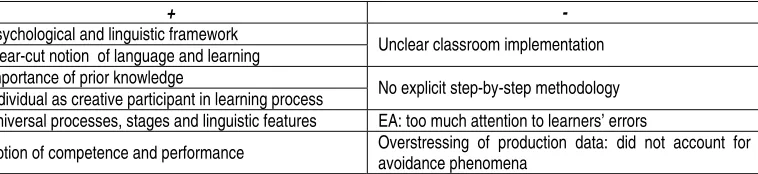
Even if there was a solid psychological and linguistic background behind Cognitive Code learning, the transformational grammar and mentalist/cognitive learning paradigms did not exactly give way to a method with a set of explicit step-by-step classroom procedures and techniques, unlike the previous method, very popular for teachers because of its explicit guidelines. That is why this layout did not attain the prominence of Audio-lingualism, as it did not have a clear classroom implementation. Besides, its major outcome, Error Analysis, also suffered some drawbacks, as it overstressed production data and paid too much attention to learners’ errors but was not able to account for avoidance phenomena. However, mentalism took the individual and his/her attempt at creating a language into account, rejected the notion of the learner as an empty organism, accepted the importance of prior knowledge and
distinguished the dichotomy of competence and performance, origin of
communicative approaches. It also studied universal aspects common for all learners and languages. Besides, it constituted the origin of the second language acquisition tradition and the humanistic approaches, both described in the following sections.
+ - Psychological and linguistic framework
Clear-cut notion of language and learning Unclear classroom implementation Importance of prior knowledge
Individual as creative participant in learning process No explicit step-by-step methodology Universal processes, stages and linguistic features EA: too much attention to learners’ errors
Notion of competence and performance Overstressing of production data: did not account for avoidance phenomena
Table 3: Cognitive Code learning in perspective
DI SCUSSI ON 7
a) Compar e t he advant ages and disadvant ages of Cognit ive Code lear ning and cont r ast t hem t o t hose of Audiolingualism.
6. THE SECOND LANGUAGE ACQUISITION TRADITION
6.1. Introduction
• Language is considered a creative process of rule formation and hypothesis testing. • Input is used to confirm or reject those rules/hypotheses about language.
• Language learning is a universal process and it is innate, because all children develop their language around the same age, regardless of the concrete language.
• LAD (Language Acquisition Device): The roots of language are pre-programmed in the minds of children when they are born, so that they would be able to acquire a language no matter whether he receives input or not. Learners should use that LAD for acquiring the target language.
• Identity hypothesis (L1=L2): The process of learning a second language is very similar to how the mother tongue is learnt. That is why many processes of L1 learning can also be applied to L2 acquisition.
Thus, the search for learning and language universals and the notion of language as a creative process constitute the two main arguments that led to the study of the similarities in L1 and L2 learning, which has been termed the Identity Hypothesis, at the core of both methods. The two attach great importance to input as a source to trigger learning and, following the Identity Hypothesis, they try to imitate the way children learn their mother tongue.
6.2. The Natural Approach
6.2.1. Theoretical background
Krashen (1985; Dulay Burt and Krashen, 1982) studied the conditions underlying all successful language acquisition, mainly based on the way children learn their first language, proposing the Monitor Theory, at the source of the classroom method. This model consists of five hypotheses:
1. Acquisition versus learning hypothesis
There are two different ways to ‘learn’ a language: a subconscious process, natural, identical to the one children learning their mother tongue use, and effective –acquisition-, and a second process –learning-, which is conscious and consists of learning grammar rules.
2. Natural Order hypothesis
Second language rules are acquired in a fixed way, pre-established, determined by innate mechanisms and not by linguistic complexity or explicit teaching.
3. Monitor Hypothesis
The monitor only controls learning, not acquisition. The monitor plans, edits and corrects the learner’s production when there is time. It sometimes interferes with the process of acquisition.
4. Input Hypothesis
It explains how language is acquired. A second language is acquired processing comprehensible input, that is, input that has been listened to and understood. If that input is beyond the level of the student and he/she does not understand it, then that input is useless. For acquisition to take place the input has to be slightly superior to the level of the learner (i+1) and comprehensible. To achieve comprehension, the learner can use some help, through the context, pictures, mime, etc. To achieve acquisition the learner must use innate mechanisms (LAD), triggered when input is heard and understood.
5. Affective filter Hypothesis
6.2.2. Features of the method: The Natural Approach
Krashen’s Monitor Theory constitutes the theoretical background of this method, together with Terrell’s school experience (Krashen and Terrell, 1983). The Natural approach considers language as communication, so meaning, rather than grammar, is at the core of their notion of language. Thus, the focus is not on explicit analysis of structures either by the teacher or learner. Following the notion that the process of learning a second language should be similar to the way children learn their mother tongue, comprehensible input is provided using visual and kinaesthetic aids, and students are not asked to produce output immediately, as they usually go through a silent period in which they understand but are not able to use the target language, in a way similar to L1 learners. There are several types of activities introduced in the lessons:
-Affective humanistic activities, intended to reduce the learners’ affective filter and involve their feelings, ideas and experiences, such as dialogues, interviews, preference ranking, personal charts, etc.
-Problem-solving activities, in which students have to find a correct answer to a situation or problem.
-Games, considered as an important element in the acquisition process and not as a way to fill up students’ lessons.
-Content activities, which focus on learning something else besides language, including mathematics, science, etc., for example, music, films, television reports, news broadcasts, and the like.
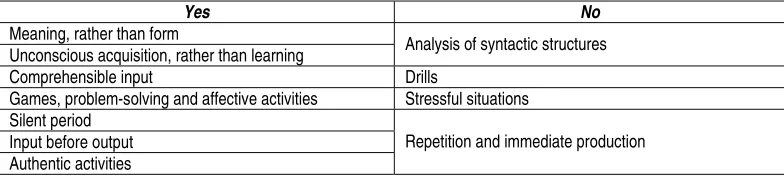
These activities provide meaningful and comprehensible input in the form of listening and reading. Production –speaking and writing- are left for a second stage, when the students have undergone their silent period and are ready to speak. The activities introduce a focus on unconscious acquisition rather than learning, and can be used to lower the students’ affective filter, because they centre on the students’ personal experience and opinions.
Yes No Meaning, rather than form
Unconscious acquisition, rather than learning Analysis of syntactic structures
Comprehensible input Drills
Games, problem-solving and affective activities Stressful situations Silent period
Input before output Authentic activities
Repetition and immediate production
Table 5: features of the Natural approach
DI SCUSSI ON 8 a) Summar ise t he f eat ur es of t he Nat ur al Appr oach.
b) W hich pr ocedur es of t his appr oach ar e st ill used in t he classr oom? W hat ar e t heir advant ages?
6.3. Total Physical Response
6.3.1. Theoretical background
Asher (1977) focused on several characteristics of first language acquisition to develop this method: the first is that children have to comprehend a lot of input before they learn how to speak. The second is that, when they are young, children receive input in which a lot of physical manipulation and action is involved (Nunan, 1991b). This association between movement and language facilitates spontaneous acquisition because of the association between stimulus and response. In this sense, this model has a clear audiolingual orientation. Asher also incorporated some humanistic principles: as in the Natural approach, it is essential to eliminate affective filters such as anxiety or stress, which could impede acquisition.
Although there is a structured psychological basis behind this method which is similar to that of the Natural approach, its linguistic orientation differs from that of Krashen and Terrell’s, and can be said to be based on a structuralist or even grammatical position (Sánchez, 1997), as input is selected using grammatical and lexical criteria.
6.3.2. Features of the method: Total Physical Response
Several key principles derived from the L1=L2 hypothesis constitute the basis of this teaching method (Nunan, 1991b):
-Comprehension should come before production, particularly at the beginning levels of second language instruction.
-The classroom should promote a relaxed climate and increase the interest and motivation of students through a well-chosen range of activities.
-The ‘here-and-now’ principle should organize all classroom teaching. -Input should be provided through commands in the imperative form. -The teacher is the instructor, and decides when, how and why to teach. -Learning is inductive rather than deductive.
-The first group of activities should involve commands, then interaction dialogues, and afterwards dramatization and role-plays. All must include physical action.
Yes No Comprehensible input
Language as structures and vocabulary Language as meaning Language learning: association of stimulus-response
through physical action Conscious reflection and analysis of linguistic structures
Unconscious acquisition Conscious learning
Silent period
Input before output Immediate production
Inductive learning Deductive learning and explanation of structures Teacher as leader of the classroom Learners: Active participants in teaching process Activities designed to reduce affective filter Stressful situations leading to anxiety
Use of commands in the form of orders
DI SCUSSI ON 9
a) Compar e t he f eat ur es of t he Nat ur al appr oach t o t hose of TPR. Enumer at e similar it ies and dif f er ences.
b) Have you exper ienced any of t hese t echniques as a lear ner ? W ould you use t hem as a t eacher ?
c) Read t he TPR classr oom pr ocedur e (Asher , 1977), and comment it s possible dr awbacks.
6.3.3. The Natural Approach and the Total Physical Response methods in perspective
Humanism and an identification of L2 and L1 learning are at the core of both methods. Moreover, many of their postulates are still applied in our days, such as the notions of input before output, the silent period, the question of comprehensible input, the reduction of the affective filter, and, for the Natural Approach, its selection of activities and its focus on meaning, rather than form. In this sense this method can be said to be the origin of the notional-functional approaches (see Section 8) that led to the Communicative move. In contrast, the TPR method goes back towards structuralist and grammatical positions in its notion of language –considered as a set of structures and vocabulary- and learning –regarded as an association of stimulus and response through physical action-.
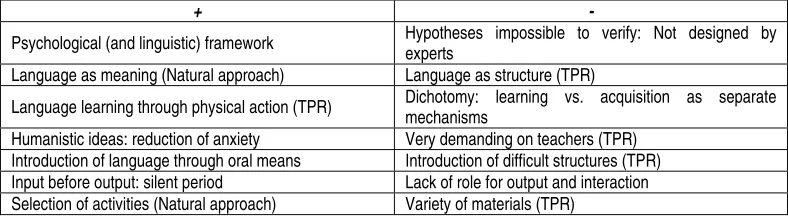
In general, the two methods have shown some problems, such as the fact that they were not designed by experts, and it has not been possible to verify their theoretical background or hypotheses. Besides, the distinction of learning versus acquisition as two separate mechanisms, one conscious and ‘unadvisable’ and the other one unconscious and ‘advisable’ is, though accepted by a widespread range of language teachers, feeble. Moreover, the role of interaction and the function of output for learning were not considered in detail. In addition, the TPR method, though popular in our days as a classroom procedure or technique, proved to be very demanding on teachers, provided a very limited range of materials and procedures, and made teaching difficult structures nearly impossible.
+ -
Psychological (and linguistic) framework Hypotheses impossible to verify: Not designed by experts
Language as meaning (Natural approach) Language as structure (TPR)
Language learning through physical action (TPR) Dichotomy: learning vs. acquisition as separate mechanisms
Humanistic ideas: reduction of anxiety Very demanding on teachers (TPR) Introduction of language through oral means Introduction of difficult structures (TPR) Input before output: silent period Lack of role for output and interaction Selection of activities (Natural approach) Variety of materials (TPR)
DI SCUSSI ON 10
a) Enumer at e t he advant ages and dr awbacks of t he Nat ur al and TPR met hods. Discuss if you would use bot h or only one of t hem.
7. HUMANISTIC APPROACHES OR DESIGNER METHODS1
7.1. Introduction
This section contemplates a number of methods which, through different in their classroom implementation, share a common framework: the primacy of affective and emotional factors within the learning process. They also have some other features in common, such as their departure from theories of language and second language acquisition research studies. In fact, they can be said to stem from common sense, rather than from any interaction between the psychological and linguistic disciplines (Sánchez, 1997). The role they attach to affect and feeling forms part of what has been termed the humanistic tradition, represented by Stevick (1982), Curran (1972), Gattegno (1972) and Lozanov (1978), among others. Humanism departs from audio-lingual habit theory and cognitive code learning and emphasizes the learner’s affective domain. Thus, language should be learner-centred, and the content, materials and learning activities should take into account the learner’s emotional attitude toward that language, its culture and his/her classmates. Humanism could be summarised saying that it is not really possible to teach anybody anything, only to help learners in their acquisition process.
7.2. Community Language Learning
7.2.1. Theoretical background
The question of how adults learn a second language, rather than an identification between children’s L1 and adults’ L2 learning, is at the core of this method. Adults show more inhibitions, they tend to analyse what they learn in a conscious way, and have a fear of making mistakes. Curran (1972) noticed that propensity to anxiety in adult language learners and focused on building a warm and supportive ‘community’ among learners, gradually moving from dependence on the teacher to complete autonomy. Psychologically speaking, this method arises from Rogers’ notions of learners in the role of clients and teachers as non-directive counsellors (a summary of this theory can be seen in Rogers, 1980). Linguistically speaking, even though Curran
1
Within Humanistic approaches we have considered three: Community Language Learning, The Silent Way and Suggestopedia (Nunan, 1991b), although other authors (Cerezal, 1996; Sánchez, 1997) also include the Second Language Acquisition tradition methods (TPR and the Natural Approach: see previous section). However, and even though both share some humanistic features, they are based on the identity
did not put forward any theory of language, his main follower, La Forge (1983) developed the notion of language as a process in which social, personal and cultural factors interact to create the linguistic identity of the human being (Sánchez, 1997).
7.2.2. Features of the method
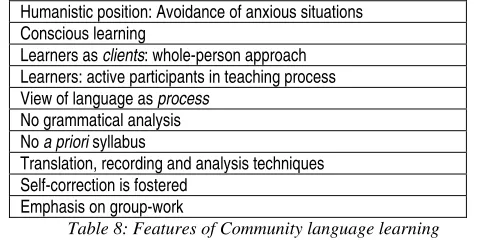
The role of affect and feeling, the notions of learner as client and teacher as counsellor, together with a view of language as a process led to a set of procedures in which traditional and innovative techniques are combined:
-Translation by the teacher of what L2 learners say is used. Then students repeat the sentences, which are recorded, revised and commented on subsequently.
-Group work has an important function, and these interactions are also recorded and transcribed by the teacher. Learners must then analyse their production and self-correct, if possible.
- There is no pre-defined syllabus in the classical sense. Students decide what and when to learn according to their needs. The teacher must sometimes discover those needs.
- The classroom is organized following a u-shape, so that participants can really communicate among themselves. The teacher is always behind the group to help solve linguistic problems, doubts and hesitations, and to eliminate negative feelings of anxiety or failure.
Humanistic position: Avoidance of anxious situations Conscious learning
Learners as clients: whole-person approach Learners: active participants in teaching process View of language as process
No grammatical analysis
No a priori syllabus
Translation, recording and analysis techniques Self-correction is fostered
Emphasis on group-work
Table 8: Features of Community language learning
DI SCUSSI ON 11
a)W hat ar e t he f eat ur es t hat dist inguish t his f r om ot her met hods alr eady ment ioned? b)Classif y t he pr ocedur es of t he met hod int o t wo gr oups: t r adit ional and innovat ive t echniques.
7.3. The Silent Way
DI SCUSSI ON 12 a) Have you ever t r ied t o t each a class wit hout speaking?
7.3.1. Theoretical background
was considered as an active, creative problem-solving process in which the use of physical cues was essential. As a materials developer, Gattegno was influenced by Cuisenaire, who had successfully used coloured charts and wooden sticks to teach mathematics. These cuisenaire rods –employed to remember learned material- together with the role of silence it attaches to the teacher constitute two of the most well-known techniques of the method. Linguistically speaking, the Silent Way had a structuralist basis, with language being considered as a set of structures and vocabulary, but with a focus on its oral aspects. However, the social function of language was not yet taken into account.
7.3.2. Features of the method
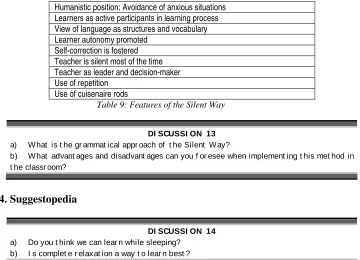
Though humanist in its general considerations, the Silent Way has an implementation different from the Community Language Learning approach. It has a very uniform classroom procedure; first sounds, then words and afterwards sentences are taught through coloured rods of different shapes, which have been previously associated to the different linguistic items. The teacher pronounces each element and asks for its repetition. He/she can use mime to guarantee or check comprehension or to indicate slight changes in content. Thus, the teacher directs the classroom but has an indirect role, because he/she has to be silent most of the time, giving an active role to the learner. In general, the method follows an audiolingual perspective, as translation is avoided at all costs. However, it also follows mentalist accounts, because self-correction and learner autonomy are promoted.
Humanistic position: Avoidance of anxious situations Learners as active participants in learning process View of language as structures and vocabulary Learner autonomy promoted
Self-correction is fostered Teacher is silent most of the time Teacher as leader and decision-maker Use of repetition
Use of cuisenaire rods
Table 9: Features of the Silent Way
DI SCUSSI ON 13 a) W hat is t he gr ammat ical appr oach of t he Silent W ay?
b) W hat advant ages and disadvant ages can you f or esee when implement ing t his met hod in t he classr oom?
7.4. Suggestopedia
DI SCUSSI ON 14 a) Do you t hink we can lear n while sleeping?
7.4.1. Theoretical background
Lozanov (1979) developed a teaching method based on the idea that the learner, given the appropriate conditions, is capable of prodigious feats (Nunan, 1991b). He based his ideas on Yoga, Soviet psychology and the use of music. From Yoga he took some techniques of relaxation, concentration and deep breathing. From Soviet psychology he borrowed the idea that learners can acquire anything, provided they do it in a deep state of concentration bordering hypnosis, and using the non-conscious and non- rational powers of their mind. Music is used to facilitate this relaxation and to activate the use of the left hemisphere, which is supposed to trigger holistic-global, non-analytic- learning. Even though this method had a sound psychological basis, Lozanov did not have a linguistic theory, although he did have a notion of the language to be taught: he focused on L1-L2 pairs (see Cerezal, 1996; Sánchez, 1997) and their memorisation, but did not attach a meaningful context to these linguistic items.
7.4.2. Features of the method
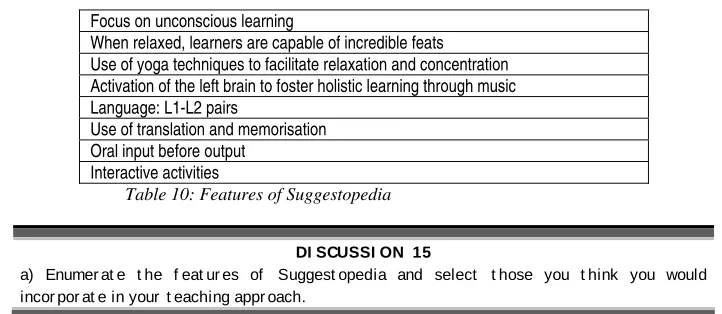
The classroom, following Suggestopedia, starts with the relaxation of the students through the appropriate music, breathing techniques, classroom furniture and voice of the teacher. Then, students listen to texts and represent different roles using the L2. Translation is also used to foster comprehension. Students are flooded with oral input which they have to learn in an inductive way, and the activities are designed so that they involve the students’ interests in such a way they do not provoke mental blocks. Interaction is also employed so that learners are able to use what they have unconsciously acquired.
Focus on unconscious learning
When relaxed, learners are capable of incredible feats Use of yoga techniques to facilitate relaxation and concentration Activation of the left brain to foster holistic learning through music Language: L1-L2 pairs
Use of translation and memorisation Oral input before output
Interactive activities
Table 10: Features of Suggestopedia
DI SCUSSI ON 15
a) Enumer at e t he f eat ur es of Suggest opedia and select t hose you t hink you would incor por at e in your t eaching appr oach.
7.4.3. The methods in perspective
individual people with little or no scientific support, and sometimes, without a well-defined notion of language. They were also advertised to be designed for achieving complete success at language learning; for accomplishing miracles. Thus, the use of the term Designer method. All three have received either enthusiastic support or criticism, and, concerning their actual success, results have been poor. In addition, the three require very specific teacher training, provide insufficient material and are very demanding for teachers. Besides, they lack a clear linguistic theory, so they tend to adopt a traditional grammatical orientation, particularly in the case of the Silent Way.
Community language learning, with its absence of syllabus, and the lack of conventional materials, is hard to put into practice, whereas Suggestopedia requires the same efforts because of different reasons: achieving complete relaxation in the students is no easy feat. Also, both are designed for adults, rather than children or teenagers. The Silent Way is also harder to implement with small children, who tend to need more verbal directions on the part of the teacher and are less autonomous. Besides, many teachers find it difficult to conduct a classroom without speaking.
On the whole, even though as methods the three show poor results, if considered as techniques within a global program, they have many advantages, introducing very useful activities, changing the classroom routine and providing the learner with an active role, while at the same time respecting his/her feelings and reducing his/her anxiety.
DI SCUSSI ON 16
a)Enumer at e t he advant ages and disadvant ages of t he t hr ee met hods consider ed in t his sect ion.
b)W ould you use any of t hese met hods in your t eaching pr act ice? c)Have you ever ex per ienced any of t hese t eaching met hods as lear ner ?
8. COMMUNICATIVE LANGUAGE TEACHING
The previously mentioned Designer Methods characterized the language teaching panorama in the decade of the 70s. However, if, from that point onwards there has been a recognized approach to language teaching, generally accepted as the norm and viewed as essential in order to be considered a good teacher, that is the Communicative Approach or Communicative Language Teaching (CLT). Its origins can be traced to the 60s, with the changes that occur in the British language teaching tradition. At this point, the foundations of Audiolingualism begin to be questioned, mainly as a result of Chomsky’s cognitivist ideas (cf. section 5).
British linguists Firth and Halliday, to those of the American sociolinguists Hymes, Gumperz, and Labov, to those of the language philosophers Austin and Searle. Another strong contributor to the Communicative Approach is Wilkins, with his proposal of a notional syllabus, incorporated by the Council of Europe in its attempt to facilitate the teaching of European languages in the Common Market. However, none of these ideas would have prospered if they had not been rapidly applied by textbook writers and equally quickly accepted by language teaching specialists, curriculum developers, and even governments. This provided the impetus for CLT, or the notional-functional approach or functional approach, as it is also termed, to become an international movement.
The latter views language learning as the product of the diverse subcompetences comprised within the general concept of communicative competence; that is, not merely linguistic or grammatical competence, as in previous methods, but also sociolinguistic, discourse, and strategic competences. Hence, the primary goal of CLT is to develop communicative competence, to move “beyond grammatical and discourse elements in communication” and probe the “nature of social, cultural, and pragmatic features of language” (Brown, 1994: 77).
Consequently, learners are expected, not so much to produce correct sentences or to be accurate, but to be capable of communicating and being fluent. Classroom language learning is thus linked with real-life communication outside its confines, and authentic samples of language and discourse or contextualized chunks rather than discrete items are employed. Students are hence equipped with tools for producing unrehearsed language outside the immediate classroom.
This general goal of CLT can be viewed in two ways, since, as Howatt (1984: 279) points out, it has both a “weak” and a “strong” version. The weak version “stresses the importance of providing learners with opportunities to use their English for communicative purposes and, characteristically, attempts to integrate such activities into a wider program of language teaching”. On the other hand, the strong version “advances the claim that language is acquired through communication”, so that language ability is developed through activities simulating target performance and which require learners to do in class exactly what they will have to do outside it.
In turn, this method’s theory of learning has a much less solid foundation. Nevertheless, according to Richards and Rodgers (2001), three main principles can be inferred from CLT practices:
1. The communication principle: Learning is promoted by activities involving real communication.
2. The task principle: Learning is also enhanced through the use of activities in which language is employed for carrying out meaningful tasks.
3. The meaningfulness principle: The learning process is supported by language which is meaningful to the student. Activities should consequently be selected according to how well they involve the learner in authentic and meaningful language use.
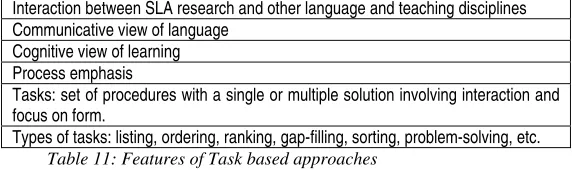
Much more discussion has been devoted to syllabus design in CLT, as it is central to this method. One of the first models to be set forth is Wilkins’ notional syllabus, which specifies notional or semantic-grammatical categories (such as time, sequence, quantity, notion, location, or frequency) and communicative function categories (for instance, requests, denials, offers, or complaints). The Council of Europe builds on this proposal and develops a syllabus including objectives, situations, functions, notions, and vocabulary and grammar. The result is Van Ek and Alexander’s Threshold Level English (1980). Further designs have since then been developed, such as task-based syllabuses (cf. section 10.1.) or the movement in favor of the abolition of the concept of syllabus.
Such syllabus types are implemented through a series of clear-cut activities and materials. The former, according to Littlewood (1981) are of two main kinds. One of them involves functional communication activities, where the information-gap principle is the basis for comparing pictures, working out sequences of events, discovering missing features in a map or picture, giving instructions, following directions, or problem-solving. The other consists of social interaction activities, based, as Nunan (1991a: 279) puts it, on the emphasis placed by CLT on “learning to communicate through interaction in the target language”. They encompass conversation and discussion sessions, dialogues and role plays, simulations, or debates.
In turn, materials are, in Richards and Rodgers’ view (2001), of three major types: text-based (e.g. textbooks), task-based (relying on jigsaw or information-gap principles), and realia (here, we are referring to authentic materials, taken from “real life” and brought into the classroom, such as signs, magazines, newspapers, maps, pictures, graphs, charts, or even objects).