Ž .
Applied Animal Behaviour Science 66 2000 305–321
www.elsevier.comrlocaterapplanim
The behavioural, physiological and immunological
responses of lambs from two rearing systems and
two genotypes to exposure to humans
P.J. Goddard
a,), A.R. Fawcett
a, A.J. Macdonald
a, H.W. Reid
ba
Macaulay Land Use Research Institute, Craigiebuckler, Aberdeen AB15 8QH, UK
b
Moredun Research Institute, International Research Centre, Pentland Science Park, Bush Loan, Penicuik, EH26 0PZ, UK
Accepted 9 September 1999
Abstract
The behavioural, physiological and immunological responses of lambs from two rearing systems and two genotypes to exposure to humans was assessed during and immediately after
Ž
testing in an open-field arena. Ninety-six lambs of two genotypes Scottish Blackface: BF and
Ž . .
Texel=Blue-faced Leicester=Scottish Blackface : T were used. From birth to weaning one of
Ž .
two management regimes was applied: extensive E , whereby animals were handled as little as
Ž .
possible or semi-intensive I , in which lambs experienced a greater level of human exposure.
Ž
Eight lambs from each of the four treatment groups received an antigenic challenge
Myco-.
bacterium a. paratuberculosis at 9 weeks of age to allow subsequent testing of immunological reactivity. At 1 and 3 weeks after weaning and 1 year later, lambs were tested in groups of four in a 4.5=4.5 m indoor arena, marked with gridlines at 0.75 m intervals. There were a number of occasions where testing revealed significant effects of genotype, management or their interaction, but in an approximately equal number of instances no significant effects of either genotype or management were observed. Genotype significantly influenced the number of squares occupied in
Ž
the test arena over a 10-min period before the human entered 100.4 vs. 110.5; sed 2.70 for BF
.
and T lambs, respectively, p-0.001 . In relation to the number of new squares entered, there was a genotype=management interaction: BFE lambs entered fewer squares than TE lambs but
Ž . Ž .
following semi-intensive management I BF lambs entered more squares than T lambs p-0.05 . When a human entered the arena after this 10-min period, while there was a gradual reduction in the number of animals which had not moved over the next 5 min, 66 animals had not moved within the allocated time. Also during this period, BF lambs stood facing the human for
)Corresponding author. Tel.:q44-1224-318611; fax:q44-1224-311556; e-mail: [email protected]
0168-1591r00r$ - see front matterq2000 Elsevier Science B.V. All rights reserved.
Ž .
Ž .
significantly longer than T lambs p-0.05 . At the time of arena testing, 12 lambs from each treatment group were fitted with heart-rate monitoring equipment. There were significant
differ-Ž . Ž .
ences in heart rate in relation to period of testing, i.e. before 107.9 or after 112.3 the point at which the human entered the arena or when the lambs were walking in the presence of a moving
Ž .
human 126.3 b.p.m.; sed 2.15, p-0.001 . When lambs were alone in the test arena, BF lambs
Ž .
had higher heart rates than T lambs p-0.05 . The heart rate of E lambs increased more than that
Ž .
of I lambs when the human entered the pen 9.4 vs. 0.3 b.p.m.; sed 3.95, respectively; ps0.05 . Immediately following completion of the behavioural tests, blood samples were collected from subsets of lambs. Plasma cortisol concentrations of BF lambs were greater than those of T lambs
Ž82.0 vs. 53.5 nmolrl; sed 10.18, p-0.01 but there was no effect of management. Blood.
samples collected from the lambs challenged with a novel antigen prior to weaning showed a genotype but not a management effect on both antibody and cell mediated immune responses, although there was a genotype=management interaction. However, it should also be noted that there were no significant effects of either genotype or management on a number of the indices recorded: latency of lambs to move from the initial entry position in the absence or subsequent presence of a human; length of time one individual was separated from the other three; distance moved in a raceway before stopping; plasma b-endorphin concentrations; heart rate in the presence of a human. Overall, these results suggest that although differences in responsiveness associated with specific genotypes of sheep can be detected in a test situation, the early life management regime may also have an effect. The results of this study caution against drawing conclusions between studies where different genotypes are employed. q2000 Elsevier Science B.V. All rights reserved.
Keywords: Sheep-handling; Human–animal relationships; Management systems; Physiology; Heart rate; Immunology; Genetics
1. Introduction
Changes in agricultural policy and financial support to agriculture in the European Ž
Union are resulting in an extensification of ruminant management systems Le Neindre .
et al., 1996; Wright, 1997 with a likely reduction in the amount of interaction between animals and humans. There is interest in the influence of human–animal interactions on
Ž animal management and the related stress responses of the animals concerned
Hems-.
worth et al., 1993 . While important factors in this relationship are being identified, the results following exposure of animals to simple tests are often inconsistent and difficult
Ž .
to interpret Le Neindre, 1989; Manteca and Deag, 1993 and few experiments have explored the potential for management systems to reduce fearfulness towards humans ŽBoivin et al., 1994 . In this context, Hargreaves and Hutson 1990 reported that. Ž .
Ž
gentling the procedure whereby repeated tactile, visual and auditory contact with a .
human makes animals easier to handle reduced the heart-rate response of sheep in relation to an approaching human. It is important to know whether long-term advantages in behavioural response accrue from differences in early life management: it has been suggested that modification of the perception of humans during critical periods of development can induce lasting changes in the response of animals to exposure to
Ž .
( )
P.J. Goddard et al.rApplied Animal BehaÕiour Science 66 2000 305–321 307
Other studies have failed to show long-lasting effects of differences in management
Ž .
practices Jensen et al., 1997 .
Little information is available on the influence of genotype on the response to management. A number of reports have indicated that, in cattle for example, there are differences between genotypes in temperament and more specifically factors such as
Ž
approachability and reactivity towards humans Murphey et al., 1980; Boivin et al., .
1992b; Le Neindre et al., 1996; Grandin, 1997 and in sheep effects of genotype and Ž
rearing conditions were shown to influence behavioural fear responses Torres-Hernan-. dez and Hohenboken, 1979; Romeyer and Bouissou, 1992; Le Neindre et al., 1996 .
The specific aim of this study was to determine whether there were differences in the behavioural, physiological or immunological responses of lambs to a brief period of intensive exposure to humans and handling in the post-weaning period in relation to prior management and whether the responses were modified by genotype. These differences in rearing management reflect the wide range of conditions found under
Ž .
practical farming situations. Metz 1987 suggested that early handling would make animals less fearful under unfamiliar circumstances and social modulation of adrenal
Ž .
responses was studied by Lyons et al. 1988 who showed, using goats, that social companions and individual temperament affected the response to human exposure. Thus, it is possible that the rearing environment per se may influence subsequent behaviour and physiological reactivity. We also wished to further explore whether measures of immune reactivity could be used in addition to more commonly used measures of stress since previous studies have shown a link between immune responses and indices of
Ž .
stress Hanlon et al., 1997 . Measures of immune status have the potential to provide a more long-term or integrated measure of stress due to the time frame of the immune response.
2. Materials and methods
2.1. Animals and management
2.1.1. Year 1
Ž . Ž
In a 2=2 study, pure-bred Scottish Blackface BF and Texel= Blue-faced
Leices-. Ž Leices-. Ž .
ter=Scottish Blackface T lambs were subjected to either extensive E and
semi-in-Ž . Ž
tensive I management regimes between lambing and weaning ns24 singleton lambs Žapproximately equal numbers of males and females.rgroup ..
Ž .
Extensive E management: Animals from these treatments were handled as little as possible. Lambs were born outside in an environment with minimal human exposure, gathered to allow anthelmintic treatment at approximately 6 weeks of age and again 3 weeks later when their mothers were shorn. Otherwise, they were not handled and were observed only from a distance to ensure adequate standards of welfare were maintained. This management treatment is typical of the management of hill sheep flocks in the UK. After lambing, both BFE and TE ewes and lambs grazed together as a single group.
Ž .
weeks of age and 3-weekly thereafter until weaning. After lambing, both BFI and TI ewes and lambs grazed together as a single group. Treatment I lambs were located in an environment subject to much more human and animal activity and they were subject to regular shepherding involving the shepherd, accompanied by his dog, moving through the group of ewes and lambs on a daily basis. This management treatment is typical of the management of upland and lowground sheep flocks in the UK.
Lambs of all treatments were born between 15 April and 25 May 1995 and were castrated and tail-docked within 24 h of birth using a rubber ring method. When the lambs were approximately 9 weeks old, their mothers were shorn and, at this time, eight lambs from each treatment group received a 0.75 ml subcutaneous inoculation of
Ž .
Mycobacterium a. paratuberculosis Central Veterinary Laboratory, Weybridge, UK in
Ž .
order to stimulate a specific immune response, both cell-mediated CMI and humoral Žantibody . All lambs were weaned at a mean age of 17 weeks at the end of August. At. this time they received anthelmintic treatment and were allocated to four adjacent outdoor paddocks, each with either four or eight lambs from each of the four treatment groups. Individual lambs were identified using a spray mark system. Each day a stockman walked through the groups of lambs which were treated identically following
Ž
weaning. By testing lambs from one paddock each day since testing could not be done .
on all lambs simultaneously the testing procedure was balanced across the four treatment groups. The first suite of tests was conducted 1 week after allocation to the paddocks and the second 2 weeks later.
2.1.2. Year 2
Following testing in year 1, the lambs of all treatments were managed outdoors as a single group with minimal human contact, save that required for routine husbandry. They were vaccinated against clostridial disease, received an oral anthelmintic on four occasions and were shorn. Supplementary feeding was undertaken on a daily basis during the winter as determined by the shepherd. Behavioural tests were conducted 1 year after the first tests, when 79 animals were available for study. One week prior to testing, the animals were re-allocated to the same four adjacent paddocks as in year 1 and again each day a stockman walked through the groups of lambs.
2.2. BehaÕioural tests
Exploratory behaviour and response to human exposure were assessed in groups of
Ž .
four lambs at 1 and 3 weeks after weaning Tests 1 and 2 and on one occasion 1 year
Ž .
later Test 3 . Over a 4-day period, lambs from each paddock in turn were moved a distance of 360 m to the indoor test area by a stockman and sheep dogs. Here they were placed in holding pens and divided into six sub-groups of four lambs, based on their treatment group. These groups of four lambs were sequentially moved a distance of less
Ž .
( )
P.J. Goddard et al.rApplied Animal BehaÕiour Science 66 2000 305–321 309
The groups of four lambs were placed in the test arena for 10 min, during which the latency to move from their initial position, the number of new squares entered by all of the individuals in the group during each 2 min and the total number of squares occupied by the group each 30 s were recorded. Entry to a new square was recorded if two feet
Ž
were placed across a boundary, for any period. Thereafter, a human not the stockman .
with whom the lambs may have been familiar entered the pen, stood still for 5 min and then walked around the pen edge at a constant speed for a further 5 min. The latency of lambs to move from their original position, the length of time spent facing the human and the number of new squares entered each minute were recorded. For the final 5 min, the length of time the nearest lambs were less than three squares from the human was recorded. The behaviour of the lambs was recorded on videotape for subsequent analysis. As the lambs were moved from the arena, they entered a 1.5m wide raceway and the distance travelled before they stopped was recorded.
All lambs were subsequently weighed.
2.3. Physiological tests
Twelve lambs from each treatment were prepared with heart-rate monitoring
equip-Ž .
ment Polar Sports Testere, Polar Electro Oy, Finland immediately prior to their
behavioural tests. After clipping a 5-cm wide strip on the left of the ribcage, behind the axilla, a belt which housed the transcutaneous pickups was attached; one pickup rested in the axilla, the other approximately 18 cm dorsal to this. Signals were recorded during the behavioural tests by a receiver secured around the belt and down-loaded to a computer following completion of the behavioural tests.
Immediately following completion of the behavioural tests, a blood sample was Ž collected by jugular venepuncture from eight lambs from each treatment group not
.
those used for heart-rate monitoring , and plasma concentrations of cortisol and b-en-dorphin were measured. Plasma samples were analysed for total cortisol concentration
Ž .
by radioimmunoassay Coat-a-Count Cortisol, EurorDPC, Caernarfon, Gwynedd, UK . The detection limit was 3.7 nmolrl and the intra-assay coefficient of variation was 12.6%. Concentrations of b-endorphin were analysed according to the method of
Ž .
Ssewannyana et al. 1990 . The detection limit was 3.6 pmolrl and the intra-assay coefficient of variation was 23.1%.
2.4. Immunocompetence
Samples of heparinized blood were collected from the eight lambs per treatment Ž
which had been vaccinated with M.a. paratuberculosis not used for heart-rate monitor-.
ing immediately after their behavioural tests were completed and at the same time on 3 successive days.
Ž .
Cell-mediated immune CMI response to M.a. paratuberculosis antigen was
exam-Ž .
ined using an in vitro lymphocyte stimulation assay LSA according to the method of
Ž . Ž .
Burrells et al. 1995 . Results were expressed as ‘‘corrected’’ counts per minute CPM :
Anti-mycobacterial antibody response to M.a. paratuberculosis antigen was assessed
Ž .
in an enzyme-linked immunosorbent assay ELISA , using the method of
Begara-Mc-Ž . Ž .
Gorum et al. 1998 . Results are expressed in terms of ELISA antibody units EAU .
2.5. Statistical analysis
Results from the behavioural tests and heart rate monitoring were evaluated by analysis of variance, following either logarithmic or angular transformation of the data to correct for skewed distribution or to accommodate the large number of occasions when zero counts were recorded and the resultant distribution of residuals. Analysis of
Ž . Ž
variance ANOVA was performed on the transformed data Genstat 5.3; Lawes .
Agricultural Trust, 1994 and, where appropriate, tables of results also present back-transformed means. Data from lambs tested together were blocked in groups of four in the analysis to account for possible lack of independence of behaviour. The structure of the ANOVA, which also allowed for higher order interactions in relation to individual lamb identity, examined effects of management, genotype and test number, together with their interactions.
Results from the cortisol andb-endorphin assays, and from the measurement of the
Ž .
response to M.a. paratuberculosis immunisation antibody ELISA and LSA , from the four treatment groups, were compared using analysis of variance with management and genotype as the main effects. ELISA and LSA data were first subjected to logn transformation to correct for a skewed distribution.
3. Results
3.1. BehaÕiour in the open-field arena
Latency of at least one member of the group of four lambs to move from original position when first introduced into the test arena showed no effect of either genotype or
Ž .
management. Overall, the mean latency was 11.3 s range 0–64 s . Neither were there any genotype or management effects on the length of time an individual lamb was separated from the other three. However, genotype significantly influenced the number of squares the lambs occupied over the 10-min period: overall, 100.4 vs. 110.5 squares; S.E.D. 2.70, p-0.001 for BF and T lambs, respectively. The test number also influenced the number of squares occupied: 99.7, 101.6 and 115.1 squares; S.E.D. 2.45, p-0.001, for tests 1, 2 and 3, respectively.
Considering the number of squares entered over the 10-min period before the human
Ž .
entered the arena, there was a genotype=management interaction p-0.05 : BF lambs Ž entered fewer squares than T lambs when managed extensively up to weaning 41.8 vs.
. Ž
57.1 but more squares than T lambs when managed semi-intensively 64.4 vs. 53.0; .
( )
P.J. Goddard et al.rApplied Animal BehaÕiour Science 66 2000 305–321 311
Fig. 1. Latency of lambs to move in the presence of a human.
the distribution of these particular animals. The time spent facing the human was significantly affected by genotype and the test number: overall BF lambs faced the
Ž .
human more and the time increased with test number Table 1 . There was a genotype=
test interaction with BF lambs showing a significantly greater increase in the length of time spent facing the human over the experimental period than T lambs. There was a significant effect of test number on the total number of new squares entered in the presence of the human over a 5-min period when, overall, lambs entered 7.2, 8.3 and 1.9
Ž . Ž
new squares in tests 1–3, respectively p-0.001; Table 2 . This effect was mostly due .
to the lambs entering more new squares in the first 2 min in tests 1 and 2 .
There was no significant effect of management or genotype on the distance the lambs moved before stopping in the raceway once the arena test was completed. Most groups of lambs moved immediately to the end of the race.
Table 1
Ž .
Mean length of time seconds lambs spent facing a stationary human in an open-field arena over a 5-min period. Lambs were of two genotypes and tested on three occasions, 1 and 3 weeks after weaning and 1 year later
Ž
Scottish Texel=Blue-faced Leicester Overall Significance
.
Blackface =Scottish Blackface S.E.D.
Test 1 74.6 84.4 19.37 Genotype p-0.05
Test 2 95.7 79.3 Test p-0.001
Table 2
Number of new squares lambs entered in the presence of a stationary human in an open-field arena over a
Ž w x.
5-min period log values with back-transformed means inn . Lambs were of two genotypes and tested on three occasions, 1 and 3 weeks after weaning and 1 year later
Ž
Scottish Texel=Blue-faced Leicester Overall Significance
.
Blackface =Scottish Blackface S.E.D.
w x w x
Test 1 1.31 3.69 1.76 5.8 0.373 Genotype n.s.
w x w x
Test 2 1.75 5.75 1.70 5.5 Test p-0.001
w x w x
Test 3 0.76 2.13 0.77 2.2 Interaction n.s.
3.2. Physiological tests
The plasma cortisol concentrations of the sampled lambs are shown in Table 3. The BF lambs had significantly higher plasma cortisol concentrations than T lambs but there was no effect of management or test number. There was, however, a significant management=test interaction with extensively reared lambs having higher plasma
Ž .
concentrations in test 1 and lower concentrations in test 2 p-0.001 . The overall mean
Ž .
b-endorphin concentration was 95.0 S.E. 6.04 pmolrl, with no significant effect of genotype, management or test number.
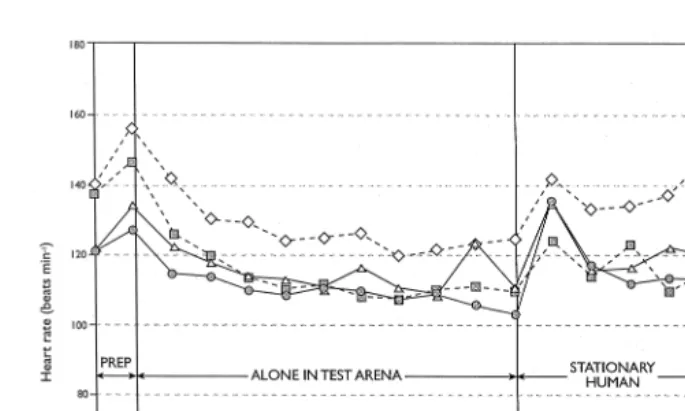
Overall, mean heart rates were lower when alone in the arena than in the presence of a stationary human and in the presence of a moving human and there was a significant
Ž y1
difference between each of these three periods 107.9, 112.3 and 126.3 beats min ,
. Ž .
respectively; S.E.D. 2.15, p-0.001 Fig. 2 . Each of these three periods was therefore considered separately in the subsequent analyses. When the lambs were alone in the
Ž .
arena, mean heart rate declined with test number p-0.01 and BF lambs had higher
Ž .
heart rates than T lambs p-0.05; Table 4 . In the presence of both a stationary and a
Ž .
moving human there was a significant effect of test number Table 5 , but neither genotype nor management significantly affected mean heart rate.
Over the 5-min period when a human entered the pen, compared to the period when Ž the lambs were alone, the heart rate of E lambs increased less than that of I lambs 9.4
y1 .
vs. 0.3 beats min , respectively; S.E.D. 3.95, ps0.05 . Although there was a greater increase above the resting heart rate when the human began to move around the pen
Ž y1.
overall increase 17.4 beats min , there was no effect of genotype or management. We compared heart rates and cortisol responses of the group of lambs with a 300s
Ž .
latency to move in the presence of a human high latency with the remaining lambs
Ž .
with latencies of less than 300 s low latency . In test 1 there was no significant difference in their heart rates over any of the three measurement periods. In test 2, high latency lambs had significantly higher heart rates in periods 1 and 3 than low latency
Ž
lambs period 1: 120.2 vs. 104.5; S.E.D. 7.59, p-0.05; period 3: 137.5 vs. 122.7; .
S.E.D. 6.08, p-0.05, for high and low latencies, respectively . In test 3 conducted 1 year later, high latency lambs had significantly lower heart rates in periods 1 and 2 than
Ž
low latency lambs period 1: 87.4 vs. 98.9; S.E.D. 4.55, p-0.05; period 2: 88.3 vs. .
104.0; S.E.D. 7.60, p-0.05, for high and low latency lambs, respectively . In test 1, Ž
()
P.J.
Goddard
et
al.
r
Applied
Animal
Beha
Õ
iour
Science
66
2000
305
–
321
313
Table 3
Ž .
Mean plasma cortisol concentrations nmolrl of lambs, following testing in an open-field arena, in weeks 1 and 3 post-weaning. Lambs were of two genotypes, subjected to two management treatments tested on two occasions, 1 and 3 weeks after weaning
Management Extensive Semi-intensive Overall S.E.D. Significance
Genotype Scottish Texel Scottish Texel
Ž Ž
Blackface =Blue-faced Blackface =Blue-faced
Leicester=Scottish Leicester=Scottish
. .
Blackface Blackface
Test 1 90.5 50.9 68.6 44.2 17.31 Genotype p-0.01
Test 2 60.9 47.7 108.0 71.2 Management n.s.
Fig. 2. Heart rate of lambs during the first of the behavioural tests in relation to breed and pre-weaning management.
.
S.E.D. 12.50 nmolrl, p-0.05 but in test 2 only two individual lambs with high latencies fell into the sub-sample which was blood sampled, and no comparison could be made.
Table 4
Ž y1.
Mean heart rate beats min of lambs when in an open-field arena over a 10-min period. Lambs were of two genotypes and tested on three occasions, 1 and 3 weeks after weaning and 1 year later
Ž
Scottish Texel=Blue-faced Leicester Overall Significance
.
Blackface =Scottish Blackface S.E.D.
Test 1 120.1 112.1 6.23 Genotype p-0.05
Test 2 116.0 98.9 Test p-0.01
Test 3 102.2 91.5 Interaction n.s.
Table 5
Ž y1. Ž
Mean heart rate beats min of lambs when in an open-field arena in the absence of a human over a 10-min
. Ž .
period , in the presence of a stationary human over a 5-min period and in the presence of a moving human
Žover a 5-min period . The lambs were tested on three occasions, 1 and 3 weeks after weaning and 1 year later.
Test 1 Test 2 Test 3 S.E.D. Significance
Alone 116.1 107.5 96.8 3.82 p-0.001
Stationary human 125.6 108.6 100.8 6.51 p-0.01
()
P.J.
Goddard
et
al.
r
Applied
Animal
Beha
Õ
iour
Science
66
2000
305
–
321
315
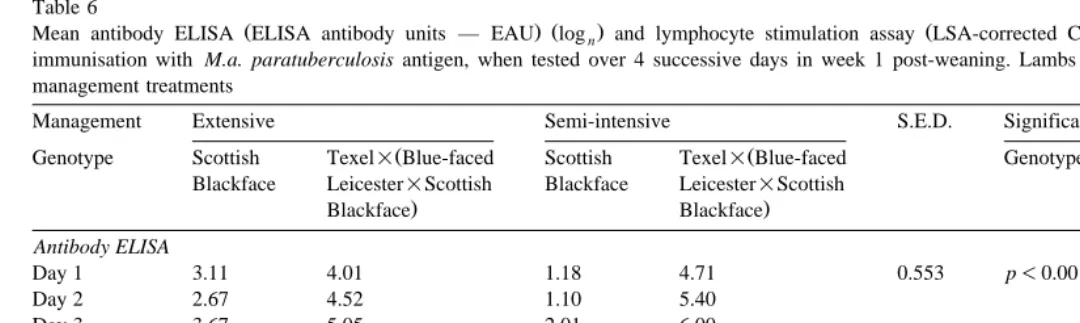
Table 6
Ž . Ž . Ž . Ž .
Mean antibody ELISA ELISA antibody units — EAU logn and lymphocyte stimulation assay LSA-corrected CPM logn activity of lambs, following immunisation with M.a. paratuberculosis antigen, when tested over 4 successive days in week 1 post-weaning. Lambs were of two genotypes, subjected to two management treatments
Management Extensive Semi-intensive S.E.D. Significance
Ž Ž
Genotype Scottish Texel=Blue-faced Scottish Texel=Blue-faced Genotype Management Interaction
Blackface Leicester=Scottish Blackface Leicester=Scottish
. .
Blackface Blackface
Antibody ELISA
Day 1 3.11 4.01 1.18 4.71 0.553 p-0.001 n.s. p-0.001
Day 2 2.67 4.52 1.10 5.40
Day 3 3.67 5.05 2.01 6.00
Day 4 3.84 5.32 2.16 5.79
Lymphocyte LSA
Day 1 3.12 3.31 1.59 3.86 0.453 p-0.001 n.s. p-0.05
Day 2 1.92 3.57 1.67 3.29
Day 3 2.75 3.09 1.96 3.73
3.3. Immunological assays
BF lambs had lower antibody and lymphocyte immune responses than T lambs Žp-0.001; Table 6 , and while no management effect was apparent, there was a. genotype by management interaction. In both assays, BFE lambs showed a greater immunoreactivity than BFI lambs, while for T lambs, the reverse was observed. Both assays showed an effect of day: over the four sampling days there was a significant
Ž . Ž .
increase in the activity in both the antibody p-0.001 and lymphocyte p-0.05 assays.
4. Discussion
A number of reports have suggested that the farm environment and management could influence the behaviour of animals in a variety of ways, including their reactivity
Ž
towards humans and their responses to potentially stressful situations Torres-Hernandez and Hohenboken, 1979; Hemsworth et al., 1986; Boivin et al., 1992a,b; 1994; Hunter et
. Ž .
al., 1997 . Similarly, Murphey et al. 1980 reported on the effect of genotype on the approachability of cattle at pasture. In the present study, some aspects of the behaviour of the lambs in the arena test were influenced by genotype and the interaction of
Ž
genotype with pre-weaning management squares occupied; squares entered; time facing .
a human . Equally, there were other aspects of the lambs’ behaviour in the arena tests Ž
which were not influenced by genotype or management length of time separated from .
group; latency to move; distance moved in raceway . This lack of marked or consistent change in relation to management differences between the two practical husbandry
Ž .
systems imposed supports the view of Boissy and Bouissou 1988 who suggested that only prolonged handling during early life substantially influenced human–animal rela-tionships.
Although neither genotype nor management influenced the latency of the lambs to move, Fig. 1, showing the latency of the lambs to move in the presence of a human, suggests that there may be two populations of animals, possibly equivalent to those with
Ž . Ž
active in terms of those which moved within the 300-s period and passive i.e. those .
which did not move personalities. This is consistent with the failure to find any relationship between the treatment group and those animals which did or ultimately did
Ž .
not move. Hemsworth et al. 1993 proposed that the distance of approach to a stationary experimenter was a useful measure of animals’ fear of humans. This needs to be set against a possible increase in latency to move with length of housing of lambs since in a previous study it was postulated that there was a reduction in the motivation to
Ž .
explore or escape with time Goddard et al., 1998 . Thus, the precise pre-test treatment may have a specific effect on the outcome of a test. Interestingly, the data from the present study revealed that there was a tendency for groups of four lambs to have high latencies to move. This suggests that once one individual moves, the others are likely to follow.
( )
P.J. Goddard et al.rApplied Animal BehaÕiour Science 66 2000 305–321 317
Ž .
despite the normal increment in heart rate associated with activity Baldock et al., 1988 . There was also a tendency for lambs with high latencies to have increased plasma cortisol concentrations. However, the effect on heart rate was inconsistent and not present 1 year later. We conclude that some physiological changes appear to be related to the latency to move within the open field arena. Such findings are consistent with the
Ž .
conclusions of Hessing et al. 1994 who showed that, in eight-week-old pigs,
individu-Ž .
als with an active behavioural response exhibited tachycardia a sympathetic response in response to a novel object, compared to pigs with a more passive behavioural response which, on the other hand, responded to a potentially fear-inducing situation with an increase in plasma cortisol concentrations. Thus, different facets of the physio-logical response may be invoked by different ‘‘classes’’ of animals in relation to the specific situation. It may be that selection from within such ‘‘classes’’ reduces experi-mental variation.
From Fig. 2 it is clear that the greatest increment in heart rate occurred immediately following a change of situation — either entry of a human into the arena or the human starting to move. These major increments tended to be short-lived, which corresponds
Ž .
with the findings of Baldock and Sibly 1990 who reported that similar increases in the absence of active behaviours were of short duration. These authors also suggested that non-motor heart rate provided an assessment of the stressfulness of the imposed procedures. On this basis it could have been expected that animals subjected to more intensive pre-weaning management in the present study would have mounted a lesser heart-rate response than extensively managed lambs, but no differences were observed in relation to management treatments, either in the first minutes or over the entire recording
Ž .
period. Lyons and Price 1987 had previously reported a lack of correlation between behavioural and heart-rate responses. Similarly, management treatment had no effect on plasma cortisol concentrations as found in a previous study which investigated the effects of post-weaning management on behavioural and physiological responses of
Ž . Ž .
lambs Goddard et al., 1998 . Baldock and Sibly 1990 suggested that non-motor heart rate provided a useful adjunct to recording behaviour alone and while, in the present
Ž
study overall, heart rates increased in periods 2 and 3 the latter with accompanying .
activity failure to discriminate between management history on the basis of heart-rate response supports the comment made above, based on behavioural observations, that the different pre-weaning management strategies imposed in the present study had little influence on the subsequent responses of the lambs.
The number of squares, occupied over a 10-min period, gives an index of the degree of cohesion between the lambs in the group and tends to suggest that while T lambs were more likely to be dispersed, lambs of both genotypes were more dispersed with increasing test number. Some habituation to the test environment could have occurred ŽTorres-Hernandez and Hohenboken, 1979 , at least between tests 1 and 2 and dispersal. could also be influenced to some extent by body size. The effect of test number is also seen in an increase in the length of time spent facing the human which, in calves, has
Ž
previously been associated with animals being less fearful of humans Becker and .
Lobato, 1997 .
Plasma cortisol concentrations were dependent upon genotype, a finding consistent
Ž . Ž .
in the present study, the immunological responses of the lambs when measured in the first year of the study were strongly influenced by genotype. Taken together, these results suggest that considerable caution is needed when comparisons are made between independent studies in which different genotypes are used: different genotypes have
Ž
rarely been considered under identical circumstances. Both ACTH the pituitary hor-.
mone responsible for cortisol release andb-endorphin would be expected to be released together from the pituitary gland in response to stress. A lack of difference in plasma b-endorphin responses, despite differences in plasma cortisol concentrations, has
previ-Ž
ously been attributed to either a difference in the time-course of response Tume and .
Shaw, 1992; Warriss et al., 1992 or the fact that they are released in a differential
Ž . Ž .
manner Fordham et al., 1989, 1991 . Rhind et al. 1998 suggested that profiles of b-endorphin alone may not provide a reliable index of weaning stress; clearly more work is needed beforeb-endorphin can be used as a reliable index of stress.
Ž .
The higher heart rates of BF lambs when alone in the test arena period 1 suggest
Ž .
that they found the experience including the preparatory handling more aversive, although there could be genuine genotypic differences in basal heart rate. Differences in
Ž .
heart rate between two genotypes of cattle reported by Le Neindre 1989 were also subject to this proviso.
It would appear that this is the first reported directly comparative study of the
Ž .
immunological responses of different genotypes of sheep. Hanlon et al. 1997 suggested that lymphocyte responses provided a more sensitive index of immunosuppression than antibody responses, but this is not borne out by the present findings. The clear differences related to genotype in both antibody and lymphocyte responses may reflect an immunosuppressive effect of cortisol which was significantly higher in BF lambs at the time of open-field testing and exposure to humans. The significant interaction between genotype and management is principally due to a reduced immunological response of BFI compared to BFE lambs. This suggests that the increased level of
Ž
human exposure perhaps particularly at the period when the novel antigen was
. Ž .
administered may have been detrimental to them. However, Rhind et al. 1998 showed that small increases in plasma cortisol concentrations induced by weaning stress did not inhibit an immune response. Since it is possible that the BF lambs may have exhibited a similar cortisol response at the time antigen was injected to that recorded following the arena tests, there may also have been a reduction in their primary immune response,
Ž .
although Griffin et al. 1988 reported a potentiation of immunocompetence in animals exhibiting an aggressive behavioural response to handling. The live weight of the lambs at the time of vaccination or testing may also have affected their response: although lambs were not weighed when vaccinated, by the time the immunological responses were measured, the mean live weight of BF lambs was 27.0 kg, while that of T lambs was 41.4 kg. The genotype differences and the genotype by management interactions recorded indicate that further study of specific immune responses is warranted, particu-larly if the success of prophylactic vaccination may be reduced by adverse management factors.
( )
P.J. Goddard et al.rApplied Animal BehaÕiour Science 66 2000 305–321 319
Ž
rate between tests 1 and 2 separated by a two-week period — possibly an habituation .
effect which is of the same order of magnitude as the difference between tests 2 and 3 Žseparated by exactly 1 year — possibly an age effect ..
5. Conclusion
Ease of management and improved welfare may be achieved by modifying the kind Ž and amount of handling, as well as the age when they occur. These are likely to act and
.
interact along a continuum to influence responses; identification of the ways human– animal relationships can be enhanced is becoming increasingly important. Long-term selection of farm breeds for a range of characteristics has led to them developing recognised traits and some genotype differences were indeed observed in the present study. As has also been shown, some genotype=management interactions can be expected. However, the failure of the present study to find marked differences in relation to the two management systems imposed pre-weaning may be that the differences
Ž .
imposed were too small to produce measurable changes; Holroyd and Petherick 1997 similarly failed to demonstrate differences in health and performance of extensively managed beef cattle in relation to different weaning processes.
Further work needs to be conducted on the refinement of appropriate behavioural indices of human–animal interactions. This comparative study has clearly indicated a difference between two genotypes of sheep in some behavioural, physiological and immunological responses to testing post-weaning, together with some genotype=
management interactions. There may be a direct link between physiological and immunological responses, possibly mediated by cortisol but, as with behaviour, it is not possible to say whether we recorded underlying genotype differences or differences in response to a stressful situation. Caution is therefore needed in the extrapolation of results across genotypes.
Acknowledgements
D.A. Elston of Biomathematics Scotland provided statistical advice. A. Brown, C.
Ž .
MacEachern, J. Scott accompanied by his sheep dogs and A. Ferguson assisted with the care of the lambs. We would like to thank an anonymous referee for most helpful comments. This study was supported by the Scottish Office, Agriculture, Environment and Fisheries Department.
References
Arave, C.W., Mickelsen, C.H., Walters, J.L., 1985. Effect of early rearing experience on subsequent behaviour and production of Holstein heifers. Journal of Dairy Science 68, 923–929.
Baldock, N.M., Sibly, R.M., Penning, P.D., 1988. Behaviour and seasonal variation in heart rate in domestic sheep, OÕis aries. Animal Behaviour 36, 35–43.
Becker, B.G., Lobato, J.F.P., 1997. Effect of gentle handling on the reactivity of zebu crossed calves to humans. Applied Animal Behaviour Science 53, 219–224.
Begara-McGorum, I., Wildblood, L.A., Clarke, C.J., Connor, K.M., Stevenson, K., McInnes, C.J., Sharp, J.M., Jones, D.G., 1998. Early immunopathological events in experimental ovine paratuberculosis. Veterinary Immunology and Immumopathology 63, 265–287.
Boissy, A., Bouissou, M.F., 1988. Effects of early handling on heifers’ subsequent reactivity to humans and to unfamiliar situations. Applied Animal Behaviour Science 20, 259–273.
Boivin, X., Le Neindre, P., Chupin, J.M., 1992a. Establishment of cattle–human relationships. Applied Animal Behaviour Science 32, 325–335.
Boivin, X., Le Neindre, P., Chupin, J.M., Garel, J.P., Trillat, G., 1992b. Influence of breed and early management on ease of handling and open-field behaviour of cattle. Applied Animal Behaviour Science 32, 313–323.
Boivin, X., Le Neindre, P., Garel, J.P., Chupin, J.M., 1994. Influence of breed and rearing management on cattle reactions during human handling. Applied Animal Behaviour Science 39, 115–122.
Burrells, C., Inglis, N.F., Davies, R.C., Sharp, J.M., 1995. Detection of specific T cell reactivity in sheep infected with Mycobacterium aÕium subspecies silÕaticum and paratuberculosis using two defined
mycobacterial antigens. Veterinary Immunology and Immumopathology 45, 311–320.
Fordham, D.P., Al-Gahtani, S., Durotoye, L.A., Rodway, R.G., 1991. Changes in plasma cortisol and b-endorphin concentrations and behaviour in sheep subjected to a change of environment. Animal Production 52, 287–296.
Fordham, D.P., Lincoln, G.A., Ssewannyana, E., Rodway, R.G., 1989. Plasma b-endorphin and cortisol concentrations in lambs after handling, transport and slaughter. Animal Production 49, 103–107. Goddard, P.J., Fawcett, A.R., Macdonald, A.J., 1998. The adaptation of hill lambs to housing conditions.
Applied Animal Behaviour Science 58, 331–339.
Grandin, T., 1997. Assessment of stress during handling and transport. Journal of Animal Science 75, 249–257.
Griffin, J.F.T., Bisset, L.R., Fisher, M.W., 1988. Influence of management stress and immunity in farmed red deer. Proc. N. Z. V. A. Deer Branch 5, 145–163.
Hanlon, A.J., Rhind, S.M., Reid, H.W., Burrells, C., Lawrence, A.B., 1997. Effects of isolation on the behaviour, live-weight gain, adrenal capacity and immune responses of weaned red deer hind calves. Animal Science 64, 541–546.
Hargreaves, A.L., Hutson, G.D., 1990. The effect of gentling on heart rate, flight distance and aversion of sheep to a handling procedure. Applied Animal Behaviour Science 26, 243–252.
Hemsworth, P.H., Barnett, J.L., Coleman, G.J., 1993. The human–animal relationship in agriculture and its consequences for the animal. Animal Welfare 2, 33–51.
Hemsworth, P.H., Barnett, J.L., Hansen, C., 1986. The influence of handling by humans on the behaviour, reproduction and corticosteroids of male and female pigs. Applied Animal Behaviour Science 15, 303–314.
Hessing, M.J.C., Hageslsø, A.M., Schouten, W.G.P., Wiepkema, P.R., van Beek, J.A.M., 1994. Individual behavioural and physiological strategies in pigs. Physiology and Behaviour 55, 39–46.
Holroyd, R., Petherick, C., 1997. The impact of weaning and processing on the health and performance of beef
Ž .
weaners. In: Hemsworth, P.H., Spinka, M., Kostal, L’. Eds. , Proc. 31st. International Congress of the ISAE, Prague, p. 159.
Hunter, E.J., Riches, H.L., Guise, H.J., Penny, R.H.C., 1997. The behaviour of pigs in lairage in relation to their post-weaning management: results of a postal survey. Animal Welfare 6, 139–144.
Jensen, M.B., Vestergaard, K.S., Krohn, C.C., Munksgaard, L., 1997. Effect of single versus group housing and space allowance on responses of calves during open-field tests. Applied Animal Behaviour Science 54, 109–121.
Lawes Agricultural Trust, 1994. Genstat 5.3 Reference Manual. Clarendon Press, Oxford.
Le Neindre, P., 1989. Influence of rearing conditions and breed on social behaviour and activity of cattle in novel environments. Applied Animal Behaviour Science 23, 129–140.
( )
P.J. Goddard et al.rApplied Animal BehaÕiour Science 66 2000 305–321 321
Le Neindre, P., Boivin, X., Boissy, A., 1996. Handling of extensively kept animals. Applied Animal Behaviour Science 49, 73–81.
Lyons, D.M., Price, E.O., 1987. Relationships between heart rates and behaviour of goats in encounters with people. Applied Animal Behaviour Science 18, 363–369.
Lyons, D.M., Price, E.O., Moberg, G.P., 1988. Social modulation of pituitary–adrenal responsiveness and individual differences in young domestic goats. Physiology and Behaviour 43, 451–458.
Manteca, X., Deag, J.M., 1993. Use of physiological measures to assess individual differences in reactivity. Applied Animal Behaviour Science 37, 265–270.
Ž .
Metz, J.H.M., 1987. The response of farm animals to humans. In: Seabrook, F.M. Ed. , The Role of the Stockman in Livestock Productivity and Management. Proc. Seminar in the Community Programme for the Coordination of Agricultural Research, Brussels, UER 10982 EN, pp. 23–37.
Moberg, G.P., Wood, V.A., 1982. Effect of differential rearing on the behavioural and adrenocortical response of lambs to a novel environment. Applied Animal Ethology 8, 269–279.
Murphey, R.M., Moura Duarte, F.A., Torres Penedo, M.C., 1980. Approachability of bovine cattle in pastures: breed comparisons and a breed=treatment analysis. Behaviour Genetics 10, 171–181.
Rhind, S.M., Reid, H.W., McMillen, S.R., Palmarini, G., 1998. The role of cortisol andb-endorphin in the response of the immune system to weaning in lambs. Animal Science 66, 397–402.
Romeyer, A., Bouissou, M.-F., 1992. Assessment of the fear reactions in domestic sheep, and the influence of breed and rearing conditions. Applied Animal Behaviour Science 34, 93–119.
Ssewannyana, E., Lincoln, G.A., Linton, E.A., Lowry, P.J., 1990. Regulation of the seasonal cycle of b-endorphin and ACTH secretion in the peripheral blood of rams. Journal of Endocrinology 124, 443–454. Torres-Hernandez, G., Hohenboken, W., 1979. An attempt to assess traits of emotionality in crossbred ewes.
Applied Animal Ethology 5, 71–83.
Tume, R.K., Shaw, F.D., 1992. Beta-endorphin and cortisol concentrations in plasma of blood samples collected during exsanguination of cattle. Meat Science 31, 211–217.
Warriss, P.D., Brown, S.N., Edwards, J.E., Anil, M.H., Fordham, D.P., 1992. Time in lairage needed by pigs to recover from the stress of transport. Veterinary Record 131, 194–196.
Wright, I.A., 1997. Identifying biological constraints acting on livestock systems in marginal areas. In: Laker,
Ž .