This paper has been presented at Sriwijaya University Learning and Education-International Conference 2014. Faculty of Teacher Training and Education, Sriwijaya University, Palembang, May 16—18, 2014.
D13-765
LEARNING MATHEMATICS FOR SOCIAL PROGRAM
STUDENTS OF SENIOR HIGH SCHOOL
Somakim
Lecturer of Mathematics Education in Faculty of Teacher Training and Education
Sriwijaya University
E-mail: [email protected]
Abstract
This study aims to know the level of social program high school students’ motivation and
learning outcomes after the implementation of role playing model in learning mathematics. The study was descriptive-quantitative. The subjects were 117 students grade XI social program in SMA N 16 Palembang. The data were collected through questionnaire and test.
Questionnaire is used to determine the level of students’ motivation, while the test is used to determine students’ learning outcomes. The results show that the role playing model can
improve level of students’ motivation and learning outcomes.
Key words:
Motivation, learning outcomes, Mathematics for social program, role
playing model.
INTRODUCTION
Learning mathematics is important for all students because it can train students’ thinking particularly in logical, analytical, systematic, critical, and creative as well as the ability to teamwork (Depdiknas, 2006;4). In addition, it can support to organize the way of thinking, for instance, develop ability of analyze, create syntheses, perform evaluations, and solve the problem.
The purpose of learning mathematics is not only for learning outcomes but also for increasing some abilities: 1) mathematical communication; 2) mathematical reasoning; 3) mathematical problem solving; 4) mathematical connections; 5) mathematical representations which are standard competences in learning mathematics according to NCTM (NCTM,200)
Another importance of learning mathematics is to develop character of students in making decisions. Therefore, mathematics is also learned for social program students of senior high school. Indeed, mathematics is one of subject in National Exam for them. However, most of social program students have a low score and less motivation in learning mathematics, Moreover, most of teacher does not support them optimally in learning mathematics.
Based on interview with the teacher who teach for social program students of senior high school stated that it is very difficult to teach them because most of students less motivation in learning mathematics. Consequently, students get low score in mathematics examination. To solve this problem, teacher needs change the way of learning mathematics in the class so the motivation of students will be generated. One of the solutions is implemented role playing model in learning mathematics. Through role playing model, students will explore the relationship among students in their role and discuss together to explore their sense, attitude, behavior, and various strategies to solve the problems. Role playing model can stimulate students to learn actively such mathematical concept.
This paper has been presented at Sriwijaya University Learning and Education-International Conference 2014. Faculty of Teacher Training and Education, Sriwijaya University, Palembang, May 16—18, 2014.
D13-766
some learning approach or learning model such as Contextual learning (CTL), Realistic Mathematics Education In Indonesia (PMRI), cooperative learning model and others.
METHODOLOGY
This research is descriptive-quantitative that is aimed to know the level of students’ motivation and learning outcomes after implementing role playing model in learning mathematics. Variable of the research is motivation and learning outcomes after implementing role playing model. Motivation of students will be measured through 25 statements in questionnaire with Likert scale. Learning outcomes will be measured through giving a test consisting of 5 questions. Subjects were 117 social program students of SMA N 16 Palembang.
The procedures of the research are: 1) preparation through designing a lesson plan and learning material by using role playing model, 2) Implementation through implementing the learning activity based on role playing model, 3) Closing through guiding students to conclude the learning process in learning mathematics.
The data collections were questionnaire and test. Questionnaire is used to know the level of
students’ motivation in learning process. The questionnaire will be presented in likert scale. The
statements consist of positive and negative statements. Test is a tool for measuring the knowledge of students regarding mathematical content. The result of test can be used to find out the learning outcomes of students after implementing role playing model in learning mathematics.
The statements of questionnaire are filled by respondent (students) even positive or negative statements which is valued by always, sometimes, seldom and never. Table 1 shows the score for each question on questionnaire.
Table 1. Score of Students’ Motivation
Statement Always Sometimes Seldom Never
Positive Statement 4 3 2 1
Negative Statement 1 2 3 4
Note :
Maximum score = 4 x total statements Minimum score = 1 x total statements
Then, percentage of score is extended by using quartil
25 43,75 62,5 81,25 100
Table 2. Level of students’ motivation
Percentage score Level
81,26 – 100 Very high
62,51 - 81,25 High
43,76 - 62,5 Low
This paper has been presented at Sriwijaya University Learning and Education-International Conference 2014. Faculty of Teacher Training and Education, Sriwijaya University, Palembang, May 16—18, 2014.
D13-767
The data of learning outcome is generated by test. Steps to do analysis of test are: 1. Write a key answer and score of the answer.
2. Check the answer of students.
3. Scoring the answer based on the rubric scoring.
The formula for scoring the answer is :
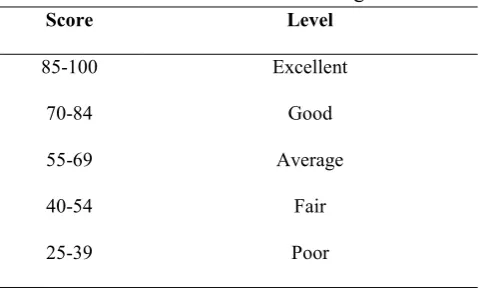
Then, the classification of learning outcomes can be seen on Table 3: Tabel 3. Level of students’ learning outcomes
Score Level
The study aims to describe the motivation and learning outcome of social program students in senior high school after implementation role playing model in learning mathematics. Table 4 and Table 5 shows results of the study as follow:
Table 4. Level of students’ motivation
This paper has been presented at Sriwijaya University Learning and Education-International Conference 2014. Faculty of Teacher Training and Education, Sriwijaya University, Palembang, May 16—18, 2014.
D13-768
Tabel 5. Level of students’ learning outcomes
Score Frequency Level
85-100 32 27,35% Excellent
70-84 63 53,85% Good
55-69 18 15,38% Average
40-54 4 3,42% Fair
25-39 - - Poor
Jumlah 117 100% -
Based on Table 5, it shows that from 117 students as subjects, there are 32 excellent students, 63 good students, 18 average students, 4 fair students and none poor students.
Discussion
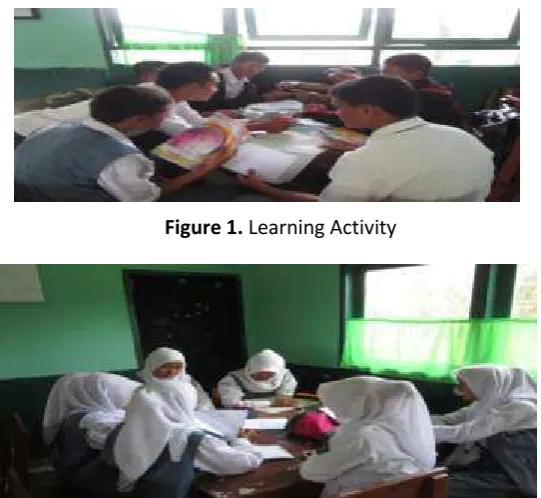
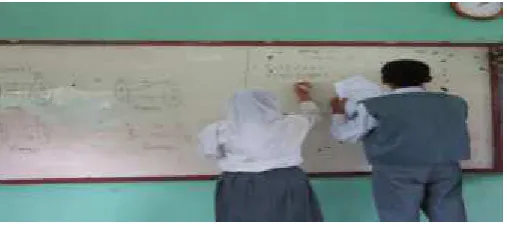
The results show that role playing model can improve motivation and learning outcome of social program students in senior high school. After implementation of role playing model, the level motivation increased because students involve actively in learning process to construct mathematical
concepts. Figure 1, 2, and 3 show students’ activity in learning process.
Figure 1. Learning Activity
This paper has been presented at Sriwijaya University Learning and Education-International Conference 2014. Faculty of Teacher Training and Education, Sriwijaya University, Palembang, May 16—18, 2014.
D13-769
Motivation of social program students can generate pleasure feeling because students are involved even individual or group work in learning mathematics through role playing model. The high motivation of student influences learning outcomes. Similarly, Dimyati (2010:109) stated that motivation is important to achieve maximum learning outcomes.
In the beginning, most social program students of senior high school have less interest in learning mathematics, but after implementationof role playing model, students are active in learning process. It indicated that students are pleased in learning mathematics. Therefore, high motivation of students to learn mathematics can influence good learning outcomes.
CONCLUSION AND SUGGESTION
According to the result and discussion, we can conclude that implementation of role playing model for social program students of senior high school can improve students’ motivation and learning outcomes. Since motivation and learning outcome can be improved through role playing model in learning mathematics, so we suggest for mathematics teacher especially social program teacher to involve students in constructing mathematical concepts.
REFERENCES.
Arikunto, S. (2010). Manajemen Penelitian. Jakarta: Rineka Cipta.
Bell, T. (1981). Promting Thinking Through Physical Education, Learning and Teaching in Action, 1: 35--40.
Depdiknas. (2006). Kurikulum Tingkat Satuan Pendidikan. Jakarta: Depdiknas. Depdiknas. (2006). Tujuan Pembelajaran Matematika. Jakarta: Depdiknas.
Depdiknas (2006). Kurikulum 2006 Standar Isi Mata Pelajaran Matematika. Jakarta: Depdiknas. Dimyati & Mujiono. 2010. Belajar dan Pembelajaran. Jakarta: Rineka Cipta.
Joyce, B., & Weil, M. (1992). Model of Teaching. Massachussetts : Allyn and Bacon.
National Council of Teachers of Mathematics. (2000). Principles and standards for school mathematics. Reston: NCTM.
Komara, E. (2012). Model Bermain Peran Dalam Pembelajaran Partisipatif, (Online),
http://khoirulanwari.wordpress.com/about/model-bermain-peran-dalam-pembelajaran-partisipatif/, accessed on August 8th, 2012.
Kusumah, Y. S. (2008). Konsep, Pengembangan, dan Implementasi computer-Based Learning dalam Peningkatan Kemampuan High-Order Mathematical Thinking. Pidato Pengukuhan Jabatan Guru Besar dalam Bidang Pendidikan Matematika UPI.
This paper has been presented at Sriwijaya University Learning and Education-International Conference 2014. Faculty of Teacher Training and Education, Sriwijaya University, Palembang, May 16—18, 2014.
D13-770
Widyaiswara. PPPG Matematika, (Online),
http://p4tkmatematika.org/downloads/smp/ModelPembelajaran.pdf, accessed on August 20th, 2012.
Acknowledgment
1. Program “Dia Bermutu” for study program mathematics education year 2012 has funded this study.