PT CHANDRA ASRI PETROCHEMICAL TBK BUSINESS, FINANCIAL AND INDUSTRY UPDATE OVERVIEW
Financial Results for First Quarter of Fiscal Year 2017
In May 2017, PT Chandra Asri Petrochemical Tbk (the "Company") released its first quarter financial results for the three months ended 31 March 2017.
The Company reported net revenues of US$632.7 million in the three months ended 31 March 2017, a 76.6% increase from the corresponding period in the prior year, and gross profit for the three months ended 31 March
2017 of US$176.3 million, a 184.8% increase from the corresponding period in the prior year. See "Financial
Update" below for further information and discussion on the Company's financial results for the three months ended 31 March 2017.
Rights Issue
On 24 May 2017, the Company filed a registration statement with the Indonesian Financial Services Authority (Otoritas Jasa Keuangan or "OJK"), in connection with a potential rights issue ("Rights Issue"). The Company is conducting the Rights Issue to fulfill the listing requirement whereby the total shares owned by non-controlling and non-principal shareholders are not less than 50,000,000 shares and are not less than 7.5% of paid- up capital based on the provision in V.1 of the Indonesia Stock Exchange ("IDX") Rule No. 1-A Concerning Listing of Shares and non-Share Equity Securities Issued by Listed Companies.
Pursuant to the Rights Issue, the Company will issue rights (the "Rights") on a pro rata basis to eligible holders of its ordinary shares of par value Rp1,000 per share (the "Shares"). Each holder of the Company's shares as recorded in the Company's shareholders register eight business days after the date of the effective statement of the Company's registration statement (the "Record Date") will be credited with Rights at a ratio of 4 Rights for every 47 existing Shares held on such date. Each Right would entitle the holder thereof to subscribe for one newly issued Share at an exercise price, which the Company expects to be between Rp18,000 per Share to Rp22,000 per Share. Assuming all of the Rights are exercised, we will have an aggregate of 279,741,494 newly issued Rights Shares ("New Shares").
The Company's shareholding structure and composition as of 31 May 2017 was as follows:
Nominal Value Rp1,000 per Share
Number of Shares
Total Nominal Value (Rp)
% of Total Nominal Value (%)
Authorised Capital ... 12,264,785,664 12,264,785,664,000
Paid-up Capital
Barito Pacific ... 1,480,383,520 1,480,383,520,000 45.04 SCG Chemicals ... 1,004,825,959 1,004,825,959,000 30.57 Prajogo Pangestu ... 503,399,869 503,399,869,000 15.32 Marigold... 169,362,186 169,362,186,000 5.15 Public (each with an ownership of less than 5%)... 128,991,024 128,991,024,000 3.92
Total paid-in capital ... 3,286,962,558 3,286,962,558,000 100.0
Shares in portfolio ... 8,977,823,106 8,977,823,106,000
Based on the contemplated size of the Rights Issue, existing shareholders who do not exercise their right to subscribe to the New Shares would be subject to a dilution of their existing Shares by up to 5.5%.
FINANCIAL UPDATE Key Factors Affecting Results of Operations and Financial Condition
Set forth below are a number of factors that have had important effects on the Company's results of operations and that the Company expects to continue to impact its financial performance in the future.
Supply and demand dynamics
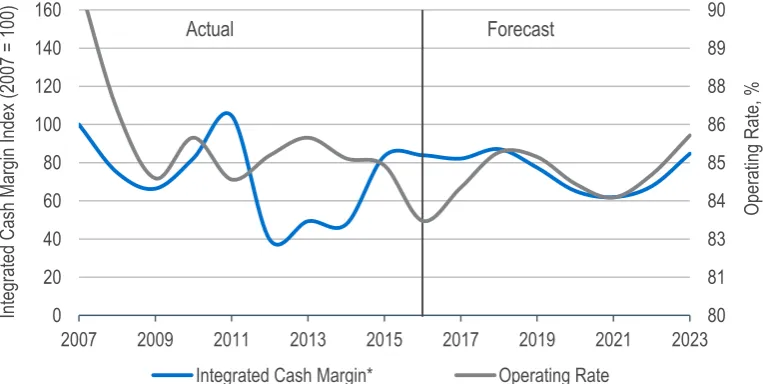
Our net sales, profit margins and operating performance are sensitive to supply and demand dynamics in both the domestic and international petrochemical markets. Demand for our products is generally linked to the level of economic activity or GDP growth. Supply is affected by production capacity available in the market. As demand for petrochemical products approaches available supply, industry capacity utilisation rates rise, and prices and margins typically increase. Historically, this relationship has been highly cyclical due to fluctuations in supply resulting from the timing of new investments in capacity and general economic conditions affecting the relative strength or weakness of demand. Generally, capacity is more likely to be added in periods when prevailing or expected future demand is strong and margins are, or are expected to be, high. Investments in new capacity can result, and in the past frequently have resulted, in overcapacity, which typically leads to a decrease in industry capacity utilisation rates and a reduction of margins. In response, petrochemical producers typically reduce capacity or limit further capacity additions, eventually causing the market to be relatively undersupplied and leading to a rise in industry capacity utilisation and margin expansion. Although we are the sole domestic producer of some of our products and we believe we have significant advantages over both our domestic and international competitors, the petrochemical industry has historically been characterised by periods of tight supply, leading to high utilisation rates and margins, followed by periods of oversupply primarily resulting from significant capacity additions, leading to reduced utilisation rates and margins. Oversupply results in reduction of the price of our products, which leads to a reduction in our profit margins, whereas during periods of tight supply, we benefit from the increase in product prices which lead to enhanced profit margins. Our historical results reflect these supply and demand dynamics and the volatile nature of the petrochemical industry.
Prices of our products are set by regional benchmark prices. Historically, we have been able to price some of our products at a premium to benchmark prices, mainly as a result of (i) our close proximity to customers, which results in shorter lead-time delivery, (ii) our ability to deliver our products regularly and in smaller quantities, and thus assisting our customers with their working capital efficiencies, as compared to imported products, which typically requires longer delivery time and bulk volume delivery, (iii) the security of product supply compared to imported products and (iv) the technical assistance that we provide. Since 2014, we experienced a decrease in the average sales price per tonne of our products. During the years ended 31 December 2014, 2015 and 2016, the average sales prices of olefins were US$1,148.2/MT, US$774.6/MT and US$758.6/MT, respectively. During the years ended 31 December 2014, 2015 and 2016, the average sales prices per tonne of polyolefins were US$1,659.6/MT, US$1,285.4/MT and US$1,191.1/MT, respectively. During the years ended 31 December 2014, 2015 and 2016, the average sales prices per tonne of styrene monomer and by-products were US$1,598.5/MT, US$1,088.5/MT and US$1,023.7/MT, respectively. During the years ended 31 December 2014, 2015 and 2016, the average sales prices per tonne of butadiene were US$1,176.9/MT, US$741.9/MT and US$689.9/MT, respectively.
Cost of feedstock
We use naphtha as our primary feedstock to produce our products and, accordingly, the cost of naphtha, all of which is purchased from independent third parties, represents by far the largest portion of our cost of goods sold. During the three months period ended 31 March 2017, the cost of naphtha accounted for approximately 64.7% of our cost of revenues. During the years ended 31 December 2014, 2015 and 2016, the cost of naphtha accounted for approximately 62.9%, 45.9% and 61.3% of our cost of revenues, respectively.
tonne of benzene, which is the primary raw material for styrene monomer, decreased by 14.8% from 2014 to 2016, from US$614/MT compared to US$721/MT in 2015. During 2015 and 2016, approximately 69.6% and 76.1% of our naphtha was supplied pursuant to one-year contracts at a benchmark price, respectively.
The prices of naphtha also tend to be correlated with the crude oil prices. The industry has seen the price of naphtha decrease since 2014, which tracked the rapid decline in the crude oil prices; in particular, starting from the fourth quarter of 2014 until the end of the first quarter of 2016, the price of Brent crude oil declined by nearly 50 per cent. Meanwhile, the prices for our products have also decreased, although at a slower rate than the decrease in the price of naphtha. As a result, our operating margins have increased during the periods. On the contrary, the oil price recovered in the first half of 2017, which led naphtha price to increase, pressuring our operating margins. The average price per tonne of naphtha decreased from US$860/MT in 2014 to US$455/MT in 2015 and US$400/MT in 2016. Our gross product margins for olefins during the years ended 31 December 2014, 2015 and 2016 were 2.0%, (0.9)% and 27.5%, respectively. Our gross product margins for polyolefins during the years ended 31 December 2014, 2015 and 2016 were 7.0%, 15.8% and 32.0%, respectively. Our gross product margins for styrene monomer during the years ended 31 December 2014, 2015 and 2016 were 1.7%, 5.0% and 8.0%, respectively. Our gross product margins for butadiene during the years ended 31 December 2014, 2015 and 2016 were 2.8%, (5.1)% and 11.1%, respectively.
We use propylene as our feedstock to produce polypropylene. We generally use all of our propylene production as feedstock for our own production of polypropylene. However, our propylene production is not sufficient for all of our polypropylene production and we typically import propylene to use as feedstock. During the years ended 31 December 2014, 2015, 2016 and the three months ended 31 March 2017, we produced 296 KT, 182 KT, 416 KT and 114 KT, respectively, of propylene and purchased 220 KT, 315 KT, 176 KT and 18 KT of propylene, respectively. During the years ended 31 December 2014, 2015 and 2016, the cost of propylene accounted for approximately 13.2%, 26.1% and 8.7% of our cost of goods sold, respectively. The price of propylene is generally determined by supply and demand for propylene in the market. Propylene price movements have not always been of the same magnitude or direction as changes in the prices we received for our products. Accordingly, increases or decreases in propylene prices have had a material effect on our margins.
As a result, increases in feedstock prices may have a material adverse effect on our margins and cash flows, to the extent that such increases are not passed through to the selling prices of our products. Significant volatility in feedstock costs may also put pressure on our margins, since sales price increases for our products may lag behind feedstock price increases. There can be no assurance that increases in feedstock prices will not adversely affect our business or results of operations in the future.
Economic conditions
Global and domestic macroeconomic conditions have historically had a significant impact on our operations and will continue to impact our operations. For example, the European debt crisis and China's economic slowdown in 2012 as well as high naphtha prices which resulted from the high oil prices triggered by heightened tensions in the Middle East stalled the growth of the petrochemical industry we operate in and have therefore resulted in significant decline in our profit margins and profitability in 2012. Moreover, in the second half of 2014, declining commodity prices, including the price of oil, led to a significant drop in the price of naphtha, which closely tracks oil prices, from which our operations benefited due to reduced feedstock cost. The global financial crisis, which commenced during the second half of 2008, had a negative effect on Indonesia and has
negatively impacted our results of operations.According to the IMF, the global downturn adversely affected the
economic performance of Indonesia, slowing real GDP growth rate to 5.6%, 5.0%, 4.8% in 2013, 2014 and 2015 respectively, before strengthening to 4.9% in 2016.
Maintenance programs (TAM, SDM) and unplanned outages
We are required to conduct TAM, which includes certification of safety valves, major repair and maintenance, major scheduled renewals and replacements with respect to our plants, to maximise operating level through plant modernisation. During the TAM, we shut our respective facilities for between 35 up to 45 days, depending on the product, which results in a decline in our production of products during such period.
2014 2015 2016 2017
Naphtha 1Q 2Q 3Q 4Q 1Q 2Q 3Q 4Q 1Q 2Q 3Q 4Q 1Q
Capacity utilisation rate ... 96.9% 98.2% 97.3% 81.7% 73.8% 66.3% 76.0% 10.5% 64.7% 92.2% 98.8% 103.1% 99.7%
Nameplate capacity (KT/A) ... 600 600 600 600 600 600 600 600 860 860 860 860 860
We are scheduled to conduct TAM every five years at our naphtha cracker plant, which typically lasts for 45 days. In September to December 2015, we conducted a scheduled TAM and expansion tie-in works, which resulted in the shutdown of our cracker facility for 85 days and limited our production capacity for 2015. The shutdown period was longer than the average as the TAM was conducted in conjunction with our cracker expansion project. After the TAM was complete, the nameplate capacity of our naphtha cracker increased to 860 KT/A. The capacity utilisation rate of our naphtha cracker during the year ended 31 December 2015 and the first quarter of 2016 was low at 56.5% and 64.7%, respectively, largely reflecting the impact of the naphtha cracker TAM and expansion tie-in works during 2015 and the ramp-up of our new capacity additions in the first quarter of 2016. The table below sets out the utilisation rates of our naphtha cracker during the periods indicated, which illustrates the effect of TAM on our production during the period.
We are scheduled to conduct the next TAM in 2020. After our recent review of our TAM procedures, we expect the TAM will result in a shutdown of our production plants for a maximum of approximately 45 days.
Our two styrene monomer plants each require a once every two year SDM for a period of 26 days to 30 days. In December 2016, we conducted a scheduled SDM, which resulted in the stoppage of our styrene monomer plants for 30 days. We conduct SDM for our butadiene plant at the same time as a TAM for our naphtha cracker plant, during which we shut down our production of butadiene for a period of up to 40 days.
Our operations are also subject to production and other factors beyond our control, which may subject us to unscheduled outages and shutdowns. In the past, we suffered from unplanned outages, including several unplanned shutdowns in 2015, due to us running several of our facilities for a longer time than usual to align them with the scheduled shutdown in relation to the scheduled TAM and expansion tie-in works for our cracker expansion project towards the end of 2015. The unplanned shutdowns, as well as the scheduled TAM and expansion tie-in works resulted in a decrease in the utilisation rate of our naphtha cracker from 93.5% in 2014 to 56.5% in 2015.
Debottlenecking and expansion plans
Our ability to increase our production and sales will depend on our ability to improve our capacity of assets through our debottlenecking and expansion plans. For example, our cracker expansion project, which we completed in December 2015, resulted in a 43% capacity increase for our products, namely ethylene (from 600 KT/A to 860 KT/A), propylene (from 320 KT/A to 470 KT/A), pygas (from 280 KT/A to 400 KT/A) and mixed
C4 (from 220 KT/A to 315 KT/A). We expect our debottlenecking and expansion plans to increase production
capacity through the installation of new equipment and machinery in our existing production facilities.
We are currently undertaking a butadiene expansion project, a debottlenecking project for our polypropylene plant and a naphtha cracker furnace revamp. PT Synthetic Rubber Indonesia ("SRI"), our joint venture company between our wholly-owned subsidiary PT Styrindo Mono Indonesia ("SMI") and Michelin, commenced construction of a new synthetic rubber plant to produce synthetic butadiene rubber in Cilegon, Banten in November 2015. In addition, we have two projects in the pipeline, namely the construction of a new polyethylene plant and a new MTBE and Butene-1 plant. We expect that the development and completion of new plants will enable us to produce new additional and higher value-added downstream products.
Tariffs
tariff of 5% to 15% of the import price if imported from non-ASEAN countries and is not subject to tariff if imported from ASEAN countries.
Environmental legislation
Our results of operations are affected by environmental laws and regulations, including those relating to greenhouse gas emissions, and environmental risks and goals generally. We have invested, and will continue to invest, a significant amount of financial and technical resources in order to achieve and maintain compliance with environmental requirements. From time to time, we also incur remediation and decommissioning costs at our current and former production facilities, as well as at other locations. Environmental considerations can also impact the markets in which we operate, including its position with respect to its competitors.
Seasonality
We have historically experienced lower sales during festive seasons, particularly during Hari Raya in Indonesia during which only food and passengers are generally allowed to be transported on public roads. We have historically been unable to deliver products to our domestic customers for approximately 14 days during this festive period. While polyethylene and polypropylene operating rates are not necessarily reduced, inventory builds up for two weeks during this festive period. Approximately two weeks prior to this festive period, demand for our products builds up, while lower sales are experienced for approximately two weeks during the festive period. To the extent that the two weeks prior to the festive period and the two-week festive period do not fall within the same quarter, our results of operations will show the effects of seasonality.
Description of Key Income Statement Line Items
Net revenue. In 2014, 2015 and 2016, we derived our net revenue from (i) the sale of olefins (ethylene, propylene, pygas and mixed C4), polyolefins (polyethylene and polypropylene), styrene monomer and its by-products and butadiene and its by-by-products and (ii) tanks and jetty rent. Our net revenue consisted of sales revenue net of VAT. We recognised domestic sales when the goods were delivered to customers. Export sales were generally made on an FOB basis and were recognised when the goods were dispatched, except for styrene monomer which was generally made on a CFR basis. In 2014, 2015 and 2016, our net revenue amounted to US$2,460.1 million, US$1,377.6 million and US$1,930.3 million, respectively.
The table below shows a breakdown of our net revenue according to each of our products and the average price of each of those products for the periods indicated.
For the year ended 31 December For the three months ended 31 March
2014 2015 2016 2016 2017
(US$ millions)
Avera ge sa les price
(US$) Volume (KT) (US$ millions) Avera ge sa les price
(US$) Volume (KT) (US$ millions) Avera ge sa les price
(US$) Volume (KT) (US$ millions) Avera ge sa les price
(US$) Volume (KT) (US$ millions) Avera ge sa les price
(US$) Volume
(KT)
Olefins
Ethylene ... 261.4 1,375.8 190.0 84.9 1,030.3 82.4 375.2 985.3 380.8 47.0 925.2 50.8 132.2 1,056.6 125.1
Propylene... 43.6 1,362.5 32.0 25.6 805.0 31.8 109.1 712.1 153.2 11.7 644.8 18.1 13.5 964.3 14.0
Pygas...193.9 979.3 198.0 60.6 567.9 106.7 106.4 451.8 235.5 22.0 415.4 53.0 44.8 640.4 70.0
Mixed C4... 15.5 553.6 28.0 — — — 19.1 556.9 34.3 0.6 342.7 1.8 5.3 984.7 5.4
Polyolefins
Polyethylene ...516.1 1,643.3 314.0 308.2 1,357.7 227.0 387.1 1,225.8 315.8 81.5 1,199.7 67.9 94.6 1,228.4 77.0 Polypropylene ...786.7 1,670.3 471.0 560.7 1,248.8 449.0 497.5 1,165.4 426.9 111.5 1,017.3 109.6 144.1 1,263.2 114.1 Styrene Monomer and
By-products
Styrene monomer ...412.7 1,605.2 257.1 251.9 1,094.7 230.1 285.3 1,031.8 276.5 59.6 966.0 61.7 105.6 1,318.4 80.1
By-products ... 6.1 1,150.9 5.3 4.0 740.7 5.4 4.0 666.7 6.0 0.8 615.4 1.3 1.4 736.8 1.9 Butadiene and
By-products
Butadiene... 109.0 1,327.6 82.1 43.2 941.2 45.9 86.7 1,015.2 85.4 13.0 747.1 17.4 65.7 2,182.7 30.1 By-products ... 109.9 1,049.7 104.7 34.7 580.3 59.8 52.6 451.9 116.4 10.0 403.2 24.8 21.9 577.8 37.9 Total net sales/ sales
Cost of revenues. In 2014, 2015 and 2016, our cost of revenues comprised the cost of goods sold adjusted for the cost of service. The total cost of goods sold comprised total manufacturing costs adjusted for work in process and finished goods. Our total manufacturing cost was primarily composed of the cost of naphtha and benzene, the principal raw materials used in our production operations, as well as direct labour and factory overhead. In 2014, 2015 and 2016, our cost of revenues was US$2,342.6 million, US$1,231.8 million and US$1,436.0 million, respectively and our cost of goods sold was US$2,340.3 million, US$1,229.8 million and US$1,433.8 million, respectively.
The tables below show a breakdown of our total cost of goods sold (consolidated and by segment) for the periods presented.
For the year ended 31 December
For the three months ended 31 March 2014 2015 2016 2016 2017
(US$ millions)
Raw materials used(1) ... 1,725.5 701.4 1,015.0 178.6 354.2
Direct labour ... 29.9 27.4 34.2 10.1 16.0
Factory overhead ... 262.7 216.2 272.8 64.3 65.0
Total manufacturing costs ... 2,018.0 945.0 1,321.9 253.0 435.1
Work in process
At beginning of year ... 10.9 15.3 10.9 10.9 12.6
At end of year ... (15.3) (10.9) (12.6) (9.8) (10.2)
Cost of goods manufactured ... 2,013.6 949.4 1,320.2 254.0 437.5
Finished goods
At beginning of year ... 116.2 66.7 58.0 58.0 70.2
Purchase of finished goods ... 277.1 271.7 125.8 26.8 18.9
At end of year ... (66.7) (58.0) (70.2) (43.0) (70.8)
Total cost of goods sold ... 2,340.3 1,229.8 1,433.8 295.8 455.8
Cost of service ... 2.3 2.1 2.3 0.5 0.7
Total cost of revenues ... 2,342.6 1,231.8 1,436.0 296.3 456.4
Note:
(1) Raw materials used only include costs of those raw materials that are used in our production process. Under our accounting tr eatment, only naphtha and benzene are designated as "raw materials". Since we also produce ethylene, propylene and C4, we designate them as "finished goods".
For the year ended 31 December
For the three months ended 31 March 2014 2015 2016 2016 2017
(US$ millions)
Olefin ... 788.4 292.6 627.7 96.0 216.5
Polyolefin ... 1,212.1 732.1 601.8 151.4 172.0
Styrene Monomer ... 413.4 245.0 268.0 59.4 95.4
Butadiene ... 212.6 81.9 123.9 22.4 59.7
Total ... 2,626.5 1,351.6 1,621.5 329.2 543.6
Eliminations ... (286.2) (121.8) (187.7) (33.5) (87.8)
Consolidated ... 2,340.3 1,229.8 1,433.8 295.8 455.8
The table below shows a breakdown of our total cost of raw materials consumed for the periods presented.
For the year ended 31 December For the three months ended 31 March
2014 2015 2016 2016 2017
(US$ millions) %
Volume (KT)
(US$ millions) %
Volume (KT)
(US$ millions) %
Volume (KT)
(US$ millions) %
Volume (KT)
(US$ millions) %
Volume (KT)
Naphtha ...1,472.1 85.3 1,559 564.8 80.5 974 880.6 86.8 2,121 151.5 84.8 409 294.8 83.2 586
Benzene ...253.4 14.7 197 136.5 19.5 182 134.4 13.2 219 27.1 15.2 48 59.4 16.8 66
Total ...1,725.5 100.0 1,756 701.4 100.0 1,156 1.015.0 100.0 2,339 178.6 100.0 457 354.2 100.0 651
2015 and 2016, our operating expenses totalled US$92.5 million, US$89.8 million and US$93.8 million, respectively. The tables below show a breakdown of selling expenses, general and administrative expenses for the periods presented.
For the year ended 31 December
For the three months ended 31 March 2014 2015 2016 2016 2017
(US$ millions)
Selling Expenses
Freight and insurance ... 39.9 39.1 38.7 8.6 10.7 Salaries and allowances ... 1.2 1.3 1.8 0.5 1.1 Depreciation... 0.2 0.4 0.6 0.2 0.2 Others ... 1.2 0.9 1.5 0.5 0.3
Total... 42.5 41.7 42.6 9.8 12.3
For the year ended 31 December
For the three months ended 31 March 2014 2015 2016 2016 2017
(US$ millions)
General and Administrative Expenses
Salaries, allowances and employee benefits ... 17.4 16.7 18.9 5.5 11.5 Professional fees ... 1.6 1.1 1.1 0.4 0.3 Depreciation... 1.1 1.2 0.7 0.2 0.2 Others ... 4.6 5.8 7.2 1.3 2.1
Total... 24.7 24.8 27.9 7.4 14.1
Finance costs. Finance costs primarily include interest expenses, bank charges and tax on interest expense. The tables below show a breakdown of finance costs for the periods presented.
For the year ended 31 December
For the three months ended 31 March 2014 2015 2016 2016 2017
(US$ millions)
Finance costs
Interest expenses on:
Bank loans ... 23.9 13.8 25.4 4.0 6.8 Others... 1.1 1.6 1.1 0.5 1.1 Total interest on financial liabilities not classified as at Fair Value
Through Profit or Loss ("FVTPL") ...
25.0 15.4 26.5 4.5 7.9
Bank charges... 5.7 5.5 3.6 0.7 1.7 Tax on interest expense... 1.2 1.6 1.7 0.4 0.3
Total... 31.9 22.5 31.9 5.6 9.9
Other income (expenses). Our other income (expenses) primarily includes gain (loss) on derivative financial instruments, share in net loss of an associate, loss on foreign exchange (net) and other gains and losses (net). The table below shows a breakdown of our other income for the three months period for the periods indicated.
For the year ended 31 December
For the three months ended 31 March 2014 2015 2016 2016 2017
(US$ millions)
Gain (loss) on derivative financial instruments ... (2.6) (1.5) 0.6 (0.2) 0.6 Share in net loss of an associate ...(0.8) (3.7) (5.9) (1.4) (1.8) Gain (loss) on foreign exchange – net ...(3.5) (11.5) (1.3) 6.9 1.9 Other gains and losses – net ... 13.5 16.0 15.2 6.2 2.3
Total... 6.6 (0.7) 8.6 11.5 3.0
liabilities were recognised for all taxable temporary differences and deferred tax assets are recognised for deductible temporary differences to the extent that it was probable that taxable income would be available in future periods against which the deductible temporary differences could be utilised. Deferred tax was calculated at the tax rates that had been enacted or substantively enacted as of the balance sheet date. The table below shows a breakdown of our income tax expense (benefit) and deferred tax expense (benefit) for the periods presented.
For the year ended 31 December
For the three months ended 31 March 2014 2015 2016 2016 2017
(US$ millions)
Current Tax ...(0.2) (21.1) (102.2) (15.3) (29.7) Deferred Tax
Company ...(7.3) (12.9) 2.7 3.0 0.5 SMI ... (0.1) (0.9) 1.4 (0.2) 0.4 PBI ... 1.2 5.3 (2.3) 0.3 (6.4) Total deferred tax expense (benefit) ...(6.2) (8.5) (1.8) 3.1 (5.5)
Total... (6.4) (29.6) (100.4) (12.2) (35.2)
On 14 January 2016, we received the results of 2014 income tax audit from the Director General of Tax ("DGT"), which stated that our taxable income in 2014 of US$44.9 million was modified to be US$60.9 million.
On 29 November 2016, the Company received tax facility benefit for an ethylene cracker expansion project from DGT, which allows a reduction in net taxable income of up to 30% of the amount invested in property, plant and equipment, totalling to Rp 3.5 trillion (US$260.5 million), per annum at 5% for six years of commercial production.
Three months ended 31 March 2017 compared to the three months ended 31 March 2016
The following discussion compares certain results of us for three months ended 31 March 2017 compared to the three months period ended 31 March 2016.
Net revenues. Our net revenues increased by 76.6% to US$632.7 million for the three months ended 31 March 2017 compared to US$358.2 million for the three months ended 31 March 2016. The increase in net revenues reflected a 36.7% growth in sales volume and an increase in the average sale price for our products during the period. The higher sales volume for the period was primarily due to higher levels of production following the successful completion of our cracker expansion project, which we completed in December 2015, followed by a ramp-up period during the first quarter of 2016. During the three months ended 31 March 2017, our net sales for olefins, polyolefins, styrene monomer and its by-products and butadiene and its by-products amounted to US$195.8 million, US$238.7 million, US$107.0 million and US$87.6 million, respectively. Net sales attributable to each of our main products are set forth below.
Olefins (ethylene, propylene, pygas and mixed C4). In the three months ended 31 March 2017, our net sales increased by 140.8% to US$195.8 million compared to US$81.3 million in the three months ended 31 March 2016, primarily attributable to the successful completion of our cracker expansion project in December 2015 and lower production in the first quarter of 2016 due to a ramp-up period.
Ethylene. Our net ethylene sales increased by 181.3% to US$132.2 million in the three months ended 31 March 2017 compared to US47.0 million in the three months ended 31 March 2016, in line with a 146.3% increase in sales volumes of ethylene to 125.1 KT in the three months ended 31 March 2017 from 50.8 KT in the three months ended 31 March 2016. Sales volumes were low in the three months ended 31 March 2016 because of the ramp-up period following our naphtha cracker expansion project which we completed in December 2015, whichsubsequently lowered production rates in the three months ended 31 March 2016.The average
sales prices per tonne of ethylene was 14.2% higher at US$1,056.6/MT in the three months ended 31 March 2017 compared to US$925.2/MT in the three months ended 31 March 2016.
US$964.3/MT in the three months ended 31 March 2017 compared to US$644.8/MT in the three months ended 31 March 2016.
Pygas. Our net pygas sales increased by 103.6% to US$44.8 million in the three months ended 31 March 2017 compared to US$22.0 million in the three months ended 31 March 2016. This was partly due to a 32.1% increase in sales volumes of pygas to 70.0 KT in the three months ended 31 March 2017 compared to 53.0 KT in the three months ended 31 March 2016. Sales volumes were low in the three months ended 31 March 2016 because of the ramp-up period following our naphtha cracker expansion project which we completed in December 2015,which subsequently lowered production rates in the three months ended 31 March 2016. The
average sales prices per tonne of pygas was 54.2% higher at US$640.4/MT in the three months ended 31 March 2017 compared to US$415.4/MT in the three months ended 31 March 2016.
Mixed C4. Our net mixed C4 sales increased by 783.3% to US$5.3 million in the three months ended 31 March 2017 compared to US$0.6 million in the three months ended 31 March 2016, in line with a 200.0% increase in sales volumes of mixed C4 to 5.4 KT in the three months ended 31 March 2017 from 1.8 KT in the three months ended 31 March 2016. Sales volumes were low in the three months ended 31 March 2016 because of the ramp-up period following our naphtha cracker expansion project which we completed in December 2015, whichsubsequently lowered production rates in the three months ended 31 March 2016.The average
sales prices per tonne of mixed C4 was 187.3% higher at US$984.7/MT in the three months ended 31 March 2017 compared to US$342.7/MT in the three months ended 31 March 2016.
Polyolefin (polyethylene and polypropylene). Our net polyolefin sales increased by 23.7% to US$238.7 million in the three months ended 31 March 2017 compared to US$193.0 million in the three monthsended 31 March 2016, primarily reflectingthe ramp-up period following our naphtha cracker expansion
project which we completed in December 2015, which subsequently lowered production rates in the three months ended 31 March 2016.
Polyethylene. Our net sales of polyethylene increased by 16.1% to US$94.6 million in the three months ended 31 March 2017 compared to US$81.5 million in the three months ended 31 March 2016. This was largely due to a 13.4% increase in sales volumes of polyethylene to 77.0 KT in the three months ended 31 March 2017 from 67.9 KT in the three months ended 31 March 2016. Sales volumes were low in the three months ended 31 March 2016 as a result of lower feedstock availability with the ramp-up period of the naphtha cracker. The increase was in line with a 2.4% increase in average sales price per tonne of polyethylene to US$1,228.4/MT in the three months ended 31 March 2017 from US$1,199.7/MT in the three months ended 31 March 2016.
Polypropylene. Our net sales of polypropylene increased by 29.2% to US$144.1 million in the three months ended 31 March 2017 compared to US$111.5 million in the three months ended 31 March 2016. This was largely due to a 4.1% increase in the sales volumes of polypropylene to 114.1 KT in the three months ended 31 March 2017 compared to 109.6 KT in the three months ended 31 March 2016 and a 24.2% increase in the average sales price per tonne of polypropylene to US$1,263.2/MT in the three months ended 31 March 2017 compared to US$1,017.3/MT in the three months ended 31 March 2016.
Styrene monomer and by-products. Our net sales of styrene monomer increased by 76.9% to US$107.0 million in the three months ended 31 March 2017 compared to US$60.4 million in the three months ended 31 March 2016. This was largely due to a 30.2% increase in sales volumes of styrene monomer and its by-products to 82.0KT in the three months ended 31 March 2017 compared to 63.0KT in the three months ended 31 March 2017 and a 36.5% increase in the average sales price per tonne of styrene monomer to US$1,318.4/MT in the three months ended 31 March 2017 compared to US$966.0/MT in the three months ended 31 March 2016.months ended 31 March 2016 and a 192.2% increase in the average sales price per tonne of butadiene to US$2,182.7/MT in the three months ended 31 March 2017 compared to US$747.1/MT in the three months ended 31 March 2016.
Cost of revenues. For the three months period ended 31 March 2017 and 31 March 2016, our cost of revenues comprised cost goods sold and cost of service. Our cost of goods sold comprised total manufacturing cost adjusted for work in process and finished goods. Our total manufacturing cost primarily comprised the cost of naphtha and benzene, our principal raw materials used, which represent 81.4% and 70.6% of our total manufacturing cost for the three months ended 31 March 2016 and 31 March 2017, respectively, direct labour and factory overhead. Our cost of revenues increased by 54.0% to US$456.4 million for the three months ended 31 March 2017 compared to US$296.3 million for the three months ended 31 March 2016, primarily due to increased consumption of naphtha, which is our primary feedstock, due to higher production levels. The average price per tonne of naphtha, which is linked to the price of Brent crude oil, increased 34.7% to US$506.7/MT in the three months ended 31 March 2017 from US$376.1/MT in the three months ended 31 March 2016. In addition, the average price per tonne of benzene, which is the main raw material for styrene monomer, increased by 60.2% to US$907.8/MT in the three months ended 31 March 2017 from US$566.5/MT in the three months ended 31 March 2016.
The tables below show a breakdown of our total cost of revenues (consolidated and by segment) for the periods presented.
For the three months ended 31 March
2016 2017
(US$ millions)
Raw materials used ... 178.6 354.2
Direct labour ... 10.1 16.0
Factory overhead ... 64.3 65.0
Total manufacturing costs ... 253.0 435.1
Work in process
At beginning of period ... 10.9 12.6
At end of period ... (9.8) (10.2)
Cost of goods manufactured ... 254.0 437.5
Finished goods
At beginning of period ... 58.0 70.2
Purchase of finished goods ... 26.8 18.9
At end of period ... (43.0) (70.8)
Total cost of goods sold ... 295.8 455.8
Cost of service ... 0.5 0.7
Total cost of revenues ... 296.3 456.4
The table below sets forth our cost of revenues for each product for the periods presented:
For the three months ended 31 March
2016 2017
(US$ millions)
Olefin ... 96.0 216.5
Polyolefin ... 151.4 172.0
Styrene Monomer ... 59.4 95.4
Butadiene ... 22.4 59.7
Total ... 329.2 543.6
Eliminations ... (33.5) (87.8)
Polyolefin (polyethylene and polypropylene). Our cost of revenues of polyolefins increased by 13.6% to US$172.0 million in the three months ended 31 March 2017 compared to US$151.4 million in the three months ended 31 March 2016, primarily reflecting higher production levels, as well as a 7.7% increase in our polyolefin sales volumes to 191.1KT in the three months ended 31 March 2017 compared to 177.5KT in the three months ended 31 March 2016.
Styrene monomer and by-products. Our cost of revenues of styrene monomer and its by-products increased by 60.8% to US$94.9 million in the three months ended 31 March 2017 compared to US$59.0 million in the three months ended 31 March 2016, primarily reflecting higher production from improving plant performance and market conditions. Sales volumes increased by 30.2% to 82.0KT in the three months ended 31 March 2017 compared to 63.0 KT in 2015.
Butadiene and by-products. Our cost of revenues of butadiene and its by-products increased by 166.5% to US$59.7 million in the three months ended 31 March 2017 compared to US$22.4 million in the three months ended 31 March 2016, primarily reflecting higher production, with more feedstock being available for use following the completion of our cracker expansion project. Sales volumes increased by 60.8% to 68.0KT in the three months ended 31 March 2017 compared to 42.3KT in the three months ended 31 March 2016.Gross profit (loss). Our gross profit increased by 184.8% to US$176.3 million for the three months ended 31 March 2017 compared to US$61.9 million for the three months ended 31 March 2016, primarily due to higher volumes from increased production capacity and higher product margins. Our gross profit margins for the three months ended 31 March 2017 and 31 March 2016 were 27.9% and 17.3% respectively.
The table below sets forth our gross profit (loss) for each product category for the periods presented:
For the three months ended 31 March
2016 2017
(US$ millions)
Olefin ... 18.2 66.5
Polyolefin ... 41.6 66.8
Styrene monomer ... 1.5 12.1
Butadiene ... 0.5 27.8
Other operating income (expenses). Our other operating income (expenses) for the three month periods ended 31 March 2017 and 31 March 2016 primarily included selling expenses, general and administrative expenses, finance costs and other income (expenses). The table below shows a breakdown of our selling expenses for the periods presented.
For the three months ended 31 March
2016 2017
(US$ millions)
Selling Expenses
Freight and insurance ... 8.6 10.7
Salaries and allowances ... 0.5 1.1
Depreciation... 0.2 0.2
Others ... 0.5 0.3
Total... 9.8 12.3
The table below shows a breakdown of our general and administrative expenses for the periods presented.
For the three months ended 31 March
2016 2017
(US$ millions)
General and Administrative Expenses
For the three months ended 31 March
2016 2017
(US$ millions)
Professional fees ... 0.4 0.3
Depreciation... 0.2 0.2
Others ... 1.3 2.1
Total... 7.4 14.1
The table below shows a breakdown of our finance costs for the periods presented.
For the three months ended 31 March
2016 2017
(US$ millions)
Finance costs
Interest expenses on:
Bank loans ... 4.0 6.8
Bonds payable ... — 1.1
Others... 0.5 0.0
Total interest on financial liabilities not classified as at FVTPL(1) ...
4.5 7.9
Bank charges... 0.7 1.7
Tax on interest expense... 0.4 0.3
Total... 5.6 9.9
Note:
(1) Fair value through profit or loss.
The table below shows a breakdown of our other income (expense) for the periods presented.
For the three months ended 31 March
2016 2017
(US$ millions)
Gain (loss) on derivative financial instruments ... (0.2) 0.6
Share in net loss of an associate ... (1.4) (1.8)
Loss on foreign exchange – net ... 6.9 1.9
Other gains and losses - net ... 6.2 2.5
Total... 11.4 3.2
Income tax expense - net. Our income tax expense - net was US$35.2 million for the three months ended 31 March 2017 compared to US$12.2 million for the three months ended 31 March 2016.
Profit for the period. In view of the foregoing, our profit for the three months ended 31 March 2017 amounted to US$107.8 million.
The Year Ended 31 December 2016 Compared to the Year Ended 31 December 2015
The following discussion compares our operating results for the year ended 31 December 2016 to the year ended 31 December 2015.
Net revenues. Our net revenues increased by 28.6% to US$1,930.3 million in 2016 compared to US$1,377.6 million in 2015. The increase in net revenues reflected a 64% growth in sales volume, partially offset by a 15% decrease in the average sale price for our products in 2016. The higher sales volume for 2016 was principally due to higher levels of production following the successful completion of our cracker expansion project by 43% to 860 KTA, which we completed in December 2015. In 2016, our net sales for olefins, polyolefins, styrene monomer and butadiene amounted to US$609.8 million, US$884.6 million, US$289.2 million and US$139.3 million, respectively. Net sales attributable to each of our main products are set forth below.
Ethylene. Our net ethylene sales increased by 341.9% to US$375.2 million in 2016 compared to US$84.9 million in 2015, in line with a 362.1% increase in sales volumes of ethylene to 380.8 KT in 2016 from 82.4 KT in 2015. Sales volumes were low in 2015 because of the 85-day shutdown during our scheduled TAM and expansion tie-in works in the latter part of the year, which also lowered our production levels for the year. Sales volumes increased in 2016 due to our cracker expansion project, which we completed in December 2015. The average sales prices per tonne of ethylene was 4.4% lower at US$985.3/MT in 2016 compared to US$1,030.3/MT in 2015.
Propylene. Our net propylene sales increased by 326.2% to US$109.1 million in 2016 compared to US$25.6 million in 2015, largely due to a 381.8% increase in sales volumes of propylene to 153.2 KT in 2016 compared to 31.8 KT in 2015. Sales volumes were low in 2015 as a result of our 85-day shutdown during our scheduled TAM and expansion tie-in works in the latter part of the year, which also lowered our production levels for the year. The average sales prices per tonne of propylene was 11.5% lower at US$712.1/MT in 2016 compared to US$805/MT in 2015.
Pygas. Our net pygas sales increased by 75.6% to US$106.4 million in 2016 compared to US$60.6 million in 2015. This was largely due to a 120.7% increase in sales volumes of pygas to 235.5KT in 2016 compared to 106.7KT in 2015, as a result of higher production for pygas and by-products and lower average sales prices per tonne of pygas. The average sales prices per tonne of pygas was 20.4% lower at US$451.8/MT in 2016 compared to US$567.9/MT in 2015.
Mixed C4. Our net mixed C4 sales were US$19.1 million in 2016 compared to nil in 2015, as the excess mixed C4 following our cracker expansion project was sold instead of being consumed as raw materials by our wholly owned subsidiary, PT Petrokimia Butadiene Indonesia ("PBI"), to produce butadiene.
Polyolefin (polyethylene and polypropylene). Our net polyolefin sales increased by 1.8% to US$884.6 million in 2016 compared to US$868.9 million in 2015, primarily reflecting the results of our cracker expansion project, which we completed in December 2015.
Polyethylene. Our net sales of polyethylene increased by 25.6% to US$387.1 million in 2016 compared to US$308.2 million in 2015. This was largely due to a 39.1% increase in sales volumes of polyethylene to 315.8KT in 2016 from 227.0KT in 2015 as a result of higher production after the 85-day shutdown for our scheduled TAM and our cracker expansion project. This increase was partially offset by a 9.7% decrease in average sales price per tonne of polyethylene to US$1,225.8/MT in 2016 from US$1,357.7/MT in 2015, in part reflecting lower feedstock costs.
Polypropylene. Our net sales of polypropylene decreased by 11.4% to US$497.5 million in 2016 compared to US$560.7 million in 2015. This was largely due to a 4.9% decrease in sales volumes of polypropylene to 426.9KT in 2016 compared to 449.0KT in 2015. Average sales price per tonne of polypropylene decreased by 6.7% to US$1,165.4/MT in 2016 compared to US$1,248.8/MT in 2015, in part reflecting lower feedstock costs.
Styrene monomer and by-products. Our net sales of styrene monomer increased by 13.1% to US$289.2 million in 2016 compared to US$255.8 million in 2015. This was largely due to a 20.2% increase in sales volumes of styrene monomer to 282.5KT in 2016 compared to 235.0KT in 2015 mainly due to improved plant performance and market conditions. The average sales price per tonne of styrene monomer decreased by 6.0% at US$1,023.7/MT in 2016 compared to US$1,088.5/MT in 2015, in part reflecting lower feedstock costs.per tonne of butadiene decreased by 7.0% to US$689.9/MT in 2016 compared to US$741.9/MT in 2015, in part reflecting lower feedstock costs.
Cost of revenues. Our cost of revenues increased 16.6% in 2016 to US$1,436.0 million as compared to US$1,231.8 million in 2015. The increase in cost of revenues was mainly due to our increased consumption of naphtha, which is our primary raw material, due to higher production as a result of our expanded ethylene capacity after the completion of TAM and expansion tie-in works in December 2015. The average cost of naphtha per ton, which is linked to Brent crude prices, decreased by 25.7% to US$410/MT compared to US$552/MT in 2015. Similarly, the average cost per tonne of benzene, which is the primary raw material for styrene monomer, decreased by 14.8% to US$614/MT compared to US$721/MT in 2015. A description of our cost of revenues by main products is given below.
Olefins (ethylene, propylene, pygas and mixed C4). In 2016, our cost of revenues of olefins increased by 156.1% to US$444.2 million compared to US$172.7 million in 2015, primarily reflecting higher production as a result of the increased nameplate capacity of our naphtha cracker after the completion of our cracker expansion project, which we completed in December 2015, as well as an increase in our olefins sales volume, which increased by 263.9% to 803.9KT in 2016 compared to 220.9KT in 2015.
Polyolefin (polyethylene and polypropylene). Our cost of revenues of polyolefin decreased by 17.8% to US$601.8 million in 2016 compared to US$732.1 million in 2015, primarily reflecting higher production as a result of our cracker expansion project, which we completed in December 2015, as well as an increase in our polyolefin sales volume, which increased by 9.9% at 742.7KT in 2016 compared to 676.0KT in 2015.
Styrene monomer and by-products. Our cost of revenues of styrene monomer and by-products increased by 9.5% to US$266.1 million in 2016 compared to US$243.1 million in 2015, primarily reflecting higher production from the improvement of plant performance and market conditions. Sales volumes increased by 20.2% to 282.5KT in 2016 compared to 235KT in 2015. Average sale prices per tonne were 6.0% lower at US$1,023.7/MT in 2016 compared to US$1,088.5/MT in 2015.
Butadiene and by-products. Our cost of revenues of butadiene increased by 51.3% to US$123.9 million in 2016 compared to US$81.9 million in 2015, primarily reflecting higher production, which was possible with more feedstock being available for use after the 85-day shutdown for TAM and our cracker expansion project. Sales volumes increased by 92.3% to 201.9KT in 2016 compared to 105.0KT in 2015. Average sale prices per tonne were 7.0% lower at US$689.9/MT in 2016 compared to US$741.9/MT in 2015.Gross profit (loss). As a result of the foregoing factors, namely, higher production as made possible with a 43% increase in our increased production capacity, higher product margins reflecting an upward trend in the industry and low crude oil prices, our gross profit increased by 239.2% in 2016 to US$494.3 million compared to US$145.7 million in 2015. A description of our gross profit by main products is given below.
Olefins (ethylene, propylene, pygas and mixed C4). In 2016, our gross profit for olefins increased to US$167.6 million compared to a gross loss of US$1.6 million in 2015.
Polyolefin (polyethylene and polypropylene). In 2016, our gross profit for polyolefin increased by 106.6% to US$282.8 million compared to a gross profit of US$136.9 million in 2015.
Styrene monomer and by-products. In 2016, our gross profit for styrene monomer increased by 81.9% to US$23.1 million compared to a gross profit of US$12.7 million in 2015.
Butadiene and by-products. In 2016, our gross profit for butadiene increased to US$15.4 million compared to a gross loss of US$4.0 million in 2015.Other income (charges) — net. Our other income — net amounted to US$8.6 million in 2016 compared to other charges — net of US$0.8 million in 2015, mainly due to higher salaries expense, finance costs with the completion of our cracker expansion project and share of net loss of an associate, partially offset by lower foreign exchange loss.
Income tax benefit (expense). Our income tax expense as a percentage of profit before tax (effective tax rates) was approximately 25.1% in 2015. Our income tax expense increased by 239.2% to US$100.4 million in 2016 compared to US$29.6 million in 2015, primarily due to higher profit before tax in 2016 as compared to 2015.
Net profit (loss) for the year. In view of the foregoing, our net profit for the year amounted to US$300.1 million in 2016 as compared to US$26.3 million in 2015. Our net profit for the year attributable to owners of the parent entity amounted to US$300 million in 2016, compared to US$26.3 million in 2015. Our net profit for the year attributable to non-controlling interests of PT Redeco Petrolin Utama ("RPU"), a subsidiary of SMI, amounted to US$0.1 million, compared to a loss of US$0.1 million in 2015.
The Year Ended 31 December 2015 Compared to the Year Ended 31 December 2014
The following discussion compares our operating results for the year ended 31 December 2015 to the year ended 31 December 2014.
Net revenues. Our net revenues decreased by 44.0% to US$1,377.6 million in 2015 compared to US$2.460.1 million in 2014. The decrease in net revenues was due to a 26.4% decrease in sales volume to 1,236.9KT in 2015 from 1,681.0KT in 2014 and a 24% decrease in the average sales price for our products. The lower sales volume for 2015 was due to lower production arising from an 85-day shutdown of our naphtha cracker as a result of TAM and expansion tie-in works and lower average sales prices, which mirrored lower crude oil prices. In 2015, our net sales for olefins, polyolefins, styrene monomer and butadiene amounted to US$774.2 million, US$1,285.4 million, US$1,088.5 million and US$741.9 million, respectively. A breakdown of our net sales by main product is given below.
Olefins (ethylene, propylene, pygas and mixed C4). In 2015, our net sales of olefins decreased by 66.7% to US$171.1 million compared to US$514.4 million in 2014, primarily reflecting lower production levels caused by our 85-day shutdown during our scheduled TAM and expansion tie-in works in conjunction with our cracker expansion project.
Ethylene. Our net ethylene sales decreased by 67.5% to US$84.9 million in 2015 compared to US$261.4 million in 2014. This was primarily due to a 56.8% decrease in sales volumes of ethylene to 82.4KT in 2015 from 190.0KT in 2014, which was a result of lower production levels caused by our 85-day shutdown during our scheduled TAM and expansion tie-in works in conjunction with our cracker expansion project. In addition, the average sales prices per tonne of ethylene was 25.1% lower at US$1,030.3/MT in 2015 compared to US$1,375.8/MT in 2014.
Propylene. Our net propylene sales decreased by 41.3% to US$25.6 million in 2015 compared to US$43.6 million in 2014, largely due to a decrease in the average sales prices per tonne of propylene. The average sales prices per tonne of propylene was 40.9% lower at US$805.0/MT in 2015 compared to US$1,362.5/MT in 2014.
Pygas. Our net pygas sales decreased by 68.7% to US$60.6 million in 2015 compared to US$193.9 million in 2014. This was largely due to a 46.1% decrease in sales volumes of pygas to 106.7KT in 2015 compared to 198.0KT in 2014, as a result of lower production of pygas and its by-products and lower average sales prices per tonne of pygas. The average sales prices per tonne of pygas was 42.0% lower at US$567.9/MT in 2015 compared to US$979.3/MT in 2014.
Mixed C4. Our net mixed C4 sales was nil in 2015 compared to 28.0KT in 2014 as we used all
Polyolefin (polyethylene and polypropylene). Our net polyolefin sales decreased by 33.3% to US$868.9 million in 2015 compared to US$1,302.8 million in 2014, primarily reflecting lower production of polyethylene as a result of our scheduled TAM and expansion tie-in works.
Polyethylene. Our net sales of polyethylene decreased by 40.3% to US$308.2 million in 2015 compared to US$516.1 million in 2014. This was largely due to (i) a 25.0% decrease in average sales price per tonne of polyethylene to US$1,357.7/MT in 2015 from US$1,643.6/MT in 2014 and (ii) a 27.7% decrease in sales volumes of polyethylene to 227.0KT in 2015 from 314.0KT in 2014, primarily caused by lower production of polyethylene as a result of our scheduled TAM and expansion tie-in works.
Polypropylene. Our net sales of polypropylene decreased by 28.7% to US$560.7 million in 2015 compared to US$786.7 million in 2014. This was largely due to a 4.7% decrease in sales volumes of polypropylene to 449.0KT in 2015 compared to 471.0KT in 2014. The average sales price per tonne of polypropylene was 25.2% lower at US$1,248.8/MT in 2015 compared to US$1,670.3/MT in 2014.
Styrene monomer. Our net sales of styrene monomer decreased by 38.9% to US$255.8 million in 2015 compared to US$418.8 million in 2014. This was largely due to a 10.3% decrease in sales volumes of styrene monomer to 235.0KT in 2015 compared to 262.0KT in 2014 mainly due to market conditions. The average sales prices per tonne of styrene monomer was 31.9% lower at US$1,088.5/MT in 2015 compared to US$1,598.5/MT in 2014.
Butadiene. Our net sales of butadiene decreased by 64.4% to US$77.9 million in 2015 compared to US$218.9 million in 2014. This was largely due to a 43.5% decrease in sales volumes of butadiene to 105.0KT in 2015 compared to 186.0KT in 2014, primarily caused by lower production of butadiene as a result of our scheduled TAM and expansion tie-in works. The average sales prices per tonne of butadiene was 37.0% lower at US$741.9/MT in 2015 compared to US$1,176.9/MT in 2014.Cost of revenues. Our cost of revenues sold decreased 47.4% in 2015 to US$1,231.8 million as compared to US$2,342.6 million in 2014. The decrease in the cost of revenues was mainly due to the decreased consumption of naphtha due to lower production, mainly resulting from our TAM and expansion tie-in works coupled with lower naphtha cost. The average cost of naphtha per tonne decreased by 40.7% to US$552/MT compared to US$931/MT in 2014. Similarly, the average cost of benzene per tonne decreased by 43.6% to US$721/MT compared to US$1,280/MT in 2014. A description of our cost of goods sold by main products is given below.
Olefins (ethylene, propylene, pygas and mixed C4). In 2015, our cost of goods sold of olefins decreased by 65.7% to US$172.7 million compared to US$504.1 million in 2014, primarily reflecting lower production levels caused by our 85-day shutdown during our scheduled TAM and expansion tie-in works in conjunction with our cracker expansion project, as well as a decrease in our olefins sales volume by 50.7% at 221KT in 2015 compared to 448KT in 2014.
Polyolefin (polyethylene and polypropylene). Our cost of goods sold of polyolefin decreased by 39.6% to US$732.1 million in 2015 compared to US$1,212.1 million in 2014, primarily reflecting lower production of polyethylene as a result of our scheduled TAM and expansion tie-in works, as well as a decrease in our polyolefin sales volume by 13.9% at 676KT in 2015 compared to 785KT in 2014.
Styrene monomer and by-products. Our cost of goods sold of styrene monomer and by-products decreased by 40.9% to US$243.1 million in 2015 compared to US$411.5 million in 2014, primarily reflecting lower production of styrene monomer. Sales volumes were lower by 10.3% at 235KT in 2015 compared to 262KT in 2014. Average sale prices per tonne were 31.9% lower at US$1,088.5/MT in 2015 compared to US$1,598.5/MT in 2014.Gross profit (loss). Despite the foregoing factors, our gross profit increased by 24.1% in 2015 to US$145.7 million compared to US$117.5 million in 2014. A description of our gross profit by main products is given below.
Olefins (ethylene, propylene, pygas and mixed C4). In 2015, our gross loss for olefins was US$1.6 million, a decreased of 115.5% compared to a gross profit of US$10.3 million in 2014.
Polyolefin (polyethylene and polypropylene). In 2015, our gross profit for polyolefin increased 50.8% to US$136.9 million compared to a gross profit of US$90.8 million in 2014.
Styrene monomer. In 2015, our gross profit for styrene monomer increased 74.0% to US$12.7 million compared to a gross profit of US$7.3 million in 2014.
Butadiene. In 2015, our gross loss for butadiene was US$4.0 million, a decrease of 164.5% to US$4.0 million compared to a gross profit of US$6.2 million in 2014.Operating income (expenses). Our operating expenses decreased by 2.9% to US$89.8 million in 2015 compared to US$92.5 million in 2014, primarily due to lower finance costs as a result of principal repayments and capitalised interests to our cracker expansion project, higher other income due to land sales, partially offset by share of net loss of an associate and loss of foreign exchange.
Other income (charges) — net. Our other charges — net amounted to US$0.8 million in 2015 compared to other
income — net, of US$6.6 million in 2014, mainly due gain from to land sales.
Income tax benefit (expense). Our income tax expense as a percentage of income before tax (effective tax rates) was approximately 53.0% in 2015. Our income tax expense increased by 362.5% to US$29.6 million in 2015 compared to US$6.4 million in 2014, due to adjustments arising from prior years' tax closeout.
Net profit (loss) for the year. In view of the foregoing, our net profit for the year amounted to US$26.3 million in 2015 as compared to US$18.4 million in 2014.
Liquidity and Capital Resources
As our liquidity and capital requirements are affected by many factors, some of which are beyond our control, our funding requirements may change over time. If we require additional funds to support our working capital or capital requirements, we may seek to raise such additional funds through public or private financing or other sources. We maintain our cash and cash equivalents in accounts with certain financial institutions and other temporary cash investments. We also maintain revolving credit facilities for working capital purposes with banks in Indonesia and Singapore with total aggregate principal amount of approximately US$614 million, including a revolving loan facility of US$85 million, comprising both secured and unsecured facilities.
The table below sets forth our cash flows for the time periods indicated.
For the year ended 31 December
For the three months ended 31 March
2014 2015 2016 2016 2017
(US$ millions)
Selected Cash Flow Statement Data
Net cash provided by/(used in) operating activities ...116.2 104.7 475.9 109.8 55.0 Net cash provided by/(used in) investing activities ...(239.4) (238.0) (69.0) (30.3) (24.7) Net cash provided by/(used in) financing activities ...89.3 22.2 (205.0) (35.1) (51.1) Net increase/(decrease) in cash and cash equivalents ... (33.9) (111.1) 201.9 44.4 20.8 Net cash provided by operating activities. Cash inflow from operating activities includes cash receipts from customers and tax restitution received. Cash outflows from operating activities include cash paid to suppliers, directors and employees and payment of corporate income taxes.
In 2016, our net cash provided by operating activities increased by 354.5% to US$475.9 million, primarily as a result of significant increase in cash receipts from customers.
In 2015, our net cash provided by operating activities decreased by 9.9% to US$104.7 million, primarily as a result of a decrease in cash receipts from customers, which was largely offset by cash paid to suppliers. The decrease was a result of (i) lower production levels and consequently lower sales volumes, caused by the scheduled TAM and expansion tie-in works which shutdown our naphtha cracker for 85 days and (ii) the decrease in average sales prices of our products following the decrease in prices of crude oil.
In 2014, our net cash provided by operating activities decreased by 24.5% to US$116.2 million, primarily as a result of an increase in cash paid to suppliers due to timing of working capital movements.
Net cash used in investing activities. Cash outflows from investing activities include acquisition of property, plant and equipment. Cash inflows from investing activities include proceeds from sale of property, plant and equipment and interest received.
For the three months ended 31 March 2017, we had net cash used in investing activities of US$24.7 million primarily attributable to (i) acquisition of property, plant and equipment of US$15.9 million, and (ii) advance payment for purchase of property, plant and equipment of US$6.0 million.
In 2016, our net cash used in investing activities decreased by 71.0% to US$69.0 million, primarily as a result of the completion of our cracker expansion project in December 2015.
In 2015, our net cash used in investing activities decreased by 0.6% to US$238.0 million, primarily as a result of the investments made in our cracker expansion project and additional investments made in an associate company as a result of sales from non-current asset.
In 2014, our net cash used in investing activities increased by 79.1% to US$239.4 million, and was largely attributable to the investments made in our cracker expansion project.
Net cash used in financing activities. Cash outflows from financing activities include payment of long-term and short-term bank loans, payment of interest and financial charges and payment of transaction costs. Cash inflows from financing activities include proceeds from long-term and short-term bank loans and proceeds from bonds payable.
For the three months ended 31 March 2017, our net cash used in financing activities was US$51.4 million, attributable to payment of long-term bank loans of US$42.8 million and interest and financial charges paid of US$8.0 million.
In 2016, our net cash used in financing activities was US$205.0 million, primarily as a result of net payments we made for long-term bank loans and short-term bank loans of US$123.1 million, interest and financial charges of US$27.9 million and dividend payments of US$43.7 million.
In 2015, our net cash provided by financing activities decreased by 75.1% to US$22.2 million, primarily as a result of a net drawdown of our term loans for investment activities of US$59.3 million, partly offset by payment of interest and financial charges of US$25.2 million and dividend payments of US$4.9 million.
In 2014, our net cash used in financing activities decreased by 9.2% to US$89.3 million, primarily as a result of a net drawdown of our term loans for investment activities of US$132.7 million, partly offset by payment of interest and financial charges of US$25.9 million and dividend payments of US$4.3 million.
Indebtedness
As of 31 March 2017, our material indebtedness consisted of the loans and notes described below. We are in compliance with the terms and conditions of our outstanding indebtedness.
US$220 million Term Loan
Bangkok Bank Public Company Limited – Jakarta Branch and The Siam Commercial Bank Public Company as arranger and lender, and (iv) Bangkok Bank Public Company Limited as agent ("Term Loan A").
The interest rate under Term Loan A is LIBOR plus 4.10% and is payable quarterly. Term Loan A is secured by, among other things, our onshore accounts, insurance claims, shares and fixed and movable assets. Under Term Loan A, we are bound by certain restrictions on our business activities, financing activities and corporate actions, such as pledging assets, disposal of assets, mergers or consolidation, changes in business activities and obtaining loans. In addition, in the event that we amend our articles of association, we must notify the agent at least five working days prior to such amendment. We notified Bangkok Bank Public Limited regarding the amendment of our articles of association in connection with the Rights Issue on 9 May 2017.
Term Loan A includes certain maintenance covenants, including for the interest service coverage ratio not to exceed 1.75 to 1.0, total debt to capitalisation ratio not to exceed 50%, dividends being limited to the amount of our net income and a requirement to maintain a certain balance in our debt service reserve and debt service accrual accounts.
We utilised Term Loan A to prepay (i) the Company’s debt to AC, where AC lent its bonds issuance proceeds to
the Company, and (ii) part of the US$150 million term loan facility agreement dated 21 November 2011.
As of 31 March 2017, the total aggregate principal amount outstanding under Term Loan A was approximately US$88.6 million. Term Loan A will mature on 29 September 2019, with an 18 months grace period.
US$94.98 million Term Loan
On 7 October 2015, we obtained a term loan in the aggregate principal amount of US$94.98 million pursuant to a term loan agreement between (i) the Company as borrower, (ii) PBI, SMI, and AC as guarantors, (iii) Bangkok
Bank Public Company Limited – Jakarta Branch, The Siam Commercial Bank Public Company, PT Bank DBS
Indonesia, DBS Bank Ltd. and The Hongkong and Shanghai Banking Corporation Limited – Jakarta Branch as
lenders, and (iv) PT Bank DBS Indonesia as agent ("Term Loan B").
The interest rate under Term Loan B is LIBOR plus a margin, comprising 4.25% for the first tranche and 4.15% for the second tranche and is payable quarterly. Term Loan B is secured by, among other things, our onshore accounts, insurance claims, shares and fixed and movable assets.
Term Loan B includes certain maintenance covenants, including for the interest service coverage ratio not to exceed 1.75 to 1.0, total debt to capitalisation ratio not to exceed 50%, dividends being limited to the amount of our net income and a requirement to maintain a certain balance in our debt service reserve and debt service accrual accounts. Under Term Loan B, we are bound by certain restrictions on our business activities, financing activities and corporate actions, such as pledging assets, disposal of assets, mergers or consolidation, changes in business activities and obtaining loans. In addition, in the event that we amend our articles of association, we must notify the agent at least five working days prior to such amendment. We notified PT Bank DBS Indonesia regarding the amendment of our articles of association in connection with the Rights Issue on 9 May 2017.
We utilised Term Loan B to prepay all amounts outstanding under the US$150 million facility agreement dated 21 November 2011, as amended and restated by an amendment and restatement agreement dated 3 October 2012.
As of 31 March 2017, the total aggregate principal amount outstanding under Term Loan B was approximately US$64.8 million. Term Loan B will mature on 7 October 2022, with a six month grace period.
US$199.8 million Term Loan
The interest rate under Term Loan C is LIBOR plus 3.5% and is payable quarterly. Term Loan C is secured by, among other things, our onshore accounts, insurance claims, shares and fixed and movable assets.
Term Loan C includes certain maintenance covenants, including for the interest service coverage ratio not to exceed 1.75 to 1.0, total debt to capitalisation ratio not to exceed 50%, dividends being limited to the amount of our net income and a requirement to maintain a certain balance in our debt service reserve and debt service accrual accounts. Under Term Loan C, we are bound by certain restrictions on our business activities, financing activities and corporate actions, such as pledging assets, disposal of assets, mergers or co