EARNINGS AND CASH FLOW PERFORMANCES
SURROUNDING IPO
Abstract
Initial public offerings (IPOs) offer a fruitful area to be explored given the existence of asymmetric information among various parties interested in the IPO. This study attempts to examine whether there is significant increase in earnings level prior to the offering to be interpreted as the existence of earnings management. The behaviour of cash flow from operation is also examined.
A sample of 35 Indonesian IPOs that made public during 2002-2005 periods was examined. The t-test for mean difference was performed to test whether earnings differences persist. The findings show that earnings level tends increase in the year closes to the IPO date, but decrease in the next two year after that. The behaviour of cash flow from operating activities is almost similar. However, this study is unable to state that earnings management is strongly evidenced in Indonesian IPO setting.
EARNINGS AND CASH FLOW PERFORMANCES
SURROUNDING IPO
1. Introduction
This study examines earnings management of Indonesian initial public
offerings (IPO). Companies offering shares publicly for listing are required by the
securities law to meet certain financial and operating criteria. Because of the major
impact of the offering prices on their private wealth and the explicit use of
accounting numbers, particularly accounting earnings, the managers and the major
stockholders of IPO firms have the incentives to manage earnings numbers to
maximize their private wealth.
According to Healy and Wahlen (1999: 368), earnings management occurs
"when managers use judgment in financial reporting and in structuring transactions
to alter financial reports to either mislead some stakeholders about the underlying
economic performance of the company or to influence contractual outcomes that
depend on reported accounting numbers". We interpret this broad definition as
including earnings management in IPO.
Levitt (1998), former chairman of United States’ capital market regulator,
has asserted that aggressive earnings management has been of concern to regulators
for several years and that concern has only intensified following evidence of
improper accounting practices by Enron, WorldCom, and some other major
corporations. Thus, a better understanding of how earnings management occurs
regulatory change; (2) auditors evaluate and report on their clients' quality of
earnings, and train novice auditors about earnings management; (3) CEOs, CFOs,
audit committees, and investors focus attention on those areas of the financial
statements where they should be most skeptical; (4) managers and audit committees
anticipate the transactions that investors will view most skeptically; (5) educators
teach students about earnings management; and (6) researchers focus their analyses
on areas of high-earnings-management activity.
A number of studies using Indonesia IPOs have been conducted, but the
results are still mixed. For example, Gumanti (2001) does not find strong support
that issuers of IPO manage accrual in the period prior to offering. Gumanti (2003)
also does not find evidence that manufacturing firm making IPO manage earnings
prior to the IPO date. However, these studies use accruals base model to predict
whether earnings before IPO date are managed. Exception of this study is Gumanti
and Swastika (2005) who examine the behaviour of IPO’s performance in the
periods before and after the issue.
Before IPO, the operating results for a great proportion of companies
demonstrate a bright performance but declined substantially right after the stock
offerings, suggesting the existence of earnings management by the IPO firms.
The phenomenon is particularly severe for accounting earnings. As a result,
accusation that IPO firms manage earnings to inflate offering prices ensues and
results in widespread public outcry and demands for government actions. In light
with this accusation, this study investigates whether IPO firms manage earnings
The remainder of this paper is organized as follows. Section two presents
review of literature. Section three describes sample selection and variable
measurement. This is followed by findings and discussions. Final section
summarises and provides genesis for future study.
2. Review of Literature
A detailed prospectus is required before new securities can be offered to the
public in an IPO. It provides information about the offering itself, a brief history of
the firm’s business, information related to past financial performance, ownership
details, and the risks associated with the investment. The investment community
recognizes that the most detailed and precise information about the issuing firm is
found in the offering prospectus. In addition, the prospectus is a legal document that
protects the issuer and the underwriter because it is written proof that the investor
was provided with all the material facts related to the offering. However, very little
is known about how useful prospectus information is to investors in their decision to
invest in an individual IPO. Because a number of issuers lack a history of past
revenues or earnings, investors are likely to be quite skeptical about the value of
prospectus information. Teoh et al. (1998) report that earnings management prior to
going public is related to long-run underperformance which could further erode the
investor’s confidence in the value of the information contained in the prospectus,
because it shows that firms could resort to window dressing prior to going public.
Nevertheless, information contained in a prospectus is often the first window to a
The valuation of IPOs and the setting of IPO offer prices represent a
challenging crossroads between valuation theory and practice. Theory dictates the
use of discounted cash flow as the conceptual foundation of valuation.
Unfortunately, estimates of future cash flows and discount rates for IPOs are
imprecise (See Kim and Ritter, 1999). In addition, it seems that stereotypical
industry practice emphasizes the use of accounting numbers as cash flow surrogates
and comparable firm multiples such as P/E ratios as proxies for discount factors.
Of course, even casual inspection of the data reveals that offer prices and
initial market prices do not conform rigidly to simple multiples of accounting
numbers, implying that underwriters and market participants incorporate additional
information into the valuation equation. An important question raised within the
IPO literature, therefore, is just how much variation in IPO prices remains to be
explained by factors other than accounting numbers and comparable firm multiples.
However, the findings reported by Kim and Ritter (1999) suggest that IPO pricing is
largely unrelated to historical accounting information. One interpretation of their
results is that underwriters and investors build their cash flow and discount rate
estimates with vastly different information.
Theoretically, cash flows are impossible to manipulate through accounting
choices. Given that earnings management can be achieved through accrual items, the
difference between earnings and cash flows can be an inference basis for the
behaviour of earnings management.
Empirical evidence seems to indicate that the evidence is identified in certain
using similar context, which indicate that the motive and incentive for earnings
management among preparers of financial reports are different. Dechow and Skinner
(2000) assert that share offerings (IPO) provide direct incentive for managing
earnings. In the same spirit, Healy and Wahlen (1999) contend that the capital
market provides specific incentive for earnings management and in particular in the
case of an IPO in which managers “overstate” reported earnings in periods prior to
equity offers.
Despite the widely accepted view that information contained in a prospectus
is valuable in assessing the risk of the offering, very little attention has been devoted
in the finance literature to studying the usefulness of the information contained in
the prospectus vis-à-vis the subsequent performance of the issuer. Hensler et al.
(1997) and Jain and Kini (2000) examine the survival of IPOs in the aftermarket
using some information from the offering prospectus.
Hensler et al. (1997) find that the issuer’s size, age at the time of the IPO,
level of underpricing, insider ownership, industry membership, and the level of IPO
activity in the market are significantly positively related to the probability of
survival whereas the number of risk factors listed in the offering prospectus is
significantly negatively related to the likelihood of survival. Jain and Kini (2000)
show that venture capitalist backed IPOs are more likely to survive compared to
others because they attract prestigious investment bankers, influence managers in
strategic resource allocation decisions, influence institutional investors, and help
Platt (1995) also uses prospectus data to predict the survival of an IPO firm
beyond the first three years of its public life and finds that predicting bankruptcies is
difficult at best. Only 31% of bankrupt IPOs are correctly classified, whereas the
corresponding rate for surviving IPOs is more than 90%. The results are, however,
based on a small sample of 32 bankrupt and 76 surviving IPOs. These studies
provide the first evidence that information contained in the prospectus can be
gainfully employed to assess the risk of an individual IPO.
The literature has paid considerable attention on the long-run
underperformance of IPOs. Ritter (1991) and Loughran and Ritter (1995) present
evidence that IPOs significantly underperform their matched-firm benchmarks in the
five years after their offering. Researchers have reported long-run underperformance
of IPOs in several other financial markets in such countries as Latin America
(Aggarwal et al., 1993), Japan (Hwang and Jayaraman, 1995; Howe et al., 1996), the
United Kingdom (Espenlaub et al., 2000), Finland (Keloharju, 1993), Singapore
(Lee et al., 1996), Korea (Kim et al., 1994), Germany (Stehle et al., 2000), China
(Mok and Hui, 1998), South Africa (Page and Reyneke, 1997), and Malaysia
(Paudyal et al., 1998).
Recent studies have examined some of the factors that affect this long-run
underperformance. Brav and Gompers (1997) show that underperformance is
concentrated in small non-VC-backed IPOs, and Teoh et al., (1998) attribute the
long-run underperformance to earnings management prior to the IPO. Houge et al.
(2001) find that IPOs with greater uncertainty exhibit poor stock return performance
periods before the offering on US IPOs. That is, IPO firms tend to use income
increasing discretionary accruals in the periods prior to the offering.
Gumanti (2003) examine the incidence of earnings management of IPO firms
in manufacturing industry that went public over the period of 1991-1994 at the
Jakarta Stock exchange. Using the total accrual approach that is similar to the one
developed by Friedlan (1994), Gumanti study finds that the issuers of Indonesian
IPOs do not make income increasing discretionary accruals in the periods prior to
the offering. The positive changes in earnings in these periods do not contribute to
positive discretionary accruals. The second test examining the behavior of
discretionary accruals in the year after the offering, that is the first year as a public
firm, shows evidence of earnings management. However, Rahman and Hutagaol
(2007) find evidence that manager manage earnings through accruals in the periods
before the offering on a sample of 149 IPOs that went public during 1994-2003. This
conflicting result demands further examination whether earnings management in
Indonesia IPO setting is pervasive.
Previous studies largely use accruals approach in testing earnings
management in IPO setting either using a simple accruals model developed in Healy
(1985), DeAngelo (1986) and Friedland (1994) or Jones and modified Jones (1991)
model including the industrial adjusted model. In this study a difference approach is
used, that is an earnings benchmark model. The spirit in doing so is based on
Holland and Ramsay (2003) who examine whether Australian firms manage
earnings to ensure reporting of positive profits and to sustain the previous year’s
profit performance.
3. Sample and Research Method
The sample in this study includes 35 firms making IPO at the Indonesian
Stock Exchange during 2001-2005 periods. All the firms have December 31 as their
fiscal year end. Financial statement data for these firms include three years before
and two years after the IPO year. Note that the complete financial report in terms of
the latest year available in the prospectus is treated as the year zero and
consequently be used as the benchmark.
This study examine the behaviour of two mostly target variables in assessing
the performance of IPO, namely the level of earnings and cash flow from operating
activities. These two variables and their derivative have been used and extensively
examined in previous studies examining earnings management of earnings
manipulation of the firms, in various economic setting not limited to IPO per se.
Holland and Ramsay (2003) use the level and change of earnings and cash flow
from operation to detect whether firms manage earnings to meet simple earnings
benchmark.
In line with Holland and Ramsay (2003), this study also examines the
behaviour of earnings and cash flow from operation in the periods before and after
the IPO year. The comparison of the level of earnings and cash flow follows Jain
and Kini (1994) who use the latest year of IPO complete financial year as the
4. Findings and Discussions
A sample of 35 IPO firms meets the selection criteria. Of the 35 sample firms,
14 firms went public in 2002, three were in 2003, ten firms went public in 2004, and
eight firms made an IPO in 2005. Two firms are from agriculture sector, four are
from basic industry and chemical, 13 are from finance sector, six firms are from
trade and services sector, followed by utility which is represented by four firms.
Three firms are from miscellaneous industry, two are from mining sector and only
one is from real estate.
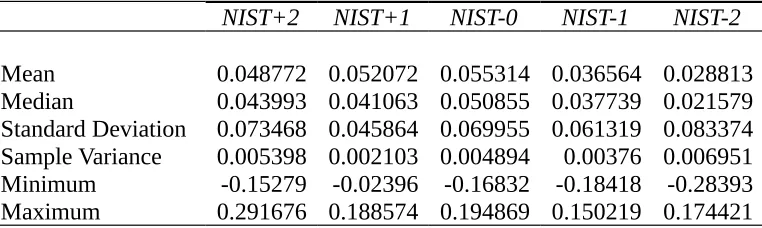
Table 1 presents the descriptive statistics for net income after tax scaled by total
assets of the same period.
Table 1 Descriptive Statistics for Net Income after Tax
NIST+2 NIST+1 NIST-0 NIST-1 NIST-2
Mean 0.048772 0.052072 0.055314 0.036564 0.028813 Median 0.043993 0.041063 0.050855 0.037739 0.021579 Standard Deviation 0.073468 0.045864 0.069955 0.061319 0.083374 Sample Variance 0.005398 0.002103 0.004894 0.00376 0.006951 Minimum -0.15279 -0.02396 -0.16832 -0.18418 -0.28393 Maximum 0.291676 0.188574 0.194869 0.150219 0.174421
NIST stands for net income after tax scaled by total assets of the corresponding
period. NIST+2 means that earnings after tax in the year two after the issue. The
average net incomes tend to increase in the year just before the offering and decrease
in the following two years after the issue. The figures are almost similar with the
median. The findings shown here seem to indicate that earnings tend to increase and
then decrease. The behaviour of net income after tax prior and after the IPO is
As shown in Table 2, cash flow from operating activities scaled by total assets
in the corresponding period shows an increase only in the first two years before the
issue, but decline in the following two years. Interestingly, the figures are negative
indicating that after the issue and on the last year prior to the issue, management of
IPO on average are unable to maintain their ability to generate income from
operating activities. It should be noted here that over the five year period, there was
always firms recording negative cash flow from operating activities. A question to
raised as that whether firms manage earnings that lead to negative effect on cash
flow.
Table 2 Descriptive Statistics for Cash Flow from Operating Activities
CFT-0 CFT-1 CFT-2 CFT-3 CFT-4
Mean -0.01634 -0.06306 -0.00311 0.042842 0.025777 Median 0.017611 -0.0205 0.020443 0.068061 0.04766 Standard Deviation 0.270077 0.213068 0.148941 0.237964 0.213193 Sample Variance 0.072942 0.045398 0.022183 0.056627 0.045451 Minimum -1.35438 -0.77288 -0.42781 -0.70226 -0.81377 Maximum 0.321854 0.195912 0.244525 0.46896 0.351794
Theoretically, cash flows are impossible to manipulate through accounting
choices. Given that earnings management can be achieved through accrual items, the
difference between earnings and cash flows can be an inference basis for the
behaviour of earnings management.
However, earnings are about ten times cash flows just before IPO and the
difference between the two widen after IPO. This pattern of the difference suggests
two types of earnings management “real earnings management” and pure accounting
firms improve earnings performance by operating activities not by accounting
manipulations. The time-series pattern of the difference reveals some implications
for earnings management. Firstly, firms do engage in real earnings management
before IPO as evidenced by the time-series pattern of cash flows. Secondly, the
evidence that earnings are much higher than cash flows for the pre-IPO period
suggests that the IPO firms also engage in accounting type of earnings management.
Lastly, the convergence of earnings to cash flows after IPO suggests that companies
refrain from earnings management after IPO either because of the lack of incentive
for accounting type of earnings management after IPO or the exhaustion of
discretionary accruals. We may all agree that due to accounting equation, an
income-increasing earnings management will lead to an income-decreasing accrual in the
future.
This is consistent with the general perception that managers tend to manage
earnings to maintain a “honey moon period” for the stock price after IPO. Using US
IPO setting, Teoh et al. (1998) argue that the incentives to manage earnings are
likely to persist in the months immediately after the offering. In this case, managers
usually can not dispose of their personal holdings until several months after the IPO.
Besides, firms face unusual legal and possible reputational scrutiny in the IPO
aftermath. Immediate accounting reversals may render earnings management
activities transparent enough to trigger law suits against the firms and its managers.
In short, the pattern of average earnings and cash flows provides affirmative
evidence for the existence of earnings management-including real earnings
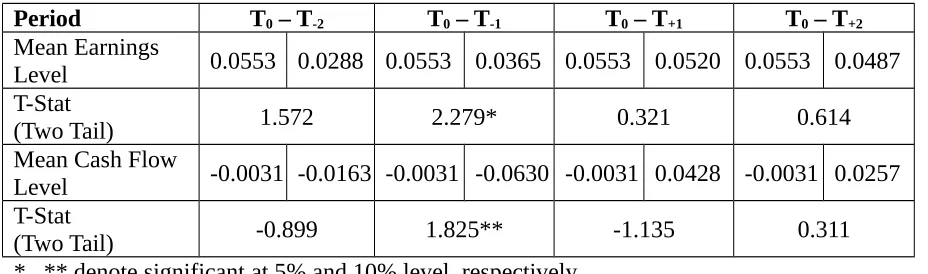
Next tests were conducted to examine whether differences in the level of
earnings and cash flow from operating activities are large enough to conclude that
earnings management has occurred. The t-test for mean difference was performed.
The results are shown in Table 3 which depicts the test for earnings management
using the latest year financial report as the benchmark period.
Table 3 Results of Test for Earnings Level and Cash Flow Differences
Period T0 – T-2 T0 – T-1 T0 – T+1 T0 – T+2
Mean Earnings
Level 0.0553 0.0288 0.0553 0.0365 0.0553 0.0520 0.0553 0.0487 T-Stat
(Two Tail) 1.572 2.279* 0.321 0.614
Mean Cash Flow
Level -0.0031 -0.0163 -0.0031 -0.0630 -0.0031 0.0428 -0.0031 0.0257 T-Stat
(Two Tail) -0.899 1.825** -1.135 0.311
* , ** denote significant at 5% and 10% level, respectively.
Results shown in Table 3 do not strongly support the notion that earnings
management has occurred. Earnings level in the year just before the offering is
significantly larger than the level in the first year after the issue. This evidence
maybe interpreted that management exercise more accounting discretion in the
period of the most recent from the IPO date. This feature is supported by the
behaviour of cash flow, although the level of significance is slightly lower.
The findings reported in this study are similar to that of Gumanti (2001; 2003)
of low earnings management in the period before the offering. Similar behaviour is
evidenced in Gumanti and Swastika (2005) who examine the operating performance
found strong evidence of earnings management. This conflicting results offer further
exploration of the phenomenon.
5. Summary and Conclusion
Because the wealth of the managers is linked to the IPO prices, the requirement
provides incentives for the managers of an IPO firm to manage earnings. Using a
sample of Indonesia 35 IPOs during the 2002-2005 periods, this study investigates
whether managers of the IPO firms exercise income-increasing discretionary
accruals before IPO to maximize the offering prices and private wealth. Evidence
suggests that companies use different discretionary components for earnings
management in the most current year prior to the offering.
However, given that the difference in the level of earnings and cash flow is
only significant in the year close to the offering year, it would be too soon to justify
that earnings management hypothesis has been strongly evidenced. First, the time
series of earnings and cash flows demonstrates an upward trend for the pre-IPO
period and a downward trend for the post-IPO period in particular the earnings level.
hypothesis, the upward trend in cash flows suggests changes in economic situation
for the IPO firms-the existence of real earnings management. Further analysis of the
time series in the gap between these two variables suggests that IPO firms enhance
earnings through both real earnings management and accounting choices.
Some implications of the findings merit further exploration. This study uses
simple test to examine the possible for earnings management during the periods
surrounding the IPO. It does not control for possible effect of accruals management
as usually employed in previous studies. Secondly, the number of sample firms
meeting the criteria to be analysed could also affect the robustness of the findings.
However, limiting the period in year 2002 is expected to avoid for confounding
effect of economic crisis which was severely hit Indonesian economy in year 1998
through early 2000 which could in many respects affect the real performance of the
going public firms. Further study may compare the figures for IPO long before the
economic crisis and those after the crisis, for instance five years after the crisis.
References
Aggarwal, R., R. Leal, and L. Hernandez, 1993. The aftermarket performance of initial public offerings in Latin America, Financial Management 22, 42-53. Brav, A. and P. Gompers, 1997. Myth or reality? The long-run underperformance of
initial public offerings: Evidence from venture and nonventure capital-backed companies, Journal of Finance 52, 1791-1821.
Dechow, P. M, and D. J. Skinner. 2000. Earnings management: Reconciling the
Gumanti, T.A., 2001, Earnings management pada penawaran pasar perdana di Bursa Efek Jakarta. Jurnal Riset Akuntansi Indonesia, 4(2): 165-183.
Gumanti, T.A., 2003. An Investigation of Earnings Management in Indonesian Manufacturing Initial Public Offerings, Gadjah Mada International Journal of Business, 5(3): 345-362.
Gumanti, T.A., dan Swastika, D.L.T., 2005. Kinerja Operasi Pasca Initial Public Offerings di Bursa Efek Jakarta, Jurnal Akuntansi dan Bisnis Manajemen, 12 (1):1-13.
Hamao, Y., F. Packer, and J. R. Ritter, 2000. Institutional affiliation and the role of venture capital: Evidence from initial public offerings in Japan, Pacific-Basin Finance Journal 8, 529-558.
Hameed, A. and G. H. Lim, 1998. Underpricing and firm quality in initial public offerings: Evidence from Singapore, Journal of Business Finance and Accounting 25, 455-468.
Hanley, K. W., A. A. Kumar, and P. J. Seguin, 1993. Price stabilization in the market for new issues, Journal of Financial Economics 34, 177-197.
Hayn,C.,1995, The information content of losses, Journal of Accounting and Economics 20,125-153.
Healy, P. 1985. The effect of bonus schemes on accounting decisions. Journal of
Accounting and Economics 7: 85-107.
Healy, P.M. and J.M. Wahlen, 1999, A review of earning management literatures and it is implication for standard setting, Accounting Horizons 13(4),365 – 383. Healy, P.M., and J. M. Wahlen. 1999. A review of the earnings management
literature and its implications for standard setting. Accounting Horizons 13 (October): 365-383.
Hensler, D. A., R. C. Rutherford, and T. M. Springer, 1997. The survival of initial public offerings in the aftermarket, Journal of Financial Research 20, 93-110.
Holland, D., and A. Ramsay, 2003, Do Australian companies manage earnings to meet simple earnings benchmarks?, Accounting and Finance, 43: 41-62. Houge, T., T. Loughran, G. Suchanek, and X. Yan, 2001. Divergence of opinion,
uncertainty, and the quality of initial public offerings, Financial Management 30, 5-23.
Howe, J. S., S. Kim, and E. Lee, 1996. The aftermarket performance of IPOs: The Korean experience, Advances in Pacific-Basin Finance Management 2, 157-164.
Hwang, C. Y. and N. Jayaraman, 1995. Long-term performance of IPOs and non-IPOs: Evidence from the firms listed on the Tokyo Stock Exchange, Advances in Pacific-Basin Finance Management 1, 317-337.
Ibbotson, R. G., J. Sindelar, and J. R. Ritter, 1988. Initial public offerings, Journal of Applied Corporate Finance 1, 37-45.
Jain, B. A. and O. Kini, 1994. The post-issue operating performance of IPO firms, Journal of Finance 49, 1699-1726.
Jain, B. A. and O. Kini, 2000. Does the presence of venture capitalists improve the survival profile of IPO firms? Journal of Business Finance and Accounting 27, 1139-1176.
Jones, J.J, 1991, Earnings management during import relief investigations, Journal of Accounting Research 29,193-228.
Kim, M. and J. R. Ritter, 1999. Valuing IPOs, Journal of Financial Economics 53, 409-437.
Klein, A., 1996. Can investors use the prospectus to price initial public offerings? Journal of Financial Statement Analysis 2, 23-39.
Lee, P. J., S. L. Taylor, and T. S. Walter, 1996. Expected and realized returns for Singaporean IPOs: Initial and long-run analysis, Pacific-Basin Finance Journal 4, 153-180.
Leland, H. and D. Pyle, 1977. Informational asymmetries, financial structure and financial intermediation, Journal of Finance 32, 371-387.
Levitt, A. 1998. The numbers game. Remarks delivered at the NYU Center for Law and Business, New York, NY, September 28.
Loughran, T. and J. R. Ritter, 1995. The new issues puzzle, Journal of Finance 50, 23-51.
Mak, Y. T., 1994. The voluntary review of earnings forecasts disclosed in IPO prospectuses, Journal of Accounting and Public Policy 13, 141-158.
McNichols, M. and G.P. Wilson. 1988. Evidence of earnings management from the
provision for bad debts. Journal of Accounting Research 26 (Supplement):
1-31.
McNichols, M., 2000. Research design issues in earnings management studies. Journal of Accounting and Public Policy 19 (4/5): 313-345.
McNichols, M., and G. P. Wilson. 1988. Evidence of earnings management from the provision for bad debts. Journal of Accounting Research 26 (Supplement): 1-31.
Megginson, W. and K. Weiss, 1991. Venture capitalist certification in initial public offerings, Journal of Finance 46, 879-904.
279-Michaely, R. and W. H. Shaw, 1995. Does the choice of auditor convey quality in an initial public offering? Financial Management 24, 15-30.
Mikkelson, W. H., M. M. Partch, and K. Shah 1997. Ownership and operating performance of companies that go public, Journal of Financial Economics 44, 281-307.
Mok, H. M. and Y. V. Hui, 1998. Underpricing and the aftermarket performance of IPOs in Shanghai, China, Pacific-Basin Finance Journal 6, 453-474.
Mulford, C. W., and E. E. Comiskey. 1996. Financial Warnings. New York, NY: John Wiley & Sons.
Page, M. J. and I. Reyneke, 1997. The timing and subsequent performance of initial public offerings (IPOs) on the Johannesburg Stock Exchange, Journal of Business Finance and Accounting 24, 1401-1420.
Paudyal, K., B. Saadouni, and R. J. Briston, 1998. Privatization initial public offerings in Malaysia: Initial premium and long-term performance, Pacific-Basin Finance Journal 6, 427-451.
Platt, H. D., 1995. A note on identifying likely IPO bankruptcies: A symphonic paradox, Journal of Accounting, Auditing and Finance 10, 71-79.
Rahman, A., and Y. Hutagaol, 2007, Earnings management melalui accruals dan real
activities manipulation pada initial public offerings dan kinerja jangka
panjang (Studi empiris pada Bursa Efek Jakarta), Paper presented at the first
Accounting Conference, Faculty of Economics University of Indonesia,
Depok, 7-9 November 2007.
Schipper, K. 1989. Commentary on earnings management. Accounting Horizon 3:
91—102.
Stehle, R., O. Ehrhardt, and R. Przyborowsky, 2000. Long-run stock performance of German initial public offerings and seasoned equity issues, European Financial Management 6, 173-196.