Open Geospatial Consortium Inc.
Date: 20150413
Reference number of this OGC document: OGC 05127r8
Version: 2.4
Category: OGC Policies and Procedures
Editor: Terry Idol
The OGC Interoperability Program
This document is an OGC Member approved Policies and Procedures Document.
Copyright © 2015 Open Geospatial Consortium
The OGC Interoperability Program 05-127r8
Table of Contents
1 The OGC Interoperability Program...1
2 Reference Documents...1
3 Technology Maturation Strategy...2
4 Interoperability Program Initiatives...4
ORM Development and Maintenance...4
Concept Development...4
Interoperability Testbeds...4
Interoperability Experiments...4
Pilots...4
OGC Network™...4
5 Roles in OGC-IP Initiatives...5
Sponsors...5
Participants...5
Observers...5
IP Team...5
6 Interoperability Program Documentation...7
Request for Quotation/ Call for Participation...7
Request for Information...7
Statements of Work...7
Engineering Reports and Change Requests...7
7 Benefits of the Interoperability Program...7
8 Collaboration for Distributed Development...8
9 OGC-IP Policies...8
Intellectual Property Rights...8
OGC Baseline...8
OGC Standards Program...8
Running Code...9
Non-Disclosure...9
Open to Observers...9
Status of Deliverables...9
1 The OGC Interoperability Program
The OGC Interoperability Program (OGC-IP) is a global, innovative, collaborative, hands-on engineering and rapid prototyping program for validating and testing geospatial technology based on OGC standards. OGC-IP activities include specification of requirements, implementation of prototypes, and demonstrations for broad awareness. The OGC IP provides evidence of technology maturity to support the consensus adoption of standards in OGC Standards Program.
The primary purpose of OGC’s Interoperability Program is to bring Sponsorsand Participants together in rapid, hands-on, collaborative engineering efforts to achieve one or more of the following objectives:
Produce and test Candidate Implementation Standards for geoprocessing interoperability; Perform research on the use of information technology (IT) regarding relevance and ability of
standards to help solve geospatial interoperability problems;
Develop and test prototype interoperable infrastructures based on OGC and related standards; Advance and demonstrate the maturity of interoperable implementations sufficient for
organizations to base procurement decisions
This document defines the OGC-IP by identifying elements of an OGC-IP initiative, i.e. roles, documents and policies. Details on these elements are provided in the Reference Documents. The Policies of the OGC-IP exist to provide guidelines for the successful completion of these objectives.
2 Reference Documents
The following documents are referenced in this document. In all cases the latest version of the referenced document will be used.
OGC Standards. http://www.opengeospatial.org/standards
OGC Reference Model. http://www.opengeospatial.org/standards/orm
OGC Intellectual Property Rights Policy and Procedure http://www.opengeospatial.org/about/? page=ipr
OGC-IP Concept Development Policies and Procedures, OGC Document 05-128r1, 2005-03-20 OGC Interoperability Testbed Policies and Procedures, OGC Document 05-129r1, 2005-03-20 OGC Interoperability Experiment Policies and Procedures, OGC Document 05-130r3, 2009-04-03 OGC Interoperability Pilot Policies and Procedures, OGC Document 05-131r1, 2005-03-20 OGC Network™ Policies and Procedures, OGC Document 05-132r1, 2005-03-20
3 Technology Maturation Strategy
Through fast paced testbeds, experiments, pilot initiatives and related feasibility studies, OGC’s Interoperability Program promotes rapid prototyping, testing and validation of standards. The OGC approach recognizes that development and management of prototypes provides for communications and progress in the development and evolution of OGC standards. Prototypes engage an organization’s thinking in explicit solutions. As a rule, the more prototypes and prototyping cycles per unit of time, the more technically polished the final product.1 The OGC process combines the emphasis on agile prototypes with architecture activities for consistent design patterns and communications2.
Through a innovative and competitive world-wide “Call for Participation” process, OGC Members cooperate not only to develop new draft standards to address interoperability challenges, but to test and validate these draft standards by applying them in real world settings. Testbed and pilot initiatives are driven by geospatial interoperability requirements expressed as real world scenarios, business cases, and applied research topics. This approach not only encourages rapid standards development, but broadly involves technology providers to aid in determining the ability of emerging standards and industry technologies to meet these requirements.
OGC Interoperability Program initiatives have helped to shorten the timelines for standards development while reducing the overall risk that a standard will not meet the needs of the community. By applying proven, repeatable policies and procedures, the OGC has successfully conducted over 40 international testbed and pilot initiatives since 1999.
The OGC Interoperability Program utilizes several types of initiatives: testbeds, experiments, pilots, plugfests and OGC Network. These initiatives are structured to develop the technology supporting the OGC Standards. The technology maturation approach of the OGC Interoperability Program is shown in Figure 1. OGC conducts the various initiatives to move from experimentation with draft specifications in a Testbed or Interoperability Experiment toward focused testing of adopted OGC standards by the community in a Plugfest and the refinement of the specifications in near-operational environments in a Pilot or in operational activities of the OGC Network.
In each initiative type, one or more of the following deliverables are produced:
1) Engineering Reports, which maybe draft standards intended to become standards or reports of testing results and conclusions. Change Requests to existing standards are also created and entered into the OGC Change Request database.
2) Software implementations of OGC standards and draft standards as debates are settled using the approach of “interoperable running code wins.”
3) Demonstrations of the software and standards in real world examples to show why the technology matters to end-users.
Each type of initiative is described in Section 4. The roles of participants in the initiatives are described in Section 5.
In tandem with the OGC IP, the OGC Compliance Testing Program is contributes to the development of the maturity of interoperable technology. By providing a process whereby compliance can be tested
Compliance testing program permits developers and users to increase the value and benefit of the standards that OGC has created. OGC IP Initiatives regularly contribute technology to the Compliance Test Program, e.g., reference implementations.
1 “Serious Play: How the World's Best Companies Simulate to Innovate,” Michael Schrage, Harvard Business School Press, 2000
4 Interoperability Program Initiatives
Interoperability Initiatives are the primary programmatic vehicle of the OGC-IP. They are designed to be cooperative activities among Sponsors, Participants, and IP Team, but most particularly among Participants representing various member organizations (See Section 5 for definition of Roles). This approach provides a means to rapidly develop and prototype specifications for insertion into the specification process in a way that considers various points of view, requirements, and objectives.
Each type of OGC IP Initiative is defined in detail in its respective Policies and Procedure document listed in the References (Section 2).
Table 1 – OGC Interoperability Program Initiatives
ORM Development and Maintenance
The OGC Reference Model (ORM) development and maintenance is
accomplished in a distributed fashion by OGC members and is managed by OGC IP Team. The ORM provides the baseline for OGC IP Initiatives
Concept Development
A Concept Development Initiative assesses emerging technologies and architectures capable of supporting eventual Interoperability Initiatives. They examine alternative prototype mechanisms that enable commercial technology to interoperate. Concept Development includes developing member consensus on the direction of further IP tasks.
Engineering Services
The Engineering Services have two main purposes: First, innovation accelerators for OGC specifications, and second to catalyze adoption by other organizations with the goal to improve understanding and use of OGC standards and
technologies and increased demand for products offered by OGC member organizations.
Interoperability Testbeds
A Testbed Initiative is a collaborative research and development effort to develop, architect, test, and demonstrate candidate standards for interoperability. A testbed can have a single sponsor, but ideally multiple sponsors will collaborate on a joint initiative that represents a set of their requirements and interests.
Interoperability Experiments
An Interoperability Experiment is managed and operated mostly by OGC member organizations focused on a specific area of refining the OGC technical baseline. The process is facilitated – not led – by an OGC staff person.
Pilots A Pilot is a collaborative effort that applies technology elements from the OGC Technical Baseline and other (non-OGC) technologies to Sponsor scenarios. In practice, a Pilot is where an OGC standard – or set of OGC standards – can be “stress tested” based on real-world application and experience.
Plugfests A Plugfest is an event where vendors cooperatively test (and possibly refine) their OGC-based products in a hands-on engineering setting. Plugfests are used to (1) assess the degree to which different products in the marketplace interoperate together based on their implementation of OGC standards, and (2) advance the interoperability of geospatial products and services based on OGC standards in general or within specific communities.
5 Roles in OGC-IP Initiatives
Members in the following roles conduct OGC IP initiatives: Sponsors, Participants, Observers, and IP Team. The roles present in an OGC-IP Initiative differ based on the type of Initiative.
Sponsors
Sponsors are OGC Member organizations that contribute financial resources in support of a given initiative. They typically drive the requirements, technical scope and agenda, and demonstration form and content of an OGC IP initiative. Sponsor Representatives are personnel assigned by the Sponsor to represent the Sponsor’s interests and position to OGC throughout the duration of a relevant initiative.
Participants
Participants are OGC member organizations that contribute to the definition of interfaces, prototypical implementations, and other engineering support for an IP initiative. Participants are defined as OGC members who have committed to contribute in-kind in a “substantial” amount. Participants are represented in an Initiative by business and technical representatives.
Observers
Observers are OGC members who have agreed to the intellectual property requirements of the OGC initiative. Observers do not have a vote in an initiative. Observers are given full access to email lists, initiative web sites and regularly scheduled initiative wide teleconferences. Observers may make
recommendations and comments to the participants via any of these fora. The relevant Initiative Manager has the authority to table any comments, recommendations or other discussions raised by observers at any point without prior warning. Failure of an observer to comply may result in suspension of access.
IP Team
The IP Team is an engineering and management team to oversee and coordinate the Interoperability Initiatives. The IP Team facilitates architectural discussions, synopsizes technology threads, and supports the specification editorial process. The IP Team is comprised of OGC staff, representatives from member organizations, and OGC consultants.
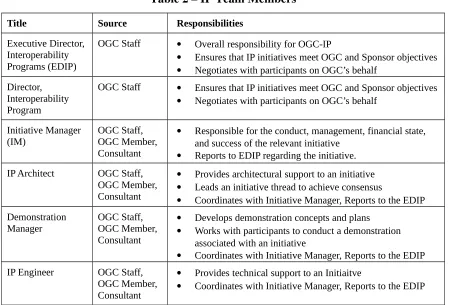
Table 2 – IP Team Members
Title Source Responsibilities
Executive Director, Interoperability Programs (EDIP)
OGC Staff Overall responsibility for OGC-IP
Ensures that IP initiatives meet OGC and Sponsor objectives Negotiates with participants on OGC’s behalf
Director, Interoperability Program
OGC Staff Ensures that IP initiatives meet OGC and Sponsor objectives Negotiates with participants on OGC’s behalf
Initiative Manager
(IM) OGC Staff, OGC Member, Consultant
Responsible for the conduct, management, financial state, and success of the relevant initiative
Reports to EDIP regarding the initiative. IP Architect OGC Staff,
OGC Member, Consultant
Provides architectural support to an initiative Leads an initiative thread to achieve consensus
Coordinates with Initiative Manager, Reports to the EDIP Demonstration
Manager
OGC Staff, OGC Member, Consultant
Develops demonstration concepts and plans Works with participants to conduct a demonstration
associated with an initiative
Coordinates with Initiative Manager, Reports to the EDIP IP Engineer OGC Staff,
OGC Member, Consultant
Provides technical support to an Initiaitve
Coordinates with Initiative Manager, Reports to the EDIP
IP Team works with OGC VP for Finance who has responsibility for Legal contracts, billing, invoice, financial tracking for OGC-IP Initiatives.
6 Interoperability Program Documentation
The IP utilizes several types of documents for the conduct of initiatives and serving as deliverables of the program. Some of these documents are internal to OGC, the IP Team, and in certain cases the Sponsors; others are available to all stakeholders. Templates for these documents are available on OGC web site.
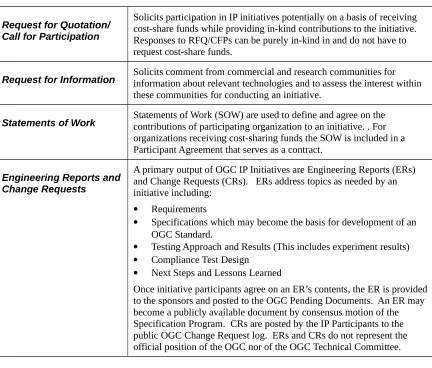
Table 3 – OGCIP Documents
Request for Quotation/ Call for Participation
Solicits participation in IP initiatives potentially on a basis of receiving cost-share funds while providing in-kind contributions to the initiative. Responses to RFQ/CFPs can be purely in-kind in and do not have to request cost-share funds.
Request for Information Solicits comment from commercial and research communities for information about relevant technologies and to assess the interest within these communities for conducting an initiative.
Statements of Work Statements of Work (SOW) are used to define and agree on the contributions of participating organization to an initiative. . For organizations receiving cost-sharing funds the SOW is included in a Participant Agreement that serves as a contract.
Engineering Reports and Change Requests
A primary output of OGC IP Initiatives are Engineering Reports (ERs) and Change Requests (CRs). ERs address topics as needed by an initiative including:
Requirements
Specifications which may become the basis for development of an OGC Standard.
Testing Approach and Results (This includes experiment results) Compliance Test Design
Next Steps and Lessons Learned
Once initiative participants agree on an ER’s contents, the ER is provided to the sponsors and posted to the OGC Pending Documents. An ER may become a publicly available document by consensus motion of the Specification Program. CRs are posted by the IP Participants to the public OGC Change Request log. ERs and CRs do not represent the official position of the OGC nor of the OGC Technical Committee.
7 Benefits of the Interoperability Program
The OGC Interoperability Program is a proven process to rapidly develop, test, validate and demonstrate new standards or enhancements to existing standards based on real world use cases identified by OGC Members. The initiatives are an effective way for members to quickly align industry efforts to advance standards to meet priority needs. The process is efficient and competitive, regularly yielding a high-level of industry participation and cooperation
candidate specifications in their products (reduces the risk that a proposed standard will not perform as intended). The accelerated process encourages rapid time to market for Standards-based solutions with OGC member vendors typically becoming early adopters of draft standards.
Return on Investment for sponsors is substantial, typically for every one Euro, Dollar, Pound Yen, in sponsorship funding, initiatives have yielded 3 times as much in terms of level of effort. This return is possible due to the alignment of OGC initiative activities with on-going activities of OGC members. Participants in OGC testbeds and pilot initiatives contribute more in in-kind contributions (labor, software, infrastructure etc.) than is provided in Sponsor funding. The results are sustainable as vendors want early influence in specification development, early skill building, visibility, and opportunity for early market deployment of standards.
For Participants, the benefits focus on the opportunity to cooperatively develop open standards. Participants gain early insight into user requirements for interoperability, and early experience with and influence in developing standards in the context of user business cases. Vendor participants are able to bring new products and services using OGC Standards into the marketplace earlier. Participation reduces development costs / risks and lead-time for developing interfaces (community-wide cost sharing). The overall result is a broaden market reach via products that implement OGC standards
The main outcome is that OGC Initiatives reduce the risk associated with an emerging standard by creating reference implementations that use draft standards, and by validating these technologies with real world business cases / scenarios in a collaborative environment of sponsors and participants.
8 Collaboration for Distributed Development
The OGC provides a variety of collaboration tools and communication assets that can be used during the execution of any given initiative. Many of these are available via the OGC Member Portal. Other technical support assets for an initiative are:
Web sites
Collaborative work sites including Wikis
OGC Network content management tool using Drupal Email reflector lists
On-line project management tool: tasks, calendars, actions, etc. Teleconferencing lines
9 OGC-IP Policies
This section contains policies that apply to all Interoperability Program initiatives.
Intellectual Property Rights
Interoperability Initiatives shall be subject to and implement the OGC Intellectual Property Rights Policy.
OGC Baseline
OGC Standards Program
The Standards Program is a main source for ideas to be developed in OGC-IP Initiatives. This begins with using the OGC Baseline. Further each OGC IP Initiative considers discussions of the SP as a basis for requirements in the planning of an initiative and for potential solutions during the execution of an initiative.
All IP Initiatives are announced to the OGC membership before the initiative begins. It is recognized that all initiatives have a planning phase before which the initiative is announced to the membership. Working groups whose scope overlaps with the subject of an IP initiative should be notified by the IP initiative managers via their OGC mailing lists, and briefed at the earliest opportunity, usually by a presentation at the next TC meeting.
It is a goal of the OGC-IP to augment the OGC Baseline. ERs resulting from an Initiative are posted as pending documents for the OGC Specification Program to consider for adoption into the Adopted Document Baseline using the procedures of the Specification Program.
Running Code
Implementation is required in the OGC-IP. An Initiative must develop an operating implementation of the draft specification for the initiative to demonstrate results. Key to demonstrating interoperable
implementations are the Technical Interoperability Experiments (TIEs). TIEs are to be performed for each draft specification. TIEs must be performed between implementations from different developers to demonstrated interoperability.
Non-Disclosure
Non-disclosure is an important issue that must be taken seriously by all Sponsors, Initiators, Participants, and Observers. Specifically, all information generated and shared within an Initiative must remain confidential until released through an OGC process.
Engineering Reports are member-privileged information and are not released outside of the membership unless a) the release is approved by OGC Staff for limited, non-public distribution or b) the document is made public by a motion and vote in the OGC Standards Program.
Open to Observers
Interoperability Initiatives shall be open to Observers without exception. Only OGC members and others approved by OGC can be provided Observer status. Organizations can make such a request at any point after the Initiative has been announced. Depending upon sponsor requirements there may be limitations on what data may be viewed by observers.
Status of Deliverables
The technical deliverables of an Initiative shall not be construed to have any official status within the OGC. Specifically, documents that are generated within an Initiative shall not be referred to as anything other than Engineering Reports (ERs). Status other than that can only be conferred by action of the OGC Technical and Planning Committees.
Public Discussions during an Initiative
Publicly state that the initiative is underway and disclose the master schedule dates, e.g., “kickoff workshop in June.”
Topics in the RFQ/CFP may be quoted as long as it is noted that this was the plan and that the final direction is up to the testbed sponsors and participants
That the Member has contributed specific technical items to an initiative and those items are under consideration in the initiative.
Including a link to the OGC page for the initiative is encouraged. Links to initiatives are posted here: http://www.opengeospatial.org/projects/initiatives
The following items are topics that should not be discussed publicly by a participant:
Do not state that decisions have been made in the initiative about OGC standards. Only the Specification Program can make statements like “the OGC has decided that”…".
Revision history
Date Version Editor Primary
clauses modified
Description
2005-11-01 0.1 George Percivall N/A Initial Version 2006-02-07 0.2 George Percivall All Edits throughout
2006-03-20 1.0 George Percivall All Slight edits to release the document as approved by the SMAC, e.g., version number, dates, document references, etc. 2010-8-23 2.0 George Percivall New Section 3
and 7. Edits throughout
Added Section 3, “Technology Maturation Strategy.”
Added Section 7, “Benefits of Interoperability Program”
Edits by the OGC Interoperability Program Staff: Nadine Alameh, David Arctur, Raj Singh. 2010-09-17 2.1 George Percivall Edits Review and edits by Carl Reed,
Jim Stephens, Luis Bermudez. 2011-07-22 2.2 George Percivall Edits in
Policies section and throughout
Added Policy regarding Standards Program coordination, including Change Requests
Removed Plugfests, which are now in Compliance Program
The OGC SMAC approved V2.2 during meeting on 2011-09-07 2014-02-26 2.3 Nadine Alameh Edits to Sec 4 Added Plugfests
2015-04-13 2.3 Terry Idol Edits to Sec 2