English Study Program of the Language and Arts Department
of Teacher Training and Education Faculty of Tanjungpura University, Pontianak. Email :[email protected]
Abstract: This research is aimed on how the use of FSLC technique which comes from cooperative learning strategy, could promote students to speak English. Particularly on how the activities in each stage of FSLC technique (formulate share, listen, and create stage) could promote students' pronunciation, vocabulary, and ideas in speaking English. This research was a Classroom Action Research which was conducted in three cycles. The research subjects were the students of class XI MIA 4 at SMA Negeri 2 Pontianak. The data were collected by observation, recording, and questionnaire. The result indicated that Formulate Stage promoted students to use relevant vocabulary and sufficient ideas in speaking English. Share-Listen Stage promoted students to speak with better pronunciation and relevant vocabulary by actively sharing, discussing, and correcting pronunciation. Create Stage promoted students to speak with sufficient ideas as well as they collaborated the ideas. In conclusion, FSLC technique successfully promoted students to actively speaking English in teaching learning process.
Keywords: FSLC Technique, Speaking English, Pronunciation, Vocabulary, Ideas
Abstrak : Penelitian ini bertujuan untuk mengetahui bagaimana tehnik FSLC dari strategy pembelajaran kooperatif, dapat mendorong siswa berbicara Bahasa Inggris. Terutama bagaimana aktivitas di setiap tahapan tehnik FSLC (Tahap Formulate, Share, Listen, dan Create) dapat mendorong siswa berbicara Bahasa Inggris dengan pengucapan, kosakata, dan ide-ide yang lebih baik. Penelitian ini menggunakan metode Penelitian Tindakan Kelas yang dilakukan selama tiga siklus. Subjek penelitian ini adalah siswa kelas XI MIA 4 di SMA Negeri 2 Pontianak. Data-data yang diperoleh melalui observasi, rekaman, dan kuisioner ini, menunjukkan bahwa Tahap Formulate telah mendorong siswa menggunakan kosakata relevan dan ide yang cukup dalam berbicara. Tahap Share-Listen dapat mendorong siswa untuk berbicara dengan pengucapan yang lebih benar dan kosakata yang relevan melalui berbagi ide, berdiskusi, dan mengkoreksi pengucapan satu sama lain. Tahap Create juga mendorong siswa untuk berbicara dengan ide yang cukup melalui kolaborasi ide yang mereka lakukan. Kesimpulannya, tehnik FSLC dapat mendorong siswa untuk bisa lebih aktif berbicara Bahasa Inggris dalam proses pembelajaran.
eaching English as foreign language in schools has an educational function and mainly purposed to create communicative learners which can be identified by how they are able to speak and respond using English based on the context. To speak and to respond means the students produce and use the language. In other words, it is about the process of building and sharing meaning through the use of verbal and non-verbal symbols. According to Thornbury (2005:1), speaking is perceived as the basis of literacy and communication and is considered the most important language skills since it plays its role in daily conversation. Baker & Westrup (2000: 34) added that speaking is the process of uttering words, phrases, clauses, and sentences using oral language meaningfully in order to share information and ideas. It is very important because the main purpose of speaking English is to set up students to be able to use the language communicatively in the classroom activity. Of course, to create meaningful communication the students determine good speaking performance which includes pronunciation, vocabulary, express the ideas (Abimanyu, 2015). Therefore, the students are supposed to pay attention on those aspects so that they are able to speak English well.
In line with the significance of speaking, the goal of teaching speaking should improve students' communicative skills. For any speaking activity used in the classroom, the consideration will always follows the accuracy of pronunciation, importance of vocabulary building, grammar use, and speaker’s contribution to explore ideas to a certain topic in a discussion. An effective teaching speaking means that teachers can help students promote their speaking by providing authentic practice that prepares students for real-life communication situations. Promoting speaking, according to Thornbury (2005: 2) involves the aspects of language such as the level of vocabulary (speech production which essentially like words follow words and phrases follow phrases), ideas of the topic (the information can be held in working memory at one time), and pronunciation (meaningful use of intonation and stress on the words).
In fact, there are some problems which cause the students do not want to speak English in the class activity. The problems come both from the students and the English teacher. From the preliminary research done by the writer in the Class XI MIA 4 of SMA Negeri 2 Pontianak, she found some problems. The problems were collected from the writer’s observation during her teaching practice in SMA Negeri 2 Pontianak starting from August 2015 to December 2015, from informal interview to the students in Class XI MIA 4, and the explanation of the English teacher in that class.
were not interested with the lesson because the way of the teacher teaches was too strict and sometimes did not give them opportunity to speak English. Some students preferred to keep silent because they were afraid with the English teacher. Some others preferred to use Indonesian language to communicate or respond the teacher rather than using English in the classroom. This condition made the students get problem in English pronunciation because they were not accustomed with English for communicating. In addition, students did not have broad English vocabulary references as to make English speech, and the intention of delivering ideas orally also become limited. In other words, their speaking was not promoted in the classroom.
From the explanation of the English teacher, she actually had problem in implementing appropriate technique with interesting activity that enables all students to speak English during the lesson. She preferred to use conventional teaching technique such as dictation, translation, and answer questions from the books. Moreover, she had difficulty in using technology because she did not accustomed with it. That become one reason she could not provide media like power point presentation or audiovisual video learning to initiate students to be interested in the learning process. To overcome the problem, the teacher had tried to use kind of group work activity, but it did not fully facilitate all students to make them speak English in the classroom because she still dominated the class by fully instruction in every single activity and often correcting errors made by students directly. Since such problems were found there, the writer thought about a technique which can provide meaningful learning environment to promote students to be active in speaking English and also to help the teacher to overcome her problem in teaching speaking English.
Based on the research background above, there were two previous researches by Azhri (2014) and Bamiro (2015) which showed how FSLC technique could improve students’ learning generally by giving the students opportunity to do active role in the classroom. The writer believes that FSLC can be also applied in language based teaching, especially for speaking skill as it comes from the concept of think-pair-share in cooperative learning which is a cooperative discussion strategy that emphasize students’ action. Therefore, the writer conducted this study in purpose of promoting students on the eleventh grade of SMA Negeri 2 Pontianak to speak English through the use of FSLC technique from cooperative learning strategy through answering these research questions: (1) Does Formulate-Share-Listen-Create (FSLC) technique in cooperative learning strategy promote students to speak English? (2) How does Formulate-Share-Listen-Create (FSLC) technique in cooperative learning strategy promote students to speak English?, and the specific research questions: (1) How does Share-Listen activities in FSLC technique promote students to speak English with better pronunciation? (2) How does Formulate and Share-Listen activities in FSLC technique promote students to use relevant vocabulary in speaking English? (3) How does Share-Listen and Create activities in FSLC technique promote students to express ideas orally?.
RESEARCH METHODOLOGY
In conducting this study, the writer applied a Classroom Action Research as the method of the research. The research procedures are described in this chart:
Chart 1. Research Procedures
The subjects of this research were the English teacher and the XI MIA 4 students of SMA Negeri 2 Pontianak Academic year 2015/2016. The students were observed in three cycles with different numbers of participants in each cycle. Cycle 1 with 36 students as participants, Cycle 2 with 35 students as participants, and Cycle 3 with 38 students as participants. The three main research instruments used to acquire data for the findings were:
1. Participant observation
Field notes and checklist observation were used to collect qualitative data about the teacher and students’ participants during the implementation of FSLC and also to answer the general and specific research questions.
2. Audio recording
It was purposed to observe how is the students’ speaking, in this case their pronunciation, vocabulary, and ideas, were being promoted.
Identifying the problems
Finding the facts and did
the analysis
Implementing the Action
Research
3. Questionnaire
The questionnaire was addressed to the students participant in order to support the data. This was used to know students’ opinion about the use of FSLC in cooperative learning strategy to promote them to speak English. The data was collected during the three cycles in three meetings. To analyze the data, the writer used comparative description and critical analytic technique. These technique elaborated the quantitative data from students’ mean score in their speaking performance for each cycle and the description of the checklist observation, field notes, and survey as the qualitative data.
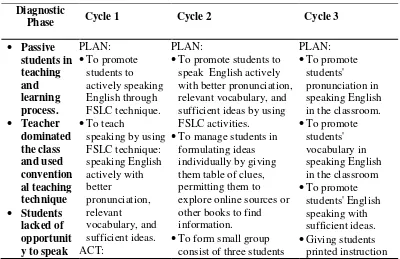
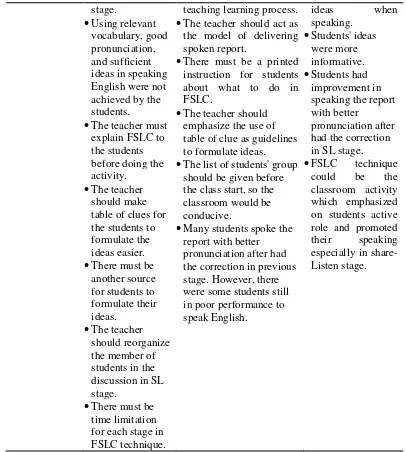
FINDINGS AND DISCUSSION clue activities after they browsed relevant vocabulary about the topic given, they could have vocabulary for their speaking in the next stage. Share-Listen stage facilitated the students to share and to give response about the topic each other through turn-taking discussion. As the result, their pronunciation and vocabulary were promoted. Moreover, the speak and record activity in this stage helped them to promote pronunciation. In addition, correcting mispronunciation activity in this stage also promoted their pronunciation as well. In the Create stage, the students' ideas was promoted as they collaborated their ideas. The details of the research findings was written in Table 1. below:
Table 1. Summary of the Cycles
Diagnostic
To promote students to speak English actively with better pronunciation, relevant vocabulary, and sufficient ideas by using FSLC activities.
To manage students in formulating ideas individually by giving them table of clues, permitting them to explore online sources or other books to find information.
To form small group consist of three students
English in in the activities of teaching and learning process. Asked students to
formulate ideas
in order to create more communicative discussion in Share-Listen stage of FSLC. The students do the peer
correction to help their friends with
pronunciation.
ACT:
Presenting topic of the lesson and material about report text.
Explaining FSLC technique to the students. The teacher gave a
picture to be discussed by the students and ask them to have questions about specific information of report.
In Think it Out activity in formulate stage, some the students browsed the internet to help them formulating ideas about the topic.
The students' activity in share-listen stage was recorded,
The students listen to others' report and make notes about new vocabulary, similarities or difference of ideas about the topic. Students in the group
corrected each other's pronunciation.
The students create new answer incorporates of the ideas from the group discussion in share-listen
introduce the
Many students were enthusiastic to take active role to respond the teacher using English. The teacher did not give
much lecturing and acted students-centered, she did not forget to introduce some relevant vocabulary related to the topic. The teacher didn’t
explain the FSLC rules in the beginning of the activities, but in the transition of each stage. The students were a bit
confused to use the table of clues to formulate the ideas because the teacher did not really emphasized the use of table of clue as it was the guideline for the students to formulate their ideas.
Some students found new vocabulary and
information from the activity of Think it Out in formulate stage.
Students found out lots of relevant vocabulary from their partners’ sharing. Students used various
vocabulary in expressing their ideas when
speaking.
A noisy class when moving the students into groups.
There were some groups which did not make the collaboration of the answer, but only record one member's answer they thought the best.
REFLECT:
The students were able to speak English during
discussing the felt helpful in using it as guidelines to formulate ideas. All students found
new vocabulary and information from the activity of Think it Out in this All students found
stage. table of clues for the students to The teacher should act as the model of delivering spoken report.
There must be a printed instruction for students about what to do in FSLC.
The teacher should emphasize the use of table of clue as guidelines to formulate ideas. The list of students' group
should be given before the class start, so the classroom would be conducive.
Many students spoke the report with better pronunciation after had the correction in previous stage. However, there were some students still in poor performance to speak English. Open Questionnaire which was also support the data showed that FSLC technique was helpful for students in promoting their English speaking in the classroom. Most of the students admitted that the FSLC technique was helpful to overcome their problems in speaking like pronunciation, relevant words choice, and expressing ideas. The data showed that 92,30% students or 36 students out of 39 students in class XI MIA 4, admitted that FSLC was helpful to promote them to speak English more activity with better performance in pronunciation, in vocabulary building, and in delivering ideas orally.
Discussion
that the students were the English pronunciation was not good enough to speak English because they were not accustomed with English for communicating, students did not have broad English vocabulary references as to make English speech, and the intention of delivering ideas orally also limited as well as the speaking opportunity in the classroom was also limited. Those happened also because the teaching learning process was dominated by the teacher with the implementation of teaching techniques which did not facilitate students to speak English actively in the classroom, like too much lecturing and dictation. Based on it, the researcher used FSLC technique to solve these problems to the eleventh grade students in Class XI MIA 4 in SMA Negeri 2 Pontianak in Academic Year 2015/2016.
The research which applied the classroom action research method, was conducted in three cycles. Each cycle consisted of planning, acting, observing, and reflecting stage. Every acting stage conducted in the teaching and learning process in one meeting within 2 x 45 minutes. The writer with a collaborator worked in collecting the data from the observation checklist table and the field notes to help the teacher during the teaching and learning process. The data was also supported by students' mean score in speaking performance, students' speaking transcription, interview, and documentation.
Based on the observation and the field notes, it showed that the FSLC technique promoted students to speak English. The teaching and learning process by the Cycle 1, Cycle 2, and Cycle 3 showed positive improvement as well as the students' English speaking was also promoted from cycle to cycles. At the first cycle, the students showed positive response towards the learning process although they preferred to use Indonesian language. In the second cycle, the students were more engaged in using English to respond the teacher and to discuss during the activities. In the third cycle, the students did not hesitate in speaking English along the teaching and learning process as the FSLC technique was implemented. They were involved in every single activity and actively spoke using English to the teacher and other students. Moreover, the teacher was able to engage the students' involvement during the classroom activities through the implementation of each stage in FSLC technique. FSLC, which comes from the concept of Cooperative Learning strategy, therefore, was a good strategy for use with problems, questions, or certain topics that could be addressed in a variety of ways which emphasize on the students’ active role in the teaching and learning process as it was stated by Johnson et al.(1991: 122).
their new vocabulary and ideas through sharing. Furthermore, ultimately presenting the collaborated answer during the create stage promoted them to speak with sufficient ideas as well. Richards (2008:19) supported those ideas by stating that in promoting students' speaking, teachers must use the variety of approaches, ranging from direct approaches focusing on specific features of oral interaction to indirect approaches that create conditions for oral interaction through group work, task work, and other strategies. Thus, students' speaking became promoted as well as the activities provided them great opportunities to do the practices.
The writer computed the students' mean score for their speaking in Cycle 1, Cycle 2, and Cycle 3. The result showed that FSLC promoted students to speak English as the chart below :
Table 2. The Graphic of Students' Mean Score of Cycle 1 and Cycle 2
Cycle Mean Score
Cycle 1
Cycle 2
Cycle 3
66,14
69,24
77,76
The table above showed that the students' English speaking was increased from the Cycle 1 until the Cycle 3. It showed that the mean score of Cycle 1 was 66,14, or categorized as C or AVERAGE. In the Cycle 2 there was a small improvement of students' mean score became 69,28 or categorized as C or AVERAGE. In the Cycle 3, the students' mean score increased to 77,76 or categorized as B or GOOD. This indicated that the performance of the students in speaking English was getting better in every cycle. It proved that the use of FSLC in cooperative learning strategy successfully promoted them to speak English.
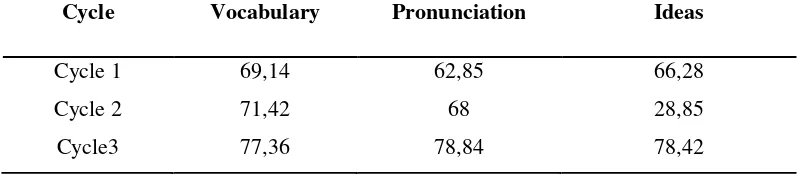
FSLC technique helped the students in promoting their English speaking with a better pronunciation, various and relevant vocabulary, and express ideas. It could be seen from the chart below:
Table 3. The Graphic of Students' Speaking Performance Aspects
Cycle Vocabulary Pronunciation Ideas
Cycle 1
Cycle 2
Cycle3
69,14
71,42
77,36
62,85
68
78,84
66,28
28,85
78,42
more active. They also more enjoyed to speak English because they had enough 'modal' for speaking after formulating their ideas first, and they did it between them.
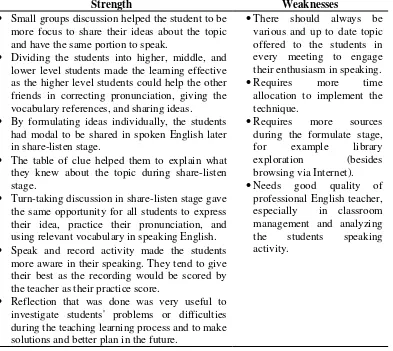
Those points indicated that the English speaking of the students in the classroom activity of SMA Negeri 2 Pontianak were promoted by giving the treatment that is the use of FSLC technique. The results of treatment showed that action purpose of this research was accepted, that is the use of Formulate-Share-Listen-Create (FSLC) technique in Cooperative Learning Strategy promotes students to speak English. The description showed that promoting students to speak English in the classroom by using a technique which emphasized on students' active role could promote their pronunciation, vocabulary, and ideas in speaking English. Students were given the same opportunity to practice their speaking with partners in group without feeling nervous. They also learned how to pronounce English words, using relevant vocabulary references, and expressed their ideas in speaking. There were many inputs from the discussion between teacher and researcher about the weaknesses and strengths in the acting process. Those can be described as follow:
Table 4. The Strength and Weaknesses of FSLC Technique Implementation
Strength Weaknesses
Small groups discussion helped the student to be more focus to share their ideas about the topic and have the same portion to speak.
Dividing the students into higher, middle, and lower level students made the learning effective as the higher level students could help the other friends in correcting pronunciation, giving the vocabulary references, and sharing ideas.
By formulating ideas individually, the students had modal to be shared in spoken English later in share-listen stage.
The table of clue helped them to explain what they knew about the topic during share-listen stage.
Turn-taking discussion in share-listen stage gave the same opportunity for all students to express their idea, practice their pronunciation, and using relevant vocabulary in speaking English. Speak and record activity made the students
more aware in their speaking. They tend to give their best as the recording would be scored by the teacher as their practice score.
Reflection that was done was very useful to investigate students' problems or difficulties during the teaching learning process and to make solutions and better plan in the future.
There should always be various and up to date topic offered to the students in every meeting to engage their enthusiasm in speaking. Requires more time allocation to implement the technique.
Requires more sources during the formulate stage, for example library exploration (besides browsing via Internet). Needs good quality of
CONCLUSION Conclusion
Based on the result of data collected in all cycles, the process of FSLC promoted students to actively speaking English in learning process. First, the Formulate stage of FSLC technique promoted students to use relevant vocabulary in speaking English through the activity completing table of clue and turn-taking discussion. Moreover, Formulate stage of FSLC technique also promoted students to speak English with sufficient ideas through Think It Out activity. Second, Share-Listen stage of FSLC technique, promoted students to speak English with better pronunciation through the activity partners' correction to mispronunciation, turn-taking discussion in group sharing, and speak-record activity. Share-Listen stage of FSLC technique also promoted students to speak English with sufficient ideas and relevant vocabulary through the use of table of clue in Turn-taking discussion activity. Third, Create stage of FSLC technique promoted students to express ideas orally using English with sufficient information through activity Collaborating answers. In addition, the result of the mean score and the result of the observation proved that the students' English speaking of the Eleventh grade students in class XI MIA 4 of SMA Negeri 2 Pontianak in the Academic Year 2015/2016 promoted through the use of FSLC technique. The mean score in Cycle 1 was 66,14, in Cycle 2 increased to 69,28 and in the Cycle 3 became 77,76. Thus, the activities on each stage of this technique helped the students to promote their speaking with better pronunciation, with the use of various and relevant vocabulary, and sufficient information to express the ideas orally.
Suggestion
BIBLIOGRAPHY
Abimanyu, Sapta “Aspects of Speaking Performance”. Accessed from
saptaabimanyu.blogspot.com/2013/02/aspects-of-speaking-performance.html?m=1 on May 8th, 2015.
Baker, J., & Westrup, H. (2000). The English Language Teacher’s Handbook: How to Teach Large Classes With Few Resources. London: Continuum. Bamiro, Adekunle (2015). “Effects of Guided Discovery and Think-Pair-Share
Strategies on Secondary School Students’ Achievement in Chemistry”.
SAGE.1-7.
Benni Al Azhri (109017000040), “Penerapan Model Pembelajaran Kooperatif Informal Tipe Formulate-Share-Listen-Create (FSLC) untuk Meningkatkan
Kemampuan Berpikir Kreatif Matematis Siswa”. Skripsi Jurusan
Pendidikan Matematika Fakultas Ilmu Tarbiyah dan Keguruan UIN Syarif Hidayatullah Jakarta, April 2014.
Burns, Anne. (2010). Doing Action Research in English Language Teaching: A Guide For Practitioners. New York: Routledge.
Johnson, D., Johnson, R., Smith, K. (1991). Cooperative Learning. Washington DC: ASHE-ERIC.
Richads, J., Rodgers, T. (2001). Approaches and Methods in Language Teaching: Second Edition. New York: Cambridge University Press.