The purpose of this study is to evaluate performance of accounting education providers in Indonesia in producing graduates required by the industry. This study compares different perception between the employers, lecturers, junior auditors and students regarding: (1) auditors’ early employment problem; (2) university performance; and (3) university improvement. We employ quantitative methods to present descriptive analysis of different perceptions of stakeholders regarding university performance. The top early employment problem of the newly hires auditor is problems with orientation and adaptation with new working environment; technical competence and soft-skill problem. Although all respondent agree that university performed well in preparing graduates for the job market, but graduates still lacking in several factors (technical skills and soft-skills) that university need to overcome. Suggestions for university improvement in order to producing graduates required by the industry are: (1) incorporate internship as compulsory subjects; (2) partnership with public accounting firm in recruitment process; (3) practical training with real audit cases via seminar/workshop; (4) student-centered learning approach; and (5) regular updates of current audit practice to lecturer.
© 2015 IRJBS, All rights reserved. Keywords:
early employment problem, employability,
soft-skills,
university performance.
Corresponding author: [email protected]
Dyah Setyaningrum, Ali Muktiyanto, Ancella A. Hermawan
Faculty of Economics and Business, Universitas Indonesia, Depok
A R T I C L E I N F O A B S T R A C T
How Indonesian Accounting Education
Providers Meet The Demand of The Industry
Vol. 8 | No. 1 ISSN: 2089-6271
INTRODUCTION
Data from 231 undergraduate programs in accounting in Indonesia in 2012 shows the average graduate absorbed by employment reached 71%-80% (Muktiyanto, 2015). It means that there are 20% to 30% of the accounting fresh graduates who are unemployed after graduation. The similar condition happens in Nigeria and Malaysia. In Nigeria, fresh graduate unemployment reached 22% and is
and employers and also imperfect information. Nemec (2013) suggests that a problem related to unemployment is graduate’s lack of knowledge and expertise needed labor market. In addition to technical competence, Singh et al. (2014) mention that graduates also lack of soft skills such as communication skills, integrity, professional ethics, and teamwork. Purcell et al. (2002) suggest a solution to the problem is the close cooperation between employers and high education provider to minimize gap between theoretical condition and real work life situations. Students are encouraged to take an internship and increase accounting experience by doing projects and solving companies’ real accounting cases.
Many researchers have argued that our education system is not doing enough to prepare our graduates for the job market. Plenty of evidence to show that employer, practitioners, professional bodies, students, graduates, and the government perceive that many employability skills have not been adequately developed in the higher education programs. These stakeholders have called for a need to improve the education and urged universities to develop their students with a more comprehensive set of soft skills to begin with their early career and to deal with the dynamic working environment (Albrecht & Sack, 2000; Burnett, 2003; Hassall et al., 2003; Jackling & De Lange, 2009; Kavanagh & Drennan, 2008).
Employers, graduates, and students have perceived a deficiency in the university education in preparing them for the job market. Employers believe a lack of required capabilities in the accounting graduates and newly qualified accountants and urge the universities and professional bodies to pay attention to workplace requirements when designing syllabus (Montano et al., 2001). Business graduates reported that their education failed to help them develop essential people skills and oral communication skills as well as personal qualities such as motivation, initiative, and enthusiasm (Athiyaman, 2001). Even students themselves feel
a deficiency in their employability capabilities. The study by Danh Nguyen et al. (2005) shows that students feel a lack in certain skills and traits such as communication, presentation, problem-solving, goal-setting, information technology, balanced personality, flexibility, initiative, and an entrepreneurial mind. The same study also finds that less than half of the student respondents think that (1) the university is the place where they learn the required personal skills and traits, and (2) they are confident to secure an employment upon graduation.
Recent study by Heang et al., (2012) in Malaysia shows that employers, auditors and students except for lecturers rated that the universities performed fairly in preparing accounting graduate for the job market. Employers foresee that university graduates may find themselves lacking technical knowledge required for performing the auditing job. Similarly, the technical knowledge acquired from university may not be effectively applied in real practice and poor command of English may hinder graduates from communicating effectively with clients and colleagues. Several suggestions given by all stakeholders help high education providers to increase graduate employability are making internship compulsory and updating the accounting course syllabus according to the industry needs. Moreover, organizing career fairs provides more opportunities for graduates to be employed. Meanwhile, seminar about auditor‘s job enables accounting graduate to better understand the job nature of auditing before they seek for the employment.
education providers in Indonesia among multiple stakeholders are still limited. The results of this study will contribute to policy development of high education providers in order to develop effective accounting curriculum to produce better equipped graduates for the job market.
The remainder of this study proceeds as follows: section II briefly explain research questions and research methodology. Section III discusses the empirical results follows by the managerial implication in section IV. Section V concludes the study.
METHODS
Early Employment Problem
It is important for employers, academics, and employed graduates to identify and understand the problems encountered during early employment and to seek for solutions to these problems. Courtis and Zaid (2002) argue that Employment problems can lead to a reduction in productivity, diminished professional identity, absenteeism, increased levels of staff turnover, and a truncated career in accounting.
Zaid and Abraham (1994) found that both graduate accountants and their employers perceived the occurrence of communication problems in the early employment. They explained that communication is central to all these four problems, and the entry-level accountants should be equipped with both oral and written communication skills. Heang et al., (2012) found that in Malaysia more than half of the employers stated that English communication skills is the attribute most lacking among the graduates, followed by accounting knowledge, and the right attitude. As the result, improvement in English communication skills has been cited as the main suggestion to enhance employability of accounting graduates. Compulsory internship and more practical training is agreed by all stakeholders to be integrated on the curriculum, because junior auditors perceived that technical knowledge acquired from university is not sufficient to handle
their job well.
University Performance
University as provider of graduates should be aware of the early employment problem and anticipate them on their curriculum development. Jackling and Lange (2009) examined accounting graduates’ perceptions of their undergraduate course in terms of skill development and found that the emphasis of their degree studies was on the development of technical skills, rather than generic skills. Hassall et al (2003) found that both employers and students agree to integrate vocational skills (communication skills, group working skills, problem solving skills, time management skills, and information technology skills) into accounting curriculum. Other researchers, such as Abraham and her colleague, have suggested incorporating emotional intelligence skills in the business and accounting education (Abraham, 2006; Jones & Abraham, 2009).
Bennett et al. (1999) reported that it is the responsibility of higher education to ensure that the students are equipped with competencies that enable them to work effectively in today‘s modern organizations. Accounting education needs to be changed to develop the skills needed by the employers to meet their needs (Albrecht & Sack, 2000; Borzi & Mills, 200; Burnett, 2003; Kerby & Romine, 2009; Lee & Blaszczynski, 1999). Furthermore, both academics and employers believe that accounting curriculum contribute to the problems experienced by entry-level accounting professions (Courtis & Zaid, 2002; Zaid & Abraham, 1994).
Research Questions
The research questions formulated for this study are:
RQ2: How do the employers, junior auditors, lecturers, and students evaluate the performance of the universities in preparing accounting graduates for the job market?
RQ3: What are the recommendations to the universities by the employers, junior auditors, lecturers, and students to enhance the employability of accounting graduates?
Data
Samples were identified from the four groups of respondents using convenience sampling techniques. Data were collected by distributing questionnaire manually and online submission via google docs. This study employs quantitative methods to present descriptive analysis regarding performance of accounting education providers in Indonesia in producing graduates required by the industry.
Variable and Measurement
Survey instruments used in this research are adopted from Heang et al., (2012) with some minor modification. An item on how well the universities have prepared accounting graduates in the job market was included using five-point Likert scale, ranging from 1 (very poor) to 5 (very good). Open ended questions were included in the questionnaire to explore more information about early employment problems and recommendation to universities by stakeholders to enhance the employability of accounting graduates. Two specific questions were included in the questionnaire for employer, the preferred criteria of accounting graduates in term of their degree and other qualifications and its associated wages difference. We will incorporate this question to give additional analysis of third research question.
RESULTS AND DISCUSSION Descriptive Statistics
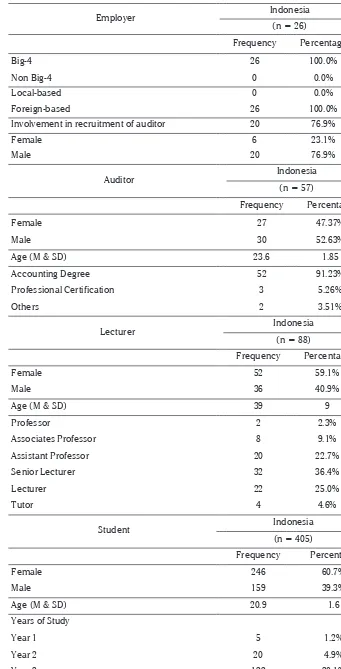
The characteristics of respondents are presented in Table 1. As can be seen from table 1, all employers interviewed/surveyed are from Big-4 accounting
firms and all foreign based public accounting firm and 76.9% employer involved in the recruitment process. The percentage of female junior auditor is slightly below their male colleagues (about 47% compared to 53%); and about 91% junior auditors in Indonesia have accounting degree, 5% have professional certification, whilst 3.5% have other specification. The female lecturers is outnumbered the male lecturers. Most lecturers surveyed are senior lecturers; with average working years in the institution are about 11 years.
The student samples are collected from undergraduate accounting program in 6 state universities in Java region; which are Universitas Indonesia, Universitas Padjajaran, Universitas Brawijaya, Universitas Diponegoro, Universitas Jendral Soedirman and Universitas Airlangga. There are about 405 students are surveyed for this research. Most of students surveyed in this research are from third or fourth year. In most Universities in Indonesia, the accounting undergraduate curriculum requires students to finish their study in 4 years. Thus most of the students surveyed in this research are from final year students which is suitable because they will soon enter job market.
Early Employment Problem
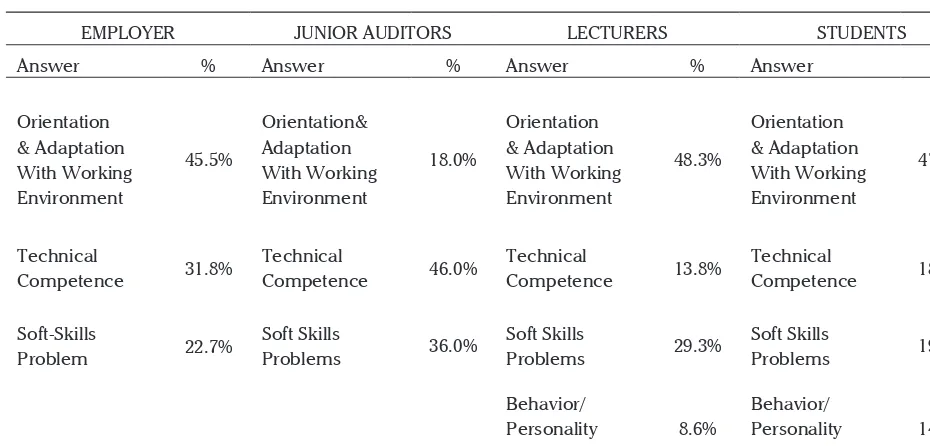
Based on table 2, we can see that all stakeholders identify similar early employment problem faced by junior auditor. According to the employers, lecturers and students; the top early employment problem of the newly hires auditor is problems with orientation and adaptation with new working environment. The adaptation problems include time management, ability to handle pressures, tight competition and difficulty to adjust campus life with real work life experiences. Although not on their top lists; junior auditors and lecturers also agree that newly hires auditor has to deal with these orientation and adaptation with working environment problem.
Employer Indonesia (n = 26)
Frequency Percentage
Big-4 26 100.0%
Non Big-4 0 0.0%
Local-based 0 0.0%
Foreign-based 26 100.0%
Involvement in recruitment of auditor 20 76.9%
Female 6 23.1%
Male 20 76.9%
Auditor Indonesia
(n = 57)
Frequency Percentage
Female 27 47.37%
Male 30 52.63%
Age (M & SD) 23.6 1.85
Accounting Degree 52 91.23%
Professional Certification 3 5.26%
Others 2 3.51%
Lecturer Indonesia
(n = 88)
Frequency Percentage
Female 52 59.1%
Male 36 40.9%
Age (M & SD) 39 9
Professor 2 2.3%
Associates Professor 8 9.1%
Assistant Professor 20 22.7%
Senior Lecturer 32 36.4%
Lecturer 22 25.0%
Tutor 4 4.6%
Student Indonesia
(n = 405)
Frequency Percentage
Female 246 60.7%
Male 159 39.3%
Age (M & SD) 20.9 1.6
Years of Study
Year 1 5 1.2%
Year 2 20 4.9%
Year 3 122 30.1%
Year 4 258 63.7%
all other stakeholders also put this problem on their top lists. Examples of technical problems are applying theory in practice, lack of current update of accounting and auditing standard, less experience in doing real audit cases and lack of accounting knowledge in specific industries.
The next early employment problems mentioned by all stakeholders are soft-skill. Soft-skills that junior auditor most lacking is: analytical skills, communication skills (oral and written) to interact with client, discipline, confidence and team work. This result in line with previous research which stated that employers nowadays value more on generic skills rather than soft skills, and development of soft skills must be embedded in learning process.
Other than those three common early employment problem mentioned by all stakeholders; lecturers and students also highlight behavior/personality as important problem. Behavior/personality problem includes loyalty, expectation of high salary, close minded and reluctance to do basic auditors’ work. The analysis of early employment problem is necessary for university as they will develop curriculum to help overcome those problems.
University Performance
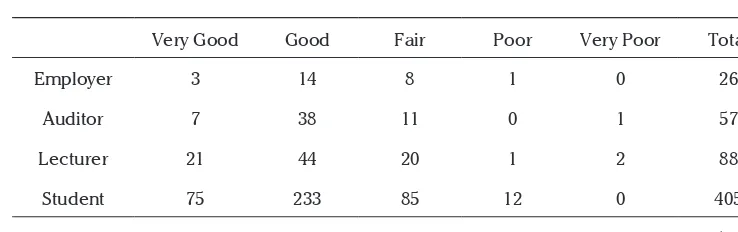
The result from table 3 shows that all groups of stakeholders rated the universities performed well in preparing graduates in job market. Table 4 shows that most the respondent (57%) give good rating for university performance, 18% give very good rating, 22% perceived fair and only 0.52% respondent rated poor performance. Although in average all respondent agree that university performed well in preparing graduates for the job market, but since graduates still lacking in several factors (technical skills and soft-skills), university has to do more effort to increase graduate employability.
Table 3. Perceived University Performance
University Improvement
Table 5 presents the answer from employers, junior auditors, lecturers and students regarding
EMPLOYER JUNIOR AUDITORS LECTURERS STUDENTS
Answer % Answer % Answer % Answer %
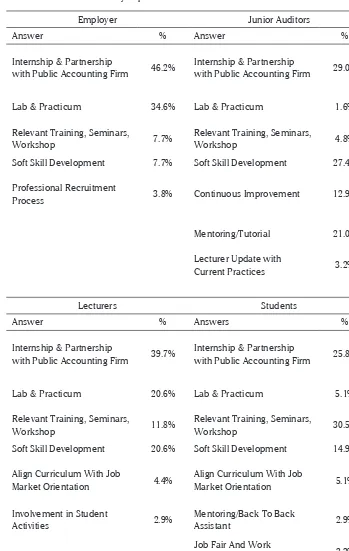
recommendation to university to overcome early employment problems in order to increase graduate employability. According to the findings; all stakeholders agree that internship should become mandatory subjects in accounting curriculum. Internship will help students to have smooth transition from campus environment to the working environment. By doing the internship, students will be able to learn about the profession and gain practical experience and reflect on what they have learned in the classroom (Muhamad, 2009). University should engage in partnership with public accounting firm in developing internship program. The partnership is win-win solution between employer and university, because internship may pave the way for permanent employment upon graduation as well as providing an in-depth understanding of actual business practices.
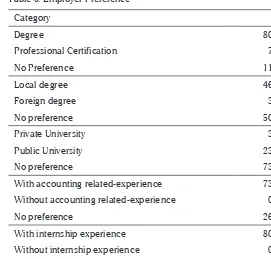
Additional questions are given to the employer regarding their preferred academic qualification in hiring an applicant for an entry-level job in the auditing (table 6). From the employers’ point of view; they prefer graduate with degree. Most employers have no preference about the university whether local vs foreign or private vs public university. Employers prefer to hire graduates with accounting related experience and with internship experience. The employer is willing to pay Rp. 4 million more to the newly hired junior auditor with
accounting experience (including internship).
Another suggestion given by stakeholders to overcome lack of technical competence are by adding more real auditing cases to the student via audit lab and practicum. Auditors also suggests to the university to give update of current audit practices to the lecturer. This can be achieved by conducting regular seminar/training/workshop by inviting guest speakers from industry and public accounting firm. For students; updates of real working experience can also be given by alumni that are currently working as auditor.
All stakeholders agree that soft-skills are another lacking factor that university should overcome. In order to increase students’ soft skills, university should align soft skill in curriculum. This could be done improvement of teaching method and encourage student to participate actively in class. Several student-centered learning method such us problem based-learning, project-based learning, case-based learning and experiential learning are proven by several researcher can increase students soft-skills (Aman et.al, 2012; Moursound, 2007; Musa et al., 2011). Involvement in student activities can help student to develop their soft-skill especially team work, interpersonal and communication skills. University should facilitate students with various extracurricular activities to give new exposure to the students.
Very Good Good Fair Poor Very Poor Total
Employer 3 14 8 1 0 26
Auditor 7 38 11 0 1 57
Lecturer 21 44 20 1 2 88
Student 75 233 85 12 0 405
Total 106 329 124 14 3 576
MANAGERIAL IMPLICATIONS
Result of this study give practical recommendation to accounting education provider in Indonesia to increase graduate employability in junior auditor position. In developing accounting curriculum,
university should bridge the gap between campus environments with working environment. This could be done by: (1) incorporate internship as compulsory subjects; (2) partnership with public accounting firm in recruitment process;
Employer Junior Auditors
Answer % Answer %
Internship & Partnership
with Public Accounting Firm 46.2%
Internship & Partnership
with Public Accounting Firm 29.0%
Lab & Practicum 34.6% Lab & Practicum 1.6%
Relevant Training, Seminars,
Workshop 7.7%
Relevant Training, Seminars,
Workshop 4.8%
Soft Skill Development 7.7% Soft Skill Development 27.4% Professional Recruitment
Process 3.8% Continuous Improvement 12.9%
Mentoring/Tutorial 21.0%
Lecturer Update with
Current Practices 3.2%
Lecturers Students
Answer % Answers %
Internship & Partnership
with Public Accounting Firm 39.7%
Internship & Partnership
with Public Accounting Firm 25.8%
Lab & Practicum 20.6% Lab & Practicum 5.1%
Relevant Training, Seminars,
Workshop 11.8%
Relevant Training, Seminars,
Workshop 30.5%
Soft Skill Development 20.6% Soft Skill Development 14.9% Align Curriculum With Job
Market Orientation 4.4%
Align Curriculum With Job
Market Orientation 5.1%
Involvement in Student
Activities 2.9%
Mentoring/Back To Back
Assistant 2.9%
Job Fair And Work
Consultation 3.3%
(3) practical training with real audit cases via seminar/workshop; (4) student-centered learning approach; and (5) regular updates of current audit practice to lecturer. According to ASEAN Mutual Recognition Agreement, the accountants are free to compete across ASEAN countries. Hence, it is essential for the higher education providers to identify problems of the entry-level employment not only in their home country but also in other members of the AEC in order the prepare the graduates facing regional as well as international job market competition.
CONCLUSION
The purpose of this study is to evaluate performance of accounting education providers in Indonesia in producing graduates required by the industry. This study compares different perception between the employers, lecturers, junior auditors and students regarding: (1) auditors’ early employment problem; (2) university performance; and (3) university improvement. We employ quantitative methods to present descriptive analysis of different perceptions of stakeholders regarding university performance. All employers and junior auditor
interviewed/surveyed are from Big-4 accounting firm; while lecturers and students surveyed are from state universities in Java Region.
According to all stakeholders; the top early employment problem of the newly hires auditor is problems with orientation and adaptation with new working environment; technical competence and soft-skill problem. In average all respondent agree that university performed well in preparing graduates for the job market, but since graduates still lacking in several factors (technical skills and soft-skills), university has to do more effort to increase graduate employability. To overcome the problem, all stakeholders agree to put internship as mandatory subjects. This is also in line with employer preference since they are willing to pay more for newly hires auditor with accounting experience. In order to increase technical competence, University should improve the curriculum more real audit cases, so students can adapt quickly with real work condition. Soft-skills need to be improved with integrating student-centered learning in all subjects; as well as encouraged students to involve in student
Category %
Degree 80.8%
Professional Certification 7.7%
No Preference 11.5%
Local degree 46.2%
Foreign degree 3.8%
No preference 50.0%
Private University 3.8%
Public University 23.1%
No preference 73.1%
With accounting related-experience 73.1%
Without accounting related-experience 0.0%
No preference 26.9%
With internship experience 80.8%
Without internship experience 0.0%
No preference 19.2%
activities to get new experience of working as a team and communicate well with others.
There are several limitations and suggestions for future research. First, respondent of this study is only from Big-4 accounting firm. The difference in public accounting firm size and based may influence the judgments of employers in recruiting the fresh graduates as junior Auditor. Thus, a further study to address this gap by including non-Big-4 should be conducted in the future. Second, lecturers and students surveyed in this study only from public university. Although, employers state
that there is no preference of private versus public university, it is necessary to find out the difference between both type universities in order to formulate proper recommendation to university provider. Third, this study presents only descriptive analysis of the university performance. Next research, should consider causality analysis of factors affecting university performance in preparing graduates to be ready in work environment. Fourth, cross country study between ASEAN countries are need to be done in order to prepare the graduates facing regional as well as international job market competition.
R E F E R E N C E S
Abraham, A. (2006). The need for the integration of emotional intelligence skills in business education.
Ahmad, Saharuddin. I, Khaidzir.A., Azizan. A, Kadir. Ariffin, Zainal. Anwar, Khairil., Mazlina, Wan. (2014). The social and academic skills and the marketability of UKM’s Graduates. Social and Behavioral Sciences 131 pp 118-123
Albrecht, W. S., & Sack, R. J. (2000). Accounting education: Charting the course through a perilous future (Vol. 16). Sarasota, FL: American Accounting Association
Aman, Aini, Ruhanita Maelah, and Sofiah Md Auzair. (2012). Implementation of integrated case studies course for accounting students. Procedia – Social and Behavioral Sciences 59, 9 – 17
Athiyaman, A. (2001). Graduates’ Perception about Business Education: an exploratory research. Journal of Further and Higher Education, 25(1), 5-19
Bennett, N., Dunne, E., & Carré, C. (1999). Patterns of core and generic skill provision in higher education. Higher education, 37(1), 71-93.
Borzi, M. G., & Mills, T. H. (2001). Communication apprehension in upper level accounting students: An assessment of skill development. Journal of Education for Business, 76(4), 193-198.
Burnett, S. (2003). The future of accounting education: A regional perspective. Journal of Education for Business, 78(3), 129-134.
Courtis, John K., and Omar Abdullah Zaid. «Early employment problems of Australian accounting graduates: An exploratory study.” Accounting Forum. Vol. 26. No. 3-4. Blackwell Publishers Ltd., 2002.
Dabalen, Andrew. Oni, Bankole.A Adekola, Olatunde. (2001).Labor market prospects for university graduates in Nigeria. Original Research ArticleHigher Education Policy, Volume 14, Issue 2, June 2001, Pages 141-159
Danh Nguyen, N., Yoshinari, Y., & Shigeji, M. (2005). University education and employment in Japan: Students’ perceptions on employment attributes and implications for university education. Quality Assurance in Education, 13(3), 202-218. Eliska, Sobotkova. Zuzana, Dohnalova. (2014). Modern Problems of the Integration of Graduates in the Czech Labour Market.
Social and Behavioral Sciences. Pp 1048-1054
Hassall, T., Joyce, J., Arquero Montano, J. L., & Donoso Anes, J. A. (2003). The vocational skills gap for management accountants: the stakeholders’ perspectives. Innovations in Education and Teaching International, 40(1), 78-88.
Heang. Lee Teck, Lin Yet-Mee, Yap Ching-Seng, Ling Chui-Ching. (2012). University Graduates’ Employability for the Position of Entry Level Auditors: Perspectives of Employers, Junior Auditors, Lecturers and Students. Research Report for Malaysian Accountancy Research and Education Foundation (MAREF), Working Paper
Jackling, B., & De Lange, P. (2009). Do accounting graduates’ skills meet the expectations of employers? A matter of convergence or divergence. Accounting Education: an international journal, 18(4-5), 369-385
Kavanagh, M. H., & Drennan, L. (2008). What skills and attributes does an accounting graduate need? Evidence from student perceptions and employer expectations. Accounting & Finance, 48(2), 279-300.
Kerby, D., & Romine, J. (2009). Develop oral presentation skills through accounting curriculum design and course-embedded assessment. Journal of Education for Business, 85(3), 172-179.
Lee, D.W., & Blaszczynski, C. (1999). Perspectives of _Fortune 500‘ executives on the competency requirements for accounting graduates. Journal of Education for Business, 75, 104-108.
Mason, G., Williams, G., & Cranmer, S. (2009). Employability skills initiatives in higher education: what effects do they have on graduate labour market outcomes? Education Economics, 17(1), 1-30.
Montano, J. L. A., Donoso, J. A., Hassall, T., & Joyce, J. (2001). Vocational skills in the accounting professional profile: the Chartered Institute of Management Accountants (CIMA) employers’ opinion. Accounting Education, 10(3), 299-313. Muktiyanto, Ali. (2015).Good University Governance dan Kinerja Program Studi: Pengaruh Praktik Akuntansi Manajemen,
Penerapan Teknik Manajemen, dan Pilihan Prioritas Strategi Sebagai Model Mediasi Fit. Draft Disertasi PPIA UI. Unpublished.
Moursund, Dave. (2007). Problem-Based Learning and Project-Based Learning. Retrieved from http://darwing.uoregon. edu/~moursund/Math/pbl.html on Dec 28, 2015.
Musa, Faridah, et al. (2011). Project-based Learning: Promoting Meaningful Language Learning for Workplace Skills. Procedia Social and Behavioral Sciences 18, 187 – 195.
Nemec. (2013). Němec, J. (2013). Ze školní lavice na židli státního úřadu. Ekonom.roč. 57, č. 15, s. 35 - 39. ISSN 1210-0714. Purcell. (2002). Purcell, K., Morley, M., Rowley, G., & Council for Industry and Higher Education (GB); Bristol Business School.
Employment Studies Research Unit (GB). (2002). Employers in the new graduate labour market: Recruiting from a wider spectrum of graduates, London, The Council for Industry and Higher Education, 32-38.
Singh, Parmjit. Thambusamy, R.X. Ramly, M.A. Fit or unfit? Perspectives of employers and university instructors of graduates’ generic skills. Social and Behavioral Sciences 123. Pp 315-324