• Tidak ada hasil yang ditemukan

Directory UMM :Data Elmu:jurnal:A:Agricultural Economics:Vol24.Issue2.2001:

N/A
N/A
Protected

Academic year: 2017

Membagikan "Directory UMM :Data Elmu:jurnal:A:Agricultural Economics:Vol24.Issue2.2001:"

Copied!
8
0
0

Teks penuh

(1)

Strategies and impact of agro-allied parastatals reform in Nigeria

Ph.D. Ade S. Olomola (Associate Research Professor)

Nigerian Institute of Social and Economic Research (NISER), P.M.B. 5, U. I. P.O., Ibadan, Nigeria

Received 1 March 1999; received in revised form 21 January 2000; accepted 27 March 2000

Abstract

This study examines the reform of agro-allied parastatals in Nigeria and determine the impact financially, economically and socially. Three enterprises, Flour Mills of Nigeria Limited (FMNL), Okitipupa Oil Palm Company (OOPC) and Nichemtex Industries Limited (NIL), were privatized in Nigeria under a reform programme aimed at improving the performance of agribusinesses in the country. The exercise was successfully conducted through public offer of shares and private placement. The reform led to an improvement in profitability, productivity, financial leverage and liquidity position of the enterprises. The social impact of privatization was also favourable. It has no adverse consequences on job security, level of employment and participation of employees in trade union matters. Successful implementation of the reform was due to several factors including high level of professional competence and dedication of officials connected with the reform, a high degree of transparency and strict compliance with laid down guidelines. At the enterprise level, the positive changes recorded by the enterprises came about through the adoption of a number of coping strategies such as the maintenance of diverse product mix, expansion of export potentials and upgrading of product quality, improved marketing management, technological restructuring and improved techniques of sourcing raw materials. At the macro level, some policy actions such as trade policy reforms and price liberalization also played significant role in enhancing the performance of the enterprises after privatization. © 2001 Elsevier Science B.V. All rights reserved.

Keywords:Agricultural parastatals; Privatization; Liberalization

1. Introduction

In spite of the large size, diversified structure and the roles played by public enterprises (PEs) in many countries worldwide there is growing concern about the low level of performance of such enterprises espe-cially in the developing world. In many African coun-tries, in particular, the dismal performance of PEs has been attributed to deficient pricing policies, inappro-priate investment decisions, capacity underutilization, inability to generate adequate working capital and maintain existing investments, overstaffing and high

Tel.:+234-2-810-2904; fax:+234-2-810-1194. E-mail address:[email protected] (A.S. Olomola).

level of indebtedness. Other problems include ex-cessive political interference in critical management decisions, lack of incentives to attract competent man-agers and the incompatibility of civil service proce-dures with commercial operations (Nellis, 1986). The resultant inefficiency, losses, budgetary burdens, poor products and services indicate the advisability to put the PEs on the path of fundamental reform. Privatiza-tion, which involves the transfer of assets or activities from the public to the private sector, has been one of the chosen techniques of reform of the PEs.

Privatization is a key element of the structural ad-justment programme (SAP) implemented by several African countries in the 1980s and 1990s but the im-plementation has been constrained by several factors

(2)

including low level of income, highly imperfect and under-developed markets, rudimentary financial mar-kets, limited demand, uncompetitive private sector (Cook and Kirkpatrick, 1998) and the low value put on public enterprises by the private sector (Adams, 1997). Other impediments include thinness and weak-ness of the capital market, restriction on foreign ownership of shares, inadequate legal framework and trade union opposition (Gonzalex Fraga, 1991; Pinera and Glade, 1991; Thoumi, 1991). There have been considerable experiences of privatization strategies and outcomes in several parts of the developing world (Hemming and Mansoor, 1988; Glade, 1991; Prager, 1992) but there has been no consistent and reliable pattern (Foreman-Peck and Manning, 1986; Pi’i, 1987; Young, 1987; Yuvapurna and Tantayotin, 1987). In Africa, the experience in Zambia has been cited as the best so far on account of unwavering government commitment, a rare political consensus, transparency and dedication of programme officials (Cruickshank, 1998). It has created thousands of Zambian shareholders in various companies, led to an influx of major international investors and has generated new jobs. The tax base has widened and government revenue increased substantially. The Ghanaian experience, however, is far less impressive. Only modest achievement was made. The problems encountered include (a) lack of post-privatization reg-ulation in the original design of the programme; (b) significant job losses which created problems because compensatory schemes were not initially worked into the programme; (c) difficulty in monitoring privatiza-tion proceeds and (d) lack of effective communica-tion which created doubts, fears, rumours, anxieties, and apprehensions in the minds of many Ghanaians about the ultimate intentions behind the privatization programme, and inadequate attention to the issue of transparency (see Boachie-Danquah, 1998).

In the case of Nigeria, there is no clear indica-tion as to whether the mechanisms adopted in im-plementing the policy can effectively resolve the is-sue of inefficiency, and inequity in the ownership of capital and at the same time stem the drain on govern-ment budget as intended. This raises the question as to whether government’s arguments for privatization and the strategies adopted actually derive from a proper diagnosis of the parastatals’ problems. Also of partic-ular concern is the outcome of the policy in social,

financial and economic terms. To date, the efficacy of the privatization policy with regard to the agricultural sector remains largely unsubstantiated. Unless the im-pact of the policy is ascertained, it will be difficult to make a sound judgement as to how deep the policy should penetrate and as to what modification should be made concerning the objectives, conduct and per-formance of the enterprises that continue to remain under government control. Thus, it is the objective of this paper to examine the strategies of privatizing the agro-allied parastatals in Nigeria and determine the impact economically, financially and socially.

2. Structure and activities of the selected parastatals

Three enterprises, Flour Mills of Nigeria Limited (FMNL), Okitipupa Oil Palm Company (OOPC) and Nichemtex Industries Limited (NIL), were included in the study. Their selection was based on avail-ability of relevant data, full implementation of the privatization policy and considerable experience of post-privatization operations. Data collection com-menced in April 1993 and lasted till June 1994 and it involved the use of questionnaires, interview sched-ules as well as gathering of secondary data. This study employs micro-level quantitative data in conjunction with meso-level analysis in assessing the implementa-tion and impact of the reform. The approach involves the collection of data from the relevant enterprises and the key agency (Technical Committee on Privati-zation and CommercialiPrivati-zation — TCPC) concerned with the reform for use in conducting the analysis within the framework of the institutions, rules and processes established by law.

There is considerable variation in the business ac-tivities and ownership structure of the parastatals. The FMNL was incorporated as a public company on 29 September 1960 with an authorised share capital of

(3)

such as bread flour, biscuit flour, macaroni, semovita, spaghetti, whole wheat, wheat offals and pellets as well as bulk and bagged cement. The company is highly import dependent for its raw materials and other supplies. Indeed, the decision to locate the company at Apapa, Lagos was based on the need to be proxi-mate to the wharf to ensure easy access to imported raw materials.

The NIL was incorporated on 3 August 1971 and started operations in 1972. The company has its reg-istered office in Lagos and its factory in Ikorodu near Lagos. As on 31 August 1990, the beneficial inter-est of Directors in the issued share capital of the company stood at 53.55%. The Lagos State Govern-ment has 11.5% interest, Nigerian Industrial Develop-ment Bank (NIDB) has 11.27%, Federal GovernDevelop-ment, 8.65% while other interests stood at 15.03%. The prin-cipal activities of the company are manufacturing and marketing of textile piece goods, polyester staple fibre and filament yarn.

The ownership structure of the OOPC was far less diversified than that of the other companies. The OOPC started as a project among the World Bank, the Federal Government and the then Western State Government in 1968. With the split of the Western State into Oyo, Ogun and Ondo States in 1976, the project was inherited by the Ondo State Government and was incorporated as a limited liability company wholly owned by the State Government. In 1987, the Ondo State Government interest was vested in the Ondo State Investment (Holding) Company Limited which made the OOPC its wholly owned subsidiary. The main business of the company is the development of oil palm estates to produce fresh fruit bunches for processing into various grades of palm oil and kernel.

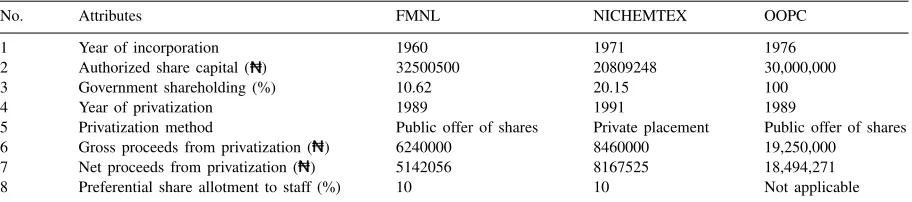
Table 1

Key elements of the privatization implementation procedurea

No. Attributes FMNL NICHEMTEX OOPC

1 Year of incorporation 1960 1971 1976

2 Authorized share capital ( ) 32500500 20809248 30,000,000

3 Government shareholding (%) 10.62 20.15 100

4 Year of privatization 1989 1991 1989

5 Privatization method Public offer of shares Private placement Public offer of shares 6 Gross proceeds from privatization ( ) 6240000 8460000 19,250,000

7 Net proceeds from privatization ( ) 5142056 8167525 18,494,271

8 Preferential share allotment to staff (%) 10 10 Not applicable

aSource: author’s findings.

It is also engaged in the production of palm wine from raphia palms which grow abundantly in Okitipupa area. The company has its headquarters in Okitipupa where a 20 t/h mill has been installed since 1974. Its location at the edge of the River Oluwa in Okitipupa makes it centrally accessible by road and water for the transportation of fresh fruit bunches from the oil palm estates to the mill.

3. Review of implementation of the reform

(4)

over-subscribed. With regard to the OOPC, the pri-vatization exercise involved a total of nine banks in addition to stockbrokers and legally required pro-fessional experts such as solicitors, auditors and reporting accountants. The exercise was effectively accomplished. The offer was concluded in a timely fashion and the objectives were achieved.

The NIL was the first enterprise to be privatized through private placement. The strategy of private placement was to be adopted on the condition that the affected enterprises did not meet the listing require-ments of the Nigerian Stock Exchange or the level of Government shareholding was too small to induce the enterprise to go public. The main guidelines specified by the TCPC for the purpose of private placement are (i) the desired number of shareholders is between 500 and 1000 including staff participation; (ii) no one shareholder other than the ‘Core Group’ should hold more than 10% of the shares on offer and (iii) as with public offers for sale of shares, formal approval by the National Council of Ministers is necessary in all cases. The ‘Core Group’ specified in the guidelines refers to prospective shareholders with demonstrated capabilities in similar industries or to workers of the enterprises organising themselves into co-operatives. Public sector investment agencies could also serve as Core Group investors to develop and nurture the affected enterprises to the state of readiness for sale through public offer of shares on the Nigerian Stock Exchange. The Core Group was to be allowed bene-ficial shareholding of between 25 and 40% so as to provide leadership in the enterprise. The privatization of Nichemtex was slated for 1989, but unlike FMNL the implementation witnessed considerable delay. The offer by private placement was concluded when the allotment result was announced to the public on 9 October 1991.

From the foregoing it is apt to point out that the privatization exercise has been successfully carried out in respect of the selected parastatals. The easi-est strategy seems to be the public offer of shares. The factors leading to the successful implementation of the programme include (i) the dedication to duty exhibited by TCPC members; (ii) the fact that the implementation guidelines are well articulated; (iii) the high degree of transparency associated with the exercise as evidenced by massive press coverage and the high priority given to widespread publicity by the

TCPC; (iv) the involvement of sub-committees in the case of privatization through sale of assets, which sub-committees were provided with clearly-stated terms of reference and code of conduct; (v) favourable private sector response; (vi) willingness of employees to participate especially in the case of privatization by private placement which is strengthened by the existence of virile staff unions; (vii) existence of a legal framework to guide the operations of the TCPC including clear specification of the functions of the TCPC and the objectives of the privatization pro-gramme and finally (viii) the fact that the TCPC was domiciled within the Presidency enabled it to operate without much financial impediments and adminis-trative encumbrances and to proceed speedily in the discharge of its responsibilities.

4. Impact of privatization

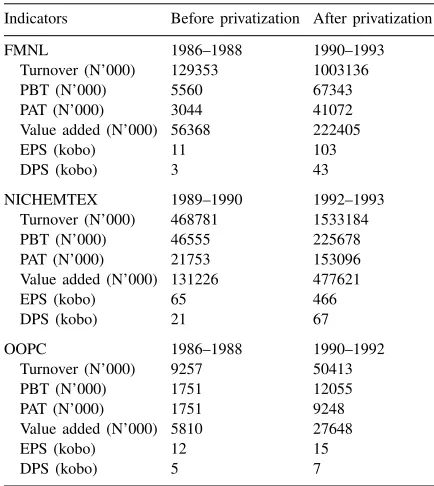
The impact analysis begins with a review of the overall level of performance of each enterprise focus-ing attention on some crucial variables like turnover, profit before and after tax, value added, earnings per share and dividend per share. Thereafter, we examine the privatization outcomes in financial, economic and social terms. With regard to FMNL, turnover increased from 129,353 before privatization (1986–1988) to 1.003 million after privatization (1990–1993) as shown in Table 2 or by about 675%. The ban on wheat importation and the consequent decline in ca-pacity utilization accounted partly for the relatively low turnover before privatization. Rising product prices and the lifting of the ban imposed on wheat importation by November 1992 would largely ac-count for the increase in turnover after privatization. There was substantial increase in profitability over the sub-periods. Profit before tax (PBT) and profit after tax (PAT) rose from 5560 and 3044 to 67,343 and 41,072, respectively. The value added also increased from 56,368 to 222,405 (or by about 294%). In response to the increase in earnings per share (from 11 to 103 kobo), the dividend per share also rose considerably from 3 to 43 kobo or by 1333%.

(5)

Table 2

Trends of profitability in the selected parastatals before and after privatizationa

Indicators Before privatization After privatization

FMNL 1986–1988 1990–1993

Turnover (N’000) 129353 1003136

PBT (N’000) 5560 67343

PAT (N’000) 3044 41072

Value added (N’000) 56368 222405

EPS (kobo) 11 103

DPS (kobo) 3 43

NICHEMTEX 1989–1990 1992–1993

Turnover (N’000) 468781 1533184

PBT (N’000) 46555 225678

PAT (N’000) 21753 153096

Value added (N’000) 131226 477621

EPS (kobo) 65 466

DPS (kobo) 21 67

OOPC 1986–1988 1990–1992

Turnover (N’000) 9257 50413

PBT (N’000) 1751 12055

PAT (N’000) 1751 9248

Value added (N’000) 5810 27648

EPS (kobo) 12 15

DPS (kobo) 5 7

aSource: annual reports of FMNL, Nichemtex and OOPC. PBT: profit before tax; PAT: profit after tax; EPS: earnings per share; DPS: dividend per share.

and 153,096, respectively. The value added also in-creased from 131,226 to 477,621 or by about 264%. The earnings per share rose from 65 to 466 kobo while dividend per share increased from 21 to 67 kobo. The level and changes in turnover and profitability in the OOPC are much lower than in the other enter-prises. Turnover increased from 9257 before priva-tization (1986–1988) to 50,413 after privatization (1990–1992). Both PBT and PAT stood at 1751 be-fore privatization but after privatization, the former in-creased to 12,055 (by 588%) while the latter rose to 9248 (by 428%). There was a slight increase in earnings per share from 12 to 15 kobo and in dividend per share from 5 to 7 kobo.

4.1. Financial and economic impacts of privatization

The analysis here is based on changes, over the pre- and post-privatization periods, in performance indicators like liquidity and leverage ratios in terms of financial impact and profitability and productivity

Table 3

Comparison of performance indicators of selected parastatals be-fore and after privatizationa

Indicators Before privatization After privatization

FMNL 1986–1988 1990–1993

Current ratio (CA/CL) 0.73 0.93 Debt–asset ratio 0.65 0.75 Debt–equity ratio 1.85 3.38

PBT/sales (%) 6.53 3.50

PAT/sales (%) 3.62 2.06

PBT/networth (%) 8.10 42.43 PAT/networth (%) 9.84 25.73 LAPI (1984=100) 126 1278

CAPI (1984=100) 69 457

NICHEMTEX 1989–1990 1992–1993

Current ratio (CA/CL) 1.07 1.34 Debt–asset Ratio 0.60 0.56 Debt–equity Ratio 2.43 1.25

PBT/sales (%) 11.99 14.63

PAT/sales (%) 7.76 9.86

PBT/networth (%) 31.61 47.01 PAT/networth (%) 25.02 31.87 LAPI (1984=100) 302 1694 CAPI (1984=100) 184 210

OOPC 1986–1988 1990–1992

Current ratio (CA/CL) 1.41 1.17 Debt–asset ratio 0.33 0.30 Debt–equity ratio 0.56 0.45

PBT/sales (%) 24.55 25.13

PAT/sales (%) 24.55 19.44

PBT/networth (%) 14.32 23.33 PAT/networth (%) 14.32 17.95

LAPI (1984=100) 59 99

CAPI (1984=100) 39 17

aSource: underlying data from annual reports of FMNL, NICHEMTEX and OOPC. CA: current assets CL: current liabil-ities; PBT: profit before tax; PAT: profit after tax; LAPI: labour productivity index; CAPI: capital productivity index.

(6)

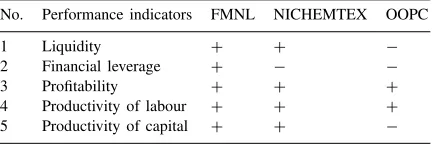
Table 4

Summary of changes in performance after privatization

No. Performance indicators FMNL NICHEMTEX OOPC

1 Liquidity + + −

2 Financial leverage + − −

3 Profitability + + +

4 Productivity of labour + + +

5 Productivity of capital + + −

With regard to Nichemtex, the current ratio in-creased from 1.07 to 1.34 implying a slight improve-ment in liquidity. Debt–asset ratio declined from 0.60 to 0.56 while debt–equity ratio also fell from 2.43 to 1.25 implying a deterioration in financial leverage. Profit before and after tax relative to sales increased from 11.99 to 14.63 and from 7.76 to 9.86%, respec-tively; whereas relative to networth the ratio increased from 31.61 to 47.01 and from 25.02 to 31.87%, re-spectively. Index of labour productivity rose from 302 to 1694 while that of capital rose from 184 to 210. Thus, there was an improvement in both profitability and productivity after privatization.

As regards OOPC, the current ratio declined from 1.41 to 1.17 indicating a deterioration in liquidity. Debt–asset and debt–equity ratios declined from 0.33 to 0.30 and from 0.56 to 0.45, respectively indicat-ing that financial leverage was lower after privatiza-tion than before. Profit before and after tax relative to networth increased from 14.32 to 23.33 and from 14.32 to 17.95%, respectively; implying that there was an improvement in profitability after privatization. In-dex of labour productivity rose from 59 to 99 while that of capital declined from 39 to 17. Whereas there was some improvement in labour productivity, the pro-ductivity of capital continued to decline privatization notwithstanding.

In sum, the changes in the performance of the en-terprises after privatization are as presented in Table 4. The positive changes recorded by the enterprises came about through the adoption of a number of coping strategies including (i) maintenance of diverse product mix such as the production of cement and other prod-ucts in the case of FMNL and palm wine in the case of OOPC; (ii) expansion of export potentials and upgrad-ing of product quality in the case of Nichemtex; (iii) involvement of reputable public companies as major distributors in order to enhance the level of turnover as in the case of Nichemtex; (iv) involvement of

reputable manufacturers in buying products to be used as raw materials as depicted by the marketing strategy of OOPC and (v) vertical (backward) integration for the local sourcing of raw materials as demonstrated by FMNL. The lifting of the ban on wheat importa-tion also contributed largely to the enhancement of the performance of FMNL.

4.2. The social impact of privatization

There has been no unfavourable development con-cerning the relationship between management and employees of the selected enterprises which can be attributed to the privatization exercise. The existing staff unions continued to operate and are being given due recognition by management. The employees con-tinue to show even more dedication to duty especially in view of their new status as beneficial owners of considerable equity share in their enterprises. Note that 10% of the privatized shares in NIL Plc and FMNL Plc now belong to the employees.

(7)

Furthermore, the policy of the company to contribute directly to societal development persists through modest donations and charitable gifts. In 1991, these amounted to 1500 but rose to 41,000 in 1993.

In Nichemtex Industries Plc, industrial relations also appear to be harmonious. Increased equity partic-ipation of the employees has been a morale booster. The commitment of the company to staff training and welfare continue undiminished since the privatization exercise. The company continues to give long service awards to deserving employees. In 1991, 1413 mem-bers of staff received awards for 10 years service, 280 for 15 years service and 3 for 20 years service. In 1992, the numbers rose to 1,915, 442 and 62 for the 10, 15 and 20 years service, respectively. In terms of donations for charitable purposes, the company continues to make useful contributions. In 1992, the company gave out 285,000 as donations to state government appeal funds and to various public as-sociations. In 1993, the amount rose to 572,293 or by about 101%. Another social impact is the di-versification of ownership structure of Nichemtex geographically and on the basis of income group. At present the owners of the company are spread across seven states in different parts of the country rather than one state prior to privatization.

In sum, the privatization exercise has not generated any tension at the enterprise level. It has no adverse consequences on job security, level of employment and participation of employees in trade union matters. The implementation guidelines have been instrumen-tal to the curtailment of social unrest especially at the enterprise level. The guidelines accord due recogni-tion to social groups for the purpose of preferential allotment of shares. In the case of privatization by sale of assets, the guidelines specify that the members of staff should be given the first opportunity to pur-chase certain items like household goods, motor vehi-cles and so forth. Such provisions have tended to curb unfavourable social impacts and have thus contributed in no small measure to the successful implementation of the privatization programme.

5. Conclusions and policy implications

The privatization of the selected parastatals was suc-cessfully implemented mainly because of government

support for the implementing agency TCPC financially and administratively and also because of the compe-tence and dedication of the TCPC members. Besides, the criteria for the choice of a particular privatization strategy were clearly stated; and the implementation guidelines as well as the reform objectives and insti-tutional arrangements were properly articulated. The study reveals that there was an improvement in prof-itability, productivity, financial leverage and liquidity position of FMNL after privatization. The situation was the same in Nichemtex except that there was dete-rioration in financial leverage after privatization. There was improvement in profitability and labour produc-tivity in OOPC after privatization. On the other hand, there was deterioration in capital productivity, finan-cial leverage and liquidity.

At the enterprise level, the social impact of privati-zation was favourable. There were no insurmountable tensions nor any disturbances from employees. Nei-ther was Nei-there any threat to their job security on account of the privatization exercise. There was in-creased equity participation by employees of FMNL and Nichemtex leading to considerable diversification of the ownership structure on the basis of income groups. Diversification on the basis of geographical spread of shareholders has also been achieved.

The emerging results indicate that in a depressed economy other forms of restructuring are required for privatization to yield the desired benefits. This is an important lesson because ownership and management problems may be fundamental but they are unlikely to be the only source of poor performance. Complemen-tary policy and enterprise-level actions are required to facilitate the performance of parastatals after privatiza-tion. These include (i) product price liberalization; (ii) trade policy reforms including tariff restructuring; (iii) enterprise-level technological restructuring and qual-ity improvement and (iv) product diversification and improved marketing management.

(8)

successful transformation from the public to private sector depends on the existence of a competitive en-vironment. Such an environment must be sustained to enhance the performance of enterprises after pri-vatization and to propel the economy towards greater efficiency.

Acknowledgements

The funds for the research that forms the basis for this paper were provided by the International Devel-opment Research Centre (IDRC) and administered by the West African Economic Association. I extend pro-found gratitude to these agencies and to colleagues who provided useful comments during a review work-shop in Cotonou, the Republic of Benin.

References

Adams, C., 1997. Privatization in sub-Saharan Africa: issues in regulation and the macroeconomics of transition. In: Paulson, J.A. (Ed.), Changing the Role of the State in Key Markets. Macmillan, London.

Boachie-Danquah, Y.,1998. Reflections on privatization in Ghana: what lessons for the rest of Africa. Development Policy Management (DPMN) Bulletin, Vol. V (1), pp. 18–22. Cook, P., Kirkpatrick, C., 1998. Reflections on privatization

in developing countries: positive and negative lessons. Development Policy Management (DPMN) Bulletin, Vol. V (1), pp. 4–13.

Cruickshank, S.A., 1998. Privatization — the Zambian experience. Development Policy Management (DPMN) Bulletin, Vol. V (1), pp. 14–17.

Glade, W. (Ed.), 1991. Privatization of Public Enterprises in Latin America. A Copublication of the International Centre for Economic Growth, The Institute of the Americas and the Centre for US Medican Studies, ICS Press, San Francisco, California.

Foreman-Peck, J., Manning, D., 1986. How well is BT performing? An international comparison of telecommunications total factor productivity. Department of Economics, The University of Newcastle.

Gonzalex Fraga, J.A., 1991. Argentine privatization in retrospect. In: Glade, W. (Ed.), Privatization of Public Enterprises in Latin America. A Copublication of the International Centre for Economic Growth, The Institute of the Americas and the Centre for US Medican Studies, ICS Press, San Francisco, California.

Hemming, R., Mansoor, A., 1988. Privatization and public enterprises. Occasional Paper, No. 56, International Monetary Fund, Washington, DC.

Nellis, J.R., 1986. Public enterprises in sub-Saharan Africa. World Bank Discussion Papers, No. 1, The World Bank, Washington, DC.

Pi’i, E.A.B., 1987. Privatization — its impact on labour relations — the Malaysian experience. In: ILO Collected Papers of the ASEAN Tripartite Symposium on Privatization — its Impact on Labour Relations, Chiang Mai, Thailand, 17–20 February.

Pinera, J., Glade, W., 1991. Privatization in Chile. In: Glade, W. (Ed.), Privatization of Public Enterprises in Latin America. A Copublication of the International Centre for Economic Growth, The Institute of the Americas and the Centre for US Medican Studies, ICS Press, San Francisco, California.

Prager, J., 1992. Is privatization a panacea for LDCs? Market failure versus public sector failure. J. Dev. Areas 26, 301–322. Thoumi, F.E., 1991. Privatization in the Dominican Republic and Trinidad and Tobago. In: Glade, W. (Ed.), Privatization of Public Enterprises in Latin America. A Copublication of the International Centre for Economic Growth, The Institute of the Americas and the Centre for US Medican Studies, ICS Press, San Francisco, California.

Young, R.A., 1987. Privatization in the Philippines and its impact on labour relations. In: ILO Collected Papers of the ASEAN Tripartite Symposium on Privatization — Its Impact on Labour Relations, Chiang Mai, Thailand, 17–20 February.

Gambar

Table 1
Table 3
Table 4

Referensi

Dokumen terkait

Jika berdasarkan hasil verifikasi memperlihatkan ketidakbenaran / ketidaksesuaian antara dokumen penunjang dengan data registrasi (data identitas dan data

[r]

Peserta harus melakukan 2 (dua) kali transaksi pembayaran jika akan mengikuti 2 jenis tes (TOEP dan TKDA), sehingga peserta harus memiliki 2 struk pembayaran1. PIN akan muncul

Sel hidup dari tanaman yang tidak dapat ditumbuhkan di medium kultur jaringan adalah pembuluh tapis, karena pada keadaan dewasa, sel ini tidak memiliki inti sel sehingga

Sedangkan sampel yang digunakan dalam penelitian ini sebanyak 40 orang yang diperoleh dengan cara ditetapkan/bertujuan ( purposive sampling ). Instrumen penelitian ini adalah angket

Pernyataan-Pernyataan di bawah ini yang ber- hubungan dengan kondisi yang dipersyarat- kan untuk supaya frekuensi gen tetap dari generasi ke genarasi adalah .... (A)

HUBUNGAN MOTIVASI DENGAN PARTISIPASI MASYARAKAT DALAM MELAKUKAN AKTIVITAS OLAHRAGA FUTSALDI KABUPATEN KARAWANG.. Universitas Pendidikan Indonesia | repository.upi.edu |

Kiajar Rajagukguk : Analisis Faktor Penyebab Penurunan Intensitas Pengelolaan Hutan Kemenyan (Studi Kasus: Hutan Kemenyan Di Desa Tangga Batu Barat, Kecamatan Tampahan,