SUPPORTING 8THGRADE OF JUNIOR HIGH SCHOOL STUDENTS’ UNDERSTANDING OF THE AREA OF A CIRCLE
Sri Rejeki1, RatuIlmaIndra Putri2, Yusuf Hartono2, Monica Wijers3, Dolly Van Eerde3
Muhammadiyah University of Surakarta1, Sriwijaya University2, Utrecht University3 However, the school practices make students focus on memorizing formulas instead of understanding concepts. Meanwhile, it is important to make students not merely recalling formulas but also understanding concepts, including the concepts of the area of a circle, which is being the topic chosen in this study. Hence, a set of learning activities which is divided into six lessons were designed based on Realistic Mathematics Education (RME) approach. Yet, this paper describes more about the third lesson which is about estimating the area of irregular plane figures and the area a circle using a grid paper. Design research was used as the research approach for this study and the data were collected through students’ written work, video registration, students’ interview, and field notes during the teaching experiment. Six students of the 8th grade of Junior High School (SMP N 1 Palembang) were involved in the teaching experiment. And, the results shows that those activities bring the students to gradually understand the concept of the area of a circle. Nevertheless, the students were coming back to the formal way to determine the area of a circle because it is difficult for them to estimate the area of a circle using a grid paper.
Keywords: Area, circle, reshaping, making grids, design research, realistic mathematics education
INTRODUCTION
Area and area measurement is one of the topics taught for elementary and junior high school in Indonesia. It is an important topic in mathematics (Kordaki&Potari, 1998). Cavanagh describes that the application of area concept influence students’ understanding of the domain in the higher grade. However, both students and teachers experience difficulties with this topic. Many studies has been done related to these difficulties (Kamii, 1996; Oldham et al., 1999; Kidman & Cooper, 1997). Asmall scale study on that topic, but particularly on the area of a circle, showed that students tend to recall only the formulas of the area and the circumference of a circle which makes them forget the formulas or use the formulas incorrectly (Abdussakir and Achadiyah, 2009). While it is important to know the formula and to do the computation for measuring the region, but it is also equally important to understand the concept (French,2004).
attempt to connect the concept to some examples of real life contexts.According to Oldham et al. (1999), common uses of the concept of area can be found in the activities of paving a courtyard with square paving stones, covering a floor with carpet, or covering a wall with wallpaper. Accordingly, the covering activities involving square paving stones were applied in this study. Moreover, a grid paper was used as the model which represented the squares as units of area measurement. Thus, this study focuses on answering this following research question: “How can grid paper support 8th grade
students’ understanding of the area of a circle?”
This study is the pilot experiment (the first cycle) of two cycles design research study. However, this only describe one of the sub research questions of the whole study. In the whole study, the general research question is “How can we support 8th grade students’ understanding of the area of a circle?”And, this general research question is elaborated into two sub-research questions:
1. How can grid paper support students’ understanding of the area of a circle?
2. How can a reshaping strategy support students’ understanding of the area of a circle? This paper focuses on answering the first sub research question.
THEORETICAL FRAMEWORK The concept of area
Area refers to a quantitative measure of two-dimensional surface contained within a boundary (Baturo and Nason, 1996). There are some basic aspects of area. Oldham et al. (1999), mentioned the following aspects:
a. The general idea of area
Area is the closed contour of a two-dimensional shape. b. Isometric transformation
The area of a shape does not change when the shape is moved or canted, two shapes have the same area if surfaces fit, the area of a flat shape does not change when its surface is curved, and the area of a curved shape does not change when its surface is flattened.
c. Conservation of area (division and addition)
The area of a shape equals the sum of the area of the parts, two shapes form a new shape when a part of the boundaries are put together and the area of the new shape is the sum of the original area.
d. Calculation
Involves the choice of a unit of area, can be determined by counting or approximating the number of units covering a shape, is dependent on the length, width, and configuration, can be calculated using a rule or formula, and is determined by the sum of small parts.
e. The area of spatial shapes
The area of spatial shapes can be specified or approximated by unfolding onto a flat plane and determining the area of the resulting net.
Students’ and teachers’ understanding of Area
The study of Kordaki and Potari (1998) has demonstrated the complexity of the concept of area and its measurement. The concept is not only a mathematical concept taught in school but also has something to do with students’ personal experiences in their life. The findings of Kordaki and Potari’s study also imply that school practices need to teach a more integrated and cultural orientation of the concept of area and place less stress on mere calculation by formulas. Moreover, the study showed that students tend to use formulas in measuring area of plane figures, particularly for a regular shape. That is why it is necessary to give students an irregular shape and ask them to measure it without allowing them to use the area formulas and other conventional measurement tools.
Learning activities based on the five tenets of RME
The process of designing a set of learning activities in this study is based on the five tenets for realistic mathematics education defined by Treffers (1987, p.248).
b. Phenomenological exploration
In the first instructional phase of a relatively new subject concrete contexts are needed for the mathematical activities. The aim is to get more insight into intuitive notions for concepts formation. This study used several contexts involving area measurement in daily life such as tiling a floor, tiling the bottom of a swimming pool, covering a garden with paving blocks, , and covering a garden with grass.
c. Using models and symbols for progressive mathematization
From the very start, in elementary problem situations, a variety of vertical instruments such as models, schemas, diagrams, and symbols are offered, explored and developed as a bridge from the informal to the formal level. In this study, to support students’ understanding of area measurement, grid paper can be used as a model to estimate the areas of regular and irregular plane figures.
d. Using students’ own construction
Students are free to use their own strategies to solve problems as a starting point for the learning. Therefore, these could lead to the emergence of various ways of solving a problem which can be used by the teacher to promote the learning process. The combined with consulting fellow students, group discussion, collective work reviews, the presentation of one’s own productions, the evaluation of various constructions on various levels and explanations by the teacher. In other words, the learning process of students is not only an individual process, but also a social process. In this study, students will work in a small group and discuss with their fellow students to solve the problem. Afterwards, the teacher will conduct a whole class discussion where the students can interact and contribute their ideas and their findings.
Hypothetical learning trajectory on the domain of area of circles
Van den Heuvel-Panhuizen et al. (2008) distinguishes three phases in learning a (new) geometric concept or property. These phases offer a direction in outlining the teaching-learning trajectory of geometric concepts and the accompanying didactic approach. a. Experiencing
The basic assumption is that the start of the teaching-learning process should always take place in a natural way and that, from there on, insight develops to a higher and higher level (Van den Heuvel-Panhuizen et al., 2008). In this study, the activities of comparing objects; and covering a garden can be visual activities which seem natural for students.
b. Explaining
Teaching geometry in RME is required to bring the students to the desired insight, by making a model. In this study, grid paper can be a model which firstly can be used by students to estimate the area of a circle.
c. Connecting
The connecting phase means that the learned subject is connected to other concepts and phenomena, which should lead to a deepening of insight (Van den Heuvel-Panhuizen et al., 2008). In this study, one can think of the importance of an understanding about the area of a circle to a daily life application. In this learning, students can estimate the grass needed to cover a circular garden.
METHOD
Research Method
Design research is chosen as the research approach in this study. The purpose of this type of research is to develop theories about both the process of learning and the means that are designed to support the learning (Gravemeijer and Cobb, 2006). And, it fits the aims of this study which are to develop theories about the process of learning on the topic of the area of a circle and about a set of activities which devided into six meetings which were designed to support the learning on the topic. Hence, what have been done in this study was developing a local instruction theory on the topic of the area of a circle. Design research consists of three phases namely preparing for the experiment, conducting the design experiment, and carrying out the retrospective analysis (Gravemeijer and Cobb, 2006). This study was conducted based on those three phases mentioned.
Participants
Six students from 8th grader of SMP N 1 Palembang involved in this study. The students are Attiyah. Siti, Alif, Dzaky, Belva, and Syila. Each of two students are the representation of students from the high level of achievement, middle level of achievement, and low level of achievement. Attiyah and Siti are the students with high level achievement; they have very good logical reasoning. Alif and Dzaky are the representation of students with middle level achievement; they can solve the problems faster but sometimes also very careless. And, for the last, Belva and Syila are the representation of the low level achievement students; they are the slower one but have a deep analysis.
Data Collection and Data Analysis
registration, students’ interview, and field notes during the teaching experiment. All the data were analyzed qualitatively and the Hypothetical Learning Trajectory (HLT) is the guidelines to analyze the data. The analysis focus on comparing the actual learning and the HLT.
A set of activities which divided into six lessons were designed and validated by experts. However, in this article, we will only discuss two crucial activities on the third lesson which is related to the research question in this stud, “How can grid paper support 8th
grade students’ understanding of the area of a circle?” Those two activities are comparing two lakes and estimating the grass needed to cover a circular garden. Before the teaching experiment, we conducted a pre-test for the students. The pre-test is aimed to identify students’ preliminary knowledge and to refine the initial HLT. In the end of the learning sequence, we conduct a post-test. In order to know to what extend the students’ development occur, the result of post-test will be compared to the result of pre-test.
All series of activities done during the preliminary experiment are audio taped and video recorded. During the learning activities, we made some notes about some interesting or important remarks. After experiencing an activity we conducted unstructured students interview about what work and what do not work, why the
Apretest was conducted before the teaching experiment to determine the students’
preliminary knowledge and to know students’ understanding about the topic would be
discussed. The pretest consists of four questions which are about comparing the area of two irregular plane figures with and without grids, determining the area of a circle with grids inside, and determining the perimeter of some plane figures including a circle. The students had to solve those problems individually for about 30 minutes. Afterwards, we did an
interview with each student. And, the students’ written work and the interview with the
students give an overview that in general, the students still mainly recall and apply formula to measure area and perimeter. Morever, some of them are still difficult to distinguish area and perimeter of a shape.
In the third question which is about determining and explaining the grass needed to cover a circular garden, some students directly apply the formula of the area of a circle without giving any explanation. However, some others did not have any idea to solve the problem. Based on the interview with the students, it is because they forget the formula to determine the area of a circle. Consequently, it emphasizes the importance of understanding concept besides knowing
formula. As French (2004) said that while it is important to know the formula and to do
the computation for measuring the region, but it is also equally important to understand the concept .
Teaching Experiment
the second activity is tiling related with units of area measurement; and the third activity is measuring the area of plane figures using a grid paper. In this paper, we will mainly discuss about the third activity because it is a crucial activities among all the lessons. The first two activities are still about recalling students understanding of area and
unit of area measurement. The teaching experiment of the three lessons were described as
follows.
1. Comparing, ordering, and designing plane figures
The first problem in this lesson is about comparing and ordering the five biggest islands in a miniature of indonesian archipelago garden which need more grass to cover. In this problem, the students did not experience misconception about area and perimeter. The
context gives clear orientation in what they have to do. It is in line with what Kordaki and
Potari (1998) said that school practices need to teach a more meaningful orientation of the concept of area.
As it was expected in the HLT, some students get the idea of overlapping strategy in comparing the islands. But, the majority applied the formula of length times width to determine the area of those figures. It might because of their mathematics learning experience which emphasize the use of formula to solve problems in area measurement. Hence, a discussion is needed in distinguising the situation when we can apply the length times width formula.
In the second problem which is about designing garden with the same amount of grass needed to vover, what students did is just play with formulas. They firstly make a rectangle with certain area and making calculation of another plane figure with the same area. Similar with the possible reason in the previous activity, it might because the students have got used to just applying formula and doing calculation in solving mathematics problem. Therefore, none of the students come up with the idea of designing a plane figure and reshaping the figure into different shape, as it was expected in the HLT.
2. Tiling related with units of area measurement
There are two activities in this second lesson. The idea of the first activity is recalling the
students’ knowledge about unit iteration in area measurement and the second activity aims
to recall both the students’ knowledge about unit iteration in area measurement and the
students’ knowledge about the shape of a circle. Moreover, in the second activity, instead of iterate a unit to one another, they are expected to make grids based on the given grids. Interestingly, it was different with the expectation mentoned in the HLT, it was because since from the first activity, the students have understood the way of tiling as the set of tiles which are put together, not always have to be put one by one. Hence, those two activities can be put together in one lesson or the first activity can be removed.
3. Measuring the area of plane figures using a grid paper
The mathematical idea in this lesson is using grid paper to measure area. This section
begins by clarifying students’ conception of area related to measurement units. There are
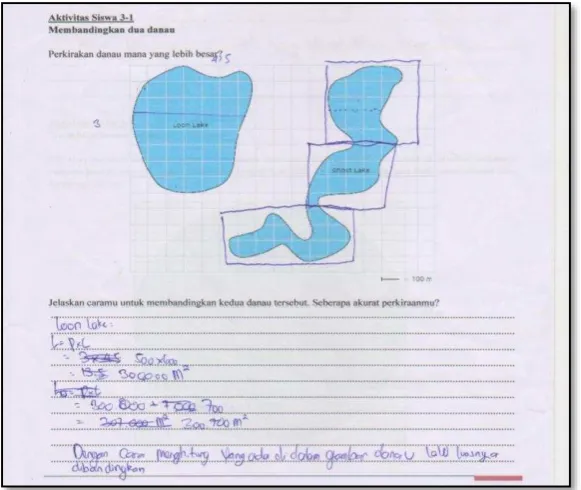
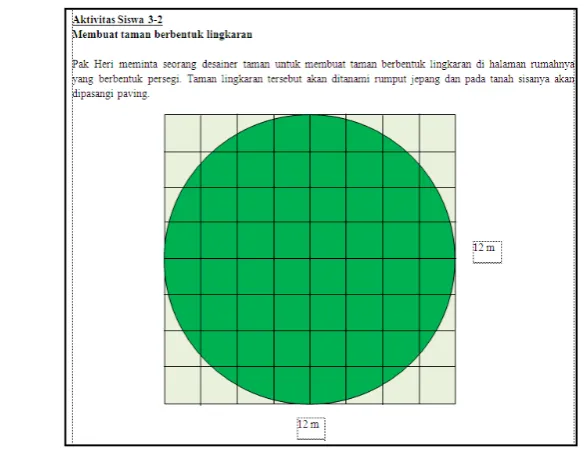
two activities in this meeting. Firstly, the students try to compare two lakes on a grid paper. Afterwards, for the second activity, the students estimate the grass needed to cover a circular garden on a square land. The students worked individually in both meetings. The first activity aims to introduce the grids in area measurement and in the second activity the students are expected to see the relationship between the area of square and the area of circle which diameter equals the side of the square land.
similar shape as it was also mentioned on the HLT. It might because in the previous activity what the students have learned is about the units of area measurement involving square tiles. Hence, the students make an analogy of the grid as a square tile.
Figure 1.The Problem of Activity 3-1
The students’ written works show that there are different ways of students in determining
the number of grids. Most students just directly count the complete grids and add the incomple grids into one complete grids then add them all. Meanwhile, there two students who counted the grids by dividing the shapes into several parts which are they think more regular. Afterwards, they did counting the grids of each shape and adding them all. The
students’ works can be seen on these following figures.
Figure 2.The Example of Students’ Written Work on Problem 3-1
Moreover, a fragment of a short discussion related to the students’ written work displayed
1 Researcher : Which one is bigger?
2 The Boys : Loon Lake
3 Researcher : Loon like is bigger. How about the girls, do you have the same
answer?
4 The Girls : Yes, Loon Lake
5 Researcher : What is your reason?
6 The girls : Because we count the grids. Loon Lake has 45 grids and Ghost
Lake 30
7 grids.
8 Researcher : Alif’s strategy is length times width, could you please tell us
which
9 is the length and which is the width? (pointing Loon lake).
10 Alif : The length is 45 and the width is 30. Oh no, we change the length
and 11 the width become the actual measurement which is 500
times 600 equals 300.000 m2.
Transcript 1.Students’ reasoning on Problem 3-1
Based on the transcript (line 2 and line 4), all students agree that Loon lake is bigger than Ghost lake. Moreover, on line 6, the girls said that they applied strategy of counting the grids. Alif, one of the students with the reasoning displayed on Figure 2 tried to explain their reasoning. They measured the area of a rectangle with 500 m wide and 600 m long (on line 11). The straight line on the figure of Loon lake represents the length of the rectangle. The students draw the rectangle to make them easier in estimating the number of grids on Loon lake. It indicates that they also reshape the figure into a regular figure and adding the rest of the grids outside the rectangle in their calculation.
For the second activity, the problem is about determining the amount of grass needed to cover a circular garden on a square land (Figure 3). The amount of grass will be in meter square and there are grids on the design as the representation of paving blocks covering the rest of the land which are not covered by grass. Surprisingly, almost all students directly apply the formulas of the area of a circle to determine the amount of grass needed to cover the circular garden. It might because when they looked at the diameter which are known as a number, the directly thought about applying the number on the formula.
In other words, the rest of the conjectures which have been mentioned on the HLT did not really revealed in the classroom. None of the students said that the grass needed to cover the circle is three fourths of the area of the square land. There were no students estimate the area of a circle by considering the given grids which make the area of the circle is more than 3r2 and less than 4r2.
Figure 4.An Example of Students’ Written Work on Problem 3-1
An example of a student’s written work (Figure 4) describes that in fact, the student tried to
use the grids in estimating the area of the circular garden. The students tried to estimate the amount of grass needed to cover the circular garden by making four triangles in all four vertices of the square. However, in the conclusion of the problem, they directly applied formula to determine the area of a circle without mentioning about the estimation results.
Moreover, from the discussion, it revealed that the students mainly depend on the formula and thought that as long as they know the formula and they can determine the area of the circle by applying the formula, they do not need to apply other strategy. Therefore, it should be explicitly mentioned that the teacher should really encourage the students to determine the area of the circular garden in the second activity by using their own way, not only by applying formulas.
Post-test
Aposttest was conducted in the end of the learning sequence. It aims to describe the
development of students’ learning and understanding of the concept and the measurement of
the area a circle. Moreover, it is also expected to show students’ strategies in solving the
problems about the topic. The analysis is conducted by comparing the results of students’
this analysis also contribute to enhance the analysis of the teaching experiment and as a consideration in drawing the conclusion.
There are four questions which are the same with the question in the pretest and the students
were also given at most 30 minutes to solve all the questions. Based on the students’ written
work and interview with the students, there are two main things we can conclude. The first thing is that the students were able to give mathematical reasoning in comparing problem. Most of them determine the bigger land by considering the number of grids inside, not only by looking at the shapes as most of them did in the pretest. The second thing is that all students could explain two different ideas of estimating the area of a circle by using formula and by using the grids. In the pretest, the students merely applied formula and there were two students who did not have any ideas to solve the problem.
CONCLUSION
As it was mentioned in the introduction of this paper, the research question of this study is “How can grid paper support 8th grade students’ understanding of the area of a
circle?”Based on the results and the discussion of pretest, teaching experiment, and posttest, there are two main things which we can conclude that those three activities bring the students to gradually understand the concept of the area of a circle. However, the students were coming back to the formal way to determine the area of a circle because it is difficult for them to estimate the area of a circle using the grid paper. Therefore, a further study about this topic might consider a need to design more lessons to really strengthen students understanding of measuring the area of a circle by using a grid paper.
However, we can not make any general conclusion based on this study since it only consists of three lessons. Yet, the idea of this study can be transferable into other different context, and even into other different level which involves this topic to be taught, in this case in the 6th grade of Elementary School. However, some adjustment are needed considering the findings of this study. Moreover, it should also be take the classroom culture, sosial culture, and the pretest results as considerations.
REFFERENCES
Abdussakir, &Aschadiyah, N., L.. (2009).
PembelajaranKelilingdanLuasLingkarandenganStrategi REACT padasiswakelas VIII SMP Negeri 6 Kota Mojokerto. Prociding Seminar NasionalMatematikadanPendidikanMatematikaJurusanMatematika FMIPA UNY, 388-401.
Baturo, A., &Nason, R. 6 . Students Teachers’ Subject Matter Knowledge within the Domain of Area Measurement. Educational Studies in Mathematics, 31: 235-268.
Cavanagh, M. (2008). Area Measurement in Year 7. Educational Studies in Mathematics, 33: 55-58.
Gravemeijer, K., & Cobb, P. (2006). Design research from the learning design perspective. In Van den Akker, J., Gravemerijer, K., McKenney, S., &Nieveen, N (Eds.), Educational design research. London: Routledge.
Kamii, C. K. (1996, October 12-15). Why can't fourth graders calculate the area of arectangle? Paper presented at the Paper presented at the 18th Annual Meeting:North American Chapter of the International Group for the Psychology ofMathematics Education, Panama City, FL.
Kidman, G., & Cooper, T. J. (1997). Area integration rules for grades 4, 6 and 8 students. In Proceedings of the 21st international Conference for the Psychology of
Mathematics Education (pp. 136-143).
Kordaki, M., &Potari, D. (1998). Children's approaches to area measurement through different contexts. The Journal of Mathematical Behavior, 17(3), 303-316.
Oldham, E., Valk, T. V. D., Broekman, H., Berenson, S. (1999). Beginning Pre-service Teachers’ Approaches to Teaching the Area Concept: identifying tendencies towards realistic, structuralist, mechanist or empiricist mathematics education. European journal of teacher education, 22(1), 23-43.
Treffers, A. (1987). Three dimensions. A model of goal and theory description in mathematics instruction the wiskobas project. Dordrecht: ReidelPublishingCompany.