SUPPORTING 7
thSTUDENTS’ UNDERSTANDING OF EQUAL SIGN
=
IN LINEAR EQUATIONS WITH ONE VARIABLE
Sari Saraswati1, Ratu Ilma Indra Putri2, Somakim3 Sriwijaya University1,2,3
1) [email protected], 2) [email protected], 3) [email protected]
Abstract
Understanding and using equal sign with one variable is dependent on the concept of equality. This study report is a part of full study on how to support students’ understanding
of linear equation with one variable. The aimed of this research is to supporting 7th graders
to understand the concept of linear equation with one variable Hence, a set of learning sequence which consist of five activities were designed. By using design research, a Hypothetical Learning Trajectory (HLT) and mathematical activities were developed to get
better understanding 7th graders in linear equation with one variable. Pendidikan
Matematika Realistik Indonesia (PMRI) approach was used in this study. Data were collected through video, students’ work, pre-test, post-test, field note and interview. Data were analyzed by comparing Hypothetical Learning Trajectory (HLT) with the actually learning trajectory in teaching experiment. The result shows that some students can used to apply equal sign in linear equation with one variable. Retrospective analysis of teaching experiment confirm that comparing the area of two rectangle are able to support students’ understanding of equal sign in linear equation with one variable.
Keywords: Equal sign, area of rectangle, linear equation with one variable, PMRI, Local Instructional Theory.
INTRODUCTION
Linear equation with one variable is one of important materials in algebra. Krantz (2006) clarified that in Al Khwarizmi’s book explained that the motivation for study algebra was to find a solution of an equation. Van de Walle, Karp and By-Williams (2010) explained that students who do not have a strong understanding of the symbols they are using, is unsuccessful in algebra. One of important symbols in linear equation with one variable which has to introduce to students is equal sign. The students who failed to understand the meaning of equal sign, they typically have difficulty to express the problems in algebra (Knuth, Stephens, McNeil & Alibali, 2006). It show that the equal sign is so important to support students understanding in linear equation with one variable.
The equal sign taught in the beginning of learning of linear equation with one variable by just showing the symbols = so that the students’ understanding become not meaningful. One of the fundamental concept of linear equation with one variable is equality (Knuth, et al., 2006). Therefore, the equality was become the main idea to teach the concept of equal sign in linear equation with one variable. It agrees with e.g., Herscovics & Linchevski; Linchevski & Herscovics; Pillay, et al. (as cited in Jupri, et al., 2012) that linear equations with one variable as the transition of students’ thinking from arithmetic to algebraic. Therefore, the activity related to the equal sign in linear equations with one variable is needed to help the students construct a complete understanding toward the meaning of it. Based on Sembiring, (2010) and Zulkardi (2002), the teaching approach that bridged the students’ understanding from the real problems to the abstract for students is Realistik Mathematics Education (RME) which in Indonesia be known as Pendidikan Matematika Realistik Indonesia (PMRI).
The aimed of this study is to contribute the classroom activities in learning the concepts of linear equation with one variable. Research question addressed here is how do 7th graders students understand the equal sign in linear equation with one variable?”
THEORETICAL FRAMEWORK
1. Equal Sign As A Balance In Linear Equation With One Variable
In linear equation with one variable, the equal sign become part of important things to understand the concept of linear equation with one variable. Baroody and Ginsburg; Behr et al.; Kieran; Rittle-Johnson and Alibali stated that many students at middle school understanding the meaning of the equal sign as an symbol of the result of an arithmetic operation rather than as a symbol of equivalence (as cited in Knuth, et al., 2006). The equations that students encounter look likes + = ⋯ or × = ⋯. Naturally, students come to know that the equations is the answer or the totoal rather than the symbols as a balance (Carpenter, Franke & Levi; McNeil, Alibali,; Molina & Ambrose in van de Walle, et al., 2010).
Van de Walle, et al., (2010) clarified that equal sign is so important caused, first, it is important for students to know, understand and symbolize the relationships in our number system. The equal sign is a basic method to represent the relations, for example,
+ = + . This is not a real strategy but also the implementation of the distributive property. These ideas formally developed through arithmetic operation.
A second, when the students failed to understand the meaning of equal sign, they will typically have difficult in algebraic expression (Knuth, et al., 2006). Even solving simple equation such as � + = requires students to see that the problems is equivalent in both sides.
design learning activities of the concept of linear equation with one variable. The procedure to understand the equal sign begin from the concept operation in arithmetic to algebric operation. So, in this research, measuring the area of a rectangle which are not uniform become the starting point to teach equal sign for students. Then, students could analyze the different strategies of accounting that area.
2. Realistic Mathematics Education
Realistic Mathematics Education (RME) is one of the theories in teaching and learning mathematics which developed in Netherland since 1970 (Zulkardi, 2002). In Indonesia, it is called as Pendidikan Matematika Realistik Indonesia (PMRI). This theory refer to idea that mathematics as human activity (Zulkardi, 2002). This theory apply that to begin the learning activity from the contextual problem which can be imagined by students (Gravemeijer, 2010 in Sembiring, 2010). Besides that, Zulkardi (2002) explained that situational level or real context is starting point in the teaching. As a basic of this reaseach, RME approach is defined elaborately through five characteristics (Treffers, 1987). a. The use of context for phenomenologist exploration
The contextual problems are starting point to find the concept what we want to accomplish. The context has to relate in the real problems for students. Its means the students could be imagined the situational problems. Using the context is expected that the students could involve to explore actively in solving the problems. Phenomena in the real life could be the source to reform the concepts. The process absorption the concepts which is appropriate the situational concrete be conceived as mathematization.
b. Use of models for mathematical concepts construction
The use of the model related to the situation and the model developed by the students themselves. The model is a situation often encountered by students. From this process, a model often becomes a thing actually exists in the lives of students.
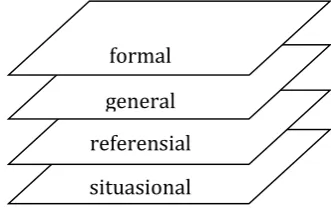
Gravemeijer (1994) explains that the development of the model is described as a process of change in certain situations (models of) become more formal situations (models for). In this case, the student is given the opportunity to use to develop the model. As the stages of development of a model of situational stage to the formal stage is shown in the following figure.
referensial general
formal
situasional
Situational level
Situational level is the basic level with regard to the situation and the strategies that are situational used in the context of settlement presented by the theory of teaching.
Referential level
The use of models and strategies at this level refers to a situation that illustrates the problem.
General level
This level focuses on the strategies that have a mathematical nature of the referential level which later developed into a formal model
Formal level
At this level students work with conventional procedures and notation without the need for context
c. Use of students’ creation and contribution
Great contribution to the learning process is expected to come from the student's own construction which directs them from informal ways to more formal.
d. Students activity and interactivity in the learning process
The interactivity is a series of events in the form of explicit negotiation, cooperation interventions, and evaluation of fellow students and teachers is an important factor in the learning process. The process of teaching and learning will be more meaningful when students communicate their ideas to each other.
e. Intertwining mathematics concepts, aspects, and units
Using a variety of relevant learning theory, interrelated, and integrated with other learning topics.
METHOD
Design research become the method in this research. There are three phases on this research which are preliminary design, teaching experiment and retrospective analysis. This research involved 32 students which are 8 students in pilot experiment and 24 in teaching experiment, and a mathematics teacher. This research was conducted in SMP Pusri Palembang which focus on the teaching experiment cycle 2.
In the preliminary design, researcher collect the literature to design the learning sequences the material linear equation with one variable. Furthermore, a series of activities that includes the conjecture of students’ thinking developed through Hypothetical Learning Trajectory (HLT).
In the second phase is teaching experiment which are consist of two cycles, pilot experiment and teaching experiment.
In the teaching experiment, instructional activities were tried, revised, and designed on a daily basis during teaching experiment (Gravemeijer & Cobb, 2006). The aimed of teaching experiment is to answers the research question. In this research, the teaching exoeriment were conducted in five meetings. This research emphasize that mathematical ideas and conjecture could be adjust during the teaching and learning process. Before teaching experiment, researcher gave the pre-test which aimed to know the students’ pre-knowledge and to know how the students master in prerequisite material of algebraic. After learning activities was done, researcher gave the post-test which aimed to know the development of students’ strategies in solve the problems related in linear equation with one variable.
In retrospective analysis, all the data obtained during the teaching experiment to be analyzed which will then be used to develop the design of the next activity. HLT serves as the main reference to determine the things that become the focus in the analysis. HLT compared with the real situation of students in this strategy and the thinking of students that actually happened during the learning. It is analyzed not only the things that support HLT but also an example of the contradiction with the conjecture was designed. Results of a retrospective analysis used to answer research questions, make conclusions and provide recommendations on how the HLT was developed for further research.
RESULT AND DISCUSSION
Hypothetical learning trajectory (HLT) is part of planning mathematics lesson which consist of the activities, goals, mathematics idea and conjecture. This paper focus on the first activities in the teaching experiment. So, the hypothetical learning trajectory (HLT) in the first activity in the second cycle explains as below:
Activities Goals Mathematical
Before the students calculate the area of a rectangle wake irregular, students partitioning (dividing) it
Activities Goals Mathematical
ideas Conjectures
- Students calculate each partition, for example, L1 = 3 × 2 = 6, L2 = 3 × 5 = 15 and L3 = (14-3) was obtained L3 × 5 = 55, then added becomes L1 + L2 + L3 = 6 + 15 + 55 in order to obtain the total is 76
From the hypothetical learning trajectory (HLT) above, then the learning sequences were applied in the cycle 2. Before it were implemented, the students gave the pre-test which aimed to know pre-knowledge related in algebraic. Besides that, knowing the students’ strategy and the extent to which the activity can be achieved. The pre-test was conducted 40 minutes by given 5 problems.
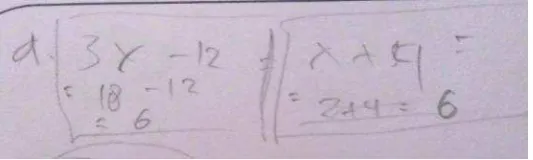
Based on the findings pre-test, the student has not mastered the material prerequisites of linear equation with one variable. The results of pre-test in cycle 2 made important information to improve the design of learning and teaching HLT in the teaching experiment. Understanding about equal sign is so important for students to support the students in learning linear equation with one variable. The students’ understanding of equal sign could support the students when they solve the problems related in linear equation with one variable. Students who do not understand the equal sign will fail to find a solution of linear equation with one variable. This can be seen in the figure 2 below.
Based on the figure , we could see that the students’ understanding of equal sign to be not meaningful. So, in the first activity in cycle 2 was designed the activity involved the use of equal sign. The activity related in contextual problems which is could be imagined for students. The aimed of this activity is to support the students’ understanding of equal sign and use of variable in algebraic expression.
At the beginning of the learning in activity 1, the teacher recalls some important points related to the learning activity 1. The teacher asks the students to recall what is meant of area. Then, the teacher give the problems to students as below.
From the problems above, the teacher asked the students to calculate area in different strategies. Most students know how to calculate the area of a rectangle that is related to the problems given. Furthermore, the teacher asked the students work individually.
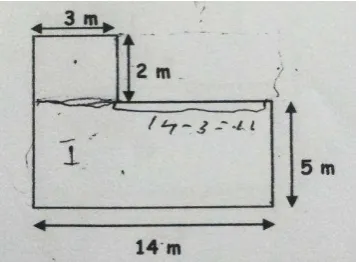
When the students worked in individually, most students could answer the question correctly. Overall student can find a combined area of a rectangle correctly and appropriately. In addition, students can also determine the length of each side of each rectangle has been cut. This is consistent with the HLT that students can calculate the sides, for example, 14-5 = 11. This can be seen in the figure 4 below.
Based on the figure 4 above show that the students divided the area become several partitions. It is, according to the HLT that students can determine the combined area of the rectangle by partitioning of shape first into several parts.
In the next activity, the students calculate the area of partitions. It can be seen from one of the students' answers on the figure 5 below.
14 m
5 m 2 m
3 m
Figure 3: The contextual Problem in Activity 1
Based on the figure 5 that the students understand in calculating the area of land. It appropriate with the LT which were designed. It could see in the following Fragment 1.
Fragment 1: Area of Rectangle
1. Researcher : Arul, how could you fine 420? 2. Student : divided by two
3. Researcher : yes
4. Student : this is …this is 5. Researcher : yes
6. Student : to find the area is x …..six 7. Researcher : yes
8. Student : so, this is 14, then 5 x 14 = 70, so the toal area is 6 x 70
9. Researcher : why it 6 x 70?
10.Student : because the area of rectangle
From the fragment 1 above indicate that student not understand the concept of area well because he multiply both of area. However, when teachers provide direction and asked other student in the group to explain the answer, Arul realize that the last step is less precise. This leads to answers obtained Arul and Hazel together and with the same strategy as well.
After the students calculate the combined area of rectangle, then the teacher asks them to discuss with each groups. Students are asked to write answers to each member of the group, especially the different strategies on the answer sheet provided. Furthermore, students analyze the different strategies. It aims to direct the students' understanding of
Figure 5:Student’s Answers of calculate the Area of Land
Area (A) = � × � Square = ×
= 6 m Area (B) = � × Rectangle = ×
= 70 m Area of A & B = +
= 76 m
Area 1 = � ×
= × =55 , the area of rectangle 1 Area 2 = � ×
= × = , the area of rectangle 2
related in "equal sign" as a balanced by analyzing the area with different strategies but have the same result.
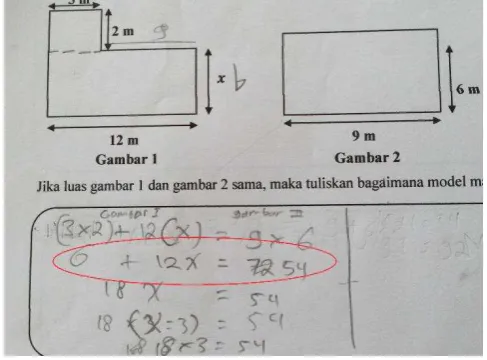
In the last of teaching experiment, researcher gave post-test to know the development of students’ strategies to solve the problems. The problems which were given is almost the same with the problems in the first activity. On of student’s answer can see in the figure 6 below.
Based on the Figure 6, it could see that the students’ strategies developed after passed the learning sequences before. The students could representing the problems related in algebraic expression using equal sign and variable.
From the result above, it show that the learning activity which be passed could support student’ understanding the concept of equal sign in linear equation with one variable. The hypothetical learning trajectory are appropriate with the actual learning trajectory. The use of equal sign which is clarified by van de Walle, et al. (2010) be accomplished in this research.
CONCUSION
According to the result, researcher conclude that the activity by comparing more strategies in calculate the area of rectangle could support students’ understanding the concept of equal sign through arithmetic to algebraic expression. Comparing the area could bridge the students’ thinking to use the equal sign as a balance.
ACKNOWLEDGMENT
A special acknowledgement must be given to DIKTI for master scholarship by the PMRI Program.
REFERENCES
Gravemeijer, K. (1994). Developing realistic mathematics education. Utrecht: Technipress, Culemborg.
Gravemeijer, K. & Cobb, P. (2006). Design research from a learning design perspective. In
Jan van den Akker, et al. Educational Design Research. London: Routledge.
Jupri, A., Drijvers, P., & van den Heuvel-Panhuizen, M. (2014). Difficulties in initial algebra learning in Indonesia, Mathematics Education Research Journal, 1-28. DOI: 10.1007/s13394-013-0097-0.
Krantz, S. G. (2006). An episodic history of mathematics. MAA Textbooks.
Knuth,E.J., Stephens, McNeil & Alibali. (2006). Does Understanding equal sign matter? evidence from solving equations. Journal for Research in Mathematics Education, .37 (4), 297 – 312.
Merzbach, U. C. & Boyer, C. B. (2011). A History of Mathematics. John Wiley & Sons, Inc. Hoboken. New Jersey.
Sembiring, R.K. (2010). Pendidikan matematika realistik indonesia (pmri): perkembangan dan tantangannya. Jurnal IndoMS. J.M.E, 1 (1), 11-16.
Treffers, A. (1987). Three dimensions. a model of goal and theory description in mathematics instruction – the wiskobas project. Dordect, the Netherlands: Reidel Publishing Company.
Van de Walle, J.A., Karp, K.S. & By-Williams, J.M. (2010). Elementary and middle school mathematics teaching development. Pearson Education, Inc. USA.