THE OCCURENCE OF ABBREVIATION
IN INDONESIA LAWAK KLUB (ILK)
TO OBTAIN HUMOR EFFECT
A THESIS
In Partial Fulfillment of the Requirements
for the Strata 1 Degree Majoring in English Department
Faculty of Humanities Diponegoro University
Submitted by: HARI SETYOWATI
13020111130069
FACULTY OF HUMANITIES
DIPONEGORO UNIVERSITY SEMARANG
ii
PRONOUNCEMENT
The writer truthfully confirms that in fact she arranged this thesis by herself without copying any results from other researches in other degrees of any university. The writer also confirms that she does not cite and quote any
material from other publications or someone‟s paper except from the
references mentioned.
Semarang, October 2016
iii
MOTTO AND DEDICATION
“Something worth to have will be worth to fight”
Ghoida
“Ever tried. Ever failed. No matter. Try again. Fail again. Fail better.”
Samuel Beckett
“Sebab sesungguhnya sesudah kesulitan itu ada kemudahan. Sesungguhnya sesudah
kesulitan ada kemudahan”
Q.S. Al-Insyirah: 5-6
This thesis is dedicated to
the writer’s family and
iv
APPROVAL
Approved by, Thesis Advisor
v
VALIDATION
Approved by
Strata I Thesis Examination Committee Faculty of Humanities Diponegoro University
In December 2016
Chair Person First Member
Drs. Catur Kepirianto, M. Hum. Ayu Ida Savitri, S.S., M. Hum.
NIP. 19650922 199203 1 002 NIP. 19790822 200801 2 013
Second Member Third Member
Dr. Nurhayati, M. Hum. Dwi Wulandari, S.S., M.A.
vi
ACKNOWLEDGMENT
Firstly, the writer would like to praise the almighty Allah SWT who
always gives strength, patience, blessing, and health so that the writer could
complete this thesis entitled, ‘The Occurence of Abbreviation In Indonesia
Lawak Klub (ILK) To Obtain Humor Effect’’.
Furthermore, the writer would like to express the deepest gratitude and
appreciation to Dra. Wiwiek Sundari, M. Hum., as the writer‟s thesis advisor. The biggest gratitude is for all of her time, patience, knowledge, correction,
advices, and support to the writer. She could not imagine having a better advisor
than her.
Her deepest thanks also go to:
1. Dr. Rediyanto M. Noor, M.Hum., the Dean of Faculty of Humanities,
Diponegoro University;
2. Dr. Agus Subiyanto, M.A., the Head of English Department, Diponegoro
University;
3. Dr. Ratna Asmarani, M.Ed., M.Hum., the writer‟s academic advisor;
4. All of English Department‟s lecturers of Faculty of Humanities of Diponegoro University, for their knowledge and dedication;
5. Her parents: Bapak Hariyanto and Ibu Jumini, for their love, praying,
vii by the writer, may Allah SWT give them blessing, health, long life, and every
best thing;
6. Her one and only sister, Annisa Suci Rahmawati, for her love and support
which are shown by her own way, may Allah SWT bless her anytime and
anywhere she does;
7. Her English teacher, Mr. Soenarno Pryanto, for his everlasting knowledge
that gave her the brightest enlightenment she could ever have, may Allah
SWT bless him as always;
8. Her uncle, Supardi, for the support, belief and encouragement, without him ,
she could not own a spirit to undergo the worst moment during her
undergraduate study and a vision to struggle to finish her thesis.
9. Her cousins, Mbak Endang and Mas Sigit, for their great knowledges,
advices, and endless supports, thank you for the inspiration of being smart
and knowledgeable teachers;
10.The members of Sixovoice: Gita, Lala, Chacha, Icha, Novia, Eva, Atika,
Rully, Wahyu, Mustika, Candra, Nisa, as her best companions for going
through any situations;
11. The GII squads: Wahyu, Dzika, Elmira, Hafshoh, Dito, and Ita, thanks for all
the prayers and support up to now;
12. The English Department friends, Faculty of Humanities, Diponegoro
University Semarang, thank you for the memorable happiness, funny, absurd
viii 13.Her another circle friends: Rinanda, Wahyu, Kun, Mar‟atu, Faris thank you
for every single time, attention and encouragement they made for her;
14.Her bestfriend, Noman Muhammad Malik, who is always be there and is
never giving up on encouraging and giving solutions for every single step the
writer takes, may Allah bless and guide him in every single decision he takes
in his life;
15.The Science Society STAN family branch Semarang: Suci, Cici, Najilla,
Linda, Hammam, Fadli for the help and the consideration to her dealing with
any situation occured; and
16.For those who cannot be mentioned one by one in taking part in helping the
writer to support and accomplish her thesis.
The writer realizes that this thesis is still far from perfect. The writer will
be glad to receive any constructive criticism and suggestion to make this thesis
better.
Finally, the writer expects that this thesis will be useful for the reader who
wants to learn morphology and pragmatics.
Semarang, October 2016
ix
TABLE OF CONTENTS
PRONOUNCEMENT ... ii
MOTTO AND DEDICATION ... iii
APPROVAL ... iv
VALIDATION ... v
ACKNOWLEDGMENT ... vii
TABLE OF CONTENTS ... ix
ABSTRACT ... xii
LIST OF TABLE ... xii
CHAPTER I INTRODUCTION ... 1
1.1 Background... 1
1.2 Research Question ... 3
1.3 Purpose ... 3
1.4 Previous Studies ... 3
1.5 Organization of Writing ... 5
CHAPTER II REVIEW OF LITERATURE ... 7
2.1. Morphemes ... 7
x
2.3. Humor ... 15
2.4. Implicature ... 16
CHAPTER III RESEARCH METHOD... 17
3.1 Research Design ... 17
3.2 Data Population, Samples, and Sampling Technique ... 17
3.3 Method of Collecting Data ... 18
3.4 Method of Analyzing Data ... 19
CHAPTER IV DATA ANALYSIS ... 21
4.1. Abbreviations ... 21
4.2. Conversation ... 24
CHAPTER V CONCLUSION ... 44
REFERENCES ... 46
xi
ABSTRACT
Language is the core part that we need to build a communication among people. For many cases, language is dynamic so that its users can manipulate it to give a certain meaning, such as, Indonesian. Many abbreviations occurred are used for different purposes, for instance, a slogan of cities, a trend among teenagers and a humor. Indonesia Lawak Klub (ILK), as a parody show of television, proves how language can be manipulated to obtain humor effect.
The theories used are Morphology from Yule and Kridalaksana in order to analyze the data through word formation and to find out pattern of abbreviation used in ILK. In addition, the writer also shows why abbreviations can obtain the humor effect in this show.
The writer conducts the research by using a descriptive qualitative approach and random sampling. The data were taken from seven episodes of ILK broadcasted in April 2014. The analyzed sample data are 13 abbreviations from 10 conversations accomplished by varies of word formation processes.
The result of the research is the fact that most of abbreviations happened during ILK are formed by multiple processes. They mostly go through by borrowing and contraction. Besides, the humor that the speakers uttered can be mostly gained by contradictive.
xii
LIST OF TABLE
Table 1. Morphological and Assosiation Process ... 12
Table 2. Abbreviation List ... 24
Table 3. Abbreviation List in order... 26
Table 4. Buntelan Kentut Association-Morphological Process... 31
1
CHAPTER I
INTRODUCTION
1.1Background
In our daily life, we are not often aware with the abbreviation occurred
around us. Many abbreviations are used as a slogan of city or regency, a
humor, and a trend among teenagers. They show us that language can be
manipulated to give a certain meaning based on the purpose of speaker.
There are some ways to create new words. Morphology, as one of the
linguistic branches, studies word formation process. For example, the society
of Kediri wants their regency becomes Bersinar Terang which stands for
Bersih, Menarik, Tertib, dan Aman. Instead of Bersinar Teran, people rather
choose Bersinar Terang as the words are easier to pronounce. In addition, the
words Bersinar Terang are easily-listened for the society since it has a
meaning as shining brightly.
Yet, in our society it cannot be separated with pragmatic aspect.
Pragmatics is another branch of liguistics that studies the meaning of words as
a communication and an expression tool. Abbreviation is one of the
communication way in our daily life and also occurs as humor tools. Society
2 example, the word sebel stands for senang betul, benci stands for benar-benar
cinta, and susuki stands for sungguh-sungguh laki-laki.
One of Indonesia television programs that show the using of
abbreviation as the attractiveness of the program is Indonesia Lawak Klub
(ILK). ILK, which is aired in Trans 7, is a parody TV show of Indonesia
Lawyer Club (ILC) aired in TV One.
ILC is hosted by Karni Ilyas. It discusses about the current issues
related to laws and criminal crimes happened in Indonesia. Its panelists are
Indonesian lawyers. The topic discussed in this show always becomes hot
debates among the lawyers and the related chiefs. In addition, its viewers can
get more knowledge and have critical thoughts about politics and laws from
the show.
In contrary, ILK is a parody of ILC that is currently being widely
popular among the society and discusses current hot issues happened in
Indonesia in a humorous way. The tagline, taken on April 21st, 2014 episode
is Indonesia Lawak Klub adalah satu-satunya acara diskusi di TV yang
menghadirkan perdebatan hangat namun memikat, setiap masalah dikupas
secara lengkap, mantap namun tidak bertanggung jawab (Indonesia Lawak
Klub is the only discussion show on TV that presents a hot debate but
attractive where every problem is completely discussed in a qualified but
3 At the beginning of each event, the host of ILK, Denny “Alyas” Candra, who gets his middle name Alyas in this show from Karni Ilyas‟ name, introduces some of the panelists that represent specific communities according
to the topic of discussion. The community names often make audiences laugh
because of the word formation. In addition, they are also associated with a
personal assessment of the panelists. Besides the abbreviation, the humor
which is represented in ILK is also resulted from the audience‟s stigma of panelists who spoke.These reasons make the writer interested in conducting
this research.
1.2Research Question
There are some problems related to the study of abbreviation used in
ILK
1. What is the pattern of abbreviation used in ILK?
2. What makes the abbreviation become a medium of humor?
1.3 Purpose
The purpose of this research is to answer the question problems are as
follows
1. To describe the pattern of abbreviation in ILK
2. To show the abbreviation in ILK becomes a medium of humor
1.4 Previous Studies
The writer uses some previous studies to make some references and to
4 The first study, written by Yestisia Krissanti Nugraheni in 2008,
entitled „The Study of Word Play (Pelesetan) In CAPEK (Catatan Pelesetan Kelik) Column‟. It is aimed at giving the description of word play through reference theory point of view, word formation rule and the motivation of
word play by using Odgen & Richard theory about the symbol of word
pointing, Lyon (1977:175) about references, and Yule (1996:17) about
expression references.The data were taken from CAPEK column on Suara
Merdeka Newspaper on every Sunday from March 15th until August 11th 2007. The conclusion that the writer draws are: 1. The study shows that the
word plays are made by deviating reference, namely Referring Expression
Deviation System and Referent Deviation System; 2. The witers finds out
eight word formation rules in this sresearch, they are: Acronym, Initialization,
Derivation, Compound Word, Clipping, Borrowing, Inflection, and Back
Formation; 3.There are three motivations of language, namely: Semantic
Motivation, Pronunciation Motivation and Morphology Motivation.
The second study, entitled „Singkatan dan Akronim Di Kalangan Remaja Di Kota Bandung’ written by Nani Astuti (2013) is done to describe
the pattern of abbreviation & acronym and to analyze the factors which
influence the teenagers in Bandung to use them to communicate through
facebook and twitter by using Morphology theory discussed by Putrayasa
5 abbreviation, 3 for acronym, and 1 for the combination both of them, and the
factors which influence to keep using this kind of word formation are because
there are such opinions that the teenagers feel more up to date if they use these
abbreviation and acronym words.
The last study, written by Andreza Widowati Putri in 2012, entitled
„Word Formation Analysis Towards Five Main Characters In “How I Met
Your Mother” (HIMYM) TV Series Season 1‟ is executed to know the particular words produced by five main characters, to know the surface
meaning and the word formation process of the particular words by using
Morphology theory from Katamba (1993), O‟Grady (1996) and Yule (2006). The conclusions she draws are: 1. There are only eight strategies used to
analyze 33 words found in HIMYM Season 1; 2. The existence of the
particular words found is determined by the invention of new words, the need
to name a new thing or idea, and the assertation to be said over and over
again.
Based on the studies above, there are none of them making a research
using abbreviations as a medium of humor. In this research, the writer
concerns to find out the abbreviation processes and the factors that make the
data can produce a humor effect.
1.5Organization of Writing
In order to present this thesis systematically, the writer presents it into
6
CHAPTER I INTRODUCTION
This chapter contains background of the study, research
question, purpose, previous studies and organization of
writing.
CHAPTER II REVIEW OF LITERATURE
It consist of theories related to this thesis. The theories
used are the word formation process to determine the
abbreviation and the relevance theory to analyze the
humor effect.
CHAPTER III RESEARCH METHOD
This chapter describes the type of research; data,
population, sample, and data source; and method of
analyzing data which are used in this thesis.
CHAPTER IV DATA ANALYSIS
This chapter discusses the explanation and analysis of
the data using the theories that have been conducted in
the previous chapter.
CHAPTER V CONCLUSION
The last chapter of this thesis gives the conclusion of
7
CHAPTER II
REVIEW OF LITERATURE
2.1.Morphemes
According to Yule (2006: 67-71), morphemes are the minimum unit
which has a meaning or grammatical function. There are two kinds of
morphemes: free morphemes and bound morphemes. In some cases, the free
morphemes which are attached together with the bound morphemes are also
known as stems.
2.1.1 Free Morphemes, are the words which have their own meaning. There
are two kinds of free morphemes:
a. Lexical morphemes
Lexical morphemes are the words that carry the content of the
messages we deliver. They are also known as an open word class
since they can be easily added by new morphemes.
Example : girl, man, house, tiger.
b. Functional morphemes
These types of free morphemes consist of conjunction, article,
preposition and pronouns. They are also known as a closed word
class since they can never be added by new morphemes.
8 2.1.2 Bound Morphemes
These morphemes are unable to form their own meanings
unless they are attached to other words. There are two kinds of bound
morphemes, namely:
a. Derivational. These morphemes can change the word class.
Example:
Care (Noun) + less => Careless (Adjective)
Good (Adjective) + ness => Goodness (Noun)
b. Inflectional. These morphemes indicate the grammar functions; past
tense, singular, plural, comparative, possessive; without changing
the word class.
Example:
Girl + -s => Girls
Work + -ed => Worked
Fast + -er => Faster
2.2. Word Formation
Delahunty (2010:136-137) explains that abbreviation is the process of
shortening word from existing ones and is usually informal. We often call it as
an acronym. It is a process of forming the words which derive from the first
letters or syllables in the sentence. For example, UNICEF is from United
9 complex words simply so that it can be easily remembered and understood.
On the other hand, blending consists of two or more words and eliminates the
majority to be combined to become a new word which its meaning has not
changed compared to the original word. For example, the word smog from
smoke and fog has a meaning as a combination both of them.
Furthermore, Kridalaksana (1989:159-163) states that abbreviation is a
shortening process by one or some parts of lexeme so that it becomes a new
form called a word. He also explains in his book titled Pembentukan Kata
Dalam Bahasa Indonesia that the shortening form of the word is not only
formed from the morphological process, but also the pragmatic fact that
ultimately determine the shorthand form of the word. The shortening form of
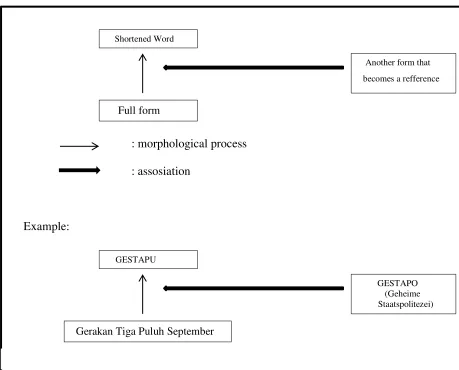
words usually has an assosiation to other words or phrases. A speaker tends to
use an abbreviation which is similar with others‟ sound or form so that it has a similar meaning, e.g. Wasalam (Wawasan Almamater), Patok (Empat
Oktober) and Benci (Benar-Benar Cinta). Kridalaksana also draws the graph
10 : morphological process
: assosiation
Example:
Table 1. Morphological and Assosiation Process
There are some types of abbreviation according to Kridalaksana (1989:
161-163):
1. Initialism is one of the shortened process results in the form of a letter or
combination of letters; both are spelled letter by letter, such as KKN
(Kuliah Kerja Nyata), and DKI (Daerah Khusus Ibukota),
2. Clipping is shortening processes that perpetuate the one part of the lexeme,
such as Prof. (Profesor), Bu(Ibu), Pak (Bapak) ,
Shortened Word
Full form
Another form that becomes a refference
Gerakan Tiga Puluh September
11 3. Acronym is the process of shortening that combines letters or syllables or
other part that is written and pronounced as a word, such as ABRI / abri/,
4. Contraction is a process of shortening lexeme which summarizes basis or
combination lexeme, such as berdikari from berdiri di atas kaki sendiri,
5. Symbol of letters is a shortening process that results one letter or more that
describe the basic concepts of quantity, unit or element, such as g (grams)
and cm (centimeters).
In addition, he explains that classifying the kinds of abbreviation in
bahasa Indonesia is quite difficult. Vries through Kridalaksana (1989:24)
states that there is no systematically form of abbreviation in bahasa Indonesia
and in these various abbreviational forms often happen overlapping to each
other. He indicates that acronym and contraction are the ones that mostly can
be overlapping . Generally, contraction has sub classification as follows
1. The perpetuation of the first syllable of each component
e.g. : Orba = Orde Baru
2. The perpetuation of the first syllable of the first component and the
perpetuation of whole word
e.g. : Banstir = banting stir
3. The perpetuation the last syllable of each component
e.g.: Gatrik = tenaga listrik
4. The perpetuation of the first syllable from first and second component and
12 e.g. : Gapani = Gabungan Pengusaha Apotik Nasional Indonesia
5. The perpetuation of the first syllable of each component and the
conjunction deletion
e.g. : Anpuda = Andalan Pusat dan Daerah
6. The perpetuation of the firs leatter of each component
e.g. : KONI = Komite Olahraga Nasional Indonesia
7. The perpetuation of the first letter of each pharse component and the
perpetuation of the first two letters of last component
e.g. : Aipda = Ajun Inspektur Polisi Dua
8. The perpetuation of the first two letters of each component
e.g. : Unud = Universitas Udayana
9. The perpetuation of the first three letters of each component
e.g. : Komrad = komunikasi radio
Yule (2006: 53-60) states that languange has sustained to change by
forming new words or new uses of old words in order to show its vitality and
creativeness according to the needs of its user. Furthermore, he explains the
word formation process in his book titled The Study of Language as follows:
1. Coinage
It is using the commercial product names to become general terms,
usually without capital letter. The examples are xerox, aspirin, nylon,
teflon. The most recent use of coinage is the term google and ebay. The
13 while ebay has a meaning to find something to buy or to sell through
internet. In addition, the using new words based on the name of certain
person or place is called eponyms, such as fahrenheit, watt, volt.
2. Borrowing
It is a word formation process by taking over other languages. Most of
languages in the world is influenced by one another. English language has
some borrowing terms such as croissant (French), yogurt (Turkish), sofa
(Arabic), and lilac (Persian).
3. Compounding
Compounding is formed by joining of two different words to produce
a new form. The examples are:
Book + case => bookcase (noun)
Low + paid => lowpaid (adjective)
4. Blending
It is the joining of two separate words to produce a single form by
taking the beginning of one word and joining it behind the other, such as:
Gasoline + alcohol => gasohol
Breakfast + lunch => brunch
5. Clipping
Reducing word to produce a word formation is getting noticeable
14 to become one syllable only. Commmon English clippings are ad which
stands for advertisement, bra is for brassiere and fan is for fanatic.
6. Backformation
It is another reduction process of word. It changes the class of word
(usually noun) to become another class of word (usually verb). The
examples are:
Television (noun) => televise (verb)
Worker (noun) => work (verb)
7. Conversion
A change in the function of word without reducing it, for example
from noun to verb. This word formation process is also known as
“functional shift” and “category change”. The common English nouns such
as bottle and chair can literally change into verb, as follows:
Chair => Somebody needs to chair the meeting.
Bottle => They bottled the honey-dew yesterday.
8. Acronyms
Acronyms consists of some initial letters of some words. It is usually
pronounced like a new single word, moreover, it becomes the term of daily
conversiation. Some common English acronyms are NASA, NATO, laser
15 9. Derivation
It is accomplished by adding affixes which are not separated as in
dictionary lists. They are: 1. Prefixes; affixes added in the beginning of the
word (in-, mis-, un-), 2. Suffixes; affixes added to the end of the word (-ish,
-less), 3. Infixes; affixes added in the middle of word and can easily be
found in other languages. Affixes are also known as bound morphemes.
10. Multiple Processes
Some words have to go through multiple processes. It is possible to
trace a word formation for more than one process to produce a certain
word. The example is the word snowballed in the sentence problems with
the project have snowballed. The word snowball (noun) is a compound
word for snow and ball and turn into a verb through conversion.
2.3. Humor
Apte in Hermintoyo (2011: 15) states that humor is the forms of
stimulation, either verbal or nonverbal potential which makes the hearers smile or
laugh. The forms of stimulation can be referred to an idea or a problem in such a
way that deliberately created by the speakers to create humor. Humor can be a
medium to convey information, express feelings, and deliver the creativity of the
speakers.
Fuad Hasan in Rahmanadji (2007:4) divides the humor in two major
16 perform degradation against a person; (2) humor is the act to vent feelings of
distress in a way that is light and can be understood, so that the tension is gone.
2.4. Implicature
According to Yule (1996: 40,45) implicatures are the way to
communicate more than is said. A listener should make a conclusion from the
utterances said by a speaker. In order to interpret implicatures, we should
assume some basics of the cooperative principles. There are two types of
implicatures, namely:
1. Conversational implicature
A speaker is intentionally to not obey the cooperative principles.
2. Conventional implicature
A speaker tends to use additional word in order to convey the meaning of
17
CHAPTER III
RESEARCH METHOD
According to Mukhtar (2013: 9), research method is a logical, sistematic and objective way to find the truth in science. It is conducted to
take proper steps to solve research problems. The writer elaborates the
research method into research design, population and sample, and method of
collecting and analyzing data.
3.1Research Design
Nasir in Mukhtar (2013: 40) explained that research design is the
entire processes needed in planning and conducting a research. The writer
conducts a linguistic research about morphology and pragmatics. Data are
taken from www.youtube.com. The writer uses a descriptive qualitative
approachment since this research describes the data systematically based on
the actual situations. Moreover, the data examined are words so that they
cannot be counted. She also analyzes the recording data and transcribes them.
In collecting data, the writer uses a non-participant observation technique. To
analyze the data, the writer uses distributional methods.
3.2Data Population, Samples, and Sampling Technique
The data source is taken from a parody show called Indonesia
18 research are abbreviations and the secondary ones are conversations where
abbreviation occured. Abbreviations happened when the host introduces
some panelists representing their communities at the beginning of the
show. The community names are in abbreviation forms to obtain humor
effect. The humor effect produced are attached to contexts happened at
that time. There are approximately six abbreviations produced in each
episode.
Population of data is 49 abbreviations taken from seven random
episodes of ILK broadcasted in April 2014. The samples of this study are
13 abbreviations as the main data and 10 conversations as the secondary
data. The abbreviations are accomplished by word formation processes,
for instance, acronym, contraction, eponym, borrowing, compounding,
derivation, and multiple processes. The sampling technique that the writer
used is a random sampling since each datum has the same potential trigger
in producing humor.
3.3Method of Collecting Data
In collecting data, the writer used observation method as
non-participant observation as the writer is an observer to the conversation
happened in ILK. The following steps are done to collect the data.
1. The writer downloaded all videos from www.youtube.com
19 3. The writer took a note and transcribed the conversation happened at
the beginning of the show.
3.4Method of Analyzing Data
In analyzing data, the writer uses a method, namely, Distributional
Method. It is a technique that divides the lingual unit data into several
parts or elements. Those parts are considered being able to make a direct
lingual unit. (Sudaryanto, 1993: 31)
In addition, Sudaryanto (1993: 15, 37) states the tool that
determines distributional method is language structural (lexeme, phoneme,
etc.). Then, he explains that the use of teknik lesap (deletion technique) is
by deleting certain elements of lingual unit and teknik sisip is by inserting
certain elements among the elements of existing lingual.
These are several steps to analyse the data.
a. The writer finds out the abbreviations
For example: Putih bersinar
b. The writer describes abbreviations stand from
For example: Pusat Pelatihan Sumber Kreasi Naluri Remaja
c. The writer explains where the abbreviations come from
For example:
Denny : Sekarang saya ke depan saya ada… Mana orangnya ya?
( Now, I will introduce you to a person who sits in front
of me… Where is he?)
20 dari Pusat Pelatihan Sumber Kreasi Naluri Remaja (If you know the shortening form, I bet you‟ll against me. I come from Pusat Pelatihan Sumber Kreasi Naluri Remaja)
d. The writer explains the context happened in the dialogue
For example:
Deny Candra, as the host of ILK, always introduces the panelists
in the beginning of the show. The panelists should introduce
themselves and the community he represents for. At that time, it is
Akbar turn to introduce himsself. To consider, Akbar has black skin
and he is often be bullied as Pangeran Kegelapan (Prince of
Darkness).
e. The writer takes note and transcribes the dialogue. Then, she chooses
and analyzes the abbreviations which made people laugh. Moreover,
she also conducts a research of the word component causing
abbreviation.
21
CHAPTER IV
DATA ANALYSIS
This chapter elaborates the analysis of the data samples collected as
explained in the former chapter. The whole samples are abbreviations found
from seven episodes of ILK broadcasted in April 2014. The writer conveys
two purposes in analyzing the data which are: (1) to show the pattern of
abbreviation formed in ILK and (2) to explain the abbreviations that become a
medium of conducting humor. The further analyses are described as follows.
4.1. Abbreviations
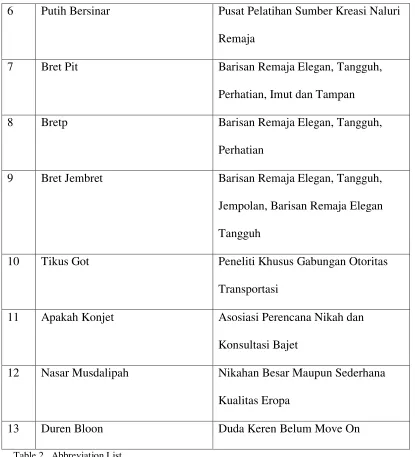
There are 13 abbreviation samples taken from seven episodes of ILK
broadcasted in April 2014, which are
No Abbreviations Stands For
1 Pitakan Keles Peneliti Taman Ilmiah Kanak-kanak
Tapi Kelakuan Eksekutif Muda
2 Butek Badan Urusan Keterlambatan Kerja
3 Buntelan Kentut Ibu Muda Teladan Keren dan Imut
4 Pesimis Pengamat Sinema dan Musik yang
Selalu Optimis
5 Kolor Ijo Kelompok Orang-orang yang Ingin
22
6 Putih Bersinar Pusat Pelatihan Sumber Kreasi Naluri
Remaja
7 Bret Pit Barisan Remaja Elegan, Tangguh,
Perhatian, Imut dan Tampan
8 Bretp Barisan Remaja Elegan, Tangguh,
Perhatian
9 Bret Jembret Barisan Remaja Elegan, Tangguh,
Jempolan, Barisan Remaja Elegan
Tangguh
10 Tikus Got Peneliti Khusus Gabungan Otoritas
Transportasi
11 Apakah Konjet Asosiasi Perencana Nikah dan
Konsultasi Bajet
12 Nasar Musdalipah Nikahan Besar Maupun Sederhana
Kualitas Eropa
13 Duren Bloon Duda Keren Belum Move On
Table 2. Abbreviation List
According to the abbreviation list above, there are some patterns of
abbreviations we can easily notice where it stands from while the rest cannot.
23
No Abbreviation Stands For
1 Bret Pit Barisan Remaja Elegan, Tangguh,
Perhatian, Imut dan Tampan
2 Bretp Barisan Remaja Elegan, Tangguh,
Perhatian
3 Bret Jembret Barisan Remaja Elegan, Tangguh,
Jempolan, Barisan Remaja Elegan
Tangguh
4 Butek Badan Urusan Keterlambatan Kerja
5 Duren Bloon Duda KerenBelum Move On
6 Putih Bersinar Pusat Pelatihan Sumber Kreasi
Naluri Remaja
7 Tikus Got Peneliti Khusus Gabungan Otoritas
Transportasi
8 Apakah Konjet Asosiasi Perencana Nikah dan
Konsultasi Bajet
9 Pitakan Keles Peneliti Taman Ilmiah Kanak-kanak
Tapi Kelakuan Eksekutif Muda
10 Pesimis Pengamat Sinema dan Musik yang
Selalu Optimis
24 Kualitas Eropa
12 Kolor Ijo Kelompok Orang-orang yang Ingin
Jualan Online
13 Buntelan Kentut Ibu Muda Teladan Keren dan Imut Table 3. Abbreviation List in order
4.2. Conversation
There are some triggers that the abbreviations can produce humor as can be seen below.
(7.3.) Denny : Sebelah kiri saya ada Cak Lontong.
(It‟s Cak Lontong in my left side) Cak Lontong : Yak, selamat malam. Salam lemper.
(Yes, good evening. Salam lemper.)
Denny : Salam lemper. Cak Lontong ini dari mana, Cak Lontong? (Salam lemper. Cak Lontong where are you from, Cak Lontong?)
Cak Lontong : Bicara masalah taman saya selaku peneliti. (Talking about the park, I am as a researcher) Denny : Peneliti, Anda ya?
(A researcher, right?)
Cak Lontong : Peneliti taman ilmiah kanak-kanak tapi kelakuan eksekutif muda.
(A scientific kindergarten researcher but young executive behaviour)
Denny : Wah, hebat ya! Meneliti taman kanak-kanak tapi kelakuannya eksekutif muda? Yang disebut?
(Wow, great huh! Researching about kindergarten but behaving like a young executive? Which is called as?) Cak Lontong : Pitakan Keles
Denny : Pitakannya enak, kelesnya itu kurang ya. (Pitakan is good, but keles is a little bit off)
Cak Lontong : No problem. Ini saya punya data... Ini yang datang di sini semua dari Jakarta ya?
(No problem. I have the data... The ones who are coming here are all from Jakarta, right?)
25 The preceding conversation was taken from ILK broadcasted on 4
April 2014. The discussion topic was Taman Hilang, Mall Berkembang (The
Fall of Open Area, The Rise of Mall). During opening of the show, Denny
introduced each panelist and asked about the background and the role they
represented. Cak Lontong had been becoming a researcher who always
conducted a survey related to the discussion topic in several episodes. He
delivered his research in his unique way. Most of the time, his research had
some twist endings that the audiences had never expected before. As a
researcher, he had a serious behaviour as well as when he answered Deni‟s
question about the community he represented for. The audiences had different
expectations of him compared to other panelists as he might be more serious.
Yet, it was undeniable when he mentioned the shortening name of the
community which made the audiences laugh.
Furthermore, the words pitakan keles are formed by the perpetuation
of the first and sixth letter of the first component, the first syllable of the
second component, the first three letters of the fourth and sixth component,
and the first and third letter of the seventh component and the deletion of the
third, fifth and eighth component. Therefore, according to the official website
of Kamus Besar Bahasa Indonesia, http://kbbi.web.id/, pitak has a meaning
as a scar or a boil scar on head or forehead. It is composed by a bound
morpheme named inflectional which has an additional suffix that does not
26 pitak (noun) + -an => pitakan (noun)
Meanwhile, keles is a slang word from kali, a clipping of the word barangkali
which means presumably.
(1.1) Denny : Di sebelah kanan saya ada Teuku Wisnu. Apabila pemirsa atau yang hadir di sini agak kaget dengan wajah Teuku Wisnu, ini mungkin karena belum makan orok ya? Silakan.
(In my right side there is Teuku Wisnu. If there‟s an audience who is pretty surprised with his face, maybe it‟s because he hasn‟t eaten an infant yet, has he? Please.)
Budi Anduk: Saya dari Badan Urusan Keterlambatan Kerja (I am from The Department of Late Working Affairs) Denny : Wah bagus sekali tuh
(Wow it is so nice) Budi Anduk: Disingkat butek.
(It is abbreviated as butek)
The preceding conversation was from ILK broadcasted on 14 April
2014. Budi was a guest panelist at ILK discussed about telatan atau teladan in
the episode. At first, Deny introduced him as Teuku Wisnu. Based on
audience shared knowledge, they had to be aware that Teuku Wisnu was an
actor who had such a good-looking appearance. He was also a singer and an
idol. Then, Denny added his utterance by saying “Apabila pemirsa atau yang
hadir di sini agak kaget dengan wajah Teuku Wisnu, ini mungkin karena
belum makan orok ya?”("If the audiences whom are at home or present here
are wondering by Teuku Wisnu face, this may be because he has not eaten an
infant yet, has he?"). It might imply that:
1. He was a cannibal
27 Yet, he was not a cannibal by the fact that he did not eat humans. For
instantly, the first notion was invalid and it left the only remaining possibly
implication; he was not good-looking. Furthermore, he introduced himself
from Badan Urusan Keterlambatan Kerja which indicated such a credible
institution. Yet, its shortening form was butek (turbid). The use of the word
butek in Indonesian language is oftenly to explain things which are dirty and
not clean, such as water. Once it is butek, then, it is not suitable to consume as
it might contain any harmful substances. The abbreviation above led the
audiences to think and to correlate what the speaker intended to say. Their
encyclopaedic memory could easily relate it to Budi Anduk‟s appearance that he was not good-looking. Therefore, the humorous effect came from implied
meaning.
Meanwhile, the word butek originally comes from Sundanese and
Javanese language. Its word formation process belongs to borrowing which is
taking over other languages. The morphological pattern was from the
perpetuation of the first letter of the first, second and fourth components and
the middle two letters of the third component. So that it makes a new word as
butek which stands for Badan Urusan Keterlambatan Kerja.
In the same episode also showed as follow
(1.5) Denny : Dan yang di paling belakang ada Chika Jessica (And in the very back, there is Chika Jessica)
Chika : Annyeonghasseyo. Kumaha damang?Pangestu. Ieu tingali nu goreng patut tea. (Halo. Bagaimana kabarnya? Baik. Lihat nih yang jelek rupanya.)
28 (I am from The Young, Cool and Cute Moms) Denny : Ibu muda keren dan imut?
(The Young, Cool and Cute Moms? )
Chika : Ibu Muda Teladan Keren dan Imut
(The Young, Good Model, Cool and Cute Moms) Denny : Oh.. Disingkat jadi apa?
(Oh.. What is the abbreviation?) Chika : Buntelan kentut
Denny : Cocok... Cocok.. Cocok..dengan omongan kamu itu cocok. Oke, Chika Jessica!
(It fits... fits... fits...well to your talk. Okay, Chika Jessica!) The conversation above showed that Chika was introduced by Denny as a
beautiful woman. She represented herself as a cool and cute mother. It
violated the maxim of relevance when she said buntelan kentut as the
shortening form of her institution. The audiences‟ stigma must be aware that such a beautiful, cool and cute mother would have a beautiful name of the
institution she represented for. In contrary, she said buntelan kentut instead of
other decent names that might represent her thoroughly.
The morphological pattern of buntelan kentut came from the perpetuation of
the last two letters of the first and sixth component, the first letter of the
second component, the first four letters and the last letter of the third
component, the first two letters of the fourth component and the last letter of
the fifth component. The entire perpetuation makes a new form as bumtelan
29 familiar with the existence word. Thus, instead of bumtelan kentut, the
speaker tended to say buntelan kentut since it was easier to utter and to
memorize. The word formation process can be seen as follow
Table 4. Buntelan Kentut Association-Morphological Process
The word buntelan is a borrowing word from Javanese language which
is buntel (wrap). It has also an additionional suffix which does not change the
class word. It can be seen as follow
Buntel (noun) + -an => buntelan (noun)
(2.7) Denny : Dan di belakangnya Boris, ada Mc Danny! (And behind Boris, there is McDanny!)
McDanny : Selamat malam, Pak! (Good evening, Sir!) Denny : Iya, selamat malam.
(Yes, good evening.)
McDanny : Kebetulan saya seorang pengamat sinema dan musik yang selalu optimis. Disingkat pesimis.
(Coincidentally, I am a cinematic and music observer who is always optimistic. It is abbreviated as pesimis)
Denny : Loh gimana sih kamu. Kamu ini kan orangnya optimis, singkatannya juga harus optimis. Jangan pesimis!
(How can it happen? You are an optimistic person, the abbreviation should be optimistic too. Not the pessimistic one!) BUMTELAN KENUT
Ibu Muda Teladan Keren dan Imut
BUNTELAN KENTUT
Morphological
30 McDanny : Tapi saya punya mottonya, Pak. Pesimis punya motto.
PESIMIS, Optimislah! Gitu, Pak.
(But I have my own motto, Sir. Pesimis has a motto. PESIMIS, be optimist! That is it, Sir.)
Denny : Kok ga enak ya. Okelah, McDanny! (It does not sound good. Okay, McDanny!)
The conversation above was taken from ILK broadcasted on 16 April
2014. The topic discussion was pembajakan hak cipta (copyright piracy).
McDanny introduced himself that he represented an institution namely
pengamat sinema dan musik yang selalu optimis. The optimistic community
changed into pessimistic when it was abbreviated. In the listeners‟ mind, it was contradictory with their common sense that pessimist was the opposite
word of optimist. The explicit content was conveyed by the speaker which
had two different enrichments and made the hearers laughed.
The word pesimis was formed by perpetuation of the first syllable of
the first component, the first letter of the second component, the middle letter
of the fourth component, the last syllable of the seventh component, the
deletion of the third, fifth and sixth component from pengamat sinema dan
musik yang selalu optimis . It was going through contraction as mentioned
former and borrowing process of English language PESSIMIST.
(3.5) Denny : Dari mana, Budi Anduk? Dari tadi
(Where are you, Budi Anduk? From earlier)
Budi Anduk : Iya, ya..Saya dari kelompok orang-orang yang ingin jualan
online, Pak. Disingkat kolor ijo.
(Yes. I am from the community for those who want to sell online, Sir. It is abbreviated as kolor ijo)
31 Budi Anduk : Artinya saya orang yang berjualan, Pak, berbisnis.
Inter-preneur.
(It means I am a person who sells, Sir. Doing business. Inter-preneur.)
Denny : Hah apa? Inter-preneur?Intermilan? (Huh? What? Inter-preneur? Intermilan?) Budi Anduk : Baik, saya perbaiki, Pak. Wirausahawan.
(Okay, I correct it, Sir. Enterpreneur.) Denny : Ya, betul.
(Yes, that is right)
Budi Anduk : Artinya, ke sini saya ikut ada konvensional, online saya juga ikut. Terakhir saya bisnis kulit, Pak. Bahan-bahan tas atau apa saja dari kulit. Khusus.
(It means that I have the conventional (shop) and also the online one. The last business I had is a leather one, Sir. The materials used for bags or anything are from leather. Special.) Denny : Kulit apa?
orang-orang yang ingin jualan online. The shortening form was kolor ijo. An
article from http://republikpos.com/2016/01/asal-mula-kolor-ijo explains that
the origin of the kolor ijo was unclear. He was allegedly as stealth that his
shape and form could not be described. The first phenomenon of kolor ijo was
sticking out of the rape cases that occurred in Bekasi, West Java in 2003.
According to witnesses and victims, he brought a machete and only wore a
piece of green drawstring at the time of committing criminal acts. Thus, the
32 According to this knowledge, people could assume that kolor ijo
which Budi Anduk mentioned was not a criminal but an entrepreneur which
represented a group of people who wanted to sell things through online. The
contradictory assumptions became triggers which led into a humor
production.
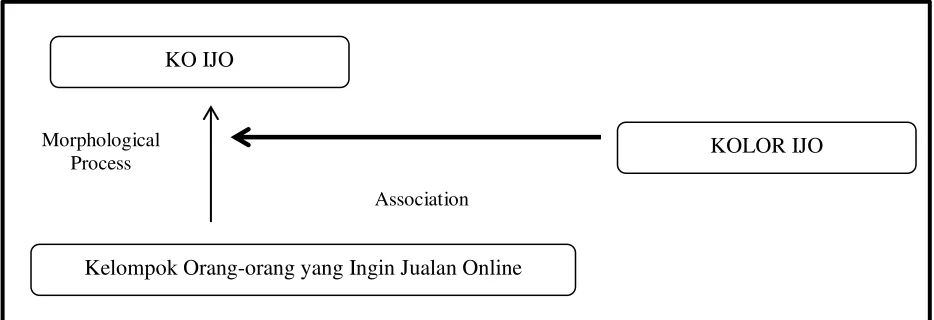
Moreover, the abbreviation was formed by the perpetuation of the first
letter of the first, second, fourth, fifth and sixth components. The entire
components make new words which is ko ijo as can be seen below
Table 5. Kolor Ijo Association-Morphological Process
The diagram above shows that its morphological process of kolor ijo
isaccomplished by adding affixes –lor in kolor. This process is called derivation. Moreover, kolor ijo is obtained by borrowing some Javanese
words. Kolor means a kind of shorts and ijo means green. Literally, kolor ijo
has a meaning as a green colored shorts, but, in reality kolor ijo is referred to a
undefined creature which haunted the citizens (especially women) to feel Kelompok Orang-orang yang Ingin Jualan Online
KOLOR IJO
Morphological Process
Association
33 insecure. In addition, kolor ijo is also obtained by compunding as can be seen
as follow
Kolor (noun) + ijo (adverb) => kolor ijo (noun)
Hence, in order to make kolor ijo as an abbreviation, it must go
through some multiple processes which are derivation, borrowing and
compounding.
Akbar : Kalau Bapak tahu singkatannya pasti protes. Saya dari Pusat Pelatihan Sumber KreasiNaluri Remaja
(If you know the abbreviation form, you must protest. I am from The Training Center of Creation Source of Teenager Instinct)
Denny : Yang disingkat menjadi? (And the abbreviation is?)
housewife) to commemorate Kartini‟s day. When it came to Akbar‟s turn, Deny
joked around and asked where the next panelist was as he could not see him
well. From the start, Akbar had warned Deny if he would not believe what he
34 Remaja community. It had no audiences‟ stigma from the community name as it sounded normal to them. The twist revealed when Deny asked the acronym of
the community name. The moment Akbar replied putih bersinar (shining white)
as the acronym of the community name, the audiences bursted into laughter.
The acronym might represent humor because at the moment Akbar
shouted the acronym, it really hurt the audiences‟ stigma of him. It was not true if Akbar had white skin, but he was confident to say putih bersinar. It was
explicitely showing that the acronym he represented for did not suit him well
regarding thathe had dark skin and always be bullied with the nickname of
Pangeran Kegelapan (The Prince of Darkness) by other panelists .
The data above also shows that the shortening pattern from Pusat Pelatihan
Sumber Kreasi Naluri Remaja is formed by perpetuation of the first syllable
from the first and fifth component, the middle three letters from the second
component, the last syllable from the third and fourth component, and the first
letter from the sixth component. So that, those entire components become a
new word as putih bersinar. Furthermore, the morphological process was
contraction as it summarized the basis or combination lexemes as shown above.
Another abbreviation in the same episode of ILK also showed as below:
(5.4.) Akbar : Saya dari Barisan Remaja Elegan, Tangguh, Perhatian Imut dan Tampan
(I am from The Row of Elegant, Tough, Caring, Cute, and Charming Youth)
35 Akbar : Barisan Remaja Elegan, Tangguh, Perhatian Imut dan
Tampan
(The Row of Elegant, Tough, Caring, Cute, and Charming Youth)
Denny : Ini imut dan tampannya agak mengganggu ya sebenarnya (The words cute and charmin g are bothersome actually) Akbar : Lihat singkatannya dulu dong, Pak.
(Listen to its abbreviation first, Sir) Denny : Apa singkatannya?
(What is the abbreviation?)
Akbar :Bret pit. Tapi kan nggak enak kalo misalkan imut dan tampannya diilangin nih ya Pak, jadi cuma Barisan Remaja Elegan, Tangguh, Perhatian. Disingkat bretp.
(Bret pit. But it sounds strange if the cute and charming parts are gone, Sir, so it is just The Row of Elegant, Tough, Caring Youth. It is abbreviated as Bretp)
Denny : Hahaha ya nggak papa (Hahaha it is okay) Akbar : Nggak enak kan?
(Sounds strange, right?)
Denny : Dari pada fitnah menurut saya (Better than tell a lie, in my opinion) Akbar : Tapi sudah saya bikinin yang baru, Pak.
Denny : Hahaha. Lu cuman ngulang doang! Haaa..Nggak enak. Oke, Akbar!
(Hahaha. You are just repeating it! Haa.. It sounds strange. Okay, Akbar!)
The conversation above was taken on 22 April 2014 which discussed
about the secure public transportation in Indonesia. This topic was arisen due
to many criminalization acts toward the passengers who use public
36 Remaja Elegan Tangguh Perhatian Imut dan Tampan. Denny denied the
words imut and tampan by saying that those words were kind of disturbing
and did not match to Akbar appearance. Then, Akbar said to him that he
should continue listening to the acronym. After knowing it was Bret Pit,
Denny suggested him to remove the initial form of imut and tampan which
were /i/ and /p/. Akbar said that it was impossible since it would disturb the
whole word composition. Then he made a new acronym which was
bretjembret by removing the words imut and tampan and it made it sounded
silly. It explicitely exlplained that the word imut and tampan were not suit
Akbar well. Moreover, the acronym form produced the repetition of word
pronunciation which sounded funny and triggered the laughter of audiences.
As we know, William Bradley Pitt, also known as Brad Pitt is a
famous Hollywood actor and producer. He starred in many blockbuster
movies such as The Curious Case of Benjamin Button and Fury. Both Brad
Pitt and Bret Pit have same pronunciation for Indonesian. The audiences must
have shared knowledge if they want to understand this joke. The expectations
of Brad Pitt, who is a handsome and good-looking Hollywood actor, toward
Bret Pit, who was represented by Akbar, bring the disperancy which make us
laugh.
Furthermore, the morphological patterns of Bret Pit (Barisan Remaja
Elegan Tangguh Perhatian Imut dan Tampan), Bretp (Barisan Remaja
37
Tangguh Jempolan Barisan Remaja Elegan Tangguh) were formed by the
perpetuation of the first letter of the entire component which can be classified
as an acronym. Another word formation process occured in Bret Pit was
eponym as it took from the name of a certain person named Brad Pitt. Both of
them had similar pronunciation. BRET PIT was pronounced as /‟bret pit/ while
BRAD PITT was pronounced as /brᵆd „pi:t/. Moreover, the lexeme ELEGAN from
Barisan Remaja Elegan Tangguh Perhatian Imut dan Tampan and such
derivative extensions was accomplished by taking from English ELEGANT. It
was called a borrowing process by taking over other language. Thus, the word
formation processes were obtained by going through multiple processes, such
as acronym, eponym and borrowing.
Another abbreviation in the same episode of ILK also showed as
follow:
(5.5.) Cak Lontong : Ya, saya Cak Lontong. Salam Lemper! Ini baru perkenalan aja saya lihat mengada-ada ya katanya.Kan untuk pencitraan, mengundang simpati. Akbar, Bretpit. Dari mana? Iya kan? (Yes, I am Cak Lontong. Salam Lemper! It is still an introduction but I notice you are all making things up. You said it was for imaging and asking for sympathy. Akbar, Bretpit. Where is it from? Right?)
Denny : Iya
(Yes)
Cak Lontong : Rico tadi apa? (What was Rico?) Rico : ...
Cak Lontong : Udah udah nggak usah disebutin. Yang realistis dong. (No need to mention. Just be realistic.)
38 Cak Lontong : Lain kali kalo mewakili sesuatu itu yang realistis. Saya ini kan peneliti. Saya mewakili Peneliti Khusus Gabungan
Otoritas Transportasi.
(Next time when you represent something, just be realistic. I am a researcher. I represent Special Researcher of Joint Transportation Authority)
Denny : Nah, ini bener nih. Serius. Disingkat apa?
(Yes, this is good. Serious. What is the abbreviation) Cak Lontong : Tikus got
Denny : Sama aja. Lu sama aja! Lu udah bener ini penelitiannya, taunya cuma tikus got. Oke, Cak Lontong!
(It is same. You are just the same! Your research is already good, but it is only tikus got. Okay, Cak Lontong!)
The conversation above Cak Lontong said that an introduction should
be realistic for not only gained sympathy but also performed an image.
Denny, as well as the audiences had an expectation that Cak Lontong would
give the reliable acronym of his community he represented for. By saying
Peneliti Khusus Gabungan Otoritas Transportasi, he gave the listeners a bait
and they assumed that it would be different than others, but instead, he made a
twist by mentioning tikus got as its abbreviation form. The difference
assumptions both from the speakers as well as the listeners built a joke which
made them laughed.
Tikus got was formed by the perpetuation of the last syllable of the
first component, the first letter and the last two letters of the second
component and the first letter of the third, fourth and fifth component of
Peneliti Khusus Gabungan Otoritas Transportasi. Its word formation was
39 also accomplised by accomplishing two different words to produce a new
form which was called compounding.
Tikus (noun) + got (noun) => Tikus got (noun)
It literally showed a kind of mouse lived in gutter. Yet, it was to show
the community name of the speaker represented for instead. Furthermore, GOT
was a borrowing word from Javanese language. It has a meaning as gutter.
Thus, tikus got had to go through multiple processes, for instance; contraction,
compounding and borrowing in order to produce a new word.
(6.1.) Ronal : Betul. Iya, jadi perkenalkan.Saya ini dokter Boyler.Saya ini adalah konsultan pernikahan dan kebetulan saya ini adalah dewan pembina sekaligus ketua dari Asosiasi Perencana Nikah dan Konsultan Bajet (Budget).
(Okay. Let me introduce my self. I am dr. Boyler. I am a marriage consultant and recently I am a supervisor board and a leader of Marriage Planner and Budget Consultant kehidupan pernikahan kan nggak pernah selesai, kan?
(Because it feels pleasant and seems will not finish as well as the marriage life mystery which is never end, right?)
Denny : Iya, betul betul (Yes, correct, correct)
Ronal : Dan kebetulan aku bikin buku, Kang Denny. Jadi ini buat yang mau nikah, boleh beli buku saya.
(And by the way, I wrote a book, Mr. Denny. This book is for people who want to marry. Those may purchase my book) Denny : Bukunya tentang apa itu?
40 Ronal : Tentang pernikahan, tentunya.Jadi ini buku memang bagus sekali buat yang mau merencakan pernikahan. Ada yang mau menikah di sini?
(It is about marriage life, of course. So it is recommended for those who are willing to plan a marriage. Is there anyone who wants to marry here right now?)
Cici Panda : Ada. Fitrop... Fitrop... Fitrop.. Belakangnya Bapak. Tuh, tuh, tuh, dia... Extravagant or An Ordinary Marriage. It is also called as Nasar Musadalipah.)
Denny : Jadi pengen beli ihh. (I really want to get one)
The conversation above was broadcasted on 29 April 2014. The
discussion topic was nikah mewah vs nikah sederhana (luxury vs modesty
marriage). Ronal had a role as dr. Boyler, the fake version of dr. Boyke. He is
a famous sexologist and doctor in varying TV shows that discusses sexuality
41 idea the meaning of konjet , it could be achieved by drawing an assumption by
the utterances in line (9). It might imply and have correlation to the
sexological term.
Even more, Ronal wrote a book about marriage. From the title we
knew that it did not matter how much money you had as long as if you wanted
to have such a Europe quality wedding, you had to read this book which
called as Nasar Musdalipah. The word Nasar Musdalipah was taken from
Nassar and Muzdalifah who were known as a celebrity couple. Nassar was a
dangdut singer from a talented TV program show called KDI (Kontes
Dangdut Indonesia) while Muzdalifah was a widow and a successful business
woman. The audience might know that this couple had a very luxurious
ceremony on their wedding day which made them as a phenomenal couple.
The similar name between the fake and the real ones made the listeners had to
recall their encyclopaedic knowledge. When they succeed, they would be able
to understand what Ronal meant to say and laugh.
The morphological process of apakah konjet was contraction as its
pattern was from the perpetuation of the first letter of the first and second
components, the last syllable of the third and sixth components, the first
syllable of the fifth component and the deletion of conjunction. Along with
contraction, it contained a borrowing word of English language namely
42
pronounced as /‟bᶺdᶾᶦt/ has a similar pronounciation to BAJET which is pronounced as /bᶺdᶾᶦt/ in bahasa Indonesia.
On the other hand, Nasar Musdalipah was accomplished through
contraction which came from the perpetuation of the first and fourth letter of
the first component; the middle two letters of the second component; the first
and third letter of the third component; the first, third, seventh letter of the
fourth component; the third syllable of the fifth and sixth component. Its word
formation process also belonged to eponym as it represented the names of
certain persons to derive some new words.
(6.7.) Rico : Pak, saya belum dikenalin, Pak. Daritadi, Pak.
(Sir, I haven‟t been introduced yet, Sir. Since long time ago,
Sir)
Denny : Ya ya ya ya ya. Siapa namanya, Dek? (Yes yes yes yes. Who is your name?)
Masayu :Kasihan banget. Kasihan banget. Coba. Kasih. Kasih. Kasih. Kasih.
(Is there no smaller chair, Sir? My legs hurt, Sir. Hanging. Sir. I am from Cool Widowers Who Have Not Moved On Yet, Sir.) Denny : Oh... Bagus, ngaku. Disingkat apa tuh?
(Oh... Nice, you admit. What is the abbreviation?) Rico : Duren bloon, Pak.
(Duren bloon, Sir)
43 Rico was a widower. He represented duda keren belum move on. Its
abbreviation name was duren bloon. Bloon is a slang word of stupid or idiot.
It was such a contradictory as he said that he was a cool widower but he was
stupid. These two opposite words implied different meaning and produced
humor.
In addition, the abbreviation pattern duren bloon was from the
perpetuation of the first syllable of the first component, the last syllable of the
second component, the first and third letter of the third component, the second
letter of the fourth component and the whole word of the fifth component. The
abbreviation was accomplished by putting some lexemes of duda kerenbelum
move on to make a new form of duren bloon. This process is called
contraction. In addition, this abbreviation contained a borrowing phrase of
English language namely move on. As stated in Oxford Advanced Learner‟s
Dictionary, MOVE means a change of place or position while MOVE ON means
hurry up. In this context, MOVE ON has a meaning as to change place from a
certain person‟s heart to other(s) since both parties (or more) might have a
44
CHAPTER V
CONCLUSION
According to the analysis the writer had been conducted on chapter
IV, the writer could draw some conclusions based on the former analysis as
follow:
1. Most of the new word formation processes of abbreviation happened in
Indonesia Lawak Klub (ILK) were formed by multiple processes (more than
one process), mostly went through by borrowing and contraction. The
patterns of abbreviation used in ILK could not be distinguished as they had
no exact formulas to perform and analyse the words. Considering Indonesia
has hundreds kinds of languages in use, no wonder bahasa Indonesia is so
dynamic in performing and producing such new words by borrowing some
words of other languages. Moreover, in accomplishing some new words, the
writer found contraction as the common process of the occuring of
abbreviations. The contraction process was often overlapping to acronym
due to some reasons, for instance, both were accomplished by shortening
the syllable of words and reading it as a new word. Hereby, the writer
reinforced as Vries through Kridalaksana (1989: 24) states that there is no
systematically form of abbreviation in bahasa Indonesia and in these