GLUCOSE OXIDASE IMMOBILIZATION ON TMAH-MODIFIED BENTONITE
Ruth Chrisnasari
1,*, Zerlina Gabriela Wuisan
1, Arief Budhyantoro
2, and Restu Kartiko Widi
2 1Department of Biology, Faculty of Biotechnology, University of Surabaya, FG Building 2ndfloor, Jl. Raya Kalirungkut Surabaya 60293, Indonesia
2
Department of Chemical Engineering, Faculty of Engineering, University of Surabaya, TG Building 6thfloor, Jl. Raya Kalirungkut Surabaya 60293, Indonesia
Received July 24, 2014; Accepted September 24, 2014
ABSTRACT
The influence of bentonite modification by tetramethyl ammonium hydroxide (TMAH) on its capability to immobilize glucose oxidase (GOX) was studied. Modification of bentonite was conducted by the adding of 0-5% (v/v) TMAH. The observed results show that the different concentrations of TMAH affect the percentage of immobilized enzyme. The results of this study show that the best concentration of TMAH is 5% (v/v) which can immobilize up to 84.71% of GOX. X-ray diffraction (XRD) and Fourier Transforms Infrared Spectroscopy (FTIR) studies have been carried out to observe the structural changes in bentonite due to TMAH modification. The obtained immobilized GOX show the optimum catalytic activity on reaction temperature of 40-50 °C and pH of 7. The immobilized GOX kinetics at the optimum conditions determined the Km and Vmax value to be 4.96x10
-2
mM and 4.99x10⁻³ mM.min-1 respectively. In addition, the immobilized GOX on TMAH-modified bentonite is stable enough so it could be re-used six times before its activity decreased by 39.44%.
Keywords:Tetramethyl Ammonium Hydroxide (TMAH); bentonite; immobilization; glucose oxidase
ABSTRAK
Pengaruh modifikasi bentonit oleh tetrametil ammonium hidroksida (TMAH) pada kemampuannya untuk mengimobilisasi glukosa oksidase (GOX) telah dipelajari. Modifikasi bentonit dilakukan dengan penambahan 0-5% (v/v) TMAH. Hasil penelitian menunjukkan bahwa konsentrasi TMAH yang berbeda berpengaruh pada presentase jumlah enzim terimobil. Konsentrasi TMAH terbaik adalah 5% (v/v) yang dapat mengimobilisasi 84,71% GOX. Studi difraksi sinar X (XRD) dan Fourier Transforms Infrared Spectroscopy (FTIR) telah dilakukan untuk mengamati perubahan struktur bentonit termodifikasi TMAH. GOX terimobilisasi menunjukkan aktivitas katalitik yang optimum pada suhu 40-50 °C dan pH 7. Enzim GOX terimobilisasi pada kondisi optimum menunjukkan nilai Km dan Vmax masing-masing sebesar 4,96x10⁻² mM dan 4,99x10⁻³ mM.min-1. Selain itu, GOX terimobilisasi pada bentonit termodifikasi TMAH cukup stabil sehingga dapat digunakan berulang sebanyak 6 kali sebelum aktivitasnya turun menjadi 39,44%.
Kata Kunci:Tetrametil Ammonium Hidroksida (TMAH); bentonit; immobilisasi; glukosa oksidase
INTRODUCTION
Bentonite is one of montmorillonite component that is composed of octahedral aluminium hydroxyl sheet sandwiched between two layers of silicon-oxygen tetrahedral [1]. However, the aluminium atoms are partially replaced by the substitution of either magnesium or iron atoms, thereby creating a charge deficiency within the unit structure. This results in a net negative charge at the clay-mineral surface which is balanced by absorption of (exchangeable) cations between adjacent platelets [2-3]. In natural montmorillonites these cations are usually calcium, sodium or magnesium according to the weathering agent associated with the formation of mineral. By the
exchange of these cations with certain other kinds of cations, bentonite can be modified [4]. Modified bentonite has a wide range of industrial applications including wastewater treatment [2,5-7], purification and clarification [8-10]. Bentonite has been used as a supporting material in enzyme immobilization, resulting in the enhancement of the stability of the immobilized enzymes [3,11-14].
reasons to immobilize GOX such as the convenient handling of enzyme preparations, the easy separation of enzyme from its product, and the re-using of the enzyme, which provides a number of cost advantages for establishing an economically viable enzyme-catalyzed process.
The properties of an immobilized enzyme are determined by the properties of both the enzyme and its supporting material. The interaction between the two provides specific chemical, biochemical, mechanical, and kinetic properties of an immobilized enzyme. In order to increase its immobilizing capability, bentonite can be modified by replacing the native exchangeable cations with organic cations such as cationic surfactant [16-17]. The obtained surfactant-modified bentonite were then used to absorb the neutral and anionic organic compounds [16] and may become a potentially excellent supports for enzyme immobilization [12-13,18]. Among the surfactants used for modification of bentonite, tetramethyl ammonium hydroxide (TMAH) is very poorly used and bentonite modified by TMA ions is not popular yet. The mechanism of the uptake of non-ionic organic compounds by TMA-modified bentonite is distinctly different from that encountered with hexadecyltrimethyl ammonium bromide (HDTMA)-modified bentonite, the most commonly used surfactants [16]. Therefore, it is necessary to study the effects of TMAH modification on the structure of bentonite and to monitor the immobilizing capability of TMAH-modified bentonite as well as the activity and the characteristic of the obtained immobilized GOX.
This work aimed to investigate the influence of TMAH modification of bentonite on its GOX immobilizing capability. The changes in bentonite structure after modification were investigated by X-Ray Diffraction (XRD) and Fourier transform infrared spectroscopy (FTIR). The characterization study of the obtained immobilized GOX on various substrate concentrations, temperatures and pH was conducted to observe the optimum reaction condition of immobilized GOX. In addition, the reusability study of GOX immobilized on TMAH modified bentonite was also determined to know the stability of immobilized GOX.
EXPERIMENTAL SECTION
Materials
Bentonite was obtained from Pacitan (East Java, Indonesia). TMAH 25 wt.%, glycerol and D-glucose were purchased from Nacalai Tesque (Japan), glucose oxidase isolated fromAspergillus niger(257 IU/mg) were purchased from MP Biomedical, O-Dianisidine and horseradish peroxidase (250-300 IU/mg) were purchased from Sigma-Aldrich (USA), H2O2 30% was
obtained from UP. Kobika Puslit LIPI (Indonesia). All other chemicals and solvents used in this study were analytical grade.
Instrumentation
Shimadzu XRD1000 X-Ray diffractometer was used to observe the XRD patterns of bentonite, modified bentonite, and immobilized GOX. The surface functional groups were characterized by FTIR (Brucker Tensor 27 spectrometer). UV-Vis spectrophotometer (Genesys 10S) was used to measure the enzyme activity and protein content.
Procedure
Bentonite modification by TMAH
To obtain TMAH modified bentonite, 250 mL of several concentrations of TMAH solution (in range 0-5%) were heated until 75 °C and 5 g of bentonite was gradually added to it. Mixtures of heated TMAH solution and bentonite suspension were refluxed for 5 h. The solid phase was separated by filtration and washed with distilled water until the pH become 7.0 to remove the unabsorbed TMAH. The TMAH modified bentonite was dried overnight at a temperature of 100 °C. The modified bentonite powder was sieved with a 140 mesh sieve and the resulting filtrate was used in further experiments. The obtained modified bentonite then was characterized by FTIR. The dry samples about 0.1 g were mixed with KBr and pressed to form tablet. The FTIR spectrum was then recorded.
Immobilization of glucose oxidase
Immobilization of glucose oxidase was carried out by dissolving 0.2 g of TMAH-modified bentonite powder and 1 mL of GOX solution (100 IU) in 4 mL 0.1 M phosphate buffer pH 7.0. After being incubated at 20 °C and shaken with rotary shaker overnight, the bentonite-enzyme dispersion was centrifuged at 4,000 rpm at 4 °C for 10 min. The supernatant was tested for Hartree Lowry protein assay to determine the amount of un-immobilized enzyme. The pellet was washed several times with phosphate buffer pH 7.0 until no protein was detected in the supernatant. The proteins detected in the supernatants from washing steps were also considered as un-immobilized enzyme.
Immobilization percentage was calculated using the equation below:
% immobilization 100%
total amount of immobilized enzyme x total amount of initial enzyme
(1)
Table 1.Percentage of immobilized GOX on TMAH-modified bentonite
Caption: different letters behind numbers indicate a significant difference (p<0.05) defined as total amount of protein in supernatant before
immobilization.
The amounts of protein in the supernatant before and after immobilization were determined using Hartree Lowry’s method using GOX as the standard [20]. The quantity of protein immobilized on the support was calculated by subtracting the protein recovered from the combined washings of the modified and unmodified bentonite-enzyme complexes from the total amount of added protein.
Glucose oxidase activity assay
Glucose Oxidase activity was determined based on Whittington’s methods [19] with slight modifications. Activity assay was carried out by mixing 500 μL of glucose (2 g/L), 50 μL of o-Dianisidine (2 g/L), 50 μL of horseradish peroxidase (60 unit/mL), 400 μL of glycerol, and 10 μL of immobilized GOX (10 IU/mL). All reagents were dissolved in 0.1 M phosphate buffer pH 7. The reaction mixture was incubated at 40 °C for 60 min. The reaction was stopped by centrifugation 11,000 rpm at 4 °C for 10 min. Oxidized o-dianisidine present in the supernatant was measured by detecting its absorbance using spectrophotometer at 525 nm.
Enzyme kinetics and characterization
The optimum pH of both immobilized and free GOX activity were determined by dissolving all reagents needed for activity assay in 0.1 M phosphate buffer pH 4.5, 5.5, 6.5, 6.75, 7, 7.25, and 7.5 respectively. To determine the optimum temperature, the immobilized and free GOX was incubated in 0.1 M phosphate buffer pH 7 for 60 min at different temperatures (30, 40, 50 and 60 °C) respectively.
Determination of the Michaelis constant (Km) and the maximum velocity (Vmax) values was done by measure the catalytic activity of immobilized and free GOX on the various concentration of glucose (1, 2, 3, 6, 9, 12, and 15%). Activity assay was performed at the optimum pH and temperature conditions. Results were represented as Lineweaver-Burk plots. Slopes and intercepts were calculated by linear regression analysis. All points were means of triplicate experiments. In addition, the effectiveness factor (EF) was used as a
comparison parameter for the immobilized system. The formula for EF is given below [21]
max
max
EF V immobilized enzyme
V free enzyme
(2)
Immobilized GOX reusability was evaluated by repeating incubation cycles (using optimum temperature and pH condition) and determining the enzyme activity at each cycle. Before being used for the next cycle, the immobilized GOX was washed with 500 mL of 0.1 M phosphate buffer pH 7.0.
RESULT AND DISCUSSION
The Effect of TMAH Concentrations on
Immobilization Percentage of GOX
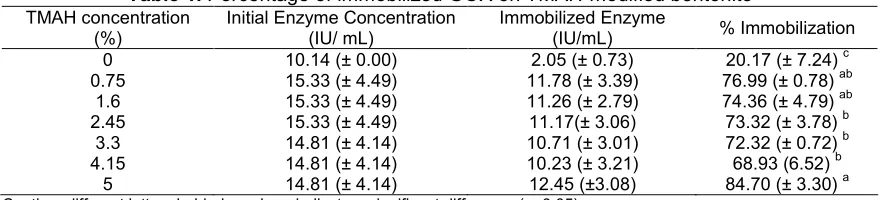
TMAH is a cationic surfactant which charge is not influenced by the pH of solutions. In this study, GOX enzyme was immobilized on bentonite that had been modified with TMAH concentrations ranging from 0.75 to 5%. In addition, the immobilization of GOX was also performed on unmodified bentonite to monitor its immobilization capability before modification. The results of Immobilized GOX using both unmodified bentonite and TMAH-modified bentonite are reported in Table 1.
Fig 1.The effect of pH on the activity of immobilized and free GOX
Fig 2. The effect of temperature on the activity of
immobilized and free GOX
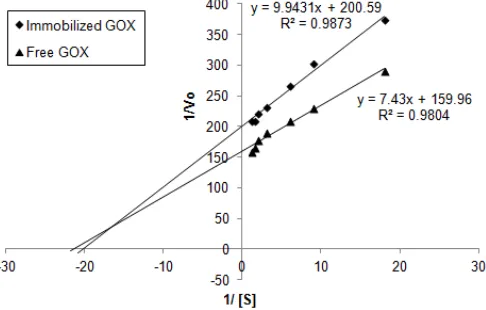
Fig 3. Lineweaver-Burk plot of the free glucose oxidase
and the immobilized glucose oxidase. Each value represents the mean of triplicate measurements and varied from the mean by not more than 5%
bilayers that may effect to various increases of the pore size and volume of bentonite. The pore size and volume formed influence the GOX immobilization percentage. The results show that the highest percentage of immobilization was achieved when using 5% TMAH for the modification. The 5% TMAH also show results that are significant different with results obtained from 2.45-4.15% TMAH, but no significant different with 0.75 and 1.6% TMAH. In other hand, there is no significant different between 0.75 and 1.6% TMAH with 2.45-4.15% TMAH, so the 5% of TMAH was used in further experiments.
Optimum pH and Temperature
The enzyme activity profiles in various pH and temperature condition can be seen in Fig. 1 and 2. The data shows that the activity of the immobilized enzyme is lower than the free enzyme. The immobilization process may leads to the conformational changes of the GOX
which may decreased its affinity and accessibility for substrate molecules thus cause a decrease in enzyme activity after immobilization process [18].
The enzyme was subjected to various temperature and pH profiles to ascertain the extent of its stability. The pH-activity relationships of the free and immobilized GOX have been studied at pH 4.5 to 7.5. Both free and immobilized GOX has a broad range of pH from 5.5-7. However among this range, the optimum pH of immobilized and free GOX was 7. It can be seen in Fig. 1 that there is an increasing activity of Immobilized GOX from pH 4.5 to 7 and decreasing activity from pH 7 to 7.5.
The optimum temperature for free enzyme activity was 30 °C, and the activity decreased by increasing the temperature. However, the optimum temperature for immobilized GOX was around 40-50 °C, because there was no significant difference between the two (Fig. 2). The optimum temperature for the free GOX shifted to 40-50 °C after immobilization on TMAH-modified bentonite. This due to the immobilized GOX probably required higher activation energy to rearrange into the appropriate conformation for the formation of the enzyme–substrate complex. At the temperature of 60 °C, both of free and immobilized enzymes showed the lowest activity. The activity reduction of free enzyme at 60 °C was around 51.16% from its optimum activity. However, the activity reduction of immobilized enzyme at 60 °C from its optimum activity was around 37.04%. The temperature profile of the immobilized GOX on the modified bentonite was more stable with respect to the free enzyme, probably because of the immobilization improved the temperature stability of the GOX.
Kinetic Parameters
Table 2.Enzyme activity levels in each cycle of reusability assay
Enzyme Cycle Converted glucose
(mmol/L) Enzyme activity (mmol/L.min)
% Activity reduction
Free Enzyme - 0.465 (± 0.018) 7.74 x 10⁻³(± 2.97 x 10⁻⁴)
-1 0.186 (± 0.024) 3.10 x 10⁻³(± 4.09 x 10⁻⁴) 0
2 0.163 (± 0.029) 2.72 x 10⁻³(± 4.78 x 10⁻⁴) 12.09
3 0.127 (± 0.011) 2.11 x 10⁻³(± 1.90 x 10⁻⁴) 31.81
4 0.125 (± 0.015) 2.09 x 10⁻³(± 2.58 x 10⁻⁴) 32.44
5 0.124 (± 0.016) 2.07 x 10⁻³(± 2.66 x 10⁻⁴) 33.08
Immobilized Enzyme
6 0.113 (± 0.004) 1.88 x 10⁻³(± 6.82 x 10⁻⁴) 39.44
Table 3.Kinetics values for free and immobilized glucose oxidase
Kinetic Parameters Free glucose oxidase Immobilized glucose oxidase
Km(mM) 4.64x10⁻² 4.96x10⁻²
Vmax(mM.min-1) 6.25x10⁻³ 4.99x10⁻³
Effectiveness factor 1 0.80
Fig 4. XRD Spectra of (a). Unmodified bentonite,
(b). TMAH bentonite, and (c) GOX-TMAH bentonite
temperature of 40 °C using various concentrations of glucose substrate (Fig. 3). This determined to check if the Michaelis constant or maximal activity was affected by immobilization. Km and Vmax values for free and immobilized GOX are given in Table 3. It was observed an increasing of Km and decreasing of Vmax after immobilization. The increase of Km indicates that the
immobilized enzyme had an apparent lower affinity for the substrate than the free enzyme, which may be caused by the steric hindrance of the active site by the support, the loss of enzyme flexibility necessary for substrate binding or diffusional resistance of the support against substrate and/or product [12,22]. In addition, the EF value of immobilized enzyme is <1, which mean that immobilization has some effect on substrate and product diffusion [22].
Stability of Immobilized Glucose Oxidase on Reuse
Enzyme activity of immobilized enzyme on 5% TMAH-modified bentonite was determined and evaluated for each cycle during reusability assay. In addition, the enzyme activity of free enzyme was also determined to investigate the effects of the immobilization process. The immobilized enzyme showed different levels of activity in each incubation cycle is shown in Table 2.
The data show that immobilized enzyme activity decreased by 39.44% after being used six times. Dramatically decrease in activity occurs between the first and the third cycle. This may occur because the enzyme immobilized by adsorption so that the enzyme is not strongly attached to bentonite. The enzyme located on the outer surface easily dislodged when given a particular treatment. However, after the third use, the enzyme remained fairly stable on the bentonite and may be trapped in the pores of the bentonite so that little leaching occurs.
Table 4.Values of 2, d and intensity of diffraction peaks of unmodified bentonite, 5% TMAH-modified bentonite and GOX immobilized on 5% TMAH-modified bentonite.
Sample 2 d (Å) I (count)
Unmodified Bentonite 5.92 8.54 355
TMAH bentonite 6.37 15.26 194
GOX-TMAH bentonite 5.78 13.86 231
Fig 5. FTIR Spectra of (a). Unmodified bentonite,
(b). TMAH bentonite, (c). GOX-TMAH bentonite, and (d). GOX enzymes
X-Ray Diffraction (XRD) Studies
The XRD patterns of unmodified bentonite, 5% TMAH-modified bentonite (TMAH bentonite), and GOX immobilized on 5% TMAH-modified bentonite (GOX-TMAH bentonite) are shown in Fig. 4. Crystallinity changes of natural bentonite as an effect of the 5%TMAH treatment can be observed from the X-ray diffractogram given in Fig. 4. The crystallinity reduction of quartz is characterized by reduction of main peak of quartz diffraction at 2=28.02. However, the main peak of bentonite at 2=6.37 degrees increased in intensity due to the trapping of TMAH molecules in the interlayer structure of bentonite. This results the destruction most of the quartz crystal planes structure as well as changes in distance between layers on bentonite, i.e. shifted from d=8.54 Å on unmodified bentonite to d=15.26 Å on the
5% TMAH-modified bentonite (Table 4). The large molecular size of TMAH affects its molecular orientation towards horizontal. The distance between layers (d) in GOX immobilized on 5% TMAH-modified bentonite (Fig.4c) is slightly different from the 5% TMAH-modified bentonite (Fig.4b). This indicates that the presence of TMAH molecules prevents the introduction of enzyme into interlayer structure of bentonite. These results are reinforcing the notion that most of the enzyme immobilized on the outer surface of bentonite is easily dislodged when given a certain treatment.
Fourier Transform Infrared Spectroscopy (FT-IR) Studies
This section discussed the role of 5% TMAH surfactant solution on changing the structure of bentonite and on absorbing GOX in the layers structure of bentonite. The FTIR spectra of unmodified bentonite, 5% TMAH-modified bentonite (TMAH bentonite), and GOX immobilized on 5% TMAH-modified bentonite (GOX-TMAH bentonite) are presented in Fig. 5. The TMAH bentonite shows structural changes compared to the structure of unmodified bentonite. The changes are characterized by the change of O-Si-O bond main peak absorption at 1000-1060 cm-1, which width and intensity are higher. This absorption peak shows the symmetry vibration of O-Si-O bonding on the TMAH bentonite structures. The widening of this absorption is due to the interactions between the O-Si groups of bentonite with the O atoms from the hydroxyl group of TMAH. This is reinforced by the appearance of the absorption peak at 400-550 cm-1. This adsorption indicates the pores formation within bentonite layers.
The emergence of the absorption peak at 800-850 cm-1 shows the external asymmetry vibration of Si-O-Si bonds between two tetrahedral SiO4 in the
vibrations of O-H bonds from the interactions between O-Si-O groups of bentonite with the O-H groups of TMAH. The wider and higher absorption intensity shows the increase in the number of interaction between bentonite and TMAH.
GOX immobilized on 5% TMAH-modified bentonite shows changes in absorption character at the main peak region (950-1050 cm-1). The O-Si-O bonds of TMAH bentonite become narrower after binding to the GOX. This is due to the bond termination between the O-Si groups from bentonite and the -OH groups of TMAH because of the inclusion of GOX. The slightly decline of the peak due to the large size of enzyme molecule resulted only a small number of GOX that can enter the layer structure of TMAH bentonite. This phenomenon is strengthened by the narrowing of the absorption peak at 3300-3600 cm-1for the O-H bonds vibration. This is due to the reduced interactions between O-Si-O groups of bentonite and O-H groups of TMAOH that have been replaced by GOX.
CONCLUSION
Bentonite was modified with various percentages of TMAH enabling the different immobilization percentage of GOX. These modifications change the characteristics of bentonite to use as an immobilization support for glucose oxidase. These findings are practically important for further applications. The immobilized glucose oxidase was relatively stable. It can be re-used six times before its activity decreased by 39.44%. The immobilized enzyme displayed an optimum activity on the reaction temperature of 40-50 °C and pH of 7. The present work demonstrates the existence promising applications of TMAH-modified bentonite in immobilizing enzymes.
ACKNOWLEDGEMENT
The authors would like to thank Kopertis VII East Java, Ministry of Education and Culture, Indonesia for providing financial support through research decentralization, Hibah Bersaing, contract no. 0008/SP2H/PP/K7/KL/II/2012. The authors also gratefully thank Xavier Daniel, PhD for his help as English-grammar proofreader.
REFERENCES
1. Sakizci, M., Alver, B.E., Alver, Ö., and Yörükoğullari, E, 2010,J. Mol. Struct., 969(1-2), 187–191.
2. Peng, X., Luan, Z., Chen, F., Tian, B., and Jia, Z., 2005,Desalination, 174(2), 135–143.
3. Dong, H., Li, J., Li, Y., Hu, L., and Luo, D., 2012, Chem. Eng. J., 181-82, 590–596.
4. Smith, J.A., and Galan, A., 1995, Environ. Sci. Technol., 29(3), 685–692.
5. Anirudhan, T.S., Suchithra, P.S., and Rijith, S., 2008,Colloids Surf., A, 326(3),147–156.
6. Zhaoa, G., Zhang, H., Fan, Q., Ren, X., Li, J., Chen, Y., Wang, X., and Chao, H.P., 2010, J. Hazard. Mater,173(1-3), 661–668.
7. Li, Q., Su, Y., Yue, Q-Y., and Gao, B-Y., 2011, Appl. Clay Sci.,53(4), 760–765.
8. Öztürk, N., Tabak, A., Akgöl, S., Uzun, L., and Denizli, A., 2007,J. Biol. & Chem., 35 (1), 67-76. 9. Öztürk, N., Tabak, A., Akgöl, S., and Denizli, A.,
2007,Colloids Surf., A, 301, 490–497.
10. Didi, M.A., Makhoukhi, B., Azzouz, A., and Villemin, D., 2009, Appl. Clay Sci., 42(3-4), 336– 344.
11. Yeşiloğlu, Y., 2005, Proc. Biochem., 40(6), 2155– 2159.
12. Ghiaci, M., Aghaei, H., Soleimanian, S., and Sedaghat, M.E., 2009, Appl. Clay Sci., 43(3-4), 289–295.
13. Ghiaci, M., Aghaei, H., Soleimanian, S., and Sedaghat, M.E., 2009, Appl. Clay Sci., 43(3-4), 308–316.
14. Cengiz, S., Çavaş, L., and Yurdakoç, K., 2012, Appl. Clay Sci., 65-66, 114–120.
15. Vroemen, A.J., 2003, Handbook of Food Enzymology, Marcel Dekker, Inc, New York, 425– 432.
16. Wang, C-C., Juang, L-C., Lee, C-K., Hsu, T-C., Lee, J-F., and Chao, H-P., 2004, J. Colloid Interface Sci., 280(1), 27–35.
17. Majdan, M., Sabah, E., Bujacka, M., Pikus, S., and Płaska, A.G., 2009, J. Mol. Struct., 938(1-3), 29– 34.
18. Sedaghat, M.E., Ghiaci, M., Aghaei, H., and Soleimanian-Zad, S., 2009, Appl. Clay Sci., 46(2),125–130.
19. Whittington, H., Kerry-Williams, S., Bidgood, K., Dodsworth, N., Peberdy, J., Dobson, M., Hincliffe, E., and Balance, D.J., 1990, Curr. Genet., 18(6), 531–536.
20. Hartree, E.F., 1972, Anal. Biochem., 48(2), 422– 427.
21. Shuler, M., Kargi, F., 2002, Bioprocess Engineering: Basic Concepts,2nded. Prentice-Hall, Upper Sadle River, NJ