DRAFT FOR DISCUSSION:
Preliminary Report and Recommendations
Aceh Green Sustainable Palm Oil Sector Strategy Development
Date:
February 2009
Presented to:
Graeme Harris, Bruce Wise, Ernst Bethe
International Finance Corporation
Advisory Services Program
Jakarta, Indonesia
Author:
Thomas B. Fricke
Table of Contents
Executive Summary………. 3
Introduction……….. 4
I. Situation Analysis………..………. 7
II. Key Issues………..………. 14
III. Priority and Secondary Recommendations for Action.………. 20
Annexes:
1. Pilot Projects……… 31
2. Aceh Green Maps and Illustrations……….. 38
3. Summary of Roundtable on Sustainable Palm Oil (RSPO)……….… 40
Executive Summary:
This report provides preliminary findings and recommendations for the development of a strategy for sustainable palm oil under the Aceh Green Vision. The Aceh Green Vision, devised by Governor Irwandi Yusuf, provides a framework for sustainable economic recovery of the province of Aceh, Indonesia, in the aftermath of the devastating Tsunami and the long-standing conflict that ended with the 2005 peace agreement.
Palm oil is the highest export value plantation crop in Aceh, involving over 260,000 hectares and benefiting about 200,000 people directly and indirectly. Palm oil is produced in 12 of Aceh’s 23 districts (kabupaten) along the western and eastern coasts. The FOB value of crude palm oil (CPO) exported from Aceh at currently depressed global prices is still estimated at over US$150 million. Therefore, development of the palm oil sector as a major source of revenue for food and fuel products is one of the Aceh Green Vision’s highest stated priorities.
Aceh’s palm oil sector, which has not recovered yet from the destructive impacts of the conflict and natural disaster, is facing a number of major issues. In order for sustainable palm oil production to succeed under Aceh Green, the following 6 of 15 issues will need priority attention:
-Lack of understanding, awareness, and experience in the field of sustainable palm oil -Lack of a supportive policy and regulatory framework
-Minimal financing and technical support for existing and prospective smallholder plantations -Threats to high conservation value forests (HCVFs) and critical peat swamp ecosystems within existing and proposed new concessions (HGUs),
-Inadequate supply of high-quality certified seeds and planting materials, and,
-Low farmgate prices and lack of CPO mills are limiting large estate and smallholder expansion. In order to address these issues, the study proposes the following recommendations for action:
1. Create the Aceh Sustainable Palm Oil Working Group with support from Governor Irwandi to guide the multi-stakeholder process around sustainable palm oil and the Roundtable on Sustainable Palm Oil (RSPO) with government, private sector, NGOs, and smallholders.
2. Update and upgrade the provincial Aceh Qanun (regulations) on Plantations in order to create capacity and consensus on land use planning, the concession approval and monitoring process, environment and labor protections, and sustainable palm oil production and processing.
3. Establish pilot sustainable palm oil public-private partnership models between private palm oil company investors and smallholders that can create precedents for Aceh. Various funders such as the provincial Plantations Department, Ministry of Finance Revitalisasi Kebun program, UNDP, etc. should be engaged to provide supplemental support to such pilot projects.
4. Create a special province-wide initiative for addressing and developing compensation mechanisms for threats to high conservation value forests (HCVFs) and critical peat swamp ecosystems by palm oil plantations under the sponsorship of the Aceh Green secretariat, funded by special efforts such as the IFC’s Biodiversity and Agricultural Commodities Program (BACP).
6. Improve supply chains by promoting crop and income diversification in plantations, promote quality improvements, provide incentives for mill development, and creating price transparency. Introduction:
The IFC Livelihoods Program in Aceh & Nias, a component of the IFC Advisory Services Program, is implementing projects to improve the livelihoods of conflict and tsunami impacted businesses within the Plantations, Aquaculture and Tourism sectors. The program’s focus is on improving productivity, linkages to markets, and facilitating access to finance in these sectors. In April 2008, IFC created three consulting contracts to assist in developing strategies and to identify new investment opportunities for three key commodities—palm oil, coffee, and cacao— under the framework of Aceh Governor Irwandi Yusuf’s ‘Aceh Green Vision’ (see Annex 2). These assignments fall under Aceh Green’s Component 3 (Grassroots Agriculture and Smallholder Estate Crop Development in Partnership with Private Sector and Parastatal Plantations and Associated Infrastructure), within the major theme area Achieving Food and Livelihood/Income Security through Sustainable Economic Development.
This specific assignment primarily focuses on the rehabilitation and expansion of both smallholder and large estates in Aceh’s palm oil sector. Development of oil palm plantations and related infrastructure is considered to be a leading means for creating long-term livelihood opportunities and supporting the peace process in the resource-rich province. It is proposed that the palm oil sector would be developed through expanded large private plantations (inti) and smallholder outgrower and cooperative plantations (plasma). The inti will provide management, capital, and technical support while the plasma would own (e.g., have title to) and run their own outgrower plantations.
Part of the Governor’s original Aceh Green framework involved the setting up of a special body called the Aceh Plantation Development Authority (APDA) modeled after the Malaysian government organization FELDA (Federal Land Development Agency). FELDA has more than 45 years experience in organizing smallholder palm oil, rubber, and cocoa projects in Malaysia. The Governor had hoped to sign a Memorandum of Understanding (MOU) for technical and managerial support with FELDA, but this has not occurred yet for political and operational reasons.
The Governor wants to ensure that both existing and new oil palm development in Aceh— whether government, private, or smallholder—will closely follow the principles and criteria of the Roundtable on Sustainable Palm Oil (RSPO), based in Kuala Lumpur, Malaysia (Annex 3). This global initiative of businesses, government, and NGOs is creating high standards and strong incentives for environmental and social responsibility in the global palm oil industry. Therefore, Aceh Green seeks to stimulate cooperation among the various stakeholders in Aceh in order to maximize alignment with RSPO and to minimize the major problems associated with oil palm expansion in Indonesia and elsewhere. These problems include forest and habitat destruction, carbon losses, and land tenure conflicts. If RSPO principles and criteria are broadly disseminated and instituted, Aceh could become a model for sustainable palm oil production worldwide.
-Develop strategies for implementing the Aceh Green Vision through sustainable palm oil plantation development,
-Identify income and employment opportunities for boosting the economy and preserving the peace,
-Activate the palm oil industry as a growth engine for both food and fuel crop expansion, and,
-Support the launching of a multi-stakeholder approach involving business, government, small holders, and NGOs.
In pursuing this assignment, the consultant has actively engaged with a number of key stakeholders:
-A number of key leaders and government agencies at the provincial level, including:
• Governor Irwandi himself,
•
Forestry and Plantations Department (Dishutbun),• Governor’s Economic Team,
• Aceh Plantation Development Authority (APDA)
•
Forestry Redesign Team (TIPERESKA), and,• Leuser Ecosystem Management Agency (BPKEL-Badan Pengelola Kawasan Ekosistem Leuser),
-Several national and international institutions, such as the Roundtable on Sustainable Palm Oil (RSPO) in Kuala Lumpur and Jakarta, United Nations Development Program (UNDP), the Reconstruction and Rehabilitation Agency for Aceh and Nias (BRR), the Ministry of Finance, and the International Organization on Migration (IOM).
-Kabupaten and local leaders and agency staff in the key production areas along the West and East coasts of the province, including Aceh Jaya, Aceh Barat, Nagan Raya, Aceh Selatan, Aceh Singkil, Subullusalam, Bireun, Aceh Utara, Aceh Timur, and Aceh Tamiang.
-A variety of development, environment, and advocacy NGOs, including Oxfam, Eye on Aceh, Aceh Social Development (ASD), Flora and Fauna International (FFI), PanEco/Yayasan Ekosistim Leuser (YEL), Worldwide Fund for Nature (WWF), and Conservation International.
-Farmer organizations and cooperatives in various kabupaten of Aceh, including local and province-wide entities located in Bireun, Aceh Utara, Nagan Raya, and Aceh Jaya.
-The private sector plantation producers association, Gabungan Pengusaha Perkebunan Daerah Aceh (Gaperda) and other local, national, and international palm oil companies. In particular, I have visited the plantations and mills of several of the key companies currently active in Aceh, including Socfindo, Mopoli Raya, Risjadson Sejahtera Agrobusiness (RSA), Astra Agro Lestari, and Minamas/Sime Darby.
Over the last several months, this study has focused on the following activities:
• Consulted with key government agencies at provincial and kabupaten levels regarding current challenges, opportunities, and technical support needed within Aceh palm oil sector rehabilitation and expansion.
•
Cooperated with the directors and individual members of the Gaperda in introducing the Aceh Green Vision and the RSPO Principles and Criteria (P & C).• Reviewed field data and analysis conducted by local and international NGOs, specifically with respect to smallholder needs and perspectives.
• Conducted field assessments of existing smallholder and large plantations in several key current and potential palm oil production areas (Tamiang, Aceh Timur, Aceh Utara, Bireun, Subulusalam, Singkil, Aceh Selatan, Nagan Raya, and Aceh Jaya).
•
Met with senior officials at national and international financing institutions and private banks (ie. Ministry of Finance, IFC, Rabobank, HSBC) to ascertain their interest and resources available for direct investments in the Aceh palm oil sector.• Identified candidate production areas and cooperative partners for a set of pilot field projects that can demonstrate the way forward in a cost-effective fashion.
•
Facilitated exchanges between government, NGO, and private sector participants from Aceh with Indonesian and international counterparts during the Roundtable on Sustainable Palm Oil (RSPO) annual meeting in Nusa Dua, Bali in November 2008.•
Supported the work of the Steering Committee on Sustainable Palm Oil to organize and conduct the first Aceh Sustainable Palm Oil Workshop that was successfully held on 12-13 December 2008 at the Hermes Hotel in Banda Aceh.I. Situation Analysis
A. Basic Facts about Aceh’s Palm Oil Sector:
Aceh contains about 261,000 hectares in large palm oil estates and smallholder farms, which collectively produced about 2 million tons of fresh fruit bunches (FFB) in 2007. The industry is concentrated in five kabupaten (districts) along the western and eastern coasts, Aceh Utara, Aceh Timur, Aceh Tamiang, Nagan Raya, and Aceh Singkil (including the newly-established municipality of Subullusalam). These six kabupaten and municipalities constitute over 84% of the total planted hectares and production, and have been the focus of most proposed new concessions and smallholder expansion schemes. Four other kabupaten (Aceh Jaya, Aceh Barat, Aceh Barat Daya, and Bireun) are also considered solid growth candidates, while five additional kabupaten and municipalities have lesser potential. Future expansion of palm oil in Aceh is enhanced by the following factors:
1. Favorable soils, climates, and rainfall patterns
2. Demonstrated high yields with optimal management and inputs
3. Strong national and international market demand for both food and fuel applications, and 4. Government support at provincial and national levels for smallholder development.
The following table, based on composite 2007 data compiled by the provincial Forestry and Plantations Department (Dishutbun) and the national Plantations Department, provides a succinct summary of the current status of Aceh’s palm oil sector. These figures are based on data obtained from the local kabupaten (district) level Dishutbun offices. Also based on local data, Table 2 in the following page itemizes the distribution of Aceh’s palm oil plantations by kabupaten. These data sets contain very similar overall plantation hectare data for large estates and smallholders, although the fieldwork indicates that their accuracy cannot be validated at the kabupaten level.
Total Palm Oil Plantations (2006/2007) Total Productive Unproductive Total Average Estimated
Source: Dishutbun NAD Hectares Hectares Hectares FFB FFB/Ha. CPO/Ha.
Perkebunan Rakyat (Smallholders)
Table 1: Total Palm Oil Plantations in Aceh Province 2007
inputs and best practices for improved fertility, weed, and pest management in order to increase yields.
During the conflict era, an estimated total of 85,000 hectares or 33% of the total plantings (52,712 hectares of smallholder and 32,316 hectares of large plantations) were essentially abandoned or neglected (Eye on Aceh, 2007). Many smallholders, especially transmigrants from outside Aceh, were unable to stay on the plantations. Most of the palm oil production areas were impacted to some degree by the conflict, while an additional about 21,000 hectares were partially or significantly affected by the Tsunami. As the data indicates, about 75,666 hectares or about 29% of total plantations are considered unproductive or still unrehabilitated from the conflict era.
One of the most significant legacies of the conflict era is the continuing difficult financial situation of most of the province’s palm oil plantation companies. Many of them were unable to repay or service their debt to private and government banks. With a backlog of unpaid interest and principal, many companies remain on the “blacklists” of the banks. This remains a major impediment to the recovery and growth of the palm oil sector in Aceh.
Distribution of Palm Oil Plantations by Kapubaten Aceh Province
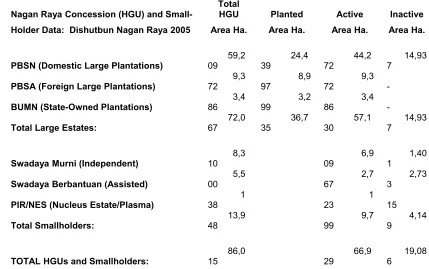
Another feature of Aceh’s palm oil plantation sector is the incomplete and often contradictory data on the private sector and parastatal concessions (HGU or Hak Guna Usaha). This is illustrated by the data provided in Table 3 below by the Dishutbun for Nagan Raya Kabupaten, which ranks as among the top two or three kabupaten for total hectares planted. This excerpt from an annual report for 2005 issued after the end of the conflict era indicates that only 36,735 hectares or slightly more than half of the granted concession area of 72,067 was actually planted. The local Dishutbun also classifies about 15,000 hectares of the large plantations and 4,000 hectares of the smallholders within “inactive” status. During the period of this study, a review and mapping of the 99 granted HGUs was being conducted by the NGOs Eye on Aceh, Oxfam, and FFI, working with the Forestry Redesign Team (TIPERESKA) housed within the Dishutbun main office in Banda Aceh. It is expected that this report, findings, and digital maps will be completed by February of 2009.
Nagan Raya Concession (HGU) and
Small-Total
HGU Planted Active Inactive Holder Data: Dishutbun Nagan Raya 2005 Area Ha. Area Ha. Area Ha. Area Ha.
PBSN (Domestic Large Plantations)
Table 3: Nagan Raya Concession (HGU) and Smallholder Data 2005
According to data obtained from a national-level Department of Plantations survey team in May 2008, Aceh’s palm oil post-harvest facilities include 23 crude palm oil (CPO) mills (PKS or pabrik kelapa sawit). These facilities have a composite capacity of 715 ton/hr or an average mill capacity of about 31 tons/hour. The team indicated that 494 tons of these mills are currently in use, or about 69% capacity. This apparent excess capacity is in fact not the case in many areas as plantations go unharvested or output is trucked long distances due to logistical issues such as lack of manpower, access roads and harvest infrastructure. Due to inconsistent quality, smallholder FFB production is frequently discounted in price or purchased in limited quantities by the large estate mills.
oversupply from over $1,000/ton down to well below $500/ton. Thus the current value of Aceh’s output would be valued at between $150-$180 million. Current farmgate prices in many areas of Aceh have declined to levels (Rp300-500/kg for FFBs) that are only marginally profitable or unattractive for smallholders.
There are currently no secondary processing plants for palm kernel oil (PKO) or refineries in Aceh. Feeder ports or tank farms for storage are virtually nonexistent. This is in sharp contrast to the vast array of post-harvest infrastructure in nearby North Sumatra and Riau, including palm-based food industries, biodiesel, oleochemical and surfactant plants, and extensive port facilities. Consequently, Aceh remains primarily a raw material producer, with local prices relatively depressed due to the previously mentioned logistical and resultant quality constraints. As a result, virtually all of current production is sold as a domestic product and indirectly exported through the port of Belawan in North Sumatra.
Despite the considerable challenges and constraints, this study found rays of hope for the future for Aceh’s depressed palm oil sector throughout the province. Whereas most smallholders and a number of large estates are still lagging behind in productivity and income, several of Aceh’s leading private companies, most notably Socfindo, Astra Agro, Mopoli Raya, and Minamas/Sime Darby, have run plantations producing over 20 tons of FFBs per hectare and efficient, well-run mills. Socfindo, the largest purely international company which has been in Aceh since the 1930s, produces an average of almost 7 tons of CPO per hectare in its long-standing Nagan Raya plantations. As a rough personal estimate, five of the leading companies in Aceh appear to produce about 65% of total production on about 25% of the land devoted to palm oil. Two of these companies, Socfindo and Minamas/Sime Darby, are members of the RSPO and are in the process of pursuing certification for their plantations and mills in Aceh and Indonesia as a whole. Also, several of these and other companies are actively pursuing partnerships with smallholders (plasma) as part of their expansion schemes.
Overall, it appears that the palm oil industry provides direct and indirect employment & income impacts to over 200,000 people in Aceh, or about 5% of the population. This includes smallholders and their families, plantation and mill managers and workers, and transport and other service industry members located in areas representing over 50% of the land mass of Aceh. As envisioned in the Aceh Green Development and Investment Strategy, the palm oil industry has the potential to provide broad economic opportunities and support the peace process if ways and means are found to unlock its latent potential.
B. Current Palm Oil Initiatives in Aceh
There are currently a number of initiatives in Aceh that have been attempting to address the challenges and potential of the palm oil sector. As in many other economic sectors, most of these efforts are running independently in minimally coordinated fashion. They fall in the categories of:
• Networking efforts,
• Government smallholder plantation rehabilitation and expansion,
• Private investment schemes,
•
Technical assistance programs, and• Research projects.
1. Aceh Sustainable Palm Oil Steering Committee
Launched early 2008 by a group of NGOs (Eye on Aceh, Oxfam, FFI, and others), this group has now incorporated leading government and private sector organizations in Aceh, including Dishutbun and Gaperda. The group was co-chaired by Pak Masnun, Director of the Dishutbun Plantations Department and . Samsul Bahri of the advocacy NGO Eye on Aceh. After several planning and organizations meetings from May-October 2008, the steering committee was able to successfully organize and conduct a 2-day workshop in Banda Aceh in December 2008 that brought in over 200 participants from the provincial and local governments, the private sector, NGOs, and producers.
The workshop sought to present the concept of sustainable palm oil and the RSPO and lay the foundations for a long-term effort. The workshop modeled effective multi-stakeholder collaboration, including supportive leadership from the head of Dishutbun Pak Hanifah, the Secretary General of Gaperda, Pak Sabri Basyah, Pak Hasan Sastra and Pak Yakob of Governor Irwandi's Economic Team, and key NGO leaders such as Eye on Aceh’s Bahri and Ian Singleton of PanEco. On the first day and the morning of the second, there were a number of excellent presentations from resource people from outside Aceh and from key people from within Aceh. Several leading sustainable palm oil experts gave presentations, including Desi Kusumadewi of the RSPO Indonesia Liaison Office (RILO), Muhammad Salim of Unilever, Arifin Lambaga of PT Mutuagung Lestari, Andi Kiki of the Kalimantan Tengah RSPO Sustainable Palm Oil recommendations which will be compiled by the workshop organizers (panitya) shortly. The consensus view of the organizers and many of the participants was that this event gave a major boost to the sustainable palm oil component of the Governor’s Aceh Green Vision.
2. Smallholder Plantation Expansion and Rehabilitation Programs
Coordinated by the provincial Plantations Department, these programs have targeted the development and rehabilitation of over 37,000 hectares of independent smallholder palm oil plantations over the period 2007-2010 in about twelve of Aceh’s kabupaten. Most of the funding is part of the Department’s provincial budget, with some initial funding in Tsunami-affected areas from the Asian Development Bank (ADB) and the BRR. Activities include nursery development, replanting, and rehabilitation for both existing and new plantations. Average expenditures per hectare range from Rp 5 to 10 million, which is only adequate to cover the smallholders’s first year costs of land clearing and preparation and planting of seedlings. The issues and limitations of this approach are described in the following section of the report.
3. Private Sector Investment Opportunity Scouting
Association (GAPKI). They have actively conducted surveys, liaised with local kabupaten level leaders and Dinas officials, and screened local partner candidates. In some instances, the local officials have issued preliminary permits (Izin Prinsip) for areas such as 4 new private concessions covering over 20,000 hectares in the newly-formed municipality of Subullusalam. However, no new HGUs have been approved by Governor Irwandi since he became Governor.
4. Aceh Plantation Development Authority (APDA)
This still formative entity has made only modest progress with the appointment of an interim Executive Director, Ir. Rustam Effendi of the University of Syiah Kuala in early 2008. As envisioned by Governor Irwandi, APDA would bring in the long-standing experience and expertise with smallholder palm oil rehabilitation and development of the Malaysian government agencies FELDA (Federal Lands Development Authority), FELCRA (Federal Land Consolidation and Rehabilitation Authority), and Yapeim (Islamic Development Foundation). However, a pending Memorandum of Understanding (MOU) between the Aceh Government and the Malaysian agencies has been stymied by a lack of agreement with the Indonesian government.
5. Aceh Plantation Sector Revitalization Policy and Strategic Planning Initiative
Governor Irwandi’s Economic Team, financed by UNDP, has drafted a proposal for a policy and strategic planning project specifically targeting Plantations and palm oil development for implementation in 2009-2010. After consultations with UNDP and this consultant, Economic Team Leader Ir. Hassan Sastra, the director-designate of the Aceh Green Secretariat, has decided to fold this effort into the emerging secretariat. The secretariat will also reactivate the Draft Qanun (Regulations) on Plantations that was forged by extensive consultations between Dishutbun, the international NGO WWF, and a number of other stakeholders in 2004-2005.
6. Ministry of Finance Revitalisasi Kebun/Bahan Bakar Nabati (Plantation Revitalization/ Biofuels).
This national Indonesian financing scheme has allocated over US$4 billion for the development of smallholder palm oil, rubber, and cacao plantations. To be administered by four government banks (Bank Mandiri, BRI, Bukopin, and BNI), this low-interest loan program is intended to be channeled through private sector companies that can act as guarantors and technical assistance providers to associated smallholder cooperatives. Initial targets were set for 40,000 hectares of new plantations and 5,000 hectares of rehabilitation with about 15 companies throughout Aceh. However, progress has been slow both at the national and Aceh levels, with only about 20% national subscription and no finalized loans disbursed in Aceh as yet.
7. Concession (HGU) Assessment and Mapping Initiative
8. NGO Smallholder Palm Oil Research and Development Projects
Several NGOs have sponsored research and development projects that assess the sustainability of Aceh’s palm oil sector and/or provide alternative models for palm oil plantation development. Those that are completed or are currently underway include:
- Eye on Aceh Research Study on the Aceh Palm Oil Sector, conducted from 2006-2007, resulting in the September 2007 publication and socialization of The Golden Crop? – Palm Oil in Post-Tsunami Aceh. This report is a well-documented and fairly comprehensive review and critique of Aceh’s palm oil industry. It analyzes social, environmental, and political issues and makes pointed policy recommendations. The report contains a fairly critical perspective on the private sector, and expresses a strong preference for cooperative and smallholder development.
- Palm Oil Development Scheme, Aceh Utara, Bireun, and Bener Meriah Kabupaten. Involving about 3,000 demobilized ex-combatants, this 6,000 hectare project will be implemented by the International Organization for Migration (IOM) from 2008-2010. The project will provide financing for plantation establishment, technical assistance and training, and cooperative organizational development. The beneficiaries will become independent assisted smallholders, not directly tied to any large plantation company.
- Sustainable Palm Oil Pilot Project, Nagan Raya Kabupaten. Designed and implemented by Yayasan Ekosistem Leuser (YEL) and funded by the Swiss NGO PanEco, this project is a small-scale smallholder demonstration effort. It involves about 35 farmers on 70 hectares located in degraded forest (hutan belukar) outside of the critical Tripa peat swamp area (Kuala Tripa), one of the highest densities of orangutans in the world. The project cooperates with the large longstanding foreign company Socfindo to provide technical support and high-yielding seedlings.
- Sustainable Palm Oil and Biofuel Feedstock Development Project, Aceh Singkil Kabupaten. Developed by the international NGO Conservation International (CI) and funded by the U.S. Department of Energy (DOE), this project is mainly a research and policy project. The project will conduct agro-ecological surveys, spatial planning exercises, and policy research with smallholders, private companies, and local government.
9. Initiatives of Smallholder Organizations and Cooperatives
In the aftermath of the peace process, organizations of palm oil smallholders have been forming at the local, kabupaten, and regional levels. This includes established efforts such as:
-Koperasi Tani (Koptan) Batee Meuasah, a 1,500 member group of ex-combatants and conflict victims in Paya Bakong Kecamatan, Aceh Utara Kabupaten, which has been actively pursuing a 6,000 hectare palm oil development project largely on its own to date (Pilot Project 1B on P. 33).
-Province-wide organizational efforts and their associates at the kabupaten level such as Koperasi Koridor Utama, based in Alue Bilie, Nagan Raya and Lembaga Kelompok Perkebunan Rakyat Nanggroe Aceh Darussalam/Kelompok Perkebunan Sawit Rakyat (LKPR/KPSR) in Langsa.
II. Key Issues
Despite the potential previously described for the palm oil sector as a major contributor to Aceh’s economic recovery, significant issues and constraints exist that need to be addressed in both the short and long term. In order for sustainable palm oil production to succeed under the aegis of Aceh Green, the following issues will need serious attention:
A. Major Issues
1. Lack of Understanding, Awareness, and Experience in the Field of Sustainable Palm Oil and the Roundtable of Sustainable Palm Oil (RSPO).
Aceh is just emerging from its isolation from the rest of Indonesia and other parts of the world. With the exception of a few well-established companies and NGOs with strong domestic and international links, most of the concepts of sustainable palm oil are relatively unknown in Aceh. To address this, government, private sector and NGOs alike are expressing a strong interest in becoming familiar and aligned with the RSPO’s standards and multi-stakeholder process (Annex 3). As first steps, the Aceh Sustainable Palm Oil Steering Committee (Pokja Sawit Berkelanjutan) was formed in 2008, comprised of government, industry, and NGO/civil society sectoral committees. A senior government official, Dishutbun Plantations Director Pak Masnun attended the RSPO annual meeting in Bali in November 2008, along with several NGO and private sector representatives. After several delays, a well-attended two-day Sustainable Palm Oil Workshop was held in Banda Aceh in mid-December financed by FFI and Oxfam. A focused long-term effort is needed to bridge the gaps in knowledge and implementation.
2. Lack of a Supportive Policy and Regulatory Framework for Sustainable Palm Oil in Aceh Province.
precedent for this was created within a collaborative effort involving the Dishutbun and various other stakeholders facilitated by WWF prior to the Tsunami in 2004.
3. Current government and official development aid (ODA)-funded smallholder palm oil development projects do not provide comprehensive financing and technical services.
The government of Aceh Plantations Department and international agencies such as the BRR have set up smallholder palm oil development projects in the aftermath of the peace agreement. These have targeted creation of about 37,000 hectares of new plantations and 5,000 hectares for rehabilitation from 2007-2010. Funding and technical inputs such as land titling, land clearing, and seedlings are provided by centralized authorities, while identification and coordination of designated smallholders and locations is left to local kabupaten Dishutbun offices. The total funds provided are approximately Rp5-10 billion per kabupaten or about Rp 5-10 million per hectare. Field interviews with local officials, NGOs, and farmers indicated that contracting procedures are not always integrated and may lead to ineffective site selection or inadequate service provision. In Bireun, for example, reportedly only about 500 of 1,000 hectares are still being maintained by smallholders one year after initial planting in 2007. Current average per hectare costs for establishing plantations from land preparation through the initial commercial harvest 5-6 years later range from Rp 35-45 million. This means that smallholders face serious financial stresses during the critical maintenance years and need to obtain supplemental income or financing through other means.
4. Major threats to high conservation value forests (HCVFs) and critical peat swamp ecosystems continue to exist within existing and proposed new concessions (HGUs).
at the provincial level for blocking the issuance of final concession (HGU) status, some unscrupulous operators or third party elements may initiate unauthorized conversion previously.
5. Supply of high-quality certified seeds and planting materials is inadequate to meet the demand for palm oil plantation expansion.
The ambitious plans to increase Aceh’s palm oil sector plantings by 200,000 hectares or more in the next five years are leading to major shortages of high-quality certified seeds (kecamba) and seedlings (bibit) in many parts of the province. At this rate of growth, over 6.3 million seeds and/or seedlings are required per year over the next 5 years given average densities of 137 trees per hectare and the need to factor in about 15% losses. Seed quality, durability, and productivity are the single-most important determinants of successful palm oil plantations. In the past, many plantations in Aceh had supply and/or technical assistance contracts with the government-funded Indonesian Oil Palm Research Institute (PPKS-Pusat Penelitian Kelapa Sawit) Marihat Research Station in Pematang Siantar, North Sumatra. According to Gaperda sources, Marihat’s annual seed production of is about 15 million seeds, which needs to be allocated to three provinces (North Sumatra, Riau, and Aceh). Currently, many companies and smallholders are seeking to purchase the hybrid high-yielding and disease-resistant Tenera varieties produced by Socfindo and LonSum at their seed nurseries in Aceh Tamiang and Pematang Siantar, respectively. Both of these companies give priority to their own estate expansion and replanting requirements, and their remaining stocks are in high demand. Regardless of source, it is important that all seeds be certified as Grade 1 and with a guaranteed germination rate. Reports are circulating about contractors selling lower-grade outsortings or substitute material as Grade 1 seeds in order to protect if not increase their profit margins.
6. Low farmgate prices and the lack of readily accessible CPO mills are limiting large estate and smallholder palm oil plantationexpansion.
B. The following are significant issues, though secondary in importance:
7. Pressure has been mounting at the local kabupaten level for the expansion of new palm oil concessions with inadequate planning and assessment.
Over the last three years since the cessation of hostilities after the Peace Accord was signed, pressure for generating legal and extralegal income and employment opportunities has been mounting in many parts of Aceh. This is particularly the case in areas where Tsunami impacts and post-disaster assistance have been minimal. The more outlying kabupaten such as Singkil, Subulussalam, Aceh Timur, and Aceh Utara, which are also among the largest current palm growing areas are in this category, as are many interior lowland areas which did not suffer major loss of lives or property during the Tsunami. Due to increasing decentralization of authority in Aceh and Indonesia as a whole, local authorities are actively pursuing palm and other plantation crop development without relying on guidance from the provincial or national level to the extent previously. For example, the former mayor and the current Plantations Department head of the newly-created Subulussalam municipality indicated in an interview that plans are underway to increase palm concessions (HGUs) from the current 25,000 hectares to over 50,000 hectares, out of a total district land area of 112,000 hectares. These developments are occurring in a context of minimal local familiarity with RSPO and sustainable palm oil principles and practices.
8. Availability of investment resources in sustainable palm oil expansion in Aceh are lagging and hampered by high risk/insecurity perceptions, a backlog of loan defaults, and a lack of effective investor promotion and coordination.
9. Supportive public infrastructure for sustainable palm sector development such as feeder ports, tank farms, and harvest roads is deficient.
At this time, most of the key small ports (ie., Calang, Meulaboh, Singkil, and Langsa) are unprepared to handle existing and projected CPO production in the next several years in terms of blending equipment, storage tank capacity, and port drayage to accept larger vessels. Consequently most CPO is sent out of Aceh overland by trucks in raw or CPO form, often over long distances. This means that product quality can be reduced and frequently results in price deductions at the terminal of final sale in North Sumatra.
10. Lack of consistency in occupational health and safety, air, water, and soil pollution controls, and energy efficiency among post-harvest processing facilities in Aceh.
With a few exceptions, most of Aceh’s 23 CPO mills (PKS) are once again operational. The study estimates that about half of existing mills are lacking in basic quality and safety standards, including occupational health and safety and air and water pollution controls. The remaining half of the mills are well-run, relatively efficient mills operated by the larger private companies. These companies are achieving yields of 22-25% CPO with Free Fatty Acid (FFA) levels of 1-4%. They are managing their solid and liquid waste streams well with minimal water, air, and soil pollution. Most have dismantled their ash incinerators, which are still being used in older mills to dispose of empty fruit bunches by burning. With some improvements and modifications many of these mills can become RSPO-compliant CPO processing mills that demonstrate energy efficiency, clean technologies, and Good Manufacturing Practices (GMP).
11. Information, knowledge, and experience in best production practices is relatively unavailable to smallholders and variable among large plantations.
Due to historical factors previously described, Aceh’s smallholder palm oil sector has not benefited from training, technical assistance, and infrastructure development initiatives of government agencies, private companies, or NGOs. Most of the previous inti-plasma projects, either of the assisted smallholder or transmigration types, were unsuccessful or stymied by the conflict. Due to the province’s relative isolation, few of the Indonesian palm oil industry’s innovations in seedling technology, integrated pest management, and nutrient cycling have been transferred beyond a few of the highly-productive large estates. These innovations could improve yields and incomes by an estimated 30-75%.
The lack of availability of accurate data on the palm oil concessions (HGUs) and smallholdings is a major shortcoming in resolving land use issues and creating a rational planning process. Despite the proliferation of digital data/geographic information systems and landscape planning projects in Aceh after the Tsunami, major data gaps still exist in this critical area. According to some sources, some of the gaps are a result of inadequate original documentation or losses of documents sustained during the Tsunami and its aftershocks. Another frequently cited factor is that a certain number of concession holders unscrupulously expanded beyond the original boundaries of their HGUs. In any event, it will be time-consuming and costly to close the data gaps. However, this is a necessary investment in order to accurately review HGU compliance with RSPO standards or to effectively pursue enforcement of the new legislation (Qanun) on plantations.
13. Land use and land ownership are frequently not legally recognized or demarcated, thus leading to land disputes and curbing investment in plantation expansion.
14. Local labor availability and smallholder organizational capacity is constrained in some areas and may undermine or deter plantation development.
Labor availability for the rehabilitation and expansion of the palm oil sector in Aceh is highly variable on a local and province-wide level. Unlike some other plantation crops such as coffee and cacao which have more of a seasonal orientation, labor requirements for palm oil production operations such as harvesting, weeding, fertilizer applications, and factory work are fairly constant throughout the year. This requires a consistent labor pool or stable smallholder family workforce, which is lacking in certain palm oil production areas. Due to the longer time period for the plantations to reach maturity and the palm oil industry’s greater reliance on technology, transport, and infrastructure, large estates often achieve greater efficiencies than smallholders. In order for most smallholders to achieve good yields and incomes, they need to set up their plantations in a well-coordinated manner with other smallholders through cooperatives or associations.
This study found several areas with shortages of skilled laborers for large estates and relatively weak smallholder organizations. In the past, large plantations relied heavily on external laborers or transmigrants, which frequently resulted in social conflicts with local populations. Many of these external laborers have been reluctant to return to Aceh after the conflict era. There is also a widespread perception in Aceh that ethnic Acehnese are more oriented to the small business, fishery, and government sectors rather than the plantation sector, particularly in the labor-intensive industrial palm oil industry. Accordingly, the issues of labor shortages and smallholder organizational capacity need to be addressed in order for the industry to move forward.
15. The role and status of the proposed coordinating entity Aceh Plantation Development Authority (APDA) is unclear.
III. Priority and Secondary Recommendations for Action
A. Priority Recommendations
The following priority recommendations pertain to the first six issues outlined in the previous section:
Issue No 1: Lack of Understanding, Awareness, and Experience in the Field of Sustainable Palm Oil and the Roundtable on Sustainable Palm Oil (RSPO).
Recommendation No. 1: Create the Aceh Sustainable Palm Oil Working Group (Pokja
Perkebunan Sawit Berkelanjutan Aceh) to guide the multi-stakeholder process with government, private sector, NGOs, and smallholders on the theme of sustainable palm oil.Recommendation:
Establish a formal working group (Pokja Perkebunan Sawit Berkelanjutan Aceh) as a provincial support organization for promoting sustainable palm oil policies, practices, and pilot projects. A strong consensus emerged at the Sustainable Palm Oil Worshop in December 2008 among the key government, private sector, and NGO participants to form a multi-stakeholder mechanism, which will hopefully be backed by an official Surat Keputusan (SK) from Governor Irwandi. This Working Group could be modeled along the lines of the existing multi-stakeholder Working Group that has been set up in Kalimantan Tengah with strong support from that province's Governor.The working group can be housed at Dishutbun such as TIPERESKA and function within a flexible framework such as the national level Indonesian Palm Oil Commission (Komisi Minyak Sawit Indonesia). The Aceh Sustainable Palm Oil Working Group can work closely with the Roundtable on Sustainable Palm Oil (RSPO) in Jakarta and Kuala Lumpur. It can set up a limited number of practical and achievable objectives and projects to pursue in the next few months and years. In order to maintain the current momentum for sustainable palm oil in Aceh, the participating organizations and individuals can contribute existing funding and staff resources, and accessing other funding in the long term.
Objectives: 1) To establish a viable support mechanism for promoting, implementing, and financing sustainable palm oil in Aceh. 2) To create a cooperative multi-stakeholder framework linking government, private sector, NGOs, and civil society.
Rationale: The Working Group on Sustainable Palm Oil has generated positive responses from key government, private sector, and NGO stakeholders. This process now needs to assume an ongoing focused but flexible organizational framework, with adequate funding, local staff, and technical support for at least two-three years.
• Organize a core team of 8-10 individuals seconded from government, private sector, NGO, and community ranks to act as coordinators of this effort. A list of potential candidates could include:
1. Samsul Bahri, Eye on Aceh
2. Isa Rahmadi, Aceh Social Development (ASD) 3. Ian Singleton, PanEco/YEL
4. Afridal Darmi, LBH-Aceh 5. Pak Masnun, Dishutbun 6. Ibu Ida, Dishutbun
7. Pak Sastra, Tim Penasehat Ekonomi Gubernur 8. Pak Yakob, Tim Penasehat Ekonomi Gubernur 9. Sabri Basyah, Mopoli Raya/Gaperda
10. Adi Zain, PT Boswa Megalopolis
• Support policy and legal initiatives on sustainable plantations (Recommendation 2)
• Socialization and training in sustainable palm oil plantation principles, practices, and certification, in collaboration with the Roundtable on Sustainable Palm Oil (RSPO)
• Selective introduction of best practice and low-cost techniques and technologies for rehabilitating and increasing the productivity and income potential of existing plantations
• Identify, evaluate, and monitor public private partnership pilot projects (Recommendation 3)
• Create a Task Force on Sustainable Financing. This idea was recommended by a conference speaker, Amol Titus of IndonesiaWISE, and was endorsed by the Discussion Group on Economy and Marketing
Planned Outcomes: Create a practical long-term mechanism for promoting sustainable palm oil in Aceh and implement it with all major stakeholders.
Target stakeholders and Allies:
-Key government agencies, ie. Dishutbun, -Gaperda and other private sector companies
-Local and international environment, development, and policy NGOs -Civil society and smallholder organizations
Issue No. 2. Lack of a Supportive Policy and Regulatory Framework for Sustainable Palm Oil in Aceh Province.
Recommendation No. 2: Revive, Revise, and Present the Qanun of Sustainable Plantations to the Provincial Legislature for Ratification by mid-2009
Recommendation:
Update and upgrade the provincial Aceh Qanun (regulations) on Plantations in order to create capacity and consensus on land use planning, the concession approval and monitoring process, environment and labor protections, and sustainable palm oil production and processing. The previous drafts produced through a consultative process involving Dishutbun, WWF-Aceh, and other stakeholders in 2004 can serve as a foundation for this effort. Materials and technical guidances produced by the RSPO can serve as a further resource for the drafting of the Qanun. Membership in RSPO should be encouraged but continue on a voluntary basis.Rationale: Aceh’s plantation sector is at a crossroads now. A clear legal framework with long-term guidelines for policy and practice is needed in order to develop Aceh’s plantation sector (especially palm oil) in a strategic and sustainable way. Enabling legislation is urgently needed now at the provincial level to effectively create economic opportunities and pre-empt potential negative environmental and social impacts.
Activities:
• Obtain a written mandate (SK-Surat Keputusan) from the Governor to launch this effort
• Form a compact working group comprised of government, private sector, and NGO/civil society representatives to guide the drafting and consultative process
• Appoint a team of 2-3 lead facilitators to review and update the 2004 WWF-Dishutbun draft Qanun on Plantations with particular modifications on sustainable production principles, criteria, and practices, such as conservation of High Conservation Value Forests (HCVF), using RSPO materials as a resource
• Conduct public consultations and technical review sessions in order to socialize the Qanun and align them with sustainability principles and the Aceh Green Vision
• Finalize the draft Qanun by March 2009 and submit for review and ratification by the provincial legislature.
Planned Outcomes: Achieving broad consensus and support for the Qanun on Sustainable Plantations, hopefully culminating in review and ratification by the Aceh legislature by mid-2009.
Target stakeholders and Allies:
-Current political leadership of Aceh: Governor Irwandi, Vice-Governor Nazir, and the provincial legislature
-Gaperda and potential plantation sector investors
Issue No. 3. Current government smallholder palm oil development projects do not provide comprehensive financing and technical support services.
Recommendation No. 3. Establish pilot sustainable palm oil public-private partnership models between government agencies, private palm oil company investors and smallholders that can create precedents for Aceh. Various agencies such as the provincial Plantations Department, Ministry of Finance Revitalisasi Kebun program, UNDP, etc. should be engaged to support such pilot projects.
Objective: Create several immediate high impact investor-smallholder pilot palm oil projects in key production areas of Aceh (Annex 1) that will provide comprehensive services and financing to all participants. These pilot projects will demonstrate partnership models that will stimulate furtherinvestment in the palm oil sector and provide maximum economic, social, and ecological benefits to Aceh.
Rationale: Viable investment models that effectively pool the technical and financial resources of government, the private sector, and smallholders are critically needed in Aceh’s palm oil industry now. These pilot projects can set up over 60,000 hectares in core plantations and over 50,000 hectares in smallholder schemes within the next five years. This could provide a significant contribution to Aceh’s economic recovery over the next 15 years.
Activities:
• Designate one palm oil specialist from the Aceh Sustainable Palm Oil Working Group to act as coordinator of this effort
• Organize a pilot project review and advisory committee
• Identify and evaluate pilot project candidates
• Project-specific investor vetting and partnership model development
• Coordinate financing and technical assistance from different sources, ie., private investment, Plantations Department, Revitalisasi Kebun program, etc.
• Review feasibility analysis, business plans, and financing proposals
• Documentation and monitoring of projects in portfolio.
-Dishutbun will disburse Rp160 billion ($15 million) per year for the establishment of 15,000 hectares of smallholder plantations per year during the next 3 years. This can serve as an equity fund for the smallholders
-Private sector companies will commit to at least 35,000 hectares of private plantations per year, with a total investment value exceeding $110 million
-Dishutbun and selected private companies will sponsor and essentially provide guarantees for about Rp480 billion ($44 million) in loans per year over the next three years from Revit Kebun-related banks to the smallholder schemes.
Target stakeholders and Allies:
-Aceh Plantations Department
- Aceh Sustainable Palm Oil Working Group
-Local, national, and international private sector palm oil companies -Smallholder organizations and cooperatives
Issue No. 4. Despite the Total Logging Ban enacted by Governor Irwandi in June 2007, major threats to High Conservation Value Forests (HCVFs) and Critical Peat Swamp Ecosystems continue to exist.
Recommendation No. 4: Create a special province-wide initiative for addressing and developing compensation mechanisms for threats to high conservation value forests (HCVFs) and critical peat swamp ecosystems by palm oil plantations under the sponsorship of the Aceh Green secretariat, funded by special funds such as the IFC’s Biodiversity and Agricultural Commodities Program (BACP).
Objective: Through a multi-stakeholder process, demonstrate that Aceh’s palm oil industry can pursue an effective growth and development strategy without further forest conversion or resource degradation.
Rationale: A special initiative is needed to protect the threatened lowland HCVFs and
peat swamps, so that Aceh province can avoid the destruction of major carbon deposits
and the loss of critical wildlife habitats. Effective incentives, controls,
and compensation mechanisms will need to be devised to garner the cooperation and support of private sector companies and local communities in the process. If this effort is successful in preventing major carbon losses and protecting biological diversity in Aceh, it can serve as a broader model for Indonesia and other tropical countries.Activities:
• Conceptualize and organize a multi-stakeholder province-wide initiative for protecting high conservation value forests (HCVFs) and fragile lowland peat swamp forest ecosystems
• Formulate and submit proposals to potential funders such as the IFC’s Biodiversity and Agricultural Commodities Program (BACP)
• Designate the team leader (s), core staff, and program advisors
• Compile and summarize all available data, maps, and written materials about Aceh’s HCVFs and peat swamps
• Survey available carbon financing organizations such as Carbon Conservation, McQuorry Bank and programs such as the AusAid Forest Carbon Initiative
• Conduct field research in the affected areas to assess carbon and biodiversity valuations
• Draft Memoranda of Understanding (MOUs) and Letters of Intent (LOI) between financing organizations, private palm companies, local communities, and third parties
• Sponsor periodic HCVF awareness-creation and training events for private companies, NGOs, and local communities, using available expertise
Planned Outcomes: Create consensus and support within government, the palm oil industry, and civil society for protecting Aceh’s critical lowland ecosystems (forests and peat swamps) through a combination of incentives, controls, and financing mechanisms.
Target stakeholders and Allies: - Aceh Plantations Department
-Badan Pengelola Kawasan Ekosistem Leuser (BPKEL), -Conservation NGOs (ie., FFI, PanEco, YEL)
-Local, national, and international private sector palm oil companies -Smallholder organizations and cooperatives
Issue No. 5. Supply of high-quality certified seeds and planting materials is inadequate to meet the demand for palm oil plantation expansion.
Recommendation No. 5: Create a provincial certified palm oil seed certification and distribution program in partnership between the Plantations Department and the Aceh Plantation Producers Association (Gaperda).
Objective: To provide assurances that companies and smallholders in Aceh province will have access to adequate stocks of high-quality certified seeds (kecamba) and seedlings (bibit) from qualified seed producers and propagation nurseries. To create verifiable means of guaranteeing the origin and quality of all palm oil planting materials that enters Aceh in coming years.
Rationale: The Government of Aceh needs to take an active role in guaranteeing palm oil planting material availability and integrity, since seed quality, durability, and productivity are the single-most important determinants of successful palm oil plantations. This initiative will make a strong contribution to the goal of increasing Aceh’s palm oil sector plantings by 200,000 hectares or more in the next five years
Activities:
• Set up a palm oil seed certification unit within the Dishutbun Plantation Department in Banda Aceh
• Signing of Memorandum of Understanding (MOU) between Dishutbun and Gaperda to establish the parameters of the cooperation between the government and the Aceh palm oil private sector within this project
• Hire one consultant from a certification/quality assurance agency such as SGS International and/or Sucofindo and a another who is a plantation crops seed specialist from a nearby University to assist in the technical design of the program
• Consult with the major producers of quality palm oil seeds and seedlings, Marihat Research Station, PT Lonsum, and PT Socfindo, to discuss availability, certification protocols, and efficient distribution.
• Set annual province-wide seed import and seedling production targets
• Create an action plan and simple operating manuals for seed storage and distribution, nursery design, transport management, etc.
• Staff recruitment and launching of the program in Banda Aceh and regional centers
• Routine monitoring of inbound palm oil seed/seedling shipments and periodic seed producer assessments
Planned Outcomes: Creation of a credible and effective government-private sector partnership in Aceh for palm oil seed and seedling certification, quality assurance, and distribution. This initiative will be able to defray a portion of its cost through corporate fees and contributions.
Target stakeholders and Allies:
- Aceh Dishutbun Plantations Department -Gaperda members
-Major Palm Oil Seed Producer Companies (Marihat Research Station, Lonsum, and Socfindo) -Smallholder cooperatives and associations
-Prospective project funders (ie., Unilever, Nestle, etc.)
Issue No. 6: Low farmgate prices and the lack of readily accessible CPO mills are limiting large estate and smallholder palm oil plantation expansion.
Recommendation No. 6: Improve supply chains by promoting crop and income diversification in plantations, supporting quality improvements, providing incentives for local mill development, and creating price transparency.
Objective: To develop strategies for boosting smallholder and estate plantation productivity and incomes in Aceh under adverse pricing and infrastructure conditions. To improve supply chain equity and transparency for smallholders and large estates as a means to overcoming price fluctuations and inefficiencies.
Rationale: Targeted improvements to the supply chain and pricing mechanisms are needed in order to address the negative impacts of the current CPO price downturn and price fluctuations.
Activities:
• Create a Supply Chain Improvement Task Force within the Aceh Sustainable Palm Oil Working Group
• Conduct an updated province-wide palm oil supply chain assessment workshop in early 2009 involving government, private sector, and NGO/civil society participants
• Develop strategies for income and crop diversification within smallholder and large scale palm oil plantations in selected pilot palm oil partnership projects (Recommendation 3): -Intercropping with food crops during years 0-4, such as soybeans, maize, and other pulses, which can provide additional food and income for families.
-Cattle grazing under mature palm oil plantations which can provide Rp 10 million per year in additional income or boost protein
• Develop and conduct training and technical assistance for harvest quality improvement that can boost farmgate pricing within specific pilot palm oil partnership projects
• Activate the multi-stakeholder pricing review boards which are mandated throughout Indonesia as a means to promote pricing transparency for all parties involved. Insert this within the draft Qanun on Plantations (Recommendation 2)
Planned Outcomes: This initiative will stimulate several supply chain improvements through active multi-stakeholder consultations, field-based technical support activities, and strengthening of information transparency.
Target stakeholders and Allies:
- Aceh Dishutbun Plantations Department
- Aceh Sustainable Palm Oil Development Working Group -Large estate plantation companies
-Smallholder cooperatives and associations
B. Lower Priority Recommendations:
Issue Number 7: Pressure is mounting at the kabupaten level throughout Aceh for the granting of new palm oil concessions.
Recommendation No. 7: A realignment of the concession approval and renewal process is needed in order to create capacity and consensus on land use planning, sustainable palm oil production, and socially-responsible business models. As a follow-up to the Aceh Sustainable Palm Oil Workshop in December 2008, a review committee on concession permitting and renewal (HGU/Izin Prinsip) comprised of Dishutbun personnel at provincial and kabupaten levels should be set up. The committee can meet quarterly and make recommendations to the Governor’s office regarding current and future HGU requests. Priority for approval should be given to public-private partnership pilot projects that incorporate RSPO sustainability principles and Aceh Green Vision objectives.
Issue Number 8: Availability of investment resources in sustainable palm oil expansion in Aceh is hampered by high risk/insecurity perceptions and a lack of effective investor promotion and coordination.
Recommendation No. 8:
In 2009, the IFC’s new Public Private Dialogue/Business Enabling Environment (PPD/BEE) programmes should create a special initiative on improving the investment climate for palm oil and other plantation crops. Current and former local personnel and consultants from the Aceh Investor Outreach Office (IOO) and/or Aceh Investment and Promotion Board should be engaged in this effort. This effort should include creating understanding and consensus on resolution of the matter of private sector debt which is in default due to the conflict.Issue Number 9: Supportive public infrastructure for sustainable palm sector development such as feeder ports, tank farms, and harvest roads is deficient.
Recommendation No. 9: Prior to April 2009, the newly-formed Aceh Sustainable Palm Oil Working Group should create a palm oil infrastructure committee and draft a long-term master plan in cooperation with Dishutbun, Gaperda, and key technical specialists at the BRR, World Bank, and UNDP. To the fullest extent, private investment for port improvement and storage development should be encouraged through tax incentives and reduction of bureaucratic and procedural constraints.
Issue Number 10: Lack of consistency in occupational health and safety, air, water, and soil pollution controls, and energy efficiency among post-harvest processing facilities in Aceh.
with support from the Provincial Environmental Protection Agency (BAPPEDALDA). Improving energy efficiency can be supported through the Aceh Green Vision’s Renewable Energy component by creating investment incentives such as clean development mechanism (CDM) funding and carbon financing.
Issue Number 11: Information, knowledge, and experience in best production practices is relatively unavailable to smallholders and variable among large plantations.
Recommendation No. 11: In cooperation with the Aceh Sustainable Palm Oil Working Group the Dishutbun and leading Gaperda members should co-sponsor observation study tours to leading edge corporate and smallholder plantations and mills in other provinces such as North Sumatra (ie., LonSum), Riau (ie. WWF/Asian Agri), and Kalimantan Selatan (ie. PT Minamas/KKPA SHE). The Working Group and Gaperda can sponsor an annual contest and one-day workshop for innovative production and post-harvest practices in Aceh.
Issue Number 12: Data on existing concessions (HGUs) is frequently inadequate and inaccurate.
Recommendation No. 12: Dishutbun Aceh and key partners in the Aceh Forest Redesign Team (TIPERESKA) such as FFI should sponsor a special review and conduct a gap analysis of the findings and final report on palm oil concessions in December 2008. This should lead to identification of collaborative mechanisms to share and update data on concessions. Specifically, this may include the creation of a smaller-scale follow-on effort to the TIPERESKA project focused on the palm oil plantations sector.
Issue Number 13: Land use and land ownership are not frequently legally recognized or demarcated, thus leading to land disputes and curbing investment in plantation expansion.
Recommendation No. 13: The Aceh Sustainable Palm Oil Working Group should sponsor a review of planning tools, mapping technologies, and legal mechanisms for stabilizing smallholder and traditional land tenure systems. This effort should engage government agencies and projects such as Dishutbun, Badan Pertanahan Nasional (BPN), and BAPPEDA and research and policy NGOs. This review should produce concrete recommendations for the draft Qanun on Plantations (Recommendation 2) and technical guidelines for public-private pilot projects.
Issue Number 15: The role and status of the proposed coordinating entity Aceh Plantation Development Authority (APDA) is unclear.
Annex 1. Pilot Projects
Several potential pilot projects have been identified during the last four months during this consulting assignment. All of these projects are intended to support Aceh Green’s strategy of sustainable palm oil sector development that provides direct benefits for smallholder farmers, especially ex-combatants and conflict victims. The preliminary identified pilot project locations include the major current and potential production areas in the following kabupaten of Aceh: 1. Aceh Jaya/Aceh Barat
2. Nagan Raya/Aceh Barat Daya/Aceh Selatan 3. Singkil/Subulussalam
4. Bireun/Aceh Utara/Bener Meriah 5. Aceh Timur/Aceh Tamiang
The matrix in Table 4 below summarizes several initial candidates which will require further vetting and due diligence in 2009. The table indicates the respective locations, private sector partners, estimated hectares for core (inti) and smallholder (plasma) plantations, and the size and status of related rehabilitated or newly-built post-harvest CPO mills:
Sustainable Palm Oil Pilot Project Candidates in Aceh IFC Aceh Green Vision Palm Oil Sector Development October 2008
Core Smallholder
Kabupaten Private Sector Partners Plantations Plantations Total Mills Status (Hectares) (Hectares) (Hectares) (MT/hr)
Koptan Perk. Batee Meuasah 9,000 6,000 15,000 30 New
Aceh Timur PT Cipta Ganda Utama