Needs analysis for the development of chemical adaptive assessment
in vocational high schools
Suwahonoa, Budiyonob,Prodjosantosoc
aUIN Walisongo Semarang, Jl. Walisongo 3 5, Semarang 50151, Indonesia bUNS, Jl. Ir. Sutami 36A, Surakarta 57126, Indonesia
cUNY, Jl. Colombo, Yogyakarta 55281, Indonesia
Email:a[email protected]
Abstract
Chemical subjects as of matter adaptive (A unit of curriculum level of education/KTSP ) and the base of fields of expertise (curriculum-2013/K-13 ) in Vocational school should be having specific characteristic which in contrast to high school. Subject s chemical in vocational school, having meaning that lesson chemical focused to give the provision for supporting mastery expertise profession. Chemical subjects taught should be in accordance with the material the field of productive or fields of expertise leaner. Chemical materials will have different implications for each different skill. Based on the pattern then to develop chemistry in vocational assessment should be preceded with the teacher's knowledge of the position of the chemical in the learning process ongoing in vocational high schools (SMK). Results of the review in the field stated that the assessment system is needed to the sustainability of chemical material adaptive as of matter in school. The needs of the procurement very urgent and important to be implemented.
1. Introduction
Redisposition KTSP curriculum and 2013 curriculum as mandated by The regulation of the minister of education no 160 in 2014 provide two references with slightly different about the objectives of secondary vocational education (SMK). In accordance with the curriculum KTSP in the regulation of the minister of education No. 22 in 2006 states, the aim of the Vocational High School (SMK) is: improving intelligence, knowledge, personality, character, and skills to live independently and to follow further education in accordance with the vocational. KTSP split the three components of subjects include (a) general education component (normative), (b) a component of basic education (adaptive) and (c) component of vocational education and training (productive). Adaptive component is intended to provide support for the provision of professional expertise and the provision mastery of self-development ability to follow self-developments in science and technology. This component also serves to form the learners as individuals who have a broad knowledge base and robust to adapt to changes in the social environment and working environment.
(specialization) gives style to the functioning of the educational unit. The structure of group C for SMK subdivided into three groups; Subject Basic Expertise (C1); Subject Group Basic Skills Program (C2); Subject Group Skills Package (C3). Chemical as an ongoing part of a subject in SMK in both the curriculum, situated as subjects adaptive to KTSP curriculum and elementary subjects fields of expertise to 2013 curriculum.
Chemical subjects as of matter adaptive (KTSP) and the base of fields of expertise (k-13) in Vocational high school should be having specific characteristic which in contrast to high school. Subject s chemical in vocational school, having meaning that lesson chemical focused to give the provision for supporting mastery expertise profession (Verona & Young, 2001). Chemical subjects taught should be in accordance with the material the field of productive or fields of expertise leaner. Chemical materials will have different implications for each different skill. Based on the pattern then to develop chemistry in vocational assessment should be preceded with the teacher's knowledge of the position of the chemical in the learning process ongoing in SMK.
Results of the review in the field (Balitbang Depdiknas, 2007:2) found that the implementation of adaptive learning still partial and has not integrated with a material productive, this was supported with the results of research (Suwahono, 2012) found that chemical material as of matter adaptive in vocational highs school still stands alone there has been no intergration directly productive with the material. These matters become the base chemical adaptive material in smk very important for the conscientious.
The purpose of this research performs activities need asesment that will be the foundation to developed a measuring instrument to measure the aptitude chemical material as of matter in vocational high school adaptive. The analysis needs activities is a scientific activities involving various techniques the collection of data from various sources of information to know the gap between state of being ideal with the state of being real English & Kaufman (1975:35), Defines analysis needs as formal a process to determine the distance or the gap between output and a significant impact of desired analysis needs as formal a process to determine the distance or the gap between output and a significant impact of desired. McNeil (1985) Defines analysis needs as formal a process to determine the distance or the gap between output and a significant impact of desired need assessment. In line with the opinions McNeil et al. (1990:165) describe about need assessment: It means a plan for gathering Information about discrepancies and for using that information to make decisions about priorities . According Anderson (1994) An analysis of the needs of be defined as a process and to determine the needs of priority, So they can be interpreted that need assessment is a manner or method for knowing the difference between conditions supposed or expected with existing conditions. Desired conditions are often called with the condition of ideal, while existing conditions, often called with real condition or real conditions.
2. Materials and methods
2.1 Subject
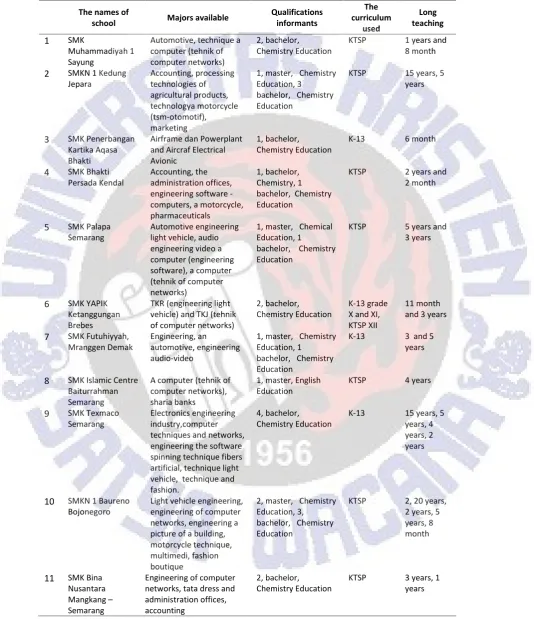
Tabel 1.Sumber informasi.
The names of
school Majors available Qualificationsinformants
2.2 Data analysis techniques
Data collection is was done with the questionnaire, technique instrument using poll compiled in a well-structured. Adoption of data activities combine model of Seels & Glasgow (1985), namely (1) phases of the collection of information; at this stage done the activity of collecting the information from the informants, informants characteristics, data collection was focused on two groups of information, which is about: (a) the informantsunderstanding of the concept and the position of chemical materials in vocational high schools , (b) needs, urgency and smoothness the chemical assessment system of adaptive materials. (2) inequalities; the gap between phases of identification, rules material in direct government on chemical as adaptive or basic material fields of expertise. (3) analysis of; this stage performance done to understand a information and identify the gap. Identified that can be resolved through gaps where planning that other problem solving that. (4) identification of obstacles and a source of; in this phase the implementation of a program various obstacles can appear so it can impact on the smooth a program.Various obstacles can include of time, facilities, material, and so forth. Its sources can also of organizing, facilities, and funding. (5) identification of purpose; identify the purpose is one of the stages important assessment needs, because the process of selecting identify the purpose is considered most urgent to solve appropriate for the conditions, as not all th In general, the data output in the form of Guyette (1983) more used a combination of quantitative in the form of numerical data, and qualitative data in the form of descriptive needs of be the goal.
3. Results and discussion
a) The knowledge the teacher on the chemical materials in adaptive
Understanding of vocational teachers (informants) in the field of the position of the chemical as adaptive materials is very important as the initial knowledge of the analysis. System development needs adaptive assessment of chemical material. From interviews with informants can be concluded that 28 informants in vocational were understood that chemistry is different from high school, 3 informants less understood and only one person were indifferent to the position of the chemical as adaptive image material can be seen in Figure 1.
Figure 2.Informants opinions about domicile chemical material in SMK.
c) Creativity teachers in implementing the learning material chemistry as adaptive. From the five teachers who have tried made a specialty chemical modules for each course of study, Only two people continue to implement the ever created, but when this study done none teachers continue the materials.
d) Obstacles teachers on the implementation of learning chemical as adaptive materials can be concluded as follows
1) 100% of informants stated that the lack of time to explain chemistry, the main reason for treating chemical as a material adaptive learning, a lot of material but not enough time available, although teachers try to increase the hours of lessons at another time, but it does not solve the problem. Especially for vocational schools that implement the curriculum in 2013 that cut hours but never cut material. 2) 80% of informants stated that the chemical material in SMK have two different
goals, as adaptive materials and matter to proceed to a higher school. This gives legitimacy that the teachers more teach chemistry in vocational high school the same as in the high schools, in this case Do not violate the rules or clues from the prevailing regulations.
3) 50% of informants stated that vocational students focusing more productive material or program expertise. Vocational high school students said chemical lessons in SMK difficult and material that should be studied very much. They also viewed that chemical material does not include the material to be tested in a final exam.
4) 90 % of teachers said that / module of teaching materials specifically to adaptive material rarely even 100 % of informants said there were no of teaching materials that specifically discuss material chemical as adaptive who applies specifically to certain fields of expertise.
e) Assessment needs teachers about chemistry as adaptive material in SMK
Complaints and see the reality in the field of 100 percent said that they really need the system modules and judgment that they would function of chemical material in vocational school.
4. Conclusion and remarks
The results of this research stated that the assessment system is needed to the sustainability of chemical material adaptive as of matter in school .The needs of the procurement very urgent and important to be implemented. The function of the subject chemical as adaptive (KTSP) and the base of fields of expertise (K-13) has understood by teachers in vocational high schools, but the implementation and conformity to productive subjects with adaptive are rare. This showed the need for system of learning and assessment as mandated in the constitution of indispensable.
References
Depdiknas (2006).Permendiknas No. 22 Tahun 2006. Jakarta: Depdiknas Depdiknas (2006).Permendiknas No. 23 Tahun 2006. Jakarta: Depdiknas
Anderson, G. (1994). A proactive model for training needs analysis. Journal of European Industrial Training,18(3), 23 28.
Guyette, S. (1983).Community-based research. Los Angeles: University of California American Indian Studies Center.
English, F.W., & Kaufman, R.A. (1975),Needs Assessment: A Focus for Curriculum Development. Seels & Glasgow (1985).Making instructional design decisions. Merrill Publishing Co.
McNeil, J.D. (1985).Curriculum: a comprehensive introduction. United States: Little Brown.