Approval ………..……….. i
Declaration ………. ii
Abstract ……….. iii
Acknowledgement ……….. iv
List of Figure………. vi
Table of contents ………. vii
CHAPTER I INTRODUCTION 1.1 The Background ...………. 1
1.2 The Definition of the Terms ………. 3
1.3 The Statement of the problems ……….. 4
1.4 The Purpose of the Study ……….………. 5
1.5 The Significance of the study ……… 5
1.6 Assumption ……… 5
1.7 Hypothesis ………. 6
1.8 Research Methodology ……….…. 7
1.9 The setting and Samples of the Study ……….….. 9
1.10 The Organization of the Thesis ……….…. 11
CHAPTER II REVIEW OF LITERATURE 2.1 The Importance of Listening for EFL learners ………. 13
2.2 Definition of Listening ……… 15
2.3 Bottom Up and Top Down Process ……….. 18
2.5 Listening Purpose ……….. 24
2.6 Input ……….. 25
2.7 What Makes Listening Difficult? ………. 28
2.8 Listening Principles ……….. 31
2.9 Teaching Listening Procedures ………. 34
2.10 Types of Classroom Listening Performance ………... 37
2.10.1 Reactive Listening ……….… 37
2.10.2 Intensive Listening ……….… 37
2.10.3 Selective Listening ……… 38
2.10.4 Responsive Listening ……….… 38
2.10.5 Extensive Listening ……….….….…. 38
2.10.6 Interactive Listening ……….…….…… 39
2.10.6.1 What is Interactive Listening? .…...… 39
2.10.6.2 How does It Work? ………...… 40 2.10.6.3 How is It Applied …….……….…….. 42
CHAPTER III RESEARCH METHODOLOGY 3.1 Research Design ……… 44
3.1.1 The design ……….…….……….. 44
3.1.2 The setting and Samples of the Study ……….... 45
3.2 The Variables of the Study ……….. 46
3.3 The Teacher ………..….….. 46
3.4 Listening Teaching Materials ……….……..… 47
3.7 Data Collecting ……….…………. 50
3.8 The Reliability of the Test ……….……..…… 52
3.9 The Difficulty Level of the Test ……….………. 54
3.10 Data Analysis ………... 55
3.10.1 The Data Analysis of the Test …... 55
3.10.2 The Data Analysis of Interactive Listening Process ……….………..…… 57
3.10.3 The Data Analysis of the Questionnaire …….. 57
3.10.4 The Data Analysis of the Interview …….……. 58
3.10.5 The Data Analysis of Linguistic Evidence …… 59
CHAPTER IV FINDING AND DICUSSION 4.1 The Gain of Experimental and Group ……….. 60
4.2 The Result of the Data Analysis of Interactive Listening Process ………..… 61
4.3 The Result of the Data Analysis of Questionnaire……….. 63
4.4 The Results of the Data Analysis of Interview ………. 69
4.5 The Result of Data Analysis of Linguistic Evidence …. 75 CHAPTER V CONCLUSION AND SUGGESTIONS 5.1 Conclusion ……… 104
5.2 Suggestions ……….. 105
APPENDIXES
Appendix 01 Basic Competences
Appendix 02 Listening Material
Appendix 03 Lesson Plan
Appendix 04 The Script of listening Comprehension Test
Appendix 05 The Paper Test
Appendix 06 Questionnaire
Appendix 07 Interview
Appendix 08Reliability and Difficulty Level of the Lest.
Appendix 09 The Sore of Pre-test and Post-test
Appendix 10The gain of experimental and control group
CHAPTER 1
INTRODUCTION
1. 1 The Background
The outset of the inquiry on this study occurred when the lecturer of English
Curriculum Analysis, MR. Didi Suherdi, assigned us to do teaching practice at school
and the executor of the teaching practice and teaching topic depended on each group.
Unintentionally, the researcher was appointed to become the executor of the teaching
practice at that time.
The teaching setting was an Islamic school. Its name is Maal-Ihsan
Balaendah in Bandung. The participants of the teaching practice were the tenth class
and the language skill taught was listening integrated with speaking activities. Such
teaching was often conducted by the researcher during teaching in SMA Negeri 1
Serui (one of senior high schools in Kepulauan Yapen Regency.
Surprisingly, the students were very interested in the way of teaching. They
were more active and enthusiastic during the class.
However, Yarusman (2004) claims that a great number of students
complained doing listening in the classroom. The teaching strategies applied in
teaching of listening were inappropriate for them, or the classroom is not conducive,
(Widyanto, 2000). The cases had a controversy with the researcher’s teaching
experience. The controversy encouraged the researcher to do an investigation on
Another thing that attracted the researcher to do an investigation on teaching
of listening was the language exposure, (Falks, 1978). It is the core of people’s
language development. Talking about language exposure, of course, is closely related
with talking about the importance of listening in people’s language development.
There are four main reasons why language exposure has important role for
people’s language development. The first, it becomes the input. It is any spoken
language heard by the people. It can be interactional conversation, interpersonal
conversation, monolog, a simple sentence, or even a word. All of these become the
materials for people’s language development
The second reason, the language exposure involves mental process of the
hearer. It is related with the people’s brain. The brain becomes the instrument which
processes the raw materials entering to people’s ears. Not all of them will be
processed in the people’s brain. They depend on people’s needs and interest, (Rost,
2002).
The inputs processed and kept in the brain become the intake, or language
inner ability. They are structured in the head and become a language chip. It becomes
the regulator for the coming language inputs and language outputs. The language chip
occurs in the head and can not be seen. Its work is very fantastic. This is the third
point hidden in language exposure.
The last reason is the intensity of language exposure heard. It refers to the
quantity of inputs coming into the people’s ears. The more people have language
words, with the intensity of listening in the classroom the second or foreign language
learner will have significant language development. This reason becomes the main
concern that motivated the researcher to do an investigation in teaching of listening.
Type of listening performance that can give intensity in language exposure or
listening exposure for the second and the foreign learner is just Interactive Listening,
that is, the teaching of listening integrated with speaking activities. In this type of
listening, the learners can have more language exposure or listening exposure from
the recorded aural texts, friend’s talking, and the teacher talks. The learner’s process
of comprehending can be complete if they are involved in speaking activities,
(Brown, 2001). In other words, Interactive Listening can be effective to develop
student’s listening ability.
Therefore, the researcher’s assumption of the Interactive Listening that could
develop student’s listening ability becomes became bigger. It strengthened the
researcher’s inquiry to make an investigation titled “DEVELOPING THE
STUDENT’S LISTENING ABILITY THROUGH INTERACTIVE LISTENING”. In
order to find out whether the Interactive Listening was affective to develop the
student’s listening ability, the writer executed a true experiment to the eleventh class
of a Senior High School in Serui in Kepulauan Yapen (one of provinces in Papua.)
1.2 The Definition of the Terms
The research is about “Developing the Student’s Listening Ability through
Interactive Listening”. The terms on it are needed to define to avoid misinterpretation
1. Developing means the effort to make better
2. The students are those who are still learning in the eleventh class of SMA
Negeri 1 Serui.
3. Listening ability means competence in comprehending English spoken
language or aural texts
4. Through means by way of
5. Interactive listening means the listening performance integrated with speaking
activities.
With the terms defined above, it can be inferred that developing the student’s
listening ability through Interactive Listening means the effort to make better the
learner’s competence in comprehending the aural texts or spoken language through
listening performance integrated with speaking activities
1. 3 The Statement of the Problem
Based on the background of the study, There is a space for Interactive
listening to be investigated. The main focus in this research was to develop the
student’s listening ability and to support it the student’s performance was integrated
speaking activities. Therefore, the research questions that would be answered through
this true experiment were as follows:
1. Is Interactive Listening effective to develop the students’ listening ability?
2. How does Interactive develop the student’s listening ability?
1.4 The Purposes of the Study
Referring to the statements of the problem above, the study attempts to find
out:
1. If Interactive Listening effective to develop the student’s listening ability.
2. How Interactive Listening develops the student’s listening ability
3. What encourages the student’s involvement
1.5 The Significance of the Study
Listening has an important role in language development whether it is as a
first language, or second language, or foreign language. It also supports the acquiring
of the other language skills, in particular speaking skill. Beside that it is also a vital
means of passing the national English test for the students.
This research is about developing student’s listening ability. Its findings, of
course, would give direct contribution to both the learner’s language development
and successful achievement in national test, in particular for the students of Senior
High Schools in Serui. The findings also give better English teaching improvement in
the future in particular in teaching of listening.
The findings also give wide space to the coming researcher who would like to
do a research in the same topic in broader scope, and they can be used as reference.
1.6 Assumption
The case investigated was “Developing Student’s Listening Ability through
enough knowledge about the topic. Beside that, the researcher also has already had
the knowledge of doing research. The population of the study was the student of
senior high school who were sitting in the eleventh class of science program. They
had already gotten Basic English Knowledge. So, it was believed could be
accomplished well
1.7 The Hypothesis
“An analytical research should present hypothesis”, (Kartadinata, 2007: 52).
The hypothesis is a tentative statement of expected relationship between two or more
variables, (Millan and Schumacher, 2001). This study is quantitative in nature which
uses a true experimental design of which the sample students were randomly selected.
The Interactive Listening was given to the experimental group, while the control
group was given non-Interactive listening or conventional one.
Through the research it was expected after a treatment, there would be a
difference in listening ability between the sample students taught with Interactive
Listening and the sample students taught with non Interactive Listening. In other
words the sample students taught with Interactive Listening had better listening
ability than the sample students taught with non-Interactive Listening or conventional
one.
Because of it, null hypothesis was adopted as the hypothesis of the research,
that is, there is no difference in listening ability between the sample students drawn
between the sample students taught using Interactive Listening and those taught by
the conventional one. The evidence that emerges with this prediction can not be
conclusive grounds for accepting the hypothesis. However, if the evidence is
inconsistent with the hypothesis is good enough grounds for describing it, (Farhady,
1982).
The study is also supported by descriptive data. It aims to find out more about
the interactive listening. However, the research questions dealing with it are not
formulated in another hypothesis statement, (Kartadinata, 2007)
1.8 Research Methodology
The study uses a quantitative paradigm. It is a true experimental design using
pretest posttest control group. In this design the sample students are randomly
selected. It is discussed in details in chapter three.
Farhady (1982: 1) defines that “a research is as a systematic approach to find
answers to the questions”. It means all the activities before doing a research should be
planned systematically, as the efforts done systematically can give systematically
effect, (Sudjana, 2005). To find out the answers to the research questions, the
researcher also does the same thing, that is, systematic research actions.
The systematic activities done by the writer ranging from the outset of the
Figure 1.1
The Diagram of Research Activities 1. Determining the focus
2. Review of Literature
3. Formulating the problem in a question form
4. Determining research paradigm
5. Determining data collection
6. Determining data analysis
7. Visiting the setting
8. Determining the sample students randomly
9. Recorded the listening script
10. Trying out the test
12. Pre-test
13. Analyzing the initial difference of sample students
14. Treatment
15. Data Gathering
Post-test
Interview
Questionnaire
Linguistic Evidence
Videotaping of Interactive Listening Process
16. Analyzing the data
17. Reporting the results
1.9 The Setting and Samples of the Study
The setting of this study is a senior high school. Its name is SMA Negeri 1
Serui. It is located in a small town of Yapen Waropen Regency and now becomes
legally opened in March, 11th 1969 together with the establishing of Yapen Waropen
as definitive regency. Although it school legally opened, it did not have teachers yet.
Because of it this school was closed until 1970 to recruit the teachers. It operated in
1971. It had only one class, and the teaching process was held in the afternoon. In
1972 it got two government teachers. In 1973 the government established its name
SMA Negeri 417 and in the same year it succeeded graduating its first output.
In 1990 this school’s name changed into SMA negeri 1 Serui. In 1998 its
name changed again into SMU negeri 1 Serui. In 2004 its name changed again into
SMA Negeri 1 Serui until now.
Now this school has become a big school. It has twenty one classrooms, five
laboratories (chemistry laboratory, physic laboratory, language laboratory, biology
laboratory, and computer laboratory), a hall for MGMP, counseling room, a library
and a canteen. It has forty seven teachers and one thousand and five students. They
are spread out in each level. The twelve years students consist of three hundreds and
seven students that are divided into ten classes. The eleven year students consist of
two hundreds and fifty two students that are distributed into seven classes: five
classes for science program and three classes for social program. The twelve year
students consist of four hundreds and fifty nine students that are distributed into nine
classes: five classes for science program and four classes for social program.
The Population of the study was those who sat in the eleventh class of science
program. They were divided in five classes: science program one, two, three, four,
class of science program one became the experimental group and consisted of thirty
one students. The eleventh class of science program three was control group. It also
consisted of thirty one students.
1. 10 Organization of the Thesis
The organization of the thesis is started with declaration, abstract, list of
appendix, and contents. The thesis consists of five chapters. And each chapter is
organized as follows:
CHAPTER ONE
The Background, The Definition of the Terms, The Statement of the Problem, The
Purpose of the Study, The Significance of the Study, The Assumption, The
hypothesis, Research Methodology, The Setting and Sample of the Study, and the
Organization of the Thesis.
CHAPTER TWO
The Importance of Listening in EFL learners, The definition of Listening, Bottom up
and Top down Process, Principles of Instructional Design, Listening Purpose, Input,
What Makes Listening Difficult, Listening Principles, Teaching Listening
CHAPTER THREE
The Design, The Setting of the Sample, The Study, The Variables of the Study, the
Teacher, Listening Teaching Materials, Teaching Procedures of Interactive Listening,
Treatment, Data Collection, The Reliability of The Test, The difficulty Level of The
Test, Data Analysis of the Test, Data Analysis of Interactive Listening Process, Data
Analysis of questionnaire, Data Analysis of interviews, Data Analysis of Linguistic
Evidence.
CHAPTER FOUR
The Gain of Experimental and Control Group , The Result of the Data analysis of
Interactive Listening Process, the Result of the Data analysis of Questionnaire, and
The Result of Data Analysis of Interview.
CHAPTER FIVE
CHAPTER 3
RESEARCH METHODOLOGY
3. 1 RESEARCH DESIGN
3. 1. 1 The Design
It has already been mentioned in Chapter One that the research applied
quantitative paradigm with a true experimental design with pretest posttest control
group design. The quantitative paradigm advises researcher to plan a research
systematically to obtain a meaningful interpretation of the results of the study. In
order to find out a meaningful interpretation of the results of the study, data gathering
procedures should be done with care, (Farhady, 1982) and the concept of validity
should be considered.
In this design, data gathering procedures had already been done with care by
paying attention to the validity of the research, such as, considering some factors
which could effect of the research validity.
To preserve validity of the study some factors (test effect, subject selection,
and history) were controlled in this design. To avoid the test effect, the test was tried
out in advance, and then its results were analyzed to determine reliability and
To avoid the effect of subject factor, the sample students who were drawn
from the population were randomly selected. To determine who was in experimental
group or control group were also randomly selected.
A pretest was also administered to both experimental group and control group.
It was conducted before the treatment. Its purpose was to find the initial variances
between the experimental group and control group. At the end of the sessions, a
posttest was given to both experimental group and control group.
To avoid the history effect, the back ground of English capability of the
sample students was also identified. Based on the identification, none of the sample
students had superiority in English ability. All of the sample students were at the
same level. Their English knowledge was just obtained from formal study.
3.1. 2 The Setting and Samples of Study
The study setting was a Senior High School in Serui. It is located in Serui
town. It is in Kepulauan Yapen Regencies (one of regencies in Papua Province). The
population of the research was students in the eleventh class of science program. It
consisted of five classes. They were science program one, two, three, four, and five.
All of the classes had the same chances to become sample students. However,
two of them should be determined as sample students. To get the sample students a
lottery was given to the five classes. Two of them were randomly selected to become
as sample students of the study using clustering sampling. When the sample students
experimental group and control group. One piece of the lottery was written on it
experimental group and another piece was not written at all. Those who took the a
lottery written experimental group on it become group experiment and those took the
blank one became group control.
From the lottery given, finally, the eleventh class of science program 1 was
randomly selected became group experiment and the eleventh class of science
program 3 became group control. Unfortunately, the two groups had equal number in
the quantity, that is, thirty one students each.
3.2 The Variables of Study
Based on the title of the thesis, there are two kinds of variables in it. The
interactive listening is as independent variable which was manipulated to give the
effect on the dependent variable. The dependent variable is student’s listening ability
which was observed and measured to determine of the effect of the independent
variable, (Farhady: 1982). Based on the variables observed and measured, this
research has got three dependent variables: if the interactive listening is effective to
develop the student’s listening ability, what makes interactive listening able to
develop student’s listening ability, and what provokes the student’s involvement.
3. 3 The Teacher
The treatment for both group experiment and group control was executed by
the researcher himself. It was conducted so to avoid unfair treatment. Beside that, the
the teacher in that school. It was also unlikely for the researcher to teach one of the
teachers to become the executor of the treatment due to limited time.
The role of the teacher in the process of teaching listening was a model,
motivator, and facilitator. Teacher as a model means the teacher gave the example or
a model to how to do the task. Teacher as a motivator means that in the process of
teaching listening, he often encouraged the students to do the tasks more enthusiastic
by giving verbal rewards. And teacher as facilitator means the teacher did not
dominate the class. He was only a helper to make the students more understandable
and able to do the tasks.
3. 4 Listening Teaching Materials
The instructional objectives of the interactive listening were adopted from the
Standard of competence for listening skills at eleventh class level. To cover the
objectives, the researcher adopted authentic listening materials and the listening tasks
were developed based on the principles of teaching interactive listening.
The authentic listening materials were adopted from the following sources: 1)
English Alive 1, 2) English Alive 2, 3) Listening Student’s Book 1, and New English
Course 3 Part A. Those listening materials were suited with the level of student’s
3. 5 Teaching Procedures of Interactive Listening
The teaching procedures of Interactive Listening were a relatively standard
format for the listening lesson developed at this time: Pre-listening, Listening or
while-listening, and Post-listening. The teaching activities in each stage are
explained as follows:
Pre-Listening
Dealing with activating the student’s prior knowledge
a) Greeting the students
b) Making students feel more comfortable
c) Attracting students’ attention: brainstorming vocabulary, questions and
answer, answering questions based on the picture, etc.
Listening or While-Listening
Dealing with listening process
a) Listening text through cassettes
b) Do speaking activities prepared by the teachers.
c) In this stage, the teacher also did diagnostic activity and doing remedial
exercises
Post-Listening
Dealing with listening product
a) Performing a dialog
3.6 The treatment
Both the experimental group and the control group got a treatment. However,
they got different treatment. The experimental group got Interactive Listening. It
means the students were asked to get the information from the spoken language or
aural text. Besides, the student’s performance is also integrated with speaking
activities. The control group got the conventional one. The conventional means the
usual way of teaching listening conducted in language classroom, that is, asking the
students to find out certain information from the spoken language or aural text the
students have just heard. The two groups got the same materials and teaching
procedures (pre-listening, while listening, and post- listening).
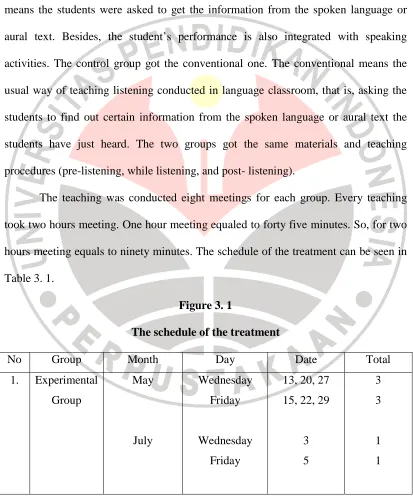
The teaching was conducted eight meetings for each group. Every teaching
took two hours meeting. One hour meeting equaled to forty five minutes. So, for two
hours meeting equals to ninety minutes. The schedule of the treatment can be seen in
The total 8
Referring to the research questions of the study, data gathering was conducted
through pre-test, post-test, videotape of Interactive Listening process questionnaires,
interview, and linguistic evidence.
The pre-test and post-test used the same test. The test was a listening
comprehension test. The test type was multiple choices with five options. It consisted
twenty five items. The test was divided into four sections. Section one was about
statements with pictures. It consisted of two items. It ranges from the item number
one up to number two. Section two was about questions and responses. It consisted of
four items. It ranges from the item number three up to number six. Section three was
about short conversation. It consisted of nine items. It ranges from the item number
seven up to fifteen. Section four was about short talk. It consisted about ten items. It
There were some phases conducted in constructing the test. The first phase
was determining the teaching material and identifying linguistic properties due to
teaching objectives to be tested and then put them into a specification of a test. The
second phase was constructing the items in cards. The third phase was editing them in
paper test. Because it was edited a listening comprehension test, the transcript of the
test was also recorded. It was recorded in TVRI station in Serui. The last phase was
trying out of the test.
Trying out of the test was intended to find out about the reliability and the
difficulty of the test. The level of reliability and difficulty of the test are meant to
indicate if the items of the test needed change or not.
The trying out of the test was conducted on the 8th May 2009. The object of
the trying out was the eleventh class of science program of SMA Negeri 1 Serui and
this class was not included as the samples students of the study.
The questionnaire is about the things related with the Interactive Listening
(see appendix 05). The type of the interview is aptitude test. It means the sample
students were asked to make a check list to the option they thought or felt was better.
The test was given to the experimental group only. The questionnaire has sixteen
items and five options. And the options are strongly agree, agree, undecided,
disagree, and strongly disagree.
Another instrument used to collect the data is interview (see appendix 06).
Interactive Listening. The interview consists of four questions. The interview was
given to the experimental group only.
Collecting linguistic evidence was also conducted in this design. It deals with
the inquiry of how many sample students had performed well and how many sample
students still did not perform well in pretest and how many samples students had
performed well and still did not perform in posttest and factors that might cause the
sample students did not perform well in the post test, and which of the listening skills
were found more difficult for them
3. 8 The Reliability of The Test
The test was tried out before it was determined as the fixed instrument in this
study. It was not tested to both experimental, or control group. It was tested in the
class ,not included, as the sample students. The purpose of trying out of the test in
this design was to find out the reliability and difficulty level of the instrument. “The
test reliability refers to the consistency of the measurement”, Millan and Schumacher
(2001: 181). The consistency of an instrument can give validity to the data gathered.
Developing the reliability of an instrument is to minimize the influence of the score
chance or other variables unrelated to the intent of the measure.
The method applied to measure the reliability of the test used the
Spearman-Brown test. According to Gronlund (1976: 110) “Split-Half Method is the measure
of internal consistency”. So the estimation of the reliability of test tried out used the
2 x Reliability on ½ test
Reliability on full test = --- 1+ Reliability on ½ test
To compute reliability based the Spearman Brown Formula was conducted by
dividing the test into in half for scoring purposes. To split the test into halves which
were most equivalent, the usual procedure was to score the even-numbered items and
the odd-numbered items separately. This provided two scores for each pupil which,
when correlated, provided a measure of internal consistency. This coefficient
indicated the degree to which the two halves of the test equivalent. This coefficient
was determined by correlating the scores of two half tests.
And the criteria used for the reliability index of the full test (Rn) are as
follows:
a. Index test is 0.00 < Rn < 0,20 (very low reability)
b. Index test is 0.20 < Rn < 0,40 (low reability)
c. Index test is 0.40 < Rn < 0,60 (medium reability)
d. Index test is 0.60 < Rn < 0,80 (high reability)
e. Index test is 0.80 < Rn < 1,00 (very high reability)
Base on the computation of the score of the test tried out, the reliability of the
test t indicated 0.674 level.the reliability. Refering to the criteria of index text of the
realibility above that the The position of the reliability of the test tried out between
0.60 < Rn < 0,80. It means the reliability of the test tried out had high reliabilty. It
had high consistency. This instrument had fulfilled a prerequisite to measure the
3. 9 The Difficulty Level of The Test
A good test is a test that can measure the good and poor students. To know if
the test suits for the poor and good, the difficulty level of the test shoud be measured.
So, before the test was determined as an instrument for this of thi research its
difficulty level was measured in advance. The following is the formula used to
measure the difficulty level of the test tried out:
= 100%
Where
TK = the difficulty level of the test
nB = sum of the students are right answer
N = sum of the students
And the criteria used to determine the difficulty level of the test as follows:
a) 0 % - 15 % (very difficult)
b) 16 % - 30 % (difficult)
c) 31 % - 70 % (medium)
d) 71 % - 85 % (easy)
e) 86 % - 100 % (very easy), (Karnoto, 1996
)
Based on the computation of the difficulty level of the test, the difficulty level
of the instrument fell between 31 % and 37 %. It indicated that the difficulty level of
the test was at medium level. In other words, the test was able to measure the poor
3. 10 Data Analysis
The data analysis conducted in this reseach was based on the types of the data
collected. Refering to the data gathering of the study there there are five knids of data
,such as, pre-test data, post-test data, Additional analysis was also conducted in this
design, that is, the linguitic eveidance. The data analysis was conducted as follows:
3. 10. 1 Data Analysis of the Test
It was mentioned above that there were two kinds of data: pre-test and post
test data which experimental and control group obtained before a treatment. The
pre-test was analyzed using t-pre-test. It was meant to find out the equality of experimental
group and control group in listening ability. One of a prerequisite of t-test is the
pretest data of experimental and control group must be in normal distribution.
However, the normal distribution of pre-test data was not computed in this
design because sample students of experimental group and control group were more
than thirty for each. For thirty or more sample students is assmued that the data is
nomally distributed, (Farhady, 1982)
The pre-test data gathered from the experimental group and control group was
also inteded to know the equal mean of both groups. if the different mean of
experiemntal group and control group are significantly different befrore the treatment
done, it can be assumed that the effect is not caused by the treatment but the varience
itself. That’s why, in this reseach design, the equal mean of the experimental group
To compare the equal mean of the pre-test in this design uses independent
t-test and (Sarwono, 209). Based on the pre-t-test data gathered (see appendix 08) that
both experimental group and control group consists of thirty one for each. The total
score of experimental group was 1352. Its avarage was 43.61 and its standard
deviation was 16.11. The total score of control group was 1396. Its avarage was 45.00
and its standard deviation is 17.00. The Std Error Difference between means of the
pretest was 4.2 and t value was - 0.3309 with df = 60 of the t-table at .05 level of
significance for two tailed test is 2.000. It indicates that t-value of pretest is lower
than t-table. It is on negative direction, but it is still in the critical value of t-table. It
means that sample students are truly drawn from the same population. In other words,
the experimental and control group have relatively same listening ability before the
treatment done.
The post-test data gathered was analayzed with independent t-test too. In the
process of analyzing the post-test, the researcher did not count directly the posttest
score in the t-test. The process of analysing the posttest score was coducted by
getting the gain of the experimental group and control group (see appendix 09).
The reason why the gaing was conducted as computation base was
pretennding a sample student of experimental group gets 30 score in pretest and 60
score and a sample student of control goup gets 60 score in pretest and 75 score in
posttest, and if we look at the socre in a glance, we will say the sample student of
experimental group is bettet though his/her score is lower. So, computing the gain of
experimental group and control group is more accurate.
The intention of analyzing the gain of experimental group and control group
was to find out if the effect of sytematically treatment done between experimental
and control group was significant or not.
3.10.2 Data Analysis of Interactive Listening Process
Data analysis of Interactive Listening Process was based on the videotaping of
the Interactive Listening Process. It was conducted by listening the raocrded teaching
listening process and choosing two meetings as the representative for all sesisons.
The first and the firth meetings were chosen as the representatives for all sessions.
The anaylis was done by listening to the two recorded sessions and put them
in a transcription. The transcription was cetegorized into Teacher’s Talk with no
Response, Teacher’s Talk with Non-Verbal Response, Teacher’s Talk with Student’s
Response, Student – Student Response, Student’s Talk with No – Response, and
Tape’s Talk with Student’s Response.
3. 10.3 Data Analysis of Questinnaire
Every item of the questinnaire has five options and each option has a degree
raging from five to one: strongly agree has five score, agree has four score, undecided
had three score, disagree had two score, and strongly disagree had one score. The
lower and the upper score, and putting them in percentage. The percentage was
obtained from the number of the students choosing a certain option divided by the
total items multipflied by 100 %..
The criteria of interpreting the analyzed data uses the following criteria:
a) 0 % - 20 % (very weak)
b) 21 % - 40 % (weak)
c) 41 % - 60 % (enough)
d) 61 % - 80 % (strong)
e)
81 % - 100 % (very strong)3.10.4 Data Analysis of Interview
The analysis of interview data was done by getting a sense as the whole and
some ideas that attract the researcher’s mind, picking up the most interesting and
writing the thoughts in the margin, making them in a list of all topics, and clustering
tothether the similar topic. From these topics into columns that might be arrayed as
major topics, unique topics, and leftovers, then grouping them that relates to each
other.
The next phase, assembling the data interview which belongs to each category
and then perform the analysis. After the performing the analysis, the reseacher
interpretes it to find out what interaction provokes the sample students in the
3.10.5 Data Analysis of Linguitic Evidence
The procedure of analying the liguistic evidence was conducted by
transcribing types of liguitic proverties in each item, and then determining the total
number of the sample students who have performed well and still do not perform well
in pretest and the total number who have performed well and still do not perform well
post test. And those who still did not do well in posttest in certain item was analyzed
to find out the factors that might bring about the case linguitically. The analysis of
listening skills was also included in the analysis linguistic evidence. It was aimed to
CHAPTER 5
CONCLUSION AND SUGGESTIONS
5. 1 CONCLUSION
Teaching of listening in senior high school still preserves many problems. The
problems, of course, are caused by many factors as well. The problems appearing
vividly in there are the English teachers more often use Indonesian than English in
English instruction and teaching of listening is seldom conducted in English language
classroom although the importance of listening in learner’s language development has
been realized. Because of it, the students have poor listening ability.
Teaching of listening which is integrated with speaking tasks or speaking
activities is seldom conducted in the classroom. It can be seen from the students’
difficulty in giving the responses toward the spoken language or aural text they have
heard. They are prone to keep silent or to give short responses using yes no answer.
However, based on the results of data analysis obtained from sample students’
gain (the difference of score of posttest and pretest of experimental and control
group), the students’ perception, attitude, or ideas towards Interactive Listening and
its speaking task, and the linguistic evidence, some conclusion can be drawn as
follows:
1. Interactive Listening (listening performance integrated with speaking
2. Speaking activities which are developed from spoken language or aural text
that the students have just heard and the quantity of language exposure they
hear during the listening class make Interactive Listening more effective to
develop student’s listening ability.
3. Speaking activities involving student – student in response exchange in a
dialog more provoke the student’s involvement in the class.
4. The main factor causing the student’s difficulty in getting the information
(match statement with picture, identifying certain information, making
inference of the setting of the conversation and the speaker’s job, getting
implied meaning, and getting main idea or topic) is the student lacks of
English vocabularies.
5. 2 SUGGESTIONS
The students of Senior High school still face many difficulties in developing
their listening ability. Their English teacher still have tendency to use Indonesian in
as means of English instruction in the classroom. It becomes one of barriers for them
to develop their listening ability. They hardly find as a language model for them to
imitate in their daily interaction and even in the classroom. Teaching of listening is
seldom conducted in English class. In addition, they lack of English vocabularies.
Based on the problems mentioned above, it is suggested the English teacher,
in particular the English teachers of Senior High School in Serui, to conduct the
following activities:
1. Using English in the classroom can enhance the students’ interest in learning
English. It also can develop their listening ability. So, the English teacher should use
English as a means of English instruction in language class.
2. Listening has importance role for learner’s language development. Therefore,
listening should have priority in teaching of English.
3. Teaching of listening integrated with speaking activities can enhance the student’s
listening ability. It is suggested the English teacher should apply it in developing the
student’s listening ability.
4. The main point in interactive listening lies on the quantity of language exposure
heard and response exchange in the form of a dialog developed from spoken
language or aural text that the students have just heard. And response exchange in the
form of dialog can provoke more involvement in the class. So, the language function
in the spoken language or aural text should be developed in the form of a dialog.
5. One of the successful keys in studying a foreign language is the student mastering the
meaning of lot of vocabularies. It is suggested the English teacher should develop the
student’s English vocabularies. It should be integrated in teaching of the four main
REFERENCES
Abdul Hmid, F. (2001). TEFLIN in Indonesia: Policy and Development. Seminar on
Specific English Indonesians. Maranatha Christian University. June 25, 2001.
Anderson. A. and Lynch. (1988). Listening. Oxford: Oxford University Press.
Admin. (200). “Interactive Listening-Speaking”, in Teaching English. BBC World Service.
Arnold, E. (1979). English Alive 1 and English Alive 2. Edward Arnold Ltd.
Barnes, D. and Todd, F. (1997) Communication and Learning in Small Groups. London: Toutledge & Kegal Paul.
Broughton, G. et al. (1978) Teaching English as a Foreign Language. MA: Routlege Education Books.
Brown, D. H. (1994) Principles of Language Learning and Teaching. New Jersy: Prentice Hall Inc.
___________. (2001). Teaching by Principles: An interactive Approach to Language
Pedagogy. San Francisco State University.
Call, M. E. (1985) “Auditory Short-term Memory, Listening Comprehension and Input Hypothesis.” TESOL Quarterly 19(4): 765-781.
Chien, C.N. and Li Wei. (1998). The Strategy Use in Listening Comprehension For
EFL Learners in Taiwan. RELC Journal Vol 28 No. 1 June 1998
Cohen, A.D. (1994) Assessing Language Ability in the Classroom. M.A: Heinle and Heinle Publisher.
__________. (1998) Strategies in Learning and Language Teaching. New York: Campman Hall, Inc.
___________. (1986) Handbook on Research on Teaching. Third Edition. Ed. Merlin. C. Wittrock. New York. Machmillian Publishing Company.
Cook, V. (1991). Second and Language Learning and Language Teaching. New York: Chapman Hall, Inc.
Cornelius, TE. (1992). New English Course Part 1A and 3A. Prentice Hall
Djiwandono, P.I. (1998) The Language Learning Strategies and Learning Styles of
Beginning and Intermediate Learners in Indonesia. TEFLIN Journal, Volume
IX. Number 1, August 1998.
Doff, A. and Becket, C. (2005). Listening. Student’s Book 1. Cambridge University Press.
Donald, R. (2009). “Interactive Listening and Speaking”, in Teaching English. BBC World Service.
Ellis, R. (1997). SLA Research and Language Teaching. Oxford: Oxford University Press.
Falk , SJ. (1978). Linguistics and Language: A Survey of Basic Concepts and
Implications. Michigan State University.
Farhady, H and Hatch, E. (1981). Research Design and Statistics for Applied
Linguistics. University of California. Los Angles. Newbury House Publisher.
Inc
Ferris, D. and Tracy T. (1996). Academic Listening/Speaking Tasks For ESL
Students: Problems, Suggestions, and Implications. TESOL Quarterly. Vol
30. No.2, Summer 1996.
Field, J. (2002). “The Changing of Face of Listening”, in Methodology Language
Teaching. And Anthology Current Practice. Cambridge University Press.
Fraenkel, J.R and Norman, E.W. 1990. How to Design and Evaluate Research in
Education. NY: McGRaw-Hill, Inc.
Gear, J. (1993). Cambridge Preparation for the TOFEL Test. Cambridge University Press.
Gebhard, GF. (1996). Teaching English as a Foreign Language. The University of Michigan.
Grafinkel, A. 1986. Listening Ability. Check it or Wreck it. Synder. B. (Ed). Second Language acquisitions. Lincoln wood: Reational Text Books.
Gronlund, EN. (1976). Measurement & Evaluation in Teaching. Macmillan Publishing Co, Inc.
Hadley, OA. (2001). Teaching Language in Context. USA: University of Illinois. Wendy Nelson.
Harmer, J. (2002). The Practice of English Language Teaching. Pearson Education Limited
__________. (2007). How to teach English. Pearson Education Limited.
Hornby, AS. (1974). Oxford Advance Learner’s Dictionary of Current English. Oxford: Oxford University Press.
Howat, A. and Dakin, J. 1974. “Language Laboratory Materials” Journal ed. J.P.B Allen, S.P.B Allen S.p. Corder
Johnson, K. (2001). An Introduction to Foreign Language learning and Teaching. Pearson Education.
Kartadinata, S.H. (2007). Pedoman Penulisan Karya Ilmiah. Universitas Pendidikan Indonesia Bandung.
Lam, KYW. (2002) “Raising Students’ Awareness of the Features of Real-World
Listening Input”, in Methodology Language Teaching. An Anthology Current Practice. Cambridge University Press.
Larser-Freeman, D. (1986) Techniques and Principles in Language Teaching. Oxford University Press.
Lestari, A.L. “English Classroom Culture Reformation: How can it done?” TEFLIN Journal. X. 1 Agustus 1999
Littlewood, W. (!981). Communicative Language Teaching. An Introduction. Cambridge University Press.
Lortier, D.C. 1975. School Teacher. Chicago. University of Chicago Press.
Long, D (1989). Second Language Listening Comprehension: A schema Theoreti Perspective. Modern Language Journal. P.32-40.
Matthews, A. 1999. Listening Skill. Journal of and Development in Education. Vol 28
number 2. Winter 1999. Athens – Gerogia.
Millian, J. and Schumacher, S. (2002). Research in Education. Addison Wesley Longman, Inc.
Morley, J. 1984. Listening and Language Learning in ESL. Developing Listening
Comprehension. New York: Bruce Jovanovich.
Murcia-Celce Marianne and Olshtain Elite. (2000). Discourse and Context in
Language Teaching. Cambridge University
Nunan, D. (2000). Language Teaching Methodology. A Textbook for Teachers. Pearson Education Limited.
________ (2002). “Listening in Language Learning”, in Language Teaching
Methodology. An Anthology in Current Practice. Cambridge University Press
________. (1995) Closing the Gap between Learning and Instruction. TESOL Quarterly Vol. 29. No. 1 Spring 1995.
Peachey, N. (2009). “A Framework for Planning a Listening Skills Lesson”, in
Teaching English. BBC World Service.
Persulessi, G. H. 1998. Listening Improvement for Students of English as a Second
Language. Jakarta Proyek Pembangunan LPTK Dirjen Dikti Depdikbud RI.
Richard, J.C. (1983) “Listening Comprehension: Approach, Design, Procedure”
TESOL Quarterly 17(2), 407 – 430.
Richards, J.C., et all Willy, (2002). Methodology in Language Teaching. An
Anthology of current Practice. Cambridge University Press.
Rivers, W. M. (1987). Interactive Language Teaching. Cambridge University Press
Rost, M. (2002). Teaching and Researching Listening. Person Education
_________. (1990). Listening in Language Learning. London: Longman
Rubin, J. (1990). Improving Foreign Language Listening Comprehension. Washington D.C. George Town University Press.
Sarwono, J. (2009). Statistik itu Mudah. Panduan Lengkap untuk Belajar Komputasi
Statistik Menggunakan SPSS 16. Andi Yogyakarta.
Sudjana. (2005). Metode Statistika. Tarsito Bandung.
Suryanti Yanti. (2002). Exploring Students’ difficulties in the Listening Classroom. Tesis Magister Pada English Department Pasca UPI Bandung.
Underwood, M. (1989). Teaching Listening. London: Longman
Ur, P. (1986). Teaching Listening Comprehension. Cambridge University Press.
Widyantmo. (2000). Developing Listening Skills through Small group Work
Interaction. Tesis Magister Pada English Department Pasca UPI Bandung.
White, G. 1998. Listening. Resource Books for Teachers. Oxford. Cambridge University Press.