Pengenalan
Bahasa Inggris
untuk
Pembelajaran
▸ Baca selengkapnya: kd bahasa inggris smp
(2)Pengenalan Bahasa Inggris untuk
Pembelajaran Matematika SMP
Penulis:
Drs. Rachmadi Widdiharto, MA.
Penilai:
Dra. Puji Iryanti, M.Sc.Ed.
Editor:
Sri Wulandari D., S.Si., M.Pd.
Ilustrator:
Victor Deddy Kurniawan, S.S.
Dicetak oleh
Pusat Pengembangan dan Pemberdayaan Pendidik dan
Tenaga Kependidikan Matematika
Tahun 2008
DEPARTEMEN PENDIDIKAN NASIONAL
KATA PENGANTAR
Pusat Pengembangan dan Pemberdayaan Pendidik dan Tenaga Kependidikan (PPPPTK) Matematika dalam melaksanakan tugas dan fungsinya mengacu pada tiga pilar kebijakan pokok Depdiknas, yaitu: 1) Pemerataan dan perluasan akses pendidikan; 2) Peningkatan mutu, relevansi dan daya saing; 3) Penguatan tata kelola, akuntabilitas, dan citra publik menuju insan Indonesia cerdas dan kompetitif.
Dalam rangka mewujudkan pemerataan, perluasan akses dan peningkatan mutu pendidikan, salah satu strategi yang dilakukan PPPPTK Matematika adalah meningkatkan peran Kelompok Kerja Guru (KKG) dan Musyawarah Guru Mata Pelajaran (MGMP) serta pemberdayaan guru inti/ guru pemandu/guru pengembang yang ada pada setiap kecamatan, kabupaten dan kota.
Sebagai upaya peningkatan mutu dimaksud maka lembaga ini diharapkan mampu memfasilitasi kegiatan-kegiatan yang terkait dengan implementasi pengembangan pembelajaran matematika di lapangan. Guna membantu memfasilitasi forum ini, PPPPTK Matematika menyiapkan paket berisi kumpulan materi/bahan yang dapat digunakan sebagai referensi, pengayaan, dan panduan di KKG/MGMP khususnya pembelajaran matematika, dengan topik-topik/bahan atas masukan dan identifikasi permasalahan pembelajaran matematika di lapangan.
Berkat rahmat Tuhan Yang Maha Esa, atas bimbingan-Nya penyusunan Paket Fasilitasi Pemberdayaan KKG/MGMP Matematika dapat diselesaikan dengan baik. Untuk itu tiada kata yang patut diucapkan kecuali puji dan syukur kehadirat-Nya.
Dengan segala kelebihan dan kekurangan yang ada, paket fasilitasi ini diharapkan bermanfaat dalam mendukung peningkatan mutu pendidik dan tenaga kependidikan melalui forum KKG/MGMP Matematika yang dapat berimplikasi positif terhadap peningkatan mutu pendidikan.
sampaikan pula kepada semua pihak yang membantu mewujudkan paket fasilitasi ini, mudah-mudahan bermanfaat untuk pendidikan di masa depan.
Yogyakarta, Kepala,
D
D
D
a
a
a
f
ft
f
t
ta
a
ar
r
r
I
Is
I
s
si
i
i
Kata Pengantar...
iii
Daftar Isi... v
Bab I
Pendahuluan
A.
Latar Belakang
...
1
B.
Tujuan Penulisan
...
2
C.
Ruang Lingkup Penulisan
...
3
D.
Cara Menggunakan Paket ...
3
Bab II
Greeting,Encouraging,And Closing Conversation
A.
Tujuan Pembelajaran
...
5
B.
Permasalahan ...
5
C.
Alternatif Pemecahannya
...
5
Tugas
1
...
11
Bab III
Saying Mathematical Symbols And Terms
A.
Tujuan Pembelajaran
...
13
B.
Permasalahan ...
13
C.
Alternatif Pemecahannya
...
13
1.
Mathematical Symbols
...
14
2.
How to say number
and symbols
... 16
3.
How to say
mathematical
expression
... 18
4.
Mathematical Terms
...
19
Tugas
2
...
37
Bab IV
Reading And Understanding Some Mathematics Topics
In Mathematics Learning
A.
Tujuan Pembelajaran
...
39
B.
Permasalahan ...
39
C.
Alternatif Pemecahannya
...
39
a.
Arithmetics ...
41
b.
Geometry ...
45
Tugas
3
...
53
Bab V
Penutup
A.
Rangkuman dan Saran
...
55
B.
Evaluasi ...
57
References ... 61
B
B
B
a
a
a
b
b
b
I
I
I
P
P
en
e
nd
da
ah
hu
ul
l
ua
u
an
n
A.
Latar Belakang
Undang-undang RI No. 20 th. 2003 tentang Sisdiknas pada pasal 50 ayat (3)
menyebutkan bahwa Pemerintah dan/atau Pemerintah Daerah menyelenggarakan
sekurang-kurangnya satu satuan pendidikan pada semua jenjang pendidikan untuk
dikembangkan menjadi satuan pendidikan yang bertaraf internasional. Sementara
itu pada Visi dan Misi Renstra Depdiknas th. 2005-2009, salah satu diantaranya
menyebutkan mewujudkan pendidikan masyarakat yang bermutu, berdaya saing,
dan relevan dengan kebutuhan masyarakat.
Memperhatikan hal tersebut di atas, sekitar tahun 2005 atau 2006, mulailah di
beberapa kota atau daerah bermunculan sekolah-sekolah yang membuka kelas
bilingual, kelas internasional, maupun Sekolah Nasional Bertaraf Internasional
(SNBI) atau Sekolah Bertaraf Internasional (SBI). Namun demikian kenyataan di
lapangan, beberapa sekolah penyelenggara program tersebut nampaknya masih
belum siap atau mengalami kendala baik menyangkut sumber daya manusia
(SDM)-nya, maupun fasilitas pendukungnya.
menyatakan memerlukan beberapa kiat menerjemahkan artikel/sumber belajar
matematika dalam bahasa Inggris, 54,9% memerlukan tentang pelafalan beberapa
mathematical symbols and terms, 53,7% memerlukan tentang pemahaman
mathematical symbols and terms, dan 50,0% memerlukan tentang praktek
greetings and personal introduction.
Tentunya apa yang disampaikan di sini masih sangat sederhana dan perlu
dikembangkan lebih lanjut serta terobosan-terobosan atau inovasi di lapangan nanti.
Berbicara bahasa Inggris yang bagi kita bukan sebagai bahasa ibu, adalah sangat
wajar apabila dalam aplikasi sehari-harinya menemui beberapa kendala. Ini semua
kembali kepada motivasi para peserta diklat ataupun para guru di lingkungan
KKG/MGMP itu sendiri. Antonia (1981) menyebutkan; Anyone who has learnt English
as a second language will attest to the importance of practice as a learning strategy,
willingness to practice is one of the strategies to be a good language learners
(seseorang yang belajar bahasa Inggris sebagai bahasa kedua akan merasakan
pentingnya praktek sebagai strategi pembelajaran, keinginan/semangat untuk
mempraktekkan adalah salah satu strategi untuk menjadi pembelajar bahasa Inggris
yang baik). Dengan demikian apa yang disampaikan di paket ini masih sebagai
pengantar, diharapkan para guru di lingkungan KKG/MGMP mendiskusikan dan
mengembangkannya lebih lanjut, bahkan memulai untuk mempraktekkannya meski
dari hal yang sangat kecil ini.
B.
Tujuan Penulisan
Setelah mempelajari dan mendiskusikan Paket ini, diharapkan para guru di
lingkungan KKG/MGMP dapat:
1
menyampaikan salam (greetings), menghidupkan percakapan (encouraging
conversation), dan menutup pembicaraan (closing a conversation) dalam
bahasa Inggris.
matematika.
3
memahami dan menerjemahkan beberapa topik matematika sederhana
yang disajikan dalam bahasa Inggris.
C.
Ruang Lingkup Penulisan
Paket Fasilitasi KKG/MGMP Pengenalan Bahasa Inggris untuk Pembelajaran
Matematika SMP ini membahas beberapa hal, antara lain; memberi salam
(greetings), menghidupkan percakapan (encouraging conversation), menutup
pembicaraan
(closing a conversation), beberapa mathematical symbols dan
mathematical terms yang sering digunakan dalam pembelajaran matematika, serta
beberapa contoh artikel/tulisan pembelajaran matematika dalam bahasa Inggris.
Penyajiannya dilakukan dengan ceramah, tanya jawab, praktek, dan diskusi.
Sementara itu, untuk penggunaan bahasa di paket ini adalah bilingual (campuran)
antara bahasa Indonesia dan bahasa Inggris. Dengan bahasa Indonesia,
dimaksudkan untuk mempermudah pemahaman isi paket, dan dengan bahasa
Inggris dengan harapan agar juga kita lebih familiar dengan istilah/ungkapan dalam
bahasa Inggris yang pada gilirannya nanti akan meningkatkan English proficiency
kita.
D.
Cara Menggunakan Paket.
Jl. Kaliurang Km. 6, Sambisari, Condongcatur, Depok, Sleman, Yogyakarta.
Kotak Pos 31 YK-BS Yogyakarta 55281
Telepon (0274) 885725, 881717, 885752, Fax: (0274) 885752
e-mail :
Website :
www.p4tkmatematika.com
atau dapat menghubungi penulis melalui e-mail: [email protected].
B
B
B
a
a
a
b
b
b
I
I
I
I
I
I
G
G
re
r
ee
et
ti
i
ng
n
gs
s,
,
E
En
nc
co
ou
ur
ra
ag
gi
i
ng
n
g
a
an
nd
d
C
Cl
l
os
o
si
in
ng
g
C
Co
on
nv
ve
er
rs
sa
at
t
io
i
on
n
A.
Tujuan Pembelajaran
Setelah mempelajari materi pada Bab II ini, diharapkan para guru di lingkungan
KKG/MGMP matematika dapat memberikan salam (greetings), memperkenalkan diri
(personal introduction), menghidupkan percakapan (encouraging conversation),
serta menutup kegiatan pembelajaran (closing conversation) di kelas secara
sederhana dalam bahasa Inggris.
B.
Permasalahan
Sebagai guru matematika, adalah tugas yang berat (sekaligus menantang) apabila
diminta untuk mengajar matematika dengan bahasa Inggris. Karena itu, begitu di
depan kelas kadang mereka gugup, kurang percaya diri, tidak tahu dari mana harus
memulai pembicaraan, bagaimana menghidupkan percakapan di kelas, maupun
mengakhiri kegiatan pembelajaran di kelas.
C. Alternatif Pemecahannya.
dan ketrampilan bisa di tempuh dengan banyak latihan dan praktek (learning by
doing).
Untuk memulai suatu pembelajaran dan menjalin komunikasi yang kondusif dengan
siswa atau orang lain, tidak jarang kita perlu memperkenalkan diri terlebih dahulu.
Dalam perkenalan diri terdapat ungkapan-ungkapan khusus yang dapat digunakan
untuk berkomunikasi dengan orang lain. Ringkasan ungkapan tersebut adalah
sebagai berikut.
1.
Salam perkenalan (Greetings for first meetings)
First Meeting
Neutral
How do you do? I’m (very) pleased/delighted to meet you
It’s (very) nice to meet you.
Informal
How do you do? Nice/good to see you
Hello Nice to have you with us
Hi (very informal but more frequent Pleased to meet you
In American English)
Reply to the Greeting
Neutral
Saat kita bertemu untuk kali pertama dengan seseorang pada situasi pribadi
atau bisnis biasanya dilakukan jabat tangan. Pada saat ini kita dapat
mengucapkan “How do you do?”. Namun ungkapan ini hanya digunakan saat
kita kali pertama berkenalan.
2.
Memperkenalkan diri sendiri (Identifying yourself)
Saat kita memperkenalkan diri kepada orang lain, kita perlu menyampaikan
informasi tidak hanya memberikan nama saja namun mungkin juga informasi
lain yang berkaitan dengan kita sendiri serta situasi saat perkenalan
berlangsung.
Identification Relevant
Information
Hello, I’m …
Hello, my name is …
Hello, let me introduce myself,
I’m …
from ….
I work for …
I’m in charge of …
I’m responsible for …
3.
Salam dan perkenalan diri di kelas (Greetings and personal introductions in
a class)
Salam (Greetings)
•
Good morning/afternoon/evening, ladies and gentlemen/everyone.
•
How do you do?
•
Hello, how are you doing/how was your holiday?
•
Hi, (folks/class), is everything okay/alright?
•
We just studied about ……today we would like to learn about…….
I’m pleased to meet you too.
Hello. How are you? Fine, thanks. How about you?
Informal
How do you do? It’s (very) nice to meet you, too.
4.
Strategi dalam Perkenalan diri (Strategies in personal introduction)
a. Slower speaking speed, don’t rush.
b. Louder volume and project the voice
c. Clearer utterance of the words
d. Establish eye contact with everyone
e. Decide and follow the setting and the culture (stand up or sit down)
f. Full self-confidence
5.
Menghidupkan percakapan (Encouraging conversation).
Untuk menjadikan suasana percakapan lebih hidup dan berkembang, maka
ada beberapa ungkapan yang bisa digunakan antara lain sebagai berikut :
Encouraging Conversation
Using a short response to show that you are listening
I see Oh?
Of course
Yes
Really?
Mmmm
Repeating a key word or phrase
A : The meeting lasted for two hours
B : Two hours ?
Asking a follow-up information question
What happened?
How was it?
What did you do to them?
6.
Permohonan menyela kepada pembicara (appealing to the speaker)
Dalam percakapan atau diskusi, kadang kita kurang mendengar atau tidak
paham apa yang dikatakan orang lain, baik itu siswa kepada guru, maupun
pembicaraan atau diskusi dengan cara antara lain sebagai berikut:
Appealing to the speaker
If you need the speaker to repeat something
Pardon? Could you please repeat that?
Execuse me? Would you mind repeating your question?
If the speaker is talking too quickly
I’m sorry. Could you please speak a little more slowly?
Would you mind speaking more slowly? I couldn’t quite follow what you said.
If the speaker is talking too softly
Sorry, I didn’t hear what you said.
Would you mind speaking a little louder?
If you do not understand the speaker
I’m sorry, but I’m not sure I understand
Sorry, but I don’t understand what you mean.
I’m not sure I follow you. Did you say that …?
If you need more help
How do you pronounce/spell that?
Would you please pronounce/spell that?
7.
Berbicara di kelas (Speaking out in class)
Untuk menarik perhatian guru atau orang lain yang sedang berbicara, kita
bisa dengan mengacungkan tangan kita. Siswa bisa juga langsung memanggil
nama gurunya (Bapak/Ibu …, Mr./Mrs …). Kadang kita juga bisa saja
memberikan tanda-tanda tertentu atau eye contact dengan guru atau
pembicara. Berikut adalah beberapa ungkapan yang bisa digunakan.
Speaking out in class
Signaling you want to speak
May I ask a question?
Could I make a comment?
Holding the floor
a.
Hesitating
Well, umm .... Umm, let’s me see
Umm, let’s see Let me think
b.
Repeating or rephrasing the question
In other word, you want to know ....
So, you’re asking me ....
c.
Asking the instructor to repeat the question if you didn’t understand
Would you mind repeating the question, please?
Would you please repeat that?
Avoiding answering
I’m not really sure I’m afraid I don’t know
I don’t really know I’m sorry, but I don’t know
8.
Menutup percakapan/kegiatan pembelajaran di kelas
Untuk mengakhiri kegiatan pembelajaran, kita tidak secara tiba-tiba selesai
begitu saja. Perlu adanya kesimpulan atau ringkasan dari permasalahan yang
telah dibahas. Beberapa ungkapan yang bisa digunakan sebagai penutup
untuk mengakhiri kegiatan pembelajaran antara lain sebagai berikut.
Closing a conversation
Signaling the end
Well, (pronounced in along, drawn – out way) ….
So, (also pronounced in along, drawn out way) ….
Well, okay ….
Well, listen, ….
Look at the time!
Ending
I should be going
I’m afraid I have to leave now. It’s getting late.
I have to (get back to work/meet someone/get to class)
I’ll let you get back to work now
Taking leave
Good-bye
See you (later/in class/tomorrow/soon)
Tugas 1:
1.
Dalam kelompok kecil yang terdiri atas 3 orang, 2 orang diantaranya silakan
mencoba mempraktekkan untuk memberi salam (greetings) dan
memperkenalkan diri (personal introduction) sementara 1 orang yang lain
mencatat garis besar pembicaraannya.
2.
Misalkan dalam suatu kelas ada seorang siswa yang bertanya, coba
kembangkan percakapan pendek (short conversation) sekitar 2-3 menit
terkait dengan hal tersebut, praktekkan percakapan tersebut, secara
bergantian.
3.
Buatlah
closing a conversation untuk mengakhiri kegiatan pembelajaran,
berikan siswa tugas PR untuk mengerjakannya. Praktekkan conversation
tersebut secara bergantian.
B
B
B
a
a
a
b
b
b
I
I
I
I
I
I
I
I
I
S
Sa
ay
yi
i
ng
n
g
M
Ma
at
t
he
h
em
ma
at
t
ic
i
ca
al
l
S
Sy
ym
mb
bo
ol
l
s
s
a
an
nd
d
T
Te
er
rm
ms
s
A.
Tujuan Pembelajaran
Setelah mempelajari materi pada Bab III ini, diharapkan para guru di lingkungan
KKG/MGMP matematika dapat membaca dan memahami istilah-istilah serta
simbol-simbol matematika (mathematical symbols and terms) dalam bahasa Inggris yang
sering digunakan dalam pembelajaran Matematika.
B.
Permasalahan
Dalam mempelajari buku atau artikel matematika dalam bahasa Inggris, sering kali
para guru mengalami kesulitan apa maksud/makna simbol matematika serta
operasinya, bagaimana pula membacanya. Demikian juga kadang para Bapak/Ibu
guru mengalami kesulitan memahami dan membaca istilah/ungkapan matematika
dalam bahasa Inggris.
C.
Alternatif Pemecahannya
bagaimana mengkomunikasikan makna ungkapan itu tidak secara simbolik saja
tetapi juga secara deskriptif-naratif, sehingga komunikasi melalui bahasa Inggris
menjadi suatu kebutuhan. Berikut ini adalah beberapa pemaknaan mathematical
symbol dalam bahasa Inggris, serta bagaimana membacanya/pengucapannya.
Sementara untuk mathematical terms, penjelasannya memang tetap dalam bahasa
Inggris, ini dimaksudkan agar Bapak/Ibu guru Matematika di lingkungan KKG/MGMP
juga mulai familiar dengan bahasa Inggris, ataupun istilah matematika dalam
bahasa Inggris dan belajar menerjemahkanya. Jika ternyata masih mengalami
kesulitan, bisa dibantu dengan kamus.
1.
Mathematical Symbols
Terkait dengan topik Mathematical symbols, Lancelot Hogben (2005)
menyebutkan:
On the topic of mathematical symbols ….every meaningful
mathematical statement can also be expressed in plain language.
Many plain language statements of mathematical expression would fill
several pages, while to express them in mathematical notation might
take as little as one line. One of the ways to achieve this remarkable
compression is to use symbols to stand for statements, instructions
and so on
(pada topik simbol-simbol matematika…, setiap makna pernyataan
matematika dapat dijelaskan dengan bahasa sederhana. Beberapa bahasa
keseharian dalam menyatakan bentuk-bentuk aljabar tersebut akan
membutuhkan beberapa halaman, sementara untuk menyatakan maksud
tersebut dengan simbol/notasi matematika mungkin hanya sedikit sekitar
satu baris. Satu cara untuk untuk mencapai penyingkatan makna ini adalah
dengan menggunakan simbol untuk menjelaskan pernyataan, perintah, atau
yang lain).
Beberapa
mathematical symbols and terms yang sering digunakan dalam
pembelajaran matematika dan berhasil dikumpulkan antara lain dari
Dictionary of Mathematics (Millington, 1971) maupun Dictionary of
(
http://www.bymath.com/symbols/symbols.html
; diakses tgl 20 Februari
2008) adalah sebagai berikut:
Math symbols
Meaningful mathematics statement
≡
identically equal
≅
congruent with
∼
approximately
≠
not equal to
≤
less than or equal to
≥
greater than or equal to
∧
logical and
∨
logical or
∀
for all
∃
there exists
∑
n-ary summation
∠
angle
N
the set of natural numbers
Z
the set of whole numbers (integers)
R
the set of real numbers
∅
an empty set
∞
an infinity sign
X
x
∈
an element x belongs to a set X
X
x
∉
an element x doesn’t belong to a set X
X
⊂
Y
a set X is a subset of a set Y
X
∪
Y
a union of sets X and Y
X
∩
Y
an intersection of sets X and Y
×
multiplication/multiplied by
÷
division/divided by
√
square root/radical sign
⊥
orthogonal to/perpendicular
π
pi = 3,14159…
!
factorial
∫
integral
[ ]
a
,
b
a numerical sign
2.
How to say number and symbols
a.
How to say numbers and ordinal numbers
Number forms
Number forms in English
1 digit numbers 0, 1, 2, 3, 4, 5, 6, 7, 8, 9
zero, one, two, three, four,
five, six, seven, eight, nine
2 digit numbers
10, 11, 12, 13, 14, 15, 16,
17, 18, 19
ten, eleven, twelve, thirteen,
fourteen, fifteen, sixteen,
seventeen, eighteen, nineteen
20, 30, 40, 50, 60, 70, 80,
90
twenty, thirty, forty, fifty, sixty,
seventy, eighty, ninety
3 digit numbers
100, 300, 500, ...
one hundred, three hundred,
five hundred, ...
4 digit numbers
2000, 4000, …
two thousand, four thousand,
...
5 digit numbers
10 000, 30 000, ...
ten
thousand,
thirty
thousand,...
6 digit numbers
300 000
three hundred thousand
7 digit numbers
5 000 000
five million
8 digit numbers
30 000 000
thirty million
9 digit numbers
500 000 000
five hundred million
Ordinal numbers
Word
Abbreviation
1
2
3
4
5
6
7
8
9
10
first
second
third
fourth
fifth
sixth
seventh
eight
ninth
tenth
1
st2
nd3
rd4
th5
th6
th7
th8
th9
th10
thb.
How to say number combination
Numbers Break
down
Explanation
47
equals(=) 40 + 7
This number has two digits. The
highest is forty, the next value is
seven. Therefore it should be
‘forty seven’
683
equals (=) 600 + 80 + 3
This number has three digits. The
highest value is six hundred
followed by eighty followed by
three. Therefore it should be ‘six
hundred and eighty three’
3562
equals (=) 3000 + 500 +
60 + 2
This number has four digits. The
highest value is three thousand
followed by five hundred followed
by sixty followed by two.
Therefore it should be ‘three
thousand five hundred and sixty
two
c.
How to say numbers with decimal point
Numbers Break
down
Explanation
3.7
equal (=) 3 + 0.7
This number has one digit. The
highest value is three followed by
zero point seven. Therefore it
should be ‘three point seven’
58.4
equal (=) 50 + 8 + 0.4
This number has two digits. The
Therefore it should be ‘ fifty eight
point four’
5.84
equal (=) 5 + 0.84
This number has one digit. The
highest value is five followed by
zero point eight four. Therefore it
should be ‘five point eight four’
d.
How to say fraction
Generally, we can say a fraction sign (ex:
ba
or a/b) with word ‘over’, for
example:
a.
5
37
, it should be said as ‘thirty seven over five’.
b.
7
3
, it should be said as ‘three over seven’
Note: The upper part of fraction called a numerator, the lower part of a
fraction called a denominator.
c. Some fractions already have a designated name, but the value of the
numerator should not more than the value of the denominator.
Example:
½
is half
3
x
is x-third; one-third, two-thirds, not five-thirds
4
x
is x-quarter; one-quarters, three-quarters, not seven-quarters
5
x
is x-fifth; one-fifth, two-fifths, three-fifths, not nine-fifths
3.
How to say mathematical expression
Math expression
English expression
25 + 352 = 377
Twenty five plus three hundred and fifty two is three
45 – 56 = -11
Forty five minus fifty six is negative eleven
3 × 7 = 21
Three multiplied by seven is twenty one
24 : 6 = 4
Twenty four divided by six is four
64
4
3=
Four raised to the power of three is sixty four or
four cubed is sixty four.
625
= 25
The square root of six hundred and twenty five is
twenty five
3
64
= 4
The cube root of sixty four is four or the third root of
sixty four is four
2
32
5
=
The fifth root of thirty two is two
x + y = 12
x plus y is twelve
x = y – 10
The value of x is equal to the value of y minus ten
x
<
y + 3
The value of x is less than the value of y plus three
4.
Mathematical Terms
Dalam pembelajaran Matematika dengan bahasa Inggris, selain beberapa
mathematical symbols yang sering digunakan oleh para guru juga pemerhati
Matematika adalah beberapa istilah matematika/mathematical terms. Untuk
menghindari atau meminimalisir kesalahpahaman maka perlu beberapa
terminologi yang diharapkan bisa membantu para guru menjelaskan istilah
atau pengertian-pengertian tersebut.
Beberapa
mathematical terms yang berhasil dikumpulkan dari berbagai
sumber mengikuti urutan abjad antara lain sebagai berikut
(
http://math.about.com/library/bla.htm
; diakses tgl 20 Februari 2008) :
Algebra - a branch of mathematics that substitutes letters for numbers. An
algebraic equation represents a scale, what is done on one side of the scale
with a number is also done to the other side of the scale. The numbers are
Algorithm – a step by step problem-solving procedures for solving
computational mathematical problems
Angle – angles are formed by two rays that begin at the same point
Arc – a section or portion of the circumference of the circle
Area – the space measured in square units that any 2 dimensional shape or
polygon occupies
Arithmetic – a branch of mathematics usually concerned with the four
operations (adding, subtracting, multiplication, and division) of positive
numbers
Array – a set of numbers that will follow a specific pattern. An orderly
arrangement often in row, columns, or a matrix
Average – the middle or most common in a set of data. There are three types
of average in mathematics- the mean, the median, and the mode.
Axis – the vertical and horizontal lines that make up the quadrants of
coordinate plane. The vertical axis is usually referred to as the y axis and the
horizontal axis is usually referred to as the x axis.
Base – the bottom of a shape, solid or three dimensional object. The base is
what the object ‘rests’ on.
Bell curve – the shape of the graph that indicates the normal distribution.
Binomial – a polynomial equation with two terms usually joined by a plus or
minus sign.
Calculus - the branch of mathematics involving derivatives and integrals. The
study of motion in which changing values are studied.
Capacity - the amount a container will hold.
Centimeter - a measure of length. 2.5cm is approximately an inch. A metric
unit of measurement.
Circumference - the complete distance around a circle or a square.
Chord - the segment which joins two points on a circle.
Coefficient - a factor of the term. x is the coefficient in the term x(a + b) or 3
is the coefficient in the term 3y.
Common factors - a factor of two or more numbers. A number that will divide
exactly into different numbers.
Complementary angles - the two angles involved when the sum is 90°.
Composite number - a composite number has at least one other factor aside
from its own. A composite number cannot be a prime number.
Cone - a three dimensional shape with only one vertex, having a circular base.
Constant - a value that doesn't change.
Coordinate - the ordered pair that states the location on a coordinate plane.
Used to describe location and or position.
Congruent - objects and figures that have the same size and shape. The
shapes can be turned into one another with a flip, rotation or turn.
Cosine - the ratio of the length (in a right triangle) of the side adjacent to an
acute angle to the length of the hypotenuse
Cylinder - a three dimensional shape with a parallel circle and each end and
joined by a curved surface.
Decagon - a polygon/shape that has ten angles and ten straight lines.
Decimal - a real number on the base ten standard numbering system.
Denominator - The denominator is the bottom number of a fraction.
(Numerator is the top number) The denominator is the total number of parts.
Degree - the unit of an angle, angles are measured in degrees shown by the
degree symbol: °
Diagonal - a line segment that connects two vertices in a polygon.
Diameter - a chord that passes through the centre of a circle. Also the length
of a line that cuts the shape in half.
from another. Finding the difference in a number requires the use of
subtraction.
Digit - digits are making reference to numerals. 176 is a 3 digit number.
Dividend - the number that is being divided. The number found inside the
bracket.
Divisor - the number that is doing the dividing. The number found outside of
the division bracket.
Edge - a line that joins a polygon or the line (edge) where two faces meet in a
3 dimensional solid.
Ellipse - an ellipse looks like a slightly flattened circle. A plane curve. Orbits
take the form of ellipses.
End point - the 'point' at which a line or a curve ends.
Equilateral - all sides are equal.
Equation - a statement showing the equality of two expressions usually
separated by left and right signs and joined by an equals sign.
Even number - a number that can be divided or is divisible by 2.
Event - often refers to the outcome of probability. Answers questions like
'What is the probability the spinner will land on red?'
Evaluate - to calculate the numerical value.
Exponent - the number that gives reference to the repeated multiplication
required. The exponent of 3
4is the 4.
Face - the face refers to the shape that is bounded by the edges on a 3
dimensional object.
Factor - a number that will divide into another number exactly. (The factors of
10 are 1, 2 and 5).
Factoring - the process of breaking numbers down into all of their factors.
Factorial notation - often in combinatory, you will be required to multiply
consecutive numbers. The symbol used in factorial notation is ! When you see
x!, the factorial of x is needed.
Factor tree - a graphical representation showing the factors of a specific
number.
Fibonacci sequence - a sequence whereby each number is the sum of the two
numbers preceding it.
Figure - two dimensional shapes are often referred to as figures.
Finite - not infinite. Finite has an end.
Flip - a reflection of a two dimensional shape, a mirror image of a shape.
Formula - a rule that describes the relationship of two or more variables. An
equation stating the rule.
Frequency - the number of times an event can happen in a specific period of
times. Often used in probability.
Furlong - a unit of measurement - the side length of one square of an acre.
One furlong is approximately 1/8 of a mile, 201.17 meters and 220 yards.
Geometry - the study of lines, angles, shapes and their properties. Geometry
is concerned with physical shapes and the dimensions of the objects.
Graphing calculator - a larger screen calculator that's capable of
showing/drawing graphs and functions.
Graph theory - a branch of mathematics focusing on the properties of a
variety of graphs.
Greatest common factor (GCF) - the largest number common to each set of
factors that divides both numbers exactly. E.g., the greatest common factor of
10 and 20 is 10.
Hexagon - a six sided and six angled polygon. Hex means 6.
Histogram - a graph that uses bars where each bar equals a range of values.
Hyperbola - one type of conic section. The hyperbola is the set of all points in
a plane. The difference of whose distance from two fixed points in the plane is
Hypotenuse - the longest side of a right angled triangle. Always the side that's
opposite of the right angle.
Identity - an equation that is true for values of their variables.
Improper fraction - a fraction whereby the denominator is equal to or greater
than the numerator. E.g., 6/4
Inequality - a mathematical equation containing either a greater than, less
than or not equal to symbols.
Integers - whole numbers, positive or negative including zero.
Irrational - a number that cannot be represented as a decimal or as a fraction.
A number like pi is irrational because it contains an infinite number of digits
that keep repeating, many square roots are irrational numbers.
Isosceles - a polygon having two sides equal in length.
Kilometer - a unit of measure that equals 1000 meters.
Like terms - terms with the same variable and the same exponents/degrees.
Like fractions - fractions having the same denominator. (Numerator is the top,
denominator is the bottom)
Line - a straight inifinite path joining an infinite number of points. The path
can be infinite in both directions.
Line segment - a straight path that has a beginning and an endpoints.
Linear equation - an equation whereby letters represent real numbers and
whose graph is a line.
Line of symmetry - a line that divides a figure or shape into two parts. The
two shape must equal one another.
Logic - sound reasoning and the formal laws of reasoning.
Logarithmn - a power to which a base, [actually 10] must be raised to
produce a given number. If nx = a, the logarithm of a, with n as the base, is
x.
Mean - the mean is the same as the average. Add up the series of numbers
and divide the sum by the number of values.
Median - the Median is the 'middle value' in your list or series of numbers.
after sorting the list into increasing order. When the totals of the list are even,
the median is equal to the sum of the two middle (after sorting the list into
increasing order) numbers divided by two.
Midpoint - a point that is exactly half way between two set points.
Mixed numbers - mixed numbers refer to whole numbers with fractions or
decimals. Example 3 1/2 or 3.5.
Mode - the mode in a list of numbers refers to the list of numbers that occur
most frequently. A trick to remember this one is to remember that mode
starts with the same first two letters that most does. Most frequently - Mode.
Monomial - an algebraic expression consisting of a single term.
Multiple - the multiple of a number is the product of the number and any
other whole number. (2,4,6,8 are multiples of 8)
Multiplication - often referred to as 'fast adding'. Multiplication is the repeated
addition of the same number 4x3 is the same as saying 3+3+3+3.
Natural numbers - regular counting numbers.
Negative number - a number less than zero. For instance - a decimal .10
Net - often referred to in elementary school math. A flattened 3-D shape that
can be turned into a 3-D object with glue/tape and folding.
because
3 × 3 ×3 × 3 = 81.
Norm - the mean or the average - an established pattern or form.
Numerator - the top number in a fraction. In 1/2, 1 is the numerator and 2 is
the denomenator. The numerator is the portion of the denominator.
Number line - a line in which points all correspond to numbers.
Numeral - a written symbol referring to a number.
Obtuse angle - an angle having a measure greater than 90° and up to 180°.
Obtuse triangle - a triangle with at least one obtuse angle as described above.
Octagon - a polygon with 8 sides.
Odds - the ratio/likelihood of an event in probability happening. The odds of
flipping a coin and having it land on heads has a 1-2 chance.
Odd number - a whole number that is not divisible by 2.
Operation - refers to either addition, subtraction, multiplication or division
which are called the four operations in mathematics or arithmetic.
Ordinal - ordinal numbers refer to the position: first, second, third etc.
BEDMAS stands for 'brackets, exponents, divison, multiplication, addition and
subtraction.
Outcome - used usually in probability to refer to the outcome of an event.
Parralellogram - a quadrilateral that has both sets of opposite sides that are
parallel.
Parabola - a type of curve, any point of which is equally distant from a fixed
point, called the focus, and a fixed straight line, called the directrix.
Pentagon - a five sided polygon. Regular pentagons have five equal sides and
five equal angles.
Percent - a ratio or fraction in which the second term on denominator is
always 100.
Perimeter - the total distance around the outside of a polygon. The total
distance around is obtained by adding tegether the units of measure from
each side.
Perpendicular - when two lines or line segments intersect and form right
angles.
Pi- the symbol for Pi is actually a greek letter. Pi is used to represent the ratio
of a circumference of a circle to its diameter.
Polynomial - an algebraic term that has 2 or more monomials. Polynomials
include variables and always have one or more terms.
Polygon - line segments joined together to form a closed figure. Rectangles,
squares, pentagons are all examples of polygons.
Prime numbers - prime numbers are integers that are greater than 1 and are
only divisible by themselves and 1.
Probability - the likelihood of an event happening.
Product - the sum obtained when any two or more numbers are multiplied
together.
Proper fraction - a fraction where the denominator is greater than the
numerator.
Protractor - a semi-circle device used for measuring angles. The edge is
subdivided into degrees.
Quadrant - one quarter (qua) of the plane on the cartesian coordinate system.
The plane is divided into 4 sections, each section is called a quadrant.
Quadradic equation - an equation that can be written with one side equal to
0. Asks you to find the quadratic polynomial that is equal to zero.
Quadrilateral - a four (quad) sided polygon/shape.
Qualitative - a general description of properties that cannot be written in
numbers.
Quartic - a polynomial having a degree of 4.
Quintic - a polynomial having a degree of 5.
Quotient - the solution to a division problem.
Radius - a line segment from the center of a circle to any point on the circle.
Or the line from the center of a spere to any point on the outside edge of the
sphere. The radius is the distance from the center of a circle/sphere to the
outside edge.
Ratio - the relation between to quantities. Ratios can be expressed in words,
fractions, decimals or percents. E.g., the ratio given when a team wins 4 out
of 6 games can be said a 4:6 or four out of six or
6
4
.
Ray – a straight line with one endpoint. The line extends infinitely.
Range - the difference between the maximum and the minimum in a set of
data.
Rectangle - a parallelogram which has four right angles.
Repeating decimal - a decimal with endlessly repeating digits. E.g., 88 divided
by 33 will give a 2.6666666666666
image/object.
Remainder - the number that is left over when the number cannot be divided
evenly into the number.
Right angle - an angle that is 90°.
Right triangle - a triangle having one angle equal to 90°.
Rhombus - a parallelogram with four equal sides, sides are all the same
length.
Scalene triangle - a triangle with 3 unequal sides.
Sector - an area between an arc and two radiuses of a circle. Sometimes
referred to as a wedge.
Slope - the slope shows the steepness or incliine of a line, determined from
two points on the line.
Square root- the square root of a number. E.g., the square root of 144 is 12.
Stem and leaf - a graphic organizer to organize and compare data. Similar to
a histogram, organizes intervals or groups of data.
Subtraction - the operation of finding the difference between two numbers or
quantities. A process of 'taking away'.
Symmetry - two halves which match perfectly.
Tangent - when an angle in a right triangle is X, the tangent of X is the ratio
of lengths of the side opposite X to the side adjacent to X.
Term - a part of an algebraic equation or a number in a sequence or a series
or a product of real numbers and/or variables.
Tessellation - congruent plane figures/shapes that cover a plane completely
without overlapping.
Translation - a term used in geometry. Often called a slide. The figure or
shape is moved from each point of the figure/shape in the same direction and
distance.
Transversal - a line that crosses/intersects two or more lines.
Trapezoid - a quadrilateral with exactly two parallel sides.
Tree diagram - used in probability to show all of the possible outcomes or
combinations of an event.
Triangle - three sided polygon.
Unit - a standard quantity used in measurement. An inch is a unit of length, a
centimeter is a unit of length a pound is a unit of weight.
Uniform - all the same. Having the same in size, texture, color, design etc.
Variable - when a letter is used to represent a number or number in equations
and or expressions. E.g., in 3x + y, both y and x are the variables.
Venn diagram - a Venn diagram is often two circles (can be other shapes) that
might be overlap or independent each other. The overlapping part usually
contains information that is pertinent to the labels on both sides of the Venn
diagram. For instance: one circle could be labeled 'Odd Numbers', the other
circle could be labeled 'Two Digit Numbers' the overlapping portion must
contain numbers that are odd and have two digits. Thus, the overlapping
portions shows the relationship between the sets. (Can be more than 2
circles.)
Volume - a unit of measure. The amount of cubic units that occupy a space. A
measurement of capacity or volume.
Whole number - a whole number doesn't contain a fraction. A whole number
is an integer which has 1 or more units and can be positive or negative.
X-axis - the horizontal axis in a coordinate plane.
X-intercept - the value of X when the line or curve intersects or crosses the x
axis.
x - a symbol most often used to represent an unknown quantity in an
equation.
Y-axis - the vertical axis in a coordinate plane.
Y-intercept - the value of y when the line or curve intersects or crosses the y
axis.
Yard- a unit of measure. A yard is approximately 91.5 cm. A yard is also 3
Tugas 2:
1.
Tulislah
mathematical expressions berikut ini dengan kalimat Bahasa
Inggris, kemudian praktekkan untuk membacanya dengan teman Anda :
a.
13 + 128 = 141 f.
5
3=
125
b.
-2
−
7 = -9
g.
4625
=
5
c.
53
×
2 = 106
h. x + 3
<
8
d.
32 : 4 = 8
e.
6
1
4
2
3
1
=
+
−
2.
Apakah yang dimaksud dengan mathematical terms berikut ini, jelaskan !
a.
Arc
b.
Complementary angle
c.
Greatest Common Factor (GCF)
d.
Obtuse triangle
e.
Protactor
3.
Jodohkanlah antara mathematical terms dalam bahasa Inggris dan bahasa
Indonesia berikut ini:
Bhs. Inggris
Bhs. Indonesia
Chord
Jajargenjang
Denominator
Sudut
tumpul
Obtuse angle
Penyebut
Paralellogram
Persegipanjang
Whole number
Tali busur
Bilangan
bulat
B
B
B
a
a
a
b
b
b
I
I
I
V
V
V
R
R
e
e
a
a
d
d
i
i
n
n
g
g
a
a
n
n
d
d
U
U
n
n
d
d
e
e
r
r
s
s
t
t
a
a
n
n
d
d
i
i
n
n
g
g
s
s
o
o
m
m
e
e
M
M
a
a
t
t
h
h
e
e
m
m
a
a
t
t
i
i
c
c
s
s
T
T
o
o
p
p
i
i
c
c
s
s
i
i
n
n
M
M
a
a
t
t
h
h
e
e
m
m
a
a
t
t
i
i
c
c
s
s
L
L
e
e
a
a
r
r
n
n
i
i
n
n
g
g
A. Tujuan Pembelajaran
Setelah mempelajari materi pada Bab IV ini, diharapkan para guru di lingkungan
KKG/MGMP matematika SMP dapat menjelaskan simbol dan istilah matematika
(mathematical symbols and terms) dalam bahasa Inggris yang sering digunakan
dalam pembelajaran matematika dan dapat menerjemahkan artikel matematika
sederhana dalam bahasa Inggris.
B. Permasalahan
Dalam membaca buku atau artikel matematika dalam bahasa Inggris, sering kali
para guru mengalami kesulitan dalam menerjemahkan tulisan/artikel tersebut.
C. Alternatif Pemecahannya
Guna mendukung pemahaman beberapa mathematical symbols dan mathematical
terms sebagaimana yang telah disampaikan pada Bab III, berikut ini akan
disampaikan beberapa topik pembelajaran Matematika khususnya bagi jenjang SMP.
Namun sebelumnya perlu kami sampaikan beberapa tips yang sekiranya bisa
digunakan dalam memahami tulisan atau artikel yang ditulis dalam bahasa Inggris
khususnya topik Matematika antara lain sebagai berikut.
1.
Munculkan
image/kesan bahwa belajar bahasa Inggris bukanlah sesuatu
2.
Sebagai bahasa simbol, Matematika dalam bahasa Inggris tidak
menggunakan banyak kata-kata, tetapi lebih fokus pada konteks keseluruhan
dari simbol-simbol yang digunakan.
3.
Awali dengan membaca keseluruhan secara sepintas (scanning) artikel atau
tulisan tersebut, jangan terjebak/terpaku pada satu atau dua kata yang
mungkin tidak bisa dipahami/sulit terjemahannya.
4.
Temukan benang merah/pikiran utama dari tulisan tersebut, yang mungkin
perlu di-break-down pada pikiran utama tiap paragraf.
5.
Apabila ternyata secara sepintas masih banyak kata-kata yang belum
dipahami (belum ditemukan terjemahannya), perlu merujuk kepada kamus.
6.
Dengan beberapa kata yang telah ditemukan terjemahannya dan
simbol-simbol matematika yang ada, cobalah merangkai makna dengan melihat
konteks yang ada kemudian menulis terjemahan bebasnya.
Sementara itu, dalam melatih pengucapan (pronounciation) beberapa mathematical
symbols and mathematical terms, ada beberapa tips yang bisa digunakan dalam
membantu melancarkan upaya tersebut. Tips tersebut antara lain adalah sebagai
berikut:
1.
Munculkan semangat just do it, jangan berpikir tentang grammar dulu.
2.
Kebenaran
pronounciation-nya kemudian, tetapi upayakan penyebutan
mathematics symbol and mathematics terms benar.
3.
Untuk mengecek kebenaran, pronounciation-nya bisa dilihat pada kamus atau
mungkin transtool di computer.
4.
Untuk melatih ketrampilan, upayakan selalu untuk mempraktekkannya just
practice, drill and practice, terlibat aktif dalam conversation.
5.
Mendengarkan
music, news, dan menonton film dalam bahasa Inggris akan
membantu penguasaan English proficiency kita.
Sebagai latihan, berikut ini adalah beberapa topik (
http://www.bymath.com
; diakses
tgl 20 Februari 2008) yang bisa digunakan untuk membantu pemahaman
a.
Arithmetics
Arithmetical operations
Addition (addends, sum). Subtraction (minuend, subtrahend, difference).
Multiplication
(multiplicand,
multiplier,
product,
factors). Division
(dividend, divisor, quotient, dividing integers, fraction, divisible numbers,
remainder, division without remainder, division with remainder). Raising
to a power (power, base of a power, index or exponent of a power, value
of a power). Extraction of a root (root, radicand, index or degree of a
root, value of a root, square root, cube root). Mutually inverse operations.
Addition – an operation of finding a sum of some numbers: 11 + 6 = 17. Here
11 and 6 – addends, 17 – the sum. If addends are changed by places, a sum
is saved the same: 11 + 6 = 17 and 6 + 11 = 17.
Subtraction – an operation of finding an addend by a sum and another
addend:
17 – 6 = 11. Here 17 is a minuend, 6 – a subtrahend, 11 – the difference.
Division – an operation of finding one of factors by a product and another
factor:
48 : 4 = 12. Here 48 is a dividend, 4 – a divisor, 12 – the quotient. At
dividing integers a quotient can be not a whole number. Then this quotient
can be present as a fraction. If a quotient is a whole number, then it is called
that numbers are divisible, i.e. one number is divided without remainder by
another. Otherwise, we have a division with remainder. For example, 23 isn’t
divided by 4 ; this case can be written as: 23 = 5 · 4 + 3. Here 3 is a
remainder.
Raising to a power. To raise a number to a whole (second, third, forth, fifth
etc.)
power means to repeat it as a factor two, three, four, five and so on.
The number, repeated as a factor, is called a base of a power; the quantity of
factors is called an index or an exponent of a power; the result is called a
value of a power. A raising to a power is written as:
3
5= 3 · 3 · 3 · 3 · 3 = 243 .
Here 3 – a base of the power, 5 – an exponent (an index) of the power,
243 – a value of the power.
The second power is called a square, the third one – a cube. The first power
of any number is this number.
Here 243 – a radicand, 5 – an index (degree) of the root, 3 – a value of the
root. The second root is called a square root, the third root – a cube root.The
second degree of square root is written:
Addition and subtraction, multiplication and division, raising to a power and
extraction of a root are two by two mutually inverse operations.
Greatest common factor
Common factor of some numbers.
Greatest common factor (GCF). Finding GCF.
Common factor of some numbers - a number, which is a factor of each of
them. For example, numbers 36, 60, 42 have common factors 2 and 3 .
Among all common factors there is always the greatest one, in our case this
is 6. This number is called a greatest common factor (GCF).
To find a greatest common factor (GCF) of some numbers it is necessary:
1)
to express each of the numbers as a product of its prime factors, for
example:
360 = 2 · 2 · 2 · 3 · 3 · 5 ,
2)
to write powers of all prime factors in the factorization as:
360 = 2 · 2 · 2 · 3 · 3 · 5 = 2
3· 3
2· 5
1,
3)
to write out all common factors in these factorizations;
4)
to take the least power of each of them, meeting in the all factorizations;
5)
to multiply these powers.
E x a m p l e .
Find GCF for numbers: 168, 180 and 3024.
168 = 2 · 2 · 2 · 3 · 7 = 2
3· 3
1· 7
1,
180 = 2 · 2 · 3 · 3 · 5 = 2
2· 3
2· 5
1,
3024 = 2 · 2 · 2 · 2 · 3 · 3 · 3 · 7 = 2
4· 3
3· 7
1.
Write out the least powers of the common factors 2 and 3 and multiply them:
GCF = 2
2· 3
1= 12 .
Least common multiple
Common multiple of some numbers.
Least common multiple (LCM). Finding LCM.
Common multiple of some numbers is called a number, which is divisible by
each of them. For example, numbers 9, 18 and 45 have as a common
multiple 180. But 90 and 360 are also theirs common multiples. Among all
common multiples there is always the least one, in our case this is 90. This
number is called a least common multiple (LCM).
To find a least common multiple (LCM) of some numbers it is necessary:
1)
to express each of the numbers as a product of its prime factors,
for example:
504 = 2 · 2 · 2 · 3 · 3 · 7 ,
2)
to write powers of all prime factors in the factorization as:
504 = 2 · 2 · 2 · 3 · 3 · 7 = 2
3· 3
2· 7
1,
3)
to write out all prime factors, presented at least in one of these
numbers;
4)
to take the greatest power of each of them, meeting in the
factorizations;
5)
to multiply these powers.
E x a m p l e .
Find LCM for numbers: 168, 180 and 3024.
S o l u t i o n
168 = 2 · 2 · 2 · 3 · 7 = 2
3· 3
1· 7
1,
180 = 2 · 2 · 3 · 3 · 5 = 2
2· 3
2· 5
1,
3024 = 2 · 2 · 2 · 2 · 3 · 3 · 3 · 7 = 2
4· 3
3· 7
1.
Write out the greatest powers of all prime factors: 2
4, 3
3, 5
1, 7
1and multiply
them:
LCM = 2
4· 3
3· 5 · 7 = 15120 .
Vulgar (simple) fractions
Vulgar fraction (denominator, numerator).
Proper fraction. Improper fraction.
Mixed number (integer and fractional parts).
Converting of a mixed number into a vulgar
improper fraction and back. Reciprocal fractions.
A part of a unit or some equal parts of a unit is called a vulgar (simple)
fraction. A number of equal parts into which a unit has been divided, is called
a
denominator; a number of these taken parts, is called a numerator. A
fraction record:
Here 3 – a numerator, 7 – a denominator.
If a numerator is less than a denominator, then the fraction is less than 1 and
called a proper fraction. If a numerator is equal to a denominator, the fraction
is equal to 1. If a numerator is greater than a denominator, the fraction is
greater than 1. In both last cases the fraction is called an improper fraction. If
a numerator is divisible by a denominator, then this fraction is equal to a
quotient:
7
63
Here 9 – an incomplete quotient (an integer part of the mixed number), 2 –
a remainder (a numerator of the fractional part), 7 – a denominator .
It is often necessary to solve a reverse problem – to convert a mixed
number into a fraction. For this purpose, multiply an integer part of a mixed
number by a denominator and add a numerator of a fractional part. It will be
a numerator of a vulgar fraction, and its denominator is saved the same.
Reciprocal fractions are two fractions whose product is 1. For example, 3/7
and 7/3 ; 15 /1 and 1/15 and so on.
b.
Geometry
Parallel straight lines
Parallel straightlines. Distance between parallel straight lines.
Angles with correspondingly parallel sides. Corresponding angles.
Alternate interior and exterior angles. One-sided interior and
exterior angles. Angles with correspondingly perpendicular sides.
Proportional segments. Thales' theorem.
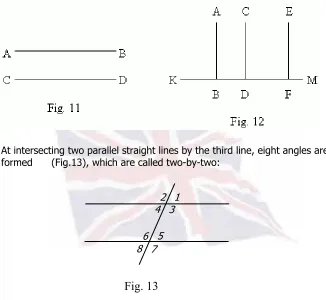
Two straight lines AB and CD (Fig.11) are called parallel straight lines, if they
lie in the same plane and don’t intersect however long they may be continued.
The designation: AB|| CD. All points of one line are equidistant from another
line. All straight lines, parallel to one straight line are parallel between
E x a m p l e . Convert
9
5
8 into a vulgar fraction
S o l u t i o n. 1) 8 · 9 = 72;
2) 72 + 5 = 77
themselves. It’s adopted that an angle between parallel straight lines is equal
to zero. An angle between two parallel rays is equal to zero, if their directions
are the same, and 180 deg, if the directions are opposite. All perpendiculars
(AB, CD, EF, Fig.12) to the one straight line KM are parallel between
themselves. Inversely, the straight line KM, which is perpendicular to one of
parallel straight lines, is perpendicular to all others. A length of perpendicular
segment, concluded between two parallel straight lines, is a distance between
them.
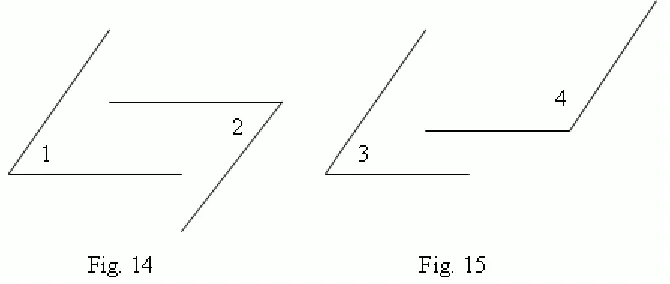
At intersecting two parallel straight lines by the third line, eight angles are
formed (Fig.13), which are called two-by-two:
1)
corresponding angles (1 and 5; 2 and 6; 3 and 7; 4 and 8); these angles
are equal two-by-two: (
1 = 5; 2 = 6; 3 = 7; 4 = 8 );
2)
alternate interior angles (4 and 5; 3 and 6 ); they are equal two-by-two;
3)
alternate exterior angles (1 and 8; 2 and 7 ); they are equal two-by-two;
4)
one-sided interior angles (3 and 5; 4 and 6 ); a sum of them two-by-two
is equal to180 deg ( 3 + 5 = 180 deg; 4 + 6 = 180 deg);
5)
one-sided exterior angles ( 1 and 7; 2 and 8 ); a sum of them two-by-two
is equal to180 deg ( 1 + 7 = 180 deg; 2 + 8 = 180 deg).
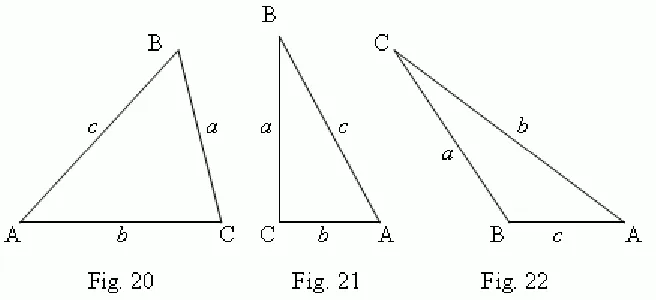
Angles with correspondingly parallel sides either are equal one to another, (if
both of them are acute or both are obtuse,
1 = 2, Fig.14), or sum of them
is 180 deg (
3 + 4 = 180 deg, Fig.15 ).
1
2
4 3
5
6
8
Fig. 13
Angles with correspondingly perpendicular sides are also either equal one to
another (if both of them are acute or both are obtuse), or sum of them is 180
deg.
Thales' theorem. At intersecting sides of an angle by parallel lines (Fig.16), the
angle sides are divided into the proportional segments:
Triangle
Triangle. Acute-angled triangle. Right-angled triangle.
Obtuse-angled triangle. Isosceles triangle. Equilateral triangle.
Scalene triangle. Main properties of triangles. Theorems about
congruence of triangles. Remarkable lines and points of a triangle.
Pythagorean theorem. Relation of sides for an arbitrary triangle.
O
A’
B’
C’
A
B
C
Triangle is a polygon with three sides (or three angles). Sides of triangle are
signed often by small letters, corresponding to designations of opposite
vertices, signed by capital letters.
If all the three angles are acute (Fig.20), then this triangle is an acute-angled
triangle; if one of the angles is right ( C, Fig.21), then this triangle is a
right-angled triangle; sides a, b, forming a right angle, are called legs; side c,
opposite to a right angle, called a hypotenuse; if one of the angles is obtuse
( B, Fig.22), then this triangle is an obtuse-angled triangle.
A triangle ABC is an isosceles triangle (Fig.23), if the two of its sides are equal
(a = c); these equal sides are called lateral sides, the third side is called a base
of triangle. A triangle ABC is an equilateral triangle (Fig.24), if all of its sides
are equal ( a = b = c ). In general case ( a b
c ) we have a scalene
triangle.
B
B
B
c
a
c
a
b
b
A
C
A
C
A
C D
Main properties of triangles. In any triangle:
1. An angle, lying opposite the greatest side, is also the greatest angle, and
inversely.
2. Angles, lying opposite the equal sides, are also equal, and inversely. In
particular, all angles in an equilateral triangle are also equal.
3. A sum of triangle angles is equal to 180 deg.
From the two last properties it follows, that each angle in an equilateral
triangle is equal to 60 deg.
4. Continuing one of the triangle sides (AC , Fig. 25), we receive an exterior
angle BCD.
An exterior angle of a triangle is equal to a sum of interior angles, not
supplementary with it: BCD = A + B.
5. Any side of a triangle is less than a sum of two other sides and more than
their difference ( a < b + c, a > b – c; b < a + c, b > a – c; c < a + b,
c > a – b ).
Theorems about congruence of triangles.
Two triangles are congruent, if they have accordingly equal:
a) two sides and an angle between them;
b) two angles and a side, adjacent to them;
c) three sides.
Theorems about congruence of right-angled triangles.
Two right-angled triangles are congruent, if one of the following conditions is
valid:
1) their legs are equal;
2) a leg and a hypotenuse of one of triangles are equal to a leg and a
hypotenuse of another;
4) a leg and an adjacent acute angle of one of triangles are equal to a leg and
an adjacent acute angle of another;
5) a leg and an opposite acute angle of one of triangles are equal to a leg and
an opposite acute angle of another.
Remarkable lines and points of triangle.
Altitude (height) of a triangle is a perpendicular, dropped from any vertex to an
opposite side (or to its continuation). This side is called a base of triangle in
this case. Three heights of triangle always intersect in one point, called an
orthocenter of a triangle. An orthocenter of an acute-angled triangle (point O,
Fig.26) is placed inside of the triangle; and an orthocenter of an obtuse-angled
triangle (point O, Fig.27) – outside of the triangle; an orthocenter of a
right-angled triangle coincides with a vertex of the right angle.
Median is a segment, joining any vertex of triangle and a midpoint of the
opposite side. Three medians of triangle (AD, BE, CF, Fig.28) intersect in one
point O (always lied inside of a triangle), which is a center of gravity of this
triangle. This point divides each median by ratio 2:1, considering from a vertex.