AM-AOMDV: Adaptive Multi-metric Ad-hoc
On-AOMDV extends the On-AOMDV scheme by including a multiple route metrics, a novel local route update and route maintenance algorithm. The algorithm uses the one-hop information exchange between neighboring nodes to increase the packet throughput and route longevity, decrease the end-to-end latency, route discovery frequency and route overhead under high mobility environments. The multiple metrics (i.e., node-to-end latency, node-to-end RSSI, and nodeKeywords: routing,distance vector routing,reactive routing,multipath routing, AODV, AOMDV, multi-hop, wireless ad hoc networks.
1 Introduction
On-demand Multipath Distance Vector (AOMDV) routing [3] is an extension of the single route AODV protocol [1].
The AOMDV scheme provides better performance in the dynamic MANET environment. It uses the information available in the routing messages of the AODV protocol to find multiple disjoint and loop-free routes during the route discovery phase. The link disjoint feature of this protocol ensures that no two parallel routes between a source-destination pair will have a common link. If the currently used route fails, the source chooses the next available route in order to continue packet transmission to the destination. In AOMDV, every node broadcasts the HELLO messages for the purpose of local link connectivity. However, the HELLO messages often interfere with the data transmission on the same or other closely spaced routes. AOMDV uses the minimum hop-count as the link metric in the route setup stage for choosing the shortest path from the source to destination. This does not necessarily support data transmission in high speed environments since minimum hop-count based metric does not consider the RSSI (received signal strength indication) degradation on multihop links (due to interference). Our investigation also shows that the AOMDV scheme still needs high frequency of route rediscovery for high node end latency in data transmission when a significant number of links fail.
In this paper, we propose the AM-AOMDV scheme, which adopts the local route update concept of LHOAR in the multipath AOMDV scheme. The AM-AOMDV scheme strengthens the route being actively used and also maintains the alternative routes through periodic unicast packets transmitted from the source to the destination. The use of multiple metrics (including RSSI, node-to-end latency and node occupancy, in addition to minimum hop-count) enables the proposed scheme to select the most efficient route from the source to destination. The multiple metrics also help in avoiding the hot spots under heavy traffic conditions.
Rest of the paper is organized as follows. Section 2 discusses the features of the AM-AOMDV. Section 3 discusses the simulation results and the performance improvements in the AM-AOMDV scheme compared to AOMDV. Finally Section 4 concludes the paper by summarizing the achievements of AM-AOMDV.
2 Adaptive Multi-metric AOMDV Routing Scheme
2.1 Multiple Routing Metrics
We use a novel multiple metric approach for converging to the most efficient route while discovering multiple routes in the route setup stage. These metric values are introduced in the routing table for each node and their corresponding paths. The enhanced routing table contains three additional metrics: (a) node-to-end RSSI metric, (b) node-to-end latency metric, and (c) node occupancy metric. The node to-end RSSI metric is defined as the RSSI value of the path from any node to the destination. We use average value of RSSI. The RSSI value of each forward link is fed back to the nodes through the ACK packets. The node-to-end latency metric consists of two parameters (i) delay from the node to the source computed from the timestamp of the RREQ packet, and (ii) the delay from the destination to the node computed from the RREP packet. The node occupancy metric is defined as the total number of data packets that any node processes per second and plays an important role under heavy traffic conditions where hot spots are likely to be created in the network. The AM-AOMDV scheme uses these metrics along with the hop-count metric to find the new paths and select the best one intelligently.
2.2 Route Setup Stage
Every node maintains a routing table which is updated whenever it receives a RREQ (Routing REQuest), RREP (Routing REPly) or a local update HELLO packet. When the application layer sends a packet to the routing queue, the source looks for a route to that destination in its routing table. If a valid route is available the node enters the data forwarding state and forwards the packet to the first hop node of the appropriate route. However, if no route is available and the node is the source of the data packet, it enters the route discovery state, which is similar to the AOMDV hop and last hop information are also used for checking node disjoint routes. Finally, when one of the RREQ packets reaches the destination node it sends an RREP back to the source node using the backward routes (appropriate to that RREQ packet) stored in each intermediate node in the reverse direction. The destination floods RREP’s in the reverse direction similar to the number of multiple RREQ’s received from the source. The RREQ-RREP pairs form multiple routes from source to destination [3].
backward route to the source. This process causes all the nodes to delete the next hop to the destination in their routing tables along that route.
2.3 Data Transmission using Local Path Update
The number of routes from the source to destination is restricted to a heuristic upper bound and the source begins data transmission on the route identified by the first received RREP packet. This route is labeled as the primary route whereas the other routes are labeled as secondary routes. All the nodes through which the RREP packet(s) travels from the destination to the source are marked as Forward Route (FR) nodes. When the first FR node on the primary route receives a data packet, it starts participating in the local path update process by broadcasting a HELLO message to its 1-hop neighbors. The HELLO packet contains path information from its routing table. A flag in the HELLO message identifies the originator of the packet, which enables the neighboring FR nodes to discard this HELLO broadcast. The 1-hop neighboring non-FR nodes, which hear this local update HELLO message, either add a new route entry or update the existing routing information. These 1-hop neighbors of the FR nodes are labeled as Surrogate Route (SR) nodes. These SR nodes help in setting up alternate routes to the destination by receiving periodic local updates from their 1-hop FR neighbors. The SR nodes respond to the local update HELLO messages received from an FR node, by broadcasting another local update HELLO but with the flag reset inside it. This enables other FR nodes to accept this HELLO broadcast from the SR nodes and add new paths in their routing table or update existing paths, if they are found to be better in terms of the multiple metrics described in Section IIA. This causes the primary route to converge to a more efficient route and thus prolong the route life-time. After receiving the first data packet, the SR nodes label themselves as FR nodes and begin the local path update process again.
2.4 Enhanced Link Layer Failure Handling
2.5 Enhanced Link Layer Failure Handling
AOMDV does not maintain or locally repair the secondary routes. As a result, the secondary route may also fail and may not be available for data transmission after the primary route has failed, especially when node mobility is high. Consequently, the route discovery frequency increases in AOMDV in the presence of high node mobility. Our scheme uses the keep alive packets to monitor the secondary routes and heal any link breakages. If any FR node does not find a valid next hop it initiates a local one hop repair query, asking its neighbors for a route via the same last hop. Non FR neighbors having paths to the destination via the required last hop reply to this query. Thus the FR node immediately adds one of these neighbors as a new next hop in its routing table. When the keep alive packet reaches the destination, it retransmits the same on the reverse route to the source via that secondary path and updates the multiple metrics in both the forward and reverse directions. This mechanism thus periodically updates the secondary routes and reduces the route discovery frequency.
3 Simulation and Discussion
We simulated the AM-AOMDV and AOMDV schemes using the discrete event network simulator ns-2.32, which supports multihop wireless scenarios [8]. The objective is to evaluate (i) packet loss ratio, (ii) average end-to-end delay, (iii)
average route discovery delay, (iv) average route discovery frequency, and (v)
routing overhead in AM-AOMDV against that of AOMDV in the presence of mobility-related route failures. Scenarios with large number of source destination pairs or connections, varying packet rates and increasing node speeds were considered.
3.1 Simulation Scenario
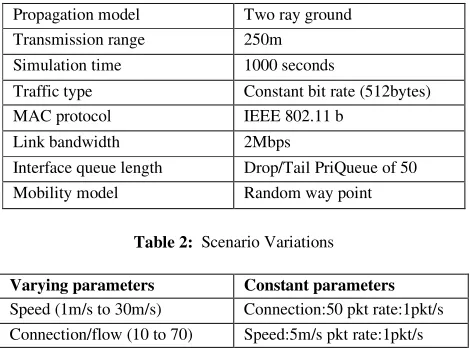
Table 1 summarizes the parameters used in our simulation setup. The original results of AOMDV are available in the literature [3]. It is important to note that the nodes can serve as source as well as destination in the network. Table II provides the set of constant parameters used during the simulation of various scenarios. We run each simulation for 1000 seconds and ignore the initial 250 seconds as done in AOMDV protocol, which is considered as a warm-up period. Each simulation is run 5 times and the results are an average of the 5 observations. Therefore each point represents a simulation of five unique traffic movement patterns. We repeat the simulations for different traffic (connections and packet rate) variations and mobility models (mean node speed).
Table 1: Simulation Parameters
Parameters Values
Propagation model Two ray ground Packet rate (0.25 to 3 pkt/s) Speed:5m/s connections:50
3.2 Varying Average Node Speed to switch to another route, the packets already queued in the nodes of the broken route are dropped. Moreover, the source node sometimes finds that all the secondary routes are also broken at high node speeds by the time the primary route fails. This is a comparison to AOMDV. Figure 1(b) show that the end-to-end latency at higher node speeds is much lower in our scheme as compared to the AOMDV. The primary path update avoids the large queuing delays in our scheme, whereas the packets in AOMDV experience large queue delay before being salvaged on another route.
network. As a result, the RREP packets cannot reach the source as quickly as before causing a considerable increase in the route discovery delay.
(a)
(b)
Fig. 1. Performance with varying average node speed. (a) %packet loss ratio, and (b) end-to-end latency.
(a)
(b)
(c)
3.3 Varying Number of Connections
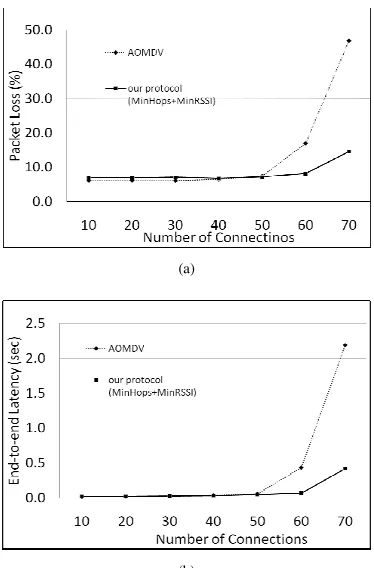
Fig. 3(a) shows packet loss performance for varying number of connections. The packet loss ratio in AM-AOMDV is substantially lower than in AOMDV, in heavy traffic conditions (>50 connections). The network saturation threshold for AOMDV is 50 connections, after which it starts experiencing heavy packet losses of >10%. However, the AM-AOMDV scheme does not reach network saturation even up to 70 connections. The local update process in AM-AOMDV controls the propagation of HELLO messages and makes a large number of SR routes available for different connections. This limits the packet loss in heavy traffic conditions due to the large number of connections. But this has a weakness in sparse networks since they would not have enough number of nodes to exchange the local updates and create more surrogate paths. Similarly, Fig. 3(b) shows that AM-AOMDV has a superior end-to-end latency performance as compared to AOMDV.
(a)
(b)
Fig. 3. Performance with varying number of connections. (a) %Packet loss ratio, (b) end to end latency.
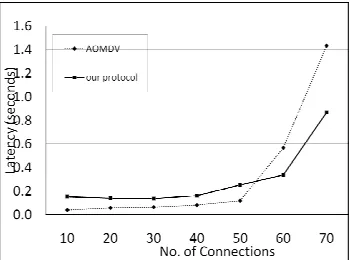
AM-AOMDV scheme shows higher route discovery delay than AOMDV. This is due to the fact that the number of local updates is low in AM-AOMDV scheme in addition to the absence of HELLO messages to maintain link connectivity. Also RREPs do not come back to the source as quickly. However AOMDV has much better link connectivity maintenance (especially in the reverse paths) because of the abundance of HELLO messages. Thus the RREP takes the fastest reverse path to reach the destination. However, the route discovery delay increases considerably in AOMDV for heavy traffic (>50 connections), whereas AM-AOMDV has much lower route discovery delay than AOMDV (almost half). This can be attributed to availability of surrogate paths that guarantee packet delivery by locally updating the primary route leading to much longer route longevity. As a result, the frequency of route discovery is much smaller than AOMDV. AM-AOMDV also maintains the secondary paths by healing them using the ‘keep alive’ packets. When the main path has to be switched, the chances of the secondary path being stale are almost half as compared to AOMDV. This again reduces the need for re-initiating the route discovery by source nodes. Conversely, since AOMDV is always using the first path (fastest response path) in the list and not maintaining the other paths, it ends up exhausting all the paths and thus has to rediscover the routes more frequently.
Fig. 4. Route Discovery delay performance for varying number of connections.
3.4 Varying Packet Rates
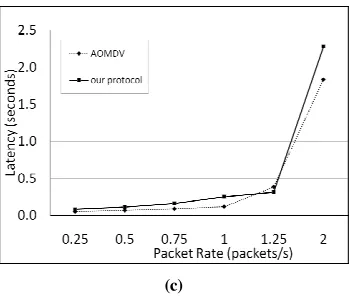
obviously the lack of link connectivity maintenance. Additionally, the number of control packets (in our case the local update HELLOs) being dropped increases at higher packet rate. Moreover, the effective loss of HELLO packets by AOMDV is much less than AM-AOMDV, which enhances this effect. To summarize, AOMDV incurs a very high routing overhead for a slight improvement in the route discovery delay. AM-AOMDV trades off the route discovery delay for achieving a reduction in overhead of half of that of AOMDV.
(a)
(c)
Fig. 5. Performance with varying packet rate. (a) %packet loss ratio, (b) Route discovery delay, and (c) End to end latency.
4 Conclusion
In this paper, we designed and implemented a new AM-AOMDV scheme which extends the AOMDV scheme by including a multiple route metrics, a novel local route update and route maintenance algorithm. For enhancing the route reliability, we use new routing metrics, namely received signal strength (RSSI), path latency and node occupancy for intelligent path selection. These metrics are used as feedback to understand the route behavior. Besides, we implement the local route update
algorithm, which strengthens the routes and also creates multiple surrogate routes by using the metric feedback mechanism. For maintaining the diversity of multiple routes, we propose a keep alive packet for updating the secondary paths in terms of their metrics. The simulation results demonstrate that the proposed AM-AOMDV scheme performs considerably better than the AOMDV routing scheme in terms of packet drops, latency and route discovery frequency, especially in high mobility and heavy traffic conditions.
References
1. C. Perkins and E. Royer, “Ad-hoc on-demand distance vector routing,” Pro. IEEE WMCSA, 1997.
2. D. B. Johnson and D. A. Maltz, “Dynamic source routing in ad hoc wireless networks, mobile computing,” Vol. 353, Chapter 5, pp. 153-181, Kluwer Academic Publishers, 1996.
4. A. Mtibaa and Kamoun F, “MMDV: Multipath and MPR based AODV routing protocol,”
Med-Hoc-Net, 2006.
5. X. Li and L. Cuthbert, “Node-disjointness-based multipath routing for mobile ad hoc networks,” ACM International Workshop on Performance Evaluation of Wireless Ad Hoc, Sensor, and Ubiquitous Networks,” (PE-WASUN) 2004.
6. S. Lee and M. Gerla, “Split multipath routing with maximally disjoint paths in ad hoc networks,” IEEE International Conference on Communication Systems (ICC), 2001. 7. S. Tang, B. Zhang, M. Watanabe, and S. Tanaka, “A link heterogeneity-aware on-demand
routing (LHAOR) protocol utilizing local update and RSSI information,” IEICE Trans. on Comm.,Vol. 88-B, No.9, pp. 3588-3597, 2005.