AENSI Journals
Advances in Environmental Biology
ISSN-1995-0756 EISSN-1998-1066 Journal home page: http://www.aensiweb.com/AEB/
Corresponding Author: Biology Department, Faculty of Mathematics and Natural Science, Bengkulu University, Bengkulu City 38125, Indonesia.
E-mail : [email protected] HP.+62-81373244627; Fax. +62-736-20919
Communities of Ants (Hymenoptera: Formicidae) In Peatland Planted With Oil
Palm Stands Of Different Age Strata
1Darmi, 2Dedik Budianta; 2Sabaruddin; 3M. Rasyid Ridho
1
Ph.D student of Sriwijaya University, Palembang and Senior Lecturer of Biology Department, Faculty of Mathematics and Natural Science, Bengkulu University, City of Bengkulu, Bengkulu Province, Indonesia
2Faculty of Agriculture, Sriwijaya University, City of Palembang, Province of South Sumatra, Indonesia
3Biology Department, Faculty of Mathematics and Natural Science, Sriwijaya University, City of Palembang, Province of South Sumatra,
Indonesia
ARTICLE INFO ABSTRACT
Article history:
Received 12 November 2014 Received in revised form 31 December 2014
Accepted 22 January 2015 Available online 25 February 2015
Key words:
Formicidae, peatlands, oil palm plantation
Peat land conversion into oil palm plantations have an impact on changes in physical, chemical and biological soil peat. Ant community is one of the soil biotic components affected on changes in physical and chemical properties of soils. This study aims to analyze the community of ants on peat lands with palm stands from a young age to old age (oil palm stands of 2, 10, 15, 19 and 23 years). In this study, the stand ages of oil palms also represent the reclamation ages of peatland. The study showed peat lands with stands of oil palms from a young age to old age have different physical and chemical properties of soil. Ant communities in the five study sites varied in terms of species richness, density, diversity and similarity index. Species diversity (the number of ant species) on peat land with oil palm stands of a young age (2 years) and old age (19 and 23 years) was higher than in the location of palm stands with age of 10 and 15 years that were periodically flooded. Ant density on land with palm stands of a young age (2 years) was higher and significantly different compared with other stand locations (10, 15, 19 and 23 years). Ant abundance was positively correlated with the thickness of the peat and the levels of N, P, K, Ca and Mg of peat soil. Ant species of Solenopsis sp was the dominant invasive species population in almost all of oil palm stand lands. Diversity index of ant community tended to be higher in land with old palm stands and was an indication that the equilibrium level of the ant community structure in the this location is higher than in the palm land with young age. The similarity level of ant species on lands with palm stands of 2, 19 and 23 years old was higher (similarity index from 81.5 to 87%) than in the location of the other palm stands. The results of this study indicate that factors of oil palm stand age, significantly affect population density of ants. The highest density of ants was in younger stands of oil palms and was significantly different from other locations. Species richness (number of species) of ants between in the younger oil palm stands and in the older ages was relatively the same, except for the locations of oil palms which were the stagnant water periodically (locations of oil palm stands with ages of 10 and 15 years) having low species richness.
© 2015 AENSI Publisher All rights reserved. To Cite This Article: Darmi, Dedik Budianta, Sabaruddin, M. Rasyid Ridho, Communities of Ants (Hymenoptera: Formicidae) In Peatland Planted With Oil Palm Stands Of Different Age Strata. Adv. Environ. Biol., 9(3), 473-480, 2015
INTRODUCTION
Ants (Hymenoptera: Formicidae) is one important component of soil biota in terrestrial ecosystems. Ants also known as one of the soil macrofauna components participating as a builder of soil ecosystems (ecosystem engineer), because they can affect the characteristic of physical, chemical and biological soil [11, 16]. Effect on soil physical properties can be attributed to the activity of ants in the manufacture of the corridor and nest on the ground, which can affect the porosity and size of the soil particles [8]. Ants also can affect the chemical properties of the soil, such as changes in soil pH to be neutral and increase the nutrient content of the soil, especially nitrogen and phosphorus. In addition, the ants also stimulate the biological processes in the soil as soil microbial activity, through the accumulation of food in the nest. Each species of ants have varying influence depending on the type and condition of their habitat [9]. Ants also act as important natural predators in the regulation of pest populations. The presence of ants keeps stabilization of ecosystem in physically, chemically and biologically [10, 15]
Study on ant community in peat lands planted with oil palms is still limited. Previous studies conducted by Yulminarti et al. [26] focused on the ant population ratio in natural forests and oil palm plantations, but she had not yet discussed how changes in ant communities in line with the development of peat land with different palm stand age. While Bruhl and Eltz, [3] studied the loss of forest ant species on oil palm plantations in Sabah, Malaysia. Therefore, it is important to do study on communities of ants (Hymenoptera: Formicidae) in peat land planted with oil palms of different age strata.
This study provides an overview of ant communities on peat land planted with oil palms from a young age to old age.The results of the present study are expected to be useful in the development of ant potential as bio-indicators of the peatland quality based on land use especially for oil palm plantations. This study is also beneficial to the development of ant potential as a natural predators in oil palm plantations in supporting the sustainable farming systems in peatlands.
MATERIALS AND METHODS
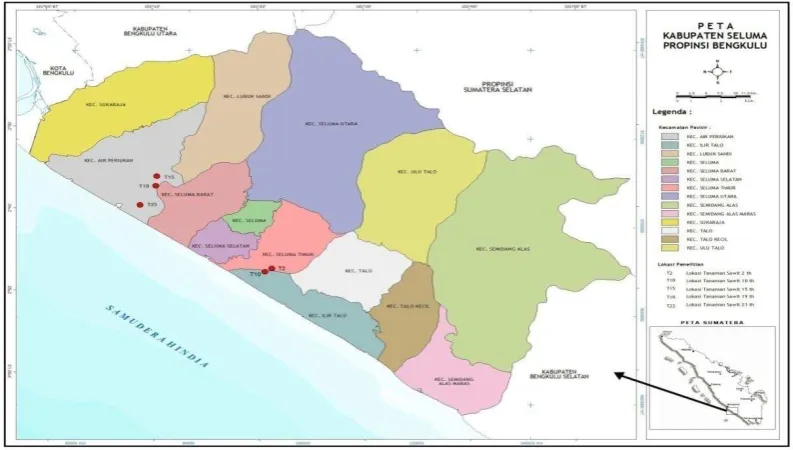
Study was conducted on peatlands in oil palm plantations, Seluma Regency of Bengkulu Province (Southern Sumatra, Indonesia). Peatlands used as a study site consists of five age strata of oil palm stands, that is the age of 2 years (T2), 10 years (T10), 15 years (T15), 19 years (T19) and 23 years (T23). In this study, the stand ages of oil palms also represent the reclamation ages of peatland. The location of palm stands with ages of 2 and 10 years in the District of East Seluma and Ilir Talo, which lies in the geographical position of 4o8'56.1"- 4o9'13.1" LS and 102o34'24.2"-102o34'53.1" BT, while three other locations in the District of Air Periukan in the geographic position of 4o0'51"- 4o3'21.2" LS and 102o25'42.3"-102o26'48.3" BT. Based on the records of GPS, the coordinate points of the study sites consisting of T2, T10, T15, T19 and T23 can be seen on a map of the study locations (Figure 1)
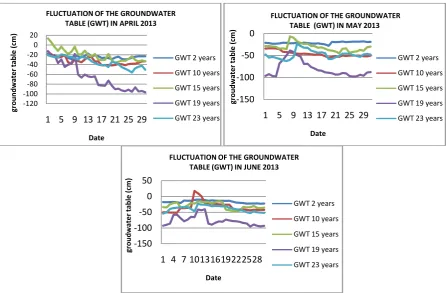
Fig. 2: Fluctuation of groundwater Table on Peatland Planted with Oil Palm Sumber: Darmi et al. [5]
Water regulation in land of oil palm plantations is still dependent on natural conditions, so that the groundwater table varies in each area / location of the study (Figure 2). In the picture, it appears, groundwater tables of five study sites fluctuated from April to June 2013. The location T10 and T15 are periodically flooded (in April and June 2013).
This study was aimed at macro-sized ants with criteria body size of > 2 mm [20, 21]. Samplings of ant soil surface at each study location were done systematically comprising 3 columns and 4 lines located between the lines of planted oil palm stands. Sampling was carried out for 3 months (April, May and June 2013) and at each location consists of 36 samples (total 180 samples at all study sites). Ant samplings used the pitfall traps, a representative method for sampling active macro invertebrates on soil surface, especially soil arthropods including ants [12, 14]. Traps are plastic containers with a height of 12 cm and a diameter of 7 cm and are equipped with a protective roof 15x15 cm size. Trapping was done for 3 days (3x24jam). Ant samples obtained included in a plastic bag and then taken to the laboratory for sorting. Quantification and identification of ants were performed in the laboratory of Biology, State University of Bengkulu and further identification in the laboratory of Entomology in Division of Zoology, LIPI-Bogor, Indonesia. In this study, it was also measured some physical and chemical properties of the soil, such as the groundwater table, peat thickness, porosity, volume weight (VW), temperature, water content, pH and levels of C, N, P, K, Ca and Mg in peat soil.
In this study, the data of ant communities obtained was analized which involves analysis of density [25], diversity index [17], dominance index [17] and index of similarity [17]. To compare the value of density between study sites, a single factor analysis of variance (ANOVA-one way) was used, while the similarity index values was analysed by cluster analysis. Correlation analysis is used to analyze the relationship between the abundance of ants with physical and chemical properties of soils. The formula used for the analysis of ant communities are as follows:
Density = individual number of certain species total of samples
Diversity Index of Shannon-Wiener (H’) : �′ =− � ln� � = �/�
Index of dominance (C): �= �
� ²
H’ = Diversity index of Shannon-Wiener Ni = Individual number of spesies to i
N = Total of individual number
Similarity Index of Sorensen: �� = 2 /( + ) Cs = similarity Index of Sorensen
j = number of species existing in two location a = number of species in location a
b = number of species in location b
RESULTS AND DISCUSSION
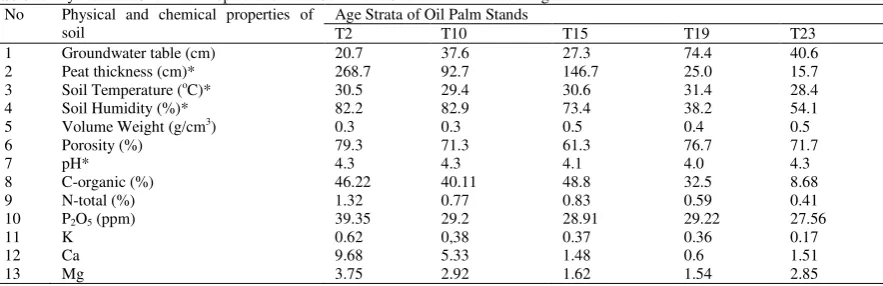
Locations to study on the community of ants, were peat lands consisting of different age strata of oil palm stands with ages of 2, 10, 15, 19 and 23 years. Five study sites have different physical and chemical properties of the soil, as listed in Table 1. The difference in physical properties of the soil can be seen from values of groundwater table, the thickness of the peat, soil temperature, water content, volume weight (VW) and porosity. The amount of groundwater table varied in five locations, as water regulation in oil palm plantations was still dependent on natural conditions. The thickness of the peat on the location of the young age palm stands (2 years) is thicker (268.7 cm) than in the location of the old age palm stands (15.7 cm). Soil porosity also tends to be higher at the age of land with palm stands younger than in older age. Volume weight (WV) of soil, also seems likely to be low at site of the young age palm stands.
The differences in the physical properties of peat soil with the age level of different land uses, related to a change in peat soils due to land reclamation for oil palm plantations. Peat land that has decades of reclaimed will be more stable, because the rate of subsidence and decomposition rate decreased compared with the reclamation of peat lands with a young age [18]
Peat land conversion into oil palm plantations, significantly decreased levels of soil organic [7], and resulted in changes in the physical and chemical soil healthy. Some chemical properties of the soil are also very different between the study sites, such as pH, levels of C, N, P, K, Ca and Mg. The pH value of the soil at five study sites ranges from 4.0-4.3 and is classified as reacting peat. Andriesse [2], stated that generally sour-reacting peat has pH level of 3.0-4.5 and C, N, P, K, Ca and Mg content tended to decrease with increasing palm stand age.
The study results on the five peat lands with oil palm stands of different ages obtained 15 macro sized species of ants (> 2 mm) whose density varied in the five study sites (Table 2). At the location of 2 years old of palm stands, it was obtained 13 species of ants, the location of 10 years = 9 species, location of 15 years = 4 species, location of 19 years = 11 species and the location of 23 years = 12 species. These results indicated that the location of 2-years of palm stands has the highest ant species richness, followed by stands with age 19, 23, 10 years and the lowest number of ant species was on the location of stands with 15 years old.
Table 1: Physical and Chemical Properties of Peat Soil in the Stands with Different Ages No Physical and chemical properties of
soil
Age Strata of Oil Palm Stands
T2 T10 T15 T19 T23
1 Groundwater table (cm) 20.7 37.6 27.3 74.4 40.6
2 Peat thickness (cm)* 268.7 92.7 146.7 25.0 15.7
3 Soil Temperature (oC)* 30.5 29.4 30.6 31.4 28.4
4 Soil Humidity (%)* 82.2 82.9 73.4 38.2 54.1
5 Volume Weight (g/cm3) 0.3 0.3 0.5 0.4 0.5
6 Porosity (%) 79.3 71.3 61.3 76.7 71.7
7 pH* 4.3 4.3 4.1 4.0 4.3
8 C-organic (%) 46.22 40.11 48.8 32.5 8.68
9 N-total (%) 1.32 0.77 0.83 0.59 0.41
10 P2O5 (ppm) 39.35 29.2 28.91 29.22 27.56
11 K 0.62 0,38 0.37 0.36 0.17
12 Ca 9.68 5.33 1.48 0.6 1.51
13 Mg 3.75 2.92 1.62 1.54 2.85
*) Source : Darmi et al. [5]
Based on groundwater table measurements, locations with palm stands of 10 and 15 years old are periodically flooded, so ant species an able to adapt with this habitat conditions were highly limited. El-Gayar [6] stated that factor of excessive irrigation in rice paddy fields have an impact on reducing the diversity of soil macro fauna. Thus the location of 15 years, in addition to periodic inundation, the average groundwater table was also lower than the location of 10 years, so it was very little number of ant species that can live in a location of 15 years old.
number of ant species found in palm stands of one year old was 24 species. When compared to the results of both studies, it appeared that the number of ant species in peat land with palm stands of 2 years in this study was lower than the number of ant species in stands of 1 year old in Riau. The occurrence of these differences was caused by several factors, such as, a different stand age factor, factor of ant size criteria studied and differences in location / habitat studied. Palm stands with age of one year old and two years old would not be the same physical-chemical properties of the soil, because at the beginning of the opening of peat lands for palm plantation land, subsidence rate is very fast compared with the decades. Factors of ant size criteria in this study are the ant macro (> 2 mm), while that in Riau, there was no size restrictions of ant size. In addition, differences in location or habitat may also cause, the ant responses were not the same so the variety of ant species was different. Results of Bruhl and Eltz study [3] in Sabah, Malaysia, also showed that a decline in the number of ant species was due to conversion of forest to oil palm plantations.
Table 2: Density of Soil Surface Ants in Peatlands Planted with Oil Palm Stands of Different Age Strata.
No TAXON Density (individu/38.5 cm
**) significantly different ns): not significantly different
The densities of ant population in five different locations of study were different as well. The highest ant density was in stand site of 2 years old and was significantly different from the other four stand locations, while ant densities at the four locations (10, 15, 19 and 23 years old) were not significantly different. The results of this study indicated that peat containing oil palm age of 2 years have ant species density that was higher than in other locations. Norowi [19] stated that the ant and arachnid populations would be abundant in the early development of the peat after reclaimed farmland. The high density of ant population on land with younger oil palm stands than on land with old age stands may cause the intensity of conventional land management such as the use of fertilizers and pesticides was lower. Crossley et al. [4], stating that the intensive land management in conventional farming systems can lead to a decrease in the abundance and diversity of soil fauna.
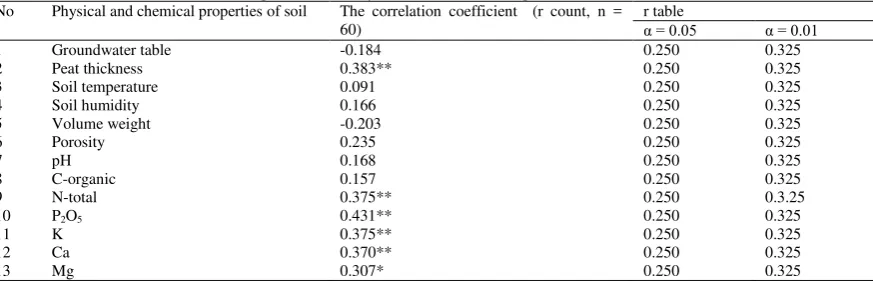
The results of correlation analysis between physical and chemical properties of the soil with an abundance of ant population showed that there is a significant correlation between soil physical and chemical factors with ant population. In Table 3, it can be seen that the ant population abundance was positively correlated with the content of N, P, K, Ca, Mg and the thickness of the peat soil, which means an increase in the population of ants in line with the increase in peat soil nutrients (N, P, K, Ca, and Mg) and the thickness of the peat. In Table 2, the highest ant density is in stand location of 2 years old.
The palm stand location of 2 years old has peat layer that is still thick with sapric maturity level and its nutrient content is higher than at other locations. This indicates that the ants prefer open habitats and the availability of sufficient organic material (such as thickness of peat layer) and the presence of ants contribute to the improvement of soil nutrients. Frouz and Jilkova [9] stated that the presence of ants could affect the chemical properties of the soil, such as changes in soil pH to neutral and increase the nutrient content of the soil, especially nitrogen and phosphorus. In addition, the ants also stimulate biological processes in the soil as soil microbial activity, through the accumulation of food in the nest.
Overall, the composition of the soil surface ants, at five study locations indicated species Solenopsis sp have the highest density (33.36 individuals / 38.5 cm 2), followed by Tetramorium sp (6.78 individuals / 38.5 cm2), Odontomachus sp (3:06 individuals /38.5 cm 2), Anoplolepis sp (1.86 individuals / 38.5 cm2), Odontoponera sp (1:42 individuals / 38.5 cm2), and the rest is ant species that have low density (<1 individuals / 38.5 cm2). Ant genus Solenopsis (fire ant) is a comprehensive invasive species that have widely distributed in disturbed habitats [13]. Study on agricultural lands (paddy, corn, red onion) showed that the abundance of fire ants is also more dominant than other ant species [1]. An ant Solenopsis genuses belonging to the subfamily Myrmicinae are often found in a variety of terrestrial habitats. This ant species is the greatest number in group and diversity among other ant subfamily [15]. Thus the high population of Solenopsis on the location of this study is in association with their high adaptability and strong competitiveness as an invasive species, so that their population is higher than other ant species.
The ant diversity index of Shannon Wiener in the five study sites varied. The highest ant diversity index (H '= 1.91) is on location of palm stands at age of 19 years old, followed by location of the palm stands at age of 23 years old (H' = 1:50); 15 years old (H '= 1.21), 2 years old (H '= 0.85) and the lowest on the location of the oil stand age of 10 years old (H' = 0.78). Index value of ant diversity at five study location appears likely to increase with increasing palm stand age. This condition indicates that on peat land planted with older oil palm stands, the balance of ant community structure more increases. This relate to the development of peat soils from young to old age and changes of peat maturity level, where the older the age of peat use, the more stable the soil conditions is so the overall it will be an impact on the physical and chemical properties of soils.
Table 4: Diversity and dominance index of soil surface ants on Peat land planted with oil Palm Stands of Different age strata. Age Strata of Palm Stands
Index of Diversity(H') Index of Dominance (C)
2 years old (T2) 0.85 0.62
10 years old (T10) 0.78 0.67
15 years old (T15) 1.21 0.34
19 years old (T19) 1.91 0.19
23 years old (T23) 1.50 0.36
Diversity index is based on the ratio of the number of species and the number of individuals [17]. The high ant diversity index on peat land with old age palm stands is due to evenness of a higher number of individuals in the community structure, whereas on land with younger palm stands, it appears that any particular ant species is dominant (Table 3). In this study, on land with young stands, ants Solenopsis are more dominant in community structure. Analysis of dominance index in Table 3 appears that the location with the palm stands of a young age has higher ant dominance index (index of dominance at the age of 2 and 10 years were 0.62 and 0.67) than in the palm stands of old age as the age of 15, 19 and 23 years with 0:19 to 0:36 of dominance index.
15 Years
10 Years
2 Years
23 Years
19 Years
53 63 81.5 87 100
Index of similarity (%)
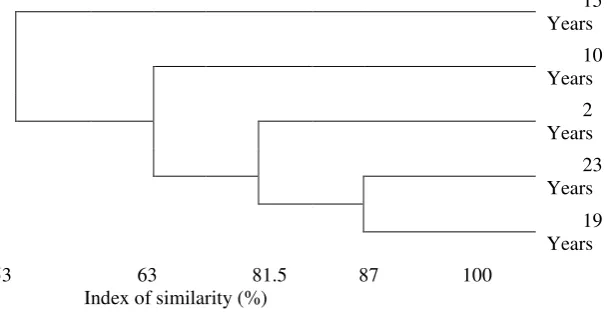
Similarity level of ant communities in five study sites was analyzed by Sorensen similarity index. In Figure 3, it appears that the stand location of 19 and 23 years old have a high degree of similarity of ant species (87% of similarity index) and those both location also have a relatively high index of similarity with the location of 2 years old (similarity index = 81.5%). Thus, the locations with 2, 19 and 23 years old have the higher similarity index than at locations 10 and 15 years old. The high degree of similarity in three stands locations (2, 19 and 23 years old) was associated with ant species richness at the three location that not varied consisting of 11-13 species of ants (Table 2). the palm stand location of ages 10 and 15 years old have low number of ant species and the low level of ant species similarity were also lower than on palm stand location of 2, 19 and 23 years old, that is 53-63%.
Conclusion:
Peat lands with oil palm stands from a young age to old age have different soil physical and chemical properties. Ant communities in five study sites varied in terms of species richness, density, diversity and similarity index. Species richness (the numbers of ant species) in palm stands with young age (2 years) and old age (19 and 23 years) were higher than in palm stands location with age of 10 and 15 years old that were periodically flooded. Ant density in stands site of young age palm (2 years) was significantly higher than ant density in other locations (10, 15, 19 and 23 years old). Ant population abundance was positively correlated with thickness of peat layer and levels of N, P, K, Ca and Mg content in peat soil. Species of ants Solenopsis sp are the dominant invasive species population at almost all locations of palm stand with different age. Diversity index of ant community tended to be higher in peat land with older age palm stands and be an indication that the equilibrium level of the ant community structure was higher than on peat land with young age palm stands. The similarity level of ant species in peat lands with the palm stands of age 2, 19 and 23 years old was higher (similarity index 81.5-87%) than the other palm stand locations. The results of this study indicate that factors of oil palm stand age, significantly affect population density of ants. The highest density of ants was in younger stands of oil palms and was significantly different from other locations. Species richness (number of species) of ants between in the younger oil palm stands and in the older ages was relatively the same, except for the locations of oil palms which were the stagnant water periodically (locations of oil palm stands with ages of 10 and 15 years) having low species richness.
REFERENCES
[1] Abtar, Hasriyanti and B. Nasir, 2013. Ants communities (Hymenoptera: Formicidae) on paddy, corn dan onion plants. Agrotekbis, 1(2): 109-112.
[2] Andriesse, J.P., 1988. Nature and management of tropical peat soil. FAO Soil Bulettin 59. Rome, Italy. [3] Bruhl, C.A. and T. Eltz, 2010. Fuelling the biodiversity crisis: species loss of ground-dwelling forest ants in
oil palm plantations in Sabah, Malaysia (Borneo). Biodivers. Concerv., 19: 519-529
[4] Crossley, J.R., D.A. Mueller and J.C. Perdue, 1992. Biodiversity of microarthropods in agricultural soil: relation to processes. Agric. Ecosyst. Environ., 40: 37-46
[5] Darmi, D. Budianta, Sabaruddin and M.R. Ridho, 2014. Abundance and distribution pattern of earthworm in peatland planted with different age of oil plam plantation in district of Seluma, Bengkulu Province. Asian Academic Research Journal of Multidisciplinary, 1(22): 492-503.
[6] El-Gayar , E.A., 2014. Effect of moderate and excessive irrigation on the community structure of soil meso and macro-fauna and litter decomposition. World Journal of Zoology, 9(1): 28-37.
[7] Firdaus, M.S. and S. Gandaseca, 2010. Effect of converting secondary tropical peat swamp forest into oil palm plantation on selected peat soil physical properties. American Journal of Environmental Sciences, 6(4): 402-405.
[8] Folgarait, P.J., 1998. Ant biodiversity and its relationship to ecosystem functioning. Bodiversity and Coservation, 7: 1221-1244.
[9] Frouz, J. and V. Jilkova, 2008. The effect of ants on soil properties and processes (Hymenoptera: Formicidae). Myrmecological News, 11: 191-199.
[10]Holldobler, B. and E.O.Wilson, 1990. The ants. Belknap Press, Cambridge, pp: 732.
[11]Jouquet, P., J. Dauber, J. Lagerlof, P. Lavelle and M. Lepage, 2006. Soil invertebrate as ecosystem engineers: Intended and accidental effect on soil and feedback loops. Applied Soil Ecology, 32: 153-164. [12]King , J.R. and S.D. Porter, 2005. Evaluation of sampling method and species richness estimator for ants in
upland ecosystems in Florida. Envoromental Entomology, 34: 1566-1578.
[13]King, J.R. and W.R. Tschinkel, 2006. Experimental evidence that the introduced fire ant, Solenopsis invicta, does not competitively suppress co-occuring ants in a disturbed habitat. Journal of Animal Ecology, 75: 1370-1378.
[15]Lach, L. Parr, C.L. and K.L. Abbott, 2009. Ant ecology. Oxford University Press. New York.
[16]Lavelle, P., T. Decaens, M. Aubert, S. Barot and M. Blouin, 2006. Soil invertebrates and ecosystem services. European Journal of Soil Biology, 42: S3-S15.
[17]Magurran , A.E., 1988. Ecological diversity and its measurement. Princeton University Press, Princeton, New Jersey.
[18]Noor, M., 2001. Agriculture of peat lands, potence dan inhibition. Kanisius, Jakarta.
[19]Norowi, H.M., B. Ismail and J. Jaya, 2010. Arthropod responses to peat land ecosystem development: Their value as agro-enviromental indicator. J. Trop. Agric. And Fd. Sc., 38(2): 275-278.
[20]Okwakol, M.J. and M.B. Sekamatte, 2007. Soil macrofauna research in ecosystems in Uganda. African Journal of Ecology, 45 (2): 2-8.
[21]Pauli, N., E. Barrios, A.J. Conacher and T. Oberthur, 2011. Soil macrofauna in agriculture lanscapes dominated by the quesungual slash and mulch agroforestry system, Western Honduras. Aplied Soil Ecology, 47: 119-132.
[22]Radjagukguk, B., 2000. The change of peat soil physical and chemical properties due to peat land reclamation for agriculture. Journal of Soil Science and Environment, 2(1): 1-15.
[23]Silvan, N., R. Laiho and H. Vasander, 2000. Changes in mesofauna in peat soils drained for forestry. Forest Ecology and Management, 133(1): 127-133.
[24]Supriyo, A. dan E. Maftu’ah, 2009. Technology of bongkor peat land rehabilitation to culture rice. Journal of Soil Science and Environment, 9(1): 58- 67.
[25]Wallwork, J.A., 1976.The Distribution and diversity of soil fauna. Acad. Press. London, New York. [26]Yulminarti, S. Salmah and T.S.S. Subahar, 2012. Number of ant species and individuals in natural peat land