BLOG DEVELOPMENT BASED ON OPEN-ENDED
Zubaidah Amir MZ1 , Risnawati2
State Islamic University Suska Riau12
1)[email protected] 2)[email protected]
Abstract
The development of technology allows everyone to access information easily. The convenience is utilized to assist students in understanding mathematics learning materials independently. Self-learning can be done anywhere, which it just needs for a media technology that helps them to learn independently, and one of them is a blog. A blog is easily accessible. A blog contains description about the nature of open-ended questions to train students on non-routine work to develop mathematical ability. The research approach is a development research, which is developing a blog based on open-ended for cryptology material. This study uses a development model of Four-D models. This study shows that a blog based on valid criteria based on the results of the validation expert educational, expert technology, expert mathematics content are average score results of validation blog is 3.32 (78.9%). Blog is also practical in its usage, and effective in improving learning outcomes, their creative thinking, and their interest in learning is very good.
Keywords : Blog, open-ended, cryptology
INTRODUCTION
Technologically advanced technology positive impact on human activities, one of which is using the internet. Through the internet, people can communicate directly without limited by time and space, life that is through the internet instant this is how makes it easier for human beings do his work. In the field of education, internet also help students students in access to a source of knowledge through accounts accounts that available in there. Using the media and ICT (Information and Communication Technology) that is developed is used to enrich learning resources, which is dynamic, and the learners interesting for the five senses and appropriated with various style learn them. The usage of software in the teaching and learning processes multimedia will increase the efficiency, increase motivation, facilitate active learning, facilitating learning experimental, consistent with learning which was centerd on students, and led to learn better (Suyanto, 2005). Then, a researcher was moved to facilitate students to learn independently with media technology.
Most of the students have a high-tech gadget and up-to-date, it is very regrettable if using gadget among students only used for the media that is playing, it would be wonderful if using gadgetry are directed to learning facility multi-dimensional and make it easier for them to contruct their knowledge. This was the basis for researchers to provide a source of knowledge in addition to them and can be accessed for free, one of which is the use blogs. Blog that initially only used to write notes a daily, there are now more developed parallel with popularity and its appeal now blogs have grown up to a source news or information alternative.
about the lecture material. The reason for using blogs in learning, namely : (1) blogs become popular because it is relatively cheap in the management, easy to develop and use; (2) blog can streamline student learning time because it was given homework to students, where each student independently working on their respective duties; (3) blog gives users the opportunity to publish posts that sorted over reverse chronological (most recent posts are above); (4) an individual task can be negotiated to be done in groups; (5) can be added to the text, graphics, images, information links with other relevant sites, and other data; and (6) the writer can do editing in post at any time and allow readers to leave comments to the original post and each comment to each other (Joshi & Chugh , 2009). It can be said, a lot of convenience to be gained by students when learning to use a blog.
In addition, the development of this blog is also based on student demand to the needs of other learning resources other than books. So to answer their curiosity towards learning materials, developed the blog contains non- routine matters and are openly to develop their independence in learning. Problem is developed in accordance with the concept of open-ended questions are questions that have an assortment of completion and the correct answer (Hancock : 1995). It is intended to allow students to be more creative to develop patterns of thought in solving the given problem and foster independent and responsible attitude in solving the given problem. Based on the background, formulation the problem are:
How are the validity, practicalities, effectiveness of blog based open-ended?
THEORITICAL FAMEWORKS
Historically, the term blog comes from web and log, which leads to web logs, weblog, and finally a blog (Wikipedia). Blogs have a very diverse functions, from a diary, media publicity in a political campaign, through media programs and corporations. Some blog maintained by a single author, while others by several authors. Many weblogs also have the facility of interaction with the audience, like a book and use the comment section to allow visitors to leave comments on the contents of the published writings, but there is also the opposite or non- interactive . Individual articles on a blog are called "blog posts”, "posts " or " entries ". A person who posts these entries is called a blogger (Huette: 2006).
According to Papert (Zagal & Bruckman: 2011) in the context of learning, in addition to the effects associated with the record -based learning paper, blogging offers the possibility for collaborative learning with enable learners to share knowledge and experiences with each other. Prior to the start of classes by using the medium of blogging, Huette (2006) says that there are some things that need to be considered include:
1. Start your own blog on any topic you choose and updates on a regular basis
2. Start a class blog with a simple announcement, the taskhomework, and external links
3. recommend students to read other related blogs. Begin by providing a list of related subjects and review the activities of the students
4. Suggest the students to respond to a post on the blog which is already developed 5. Assign students to create and maintain a group blog .
6. Assign each student to start and maintain their own blog on their subject of interest associated with the class
associational thinking, 3) can Encouraging analogical thinking, 4) the potential for increased access and exposure to information quality, and 5) a combination of solitary and social interaction.
METHOD
The research aims to develop a learning media using blogs based open-ended to materials Cryptology, then this research is development (development research). In
accordance with the model or development known as the Four-D by Thiagarajan et. Al,
reaches consists of:
1. The Define Stage
a. Front-End Analysis
At this point, researchers to do identify and analyze the need to learn by doing sharing to their colleagues about the development new material mathematics, and to find capital supporters and adjusted with the media that will be developed and used.
b. Analysis of students (leaner analysis)
Collecting information from students of students in readiness to use technology used in learning.
c. Analysis of the concept
Analyzing standard and basic competencies of the material lectures by putting together a learning achievement indicators look and design media blog that will be developed .
d. Analysis of the task (task analysis)
Analyzing the questions that will be post (to blog that adjusted with the approach open-ended)
2. The Design Stage
a. Designing the test reference standard (constructing criterion-referenced test) Activities of this phase are design and develop test instruments for product testing activities to a limited group of subjects to describe in what should be revised in designing the instrument.
b. Selection of media
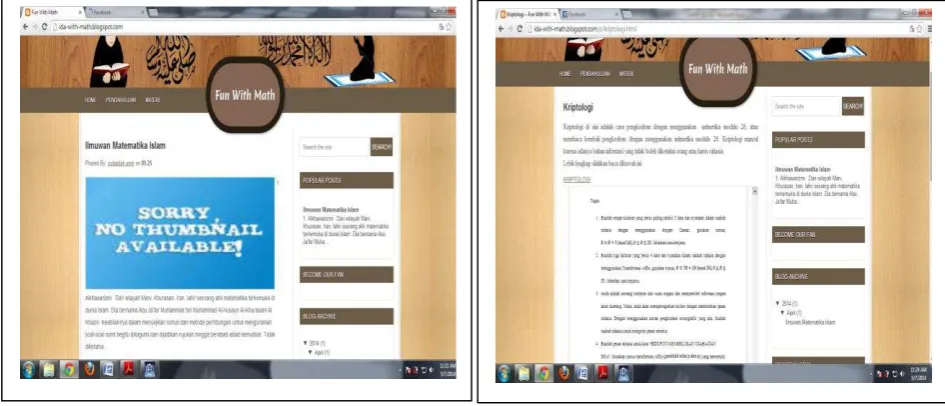
The media used is a blog that contains material that is posted Criptology periodically by researchers.
c. The selection format
Researchers will disseminate the use of blogs in learning and can be used to students. Learning format is selected that meets the criteria of selection of media interest, facilitate and assist in the learning of mathematics.
d. The initial design
The initial design is the design of the entire device is learning to be done before the test carried out. The draft are: syllabus, the look and content of the blog, as well as material cryptology.
3. The Develop Stage
a. Expert validation phase, a blog that have been designed, after that it is consultation and discussion with experts with fill the sheet validation. There are 2 kinds of validation, namely:
2) The validity of the technology, that is the look and content of media blogs can be easily used and understood by the students.Trial legibility
b. Trial legibility the words or phrases that are not understood at the tip sheets prepared. 2) Revise the content of the blog is based on the input above, if there are no
revisions, the draft ready to be tested. c. Product trials
Product trials conducted after validation, readability test and revised and declared valid for trial in the model class. The class model is a class 4A, Department of mathematics education, UIN Suska Riau the number of 38 students.
4. The Disseminate Stage
After going through a series of three activities above and has been revised and declared valid by the validator, the next activity more broadly disseminate to other blog users outside of mathematics education student UIN to access the blog as well as provide the opportunity for others to post comments as an input to the researchers.
RESULTS AND DISCUSSION
A. The Validity blogs and other instruments
Validation is done by 3 people validator material consisting of mathematics expert, media experts (technology) and education experts. The validated aspects can be seen from the following table:
Based on the analysis conducted by third validator states that:
1. Average score results of validation blog is 3.32 (78.9%) with a valid criteria that the media has also been developed in accordance with the curriculum, the materials contained in accordance with the purpose of learning, there are also Islamic values. In addition, the media has developed a good look at the screen and navigation system are clear and smooth.
category. Problems meets the criteria of open-ended and meet indicator effective use of blogs. Indicators on the observation sheet and questionnaire sheets also describe the practicalities of the use of blogs.
B. Practicality of blog
Based on the results of the questionnaire, the results of observation data obtained by this blog very practical to use. Practical blogs that can easily be accessed anytime and anywhere, besides access it at no charge. able to shorten the time for lecturers in the delivery of content. Results of interviews to some students, the information obtained about the questions given a very interesting and has a challenge for them because they do answer to the question will never be the same with another student
C. Effectiveness of blog
The effectiveness of blogs based upon the result of work students in solving the questions that are in blog, around 85.9 percent students able to answer questions with good. Creativity of the students in doing that open-ended are prominent, and fulfill indicators creative thinking (Torrance) that is originality (a capacity to produce an idea is not used in everyday habit), flexibility or flexibility (capacity to produce ideas various), this is seen those who make password and make coding in accordance with coding that they use so that the students answer will never be the same with each other. Their interest to learn a student's to increase, this was marked by frequent they sharing to a lecturer the owner blogs and to a friend his counterpart.
CONCLUSION AND SUGGESTION
Based on the result analysis of data, the describe that the development media blog-based open-ended to meet the criteria were valid, practical in its usage, and effective in improving learning outcomes, creative thinking they, and their interest in learning is very good.
The recommended advice is to keep wearing other relevant learning resources in the use of blogs, such as the absence of supporting materials, modules and so on so that the
blog is not used as the sole source of learning by learners. In addition, internet access should also be prepared to use a blog to be learning to run smoothly. The material on the blog is only limited to the material cryptology, it is advisable for other researchers to develop different media on the matter.
REFERENCES
Suyanto, A H. (2011). Website design e-learning.
Available in http://jurnalkomputer.com / accessed on June 28, 2011.
Hancock, C.L. (1995). "Enhancing Mathematics Learning with Open-Ended
Questions." Assessment Standard for School Mathematics. 86 (9).
Huette, S. 2006. Blogs in Education. Universiti of Oregon.
Avalaible In http: /tep.uoregon.edu/shared/blogswikispodcasts/BlogsInEducation.pdf Accessed on January 23, 2014.
Joshi, M. , Chugh, R. (2009). New terms is referred in the teaching and learning of
Accounting: Use of educational blogs for reflective thinking. International Journal of Education and Development using Information And Communication Technology . 5 (3) 6-18.
Thiagarajan, S. , Semmel, D. S & Semmel, M. I. (1974). Instructional Development for Training launching of Expectional Children. Minneapolis, Minnesota: Leadership Training Institute/Special Education, University of Minnesota.
Wikipedia. (2011). Pengertian Blog. Available in http://id.wikipedia.org/wiki/Blog. Acessed on January 28, 2014
Wordpress. (2011). Introduction to wordpress.com. Available
in http://en.support.wordpress.com /introduction/ accessed on December 1,
2013.
Wordpress. (2011) About wordpress. Available in http://wordpress.org/about/