J. Biol. Indon. Vol 6, No.2 (2010)
Vol. 6, No. 2, Juni 2010 Akreditasi: No 816/D/08/2009 BOGOR, INDONESIA
JURNAL
BIOLOGI
INDONESIA
ISSN 0854-4425Isolasi Bakteri Pendegradasi Phenanthrene dari Batanta-Salawati Raja Ampat Papua Rini Riffiani
153
Perubahan Tutupan Hutan Mangrove di Pantai Timur Sumatera Utara Periode 1977-2006
Onrizal
163
Keragaman Genetika Ramin [Gonystylus bancanus (Miq.) Kurz] dari Provinsi Riau Berdasarkan Profil Random Amplified Polymorphic DNA
Yulita Kusumadewi, Yuyu S. Poerba, &Tukirin Partomihardjo
173
Laju Kehilangan dan Kondisi Terkini Habitat Baning Sulawesi (Indotestudo forstenii) di Semenanjung Santigi, Sulawesi Tengah, Indonesia
Awal Riyanto, Suprayogo Soemarno dan Achmad Farajallah
185
Plant-β Diversity and Composition in Mount Nok and the Waifoi Forest of the Waigeo Raja Ampat Islands: with Special Reference to The Threatened Species
Didik Widyatmoko
195
Emisi Gas Dinitrogen Oksida dari Tanah Sawah Tadah Hujan yang diberi Jerami Padi dan Bahan Penghambat Nitrifikasi
A. Wihardjaka
211
Pengelompokan Kelelawar Pemakan Buah dan Nektar Berdasarkan Karakteristik Jenis Pakan Polen di Kebun Raya Bogor, Indonesia
Sri Soegiharto, Agus P. Kartono, & Ibnu Maryanto
225
JURNAL
BIOLOGI
INDONESIA
J. Biol. Indon. Vol 6, No. 2 (2010)
Jurnal Biologi Indonesia diterbitkan oleh Perhimpunan Biologi Indonesia. Jurnal ini memuat hasil penelitian ataupun kajian yang berkaitan dengan masalah biologi yang diterbitkan secara berkala dua kali setahun (Juni dan Desember).
Editor Pengelola Dr. Ibnu Maryanto Dr. I Made Sudiana Dr. Anggoro Hadi Prasetyo
Dr. Izu Andry Fijridiyanto
Dewan Editor Ilmiah Dr. Abinawanto, F MIPA UI Dr. Achmad Farajalah, FMIPA IPB
Dr. Ambariyanto, F. Perikanan dan Kelautan UNDIP Dr. Aswin Usup F. Pertanian Universitas Palangkaraya Dr. Didik Widiyatmoko, PK Tumbuhan, Kebun Raya Cibodas-LIPI
Dr. Dwi Nugroho Wibowo, F. Biologi UNSOED Dr. Parikesit, F. MIPA UNPAD
Prof. Dr. Mohd.Tajuddin Abdullah, Universiti Malaysia Sarawak Malaysia Assoc. Prof. Monica Suleiman, Universiti Malaysia Sabah, Malaysia
Dr. Srihadi Agung priyono, F. Kedokteran Hewan IPB Y. Surjadi MSc, Pusat Penelitian ICABIOGRAD
Drs. Suharjono, Pusat Penelitian Biologi-LIPI Dr. Tri Widianto, Pusat Penelitian Limnologi-LIPI
Dr. Witjaksono Pusat Penelitian Biologi-LIPI Alamat Redaksi
Sekretariat Oscar efendi SSi MSi
d/a Pusat Penelitian Biologi - LIPI
Jl. Ir. H. Juanda No. 18, Bogor 16002 , Telp. (021) 8765056 Fax. (021) 8765068
Email : [email protected]
Website : http://biologi.or.id
Jurnal ini telah diakreditasi ulang dengan nilai A berdasarkan SK Kepala LIPI 816/ D/2009 tanggal 28 Agustus 2009.
J. Biol. Indon. Vol 6, No.2 (2010)
KATA PENGANTAR
Jurnal Biologi Indonesia edisi volume 6 nomer 2 tahun 2010 yaitu memuat 11 artikel lengkap dan sebuah artikel tulisan pendek. Penulis pada edisi ini sangat beragam yaitu dari Departemen Kementerian Kehutanan, Pertanian, Fakultas MIPA IPB, Fakultas Kehutanan IPB, Fakultas. MIPA Universitas Indonesia, Fakultas Pertanian Universitas Sumatra Utara, Pusat Konservasi Kebun Raya Bogor, Pusat Penelitian Limnologi-LIPI Bogor dan Pusat Penelitian Biologi LIPI Bogor. Topik yang dibahas pada edisi ini meliputi empat topik dalam bidang Botani, dua topik tentang mikrobiologi satu topik mengenaik hasil perombakan bakteri dan bahan organik lainnya dan lima topik dalam bidang zoologi
Beragamnya penulis pada edisi ini yang membahas tiga topik utama yaitu Zoologi, Botani dan Mikrobiologi diharapkan semakin banyak keragaman pembaca dan akhir kata yang diharapkan dari editor jurnal ini akan semakin banyak penulis yang berkeinginan membagi hasil karya penelitiannya dengan menulis ke dalam Jurnal Biologi Indonesia.
J. Biol. Indon. Vol 6, No. 2 (2010)
UCAPAN TERIMA KASIH
Jurnal Biologi Indonesia mengucapkan terima kasih dan penghargaan kepada para pakar yang telah turut sebagai penelaah dalam Volume 6, No 2, Juni 2010: Dr. Niken TM. Pratiwi, Fakultas Perikanan dan Ilmu Kelautan-IPB
Ir. Majariana Krisanti MSi, Fakultas Perikanan dan Ilmu Kelautan-IPB Onrizal MSi, Universitas Sumatra Utara
Dr.Tike Sartika, Balitnak, Departemen Pertania, Ciawi bogor Dr. Dwi Astuti, Puslit Biologi-LIPI
Drs. Edi Mirmanto MSc, Puslit Biologi-LIPI Drs. Roemantyo, Puslit Biologi-LIPI Drs. M. Noerdjito, Puslit Biologi-LIPI
Drh. Anang S. Achmadi MSc, Puslit Biologi-LIPI Sigit Wiantoro SSi ,MSc Puslit Biologi-LIPI Ir. Dwi Agustiyani MSc, Puslit Biologi-LIPI
J. Biol. Indon. Vol 6, No.2 (2010)
DAFTAR ISI
Isolasi Bakteri Pendegradasi Phenanthrene dari Batanta-Salawati Raja Ampat Papua Rini Riffiani
153
Perubahan Tutupan Hutan Mangrove di Pantai Timur Sumatera Utara Periode 1977-2006
Onrizal
163
Keragaman Genetika Ramin [Gonystylus bancanus (Miq.) Kurz] dari Provinsi Riau Berdasarkan Profil Random Amplified Polymorphic DNA
Yulita Kusumadewi, Yuyu S. Poerba, &Tukirin Partomihardjo
173
Laju Kehilangan dan Kondisi Terkini Habitat Baning Sulawesi (Indotestudo forstenii) di Semenanjung Santigi, Sulawesi Tengah, Indonesia
Awal Riyanto, Suprayogo Soemarno dan Achmad Farajallah
185
Plant-β Diversity and Composition in Mount Nok and the Waifoi Forest of the Waigeo Raja Ampat Islands: with Special Reference to The Threatened Species
Didik Widyatmoko
195
Emisi Gas Dinitrogen Oksida dari Tanah Sawah Tadah Hujan yang diberi Jerami Padi dan Bahan Penghambat Nitrifikasi
A. Wihardjaka
211
Pengelompokan Kelelawar Pemakan Buah dan Nektar Berdasarkan Karakteristik Jenis Pakan Polen di Kebun Raya Bogor, Indonesia
Sri Soegiharto, Agus P. Kartono, & Ibnu Maryanto
225
Kemampuan Kawasan Nir-Konservasi dalam Melindungi Kelestarian Burung Endemik Dataran Rendah Pulau Jawa Studi Kasus di Kabupaten Kebumen
Eko Sulistyadi
237
Analysis of Nutrient Requirement and Feed Efficiency Ratio of Maroon Leaf Monkey (Presbytis rubicunda Mueller, 1838)
Wartika Rosa Farida
255
Oksidasi Nitrit Oleh Bakteri Heterotrofik Pada Kondisi Aerobik
Dwi Agustiyani, Ruly Marthina Kayadoe & Hartati Imamuddin 265 Pencirian Karbon Organik Air Sungai Citarum Hulu Dari Masukan Air Limbah Penduduk dan Industri
Eko Harsono dan Sulung Nomosatryo
277
TULISAN PENDEK
Arti Kebun Raya Bogor Bagi Kehidupan Kumbang Sungut Panjang (Coleoptera, Cerambicidae)
Woro Anggaraitoningsih Noerdjito
255 Jurnal Biologi Indonesia 6(2): 255-263 (2010)
Analysis of Nutrient Requirement and Feed Efficiency Ratio of Maroon
Leaf Monkey (Presbytis rubicunda Mueller, 1838)
Wartika Rosa Farida
Bidang Zoologi, Pusat Penelitian Biologi – LIPI, E-mail: [email protected]
ABSTRAK
Analisis Kebutuhan Nutrien dan Efisiensi Penggunaan Pakan pada Lutung Merah (Maroon Leaf Monkey Mueller, 1838). Penelitian ini bertujuan untuk mempelajari kebutuhan nutrien
dan efisiensi penggunaan pakan pada lutung merah (Presbytis rubicunda). Penelitian telah dilakukan di Penangkaran Mamalia Kecil Bidang Zoologi, Pusat Penelitian Biologi – LIPI selama 38 hari yang terdiri dari 10 hari masa adaptasi pakan dan 28 hari (4 minggu) masa pengumpulan data. Obyek yang digunakan adalah dua ekor lutung merah terdiri dari satu ekor jantan dan satu ekor betina. Pakan alternatif yang diberikan selama penelitian adalah daun beringin (Ficus benyamina), daun selada (Lactuca sativa), kangkung (Ipomoea aquatica), buncis (Phaseolus vulgaris), markisa (Passiflora quadrangularis), ubi jalar (Ipomoea batatas), dan pisang lampung (Musa sp.). Parameter yang diamati adalah konsumsi pakan, pendugaan kebutuhan nutrien, dan efisiensi penggunaan pakan. Jenis pakan yang paling palatabel bagi lutung merah jantan adalah ubi jalar sedangkan bagi lutung merah betina adalah buncis. Rataan konsumsi pakan berdasarkan bahan kering adalah 78,09 gram/ekor/hari. Rataan konsumsi nutrien adalah abu 4,60 gram/ekor/hari, protein kasar 7,87 gram/ekor/hari, lemak kasar 3,05 gram/ekor/hari, serat kasar 10,56 gram/ekor/hari, bahan ekstrak tanpa nitrogen 51,40 gram/ ekor/hari, dan bruto energi 2948,50 kal/ekor/hari. Rataan pertambahan bobot badan lutung merah selama penelitian adalah 6,25 gram/ekor/hari dengan efisiensi penggunaan pakan 15,84%. Data konsumsi nutrien tersebut dapat digunakan sebagai dasar penyusunan ransum dan pakan bagi lutung merah di penangkaran.
Key words: Consumption, feed utilization, Presbytis rubicunda, captive breeding INTRODUCTION
Maroon leaf monkey (Presbytis
rubicunda) is one of the kinds of
protected animals based on Minister of Agriculture Decree No. 537/Kpts/Um/ 7/1977. In APPENDIX II CITEs (Baillie and Groombridge, 1996) and IUCN, this animal is categorized as vulnerable. Supriatna and Wahono (2000) stated that the population of this animal decreased along the year as the effect of habitat damages and illegal trade.
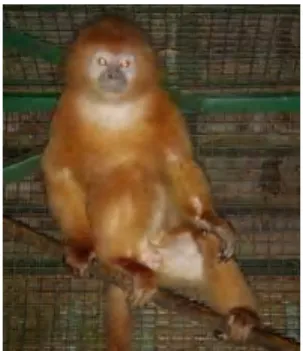
This animal has long tail, longer than its body, with reddish hairs and bluish face. In their habitat, they live in group up to eight heads and mastered by one male. Maroon leaf monkey is arboreal, diurnal animal, and the eater of leaves (folivorus), however, they also eats fruits and flowers. Their habitats include mangrove, primary and secondary forests both in low and high level land. Biological aspects of this animal are extremely a little and constituted deficient data (Kool, 1989).
256
Wartika Rosa Farida
The distribution of maroon leaf monkey in Indonesia includes Sumatera, east part of Kalimantan, and in the bigger amount in Sabah, Malaysia. Nowadays, the existence of this animal is increasingly threatened as the consequence of forest clearing on a large scale, forest fire, illegal hunting, and uncontrollable trading. The extinction of the wild animals is accelerated by the fact that their habitats are interrupted that, in turn, drive to decrease the biodiversity. Besides, there are another factors also accelerated the extinction process of primate: illegal hunting to get primate babies for souvenir, illegal ownership, and illegal trading.
It is urgent to conduct research to obtain information which can helping to
do ex situ captive breeding management
of maroon leaf monkey. The fulfilling of nutrient need of this animal in ex situ
captive breeding is necessary for the efforts of preserving the existence of this animal. The giving of alternative feed that is different from original feed in its habitat to maroon leaf monkey should helped fulfilling main need of this animal. The aim of this research is meant to obtain the data of (1) nutrient requirement and feed efficiency ratio of maroon leaf monkey in ex situ captive breeding and (2) the kinds of alternative feed to replace original feed in its original habitat. MATERIAL AND METHODS
The material used in this research is two maroon leaf monkey, one male aged 3 years and one female aged less than 1 year. Captive rooms used are two individual captive rooms, namely the type
with size of 3.15 m long, 2.26 m wide, and 1.99 m high, and wall of wire fence with holes of size 2.5 cm x 2.5 cm which is covered by fine wire fence with holes of size 7 mm x 7 mm. Each captive room is completed with plastic plate to put feed and plastic cup to put water drinking and bamboo trunks placed crisscross in the center of captive room used by maroon leaf monkey to do its activities.
The feedstuff is given with the way of cafeteria feeding in the morning (08:00 a.m) and afternoon (04:00 p.m) while drinking water is given ad libitum so that there is water along the time. All of feedstuffs are given in conformity. Preliminary treatment is done for 10 days so that maroon leaf monkey could adapt to feedstuff given. The period of data collecting is 4 weeks (28 days).
The feedstuff given in this research are ficus’ leaf (Ficus benyamina), lettuce (Lactuca sativa), kangkong
(Ipomoea aquatica), string bean
(Phaseolus vulgaris), passion fruit
(Passiflora quadrangularis), sweet
potatoes (Ipomoea batatas) dan
Lampung banana (Musa sp.). All of feedstuff are washed to remove pesticide residue and other dirty things, put in plastic plate in each captive room to enable maroon leaf monkey choosing its feedstuff. Every kind of feedstuff is weighing before giving to this animal. In the next morning, the rest of feedstuff will be weighed.
The measuring of temperature and humidity in the research area is done using thermo-hygrometer which is put in one side of captive room. Temperature and humidity are noted three times a day:
257
Analysis of Nutrient Requirement and Feed Efficiency
Picture 1. Maroon leaf monkey (Photo: W.R.Farida, 2009)
in the morning (06.00 a.m), in the noon (12:00 p.m), and in the afternoon (04:00 p.m).
Proximate analysis is conducted to get information about nutrient content of each kind of feedstuff. The need of nutrient can determinate by measuring the consumption of every feedstuff per day per animal. The average of feedstuff consumed by maroon leaf monkey then could be decided as the standard of feed need.
Data analysis used descriptive method. This research method is chosen by considering that the sum of material is limited. Data processing is done by describing the data obtained in the form of tables or graphs in the statements to explain and summarize the results of the research.
RESULTS
Temperature averages during research in the morning, noon, and afternoon are 25.41ºC, 30.76ºC, and 29.82ºC, consecutively; while humidity averages in the morning, noon, and afternoon are 81.93%, 64.15%, and 29.32%, consecutively. Sukandar (2004)
reported that the temperature and humidity in the original habitat of maroon leaf monkey are between 20ºC and 30ºC for temperature and 80% for humidity.
The condition of low temperature and high humidity in the morning and high temperature and low humidity in the noon will give effect to condition and activities of maroon leaf monkey in captive breeding. Extreme temperature influences feed consumption of the animal. High temperature decreases the consumption while low temperature increases the consumption.
Table 1 shows that the content of N-free extractives and protein of leaves are high enough, because part of leaves that given to maroon leaf monkey is shoot/young parts which is having nutrient content higher than other parts (de graff
et al. 2004 in Prayogo 2006) and
according to Kappeler (1981) leaves are the source of high protein. The dry matter content of feedstuff also has high crude fiber because vegetable and fruit that given are the source of high crude fiber (Yulianti et al. 2006). The feedstuff with the highest crude fiber is ficus’ leaf, namely 39.45%.
258
Wartika Rosa Farida
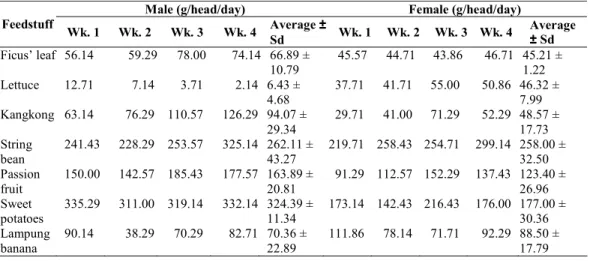
Based on the consumption of fresh feedstuff (Table 2), male maroon leaf monkey most likes sweet potatoes, string bean, and passion fruit, consecutively. Lampung banana is consumed more than ficus’ leaf in the week1 and week 4. Kangkong is liked more than ficus’ leaf and lettuce. Female maroon leaf monkey most likes string bean, sweet potatoes, passion fruit, and
lampung banana, consecutively. In the first two weeks, it consumed more ficus’ leaf, however, in week 3 and week 4, it consumed more kangkong and lettuce.
Based on the amount of fresh feedstuff consumed weekly, female maroon leaf monkey consumed more lettuce than male maroon leaf monkey do. It is caused by the fact that female maroon leaf monkey is still young and
Notes : DM = dry matter, CP= crude protein ; C.Fat = crude fat, CF = crude fiber; NFE = nitrogen free extractives; GE = gross energy
Table 1. Compositon of nutrient content feedstuff in the research of maroon leaf monkey (100% dry matter)
Male (g/head/day) Female (g/head/day)
Feedstuff Wk. 1 Wk. 2 Wk. 3 Wk. 4 Average Sd ± Wk. 1 Wk. 2 Wk. 3 Wk. 4 Average ± Sd Ficus’ leaf 56.14 59.29 78.00 74.14 66.89 ± 10.79 45.57 44.71 43.86 46.71 45.21 ± 1.22 Lettuce 12.71 7.14 3.71 2.14 6.43 ± 4.68 37.71 41.71 55.00 50.86 46.32 ± 7.99 Kangkong 63.14 76.29 110.57 126.29 94.07 ± 29.34 29.71 41.00 71.29 52.29 48.57 ± 17.73 String bean 241.43 228.29 253.57 325.14 262.11 ± 43.27 219.71 258.43 254.71 299.14 258.00 ± 32.50 Passion fruit 150.00 142.57 185.43 177.57 163.89 ± 20.81 91.29 112.57 152.29 137.43 123.40 ± 26.96 Sweet potatoes 335.29 311.00 319.14 332.14 324.39 ± 11.34 173.14 142.43 216.43 176.00 177.00 ± 30.36 Lampung banana 90.14 38.29 70.29 82.71 70.36 ± 22.89 111.86 78.14 71.71 92.29 88.50 ± 17.79
Table 2. Fresh feedstuff consumed by male and female maroon leaf monkey
Notes : Wk = week
Feedstuff DM Ash CP C. Fat CF NFE GE
(cal/g) --- (%) --- Ficus’ leaf 25.05 13.78 14.35 8.82 39.45 23.60 4335 Lettuce 8.01 21.28 33.18 5.37 8.95 31.22 3786 Kangkong 9.89 10.69 30.55 3.38 14.85 40.53 4314 String bean 75.40 5.63 4.12 1.22 12.17 76.86 3545 Passion fruit 14.78 5.10 1.91 14.87 24.19 53.93 4137 Sweet potatoes 25.22 2.78 3.69 1.06 9.43 83.04 3699 Lampung banana 38.75 3.49 33.65 0.52 1.03 61.31 3218
259
Analysis of Nutrient Requirement and Feed Efficiency
with the growing teeth preferred lettuce which is softer and contends lower crude fiber than ficus’ leaf and kangkong (Table 1). Consumption is feedstuff amount consumed by animal while the feedstuff is given ad libitum (Parakkasi 1999). According to Maynard et al. (1979), the purpose of an animal consuming its ration is to maintain its life, to grow, and to produce. Palatability is one of some factors determining the rate of ration consumption of animal. According Church and Pond (1988), palatability is influenced by the form,
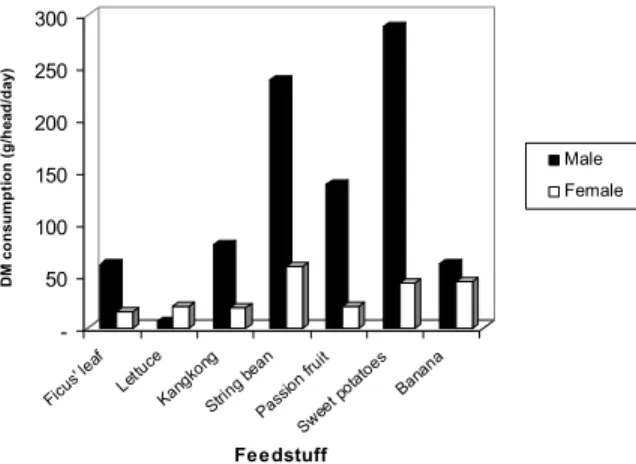
Figure 1. Average of dry matter consumption of maroon leaf monkey (g/head/day)
Figure 2. Average of dry matter consumption of maroon leaf monkey based on feedstuff (g/ head/day)
smell, taste, texture, and temperature of feedstuff given.
Based on sex of maroon leaf monkey, dry matter consumption of feedstuff by this animal shows (Table 2) fluctuation in consuming dry matter by both male and female. There is an increase of consuming dry matter of feedstuff by female maroon leaf monkey in week 2 to week 4, on the contrary a decrease of consuming dry matter of feedstuff by the female happened. In week 1, female maroon leaf monkey consumed high dry matter of feedstuff
-50 100 150 200 250 300 D M c ons umpt ion (g/ h ea d /d ay ) Ficu s' le af Lettu ce Kang kong Strin g be an Pass ion fru it Swee t pot atoe s Bana na Feedstuff Male Female 119. 69 108. 76 12 8.31 14 1.03 89.5 7 11.0 2 13.12 13.15 0 20 40 60 80 100 120 140 160
Week 1 Week 2 Week 3 Week 4
Observation time D M co n su m p ti o n ( g /h ead /d ay) Male Female
260
Wartika Rosa Farida
because it still adapted to alternative feedstuff given. While in week 2 and the next week, it has adjusted to its basic need. Based on the amount of feedstuff consumed, male maroon leaf monkey consumed more dry matter of feedstuff than female maroon leaf monkey (Figue 1), because the male is adult monkey aged 3 years with body weight more than the female, while the female is young monkey aged 1 year in growing period. Winter and Funk (1956) reported that ration consumption is influenced by energy and protein contained in the ration, race, sex, and growth rate. Ration amount consumed is depended on body size of animal, daily activities in doing moving activity, temperature in and around captive room, quality and quantity of ration given, and its management. The same fact is also stated by Moen (1973), that feed consumption is influenced by sex, age, surrounding condition, and season change. High temperature can cause a decrease in feed consumption and an increase in drinking water consumption.
Figure 2 shows that consumption of dry matter from sweet potatoes and string bean is the biggest amount and like most by the male, while the female preferred string bean and lampung banana. High consumption of sweet potatoes is caused by its carbohydrate content of 75%-90% used by the body as energy resources (Muhilal 1991). The family of maroon leaf monkey is the eater leaves primate (folivorus) (NRC 2005), though in its original habitat it also consumes fruit, seed, and liana
DISCUSSION
Consumption is the amount of feeds can eaten by every animal and constitutes essential factor which is basic to determine principal need for life and production (Parakkasi 1999). Sweet potatoes, string bean, dan lampung banana with the sweet taste are the kinds of feeds palatable for maroon leaf monkey. Palatability factor is urgent in measuring feed consumption for animal (Tomaszewska et al. 1991).
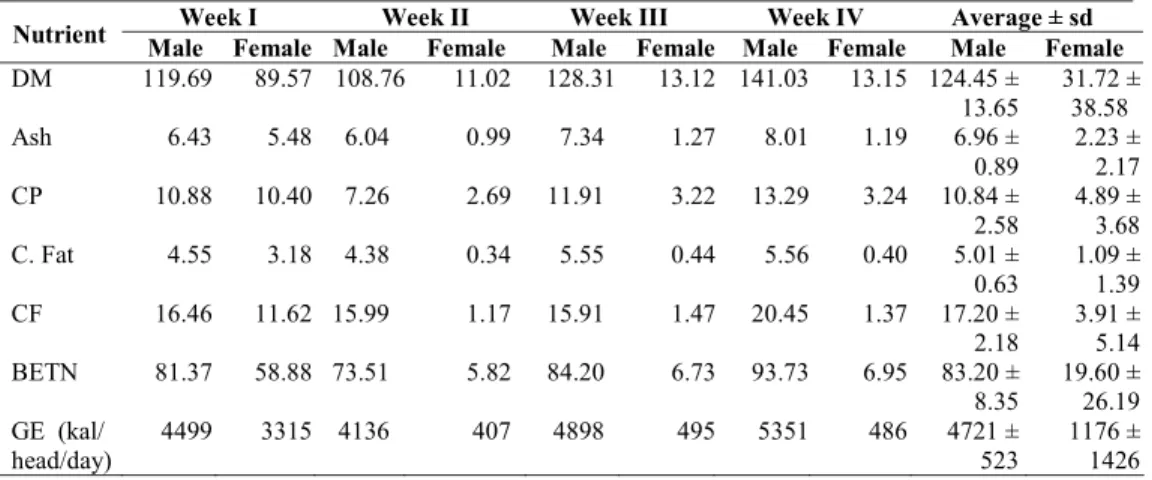
The amount nutrient consumption by maroon leaf monkey is influenced by the amount of dry matter consumption and nutrient content of every feed material. The amount of nutrient consumption is also effected by the difference of feeds palatability. Based on averages of nutrient consumption, that of male maroon leaf monkey is higher than that of female leaf monkey, because body weight of the male is higher so that the nutrient requirement is also bigger.
Percentage of the highest need of nutrient is N-free extractives, namely 66.85% for male maroon leaf monkey and 61.79% for the female (Table 4). N-free extractives are carbohydrate not contending crude fiber and contends much starch (Tillman et al. 1991). It is caused by the fact that feed material given contended higher N-free extractives than other nutrients. N-free extractives consumed by maroon leaf monkey is relatively higher than that of other nutrients.
The feeds with high N-free extractives are easily digested and contend high energy. The percentage
261
Analysis of Nutrient Requirement and Feed Efficiency
Week I Week II Week III Week IV Average ± sd
Nutrient Male Female Male Female Male Female Male Female Male Female
DM 119.69 89.57 108.76 11.02 128.31 13.12 141.03 13.15 124.45 ± 13.65 31.72 ± 38.58 Ash 6.43 5.48 6.04 0.99 7.34 1.27 8.01 1.19 6.96 ± 0.89 2.23 ± 2.17 CP 10.88 10.40 7.26 2.69 11.91 3.22 13.29 3.24 10.84 ± 2.58 4.89 ± 3.68 C. Fat 4.55 3.18 4.38 0.34 5.55 0.44 5.56 0.40 5.01 ± 0.63 1.09 ± 1.39 CF 16.46 11.62 15.99 1.17 15.91 1.47 20.45 1.37 17.20 ± 2.18 3.91 ± 5.14 BETN 81.37 58.88 73.51 5.82 84.20 6.73 93.73 6.95 83.20 ± 8.35 19.60 ± 26.19 GE (kal/ head/day) 4499 3315 4136 407 4898 495 5351 486 4721 ± 523 1176 ± 1426
Notes : DM = dry matter, CP= crude protein ; C. Fat = crude fat, CF = crude fiber; NFE = nitrogen free extract; GE = gross energy
Table 3. Average of nutrient consumption of maroon leaf monkey (g/head/day)
Male Female Average ± Sd
Nutrient ---(% DM)--- Ash 5.59 7.03 6.31 ± 1.02 Crude protein 8.71 15.41 12.06 ± 4.74 Crude fat 4.03 3.44 3.74 ± 0.42 Crude fiber 13.82 12.33 13.08 ± 1.05 NFE 66.85 61.79 64.32 ± 3.58 GE (Kal/100 g BK) 3793.49 3707.44 3750.47 ± 60.85
Table 4. Estimation of nutient need of maroon leaf monkey
Notes : DM = dry matter; NFE = nitrogen free extractives; GE = gross energy
average for crude fiber need is the second highest need, namely 13.08%. This is caused the ability of maroon leaf monkey in digesting the feeds contending crude fiber in its digestive tract as the consequence of the presence of bacteria there to fermenting the feeds originated of plants (NRC 2003).
Female maroon leaf monkey showed higher body weight addition than the male
experienced, namely around 350 g or 9.21 g/head/day (Table 5). It can be explained, female maroon leaf monkey is animal in growing period so that their body weight growth is high, while the male is adult monkey who just less experienced growth. Growth is an extremely complex process including body weight gain and the growth will be spread evenly and simultaneously
262
Wartika Rosa Farida
(Maynard et al. 1979). Body weight gain data is obtained through measuring body weight increase by calculating repeatedly in certain time such as daily, weekly, or monthly (Tillman et al. 1991). The efficiency of feeds using is comparation between body weight gain and dry matter consumption of ration (Crampton & Harris 1969). Research result showed that female maroon leaf monkey who is younger than male maroon leaf monkey seemed has higher feeds using efficiency, namely 29.04%.
CONCLUSION
From the result of this research it can be concluded that average of feedstuff consumption for maroon leaf monkey are 126.80 g/head/day fresh material and 78.09 g/head/day dry matter. N-free extractives is the nutrient consumed most. The estimation of nutrient requirement by maroon leaf monkey is as follows 6.31% ash, 12.06% crude protein, 3.74% crude fat, 13.08% crude fiber, and 64.32% N-free extractives. The estimation nutrient requirement of maroon leaf monkey can be known from the result of this research
so that feeds intake for this animal can be better.
REFERENNCES
Baillie, J. & Groombridge, B. (compilers and editors) 1996. 1996 IUCN
Red List of Threatened Animals.
IUCN, Gland, Switzerland. Church, DC & WG. Pond. 1988. Basic
Animal Nutrition and Feeding. 3rd Edition. John Wiley and Sons, Inc., Canada.
Crampton, EW. & LE. Harris. 1969. Applied Animal Nutrition. W.H. Freeman and Co. San Fransisco. Kappeler, M. 1981. Sketch of The
Ecological Position. [http:www. markuskappler.ch/gips- /chapter8. html]. [10 Maret 2008].
Kool, KM. 1989. Behavioural Ecology of the Silver Leaf Monkey
(Trachypithecus auratus
sondai-cus) In the Pangandaran Nature Reserve, West Java, Indonesia. University of New South Wales, Sidney.
Maynard, LA., JK. Loosli, HF Hintz, & HG. Wanner. 1979. Animal Table 5. Daily weight gain and feed efficiency ratio of maroon leaf monkey
Description Male Female
Body weight in the beginning of observation (g) 7,850 1,750
Body weight in the end of observation (g) 7,975 2,100
Daily weight gain (g/head/day) 3.29 9.21
Dry matter consumption (g/head/day) 124.45 31.72
263
Analysis of Nutrient Requirement and Feed Efficiency
Nutrition. 3rd Ed. McGraw Hill Publishing Co Ltd. New York. Muhilal. 1991. Ubi Jalar Kurangi Resiko
Buta. http://www.mail-archive. com. Kompas (on-line) Jakarta. [16 Februari 2008].
Moen, AN. 1973. Wildlife Ecology. W. H. Freeman and Company. San Fransisco.
National Research Council. 2005. Nutrient Requirements of Nonhu-man Primates, 2nd Revised Edition. The National Academies Press, Washington, D.C.
National Research Council. 2003. Nutrient Requirements of Nonhu-man Primatess, 2nd Revised Edition, The National Academies Press, Washington, D.C.
Parakkasi, A. 1999. Ilmu Nutrisi dan Makanan Ternak Ruminan. UI-Press, Jakarta.
Prayogo, H. 2006. Kajian tingkah laku dan analisis pakan lutung perak
(Trachypithecus cristatus) di
Pusat Primata Scamutzer Taman
Margasatwa Ragunan. Tesis.
Program Pasca Sarjana. Institut Pertanian Bogor. Bogor.
Sukandar, S. 2004. Laporan Inventarisasi Flora dan Fauna di Cagar Alam Takokak. Balai Konservasi Sumber Daya Alam Jawa Barat I. Direktorat Jenderal Perlindungan Hutan dan Konservasi Alam. Departemen Kehutanan. Ban-dung.
Supritna, S & EH. Wahono. 2000. Panduan Lapangan Primata Indonesia. Yayasan Obor Indonesia. Jakarta.
Tillman, AD, H. Hartadi, S. Reksoha-diprodjo, S. Prawirokusumo, & S. Lebdosoekojo. 1991. Ilmu Maka-nan Ternak Dasar. Gajah Mada University Press.
Tomaszewska, MW., IK Sutama & TD. Chaniago. 1991. Reproduksi, Tingkah Laku, dan Produksi Ternak di Indonesia. Gramedia Pustaka Utama. Jakarta.
Winter, AR, & EM. Funk.1956. Poultry Science and Practice. 4th Ed. Chicago. Philadelphia. New York. 323-326.
Yulianti, S., Irlansyah, E. Junaedi & M. Widjaya. 2006. Khasiat dan Manfaat Apel. Agro Media Pustaka, Jakarta.
Memasukkan: Oktober 2009 Diterima: Januari 2010
J. Biol. Indon. Vol 6, No. 2 (2010)
PANDUAN PENULIS
Naskah dapat ditulis dalam bahasa Indonesia atau bahasa Inggris. Naskah disusun dengan urutan: JUDUL (bahasa Indonesia dan Inggris), NAMA PENULIS (yang disertai dengan alamat Lembaga/ Instansi), ABSTRAK (bahasa Inggris, maksimal 250 kata), KATA KUNCI (maksimal 6 kata), PENDAHULUAN, BAHAN DAN CARA KERJA, HASIL, PEMBAHASAN, UCAPAN TERIMA KASIH (jika diperlukan) dan DAFTAR PUSTAKA.
Naskah diketik dengan spasi ganda pada kertas HVS A4 maksimum 15 halaman termasuk gambar, foto, dan tabel disertai CD. Batas dari tepi kiri 3 cm, kanan, atas, dan bawah masing-masing 2,5 cm dengan program pengolah kata Microsoft Word dan tipe huruf Times New Roman
berukuran 12 point. Setiap halaman diberi nomor halaman secara berurutan. Gambar dalam bentuk grafik/diagram harus asli (bukan fotokopi) dan foto (dicetak di kertas licin atau di scan). Gambar dan Tabel di tulis dan ditempatkan di halam terpisah di akhir naskah. Penulisan simbol α,
β, χ, dan lain-lain dimasukkan melalui fasilitas insert, tanpa mengubah jenis huruf. Kata dalam bahasa asing dicetak miring. Naskah dikirimkan ke alamat Redaksi sebanyak 3 eksemplar (2 eksemplar tanpa nama dan lembaga penulis).
Penggunaan nama suatu tumbuhan atau hewan dalam bahasa Indonesia/Daerah harus diikuti nama ilmiahnya (cetak miring) beserta Authornya pada pengungkapan pertama kali.
Daftar pustaka ditulis secara abjad menggunakan sistem nama-tahun. Contoh penulisan pustaka acuan sebagai berikut :
Jurnal :
Hara, T., JR. Zhang, & S. Ueda. 1983. Identification of plasmids linked with polyglutamate production in B. subtilis. J. Gen. Apll. Microbiol. 29: 345-354.
Buku :
Chaplin, MF. & C. Bucke. 1990. Enzyme Technology. Cambridge University Press. Cambridge.
Bab dalam Buku :
Gerhart, P. & SW. Drew. 1994. Liquid culture. Dalam : Gerhart, P., R.G.E. Murray, W.A. Wood, & N.R. Krieg (eds.). Methods for General and Molecular Bacteriology. ASM., Washington. 248-277.
Abstrak :
Suryajaya, D. 1982. Perkembangan tanaman polong-polongan utama di Indonesia. Abstrak Pertemuan Ilmiah Mikrobiologi. Jakarta . 15 –18 Oktober 1982. 42.
Prosiding :
Mubarik, NR., A. Suwanto, & MT. Suhartono. 2000. Isolasi dan karakterisasi protease ekstrasellular dari bakteri isolat termofilik ekstrim. Prosiding Seminar nasional Industri Enzim dan Bioteknologi II. Jakarta, 15-16 Februari 2000. 151-158.
Skripsi, Tesis, Disertasi :
Kemala, S. 1987. Pola Pertanian, Industri Perdagangan Kelapa dan Kelapa Sawit di Indonesia.[Disertasi]. Bogor : Institut Pertanian Bogor.
Informasi dari Internet :
Schulze, H. 1999. Detection and Identification of Lories and Pottos in The Wild; Information for surveys/Estimated of population density. http//www.species.net/primates/loris/ lorCp.1.html.
J. Biol. Indon. Vol 6, No.2 (2010)
Kemampuan Kawasan Nir-Konservasi dalam Melindungi Kelestarian Burung Endemik Dataran Rendah Pulau Jawa Studi Kasus di Kabupaten Kebumen
Eko Sulistyadi
237
Analysis of Nutrient Requirement and Feed Efficiency Ratio of Maroon Leaf Monkey (Presbytis rubicunda Mueller, 1838)
Wartika Rosa Farida
255
Oksidasi Nitrit Oleh Bakteri Heterotrofik Pada Kondisi Aerobik Dwi Agustiyani, Ruly Marthina Kayadoe & Hartati Imamuddin
265
Pencirian Karbon Organik Air Sungai Citarum Hulu Dari Masukan Air Limbah Penduduk dan Industri
Eko Harsono & Sulung Nomosatryo
277
TULISAN PENDEK
Arti Kebun Raya Bogor Bagi Kehidupan Kumbang Sungut Panjang (Coleoptera, Cerambicidae)
Woro Anggaraitoningsih Noerdjito