and Rural Development Research
Vol. 3 No.1 Januari 2017
Assessment the Impact Of Asean
Free Trade Area (AFTA) on Exports
of Indonesian Agricultural
Com-modity
DOI: 10.18196/agr.3139
ABSTRACT
This paper focuses on investigation whether Indonesian membership on ASEAN Free Trade Area (AFTA) increased export of agri-culture commodity. The panel augmented gravity model data from 33 major partner countries over the period of 2000-2014 has been applied to analyze the factors affected Indonesian agricultural exports. The overall finding showed that Indonesian agricultural exports were positively correlated with the size of economy and partner countries population, while they are negatively cor-related with the appreciation of currency exchange rate and the enrollment on free trade agreement. Moreover, the Indonesian membership on AFTA does not gave sig-nificant impact and profitable on Indone-sian agricultural exports.
K KK
KKeywordseywordseywordseywordseywords: : : : : AFTA, Gravity Model, Agricul-tural Exports, JEL Classifications: F15, C23, Q17
INTRODUCTION
In present time, there is a growing concern on the formation of free trade agreement (FTA) among countries over the globe. Based on report from World Trade Organization (WTO) on 1st July 2016, some 635 of Regional Trade Agreements (RTAs) had been notified to the organization (World Trade Orga-nization, 2016). Economic integration in general could lead to increase trade and other benefits in the form of a more competitive trade region by removal trade and non-trade barriers and free flow of goods and services.
The basic principle of any economic integration form is the elimination of barriers to trade among two or more member countries. Regional economic integration implies the countries to come together in some type of partnership to foster trade and development. Economic integration processes can be real-ized through various stages, namely: preferential trading area; free trade area, monetary union; customs union, common market; economic union, customs and monetary union; economic and monetary union, fiscal union; and full or complete economic integration (Ndulu et al., 2005)
Indonesia as the largest economy in South-east Asia also involved on several regional economic cooperation’s. According to RTA database that notified to WTO, until 2015 Indonesia had become member of at least seven free trade agreements (FTA) which is one of them is the trade liberalization among ASEAN countries called ASEAN Free Trade Area or AFTA (World Trade Organiza-tion, 2016). AFTA is the oldest and the most developed trade agreement among Indonesia’s free trade agreements. AFTA trade agreement was signed by six original members of ASEAN in 1993 and became full operated by all ten ASEAN member countries in 2003 which covered trade liberalization agreement on good and services (ASEAN Secretariat, 1992).
A previous study conducted by Zahniser et al. (2002) amined the impact of regional economic integration on ex-ports of agricultural commodities of The United States (U.S.) revealed that the membership on free trade agreement showed positive value and statistically significant effect on export. Another study about the effect of free trade agreement on Turkish agricultural exports was conducted by Erdem and Nazliogrlu (2008), the results showed that Turkish agricul-tural exports to the Turkish-European Union FTA countries shows positive and significant which means that Turkish ex-ports to the FTA countries were higher than non-FTA mem-bers. And the latest research conducted by Oktaviani et al. (2008) on the impacts of ASEAN agricultural trade liberal-ization also showed positive effect on export of several com-modities such as rice, sugar, plant based fiber and animal products.
Despite many potential benefit, trade liberalization gets much criticism regarding its effect on economy, particularly the liberalization in agriculture sector since agriculture still becomes major sector by many countries especially develop-ing countries. For Indonesia, agriculture sector is still con-sidered as the economic backbone due to the contribution of this sector to country’s Gross Domestic Product (GDP) and supply around two fifth of country’s labor force. Based on Statistics Indonesia or Badan Pusat Statistik (BPS), the share of agriculture sector to Indonesian GDP are around 14.43%-15.29% in the last 15 year since 2000 to 2014 (Statistics In-donesia, 2016a). In term of employment, according to Statis-tic of Indonesia, agriculture sector provides 38,291,111 em-ployments or about 31.74% of Indonesian workforce (Statis-tics Indonesia, 2016b).
A recent study about the Impact of Free Trade Agree-ment on Indonesia’s Agriculture Trade was conducted by Dianniar (2013). Using the gravity model, this research showed that Indonesia’s participation in AFTA and ASEAN China Free Trade Agreement (ACFTA) did not have a sig-nificant impact on Indonesia’s agricultural trade flows. How-ever, this does not necessarily mean that become a member of FTA would not favorable for Indonesia.
Trade liberalization undertaken by Indonesian govern-ment through the membership in ASEAN Free Trade Area (AFTA) on the one side may encourages economic growth and increases trade because Indonesia’s commodity would have larger market and get more efficient trade procedure within AFTA. However, in the same time the participation in AFTA also gave more access to another ASEAN countries into Indonesian market which may threaten domestic agri-culture commodity. Within ASEAN agreement, agriagri-culture
commodity would compete with another ASEAN countries imported product which may cheaper and better in quality. According to above exploration, it is interesting to inves-tigate whether Indonesian agricultural exports are influenced by Indonesia’s membership in AFTA. It is also appeal to find out whether these facts effect on Indonesia’s decision to par-ticipate in free trade agreement. Hence the objective of this study is to assess the economic impact of ASEAN Free Trade Area (AFTA) on Indonesia’s agriculture exports.
METHODOLOGY
The assessment of the impact of free trade agreement on Indonesian agricultural exports could be analyzed using grav-ity model. The gravgrav-ity model is widely used tool to analyze factors affecting agricultural trade flows such as free trade agreement, exchange rate, common border, language com-monality and arable land (Erdem and Nazlioglu, 2008).
The traditional basic gravity model established by Tinbergen (1962) underlying the value of exports from coun-try i to country j. Exports as dependent variable is a positive function of countries gross domestic product (GDP), but negatively related to the distance between countries. While many literatures agree to the empirical model that GDP and distance is the main explanatory variable, many studies uses other variable to be included as another explanatory vari-able. Ghosh and Yamarik (2004) showed a list of 48 inde-pendent variables that has been used in literatures to esti-mate the gravity model in various combinations such as eco-nomic development (GDP), trade policy, common language, common border, currency exchange rate, landlock and area. Sohn (2005) concluded that in gravity model, the most common dependent variables are exports and bilateral trade flows. While the explanatory variables are factors indicating demand and supply of trading countries, and impedance fac-tors of trade flow between countries. The proxies for demand and supply are measures of countries economic and market size such as income level, population, area size and GDP per capita.
To this end, this research follows Erdem and Nazlioglu (2008) and Greene (2013) gravity model specification, the model is as follows:
LnEijt = β0 + β1GDPit + β2GDPjt + β3lnDistij + β4lnPopjt + β5lnLandjt + β6lnExit + β7Exjt
+ β8AFTAij + εijt
Where: Eijt is total Agricultural export from Indonesia (i) to partner countries (j) measured in current US$ dollar. Ag-riculture exports commodity in this paper are refer to the AFTA Agreement on the Common Effective Preferential Tariff Scheme (CEPT). According to the agreement, agricul-tural products were defined as non-processed product rounded up on Chapter 01 to Chapter 24 Harmonized Sys-tem and other product which were similar to unprocessed agricultural material (ASEAN Secretariat, 1992).
Furthermore, on the right-hand side, GDPit and GDPij were the sum of real gross domestic product (GDP) of Indo-nesia (i) and partner (j) countries which was measured in 2010 U.S. dollars. GDP was a proxy of country’s income and stage of development. Income effect on export was expected to be positive (Amin et.al, 2009).
Distij was geographical distance between capital cities of Indonesia and partner countries in kilometers. Distance was hypothesized to be negative effect on agricultural export (Karemera, 1999). Therefore, the further distance between exporter and importer countries, the higher in cost will take which reduce importer profit. Popjt was Indonesian partner country population. Population is represented country’s market size and potential domestic consumption. Partner countries population as an importer is expected to have posi-tive impact on Indonesian agriculture export for the reason that larger market tends to consume more importer goods (Lambert and McCoy, 2009). Landjt represents total irrigated land of Indonesian partner country in hectare. The partner countries irrigated land variable was expected to have nega-tive effect on Indonesian agricultural exports since the ex-tent of irrigated land may interfered importing country’s ability to produce more agricultural product (Erdem and Nazioglu, 2008).
The next variables were Excit and Excjt which were Indo-nesian currency real exchange rate and partner countries currency real exchange rate per US$ dollar. The literature suggested that the appreciation of exporter currency can de-crease exports due to increasing export price (Greene, 2013). On the contrary the depreciation of exporter currency could enhance export (Karemera et.al, 1999). AFTAijt is dummy variable if Indonesia and partner country are member of ASEAN free trade agreement (AFTA). The formation of free trade agreement by Indonesia and partner countries was
ex-pected to boost the volume and value of Indonesian agricul-ture export in the reason of FTA would reduce or even re-move tariff and nontariff barriers (Kristjánsdóttir, 2005).
Panel data was used in this study. The reason for using this type of data was because panel data could give empirical analysis in a way that is not feasible if just use a cross-section or time series data. According to Wooldridge (2013), there are four types of panel data estimation model: Pooled OLS, Fixed Effect Model (FEM), Random Effect Model (REM) and First Difference (FD).
In order to choose which is the best effective model for this research among estimation models, Hausman Test is applied. The null hypothesis that underlying the Hausman test is that REM is more preferable. The test statistic devel-oped by Hausman has an asymptotic ÷2 distribution. By test-ing the model, we are able to choose the best estimation model based on the available data set and eventually we will make the proper analysis. (Wooldridge, 2013).
Egger (2000) pointed out that the random effects model (REM) would be more appropriate when estimating trade flows between randomly drawn samples of trading partners from a larger population. While, the fixed effects model (FEM) would be a better choice than REM when one is inter-ested in estimating trade flows between a predetermined se-lection of nations. Since the sample of this study includes trade exchanges between Indonesia and its trading partners, the FEM might be the most appropriate estimation. How-ever, Hausman test is also conducted to check whether the REM is more efficient that the FEM estimation.
RESULT AND DISCUSSION
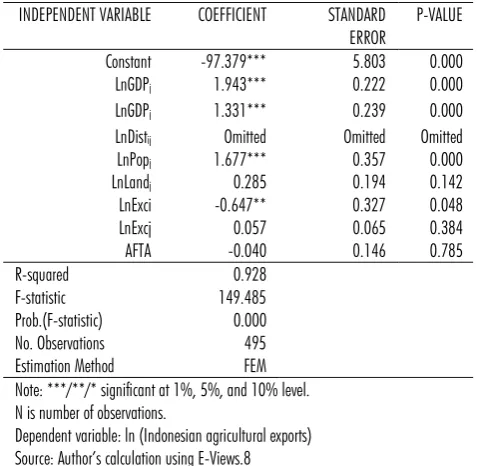
Table 1 and Table 2 demonstrated the estimation results of gravity model of Indonesian agricultural exports with their trading partners for year 2000 to 2014. The Hausman test and Wald test showed that the Fixed Effect Model (FEM) was found to be the most suitable model for this study.
TABLE.1. GRAVITY MODEL USING FIXED EFFECT MODEL
INDEPENDENT VARIABLE COEFFICIENT STANDARD ERROR
P-VALUE
Constant -97.379*** 5.803 0.000 LnGDPj 1.943*** 0.222 0.000
LnGDPj 1.331*** 0.239 0.000
LnDistij Omitted Omitted Omitted
LnPopj 1.677*** 0.357 0.000
LnLandj 0.285 0.194 0.142
LnExci -0.647** 0.327 0.048 LnExcj 0.057 0.065 0.384
AFTA -0.040 0.146 0.785 R-squared 0.928
F-statistic 149.485 Prob.(F-statistic) 0.000 No. Observations 495
Estimation Method FEM Note: ***/**/* significant at 1%, 5%, and 10% level. N is number of observations.
Dependent variable: ln (Indonesian agricultural exports) Source: Author’s calculation using E-Views.8
Table 1 indicates the result of panel data estimation of 495 observations of Indonesian agricultural exports with their trading partners for year 2000 to 2014. The R2 value
pre-sented in the Table I shows 0.928 value means that 92.8 percent of the variation on Indonesian agricultural exports across the data set could be explained by the model.
The estimated coefficient of the LnGDPi denotes Indo-nesian national income (GDP) was positive and statistically insignificant effect on export. The magnitudes for this vari-able was 1.943 bear a meaning that 1 percent increase on Indonesian GDP would increase Indonesian agricultural ex-port by 1.9 percent. This result revealed that the positive growth on Indonesian economy has positive impact on In-donesian agricultural exports. LnGDPj as a proxy for the in-come effect of the partner country size of economy also show positive sign as expected and statistically significant on ex-ports. The coefficient of partner countries GDP was 1.331 means that 1 percent increase on importer income would boost Indonesian agricultural exports by 1.3 percent. This result indicates that the growth of partner countries income
leads to increase exports. This result in line with other study which was concluded that big country trade more than small countries in agricultural commodities (Grant and Lambert, 2005).
TABLE 2. INDIVIDUAL EFFECT REGRESSED WITH TIME-INVARIANT VARIABLE
Independent Variable Coefficient Standard Error p-Value LNDistij 2.169*** 0.012 0.000
R-squared 0.552 495
FEM No. Observations
Estimation Method
Note: ***/**/* significant at 1%, 5%, and 10% level. Source: Author’s calculation using E-Views.8
The estimation result of distance as mentioned on Table 2 surprisingly showed unexpected positive value and statisti-cally significant impact on Indonesian agricultural export. The positive effect of distance on exports was happened may due to some reasons. According to Dreyer (2014), the vari-able of distance could have a positive effect on agricultural trade because of distance are not only represent transporta-tion cost but also the differences on climate, land and agri-culture products among partner countries. The misaligned of distance also revealed that distance was not an obstacle factor for Indonesia to develop trade with partner countries around the world. Regarding with the result on distance ef-fect, from 33 partner countries in this study, around 80.50 percent of Indonesian exports (value $ 190.22 Billions) over the year 2000-2014 are not to neighboring ASEAN coun-tries but spreads over the globe from Asian councoun-tries like India (4,998 km) and China (5,221 km), to European tries Netherland (11,362 km) and the farthest partner coun-tries United Stated of America (16,371 km). One of the rea-son is the development in transportation and technology which is leads to the more efficient and cheaper transporta-tion cost. Nowadays transportatransporta-tion cost is not a big portransporta-tion of trade cost since the marginal cost of land and shipping transportation is low (Wu, 2015).
The next variable is partner countries irrigated land. This variable has an unexpected positive sign but statistically in-significant effect on agricultural exports. This means that the extent of irrigated land owned by partner country does not effect on Indonesian agricultural export. The insignifi-cant effect of land on export may due to the difference on climate, which is caused by different types of agriculture com-modities (Wu, 2015). So, even the importing countries have larger irrigated land but they still need agriculture product from Indonesia.
Moreover, the variable real exchange rate of Indonesia (Exci) shows negative sign and statistically significant. Real exchange rate of Indonesia represented the fluctuation of Indonesian currency Rupiah. The negative result of Indone-sian Rupiah exchange rate indicated that price competitive-ness was important factor on Indonesian agriculture exports (Greene, 2013). The coefficient of real exchange rate of In-donesia was -0.647 means that 1 percent appreciation of Rupiah would lower Indonesian agricultural exports by 0.65 percent. Whilst real exchange rate of importer countries (Excj) showed positive value but statistically insignificant, meaning that fluctuation of partner country’s currency exchange rates did not effect on exports. The insignificant effect of change in partner countries real exchange rate indicated that low exchange rate risk was not the determinant factor for im-porter countries to buy Indonesian agricultural products (Folaweo and Olokojo, 2010).
The dummy variable ASEAN Free Trade Area (AFTA) as a proxy of country’s economic integration within ASEAN shows unexpected negative value but statistically insignificant impact on Indonesian agriculture commodity exports. The insignificant effect of the formation of AFTA on agricultural export might because the liberalization on agriculture com-modities was growing slowly since agriculture comcom-modities often excluded from the reduction on tariff within FTA and even included in the agreement, tariff reduction on agricul-ture commodities often takes longer time than other com-modities. For instance, the agriculture liberalization on AFTA, even AFTA agreement been in effect since 1993, but agricul-tural commodities were excluded on reduction tariff in AFTA agreement (agricultural product were included in the sensi-tive and highly sensisensi-tive list). Trade liberalization on agricul-tural commodity within AFTA start in 1 January 2003 for ASEAN-6 (Indonesia, Malaysia, Singapore, Thailand, the Philippines and Brunei) and completed in 1 January 2010 for all member countries.
Another reason may because ASEAN has small market size in the global economy and most international trade by Indonesia are with non-ASEAN countries. Indonesian agri-cultural export to 10 ASEAN partner countries on the data set in this study only 21.4 percent (value $ 51.75 billions) compare with non-ASEAN countries counted more than 78.6 percent (value $ 190.22 Billions) of total Indonesian agricul-ture export over the year 2000-2014. Hence, the expected gain from tariff reductions under the AFTA scheme was very small since the tariff reduction was applied only to ASEAN members. This result is in line with other study by Dianiar (2013) which was pointed out that the participation on AFTA did not bring significant effect on Indonesian agricultural exports commodities.
CONCLUSION
The objective of this study is to employ an “augmented” gravity model of international trade to empirically analyze the impact of ASEAN Free Trade Area (AFTA) on Indonesia’s agricultural exports during the years 2000-2014. The gravity equation included standard gravity variables plus dummy variable AFTA. The results are based on the study of 33 In-donesian trading partners over 15 years’ period. Regression analysis was performed on panel data in three ways: pooled OLS, the random-effect model, and the fixed-effect model. The fixed-effect model was selected because it fits the data and more efficient than either pooled or the random-effect models.
The result shows that conventional variable of the gravity model (i.e. GDP as size of economy and population) has sig-nificant impact on Indonesian agricultural exports. Unex-pected sign is shown also by independent variable distance which has positive and significant effect on exports. The other variables partner countries irrigated land (LAND) has posi-tive sign but statistically insignificant. The variable of Indo-nesian real exchange rates shows as expected in negative sign and bring significant impact on Indonesian agricultural ex-ports. While partner countries real exchange rates were posi-tive but insignificant impact on export. An unexpected re-sult was found on the participation on AFTA. Trade liberal-ization within AFTA was not significant and profitable on Indonesian agriculture exports.
employed few on its explanatory variable. Hence, for further development of this study it is obligatory to consider include more explanatory variable that already proved by other pre-vious research, such as dummy variable common language, colonial link and investment.
REFERENCES
Amin, R. M., Hamid, Z., & Saad, N. M. 2009. Economic Integration Among ASEAN Countries: Evidence from Gravity Model. Working Paper. East Asian Development Network; p-79.
ASEAN Secretariat. 1992. Agreement on the Common Effective Preferen-tial Tariff Scheme for the ASEAN Free Trade Area (Online). Accessed: 7 December 2016. http://www.asean.org
Centre d’Etudes Prospectiveset d’Informations Internationales (CEPII). 2016. CEPII’s Distance and Geographical Database (Online). Accessed: 3 December 2016. http://www.cepii.fr/anglaisgraph/bdd/ distances.htm.
Dianniar, U. 2013. The Impact of Free Trade Agreements on Indonesia’s Agricultural Trade Flows: An Application of the Gravity Model Ap-proach.Thesis, International Institute of Social Studies. The Hague, The Netherlands.
Dreyer, H. 2014. Misaligned distance: why distance can have a positive effect on trade in agricultural products. Institute of Agricultural Policy and Market Research, University of Giessen, Germany. Selected Paper prepared for presentation at the Agricultural & Applied Economics Association’s 2014 AAEA Annual Meeting, Minneapolis, MN, July 27-29, 2014.
Egger, P. 2000. A note on the proper econometric specification of the gravity equation. Economics Letters, Journal Austrian Institute of
Eco-nomics Research 66: 25-31.
Erdem, E. & Nazlioglu, S. 2008. Gravity Model of Turkish Agricultural Ex-ports to the European Union. Working Paper. International Trade and Finance Association 2008. The Berkeley Electronic Press (bepress). Food and Agriculture Organization (FAO). 2016. Area Equipped by
Irriga-tion Data. Accessed 17 December 2016 http://www.fao.org/nr/wa-ter/aquastat/irrigationmap/index.stm.
Folawewo, A. O., & Olokojo, S. A. 2010. Determinants of agricultural exports in oil exporting economy: empirical evidence from Nigeria.
Journal of Economics Theory: 84-92.
Ghosh, S. & Yamarik, S., 2004. “Are preferential trade agreements trade creating? An application of extreme bounds analysis”. Journal of
In-ternational Economics: 369-395.
Grant, J. H. & Lambert, D. M. 2005. Regionalism in world agricultural trade: lesson from gravity model estimation. Selected Paper prepared for presentation at the American Agricultural Economics Association Annual Meeting, Providence, Rhode Island, July 24-27, 2005.
Greene, W. 2013. Export Potential for U.S. Advanced Technology Goods to India Using a Gravity Model Approach. Office of Economic
Work-ing Paper. Office of Economics U.S. International Trade Commission.
No. 2013-03B. Washington DC.
Karemera, D., Smith, W. I., Ojah, K., & Cole, J. A. 1999. A gravity model analysis of the benefits of economic integration in the Pacific Rim.
Journal of Economic Integration 14(3): 347– 367.
Kristjánsdóttir, H. 2005. A Gravity Model for Exports from Iceland.
Work-ing Paper. Centre for Applied Microeconometrics University of
Copenhagen. Copenhagen, Denmark.
Lambert, D. & McKoy, S. 2009. Trade creation and diversion effects of preferential trade associations on agricultural and food trade. Journal
of Agricultural Economics 60 (1): 17–39.
Ndulu, B., Kritzinger-van, L., & Reinikka, R. 2005. Infrastructure, Regional Integration and Growth in Sub-Saharan Africa. Working Paper. Africa in the World Economy - The National, Regional and International Challenges, Fondad, The Hague, December 2005. pp.101-119. Oktaviani, R., Puspitawati, E., & Haryadi. 2008. Impacts of ASEAN
Agri-cultural Trade Liberalization on ASEAN-6 Economies and Income Dis-tribution in Indonesia. Working Paper. Asia-Pacific Research and Train-ing Network on Trade (ARTNeT), an initiative of UNESCAP and IDRC, Canada.
Sohn, C. H. 2005. Does the gravity model explain South Korea’s trade flows. The Japanese Economic Review 56(4): 417-30.
Statistics Indonesia. 2016a. GDP at 2000 Constant Market Prices by In-dustrial Origin, 2000-2014 (Online). Accessed 2 December 2016. https://www.bps.go.id/linkTabelStatis/view/id/1206
Statistics Indonesia. 2016b. Population 15 Years to Top Who Worked by Main Industry 1986-2016 (Online). Accessed 2 December 2016. https:/ /www.bps.go.id/linkTabelStatis/view/id/970
Tinbergen, J. 1962. Shaping the World Economy, Suggestions for an
In-ternational Economic Policy. Twentieth Century Fund, New York.
UN-Comtrade. 2016. International Trade Statistic Database. United Na-tion Commodity Trade Database (Online). Accessed 7 August 2016 http://comtrade.un.org/data/
Wooldridge, J. M. 2013. Introductory Econometric, A Modern Approach. South Western CENCAGE Learning, Canada.
World Bank. 2016. World Development Indicators (Online).Accessed 2 August 2016 http://data.worldbank.org/data-catalog/world-develop-ment-indicators
World Trade Organization (2016). Regional Trade Agreement Database (Online). Accessed: 2 December 2016. https://www.wto.org/english/ tratop_e/region_e/region_e.htm.
Wu, Haonan. 2015. Revisiting the Distance Coefficient in Gravity Model. Cornel University Library. USA. Accessed: 2 December 2016. https:// arxiv.org/abs/1503.05283
Zahniser, S.S., Pick, D., Pompelli, G., & Gehlhar, M.J. 2002. Regionalism in the western hemisphere and its impact on U.S. agricultural exports: a gravity-model analysis. American Journal of Agricultural Economics