This paper has been presented at Sriwijaya University Learning and Education-International Conference 2014. Faculty of Teacher Training and Education, Sriwijaya University, Palembang, May 16—18, 2014.
C9-567
PROFILE OF STUDENT LEARNING STYLES AND MEDIA
NEEDS ICT-BASED LEARNING COURSE IN MODERN PHYSICS
Ketang Wiyono
Physics Education, Sriwijaya University
Email: [email protected]
Abstract
This study aimed to investigate profile of the student's learning styles and to find out needs of ICT-based learning media for modern physics course. This research was a descriptive study to expose students' learning styles by using questionnaire. In this research there were three types of students’ learning styles, which were visual learning style, auditory learning style, and kinesthetic learning style. To determine instructional media needs for modern physics, the researcher collected information through questionnaire containing questions about the important of using instructional media for modern physics course. The results of this study shows that there are 35.90% visual learners, 41.03% auditory learners, and 23.08% kinesthetic learners. Based on data of the questionnaire it shows that 93% of students expressed that instructional media should support and manage the differencies of learning styles in learning modern physics course. The results of this study tell us that every student has a unique learning style, and students need a form of ICT-based instructional media which is suitable for their own learning styles to study the course of modern physics.
Key words: learning styles, instructional media, ICT, modern physics
INTRODUCTION
Information and comunication technology is growing rapidly. These developments influence in many aspects of human life , including in the education . Every technology era has influence and forman education era in it’s time. The development of information and communication technology in education marked by the use of computers and the internet as an intructional media. Various studies in the use of information and communication technologies in the teaching of physics has been done. The utilization of information and communications technology on the basic physics lectures to enhance the understanding of fundamental physics concepts (Dori and Belcher, 2005), can improve concepts understanding of physics teacher candidates (Darmadi et al , 2007; Gunawan et al , 2008) , can overcome the basic physics student misconceptions (Muller & Sharma , 2007), improve critical thinking skills and generic science (Budiman et al, 2008; Yahya et al, 2008, Wiyono et al, 2009) . The successful use of information and communication technology in the lecture due to basic physics students more active and independent ( Darmadi et al , 2007), computer animation in learning processes based information technology and communication can visualize abstract that impossible to seen or imagined (Burke, 1998) , capable of reshowinformation required. The use of information and communication technology learning in advanced physics is helping students to understand the abstract concepts. According McKagan (2007) students will more easily understand the abstract concept of quantum mechanics with the help of interactive software.
This paper has been presented at Sriwijaya University Learning and Education-International Conference 2014. Faculty of Teacher Training and Education, Sriwijaya University, Palembang, May 16—18, 2014.
C9-568
and microscopic concepts of Modern Physics. In order Modern Physics concepts are abstract and microscopic easily understood by students need an innovation in the course of modern physics. One innovation in the lecture that the integration of information and communication technology in modern physics lectures (Wiyono, 2013).
Learning by using information and communication technologies that exist today generally give the same presentation of learning materials for each user because it assumes that all users are homogeneous characteristics. In fact, every user has different characteristics both in terms of level of ability, learning style, background or anything else. Learning system which uses information and communication technologies should be able to adapt it’s display the variety of user characteristics, so as to have a high learning effectiveness (Wiyono, 2012). One learning style is known for its simplicity VAK. VAK learning styles using the three main sensory receivers that visual, auditory and kinesthetic. In determining a student 's learning style seen from the dominant learning style. VAK learning styles is based on the modaliti theory, that although in any learning process students receive sensory information from threesensory, but there will be one or two dominant sensory. Learning style differences is in line with the principle of the development of computer -based permbelajaran namely : ( 1 ) goal-oriented learning, ( 2 ) individual-oriented learning, ( 3 ) self-oriented learning, and ( 4 ) complete the learning-oriented. Based on the background of the above problems, we should know the profile of student learning styles and needs of ICT based instructional media on the course of modern physics.
THEORITICAL BACKGROUND
There are many definitions of learning styles or learning styles. According to James and Blank (1993 ), learning style is defined as the habit of learning in which a person feels the most efficient and effective in receiving , processing , storing and issuing learned something. Mc Loughlin (1999) concluded that the term refers to the habit of learning styles in acquiring knowledge. Honey and Mumford (1992 ) defines learning styles as the attitudes and behavior that shows how to learn the most preferred one. Rita Dunn (DePorter , 2006) found many variables that affect the way people learn factors that include physical, emotional, sociological and environmental. One's learning style is a combination of how a person absorbs and organize and process information .
Some research on learning styles suggests that ( 1 ) some students have different learning habits with others, ( 2 ) some students learn more effectively when taught with the most preferred method , and ( 3 ) student achievement related to how to learn ( Riding & Rayner , 1998 ). Learning styles influence the effectiveness of training, no matter whether the training is conducted in person or on-line ( Surjono, 2008). This shows how important the role of learning styles in teaching and learning. Learning style is often measured using psychometric questionnaires or tests ( McLoughlin, 1999) .
One learning style is known for its simplicity of visual, auditory and kinesthetic (VAK). VAK learning styles using the three main sensory receivers , that visual , auditory and kinestetic in determining a student 's learning style seen from the dominant learning style (Rose, 1987). VAK learning styles is based on the theory that although in each modality learning students receive sensory information from three sensory, but there is one or two dominant sensory.
This paper has been presented at Sriwijaya University Learning and Education-International Conference 2014. Faculty of Teacher Training and Education, Sriwijaya University, Palembang, May 16—18, 2014.
C9-569
Munir (2008) states multimedia as a computer system that consists of hardware and software that provides an easy to combine various components such as images, video, graphics, animation, sound, text, and data is controlled by a computer program. In other words , multimedia technology includes a variety of media in an interactive learning software. Multimedia presentation can be defined as technology that optimizes the computer's role as media that display text, sound, graphics, video, animation in an integrated and interactive display .
Multimedia interactive consist of presentations in the form of text, audio, graphics, animation and interactive simulation can adapt the different ways that students learn so that they learn in a fun environment. Presented visualization allows students to navigate, interact, create and communicate by using their senses to the optimum so that the information is entered into the memory banks are more durable and easy to be called at the time the information is used. Information processing in concept formation would easily be called when stored in long term memory, especially in the form of an image (Matlin, 1994) .
METHOD
This study uses Educational Research and Development. This type of research R & D is a process used to develop and validate educational products (Gall et al , 2003). In general, the development of research carried out in 3 stages, namely : 1) phase preliminary study was conducted by applying a qualitative descriptive approach, 2) phase development design of interactive adaptive multimedia models, followed by validation of expert (expert judgment), revision and improvement, followed by a limited trial as well as the evaluation and improvement, 3) the evaluation phase includes implementation models made with quasi-experimental methods (pretest - posttest control group). In the first year dihasilan learning CD that has a valid and practically ready to be mass produced. In this paper will only describe the profile of a student 's learning style and needs of the ICT-based learning media in modern physics course.
RESULTS AND DISCUSSION
This paper has been presented at Sriwijaya University Learning and Education-International Conference 2014. Faculty of Teacher Training and Education, Sriwijaya University, Palembang, May 16—18, 2014.
C9-570
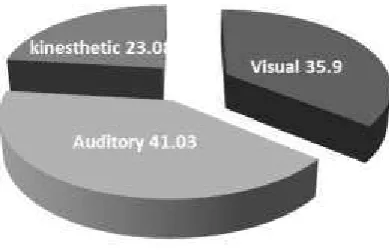
Figure 1. Studentlearningstylesprofile
Based on Figure 1 the most percentage of learning style experiments classroom in auditory learning style 41.03% and respectively subsequent visual learning style 35.9% also kinesthetic learning styles 23.08%. The results of student responses to the questionnaire needs the use of information and communication technology in modern physics lectures can be seen in Table 1.
Table 1. The results ofstudentresponsesto the needs ofthe useof
informationandcommunicationtechnologyinmodernphysicslectures
No Statement Percentage
1 Modernphysics courseisa coursethatisa hard concept 95 2 Modern physics course there are abstract concepts 94 3 Modernphysics coursethere arethe conceptsof microscopics 92 4 Modernphysics coursethere arethe conceptsof macroscopics 93 5 To explain abstract concepts necessary ICT-assisted learning media 91 6 To explainthe concept ofthemicroscopicnecessaryICT-assisted learning media 91 7 To explainthe concept ofthemacroscopicnecessaryICT-assisted learning media 83 8 ICT-assisted learning mediashould beusedto adapt thestudent's learning style
differences 93
Average 93
This paper has been presented at Sriwijaya University Learning and Education-International Conference 2014. Faculty of Teacher Training and Education, Sriwijaya University, Palembang, May 16—18, 2014.
C9-571
Figure 2. Example ofan interactivemultimedia displayof modernphysics-based
learning style
The next, draft of interactive multimediamodern physics validated and limited tested. The results of expert assessment obtained information that the average percentage of experts assesment to the draft ofinteractive multimedia based learning styles of Modern Physics by 94 % for the content rubric, 83 % for technical rubric and 88 % for the presentation rubric. These results indicate that the expert assessment of the draft software is quite high with a mean score of 88 % from the ideal. In addition to scoring, experts also provide suggestions for improvements to the MMI based learning styles softwareare made as follows : ( 1 ) in the lead section should be assigned to the other link, ( 2 ) add the problem solving example, ( 3 ) needs to be reexamined simulations there are still empty, the possibilities are too heavy or broken links. All the suggestions of experts have been accommodated in the software that has been revised, and subsequently conducted a limited trial. Based on the advice and input from experts, the draft of MMI Based Learning Styles Modern Physics then revised both of content and of display software then performed limited testing.
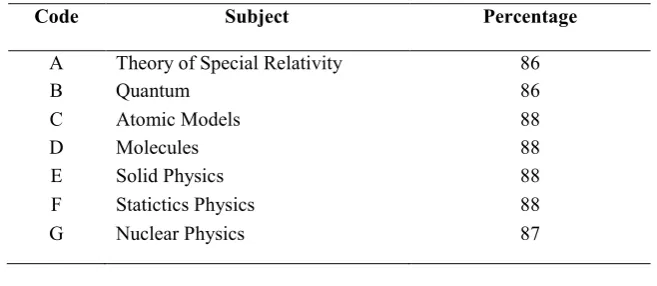
Limited trial conducted to obtain feedback from users MMI Based Learning Styles, that students of Physical Education. The instrument used in this trial a questionnaire responses of students to MMI Based Learning Styles Modern Physics. Obtaining the average response for each student on a limited trial subjects such as Table 2 .
Table 2. Percentage of student responses to the software-based interactive multimedia learning styles
of modern physics
Code Subject Percentage
A Theory of Special Relativity 86
B Quantum 86
C Atomic Models 88
D Molecules 88
E Solid Physics 88
F Statictics Physics 88
This paper has been presented at Sriwijaya University Learning and Education-International Conference 2014. Faculty of Teacher Training and Education, Sriwijaya University, Palembang, May 16—18, 2014.
C9-572
Students also provide advice and input for improvement of the software developed , namely : (1) writing and drawing on some of the display is too small , (2) there is some writing that one type (3) there are some animated videos that are not running. After limited testing and refinement of the final revision MMI Based Learning Styles software of Modern Physics course in accordance with the advice and input from the user ( student ) so obtained Interactive Multimedia Learning Styles Based on Modern Physics course .
From the research it appears that expert assessment and student responses to the model developed is quite high, it is because these models are equipped with a test of learning styles, animations and interactive simulations that help students understand the concepts of modern physics that are abstract and microscopic .
Some research on learning styles suggests that ( 1 ) some students have different learning habits with others, ( 2 ) some students learn more effectively when taught with the most preferred method, and ( 3 ) student achievement related to how to learn ( Riding & Rayner , 1998). The use of interactive multimedia based learning styles in learning can : ( 1 ) displays an appropriate alternate pages with individual characteristics, ( 2 ) oriented to a wider user group, ( 3 ) provide navigation to limit the range of users in finding information ( Surjono , 2006 ) .
Expert validation results and student responses on limited testing also afftected by influence of multimedia functions in learning that: (1 ) assist students in understanding abstract concepts and microscopic, simplifying complex calculations, and accelerate sustainability of the learning process. Presentation of the information or skills as a whole and complete, as well as designing the scope of information and skills systematically according to the level of ability and time allocation; ( 2 ) assist students in activating internal psychological functions among others in focusing and maintaining attention, maintain mental balance, and encourage self-learning ( Arifin et al , 2003 ). Another function of interactive multimedia in education is the learning software, which provides facilities for students to learn the material. Multimedia has a privilege of which are ( 1 ) by facilitating interactive feedback; ( 2 ) the freedom to determine the topic of learning; ( 3 ) systematic control in the learning process (Munir , 2008) .
CONCLUSION AND REMARK
Based on the research that has been done on the development of a model-based interactive multimedia learning styles of modern physics can be concluded that there are 35.90% visual learners, 41.03% auditory learners, and 23.08% kinesthetic learners subject in physics education. Based on data of the questionnaire it shows that 93% of students expressed that instructional media should support and manage the differencies of learning styles in learning modern physics course. The results of this study tell us that every student has a unique learning style, and students need a form of ICT-based instructional media which is suitable for their own learning styles to study the course of modern physics.
This paper has been presented at Sriwijaya University Learning and Education-International Conference 2014. Faculty of Teacher Training and Education, Sriwijaya University, Palembang, May 16—18, 2014.
C9-573
REFERENCES
Arifin, M .et al.(2003). Chemistry Teaching and Learning Strategies. Bandung: ChemicalEducation ProgramsFPMIPAUPI.
Arsyad, A. (2006). Instructional Media. Jakarta: Raja Grafindo Persada.
Budiman, I. et al. (2008). Interactive Multimedia Model Learning Particle Wave Duality to Improve Understanding ofThe Concepts and Critical Thinking Skills. Journal of research education IPA. 2, (1), 48--55.
Burke, K.A. (1998). Developing and Using Conceptual Computer Animation for Chemistry Instruction. Journal of Chemical Education. Vol. 75. Iowa State University.
Darmadi, I.W. et al. (2007). Learning Based Information Technology to Improve Student Mastery of Concepts of Physics Teacher Candidates. Journal of research education IPA. 1, (1).
DePorter, B dan Mike Hernacki. (2006). Quantum Learning. Jakarta: Kaifa (PT. Mizan Pustaka). Dori, Y.J. & Belcher, J. (2005). How Does Technology-Enable Active Learning Affect Undergraduate
Student’s Understanding of Electromagnetism Concept? The Journal of Learning Science.14, (2), 243--279.
Gall, M.D., Gall, J.P., & Borg, W.R. (2003). Educational Research: An Introduction 7thEdition.
United States: Perason Education, Inc.
Gunawan, et al. (2008). Interactive Multimedia Model Learning to improving Concept Mastery Candidate Master In Material Elasticity. Journal of research educationIPA. 2, (1), 11--22. Honey, P. & Mumford, A. (1992). The Manual of Learning Style (3rd ed). Maidenhead, UK: Peters
Honey.
James, W.B., & Blank, W.E. (1993). ”Review And Critique Of Avalilable Learning-Style Instrument For Adult”. In D. Flannery (Ed.), Applying Cognitive Learning Styles (pp.47--58). San Francisco: Jossey-Bass.
Matlin. (1994). Cognition. New York: Mc Graw Hill.
McKagan, S. B., et al. (2007). “Developing and Researching PhET Simulations For Teaching
Quantum Mechanics”. Physics Education Research.1, (0709),4503.
McLoughlin, C. (1999). ”The Implications Of Reserach Literature On Learning Styles For The Design Of Instructional Material”. Australian Journal of Educational adaptivity in leraning system.
Paper presented at the Knowledge Transfer, London, UK.
Muller, D.A. & Sharma, M.D. (2007). “Tacling Misconception In Introductory Physics Using Multimedia Presentations”. UniServe Science Teaching and Learning Research Proceedings.
Munir. (2008). Curriculum-Based InformationandCommunicationTechnology. Bandung : ALFABETA.
Riding, R., & Rayner, S. (1998). Cognitive styles and learning strategies. London: David Fulton Publiser.
Rose, C. (1987). Accelerated Learning. New York : Bantam Dell Pub Group.
Surjono, H.D. (2006). Development andEvaluation of an adaptive Hypermedia System Based on Multiple Student Characteristics. Unpablised doctoral dissertation, southern Cross University, Lismore NSW Australia.
This paper has been presented at Sriwijaya University Learning and Education-International Conference 2014. Faculty of Teacher Training and Education, Sriwijaya University, Palembang, May 16—18, 2014.
C9-574
Report on curriculum-based Information and Communication Technology.Yogyakarta State University.
Wiyono, K.Etal.(2009). Interactive MultimediaModel Learning SpecialRealtivitastoImproveGenericScienceSkillsHigh School Students.Journal of research education IPA. 3, (1), 21--30.
Wiyono, K. et al. (2012). Interactive Multimedia Model Based Learning StylestoImprove ConceptIntroductoryPhysicsMasterySolids. Journal of Physics Education Indonesian.8 (1), 74--82.
Wiyono,K. (2013). Development of Interactive Multimedia Based Visual Learning Style In Modern Physics Course. The 3rd International Conference on Theoretical and Applied Physics. State University of Malang