DEVELOPMENT OF INTERACTIVE MULTIMEDIA
BASED VISUAL LEARNING STYLE IN MODERN PHYSICS COURSE
Ketang Wiyono,*
Physics Education, Sriwijaya University * Email: [email protected]
Abstract
This research aims to develop interactive multimedia based visual learning style in modern physics course. The ccharacteristics of interactive multimedia consists of presentation, text, video, simulation, animation by adapting the visual learning style of students. In this study used research development model 4-D to develop interactive multimedia based visual learning style. Preliminary results of the study indicate that the modern physics course emphasizes mastery of physics concepts mathematically and not adapting student learning style differences. The results of material analysis on modern physics course covering the topics of the theory of relativity, quantum phenomenon, models of atoms, molecules, solids physics, and statistical physics. Such topics are abstract and microscopically so necessary media to increase students understanding. Results-based development of interactive multimedia design visual learning style and then validated in the test limited to students. Validation of the results revealed that the developed multimedia design valid and the results of limited test students developed the practical media states. It can be concluded that the interactive multimedia-based visual learning styles feasible to implement in the course of modern physics.
Keywords: Interactive multimedia, visual learning style, modern physics.
INTRODUCTION
Modern physics is one of education physics course in Sriwijaya University. The aim of this course to deliver the students that understanding and study of physics phenomenon can explain in factual, deductive, inductive, logic and ratiolist thougt context. The cncepts in modern physics abstract and microscopics. Physics Education Technology (PhET) needed in physics learning process now (Finkelstein, 2006).
Preliminary study results indicate that in the study of modern physics students have difficulties in understanding the concepts that are abstract and microscopoic because unavailability of adequate media to visualize these concepts. Media available only in the form of a power point text and images that not adapting student learning style differences. In order to make concepts of modern physics that abstract and microscopic easily to understand by students its necessary to innovate in advanced physics course. One of this innovation in the lecture that integrate information and communication technology in the interactive multimedia [ 1 ].
Some research of interactive multimedia use in physics lectures has done. Interactive multimedia could increase the based physics concept understanding 2], increase the understanding concept of prospective physic’s teacher [ 3, 4 ], solve the student’s based physics misconception [ 5 ] , increase the critical thinking skills and generic science skills [ 6, 7, 8 ] . Succes of interactive multimedia in based physics lectures because of students be more active and autonomous [3] , computer’s animation in interactive multimedia can visualize the some abstract process that cann’t see and imagine [9 ] , could re show the necessary informations.
Use of interactive multimedia in advanced physics is necessary to help students in understanding the abstract concepts . Based on McKagan [10] students would easier understand the quantum mechanics concept that abstract with interactive software help.
Prosiding ICTAP 2013, 11 Oktober 2013,M alang,Jat im
699
material that the difficulties level suitable with users level, and the way to presented of material suitable to the user’s learning style.
Based on problems explanation in background, is necessary to do the research about development models of interactive multimedia based visual learning style to increase the concept mastery and students critical thinking skills in modern physics course.
RESEARCH METHODOLOGY
This research is development research with 4-D model to develop interactive multimedia based visual learning style. Generally the research did in 4 phase there are: 1) define to need assesment, 2) design of multimedia by storyboard, 3) development of interactive multimedia continue with expert validation (expert judgement), 4) dessiminate to implementation interactive multimedia.
This research done in Sriwijaya University that perform the Education Physics Study Program for students teacher. Subject of research is physics prospective teacher students in fifth semester of physics teacher candidates Physics Education Program are following Modern Physics course. The population of study was all student teachers of physics at the State University in South Sumatera. Samples were selected by purposive sampling technique. Sample limited test amount to 7 people
In this study used the instrument in sheets of expert validation, to validate the draft software that has been developed by modern physics and multimedia experts. Questionnaire responses were used to recruit students respond and suggestions from students about the models developed
RESEARCH RESULT
This study begins with a Preliminary Study of the literature study includes analysis of competencies, essential materials, analytical concepts and analytical indicators of critical thinking skills that could developed of interactive multimedia learning model based on learning styles of modern physics. The next phase was a study on the learning of modern physics. The last part of the preliminary phase of finding a description that includes description of the results, map results, analysis of weaknesses. Preliminary results of the study showed the low learning outcomes of modern physics is one of them caused students difficulty in understanding the concepts of modern physics are abstract and microscopic.
Design development, at this stage of the preparation of the model-based interactive multimedia learning styles of modern physics. The preparation of the model-based interactive multimedia learning styles of modern physics is making a storyboard as a guide in developing software.
Then the storyboard made as draft of interactive multimedia based learning styles of modern physics. Draft design- model of interactive multimedia based learning styles of modern physics is the preliminary results that have not been validated by experts. Here are some examples of display- interactive multimedia based learning styles of modern physics such as figure 2.
Figure 2. Example of draft interactive multimedia based learning styles of modern physics
Next draft interactive multimedia based learning styles of modern physics validated and limited test.
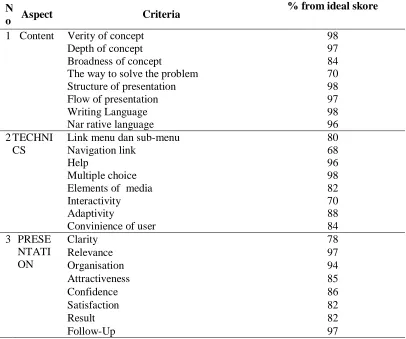
Expert Validation results against Interactive Multimedia -Based Visual Learning Styles in Modern Physics Course
too small, (4) there are some materials such as solid-state physics and molecules that are not animated, (5) add the example problems solving.
TABLE 1. Experts Assessment to draft interactive multimedia software based learning styles of modern physics Results of Limited Test Interactive Multimedia Based Visual Learning Styles in Modern Physics Material
Limited testing conducted to obtain feedback from users Interactive Multimedia -Based Learning styles , the students of Physicsl Education . Instruments used in these test in questionnaire responses of students to Modern Physics Interactive Multimedia-Based Learning Styles . Limited test results Modern Physics Interactive Multimedia Based Learning Styles show in Table 2 . From Table 2 that the percentage of student responses to the software developed high enough that on average 87 % of the ideal score . This indicates that the software is able to be used by students , although there needs to be revised and improved as per the suggestions and feedback from students .
TABLE 2. Score precentation of student responses to interactive multimedia software based learning style on modern physics for each aspect
No Aspect
% of score for sub subject
A B C D E F G
Prosiding ICTAP 2013, 11 Oktober 2013,M alang,Jat im
701
2 The test is easy to understand their
learning styles
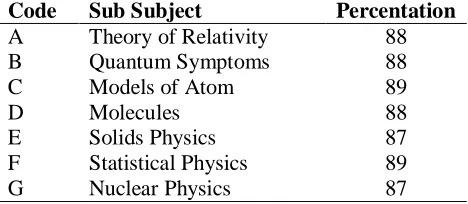
A: Theory of Relativity E: Solids Physics B: Quantum Symptoms F: Statistical Physics
C: Models of Atom G: Nuclear Physics
D: Molecules
From table 2 we get the average of student responses on each limited test subjects such as table 3.
TABLE 3. Percentage of student responses to the software- interactive multimedia based learning styles of modern physics developed, there are: (1) text and images on a display is too small, (2), there is some writing that miss-type (3) there are some animation videos too small, (4) there are video animation not running. After the limited test continue to revise and improve the software with the advice and input from users (students) in to obtain an Interactive Multimedia-Based Visual Learning Styles in Modern Physics course.
DISCUSSION
Development of interactive multimedia learning model preceded by analysis abtrak concept, and a concept based on the principles of modern physics material. From the research it appears that expert assessment and students responses to the model developed is quite high, it is because these models are equipped with a learning style test, animations and interactive simulations that help students understand the concepts of modern physics that are abstract and microscopics.
learning can: (1) display an appropriate alternate pages with individual characteristics , (2) oriented to a wider group of users , (3) provide navigation to limit the range of users in finding information CITATION Sur08 \l 1057 [ HYPERLINK \l "Sur08" 11 ] . One's learning style is a combination of how a person absorbs and organize and process the information . Learning styles influence the effectiveness of training, no matter whether the training is done in person or on-line CITATION Sur06 \l 1057 [ HYPERLINK \l "Sur06" 12 ] . It is shows how important the role of learning styles in learning and teaching. Learning style is often measured using questionnaires or psychometric test CITATION McL99 \l 1057 [ HYPERLINK \l "McL99" 13 ] . Expert validation results and student responses on limited test also due to the influence of multimedia in the learning function such as: (1) assist students in understanding abstract concepts and microscopic, make simple of complex calculations, and accelerate the learning process . Presentation of the information or skills are intact and complete , as well as designing the scope of information and skills of systematically according to the level of ability and time allocation, (2) assist students in activating internal psychological functions such as the concentration of attention and maintain the attention, maintain mental balance, then encourage independent learning CITATION Ari03 \l 1057 [ HYPERLINK \l "Ari03" 14 ] . Multimedia have some privilege such as: (1) interactive by giving facilitating feedback, (2) free to determine the topic of learning, (3) systematic control of the learning process CITATION Mun08 \l 1057 [ HYPERLINK \l "Mun08" 15 ] .
CONCLUSIONS AND SUGGESTIONS
Based on the research about development of interactive multimedia based learning styles models of modern physics course, concluded that :
1. Interactive multimedia based learning learning styles model make students easy to learn the concepts of modern physics that are abstract and microscopic, because the model was developed to adapt the differences of student's learning style .
2. expert assessment of the developed models in average 87 %, with the recommendation of model tested .
3. limited test results showed that the student response in average 88%, this suggests that the model developed can be used by students .
Based on the research its necessary to do the following things :
1. do the final revisions of developed model to improve the weaknesses of existing models
2. implemented on modern physics course to test the effectiveness of the model in improving the concepts mastery and critical thinking skills of students .
REFERENCES
1. K. Wiyono, " Model-Based Interactive Multimedia Learning Styles to Increase Mastery of Concepts Introductory Physics Solids," Indonesian Journal of Physics Education, vol. 8, no. 10, 2012.
2. Y. J. Dori and J. Belcher, "How Does Technology-Enable Active Learning Affect Undergraduate Student’s Understanding of Electromagnetism Concept?," The Journal of Learning Science, vol. 14, no. 2, pp. 243-279, 2005.
3. I. W. Darmadi, dkk., " Information Technology-Based Learning to Improve Student Mastery Concepts of Physics Teacher Candidates," Journal of Science Research, vol. 1, no. 1, 2007. 4. Gunawan, dkk., " Interactive Multimedia-Based Learning Model to Increase Mastery of Concepts
Prospective Teachers to Content Elasticity," Journal of Science Research, vol. 2, no. 1, pp. 11-22, 2008.
5. D. A. Muller and M. D. Sharma, "Tacling Misconception In Introductory Physics Using Multimedia Presentations," in UniServe Science Teaching and Learning Research, 2007.
Prosiding ICTAP 2013, 11 Oktober 2013,M alang,Jat im
703
48-55, 2008.
7. S. Yahya, dkk., " Interactive Multimedia Learning Model To Boost Optic Physical Concepts Mastery, Generic Skills Science And Critical Thinking Skills Teacher of Physics," Journal of Science
Research, vol. 2, no. 1, pp. 56-63, 2008.
8. K. Wiyono, dkk., " Interactive Multimedia Learning Model to Improve Special Realtivitas Generic Science Skills High School Students," Journal of Science Research, vol. 3, no. 1, pp. 21-30, 2009. 9. K. A. Burke, "Developing and Using Conceptual Computer Animation for Chemistry Instruction,"
Journal of Chemical Education, vol. 75, 1998.
10. S. B. McKagan, "Developing and Researching PhET Simulations for Teaching Quantum Mechanics," Physics Education Research, vol. I, pp. 0709 :4503.
11. H. D. Surjono and Nurkhamid , " Developing Adaptive E-Learning Model for Student Learning Style Diversity to Improve Teaching Effectiveness, "State University of Yogyakarta, Competitive Grant Research Report 2008
12. H. D. Surjono, "Developement and Evaluation of an Adavtive Hypermedia System Based on Multiple Student Characteristics," southern Cross University, Lismore NSW Australia, Unpublised doctoral dissertation 2006.
13. C. McLoughlin, "The Implication of Research Literature on Learning Sstyles for the Design of Instructional Material," Australian Journal of Educational Adaptivity in Learning System, no. Paper presented at the Knowledge Transfer, London, UK, 1999.
14. M. Arifin, dkk., Teaching and Learning Strategies. London: Department of Chemistry Education FPMIPA UPI, 2003.
15. Munir, Curriculum-Based Information and Communication Technology. Bandung: ALFABETA, 2008.