Onomatopoeia in
Minions: Banana!
Comic and Its Indonesian Version
(Translation Approach)
Yunita Widiyantari,S.S.,M.Hum1 ,Ni Luh Sintha MW2 University of Surakarta, Jl Raya Palur KM 5 Surakarta, Indonesia
[email protected] [email protected]
Abstract: Several aims are constructed such as the types of onomatopoeia, the technique of translation, the translation quality and the impact of the technique to the translation quality of onomatopoeia in children comic entitled “Minions: Banana!” and its translation version entitled “Minions: Banana!”. Descriptive qualitative method is used. Meanwhile, the data used in this research consist of two data. The first data is the onomatopoeia words which are found in comic entitled “Minions: Banana!” both in English and Indonesian version. The second data is questionnaire which are distributed to the three raters. The distributed questionnaires are about translation technique and translation quality assessment. As the result, there are 63 data altogether. There are 2 types of onomatopoeia which are lexical onomatopoeia (22 data or 35%), non-lexical onomatopoeia (36 data or 57%), and 5 data or 8% are uncategorized. Futhemore the translation techniques used to translate onomatopoeia are 4 techniques which are adaptation (8 data or 12,7%), borrowing (32 data or 50,8%), discursive creation (7 data or 11,1%), and established equivalent (16 data or 25,4%).
Keyword: onomatopoeia, comic, translation technique, quality.
1. INTRODUCTION
Onomatopoeia is the use of words which includes sounds that similar to the noise that the word refers to. Onomatopoeia can be found in comic books. But in other cases, it can be found in children story books. The example of the use of onomatopoeia is boom, bang, honk, and so on. Onomatopoeia cannot be same in each country because of the different language of the countries around the world. Researcher is interested to analyze the onomatopoeia particularly the Indonesian and English onomatopoeia.
Onomatopoeia is a sound that imitates something around us. In specific, sounds which can include to onomatopoeia are sound of animals, humans, nature, things, and elements like fire, wind, water, and earth. For example, the sound of sheep “baa” in English and “mbek” in Indonesian language. The words baa and mbek have the same meaning as the sounds of a sheep. But the expression of the onomatopoeic words is different. The thing which makes differences of sound produce in
onomatopoeic words is the language culture. Thus, each country has different expressions of onomatopoeia because their languages are also different. In other reason, the differences of the phonological language also influence the shape of onomatopoeic words. It is not easy to transfer the meaning of onomatopoeic words from one language to another one. The problems of transferring meaning can be analyzed using a translation analysis.
There are many comics and children stories which consist of onomatopoeia, but researcher decided to choose Minions comic as the research object. This comic contains onomatopoeic words each page. Some previous research analyzed children story book and movie, and to make this research different from other research, researcher chooses strips comic entitled “Minions: Banana!” as the object.
This is the example of onomatopoeia which shows how the meaning of the English onomatopoeia was brought into Indonesian onomatopoeia.
The 2nd International Conference on Technology, Education, and Social Science 2018 (The 2nd ICTESS 2018)
Picture 1.
Example of onomatopoeia in Minions comic
Context of Situation :
One of the minions is mopping the laboratory’s floor.
ST : Splotch splitch TT : Cprot Cpret
The above example shows the transformation of the words. Technique used by the translator is adaptation because there is a shift of cultural element from the source text to the target text. In translating onomatopoeia, the translators have to consider the terms used in target text, whether it can be accepted or not. It is different with translating sentence in a text.
2. RESEARCH METHOD
The paper applies descriptive qualitative method. Data influence in determining a method of research. In this research, it’s decided to apply a qualitative method because the data were taken randomly. A qualitative method points up on the process not to the outcome, opposite to the quantitative method. Then, after analyzing the data, the result of this research described on the discussion.
The paper uses the onomatopoeia words as the data and to complete them, they are also put down the data from raters. The data sources used are comic and the
raters result. The first data used are the onomatopoeic words taken from the comic. To find the onomatopoeic words, researchers read the comics both in English and Indonesian version, then make a list of data. The second data are questionnaires. Questionnaires contributed to the raters. They contribute to rate the technique and quality of translation used in translating onomatopoeic words in comic. The raters must have experiences in translation field and expert as a rater. There are some methods in collecting data. This research use two methods in collecting data, there are analysis method and questionnaire. In analyzing method, researcher analyzed the comic to find the onomatopoeia words. In analyzing data, each data of onomatopoeia will be named as datum and will be given number to each datum. To make easier in analyzing, researcher make code and the example of the code explained as follow :
Datum : 01/ST/MBE/P.03
ST TT
PAF BLUSH
The explanation:
01 : refers to the number of datum ST : refers to source text and TT refers
to target text
MBE : refers to MINIONS: BANANA! English comic version and MBI refers MINIONS: BANANA! Indonesian comic version P.03 : refers to the page
Furthemore,the procedures of this research are done by the following stages:
1. Determining the topic of research. 2. Finding the source of data. 3. Collecting the data.
4. Classifying the data based on the types of onomatopoeia.
5. Listing and giving codes to the data.
6. Comparing and identify the technique of translation.
7. Making questionnaires form of the data to be assessed by the raters.
8. Analyzing the data based on the quality assessment to find out the impact of the translation
technique to the quality of onomatopoeias translation in children comic.
9. Drawing conclusion and giving suggestion request.
3. DISCUSSION
A. 1. Types of Onomatopoeia Categorization
This sub-chapter discusses of the types of onomatopoeia used in comic Minions: Banana!. Attridge (in Flori, 2014) states there are two types of onomatopoeia. They are lexical and non-lexical onomatopoeia.
A. 1. 1. Lexical Onomatopoeia
Attridge (in Flori, 2014: 245) introduces two types of onomatopoeia which are lexical and non-lexical onomatopoeia. Lexical onomatopoeia is the type which the words are deployed in a society as to make a strong link between a sound of speech or word and the non-sound speech or the thing denoted.
Example 1 :
Number of data : 15/ST/MBE/P.27
Picture 3.1. Example 1 of datum categorized as Lexical Onomatopoeia
Context of situation :
The minions are on weapon test day. Each minion brings their weapon to crush a watermelon, and then beside it is also one minion who will give assessment of their weapon. The first until forth minion were already done with their own weapons, and the last
minion brings a flower. The assess minion laugh at him.
The onomatopoeia warf warf warf cannot be formed by only one word. This onomatopoeia is sound of human laugh and repetition. The use of one word cannot represent the meaning of the text.
Example 2 :
Number of data : 18/ST/MBE/P.11
Picture 3.2. Example 2 of datum categorized as Lexical Onomatopoeia
Context of situation :
One minion is doing an experiment and is making a flying boots. He tries his experiment, he can fly with it. But, when he is on the top of the room, the flying boots run out of fuel.
The second example of onomatopoeia type is poot poot poot poot. This onomatopoeia is a representation of machine fail. The use of only one word, make it spell unnaturally and odder. One word cannot be interpreted the context of activity in the picture.
A. 1. 2. Non-Lexical Onomatopoeia The second type is non-lexical onomatopoeia. The opposite with lexical onomatopoeia, non-lexical onomatopoeia no need to apply formation of words. In this type, the onomatopoeia which use only one word is already presents the meaning of the picture.
167
Example 1 :
Number of data : 29/ST/MBE/P.04
Picture 3.3. Example 1 of datum categorized as Non-Lexical
Onomatopoeia
Context of situation :
One minion opens his locker, takes his gun and then shows it to another minion. There are also four other minions shows their own weapon, but the last minion only shows a watch. His friends laugh at him. He clicks the watch and he gets in into it.
The first onomatopoeia is click!. It explains a sound of something clicking. To transfer the meaning of the picture, it does not need to repeat like in lexical onomatopoeia.
Example 2 :
54/ST/MBE/P.22
Picture 3.4. Example 2 of datum categorized as Non-Lexical Onomatopoeia
Context of situation :
Start with a piece of cheese which is a bait to catch a mouse. When the mouse comes out to get the cheese, the
mouse trap has felt by a minion. After that, he brings it to the laboratory to be an experiment mouse. The second example is the word blam. This onomatopoeia is an interpretation of explosion sound. As the explanation before, this kind of onomatopoeia no need to be repeated like lexical onomatopoeia. It stands by itself and also it does not need additional word to make it has a meaning.
A. 2. Technique of Translation
In analyzing the technique of translation in comic, researcher applied the theory proposed by Molina and Albir (2002). They divided the technique of translation into eighteen techniques which are adaptation, amplification, borrowing (pure borrowing and naturalized), calque, compensation, description, discursive creation, established equivalent, generalization, linguistic amplification, linguistic comprehension, literal translation, modulation, particularization, reduction, substitution, transposition, and variation.
Onomatopoeia is a special thing in a language which sometimes it does not have a specific meaning indeed meaningless. The problem on translating onomatopoeia is that the translator translates the word correctly or not because not all the English onomatopoeia can be translated into Indonesian. When it happens, sometimes the translator chooses to translate the word randomly without taking notice of the word choice.
To know how the translator translated the comic, researcher explain the technique used by translator which the technique rated by raters. The explanation will be explained below :
A. 2. 1. Adaptation
Adaptation is a change of the element of culture in source language to the target language that has the same characteristic. The translator uses this
technique to translate the English onomatopoeia which has the same characteristic with the Indonesian onomatopoeic word.
Example 1 :
01/ST/MBE/P.30 → 01/TT/MBI/P.03
Picture 4.1. Example 1 of Adaptation Technique
Context of situation:
At the beginning of the story, there is a kid who is playing with his ball. His ball falls into a big hole which is opened by the minion with their weird space ship. They go down slowly with the kid still looking at them. Then, after they get in to their base camp, the door closes very fast and make a noise.
The word paf translated into blush. The word paf included to the culture element and to make the translation result can be accepted, it is translated become blush. For this reason, it is included to adaptation.
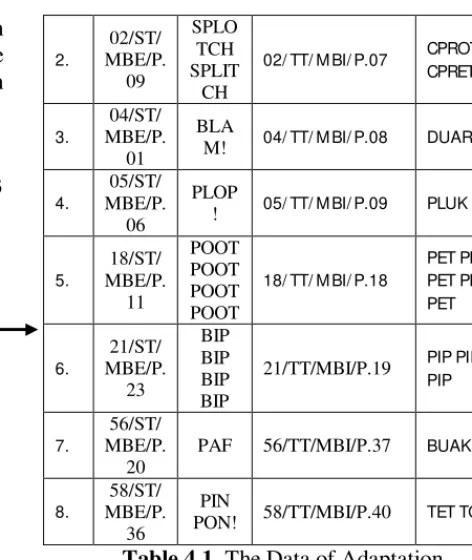
The number of data which apply adaptation technique presented on the table below.
No.
Original
Onomatopoeia Translated Onomatopoeia
Numbe r of Datum
ST Number of
Datum
TT
1.
01/ST/ MBE/P.
30
PAF 01/ TT/ M BI/ P03 BLUSH
2.
02/ST/ MBE/P.
09
SPLO TCH SPLIT CH
02/ TT/ M BI/ P.07 CPROT CPRET
3.
04/ST/ MBE/P.
01
BLA
M! 04/ TT/ M BI/ P.08 DUAR
4.
05/ST/ MBE/P.
06
PLOP
! 05/ TT/ M BI/ P.09 PLUK
5.
18/ST/ MBE/P.
11
POOT POOT POOT POOT
18/ TT/ M BI/ P.18
PET PET PET PET PET
6.
21/ST/ MBE/P.
23
BIP BIP BIP BIP
21/TT/MBI/P.19 PIP PIP PIP
PIP
7.
56/ST/ MBE/P.
20
PAF 56/TT/MBI/P.37 BUAK
8.
58/ST/ MBE/P.
36
PIN
PON! 58/TT/MBI/P.40 TET TOOT
Table 4.1. The Data of Adaptation Technique
A. 2. 2. Borrowing
This technique is called borrowing because in translating word from one to another language people use the original word form or changing only one letter from the word itself. Translator borrows the words and then brings it to the target language.
Example 1 :
07/ST/MBE/P.07 → 07/TT/MBI/P.10
Picture 4.3. Example 1 of Borrowing Technique
Context of situation :
One of the minions walks in to the office to see the worker minions. After getting in the office, he sees all of his friends look sleepy and not concentration. Some minions look lazy and noisy.
Two pictures above show there is no change of onomatopoeic word, neither the word structure nor one of the letters. In this case, translator applies borrowing technique for the reason he/she cannot translating the word rrrraaah because there is no expression which has a same meaning with the source language. Therefore, the translator still uses the word rrraaah and bring it to the target language.
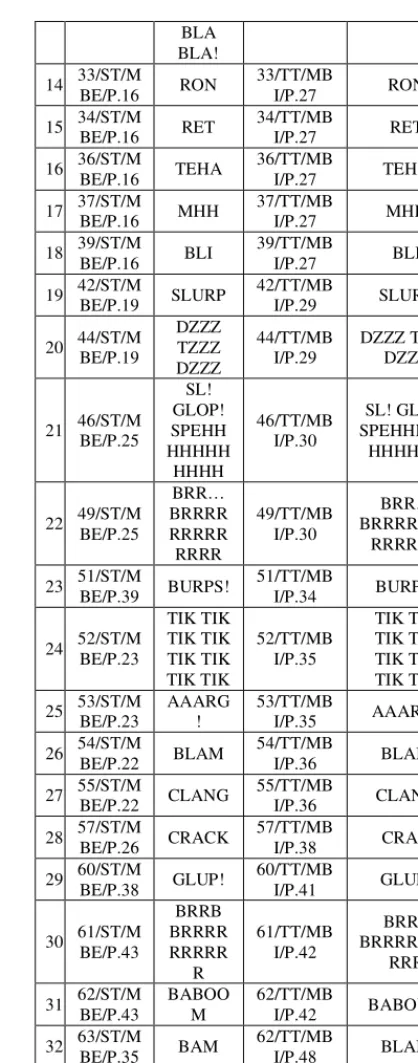
From the analysis above, this is the list of datum which applies translation technique of borrowing.
N o .
Original
Onomatopoeia Translated Onomatopoeia
Number
I/P.11 DRIIIING
5. 16/ST/M Table 4.2. The Data List of Borrowing
Technique
A. 2. 3. Discursive Creation
Discursive creation is a technique from Molina and Albir which this technique is changing the source text by using unpredictable text or words that out of context. Translator uses this technique when there is no word that has the same form and meaning with the source text. Then, translator
170
171
changes the text with the word that canexplain the situation of the source text.
Example 1 :
10/ST/MBE/P.45 → 10/TT/MBI/P.14
Picture 4.11. Example 1 of Discursive Creation Technique
Context of Situation :
There is a minion who is very ignorant. He put something on his friend chair and after it was sat by his friends, it will sound like fart.
On the picture above, the change of the word Parp! to the word Proot included to discursive creation technique. Indonesian people usually use onomatopoeia dut or brut as a representation of fart sound. In this comic, translator used a word which is out of context of a fart sound. But the target text adjusting with the context of situation.
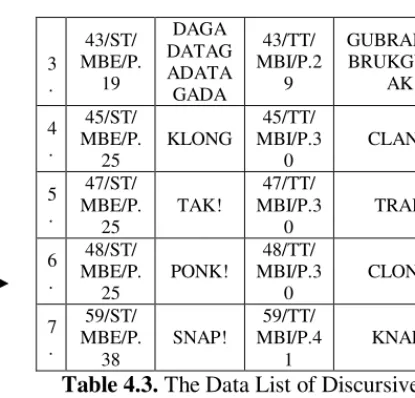
Table 4.3. The Data List of Discursive Creation Technique
A. 2. 4. Established Equivalent
Established equivalent is a technique introduced by Molina and Albir which this technique translated a word from one to another language by using a common term on the dictionary or in target language itself. Translator uses this technique when translating some words which already have the same meaning in other languages but different in text. In the case of translating onomatopoeia, translator translated word by using the terms used in society of target language or creates the onomatopoeia by hearing the sounds of something.
Example 1 :
03/ST/MBE/P.09 → 03/TT/MBI/P.07
Context of situation : grining and bearing it.
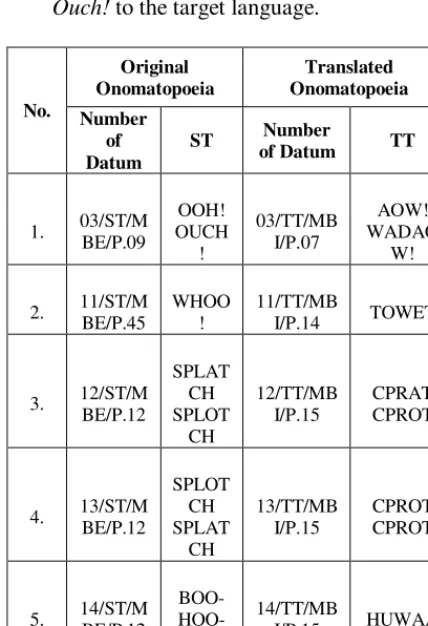
The first example above is example of the used of established equivalent technique. This expression included to this technique for the reason of it translated with the same style of word repetition but different in its pronunciation style. On the target language, translator uses words that have the similarities to the source Indonesian society than bringing Ooh! Ouch! to the target language.
No.
6. 20/ST/M SCRU 20/TT/MB KRIUK
BE/P.29 NCH
Table 4.4. The Data List of Establish Equivalent Technique
4. CONCLUSIONS
The conclusion can be drawn as follows :
1. In this research, it’s found two types of onomatopoeia used in Minions: Banana! comic. Those are (1) lexical onomatopoeia and (2) non-lexical onomatopoeia. From 63 data found by researcher, 22 data are included to lexical onomatopoeia, 36 data are included to non-lexical onomatopoeia, and 5 data are included to uncategorized because it cannot be included to lexical and non-lexical onomatopoeia.
172
173
2. In analyzing the technique oftranslation, researcher applies the theory from Molina and Albir which has 18 categories of technique. In this research, it is found there are 4 technique used by translator to translate the Minions: Banana! comic. From 63 data, 8 of the data categorized as adaptation technique, 32 data categorized as borrowing technique, 7 data categorized as discursive creation technique, and 16 data categorized as established equivalent technique.
5. ACKNOWLEDGEMENTS
Thank you Alloh SWT for the blesses in my life. Many thanks are delivered also for my husband Chairil Efendi to the never ending supports and also my little angle Fairuz Yumna Nafira. You are the best gifts for me. To Ni Luh Sintha , my real partner in the last research, let’s rock the world! At last, abundant thanks go for collegues in English Department Faculty Language and Literature University of Surakarta.
6. REFERENCES
Ah-Koon, Didier and Renaud Collin. 2015. Minions: Banana!. London: Titan Comics.
______ 2016. Minions: Banana! (Indonesian Edition). Jakarta: Elex Media Komputindo.
Cruse, Alan. 2000. The Meaning of Language: An Introduction to Semantics and Pragmatics. New York: Oxford University Press.
Eisner, Will. 1985. Comics & Sequential Art. Florida: Poorhouse Press.
Eliza, Tiara. 2012. “An Analysis of Onomatopoeia in Garfield Comic”. A Journal. Andalas University.
http://jimbastrafib.studentjournal.ub.ac.id (accessed on September 20th, 2016)
http://lib.unnes.ac.id (accessed on
September 20th, 2017)
https://core.ac.uk (accessed on September 22nd, 2017)
http://repository.uinjkt.ac.id (accessed on September 22nd, 2017)
http://wa.amu.edu.pl (accessed on October 3rd, 2017)
http://www.thomastsoi.com (accessed on October 3rd, 2017)
http://joannamarple.com (accessed on October 3rd, 2017)
http://eprints.lib.hokudai.ac.jp (accessed on October 4th, 2017)
https://www.academia.edu (accessed on October 24th, 2017)
https://www.diva-portal.org (accessed on October 25th, 2017)
https://www.superduperinc.com (accessed on October 25th, 2017)
http://www.ling.gu.se (accessed on October 25th, 2017)
http://www.typoday.in (accessed on
October 25th, 2017)
http://www.englishteachersinrussia.org (accessed on October 25th, 2017)
http://fcweb.limestone.on.ca (accessed on October 25th, 2017)
http://www.merriam-webster.com (accessed on October 31st, 2017)
http://www.worldlibrary.org (accessed on October 31st, 2017)
http://www.ohio.edu (accessed on October 31st, 2017)
http://www.pliegosdeyuste.eu (accessed on October 31st, 2017)
http://www.phil.muni.cz (accessed on October 31st, 2017)
http://cw.routledge.com (accessed on October 31st, 2017)
http://
Kusuma, Silvia Mega. 2013. “The Study of Onomatopoeia Types and Translation Strategies in Don Rosa’s The Life and Times of Scrooge Mcduck”. A Thesis. Sanata Dharma University
Lestari, Flori. 2014. “Onomatopoeia Translation in Wreck-It Ralph The Movie”. A Thesis. State Islamic University Syarif Hidayatullah.
Machali, Rochayah. 2000. Pedoman Bagi Penerjemah. Jakarta: Grasindo.
______ 2009. Pedoman Bagi Penerjemah. Bandung: Kaifa.
Molina, L and Albir, A.H. 2002. “Translation Technique Revisited: A Dynamic and Functional Approach”. META, vol. 47, no. 4, 2002. Barcelona, Spanyol: Universitat Autonoma Barcelona.
Pertiwi, Dewi Hana. 2015. “Translation of Onomatopoeia and Iconicity in Children Story Book: Crocoffein – Coffee of Friendship by Watiek Ideo and Fitri Kurniawan”. A Thesis. State Islamic University Syarif Hidayatullah.
Siwi, Amalia Rizki. 2015. “An Analysis of Onomatopoeia Translation in The Bilingual Comics WOW!: Alladin’s Magic Lamp, Cinderella, and The Ugly Duckling”. A Thesis. Sebelas Maret University.
Sugiyono. 2016. Metode Penelitian Kuantitatif, Kualitatif, dan R&D. Bandung: Alfabeta.
Sutopo, H.B. 1996. Metodologi Penelitian Kualitatif. Surakarta: UNS.
174