Advanced Materials Research: Editorial Board
AMR Editor(s) in Chief
Prof. Xiao Zhi Hu
University of Western Australia, School of Mechanical and Chemical Engineering Perth, Australia, WA 6009
Prof. Alan Kin Tak Lau
AMR Editorial Board
Dr. Peng Cao
University of Auckland, Department of Chemical and Materials Engineering Private Bag, Auckland, New Zealand, 92019
Prof. Ionel Chicinaş
Technical University of Cluj-Napoca, Faculty of Materials and Environmental Engineering, Department of Materials Science and Engineering
103-105 Muncii Blv., Cluj-Napoca, 400641, Romania
Prof. Prafulla K. Jha
Maharaja Sayajirao University of Baroda, Department of Physics, Faculty of Science Vadodara, India, 390 002
Prof. Heinz Palkowski
Clausthal University of Technology, Institute of Metallurgy Robert-Koch-Strasse 42, Clausthal-Zellerfeld, 38678, Germany
Prof. Wolfgang Sand
University of Duisburg-Essen, Biofilm Centre, Aquatic Biotechnology Geibelstrasse 41, Duisburg, 47057, Germany
Dr. Ching Hua Su
Table of contents
Periodical:
Advanced Materials Research
Volume:
Advanced Materials Science and Technology
Papers published in this volume:
The Role and Prospect of Nanomaterials in Polymeric Membrane for Water and Wastewater Treatment: A State-of-the-Art Overview
Ahmad Fauzi Ismail, Pei Sean Goh p.3
Synthesis of Low Fouling Porous Polymeric Membranes
Heru Susanto, Dwi Putri Julyanti, Anis Roihatin p.7
Mass Production of Stacked Styrofoam Nanofibers Using a Multinozzle and Drum Collector Electrospinning System
Muhammad Miftahul Munir, Ade Yeti Nuryantini, Iskandar, Tri Suciati, Khairurrijal p.20
Transparent and Conductive Fluorinated-Tin Oxide Prepared by Atmospheric Deposition Technique
Agus Purwanto p.24
Gas Sensing Using Static and Dynamic Modes Piezoresistive Microcantilever
Ratno Nuryadi, Lia Aprilia, Nuning Aisah, Djoko Hartanto p.29
One-Step Fabrication of Short Nanofibers by Electrospinning: Effect of Needle Size on Nanofiber Length
Indra Wahyudhin Fathona, Khairurrijal, Akihiro Yabuki p.33
Carbon Dioxide Permeation Characteristics in Asymmetric Polysulfone Hollow Fiber Membrane: Effect of Constant Heating and Progressive Heating
Muhamad Azwar Bin Azhari, Nooririnah Binti Omar, Nuzaimah Binti Mustaffa, Ahmad Fauzi Ismail p.37 Electrospinning of Poly(vinyl alcohol)/Chitosan via Multi-Nozzle Spinneret and Drum Collector
Ade Yeti Nuryantini, Muhammad Miftahul Munir, Muhamad Prama Ekaputra, Tri Suciati, Khairurrijal p.41 A Simple Way of Producing Nano Anatase TiO2in Polyvinyl Alcohol Fibers
Sabarman Harsojo, Kuwat Triyana, Harini Sosiati p.45
Synthesis of Hydroxyapatite Nanoparticle from Tutut (Bellamya javanica) Shells by Using Precipitation Method for Artificial Bone Engineering
Lenita Herawaty, Eti Rohaeti, Charlena, Sulistioso Giat Sukaryo p.284
Shariff Ibrahim, Megat Ahmad Kamal Megat Hanafiah, Faisal Fadzil p.288
Effect of Deacetylation on Characterization of pH Stimulus Responsive Chitosan-Acrylamide Hydrogels Using Radiation
Kris Tri Basuki, Deni Swantomo, Sigit, Kartini Megasari p.292
Synthesis of Smart Biodegradable Hydrogels Cellulose-Acrylamide Using Radiation as Controlled Release Fertilizers
Deni Swantomo, Rochmadi, Kris Tri Basuki, Rahman Sudiyo p.296
Structural Studies of 1,3:2,4-Dibenzylidene Sorbitol Gels
Hiroyuki Takeno, Yuta Kuribayashi p.300
Effects of Surface Treatments on Nata de Cassava on the Tensile Strength and Morphology of Bacterial Cellulose Sheet
Dini Cahyandari, Heru Santoso Budi Rohardjo p.305
Impact and Thermal Properties of Unsaturated Polyester (UPR) Composites Filled with Empty Fruit Bunch Palm Oil (EFBPO) and Cellulose
Elmer Surya, Michael, Halimatuddahliana, Maulida p.310
Biodegradation of Low Density Polyethylene (LDPE) Composite Filled with Cellulose and Cellulose Acetate
Halimatuddahliana, Ahmad Mulia Rambe p.314
The Treated Rice Straw as Potentially Feedstock of Wood and Rice Straw Fiber Blend for Pulp and Paper Making Industry
Ariadne L. Juwono, Handoko Subawi p.318
Experimental Studies of Thermo-Induced Mechanical Effects in the Main-Chain Liquid Crystal Elastomers
Impact and Thermal Properties of Unsaturated Polyester (UPR)
Composites Filled With Empty Fruit Bunch Palm Oil (EFBPO) and
Cellulose
Elmer Surya
1, a, Michael
1,b, Halimatuddahliana
1,c, Maulida
1,d1
Department of Chemical Engineering, Universitas Sumatera Utara,
1-1-1-1 Jalan Almamater, Kampus USU Medan 20155, North Sumatra, Indonesia a
[email protected], [email protected] c
[email protected], [email protected]
Keywords: Unsaturated Polyester, EFBPO, Cellulose, Hand-Lay Up, Impact Test
Abstract. In this research, the impact properties of unsaturated polyester (UPR) composites filled with empty fruit bunch palm oil (EFBPO) and cellulose are investigated. The composites were made by hand-lay up method by mixing UPR with the content of each fillers (EFBPO and cellulose) of 5,10,15,20 wt.%. The parameter which was carried out on the prepared samples was impact test. It was found that the addition of fillers to the matrix caused the impact strength of composites increased at 10% addition of EFBPO and 5% addition of cellulose. The results are confirmed by fourier transform infra-red (FTIR) and supported by thermogravimetric analysis (TGA) and scanning electron microscopy (SEM).
Introduction
The study of polymer composites filled with natural fibers has increased rapidly. Natural fibers provide a better property than synthetic fillers such as lower cost, high modulus and strength, lower density, ease of fiber treatment and a wide range of application [1]. Also environmental problem caused by and higher cost from synthetic fillers has led researchers to prefer natural fiber over synthetic filler. The main component giving rise to these improve properties is cellulose. Several natural fibers such as hemp, kenaf, kraft and jute has been investigated [1-4]. One commercial type of matrix commonly used is unsaturated polyester (UPR). UPR is one of thermosets which possess better properties than other types of thermoset such as low shrinkage, ability to mold at room temperature, low viscosity, thermal and weather resistance, and low cost [5-8]. Other fillers potentially of use are empty fruit bunch palm oil (EFBPO). As one of the largest country produced of palm oil, Indonesia has plenty of EFBPO waste. If EFBPO could be treated further such as by bleaching and pulping, then cellulose inside EFBPO could be extracted. The objective of this study is to investigate the effect of filler contents on different types of fillers such as EFBPO and cellulose to impact produced in the properties of composites.
Experimental Procedure
Materials Unsaturated Polyester Yukalac 157® BTQN-EX was supplied by PT. Justus Kimia Raya Indonesia and empty fruit bunch palm oil (EFBPO) and cellulose was obtained from Indonesian Oil Palm Research Institute. The matrix, unsaturated polyester (UPR) was mixed with the fillers with content 5,10,15,20 wt% of each fillers (EFBPO and cellulose) by using hand lay-up method. The catalyst used was methyl ethyl ketone peroxide (MEKP) acted as hardener for the matrix for 1,5 wt% of the matrix. The curing period took 24 hours. The composites then were tested in accordance to ASTM D4812-11 and carried out by GOTECH Impact Tester. The fracture of composite from impact test then was analyzed by Scanning Electron Microscope (SEM) JEOL JSM-6360 LA. The data then was supported by Fourier Transform Infra-Red (FTIR) using Shimadzu IR-Prestige 21 and Thermogravimetric Analysis (TGA) using Shimadzu Simultaneous TGA/DTA Analyzer DTG-60.
Advanced Materials Research Vol. 896 (2014) pp 310-313 © (2014) Trans Tech Publications, Switzerland
doi:10.4028/www.scientific.net/AMR.896.310
Results and Discussion
The impact properties of UPR-EFBPO and UPR-Cellulose composites is shown in Fig.1
Fig.1 shows that impact strength of UPR-EFBPO composites increase as the fillers content increase while the impact strength of UPR-cellulose composites decreases. This is happening due to absorption of UPR matrix by cellulose during the mixing between both of them to produce UPR-cellulose composites while it was not found in mixing between UPR and EFBPO. The cellulose fillers which extracted from EFBPO have high pores compared before EFBPO treatment of pulping and bleaching hence its tendency to absorb UPR would be higher than EFBPO. As the cellulose content is increased to 20 wt%, the matrix cannot provide a sufficient area to hold up the fillers, hence the interfacial adhesion between matrix and fillers decreases which results in the decreasing impact strength of UPR-cellulose composites as the fillers content increase. The maximum impact strength is found at 5 % filler content. On the other hand, the impact strength of UPR-EFBPO composites is found to increase as the fillers content increases where the maximum value at 20% filler content. This shows that a good interfacial adhesion between matrix and fillers occurs. The increased fillers make the composites more elastic and enhance the flexibility of network in composites so it absorbs more
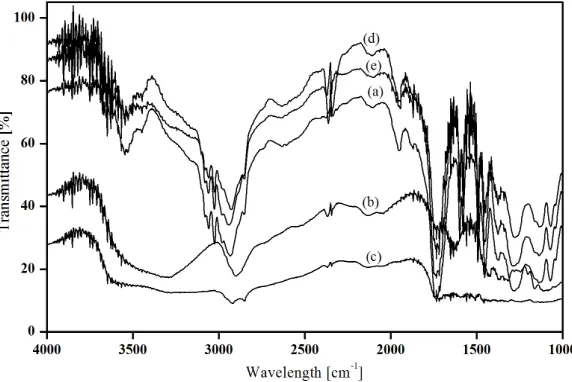
energy to failure [9-10].The composites then were characterized by Fourier Transform Infra-Red (FTIR) as is shown by Fig.2.
Fig.2 shows the FTIR characterization of the compounds analyzed. It can be observed that the IR spectrum of both composites formed has a similar spectrum with UPR matrix. Hence it shows that mixing of matrix with the fillers does not give any new peaks in the composites. The interaction occurs in the composites had been stated previously by Ray and Rout [8] such as mechanical anchoring, interaction
between natural fillers and resin where –OH group in matrix (UPR) backbone provide an area to hold hydrogen bonding with natural fillers which contain many hydroxyl groups inside and attractive molecular forces (Van der Waals force and hydrogen bonding). The possibility interaction between matrix and fillers is shown in Fig. 3. Since each of EFBPO and cellulose contains hydroxyl groups, both of them would have similar interaction with the matrix.
Fig.4 shows the scanning electron microscope (SEM) analysis of impact fracture of composites. It shows that the addition of fillers reduce the amount of void in the matrix. From both composites’ fracture, it shows the fiber pull out from the matrix. Fig.4 (b) and (c) shows the fiber pull out of UPR-EFBPO composites and UPR-cellulose composites. In UPR-EFBPO composite, it can be seen that the EFBPO fiber has more size diameter compared to cellulose in UPR-cellulose composite which its fiber pull out consists of several fibrils. This form difference between EFBPO and cellulose
Figure 1. Relationship Between Impact Strength and Fillers Content
Figure 2. FTIR Analysis of: (a) UPR, (b) Cellulose, (c) EFBPO, (d) UPR-Cellulose, (e) UPR-EFBPO
could lead in difference of energy absorbed in each of composites which EFBPO would absorb more energy to break it down compare to cellulose. Therefore UPR-EFBPO composite must have higher impact value than UPR-cellulose composites. The SEM analysis is shown in Fig.4.
Figure 3. Possibility Interaction Between Matrix and Natural Fillers [8]
Figure 4. Fracture Analysis of Scanning Electron Microscopy (SEM): (a) UPR (b) UPR-EFBPO (c) UPR-Cellulose with Magnificent 500x
As addition data of this study, the thermo gravimetric analysis (TGA) of EFBPO, cellulose, UPR-EFBPO 80/20 and UPR-cellulose 95/5 is done and shown in Fig.5.
Fig.5 shows that TGA curves of the materials exhibit three mass loss steps. The initial mass loss of EFBPO and cellulose is below 225oC while for UPR and both composites the initial mass loss is below 325oC which is due to loss of volatile material and loss of moisture [11]. In the second step, the natural fibers are decomposed due to degradation of its inside material to become a volatile material [11] between 225oC and 375oC. Meanwhile for UPR and both composites, degradation of materials is due to decomposition of matrix and fibers between 350oC-450oC. In the final step, natural fiber release and structural rearrangements [12]. Table 1 gives the thermal data of TGA curves. From Table 1, it can be seen that UPR has more thermal stability compared to composites. This is due to cross-linking process in UPR when cured process occurs, hence the polymer network becomes denser and it needs more thermal energy to break down the network [9]. When natural fillers filled into the matrix, it causes the thermal stability of composites formed decreases because the natural fillers have low thermal stability. From both composites, it can be seen that UPR-cellulose composite has more thermal stability than UPR-EFBPO composite due to its more degree of crystalline in cellulose than EFBPO when EFBPO is having bleaching and pulping process produced cellulose.
Void (c) Cellulose, (d) UPR-EFBPO Composite, (e)
UPR-Cellulose Composite
Table 1. Thermal data of TGA curves of materials:
UPR-Cellulose 95/5 312,35 445,03 11,923
Conclusion
(1) UPR-EFBPO composites have higher impact strength than UPR-cellulose composites.
(2) In both composites formed, interaction occurs such as mechanical anchoring, hydrogen bonding and Van der Waals forces.
(3) UPR still has the higher thermal stability than its composites due to “undisturbed” cross-linking in polymer network
References
[1] H.N. Dhakal, Z.Y. Zhang, M.O.W. Richardson, Effect of water absorption on the mechanical properties of hemp fibre reinforced unsaturated polyester composites, Composites Science and Technology (2007,67), 1674-1683.
[2] M. R. Ishak, Z. Leman, S. M. Sapuan, A. M. M. Edeerozey and I. S. Othman, Mechanical properties of kenaf bast and core fibre reinforced unsaturated polyester composites, IOP Conf.Series: Materials Science and Engineering 11 (2010) 012006
[3] Zhenhua Gao, Dieying Ma, Xinying Lv, and Qingwen Wang, Formation and Evaluation of Kraft Fibre-Reinforced Unsaturated Polyester (UPE) Composites, BioResources (2011) 6(4): 5167-5179 [4] D. Djeghader, B. Redjel, H. Hadidane, Impact Toughness of Composite Materials Jute-Polyester and Glass-Polyester, 1st International Conference on Sustainable Built Environment Infrastructures in Developing Countries ENSET Oran (Algeria) - October 12-14, 2009
[5] A.V.N. Prasad, K.M. Rao, G. Nagasrinivasulu, Mechanical Properties of banana empty fruit bunch fibre reinforced polyester composites, Indian J. Fibre & Textile Research, (2009,34) 162-167 [6] B. Deepa, L.A. Pothan, R. Mavelil-Sam, S. Thomas, Structure, Properties and Recyclability of Natural Fibre Reinforced Polymer Composites, Recent Developments in Polymer Recycling, (2011), 101-120.
[7] S. Waigaonkar, B.J.C. Babu, A. Rajput, Curing Studies of Unsaturated Polyester Resin Used in FRP Products, Indian J. Engineering & Material Sciences, (2011,18), 31-39.
[8] D. Ray, J. Rout, Thermoset Biocomposites in A.K. Mohanty, M. Misra, L.T. Drzal, Natural Fibers, Biopolymers, And Biocomposites. CRC Press: U.S.A. 2005, 305-306 & 313-315.
[9] A.H.P.S. Khalil, M.M. Marliana, T. Alshammari, Material Properties of Epoxy-Reinforced Biocomposites With Lignin From Empty Fruit Bunch As Curing Agent, BioResources (2011) 6(4), 5206-5223.
[10] M. Khalid, C.T. Ratnam, T.G. Chuah, S. Ali, Thomas S.Y. Choong, Comparative study of polypropylene composites reinforced with oil palm empty fruit bunch fiber and oil palm derived cellulose, Elsevier Materials & Design (2006, 29), 173-178.
[11] S. Siyamak, N.A. Ibrahim, S. Abdolmohammadi, M.Z. Rahman, Enhancement of Mechanical and Thermal Properties of Oil Palm Empty Fruit Bunch Fiber Poly(butylene adipate-co-terephtalate) Biocomposites by Matrix Esterification Using Succinic Anhydride, Molecules (2012, 17), 1969-1991.
[12] M. Jawaid and A.H.P.S. Khalil, Effect of Layering Pattern on The Dynamic Mechanical Properties and Thermal Degradation of Oil Palm-Jute Fibers Reinforced Epoxy Hybrid Composite, BioResources (2011), 6(3), 2309-2322.